Find partners
Modern Law Library

Modern Law Library

Hosted by Legal Talk Network

Episodes

262

Latest episode

May 2026

Language

EN

About the show

Discover books and stories that explore the law in new and surprising ways through eye-opening conversations with their authors. Whether it’s fiction or non-fiction that you seek, Modern Law Library features today’s top legal authors and delves into legal theories, historical events, true crime, and law-inspired storytelling. Join Lee Rawles twice a month as she opens up a new legal publication on Modern Law Library, a Lisagor Award-winning podcast.

Listen to episodes

60 recent
May 27, 202649 min

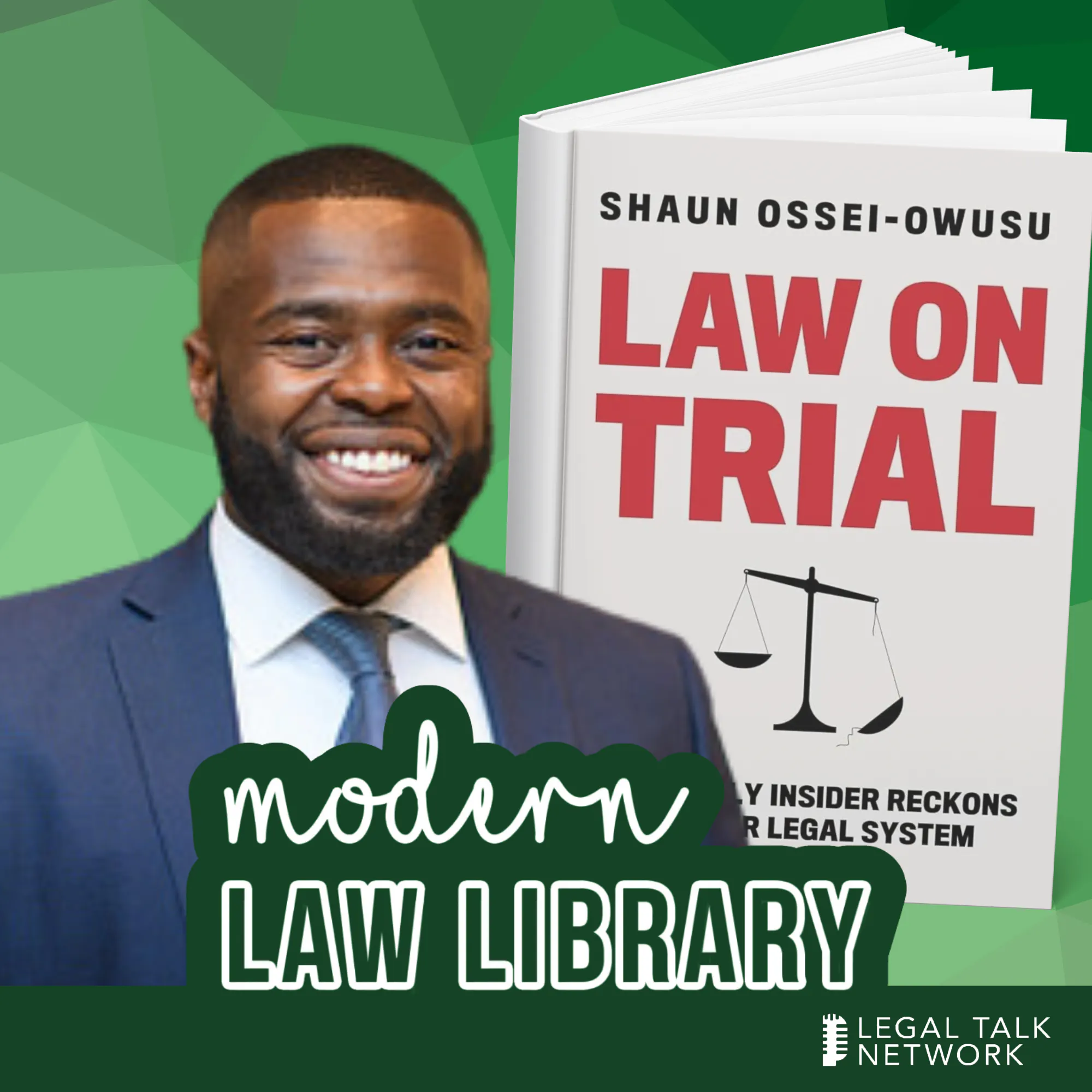
'Unlikely insider' critiques how law school thinking can reinforce injustices

When Shaun Ossei-Owusu looked around at his classmates at UC Berkeley School of Law, there were many upper middle class children of lawyers who were coming straight from their undergraduate degrees. There were not many people like him, a child of Ghanaian immigrants who grew up in an impoverished South Bronx community and was now finishing his PhD as a returning student. That background and his academic training gave him a different perspective on the law school curriculum. For example, his Property Law class was mostly focused on the ins and outs of titles and transfers. "It was strange to me, particularly being going to school at Berkeley, how little the class said about homelessness," Ossei-Owusu tells host Lee Rawles in this episode of the Modern Law Library. "We have about 750,000 people in this country who are unhoused in any given night. And this is the course, Property Law, that's most directly concerned with how we organize access space and shelter. And the course doesn't say much about homelessness. And so I felt that that was strange, but I didn't want to be the student in class saying, 'Well, why aren't we talking about this?' " Ossei-Owusu went on to practice healthcare enforcement law at Sidley Austin, and worked for the Legal Aid Society of the District of Columbia. His time as a litigator and public interest lawyer gave him a look at how law school principles fared in real world situations. "Lawyers are implicated in many of the hot-button issues of the day, and much of that is tied to the ways that we train lawyers in law school to distance legal reasoning from social and moral consequences–and the ways they bring that habit into legal practice, whether it be BigLaw, public interest lawyering, or government lawyering," Ossei-Owusu says. It's something he now thinks deeply about as a professor at the University of Pennsylvania Law School who focuses on criminal justice, social welfare and professional responsibility. In Law on Trial: An Unlikely Insider Reckons with Our Legal System, he calls out the ways this early training can result in further injustice and inequality for society. "Professional ethics say your job is to primarily serve clients, which creates an inevitable distance between what lawyers do and who pays the price," writes Ossei-Owusu in Law on Trial. "The result is a system that trains smart people to engineer brilliant solutions while staying disconnected from the human wreckage they may leave behind." In this episode of the podcast, Ossei-Owusu and Rawles talk about the hard truths of public interest legal work, how regulatory work can sometimes have more impact than litigation, and and how good intentions alone cannot erase harm.

May 6, 20261 hr 7 min

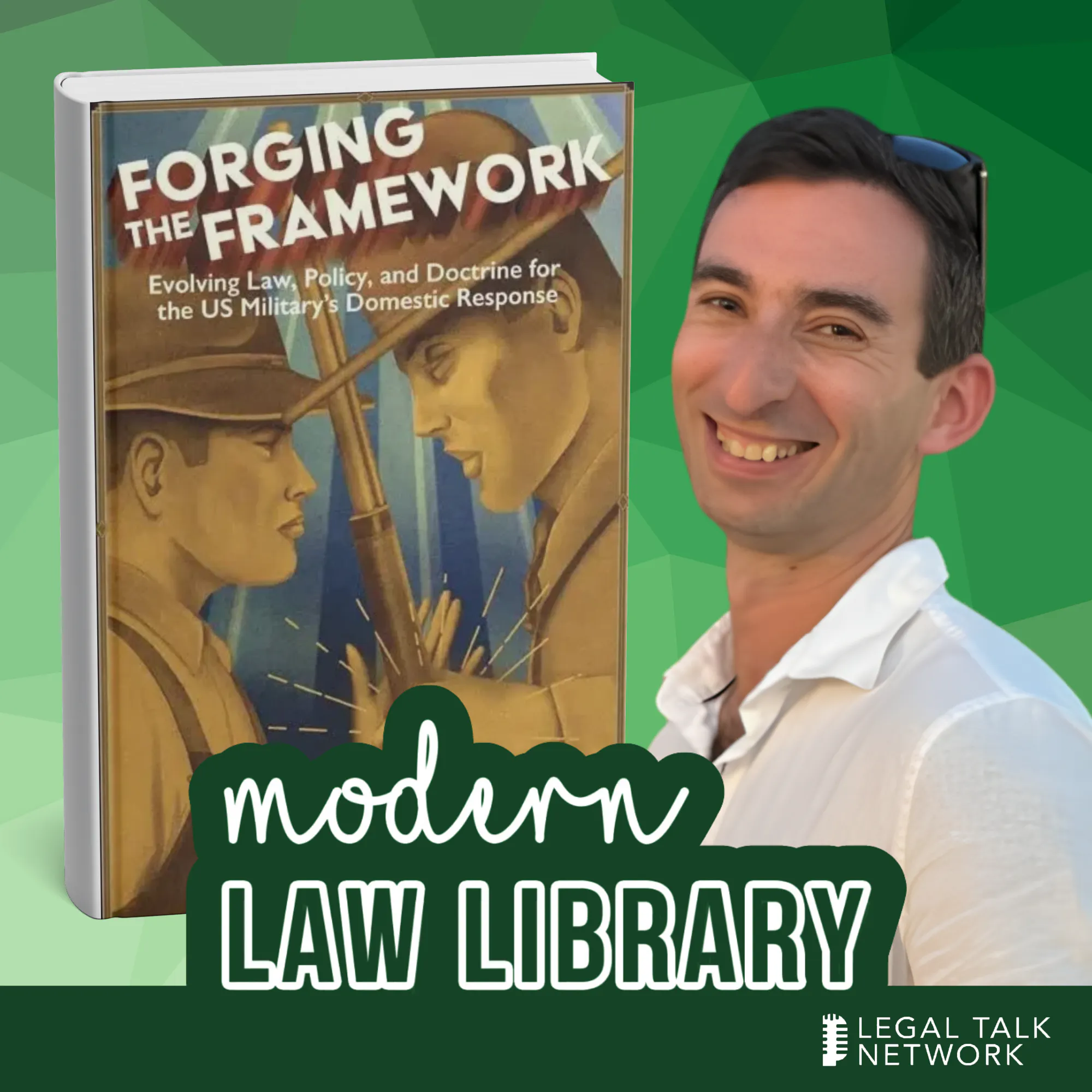
How we deploy the military domestically, and why

The Third Amendment to the Constitution forbids the quartering of troops in Americans' houses. It's a reminder of how uneasy the people of the country have been about the domestic deployment of our soldiers. There are robust rules about how the military can be used on American soil, but how did those rules come about? It's a question that National Guard officer Jonathan Bratten hoped to help answer in Forging the Framework: Evolving Law, Policy, and Doctrine for the US Military's Domestic Response, which he edited and contributed to as one of the authors. "It was really cool to see the way that the roots of our processes are built into the colonial era, just as the roots of a lot of our frictions are built into the colonial era," Bratten tells Modern Law Library host Lee Rawles. Forging the Framework, which is available for free from the Army University Press, looks at how different periods of American history shaped how the military operates on American soil today. As a country that has not faced many invasions, the bulk of domestic military operations have been to respond either to civil unrest or to natural disasters. "When you look at how this affects those who serve, I just think about the number of people who got called off of the COVID-19 mission, where [you were] helping your community members to go deploy, to protect, go into support of law enforcement during the George Floyd protests," says Bratten. "There's just that weird duality that exists in the Guard and these experiences sort of ripple through." In this episode of the Modern Law Library, Bratten and Rawles dive deep into the Pullman Strike, Posse Comitatus, slave revolts, the rewards of disaster response and the difficulty of convincing militiamen to confront their rioting relatives. Download Jonathan's book here.

April 16, 202643 min

Sherry Thomas's sleuthing librarians and gender-bent Sherlock

Coming across the right book at the right time can make all the difference, says Sherry Thomas, author of the popular Lady Sherlock series. In her case, picking up a historical romance from the library led to her writing career.  "Two years into my career as stay-at-home mom, I grabbed a historical romance, which I devoured growing up," Thomas tells the Modern Law Library's Lee Rawles. "I grabbed a historical romance from the library, took it home and was going to spend my son's nap time enjoying it. But it turned out that I did not enjoy that book at all. In fact, I was kind of furious at it  because I didn't enjoy it at all. And I spent the entirety of my available time that day on that and did not get any pleasure in return. So very seldom does this ever happen to me. But on that day, I was kind of angry. And by the time my husband returned home from work, I said to him, 'I am going to write historical romances.'"  Thomas did successfully publish several historical romances, then shifted genres to historical mysteries, publishing eight books in her best-selling Lady Sherlock series. The ninth will be released in the fall. Her newest release is a contemporary mystery, The Librarians, prompted by a suggestion by her publishers. "They specifically said, 'We want this to be The Thursday Murder Club, but with librarians,' " says Thomas.  In this episode of the Modern Law Library, Thomas shares more about her writing journey, how she came up with her Charlotte Holmes character, her love of libraries and her tips for other would-be mystery writers.

April 1, 202639 min

Book Club: The Brethren introduces Tricky Dick's chief justice

It's time for the first official meeting of the Modern Law Library Book Club, and Lee has invited on her friend (and go-to Nixon expert) Victor Li to talk about his experience reading the 1979 bestseller The Brethren: Inside the Supreme Court. As both a lawyer and journalist, Victor gives his thoughts on how Woodward and Armstrong were able to pierce the secrecy of the Supreme Court and show the behind-the-scenes wrangling as Nixon's newly-appointed chief justice, Warren Burger, took over from famed liberal Chief Justice Earl Warren. Up next, we'll be discussing Chapter 1, the 1969 Term, and we want to hear from you! Email your comments or a voice message to modernlawlibrary@legaltalknetwork.com to appear on a future episode. Check out our discussion group on Goodreads: https://www.goodreads.com/group/show/1285340-modern-law-library  Purchase your copy of The Brethren: Inside the Supreme Court: https://amzn.to/4cRQivF

March 18, 202649 min

Your household devices are tracking you—but who else is watching?

Your smartwatch tracks your heart rate and counts your calories. Your Ring camera lets you know when a package has been delivered. The GPS in your car smoothly directs you to a restaurant you've never been to before. We've grown used to getting a technological assist for everything from finding our keys to checking where our children are at curfew. But the consumer electronics which can make our lives easier can also be used by the government to track and prosecute us–and Fourth Amendment protections haven't been keeping up. Prof. Andrew Ferguson of George Washington University Law School has long been an advocate for digital privacy, and in his new book, Your Data Will Be Used Against You: Policing in the Age of Self-Surveillance, he hopes to kick off a movement to protect Americans from government intrusion. In this episode of the Modern Law Library, Ferguson and host Lee Rawles talk about cases where people's device data wound up being used against them, how personal information is being sold by data brokers, and how the Wiretap Act could point the way forward for future data privacy protections. Ferguson also shares tips on how to sabotage your data and explains the Tyrant Test.

March 4, 202610 min

Introducing the Modern Law Library Book Club

For more than a decade, the Modern Law Library has been chatting with authors about their books. But there haven't been many opportunities to talk directly with our listeners, and we want that to change. We are so excited to announce that we are launching a monthly book club series, which will appear in your normal podcast feed.  This year, we are going to be diving into The Brethren: Inside the Supreme Court, by Bob Woodward and Scott Armstrong. This book made waves when it was released in 1979, giving readers an unprecedented look into the U.S. Supreme Court chambers. Covering the 1969 to 1975 terms, The Brethren exposed the internal debates over matters like the Pentagon Papers and Roe v. Wade.  Each month, we will be reading a section of the book and inviting on a guest to discuss the issues raised. To be ready for the first book club meeting at the end of March, read the introduction and prologue! We are hoping to hear from you, so if you have a comment about the book or want to share your experiences with it, email us a written message, video or audio recording to modernlawlibrary@legaltalknetwork.com.  You can purchase a copy here and join in the discussion in our Goodreads group athttps://www.goodreads.com/group/show/1285340-modern-law-library

February 19, 202655 min

Meet the 'inscrutable' SCOTUS justice who made the Nuremberg trials possible

Robert H. Jackson was not an easy man to know, but "I found being in Robert Jackson's company on the whole a great pleasure," says G. Edward White, author of the new biography Robert H. Jackson: A Life in Judgement. A longtime ally of Franklin Delano Roosevelt, Jackson served as both Solicitor General and Attorney General before FDR nominated him to the U.S. Supreme Court. However, he often pined for his previous life as a small-town litigator in Jamestown, New York. A solitary worker by nature, Jackson did not relish the collegiate aspects of the court, and his influence was therefore limited. "Jackson was nominally gregarious, active, fun-loving, witty pleasant–but at the same time, he was remote," White tells Modern Law Library's host Lee Rawles. "In some ways, his gregariousness was a barrier to maybe a closer understanding of him." But as a litigator and as a justice, Jackson made important historical contributions. One major such contribution was in establishing the format and location of the post-World War II international military tribunals of Nazi leaders, now known as the Nuremberg Trials. Jackson took a leave of absence from the U.S. Supreme Court to be the country's lead negotiator as the United States, Great Britain, France and the Soviet Union debated how tribunals would take place. He then served as the United States' chief prosecutor. White and Rawles also discuss the roadblocks that have prevented Jackson from being better known in legal history; how Justice Felix Frankfurter tried to protect Jackson's post-death legacy; and Jackson's controversial cross-examination of Nazi politician Hermann Goering. In honor of the Olympics, White (who has written books on baseball and soccer) also shares his perspective on the benefits that athletics brings to lawyers.

February 5, 202645 min

The Help: What labor rights do domestic workers have

A foundational principle of Anglo-American law is that "a man's house is his castle." It establishes rights ranging from privacy to justifiable homicide. But what about when your castle is another person's workplace? What rights do they have? In Bringing Law Home: Gender, Race and Household Labor Rights, Katherine Eva Maich examines the history of labor protections for nannies, housecleaners and other household employees, and compares how domestic workers fare under the laws in New York City and Lima, Peru. In this episode, Maich and the Modern Law Library's host Lee Rawles discuss human trafficking, worker rights and responsibilities, the impacts of slavery and colonialism on the Global South, and the real human relationships that develop between employees and employers within the home.

January 23, 202636 min

Cold case investigation into 'Walking Tall' sheriff uncovers murder

In the movie 1973 film Walking Tall, Sheriff Buford Pusser is a heroic law enforcement officer in small-town Tennessee whose fight against the Dixie Mafia leads to an ambush and shooting that left his beloved wife Pauline dead. The movie and its sequels and remakes made Pusser, who died in a 1974 car crash, into a folk hero. Dwayne "The Rock" Johnson played him in the 2004 Walking Tall remake. The Pusser legend became a cottage industry for Adamsville, Tennessee, where the Buford Pusser Home and Museum is based. Mike Elam, a former law enforcement officer, started researching Pusser's life as a hobby back in the 1970s. Once the internet became an avenue for exploration, "I started a social media page and I was very much a fan of Buford Pusser at that time," Pusser tells Modern Law Library host Lee Rawles. "And it was one of those things where I got to researching it and learned far too much for my own liking, because I did not like the man I saw as opposed to the one that was in the movie." Elam's decades of research and interviews with people who had encountered Pusser led to a book, Buford Pusser: The Other Story. It also led to the Tennessee Bureau of Investigations reopening the case into Pauline Pusser's murder and exhuming her body. In 2025, they announced that the investigation revealed details that pointed to one suspect: Buford Pusser himself. In this episode, Elam discusses his long investigation, tips for other true crime citizen detectives, what he thinks now about the way Buford Pusser has been memorialized–and how he found the gun that killed Pauline.

January 8, 20261 hr 3 min

What place do prisons have in democracies?

The idea that prisoners should be treated humanely was discussed by Enlightenment Era aristocrats, "but the idea that they are people who are peers is new," says Yale Law professor Judith Resnik. "As Democratic norms turned us all into equal citizens, equal persons in a jurisdiction, the question of government's relationships in courts, policing, schools and prisons changed over the last hundred years," says Resnik, author of Impermissible Punishments: How Prison Became a Problem for Democracy. In this episode of the Modern Law Library, Resnik walks host Lee Rawles through centuries of discussion about how punishments are deemed to be permissible, from a trial about whipping prisoners in Arkansas to the League of Nations' effort to develop minimum standards of treatment in prisons worldwide. "People who run prisons have a very challenging time, and there's a body of data growing that people who work in prisons, like people who live in them, have higher stress, heart attacks, blood pressure, suicide rates," Resnik tells Rawles. "These are terrible environments of concrete and metal and noise and often dirt and violence. In the United States, many people who are in detention have had mental health issues and behavioral issues of significant kinds. And when you take people with limited training, often with staffs that are too thin, interacting with overcrowded facilities of metal and concrete, with limited resources, you end up generating scary places for everybody. "So one of the kind of puzzles, if you step back, is how a thing called corrections, that promises safety, has generated institutions that are deeply unsafe for the people who live and work in them."

Is this your show?

Claim this listing to keep it up to date, reach guests who want to pitch you, and manage bookings with Guestify.

Claim this listing

More Business podcasts