Find partners
Women Disrupting Tech

Women Disrupting Tech

Hosted by Dirkjan Hupkes

TechnologyInterviews guests

Episodes

166

Latest episode

Aug 2026

Language

EN-US

About the show

Women Disrupting Tech features female founders, tech leaders, and women in tech building the next generation of technology companies. Each week, host Dirkjan Hupkes talks with a founder about how she's scaling a startup, navigating funding, building resilient teams, and tackling challenges from AI ethics to healthcare innovation to climate tech. Whether you're a female tech entrepreneur, aspiring founder, startup leader, or advocate for more women in technology, this show gives you actionable strategies and proven frameworks from women reshaping tech. New episodes every Thursday.

Listen to episodes

60 recent
August 27, 2026Episode 16750 min

Turning Early Fans Into a Marketing Engine with Elise Mol

Only 3% of people who show up to an event went looking for it. The other 97% came because someone they trust was already going. In this episode of Women Disrupting Tech, I talk with Elise Mol, co-founder of Bash, a platform that helps event organizers turn ticket buyers into a community-driven marketing engine. We explore why exclusive early access beats public discounts, why the events industry is under more financial pressure than most people assume, and what it takes to build trust-based growth instead of relying on paid ads. What you’ll learn in this episode Why public “early bird” discounts fail to reward loyal community members, and what exclusive access does instead Why your first ticket buyers act as an organic marketing channel in the months before an event How the “plus-one” system turns a single ticket into a referral loop through WhatsApp and other personal channels Why the post-COVID events industry is under more financial pressure than headlines suggest Why BASH chose to work with organizers who already understood their model, rather than trying to convince skeptics Why proving one local market matters more than international expansion early on A simple practice for turning routine tasks like washing the dishes into space for solving hard problems Chapters 00:00 Introduction 04:50 BASH and Its Origins 07:04 The Impact of COVID-19 on Event Planning 10:05 Transitioning from User to Organizer Focus 12:53 Challenges Faced by Event Organizers Post-COVID 16:08 The Importance of Early Ticket Sales 18:51 Building Community and FOMO in Event Marketing 21:46 BASH’s Role in Supporting Event Organizers 26:43 The Art of Event Organization 32:46 Building Community Through Events 38:39 Scaling and Cultural Considerations 42:38 Goal Setting and Company Growth 46:09 Design Principles for Trust and Belonging More about the episode Blog: https://womendisruptingtech.blog/2026/08/27/episode-167/ Substack: https://womendisruptingtech.substack.com/p/episode-167 Connect with Elise Mol and BASH Elise Mol on LinkedIn: https://linkedin.com/in/elisemol BASH: https://bash.social Connect with host Dirkjan Hupkes LinkedIn: https://www.linkedin.com/in/dirkjan-hupkes/ FundingCoach: https://fundingcoach.ai About Women Disrupting Tech Every week, Women Disrupting Tech covers the decisions, patterns, and structural realities that female founders and investors rarely discuss in public but run into every time they meet. Follow to get it in your feed. 🎧 Also available on Spotify, Apple Podcasts, or Amazon Music. 👉 Subscribe for more conversations with women building the future of tech.


August 20, 2026Episode 16652 min

Using Technology To Bring the Human Side Back To Medicine with Dr. Hannah Allen | Ep. 166

A third of a GP’s working week goes to admin, and 42% of UK GPs say they want to leave the profession within five years. Dr. Hannah Allen left clinical practice to fix that, and now leads clinical strategy at Heidi, an AI scribe used by clinicians in over 110 countries. In this episode of Women Disrupting Tech, I talk with Dr. Hannah Allen, Chief Medical Officer at Heidi, about what happens when you take the keyboard out of the exam room. Hannah trained as a doctor focused on women’s health before moving into health tech. She’s still a practicing GP, running a women’s health clinic while leading the clinical function at Heidi. She explains why she believes technology’s real job in medicine isn’t replacing clinical judgment; it’s giving doctors their attention back. This episode is for founders building in health tech or other regulated industries, for clinicians curious about how AI actually fits into their day, and for anyone who wants to understand where women’s health data is still missing from medicine. What you’ll learn in this episode: * Why a third of a GP’s week goes to admin, and how that connects to the 42% of UK GPs who say they want to leave the profession within five years * Why over 90% of patients feel more listened to when their doctor uses an AI scribe like Heidi * Why building healthcare AI requires regional, linguistic, and cultural adaptation from day one, not as an afterthought * Why up to 75 to 80% of clinicians already use some form of AI, even as most say they’re skeptical of it * Why how a woman’s body behaves during pregnancy can predict her health decades later, and why that data mostly goes uncaptured * Why female founders get “preventer” questions from VCs while male founders get “promoter” questions, and what Hannah does to counter that * Why Hannah tells founders to obsess over the problem, not the product Chapters: 00:00 Introduction 04:35 Introduction to Dr. Hannah Allen 07:32 Transitioning from Medicine to Tech 10:31 The Role of Technology in Healthcare 13:43 Global Healthcare Challenges 17:15 Predicting Women’s Health Issues 21:20 AI in Healthcare: Opportunities and Concerns 25:18 Heidi: Revolutionizing Clinical Workflows 27:14 The Rise of Heidi: Word of Mouth Success 28:50 Measuring Impact: Time Savings and Burnout Reduction 30:01 Expanding Horizons: Beyond Documentation 32:03 The Role of AI in Clinical Practice 35:18 Transforming Patient Interactions with AI 39:01 Patient Feedback and Trust in AI 43:50 The Human Element in Healthcare 45:04 Future Vision: A Seamless Healthcare Experience 47:18 Advice for Founders: Building for Real Problems 50:44 Closing Thoughts and Resources More about the episode Show Notes: https://womendisruptingtech.blog/2026/08/20/episode-166/ Substack: https://womendisruptingtech.blog/2026/08/20/episode-166/ Connect with Dr. Hannah Allen and Heidi LinkedIn: https://www.linkedin.com/in/dr-hannah-a-a27ba650/ Heidi website: https://www.heidihealth.com/en-ie Heidi LinkedIn: https://www.linkedin.com/company/heidi/ More about the TEDx Coolhaven Women event on 9 October in Rotterdam More about the event: https://www.ted.com/tedx/events/68333 Buy your tickets at: https://www.eventbrite.nl/e/tedx-coolhaven-women-the-new-builders-tickets-1992166654090?aff=oddtdtcreator&keep_tld=true Use code WDT25 for an exclusive 25% discount. Connect with host Dirkjan Hupkes LinkedIn: https://www.linkedin.com/in/dirkjan-hupkes/ FundingCoach.ai: https://fundingcoach.ai Substack: https://womendisruptingtech.substack.com/ About Women Disrupting Tech Every week, Women Disrupting Tech covers the decisions, patterns, and structural realities that female founders and investors rarely discuss in public but run into every time they meet. Follow to get it in your feed. 🎧 Listen to Women Disrupting Tech on Spotify, Apple Podcasts, or YouTube. 👉 Subscribe for more conversations with women building tech from the ground up.

August 13, 2026Episode 1651 hr 0 min

Tackling Menstrual Cup Hygiene and Period Poverty with Sophie Haccou | Ep. 165

One in eight women in the Netherlands must choose between food and tampons. Sophie Haccou bootstrapped CupHub to close that gap, and is about to launch the crowdfunding campaign that could take her full time. In this episode of Women Disrupting Tech, I talk with Sophie Haccou, co-founder of CupHub, about building a hardware startup from a university design project to a live crowdfunding campaign. Sophie and her co-founder Aart are developing Casey, a portable rinsing device that makes menstrual cups practical to use outside the home, and bootstrapped the company by waitressing at night while building it during the day. What you’ll learn in this episode : - Why one in eight women in the Netherlands have to choose between food and tampons, and how that defines period poverty - Why menstrual cups cost more upfront but save money over time, and why that upfront cost is the real barrier - Why almost no public toilet stall has a sink, and how that drives the design of Casey - Why VCs told Sophie and Aart it was too early for them, and how that pushed them toward crowdfunding instead - What Sophie’s 100,000 euro crowdfunding goal will fund, and what changes at the 200,000 euro stretch goal - How bootstrapping meant working nights as a waitress while building CupHub during the day - Why Sophie’s dream is to tackle period poverty beyond the Netherlands, including an early conversation about testing Casey in Kenya Chapters: 00:00 Introduction 04:50 Introduction to Sophie Haccou and CupHub 08:47 Development of Casey, the portable menstrual cup rinser 12:51 Designing user-friendly and sustainable menstrual products 16:51 Business model: crowdfunding and social impact partnerships 18:50 Material safety and standards for menstrual cups 20:42 Future prospects: diagnostics and FemTech innovations 22:41 Global expansion and impact in developing countries 24:49 The role of community in breaking taboos 26:51 Crowdfunding strategy and investor engagement 28:50 Partnerships with food banks and NGOs 30:58 Access to clean water and sterilization in different regions 32:50 The importance of education in schools about menstruation 34:56 The social and health impact of menstrual products 36:57 The future of FemTech and diagnostics 38:43 Advice for female founders and entrepreneurs 40:49 Building a community and sharing experiences 42:43 Expanding internationally and future goals 44:52 Funding strategies and business sustainability 46:43 The role of men in menstrual health awareness 48:52 Closing thoughts and how to support CupHub More about this episode: Blog: https://womendisruptingtech.blog/2026/08/13/episode-165/ Substack: https://womendisruptingtech.substack.com/p/episode-165 Connect with Sophie Haccou and CupHub: Crowdfunding campaign: crowdaboutnow.nl/campaign/CupHub LinkedIn: https://www.linkedin.com/company/cuphub/ Instagram: @CupHubOfficial Website: CupHub.net More about the TEDx Coolhaven Women event on 9 October in Rotterdam More about the event: https://www.ted.com/tedx/events/68333 Buy your tickets at: https://www.eventbrite.nl/e/tedx-coolhaven-women-the-new-builders-tickets-1992166654090?aff=oddtdtcreator&keep_tld=true Use code WDT25 for an exclusive 25% discount. Connect with host Dirkjan Hupkes LinkedIn: https://www.linkedin.com/in/dirkjan-hupkes/ FundingCoach.ai: https://fundingcoach.ai Substack: https://womendisruptingtech.substack.com/ About Women Disrupting Tech Every week, Women Disrupting Tech covers the decisions, patterns, and structural realities that female founders and investors rarely discuss in public but run into every time they meet. Follow to get it in your feed. 🎧 Also available on Spotify, Apple Podcasts, Amazon Music or YouTube. 👉 Subscribe for more conversations with women building hardware companies from the ground up.

August 6, 2026Episode 1641 hr 8 min

Building an Adaptable Pessary To Restore Women's Autonomy with Mirjam Weemhoff & Bart van Diepenbeek | Ep 164

50% of women over 40 will experience some degree of pelvic organ prolapse. Most still manage it with a device that has barely changed in decades. In this episode of Women Disrupting Tech, I talk with Mirjam Weemhoff, urogynecologist and co-founder, and Bart van Diepenbeek, CEO, of Saturn Pelvic Health. Together they built FlexSupp, an adaptable pessary built to replace the one-size-fits-all devices women rely on for prolapse. We get into the clinical problem, the research behind it, and how they built the company. If you're a founder building medtech or health tech products, a woman in tech curious how founding teams get structured, or just someone who is interested in women’s health innovation, this episode is for you. What you’ll learn in this episode : * Why traditional pessaries fail so often, and what actually causes prolapse * How FlexSupp’s adaptable design replaces the one-size-fits-all approach * Why the team deliberately chose a male CEO to normalize investor conversations * Why established pessary producers have little incentive to innovate * What the last ten percent of medical device development looks like, and how a diverse team handles setbacks * Why they chose Europe before the US, against the more common playbook * The prevalence numbers behind prolapse, and why it stays hidden Chapters: 00:00 Introduction 04:30 Introduction to Saturn Pelvic Health and the team 04:54 Mirjam Weemhoff shares her background and motivation 06:30 The clinical problem of pelvic organ prolapse 07:39 The founding story and team formation 09:31 Bart van Diepenbeek joins the team and his motivation 12:33 The importance of team diversity and gender balance 14:11 Prevalence and impact of pelvic prolapse 16:22 How prolapse affects organ function and daily life 18:37 Limitations of current pessaries and surgeries 21:40 Advantages of the new adaptable pessary design 26:26 The development process of FlexSupp and research insights 39:48 Research and MRI studies informing product design 41:52 Current stage and remaining risks in product development 45:18 Lessons learned and unexpected challenges 48:56 Market entry strategy and regulatory considerations 53:57 Convincing stakeholders and overcoming barriers 58:34 Addressing gender and cultural aspects in healthcare 1:03:28 Why start in Europe before expanding globally 1:04:33 Closing thoughts and contact information Connect with Mirjam Weemhoff, Bart van Diepenbeek, and Saturn Pelvic Health Mirjam Weemhoff: https://www.linkedin.com/in/mirjam-weemhoff-she-her-b343581b9/ Bart van Diepenbeek: https://www.linkedin.com/in/bart-van-diepenbeek-b771734/ Saturn Pelvic Health: https://www.saturnpelvichealth.com/ FlexSupp product details: https://www.saturnpelvichealth.com/about-our-product/ More about the episode Read more on the blog: https://womendisruptingtech.blog/2026/08/06/episode-164/ More reflections on Substack: https://open.substack.com/pub/womendisruptingtech/p/episode-164 Connect with the host: https://www.linkedin.com/in/dirkjan-hupkes/ More about the TEDx Coolhaven Women event on 9 October in Rotterdam Event website: https://www.ted.com/tedx/events/68333 Buy your tickets at Eventbrite Use code WDT25 for an exclusive 25% discount. About Women Disrupting Tech Every week, Women Disrupting Tech covers the decisions, patterns, and structural realities that female founders and investors rarely discuss in public but run into every time they meet. Follow to get it in your feed. 🎧 Listen to Women Disrupting Tech on Spotify, Apple Podcasts, or YouTube. 👉 Subscribe for more conversations with founders building the future of health tech.

July 30, 2026Episode 1631 hr 29 min

Health 4.0: Transforming Healthcare For Real Health Equity with Robin Blackstone, MD | Ep. 163

Our healthcare system wasn't designed for the 21st century. It is a century-old model built in an era without AI, designed to rescue sick people instead of keeping people healthy in the first place. In this episode of Women Disrupting Tech, host Dirkjan Hupkes talks with Dr. Robin Blackstone about healthcare innovation, AI in medicine, and what real health system reform actually requires. Whether you are following digital health trends or are a founder and investor building in the space, this conversation explores how a reimbursement system built after World War I still rewards treating sickness over prevention, and unpacks her Health 4.0 framework for closing that gap. What you’ll learn in this episode: The true cost: Why healthcare is the second line in the P&L of major US companies and why employees pay up to $6,000 per year for coverage. Health 4.0: How to redefine care around continuous, personalized, AI-enabled health instead of episodic disease treatment. Systemic incentives: What it would actually take for hospital CEOs, insurers, and health ministers to align incentives around wellness. Data and equity: Why social determinants of health and data equity matter for building a system for "the other ninety-nine percent." Technology's role: How AI connects people and systems to combat loneliness and drive decision-making. Chapters: 00:00 Introduction 03:45 Introduction to Healthcare Innovation 06:35 The Journey of a Female Surgeon 09:33 Challenges in the U.S. Healthcare System 12:19 The Need for Systemic Change 15:27 Aligning Incentives in Healthcare 18:17 The Role of Technology in Health 21:18 Social Determinants of Health 24:15 The Impact of Environment on Health 27:05 AI’s Role in Personalized Medicine 30:09 Overcoming Barriers to Technology Adoption 33:01 Addressing Loneliness with Technology 35:41 The Role of AI in Human Connection 36:58 Understanding Health 4.0 41:16 Shifting from Crisis Management to Prevention 46:31 Incentive Changes in Healthcare 53:02 The Importance of Data in Healthcare 57:10 Monetizing Data and Equity in Healthcare 1:00:11 AI’s Role in Decision Making 1:02:16 Transforming Healthcare: A Personal Journey 1:05:46 Strategies for Healthcare Leaders 1:08:25 Reimagining Insurance and Payment Systems 1:10:44 Building a New Health System 1:11:50 The Human Element in Healthcare 1:16:18 Introducing Dr. AI: A New Frontier 1:21:23 Empowering Female Founders in Health Tech 1:27:17 How to Learn More and Connect with Dr. Blackstone Links & Resources: Show notes and blog: https://womendisruptingtech.blog/2026/07/30/episode-163/ Women Disrupting Tech on Substack: https://open.substack.com/pub/womendisruptingtech/p/episode-163?r=2v0lts&utm_campaign=post&utm_medium=web&showWelcomeOnShare=true Connect with Dr. Robin Blackstone: Website: https://robinblackstone.com/ Book: https://robinblackstone.com/the-book/ Papers: https://papers.ssrn.com/sol3/cf_dev/AbsByAuth.cfm?per_id=11181028 LinkedIn: https://www.linkedin.com/in/robinblackstone/ Podcast: https://robinblackstone.com/podcast/ YouTube: https://www.youtube.com/@RobinBlackstoneDoctorAI Substack: https://robinblackstone.substack.com/ Connect with host Dirkjan Hupkes: LinkedIn: ⁠https://www.linkedin.com/in/dirkjan-hupkes/⁠ FundingCoach.ai: ⁠https://fundingcoach.ai Substack: ⁠https://womendisruptingtech.substack.com/⁠ About Women Disrupting Tech: Every week, Women Disrupting Tech covers the decisions, patterns, and structural realities that female founders and investors rarely discuss in public but run into every time they meet. Follow to get it in your feed. 🎧 Listen on Spotify, Apple Podcasts, or YouTube.

July 23, 2026Episode 1621 hr 21 min

Rethinking Incontinence: Building the Certain Valve with Leonie van de Kamer | Ep. 162

One in three women will experience incontinence in her life, yet the options have stayed stuck at pads or surgery. Leonie van de Kamer is building the option in between. In this episode of Women Disrupting Tech, I talk with Leonie van de Kamer, CEO and co-founder of Certain, about a patient-controlled device placed in the urethra for female stress urinary incontinence, positioned between disposable pads and invasive surgery. We trace how the valve technology started as a hormone-free contraceptive at Choice, why the team spun Certain out as a separate company, and what it takes to fund a preclinical medtech startup. This episode is for female founders, women in tech, and health tech entrepreneurs, plus investors and women in leadership who want to see how a real medtech company gets built: the market validation, the regulatory strategy, and the funding decisions behind a women's health product. What you'll learn in this episode: Why incontinence ranks as the second most impactful chronic disease on quality of life, and why one in three women is affected by anatomy, not injury How the same valve became two companies: adapting contraceptive technology to incontinence, and when to spin out rather than run a platform Why incontinence is a lower-risk investment case than contraception, in Leonie's own words How a lean medtech team "steers the orchestra" using external specialists instead of hiring every expert in-house Why the UK is a strategic first market after its ban on surgical meshes and tapes What early market validation with clinicians, patients, and insurers actually looks like before the product exists How Leonie uses AI to filter investors and cut the time lost to the wrong funding conversations Chapters: 00:00 Introduction 03:20 Introduction and background of Leonie van de Kamer 05:17 Leonie's journey from medicine and entrepreneurship 08:13 Inspiration behind Certain's incontinence device 13:22 Technical challenges and design considerations 18:26 Market strategy and spin-out process 23:15 Societal impact and addressing taboo in women's health 28:20 Regulatory classification and approval pathway 33:21 Funding strategies and investor relations 43:23 Building a lean team and quality management 53:20 Market opportunities in the UK and Europe 1:03:15 Future milestones and strategic partnerships 1:13:10 Closing thoughts and connecting with Leonie van de Kamer Blog and show notes: Show notes: https://womendisruptingtech.blog/2026/07/23/episode-162/ Substack: https://open.substack.com/pub/womendisruptingtech/p/episode-162?r=2v0lts&utm_campaign=post&utm_medium=web&showWelcomeOnShare=true Connect with Leonie van de Kamer and Certain: Website: https://www.certain.care/ LinkedIn: https://www.linkedin.com/in/leonie-van-de-kamer-2ba79a2b Connect with Dirkjan Hupkes and Fundingcoach.ai LinkedIn: https://www.linkedin.com/in/dirkjan-hupkes/ Website: https://fundingcoach.ai/ About Women Disrupting Tech Every week, Women Disrupting Tech covers the decisions, patterns, and structural realities that female founders and investors rarely discuss in public but run into every time they meet. Follow to get it in your feed.

July 16, 2026Episode 1611 hr 5 min

Why FemTech Needs to Move Beyond Wellness Apps with Karen Berg | Ep. 161

Meditation and sleep apps are not fixing women’s health. Karen Berg explains why femtech needs real clinical answers instead. In this episode of Women Disrupting Tech, I talk with Karen Berg, partner at Healthy Capital, a venture capital fund investing in digital health, about her path from law and investment banking into impact investing, and why she thinks femtech needs to move past wellness apps and into real diagnosis and treatment. This episode is for founders building in health tech, women entrepreneurs, people in women in tech, and investors who want to know what makes a digital health startup investable. What you’ll learn in this episode: Why regulatory complexity can work as a moat, not a burden, for healthcare startups What Healthy Capital looks for before investing: a distinctive, hard-to-replicate solution Why femtech needs to move beyond wellness apps for meditation or sleep, and focus on serious medical issues How the Life Impact Framework measures healthcare startups across cost, quality and capacity Why AI in women’s health is limited by a lack of historical medical data on the female body Why closing the funding and health gap for women requires men and women working together Chapters: 00:00 Introduction 02:47 Karen Berg's background 03:44 Karen's transition from finance to healthcare 04:56 Impact of personal loss and career change 06:12 Attraction to complex, regulated markets 08:38 Experience with her brother’s illness and sabbatical 11:38 Why healthcare and impact matter to Karen 14:37 Investing in digital health and early-stage companies 16:09 The role of AI and data in women's health 21:48 Bias, representation, and funding disparities 29:42 Defining impact and measurement frameworks 38:58 Women's health as a serious, underserved market 47:17 Impact of societal awareness and education 52:29 The importance of diversity in investment teams 56:33 The debate: FemTech vs. HealthTech branding 1:02:02 AI funding coach for female founders 1:03:33 Closing remarks and where to connect Connect with Karen Berg and Healthy Capital: Karen Berg on LinkedIn: https://www.linkedin.com/in/karen-berg-9a97213 Healthy Capital website: https://www.healthy.capital/ Healthy Capital on LinkedIn: https://www.linkedin.com/company/healthydotcapital/ Connect with me: Dirkjan Hupkes on LinkedIn: https://www.linkedin.com/in/dirkjan-hupkes/ About Women Disrupting Tech Every week, Women Disrupting Tech covers the decisions, patterns, and structural realities that female founders and investors rarely discuss in public but run into every time they meet. Follow to get it in your feed. 🎧 Listen to Women Disrupting Tech on Spotify, Apple Podcasts or YouTube. 👉 Subscribe for more conversations with women building the future of health tech.

July 9, 2026Episode 1601 hr 21 min

Why the Funding Gap Starts Before Female Founders Ever Pitch with Nithya Ruff | Ep. 160

Only 2% of VC funding reaches female founders. Nithya Ruff argues the problem doesn’t start at the pitch table. It starts with how girls are raised and who gets to make investment decisions. In this episode of Women Disrupting Tech, host Dirkjan Hupkes talks with Nithya Ruff, former Head of Open Source at Amazon, chair of the Linux Foundation board, and LP in funds focused on South Asian women and diverse founders. We cover why VC funding for female founders remains structurally stuck at 2%, what her father’s advice about financial independence built over time, and how AI and open source are changing who gets to build technology. This episode is for female founders, women in tech, women entrepreneurs, and early-stage investors who want to understand why the funding gap persists and what structural change, not individual mindset shifts, can actually move it. What you’ll learn in this episode Why the VC funding gap is an investor pipeline problem, not a founder pipeline problem, and what that distinction means for change How financial independence, instilled early, shapes confidence and career trajectory for women in tech Why women now lead the Python, Rust, Apache, and Linux foundations, while the coding side of open source remains male-dominated What AI is doing to the “priesthood of software development” and why it matters for non-technical founders Why women enter entrepreneurship later than men, and what corporate culture has to do with it What early-stage founders consistently underestimate beyond the go-to-market strategy Why building a peer support community is as important as building the product itself Chapters 00:00 Introduction 02:43 Nithya’s Journey to the US 11:17 The Influence of Family on Confidence 18:06 Navigating Cultural Differences in Parenting 27:24 Challenging Gender Norms in Family Dynamics 27:40 The Funding Gap for Female Founders 33:00 The Need for More Female Investors 36:31 Empowering Women in Investment 41:53 The Startup Path for Women 47:04 Integrating Work and Life in Startups 50:16 The Open Source Model and Its Impact 56:35 AI: A Tool for Empowerment 1:01:57 Building Community and Support Systems 1:06:38 Underestimating the Go-to-Market Strategy 1:11:58 Governance and Flexibility in Startups 1:18:19 The Balance of AI and Human Connection Show notes and Substack Show notes: https://womendisruptingtech.blog/2026/07/09/episode-160/ Substack: https://open.substack.com/pub/womendisruptingtech/p/episode-160?r=2v0lts&utm_campaign=post&utm_medium=web&showWelcomeOnShare=true Connect with Nithya Ruff LinkedIn: https://linkedin.com/in/nithyaruff Substack: https://substack.com/@nithyaruff779075 Connect with Dirkjan Hupkes LinkedIn: https://www.linkedin.com/in/dirkjan-hupkes/ About Women Disrupting Tech Every week, Women Disrupting Tech covers the decisions, patterns, and structural realities that female founders and investors rarely discuss in public but run into every time they meet. Follow to get it in your feed.

July 2, 2026Episode 1591 hr 22 min

From Fragmentation to Collaboration in FemTech with Maaike Steinebach and Sophie van Dijk | Ep. 159

More than 90 FemTech companies in the Netherlands are working to close the gender health gap. Most didn’t know the others existed. In this episode of Women Disrupting Tech, I talk with Maaike Steinebach and Sophie van Dijk, co-founders of FemTech NL, the organization connecting FemTech companies across the Netherlands. We talk about why the ecosystem has been so fragmented, and what FinTech has already learned about moving from competition to collaboration. This episode is for FemTech founders raising their first round, investors building a thesis in women’s health, and women in tech curious about how a fragmented industry starts moving together. What you’ll learn in this episode : Why more than 90 FemTech companies in the Netherlands have been building in isolation from each other What FemTech NL’s five pillars, communication, data, collaboration, research, and funding, are meant to fix Why the most successful founders lead with the commercial opportunity, not the social case What FinTech’s shift from competition to collaboration can teach FemTech about adoption Why the global opportunity here is valued at $1 trillion a year, according to a McKinsey study Why the goal isn’t “the future is female,” but equal healthcare for men and women Why closing the gender health gap would take more than a century, at the current pace, and what could speed that up Connect with Maaike Steinebach and Sophie van Dijk Maaike Steinebach on LinkedIn: https://www.linkedin.com/in/maaike-steinebach-8a3a304/ Sophie van Dijk on LinkedIn: https://www.linkedin.com/in/sophie-vandijk/ FemTech NL website: femtechnl.com Show notes Blog: https://womendisruptingtech.blog/2026/07/02/episode-159/ Substack: https://open.substack.com/pub/womendisruptingtech/p/episode-159?r=2v0lts&utm_campaign=post&utm_medium=web&showWelcomeOnShare=true About Women Disrupting Tech Every week, Women Disrupting Tech covers the decisions, patterns, and structural realities that female founders and investors in HealthTech, FinTech, ClimateTech, and AI rarely discuss in public but run into every time they meet. Follow Women Disrupting Tech on Spotify, Apple Podcasts, or YouTube to get it in your feed.

June 25, 2026Episode 15852 min

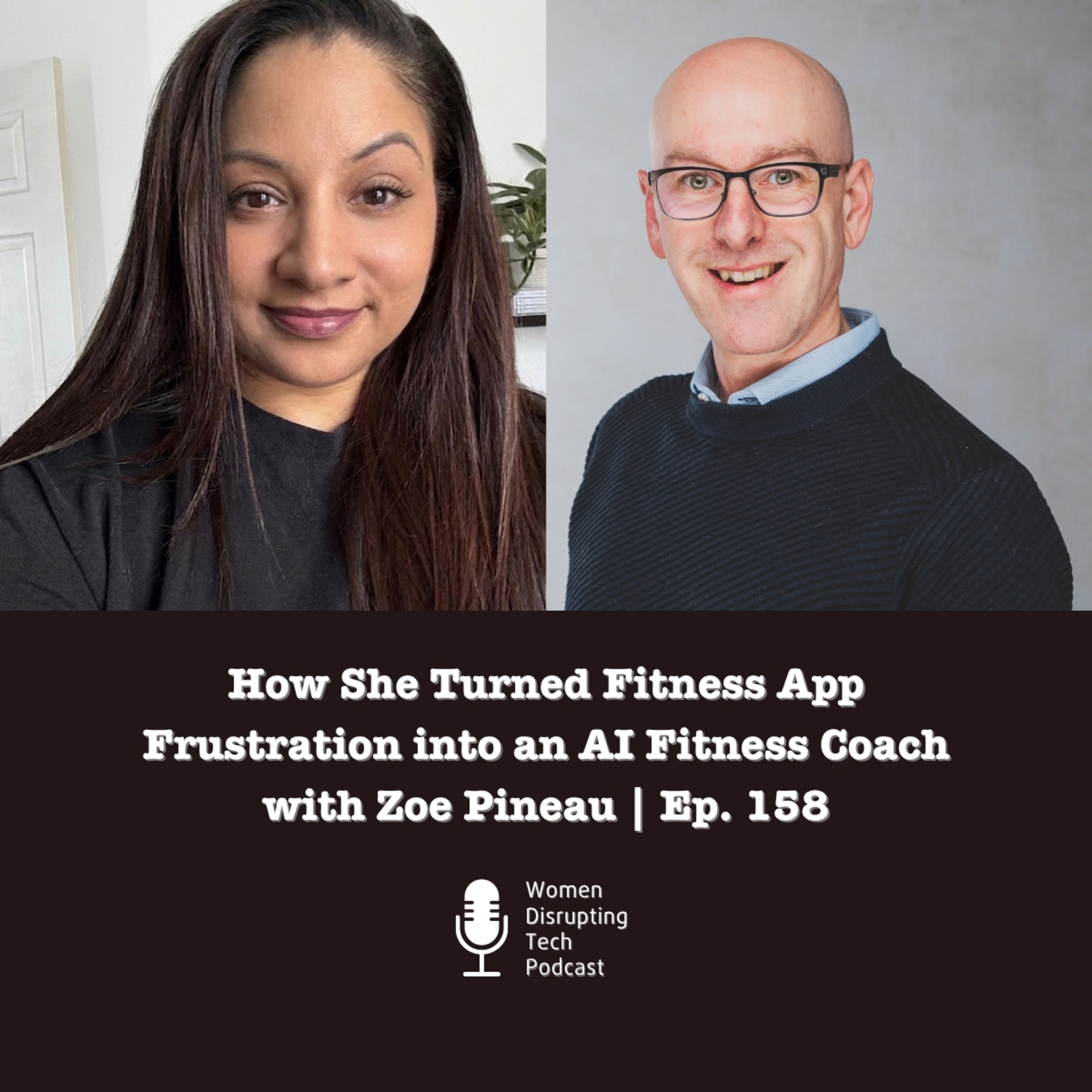
How She Turned Fitness App Frustration into an AI Fitness Coach with Zoe Pineau | Ep. 158

Most fitness apps are built to track everything. That's exactly why people stop using them. In this episode of Women Disrupting Tech, I talk with Zoe Pineau, co-founder of Fitly AI, about how she lost 150 pounds through macro tracking, spent six years building a traditional fitness app that didn’t break through, and then rebuilt from scratch in one month using AI. We explore why friction kills fitness habits before they start, and how a chat-based agent changes that equation. This episode is for female founders, women in tech, and health tech entrepreneurs who want to understand how AI is reshaping user experience, and for anyone building in a saturated market where being better is no longer enough. What you’ll learn in this episode Why macro tracking is mathematically reliable but practically abandoned by most people How Fitly AI lets users log an entire workout and meal in a single sentence, removing the admin burden that kills consistency Why “better” is not a differentiator in a saturated market, and what to build instead How Zoe used her own transformation as proof of concept when pitching investors Why apps are disappearing and what the age of agents means for founders building in this space How a 30-day momentum report keeps founders motivated and investors informed Chapters: 00:00 Introduction 02:50 Introduction to Fitly AI and Personal Journey 05:45 Transformative Weight Loss Experience 08:47 Mindset Shift and Habit Formation 11:32 Understanding Weight Loss as a Mathematical Process 14:11 The Importance of Macro Tracking 16:55 Innovating Fitness Apps with AI 19:47 Simplifying User Experience in Fitness Tracking 22:53 Building Fitly AI: Lessons Learned 25:31 The Impact of AI on App Development 28:25 Leveraging AI for Business Insights 30:33 The Role of Prior Experience in AI Utilization 32:30 Data Privacy and Security in AI Applications 35:02 Collaborative Development: A Team Approach to App Building 37:17 Navigating the Fundraising Landscape 39:22 Addressing Competition: Lifestyle Changes vs. Quick Fixes 42:18 Motivation and Consistency in Fitness Tracking 45:13 The Future of Fitness Apps: Integrating AI Agents 47:55 Building a Funding Coach AI for Female Founders Connect with Zoe Pineau and Fitly AI LinkedIn: https://www.linkedin.com/in/zoe-pineau-850588105/ Instagram: https://www.instagram.com/zoepineau TikTok: https://www.tiktok.com/@thezoepineau Website: https://www.fitly.chat Show notes of the episode Blog: https://womendisruptingtech.blog/2026/06/25/episode-158/ Substack: https://open.substack.com/pub/womendisruptingtech/p/episode-158?r=2v0lts&utm_campaign=post&utm_medium=web&showWelcomeOnShare=true About Women Disrupting Tech Every week, Women Disrupting Tech covers the decisions, patterns, and structural realities that female founders and investors in HealthTech, FinTech, ClimateTech, and AI rarely discuss in public but run into every time they meet. Follow Women Disrupting Tech on Spotify, Apple Podcasts, or YouTube to get it in your feed.

Is this your show?

Claim this listing to keep it up to date, reach guests who want to pitch you, and manage bookings with Guestify.

Claim this listing

More Technology podcasts