Find partners
The Road to Accountable AI

The Road to Accountable AI

Hosted by Kevin Werbach

TechnologyBusinessInterviews guests

Episodes

72

Latest episode

Jun 2026

Language

EN

About the show

Artificial intelligence is changing business, and the world. How can you navigate through the hype to understand AI's true potential, and the ways it can be implemented effectively, responsibly, and safely? Wharton Professor and Chair of Legal Studies and Business Ethics Kevin Werbach has analyzed emerging technologies for thirty years, and created one of the first business school course on legal and ethical considerations of AI in 2016. He interviews the experts and executives building accountable AI systems in the real world, today.

Listen to episodes

60 recent
June 11, 2026Episode 1432 min

Nadav Cornberg (Eve Security): Interrogating Agents Before They Act

Kevin Werbach speaks with Nadav Cornberg, co-founder and CEO of Eve Security, about securing agentic AI where it counts: at the moment an agent actually does something. He recounts how customers upended his own assumptions that AI agent security should focus on visibility and after-the-fact detection. Buyers insisted on runtime enforcement first, reasoning that learning a production database was deleted after the fact helps no one. With Eve's "interrogation" approach, when an agent attempts an anomalous, high-risk action, Eve's agent-in-the-loop pauses and questions it about its intent, before approving, blocking, or escalating to a human. Cornberg describes building a deterministic enforcement layer on top of inherently non-deterministic models, with the system minting explicit rules from observed behavior so that the large majority of everyday requests resolve deterministically. Ultimately, the consequenes are the same whether an unintended action originates in a prompt injection or a simple hallucination. On the perennial human-in-the-loop question, Cornberg argues that escalating everything would drown security teams as the agentic workforce scales, so the platform automatically handles lower-risk cases with justification and reserves human review for the genuinely critical. He closes predicting that "agentic security" will fragment into distinct segments much as endpoint, network, and cloud security once did, and that intent is fast becoming the field's organizing idea. Nadav Cornberg is the co-founder and CEO of Eve Security, an Austin-based agentic AI observability and policy-enforcement company whose platform governs how AI agents interact with an organization's most critical systems. He brings roughly two decades in product development and engineering, including an early decade in cybersecurity at RSA and Check Point and later work in physical access security across gaming and hospitality before returning to security for the agentic era.  Transcript Founders' blog: Why We Started Eve Security

June 4, 2026Episode 1333 min

Venkat Siva (Compfly): Governing Agents at the Execution Boundary

Kevin Werbach speaks with Venkat Siva, co-founder and CEO of CompFly AI, about why governing autonomous agents requires a fundamentally different approach than securing traditional software. Siva argues that agents create a genuinely new control problem. Because they decide at runtime which tools to call and which actions to take, governance cannot simply be bolted onto existing MLOps or security platforms built for fixed, deterministic workflows. Instead, control has to move to the "execution boundary" — the point where an agent's decision turns into a real-world action. And agent safety is much more than just model safety. In practical terms, Siva makes the case for giving every enterprise agent a distinct, cryptographically verifiable identity using decentralized identifiers (DIDs) and verifiable credentials. He addresses the growing problem of "shadow agents," pointing to employees experimenting with powerful open-source autonomous tools inside enterprises, and explains discovery techniques like intercepting traffic to model APIs and watching for who requests LLM keys. He offers the concept of an "autonomy budget": classify actions by reversibility and financial, regulatory, and customer impact, so an agent might autonomously issue a small refund but require human approval for a large one. Drawing on his time at the electric automaker Rivian, Siva closes by contrasting recoverable digital failures with the irreversible stakes of agents embedded in physical systems, arguing that governance there must borrow from safety engineering. Venkat Siva is the co-founder and CEO of CompFly AI, an early-stage company building a control plane to discover, validate, secure, and govern autonomous agents from code to production. Before founding CompFly with Anand Salodkar, he spent more than two decades building enterprise platform products that help organizations adopt new technology safely and at scale, including work at the electric vehicle maker Rivian.  Transcript The Architecture of Trust (Compfly Manifesto) CoSAI Model Context Protocol Security white paper

May 28, 2026Episode 1231 min

Munmun De Choudhury (Georgia Tech): Conversational AI and Mental Health

Conversational AI is increasingly being used as a source of emotional support, even though general-purpose chatbots were never designed for that purpose. Concerns about AI's mental health impact, up to and including suicides, have moved onto the public policy agenda. Munmun De Choudhury, who has been studying the intersection of digital technology and mental health longer than almost anyone, walks through what researchers know, what they don't, and why the answers keep moving.  The conversation centers on the difficulty of governing technologies whose capabilities and patterns of use are both changing every few weeks. De Choudhury invokes the cautionary tale of Google Flu Trends as a warning: any framework that assumes user behavior is fixed will eventually break. She argues that the harms and benefits of conversational AI are not just person-dependent but task-dependent, which makes general-purpose chatbots fundamentally harder to evaluate than the narrow medical AI systems researchers built for decades. She lays out a multi-stakeholder agenda to address AI's mental health risks, and argues that foundation models need to take into account principles from psychotherapy.  Dr. Munmun De Choudhury is the J.Z. Liang Professor in the School of Interactive Computing at Georgia Tech, where she founded and directs the Social Dynamics and Wellbeing Lab (SocWeB). She is one of the most cited researchers in digital mental health and is widely credited with pioneering the computational use of social media data to study mental health outcomes. She co-leads the Patient-Centered Care Delivery research pillar at the Children's Healthcare of Atlanta Pediatric Technology Center, serves on the advisory board for the Australian government's eSafety panel, and was inducted into the SIGCHI Academy in 2024. Her honors include the 2023 SIGCHI Societal Impact Award and the 2021 ACM-W Rising Star Award.  Transcript Benefits and Harms of Large Language Models in Digital Mental Health From Lived Experience to Insight: Unpacking the Psychological Risks of Using AI Conversational Agents

May 21, 2026Episode 1132 min

Emre Kazim (Holistic AI): Why AI Governance is Life Cybersecurity

Holistic AI was one of the first companies built specifically to govern, audit, and red team AI systems. As co-founder and co-CEO Emre Kazim explains, its original thesis was that AI governance would mirror data governance: a compliance-driven regime. He now believes the better analogy is cybersecurity: a more technical, incident-driven discipline where best practices emerge from real-world events and propagate across industry, rather than descending from abstract regulatory frameworks. Kazim argues this shift has significant implications for who owns AI governance inside enterprises, what skills they need, and why documentation-and-reporting vendors are unlikely to capture the core of the market. Kazim also makes the case that human-in-the-loop oversight, long treated as the default answer to AI risk, has become untenable as systems grow more dynamic and agentic. He distinguishes between two enterprise adoption patterns: a democratic model in which every employee has a copilot, and a vanguard model in which a small number of mission-critical agentic systems drive most of the value and demand most of the governance attention. Finally, he argues that meaningful research capacity will be the price of entry for AI governance firms going forward. Dr. Emre Kazim is the co-founder and co-CEO of Holistic AI, an AI governance platform company spun out of University College London in 2020. He previously served as a Research Fellow in UCL's Department of Computer Science. Kazim has published more than 50 peer-reviewed articles on AI ethics and governance, serves as a member of the OECD's Network of Experts on AI, and is involved with the NIST AI Safety Institute. Transcript Towards Algorithm Auditing (Royal Society Open Science, 2024) What is AI Governance? (Holistic Blog, February 2026)

May 14, 2026Episode 1035 min

Rumman Chowdhury (Humane Intelligence): The Need for Discernment

Kevin Werbach speaks with long-time responsible AI leader Rumman Chowdhury the current environment, in which substantive standards and oversight efforts for AI are taking shape amid a larger anti-regulation wave. Chowdhury distinguishes sharply between frontier labs, where the posture is largely "AI at all costs," and the non-tech enterprises she works with, who are wrestling with how to scale governance bodies that originally reviewed single AI implementations to hundreds of systems, third-party procurement questions, and agentic workloads. She describes the current evaluations market as immature on nearly every dimension, and explains why generic benchmarks rarely translate to enterprise contexts like insurance or auto manufacturing. The conversation then turns to AI's impact on work and education. Her concern is that companies pursuing short-term efficiency by cutting entry-level hiring will face what MIT researchers Caosun and Aral call the "augmentation trap," in which workers' cognitive skills atrophy while new workers never develop them. She offers "discernment" as her 2026 word of the year, discribing the skill -- more than just critical thinking -- we must cultivate and defend. Her new podcast and forthcoming book, Thinking About Thinking, argues that our notion of intelligence was built for an Industrial Revolution workforce we are now automating away. Dr. Rumman Chowdhury is the founder of Humane Intelligence PBC, building modular, tool-agnostic AI evaluation infrastructure for enterprise and real-world contexts. She co-founded the nonprofit Humane Intelligence in 2022 and served as its CEO until 2025. She previously was Director of the Machine Learning Ethics, Transparency, and Accountability team at Twitter, founder of the algorithmic audit platform Parity, and Global Lead of Responsible AI at Accenture, where she built one of the first enterprise-level bias detection tools. She has served as U.S. Science Envoy for AI and as a Responsible AI Fellow at Harvard's Berkman Klein Center, and holds a doctorate in political science from the University of California, San Diego. Transcript Virginia SB 384 / HB 797 — Independent Verification Organization legislation (Fathom) The Augmentation Trap: AI Productivity and the Cost of Cognitive Offloading Open to Debate: Will AI Make Work Obsolete? Why AI evals need to reflect the real world (Transformer)

May 7, 2026Episode 929 min

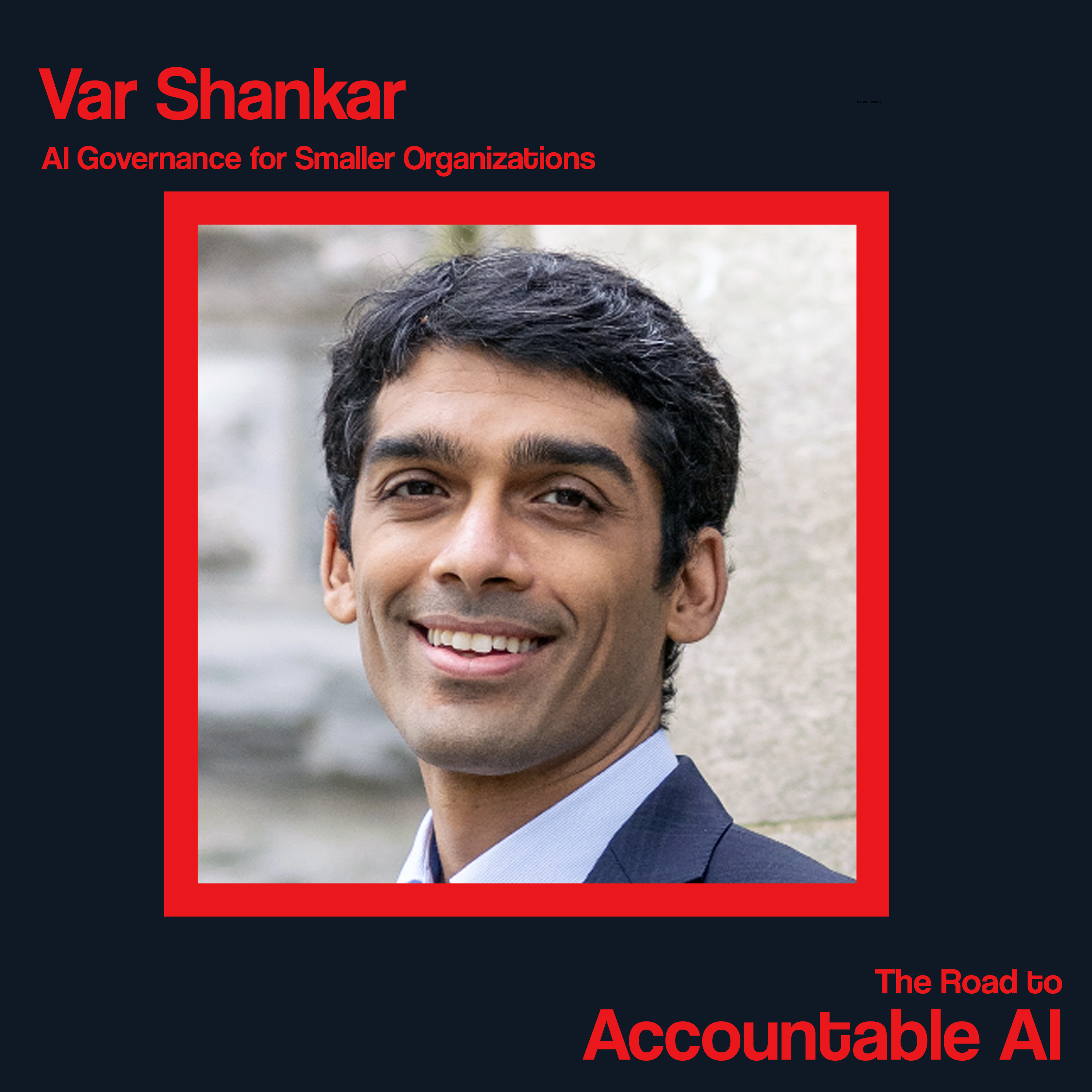
Var Shankar: AI Governance for Smaller Organizations

Var Shankar makes the case that most AI governance guidance is built for large, sophisticated, multifunctional global enterprises — and that this leaves out the roughly half of American workers employed at organizations with fewer than 500 people. Through the Council on AI Governance, the nonprofit he leads with Alexis Cook, he is trying to fill that gap with open, current, and pragmatic resources, including an AI Governance Playbook organized around four focus areas: strategy, risk and compliance, workforce literacy, and operational management. He tells Kevin that the case for AI governance no longer needs to be made; what smaller organizations now need is help asking vendors the right questions and clarifying who owns what internally when a few people are doing many jobs. The conversation then turns to the parts of the field Var thinks are most undercooked. Workforce literacy, he argues, is the focus area most often neglected because it functions as a vitamin rather than a painkiller — long-term, hard to resource, and easy to reduce to a training module when what is actually needed is hands-on involvement in pilots and documentation. He explains why healthcare offers an unusually strong foundation for AI assurance, with its existing regulatory architecture, comfort with use-case variability, and tradition of post-deployment monitoring, and he describes assurance itself as the connective tissue between an organization and the outside world — distinct from regulation and from internal governance, not a substitute for either. Drawing on a pilot he co-authored on with the Standards Council of Canada testing system-level certification at a Canadian bank, he highlights two surprising lessons: that even simplified certification criteria get interpreted differently by different actors, and that even one of the world's most forward-thinking public standards bodies lacked the technical capacity to play standard-setter for something as dynamic as an AI system. He closes with practical advice for risk and compliance professionals: start with the positive vision of what the organization is trying to do with AI, observe how existing IT, data, and security governance already work, and identify which standards ecosystems the organization is already plugged into. Var Shankar is Executive Director of the Council on AI Governance, an independent nonprofit developing open AI governance resources for organizations of all sizes. He previously served as Executive Director of the Responsible AI Institute and as Chief AI and Privacy Officer at Enzai, a regtech AI compliance startup. An attorney by training and a graduate of Harvard Law School, he practiced law at Cravath, Swaine & Moore and earlier worked on the Clinton Global Initiative and with the government of British Columbia on digital government and COVID response. He teaches AI governance at Purdue, where he has helped develop a master's-level AI auditing program, and serves on the OECD Network of Experts on AI, the World Economic Forum's AI Governance Alliance, and the Brookings Forum for Cooperation on AI. He co-developed Kaggle's Intro to AI Ethics course with Alexis Cook. Transcript   Council on AI Governance: AI Governance Playbook Context-specific certification of AI systems: a pilot in the financial industry (AI and Ethics, 2025) Standards Council of Canada AI accreditation pilot

April 30, 2026Episode 837 min

Katie Fowler (Thomson Reuters Foundation): How 3,000 Companies Approach AI Governance

Good data about how companies are implementing AI governance programs is essential both for organizations to benchmark their efforts, and for observers to understand the state of development. In this episode, Katie Fowler, Director of Responsible Business at the Thomson Reuters Foundation, joins Kevin Werbach to discuss the findings of Responsible AI in Practice, a new report drawing on a global dataset of roughly 3,000 companies across 13 sectors. Fowler unpacks the report's central finding: an enormous gap between corporate AI ambition and operational governance, with 44 percent of companies reporting an AI strategy but only 13 percent publicly committing to a formal governance framework. She argues that the gap is structural rather than just a disclosure failure, noting that AI expertise often sits deep within technical teams rather than at the leadership levels responsible for organization-wide rollout. She points to striking regional variation in workforce protections, the EU AI Act's emergence as a de facto global reference framework even outside Europe, and pushes back on the narrative that regulation stifles innovation. Looking forward, she discusses how investors are using transparency as a proxy for risk management in the absence of mature responsible AI metrics, and outlines the long-term vision of building a dataset robust enough to support a responsible AI index tied to financial materiality. Katie Fowler is Director of Responsible Business at the Thomson Reuters Foundation, the independent charity affiliated with Thomson Reuters. She leads initiatives including the Workforce Disclosure Initiative (a global platform collecting survey data on how companies treat workers across their direct operations and supply chains) and the AI Company Data Initiative, launched in partnership with UNESCO. Before joining the Foundation, Fowler held leadership roles at The Social Innovation Partnership and Chance for Childhood.  Transcript Responsible AI in Practice: 2025 Global Insights from the AI Company Data Initiative Why a Companywide Effort Is Key to Responsible and Trustworthy AI Adoption (Katie Fowler, techUK guest blog, 2025)

April 23, 2026Episode 738 min

Henry Ajder, Latent Space Advisory: Deepfakes and the Crisis of Digital Trust

AI-generated deepfakes are exploding in volume and quality, posing frightening challenges for public discourse, security, safety, and more. My guest, Henry Ajder, has been mapping the deepfake landscape since before most people had heard the term. In this conversation, he describes the dramatic changes in realism, efficiency, accessibility, and functionality of synthetic media tools since he published the first comprehensive census of deepfakes in 2019. Ajder describes the current moment as one of "epistemic nihilism," where people cannot reliably distinguish real from synthetic content and the available technological responses are not yet at a level of categorical trust. He introduces a framework of "deception, doubt, and degradation" for understanding deepfake harms, and draws a distinction between the clearly malicious, the clearly beneficial, and a vast unsettling middle ground of uses that society has not yet figured out how to evaluate. On the response side, Ajder warns that media literacy advice is not just outdated but actively harmful, because it gives people false confidence in their ability to spot fakes. Detection tools, watermarking, and content provenance standards like C2PA, while valuable, each have real limitations. Ajder's practical advice for organizations centers on red-teaming, understanding what your tool is actually for and who it serves, and recognizing that authenticity is a strategic asset in a synthetic age. Henry Ajder is the founder of Latent Space Advisory and one of the world's foremost experts on deepfakes and generative AI. He authored the landmark 2019 State of Deepfakes report, and has since advised organizations including Meta, Adobe, the UK Government, the EU Commission, the US FTC, and the World Economic Forum. He co-leads the University of Cambridge's Generative AI in Business programme, and sits on Meta's Reality Labs Advisory Council. Transcript Latent Space Advisory The State of Deepfakes: Landscape, Threats, and Impact (2019) The Future Will Be Synthesised (BBC Radio 4 Documentary Series, 2022)

April 16, 2026Episode 630 min

Phil Dawson, Armilla AI: Insurance for AI Risks

Could a private insurance market play a significant role in compensating for AI-related harms and incentivizing companies to engage in more effective AI governance? Phil Dawson of Armillla AI explains why AI insurance is emerging as a distinct product category, why traditional policies aren't effective at addressing AI risks, and what AI insurance actually covers. Dawson details Armilla's journey from AI testing platform assurance provider to, managing general agent for AI insurance policies, arguing that the company's AI audit experience gave it the risk data and evaluation capabilities needed to underwrite AI systems. A key turning point, he says, was realizing that as companies received reports showing how their models performed or underperformed, they became more concerned about risk, and insurance emerged as the next logical step to build trust. Dawson identifies the absence of claims data as the central challenge for AI underwriting, which forces insurers to rely on proxy signals. He argues that policymakers can help by incentivizing transparency, disclosure, and third-party assessment. Drawing on lessons from cyber insurance, Dawson contends that risk-based pricing must be grounded in system-level governance evaluation. He also describes Armilla's partnership program, which connects insured companies with AI governance platforms, auditing firms, and certification bodies, ultimately driving improved AI governance maturity across the sector. Philip Dawson is Head of AI Policy and Partnerships at Armilla AI, an MGA and Lloyd's cover holder that provides dedicated AI insurance products. A lawyer and public policy adviser, he has spent nearly a decade working on AI governance, including early involvement in the drafting of the OECD AI Principles and roles at Element AI, the United Nations, and the Harvard Kennedy School's Carr Center for Human Rights Policy. Transcript Ready or Not: The Impact of Artifician Intelligence on Insurance Risks (Armilla AI and Lockton, February 2026) Armilla AI Raises Lloyd's-Backed Coverage to $25M as Traditional Insurers Retreat from AI Risk (Fintech Finance News, January 22, 2026)  Gen AI Risks for Businesses: Exploring the Role for Insurance (Geneva Association, October 2, 2025)

April 9, 2026Episode 532 min

Walter Haydock, StackAware: In Search Of AI Governance Certification

Walter Haydock draws a direct line from military risk management to the enterprise AI challenge. His argues that organizations need to stop doing "math with colors," and move toward quantitative assessment that assigns dollar values to potential AI failures. Much of the conversation in this episode focuses on ISO 42001, the global standard for AI management systems, which Haydock has championed and which his own firm has gone through. He draws a three-part taxonomy of AI governance frameworks: legislation you either comply with or don't, voluntary self-attestable frameworks like the NIST AI RMF, and externally certifiable standards like ISO 42001 that bring independent verification. Haydock outlines a forward-looking vision in which certification, insurance, and legal safe harbors reinforce one another. Machine-readable audit data will eventually allow insurers to make informed underwriting decisions about AI risk, reducing uncertainty for both enterprises and their customers.  Though, as he acknowledges, we are still far from that environment, with AI audits today still roughly 90% manual. Walter Haydock is the founder of StackAware, which helps AI-powered companies manage security, compliance, and privacy risk. Before entering the private sector, he served as a reconnaissance and intelligence officer in the U.S. Marine Corps, as a professional staff member for the Homeland Security Committee of the U.S. House of Representatives, and as an analyst at the National Counterterrorism Center. He is a graduate of the United States Naval Academy, Georgetown University's School of Foreign Service, and Harvard Business School. Transcript Deploy Securely (Haydock's Substack)

Is this your show?

Claim this listing to keep it up to date, reach guests who want to pitch you, and manage bookings with Guestify.

Claim this listing

More Technology podcasts