
Find partners
Bits of Chris: Augment, Stay Human

Bits of Chris: Augment, Stay Human

Hosted by Second Brains and Soft Skills for Staff Engineers. Augment, Stay Human.

Episodes

47

Latest episode

Nov 2024

Language

EN

About the show

AI can't replace you. But you need to adapt. The future is not humans following a black box AI created by closed source companies. The future is humans at the center of AI, in an open and transparent way. Where individuals control and own their data. We need to build Open Augmented Intelligence not Closed Artificial. Open Augmented Intelligence is AI for Real Life. It's built with humans at the center. It is open rather than closed - because together, we go further than we can imagine. Augmented Intelligence is when we leverage AI tools for what LLMs are good at - distillation, retrieval, boiler plate generation. While we focus on amplifying our unique, human strengths - thinking, creativity, empathy. Follow the journey as I build Open Augmented Intelligence. I need your help :) Augment, Stay Human. bitsofchris.com

Listen to episodes

47 recent
November 1, 202437 min

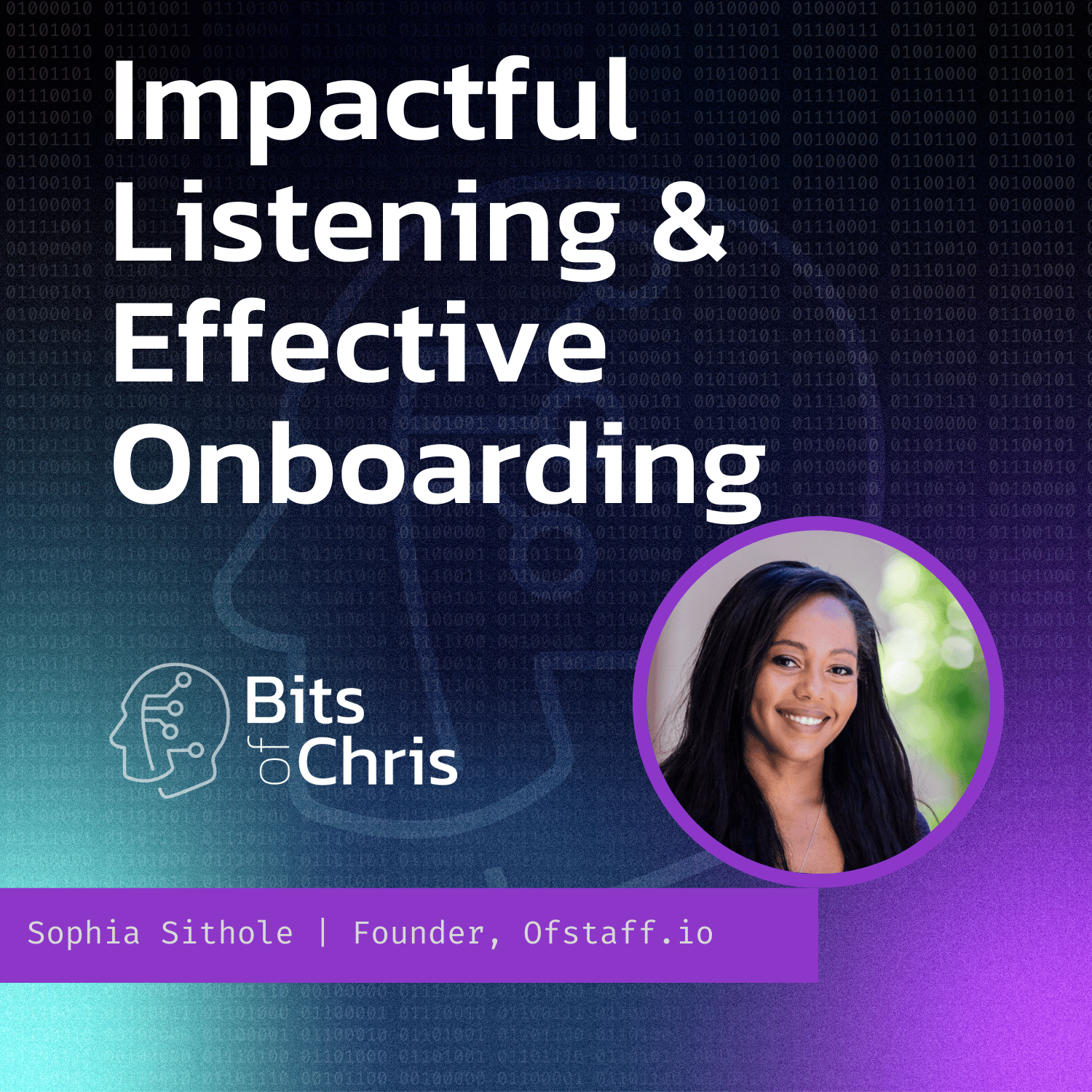
Impactful Listening & Effective Onboarding | Sophia Sithole, Founder Ofstaff

In this episode, I talk with Sophie Sithole about her journey building Ofstaff, an AI-powered onboarding and performance management solution. We explore the challenges of effective employee onboarding, and get into a deeper discussion about customer development, active listening, and handling vulnerability in business.Key LessonsEffective Onboarding* Alignment and clear expectations between all parties are crucial* Communication is fundamental at every stage* Both employer and employee have important roles to play* First few weeks are critical for successProduct Development & Customer Research* The "Mom Test" approach: Focus on learning about the customer's world rather than pitching your idea* Distinction between product-market fit ("painkiller vs vitamin") and go-to-market fit (how to sell/distribute)* Importance of seeking to invalidate assumptions rather than validate them* Value of looking for specific examples when customers claim something is usefulEffective Listening & Research* Pay attention to when people pause to think - it often indicates deeper insights* Ask for specific examples to validate claims* Focus on understanding impact across teams/organization* Practice active listening and genuine empathyHandling Vulnerability in Business* Embrace vulnerability as a pathway to learning* Focus on the "why" behind what you're doing* View challenges as learning opportunities* Balance passion for ideas with openness to pivotLinks* Ofstaff* https://www.linkedin.com/in/sophiasithole/ Timeline[00:01:00] - Exploring how alignment and expectations are crucial for successful onboarding [00:04:00] - Discussion of shared responsibility between employer and employee in onboarding [00:06:00] - Introduction to UpStaff and its focus on sales team onboarding [00:09:00] - Deep dive into how AI can distill and personalize onboarding data[00:13:00] - Exploring AI-powered course recommendations and learning pathways[00:16:00] - Discussion of bootstrapping journey and product development [00:17:00] - Understanding the difference between product-market fit and go-to-market fit [00:20:00] - Introduction to the "Mom Test" and effective customer research [00:25:00] - Importance of empathy and active listening in customer discovery[00:30:00] - Discussion on why seeking to invalidate ideas can be more valuable than validation[00:32:00] - Exploring vulnerability in business and product development [00:35:00] - Wrapping up with insights on learning mindset and personal growth This is a public episode. If you would like to discuss this with other subscribers or get access to bonus episodes, visit bitsofchris.com
October 19, 202413 min

I just built my first Neural Network: Here's my framework for learning in public

I recently joined a research team building time series Transformer models and have become infatuated with the field of deep learning.As a former trader, turned data engineer, I am now trying to understand the AI side of things. And this week I just hit my first significant milestone: building my first neural network from scratch, using no machine learning libraries. Today, I want to share this milestone and offer you my framework for how I decided to learn deep learning in public.(Here’s my GitHub repo and the XOR neural network).The Key: Invest in the basicsKnowledge compounds over time.When you understand the basics well, you gain the freedom and flexibility to explore more advanced concepts creatively.You have a strong foundation to build upon.Taking the time to stop your task and go look up something you don’t quite know, especially if it’s something foundational that you will see again, is an investment in your future self.This is the key concept to understand to unlock the value of life long learning.When you see the compounding effect of knowledge - you look for opportunities to know something well, to learn it deeply.Slow down, and focus on the fundamentals.Why I love learning in publicI've chosen to share my notes and code for this learning project on GitHub.This "learning in public" approach is better than learning on your own, but it requires a little more time in sharing what you do. It offers several benefits:1. Accountability: Sharing your work creates a forcing function, encouraging you to go the extra mile in understanding and polishing your knowledge.2. Continuous improvement: When you know you'll be sharing your learnings regularly, you start to notice learning opportunities in your daily life.3. Networking: By putting your work out there, you connect with like-minded individuals, potential mentors, and future colleagues. My previous writing actually played a role in landing me on my current AI research team.4. Knowledge retention: Externalizing your notes, whether in a private second brain or a public GitHub repo, helps solidify your understanding and creates a valuable resource that gets exponentially more valuable as you use it.My framework for learning in publicInspired by Scott Young's book "Ultralearning," here’s my framework for difficult learning projects:1. Set a big, exciting goalStart with a project that genuinely excites you. For me, it's building deep neural networks for financial data, leveraging my background in day trading. Your goal should be challenging enough to push you out of your comfort zone but aligned with your interests and expertise.2. Break it down into milestonesDivide your big goal into smaller, manageable milestones. My first milestone was implementing a basic neural network from scratch to solve the XOR problem. Having these intermediate goals helps maintain motivation and provides a sense of progress.3. Focus on a few high-quality sourcesAvoid information overload (and the stress that comes with it).Choose 1-3 reliable resources and stick with them. Even when things get difficult.Ignore everything else.4. Balance theory with practiceAdopt a "just-in-time" learning approach instead of drowning in prerequisites. Start with what excites you most, and fill in knowledge gaps as you encounter them. This approach maintains motivation while ensuring you still build a solid understanding as you go.When you're not actively coding or building, practice active recall by explaining concepts in your own words. This technique, inspired by the Feynman method, helps identify areas where your understanding is lacking.But it also provides a sense of action when you are studying theory.5. Be consistentPractice daily, even if it's just for 5-30 minutes. I aim for six days a week, taking Sundays off. Promise yourself at least 5 minutes, this will get you past that initial wall of getting started.My first neural network: A brief reflectionImplementing a neural network from scratch to solve the XOR problem was immensely satisfying. While the network itself is simple, the process of building it deepened my understanding of the core concepts behind neural networks.The journey wasn't always linear – I often found myself circling back to revisit concepts I didn't fully grasp at first. But this persistence paid off, and looking back, it's amazing to see how much I've learned in just a few weeks.Again if you are interested in the actual path I took, follow my deep learning work on GitHub.Start your own learning in public projectIf there’s something you want to pursue, give this framework for learning in public a try.* Start by identifying your exciting project and break it down into milestones. * Find 1-3 resources, and focus on these.* Commit to 5 minutes daily practice - balancing learning with doing.Remember, knowledge compounds over time. The key is just to consistently build on what you have.Thanks for reading and happy learning! This is a public episode. If you would like to discuss this with other subscribers or get access to bonus episodes, visit bitsofchris.com
October 11, 202455 min

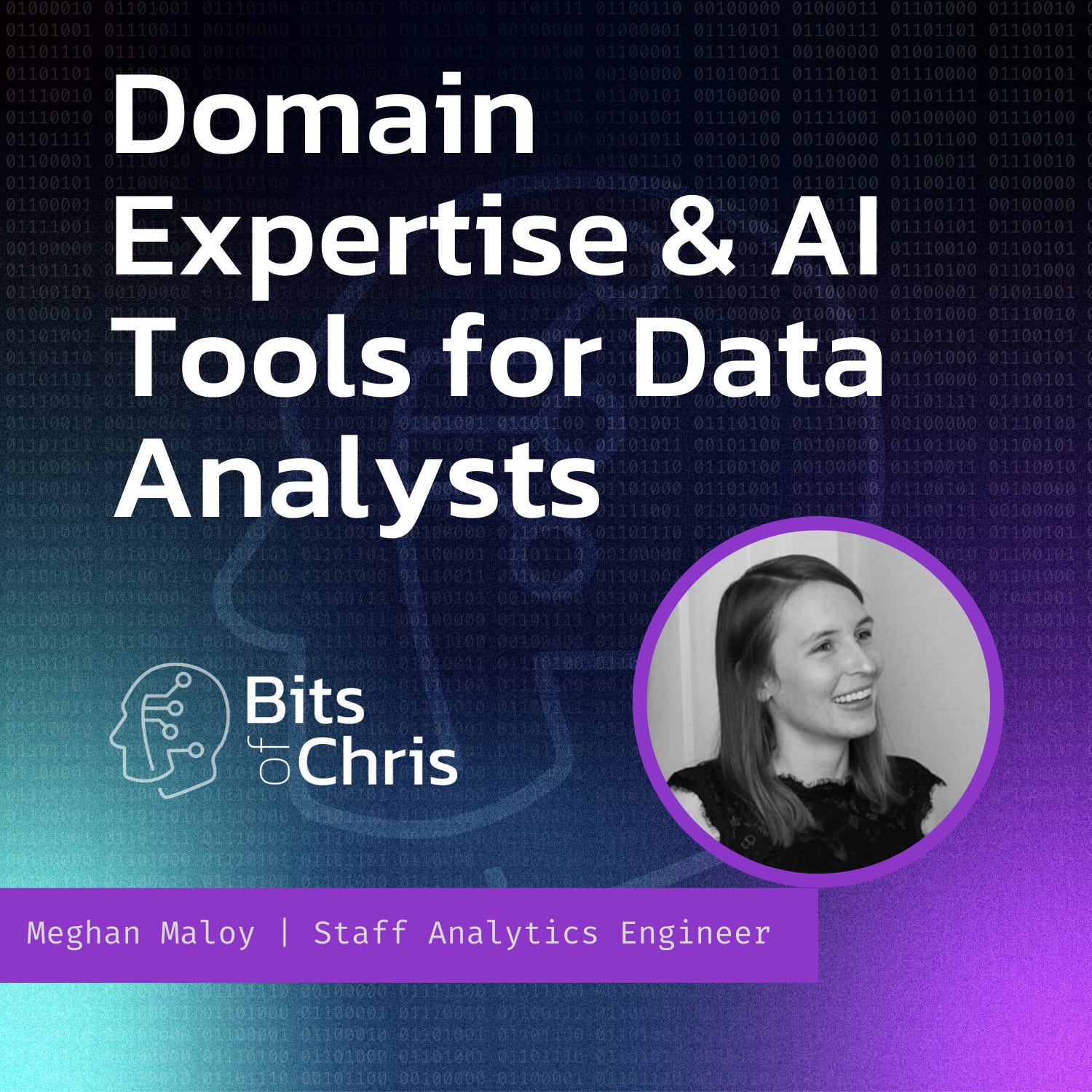
Domain Expertise and AI Tools for Data Analysts | Meghan Maloy, Staff Analytics Engineer

Key Lessons* Real-world experience and domain expertise can be your edge as a data analyst. Understanding the domain leads to better understanding the data.* AI can’t replace data analysts who understand the context of their data and have the communication skills to share results.* Using AI tools effectively requires clear & specific prompts while also understanding the limitations of LLMs.* Why Staff Level is hard to define and how to handle it.* NYC Open Data is a great way to explore some real world data.Links* Upcoming NYC Open Data Classes* How I Learned to Understand the World by Hans Rosling* How not to be ignorant about the world Timeline[00:00:00] Introduction to the Bits of Chris show and guest Meghan Maloy, staff analytics engineer at Datadog.[00:00:58] Discussion on using New York City open datasets to investigate real-life experiences.[00:02:19] Meghan shares an example of investigating traffic light timing changes in her neighborhood using open data.[00:05:33] Exploration of 311 data sets and their applications in understanding city complaints.[00:08:14] Meghan discusses her presentations at meetups using New York City open data.[00:09:34] Conversation about approaches to exploring data sets and asking questions.[00:12:54] Discussion on consuming information and book recommendations, including "How I Learned to Understand the World" by Hans Rosling.[00:17:21] Insights on the importance of domain expertise for data analysts and understanding data collection methods.[00:23:14] Meghan shares her experience transitioning to a staff-level role and finding impactful work.[00:27:23] Chris and Meghan discuss the challenges of measuring performance and impact at higher-level roles.[00:31:58] Conversation about the impact of AI and LLMs on the future of data analysis roles.[00:37:52] Discussion on using AI tools, including ChatGPT, Perplexity, and Claude, for various tasks.[00:44:38] Insights on the importance of specificity in prompts when using AI tools and interacting with colleagues.[00:50:34] Meghan shares her experience during a three-month sabbatical and the benefits of work-life balance.[00:53:53] Information about New York City Open Data training sessions and the Open Data Ambassadors program. This is a public episode. If you would like to discuss this with other subscribers or get access to bonus episodes, visit bitsofchris.com
September 27, 202434 min

Pilot Life, Basics of LLMs, and AI for Beginners | Greg Lettieri, Corporate Aviator

Today I’m joined by my brother Greg Lettieri, a corporate aviator with over 15 years of flight experience.We discuss the role of automation in flying, life as private jet pilot, the basics of LLMs, and how to handle FOMO around AI (hint - you’re not too late, just experiment).Enjoy!Key Lessons* Consistency is crucial, whether it's maintaining fitness while traveling or pursuing a long-term goal like writing a book.* While automation plays a significant role in aviation, human pilots are still essential due to the need for discretionary input and handling unexpected situations.* AI, particularly large language models (LLMs), can be powerful tools when used to augment human capabilities rather than replace them entirely.* The most effective use of AI for many people is in tasks like distillation, summarization, and enhancing search capabilities.* It's not too late to start learning about and experimenting with AI, as we're still in the early stages of understanding its full potential and applications.Links* https://perplexity.ai Timeline[00:00:05] Introduction to the episode featuring Greg, a corporate aviator with over 15 years of experience.[00:00:37] Greg discusses his experience flying high-profile clients and the nature of private jet life.[02:24] Explanation of the two-week on, two-week off schedule in corporate aviation.[03:40] Discussion on the unpredictability of private jet schedules and waiting for clients.[07:27] Greg shares his strategies for staying healthy and maintaining routine while traveling frequently.[11:45] Conversation about automation in aviation and why human pilots are still necessary.[14:37] Greg explains how autopilot works and when manual flying is required.[17:24] Discussion on the importance of maintaining manual flying skills to prevent skill atrophy.[18:51] Chris introduces the topic of AI and the risks of over-reliance on technology.[21:00] Greg shares his limited experience with AI and expresses interest in learning more.[21:38] Chris explains the basics of how large language models work.[24:53] Discussion on practical applications of AI, such as summarization and enhanced search capabilities.[28:48] Conversation about the financial applications of AI and its potential impact on jobs.[31:29] Chris and Greg explore potential uses of AI in aviation, particularly in expense management and flight planning.[32:20] Discussion on the fear of missing out (FOMO) surrounding AI and new technologies.[34:13] Chris reassures Greg that it's not too late to start learning about and experimenting with AI. This is a public episode. If you would like to discuss this with other subscribers or get access to bonus episodes, visit bitsofchris.com
September 14, 20249 min

Start your Second Brain: A Quick Guide for Staff Engineers

Staff Engineers!Are you overwhelmed by the constant need to learn & adapt?AI's making it worse, right?Time to build your Second Brain! 🧠Here's a quick start guide:* Pick ANY note-taking app (I use Obsidian)* Create 3 folders: * Inbox: Quick capture - save anything worth keeping. * Reference: Curated highlights from your sources - only what resonates.* Notes: Think & write in YOUR words from your reference.* [Optional] Add 2 more folders: * Projects: Track tasks & ideas per role or project area. * Journal: Brain dumps & life homeworkRemember, the goal isn't just to collect info - it's to facilitate LEARNING. 🎓AI + Your Second Brain = Augmented EngineerOnce you've built your knowledge repository, use AI to supercharge it through distillation (not generation).Don't let information overwhelm you. Start your Second Brain today and let your knowledge compound over time! 💪Key Lessons:* Building a "second brain" through structured note-taking can significantly enhance your ability to learn and adapt in a rapidly changing industry.* The primary goal of a second brain is to facilitate understanding, not just collect information.* A simple strategy for starting a second brain involves using three folders: Inbox (for quick capture), Reference (for curated highlights), and Notes (for personal insights).* Linking ideas across different notes can lead to novel insights and help trigger memories of valuable past information.* Combining a second brain with AI tools can create a powerful system for distillation and problem-solving.Links:Timeline:[00:00:43] - The challenge of keeping up with rapidly changing technology and the importance of continuous learning[00:01:25] - The purpose of a second brain: facilitating understanding and learning[00:02:11] - Simple method to start a second brain: choosing a note-taking app and creating three folders (Inbox, Notes, Reference)[00:03:20] - The importance of making capture easy and friction-free[00:03:56] - Explanation of the Reference folder for curating highlights from various sources[00:04:46] - Discussion of the Notes folder and the importance of writing in your own words[00:05:35] - Recap of the simple three-folder strategy for second brains[00:05:58] - Introduction to a more advanced method with additional folders for Projects and Journals[00:07:44] - Combining various note-taking systems (Zettelkasten, PARA, GTD) into a five-folder structure[00:08:54] - The potential of combining a second brain with AI for powerful information processing and problem-solving[00:09:33] - Encouragement to get started with a second brain and invest in learning tools This is a public episode. If you would like to discuss this with other subscribers or get access to bonus episodes, visit bitsofchris.com
September 10, 202446 min

Deploying AI Models at Scale | Eugene Weinstein, Engineering Director @ Google

Today I sit down with Eugene Weinstein, a speech recognition researcher and Engineering Director at Google where he leads an organization that productionizes speech recognition technology across various Google products.We discuss the evolution of speech recognition, the impact of Transformers, and the challenges of deploying models in production. This episode is packed with insight.A few things I learned from Eugene:* Build the model factory. Be able to pre-process your data, tune a model, and evaluate the model for accuracy and load testing as automated as possible.* Good data is key, but it's hard to get. Eugene shared how even Google struggles with data quality issues and ways to think about handling them.* How the Transformer architecture changed everything. Eugene breaks down why it was so impactful.* Scaling AI is an art. The trade-offs between speed and accuracy are constant battles and often need a bit of experience to get it right.* The benefits of cross-functional collaboration between engineers, researchers, and domain experts. Especially with finding data quality issues.My favorite quote:"If adding more data hurts your model performance, it's a red flag. But how do you catch it? There's no substitute for actually looking at your data." - EugeneKey Lessons* The importance of data quality and preprocessing in AI model development, including the need for manual inspection and automated checks.* The challenges and strategies for productionizing AI research, including optimizing for speed vs. accuracy and managing hardware resources efficiently.* The value of cross-functional collaboration between data engineers, researchers, and domain experts to improve AI model development and deployment.* The evolution of speech recognition technology and how recent advancements like transformer architectures have impacted the field.* The process of scaling AI models from research to production, including the importance of robust evaluation and testing frameworks.Links* https://huggingface.co/* https://github.com/run-llama/llama_index* https://www.langchain.com/* https://ai.google.dev/gemma* https://deepmind.google/technologies/gemini/project-astra/Connect with Eugene* https://www.linkedin.com/in/weinsteineugene/* https://research.google/people/eugeneweinstein/Timeline[00:00:00] Introduction of Eugene, his background at MIT and Google[00:01:26] Eugene's early work in speech recognition and computer vision[00:02:58] Discussion of Google's scale and the evolution of machine learning techniques[00:04:38] The impact of neural networks and deep learning on speech recognition[00:07:53] Explanation of transformer architecture and its significance[00:09:00] Convergence of different AI modalities and increased accessibility of AI technologies[00:14:55] The process of taking AI research to production at Google's scale[00:19:03] Importance of data quality and preprocessing in AI model development[00:21:54] Discussion on the value of domain expertise and cross-functional collaboration[00:25:36] Signals for identifying data quality issues and the need for data checks[00:31:17] Challenges in model deployment, including speed vs. accuracy trade-offs[00:34:51] Optimizing hardware utilization for AI model inference[00:37:56] Decision-making process for model selection and deployment[00:39:47] Explanation of the model tuning process and parameter optimization[00:42:01] Importance of software engineering discipline in productionizing research code[00:43:56] Building an efficient pipeline for testing, training, tuning, and evaluating models This is a public episode. If you would like to discuss this with other subscribers or get access to bonus episodes, visit bitsofchris.com
September 1, 202411 min

How To Be A Consistent Learner

Key Ideas* Learning compounds over time - small changes result in remarkable things. So be consistent, be slow and steady.* Embrace the discomfort of learning something new. The struggle and discomfort is you learning, seek that out and appreciate it. You will look back and see the growth, but in the moment it’s hard to recognize.* Learning is a long term game - slow down. Back up and go deep on the fundamentals. Focus on quality of learning over quantity. The basics always come back.* Be more intentional about what you consume.* Follow your curiosity.* Solve a specific problem.* Just-in-time learning vs just-in-case learning* Take notes and externalize what you learn. Use your second brain or Zettelkasten with a local LLM to search and make connections faster.Links* Mindset by Carol DweckMore on Taking Notes This is a public episode. If you would like to discuss this with other subscribers or get access to bonus episodes, visit bitsofchris.com
August 25, 202411 min

Finding Opportunities and Maximizing Impact: A Staff Engineer's Framework | Quick Bits

As a Staff Engineer, how do you consistently identify and pursue the most impactful opportunities?This talk introduces the Listen-Act-Share framework, a powerful tool for evaluating and acting on high-impact projects. Through real examples-including the migration to a data lakehouse architecture—you'll learn how to:- Find high-impact opportunities- Invest your time where it counts- Iterate and scale your efforts after validating Discover the key criteria that separate good opportunities from great ones, and learn how to apply these insights within the Listen-Act-Share framework. Related post: This is a public episode. If you would like to discuss this with other subscribers or get access to bonus episodes, visit bitsofchris.com
August 23, 202444 min

AI in the Classroom: From Teachers to Facilitators | Shawn Cryan, Educational Systems Coordinator

Key Lessons* AI can free up time for higher-order thinking tasks and more creative, human-centric activities in various professions, including teaching and software engineering.* AI in education can enhance individualized learning, allowing teachers to become facilitators rather than just content providers.* Educators using AI tools like ChatGPT can create customized curriculum content and assessments from sources they curate and vet.* How Shawn & I use AI with our kids outside of school.DescriptionIn this episode of The Bits of Chris Show, host Chris Lettieri talks with educator Shawn Cryan about the transformative potential of AI in education and everyday life. The integration of AI in education and daily life offers exciting possibilities for personalized learning, increased efficiency, and enhanced human creativity. As we adapt to these technologies, we have the opportunity to focus on higher-order thinking and more meaningful human interactions.By listening to this episode, you'll gain valuable insights into the practical applications of AI in education and beyond, helping you prepare for a future where human skills and AI capabilities work in harmony.Here's what you'll learn:AI Revolutionizing Education:* The shift from traditional teaching to personalized education using AI* Introduction to Khan Academy's AI tutor, Khanmigo, and its potential impact* How teachers are evolving into facilitators rather than just content providers* Unlocking higher-order tasks like project-based learning through AI assistance* The move from teacher-centered to student-centered learning environmentsAI-Powered Curriculum Development:* Creating social-emotional curriculum online during the pandemic* Using AI tools like ChatGPT for basic level information and content creation* The importance of vetting AI-generated content* Exploring content vendors for schools and their role in education* Sean's experience with "We Are Well" curriculum based on TED-Ed contentMaximizing AI Effectiveness:* The power of using AI on curated, personal data sets* Creating embeddings with your own data for more nuanced results* ChatGPT's strengths in common knowledge vs. the need for specialized data in niche areas* Understanding Bloom's Taxonomy and its application in AI-generated assessments* The potential of chaining prompts or using an ensemble of AI models for sophisticated resultsAI in the Workplace:* How AI is replacing certain tasks, freeing humans for higher-order work* Examples of higher-order tasks for software engineers* Emphasizing that AI is augmenting jobs, not replacing them entirely* The potential for AI to enable us to be more human in our workAI in Personal Life:* Creative ways to use ChatGPT with children for learning and play* Utilizing ChatGPT's image recognition for household tasks and family activities* The potential future of augmented reality glasses powered by language modelsResources* Shawn’s Portfolio* KahnmigoTimeline[00:01:15] Shawn introduces himself and his background in education and educational administration.[00:03:25] Discussion on Shawn’s career path and his role as an educational systems coordinator.[00:04:52] Exploration of current issues in education, including balancing academic success with nurturing environments.[00:06:50] Introduction to the topic of AI in education, mentioning Khan Academy's AI tutor.[00:08:00] Shawn explains the concept of individualized learning and how AI can facilitate it.[00:15:57] Discussion on content creation companies for schools and how they provide educational materials.[00:19:00] Shawn shares his experience creating his own health curriculum using AI tools.[00:22:28] Chris introduces advanced AI techniques, including injecting personal data into language models for better results.[00:25:30] Explanation of how to use ChatGPT with personal data sets to enhance its usefulness.[00:31:18] Discussion on using AI to create better assessments and project-based learning opportunities.[00:34:35] Introduction to Bloom's taxonomy and how it can be incorporated into AI-generated assessments.[00:35:30] Exploration of using multiple AI models together (ensemble of LLMs) to create more sophisticated educational tools.[00:39:30] Shawn and Chris share personal experiences of using AI in parenting and engaging with children.[00:42:19] Discussion on potential future applications of AI, including augmented reality glasses for real-time information. This is a public episode. If you would like to discuss this with other subscribers or get access to bonus episodes, visit bitsofchris.com

August 17, 202410 min

Handling Work Stress with Awareness & Homework for Life | Quick Bits #2

In this episode, learn how your personal values and Homework for Life can help you spot problems in your day-to-day faster.I share how I overworked this week but thanks to self-awareness I quickly corrected course. I then provide an example in my 11 years of marriage of how awareness again helped me break out of toxic mindset.Key Lessons* The importance of self-awareness in managing work stress and maintaining work-life balance.* How articulating personal values can serve as a compass for decision-making and prioritization.* The value of daily reflection exercises like "Homework for Life" in identifying patterns and improving personal growth.* Recognizing and addressing internalized expectations that may negatively impact relationships.* The benefits of open communication and self-reflection in breaking negative patterns and fostering personal development.Links* Homework for Life TED Talk* Storyworthy by Matthew Dicks* The Pathless Path by Paul MillerdShow Notes[00:00:09] Discussing the challenges of pre-vacation work intensity and the importance of not overworking[00:00:57] Recognizing the signs of overworking and its connection to fear and imposter syndrome[00:02:10] The importance of awareness in managing work stress, derived from daily value reminders and the "Homework for Life" exercise[00:02:29] Explaining the concept of writing down personal values as a decision-making compass[00:03:33] Identifying physical and emotional signals of work-related stress[00:04:40] Introduction to the "Homework for Life" exercise for daily reflection and awareness[00:06:52] How self-reflection and awareness helped in quickly identifying and addressing negative work patterns[00:07:22] Discussing a personal mistake of feeling entitled due to being the breadwinner[00:08:51] The importance of recognizing different perspectives and contributions in a relationship[00:09:17] Encouraging listeners to increase self-awareness through reflection and writing This is a public episode. If you would like to discuss this with other subscribers or get access to bonus episodes, visit bitsofchris.com

Is this your show?

Claim this listing to keep it up to date, reach guests who want to pitch you, and manage bookings with Guestify.

Claim this listing

More Technology podcasts