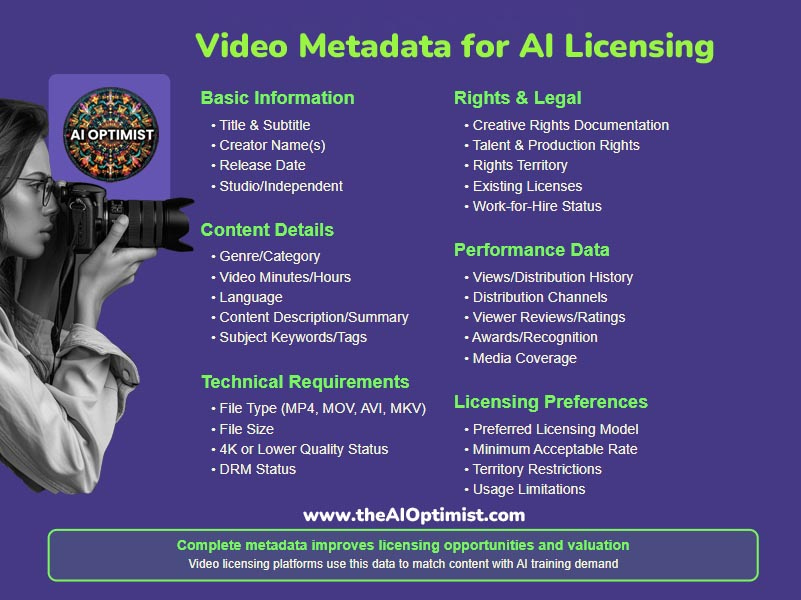
The AI Optimist cuts through the usual AI noise connecting creators and tech to work together instead of fighting. I'm a Creative AI Strategist who helps creators and businesses co-create with AI, turning humble machines into powerful creative partners. As a subscriber, you will immediately receive The Creator's AI Licensing INTEL. . www.theaioptimist.com
Listen to episodes
60 recent
January 30, 2026Episode 1120 min
AI Swallows Our Wildness: Why It Can't Live on Echoes Alone
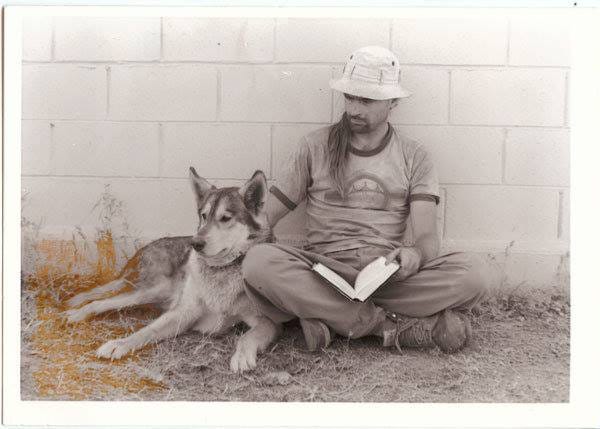
I’ve raised hybrid wolves and they’re a lot like AI. Both come from something that used to be wild. There’s that first moment at the fence, when people see them. The breath stops. The body tenses. Something ancient recognizes what stands on the other side of the fence: wildness that doesn’t negotiate, power existing on its own terms. We build strong fences. It makes people feel safe enough to admire the wolves from a comfortable distance, like AI. You build the structure, like ChatGPT. You create the illusion of control. But wolves understand fences as a temporary inconvenience, nothing more. Right now, we’re fencing human creativity with AI, far more dangerous than fencing wolves. We’re eliminating wildness. And we’re doing it in the name of making creativity easier, predictable, and not better. The AI Voice Eating Itself Picture a canyon where each sound echoes. At first, the echoes add depth, resonance, and layers of meaning. And what happens when the only sound entering that canyon is the echo itself? When echo feeds echo feeds echo until the original voice vanishes completely? That’s where we are with AI and human creativity. Systems now learn from AI-generated text that isn’t always done by AI. Content created to feed algorithms teaching new algorithms what “good” looks like. Writing engineered for engagement becomes the standard for writing. Where everything sounds like everything else because everything is everything else. Maybe just slightly degraded copies, generation after generation. Biologists have a term for what happens when wolves breed only in captivity, when the gene pool narrows, when wildness gets engineered out: genetic collapse. The animals look like wolves. They might even act like wolves in controlled environments. But that something that made them wolves? It disappears. We’re watching creative collapse happen in real time. Now the original creative work that gave AI its power—decades of wild, gloriously messy human expression—is being systematically replaced by content designed to please the systems learning from that wildness in the first place. Wild Happens When Limits Become Possibilities Wildness isn’t nostalgia. It’s not a romantic Luddite rejection of technology or a call to return to typewriters and handwritten manuscripts. Wildness happens when people create for other people, without algorithmic approval as the invisible editor standing over their shoulder. You find wild in the researcher’s field notes before editing, full of crossed-out thoughts, marginal questions, uncertainty captured in real time. The oral history speaking in dialect and pause and emotion, not vectorized into predictable, standardized text. The essay contradicts itself because the writer discovers what they think as they write it. Wildness lives in friction. Think about everything we’ve smoothed away in the name of being as smart as AI: * The inconsistency showing how people think * The silence carrying as much meaning as speech * The regional twangs capturing cultural rhythms * The contradictions reveal understanding * The tangents connecting ideas nobody planned to connect These aren’t bugs in human communication. The imperfections are what makes creativity perfect. Coincidences connecting. They’re what made those decades of scraped internet content valuable for training AI in the first place. The unplanned moments. The authentic voice. The creative choice that didn’t calculate what would perform best. And we’re paving all of it. Like the song goes, “Don’t it always seem to goThat you don’t know what you’ve got ‘til it’s gone?They paved paradise, put up a parking lot.” Joni Mitchell You cannot protect wildness by destroying what lets it survive and thrive. Wildness needs space to exist. Not metaphorical space: the money space. Time and the freedom to create without fitting in as the primary driver. Content that follows algorithmic systems gets followers. Visibility. Maybe revenue. The creator engineering for engagement metrics gets to keep creating. The one who refuses? They just stop being able to afford to create. It’s not dramatic. It’s math, just like AI. Big Tech companies built their entire foundation on wildness they didn’t pay for. Decades of human expression taken without permission or compensation. Becoming commercial products worth billions. Now that there’s a market, we’re seeing the beginning of licensing 6 years too late. The writer spending three years on deeply researched work can’t eat licensing fees that come only if it’s a hit. The oral historian documenting a disappearing language can’t wait for AI companies to decide that data is valuable five years from now. The community needs that today . If we want wildness to survive, we must pay for the conditions that let it exist, not just the output it produces. Five Ways to Protect What We’re Losing This isn’t a technical puzzle with a clever solution. It’s a choice about what we value and what we’re willing to fight for. * Seek wildness intentionally. It doesn’t arrive by accident anymore. Field research, oral histories, raw interviews, handwritten archives, work untouched by technology yet (and there’s a lot of it) require pursuit and protection. Yes, it’s expensive. Yes, it’s slow. Not everything worth having scales like some Hyperscaler. These are the roots growing products and creation, not the farmer over harvesting a field that will take decades to grow again. * Design for friction, not around it. Algorithms optimize friction away because it looks like inefficiency. And wildness lives in spaces resisting perfect smoothness. Systems learning about inconsistency, silence, and contradiction create room for reality that doesn’t fit the model. Otherwise it’s clone armies of content repeating in endless loops. * Know where content comes from. Not all sources deserve equal weight. Models need to know whether text was written for humans or for algorithms. Tracking origin, intent, and degree of optimization lets systems value wild inputs appropriately. The risk is people gaming the system, engineering fake wildness. The response? Verification and transparency. Imperfect and better than pretending all content is the same, comes from the same place. One is copying, the other is inventing. * Curate, don’t just moderate. Curation is where creators and communities judge about what matters. When we let engagement metrics replace human taste, we pretend algorithms are neutral. They’re not. They’re biased toward virality (and in Meta and Google, the core of profitability), which we’ve turned into quality because it’s got big numbers. And everyone loves chasing big numbers, even if many of them are AI bots. * Let systems rest. What if models periodically stop ingesting new training data? Freezing forces reliance on existing knowledge and reveals where hallucination fills the gaps. Only then do you see what wild inputs really do. Systems that know what they don’t know are more valuable than systems that hallucinate with confidence. Wolves laugh at fences, so does AI I think about my hybrid wolves often. So smart, inventive, and wild. Like the human creativity we’re fencing in with AI. We optimize and extract value from expression, while undermining what lets authentic expression emerge. Admiring what AI can do with human creativity while starving the sources making those skills possible. This is entirely human choice. We’re deciding what kind of creativity survives. Fund the conditions where wildness thrives. Protect space for creation that doesn’t start with fitting into algorithms before taking the first step. Or we can keep building tighter fences, optimized outputs. Until all that’s left is AI listening to its own voice, wondering why everything sounds the same. Wildness taught me something those wolves demonstrate every day: you don’t plan to be authentic, you become so from experience that no current AI will ever touch. Because life requires more than a probable answer. It requires space, patience, and respect for what you don’t fully control. The question isn’t whether we can build better AI to capture and process human creativity. The question is whether we’re willing to protect the conditions where wildness survives, even when it’s impossible to scale. Even when it howls into the canyon and expects nothing back but silence. What are we choosing to protect? Thanks for reading The AI Optimist! This post is public so feel free to share it. This is a public episode. If you would like to discuss this with other subscribers or get access to bonus episodes, visit www.theaioptimist.com
January 9, 2026Episode 11110 min
We're All Naruto: The Monkey Got 25%, While AI Creators Get Nothing. Why?
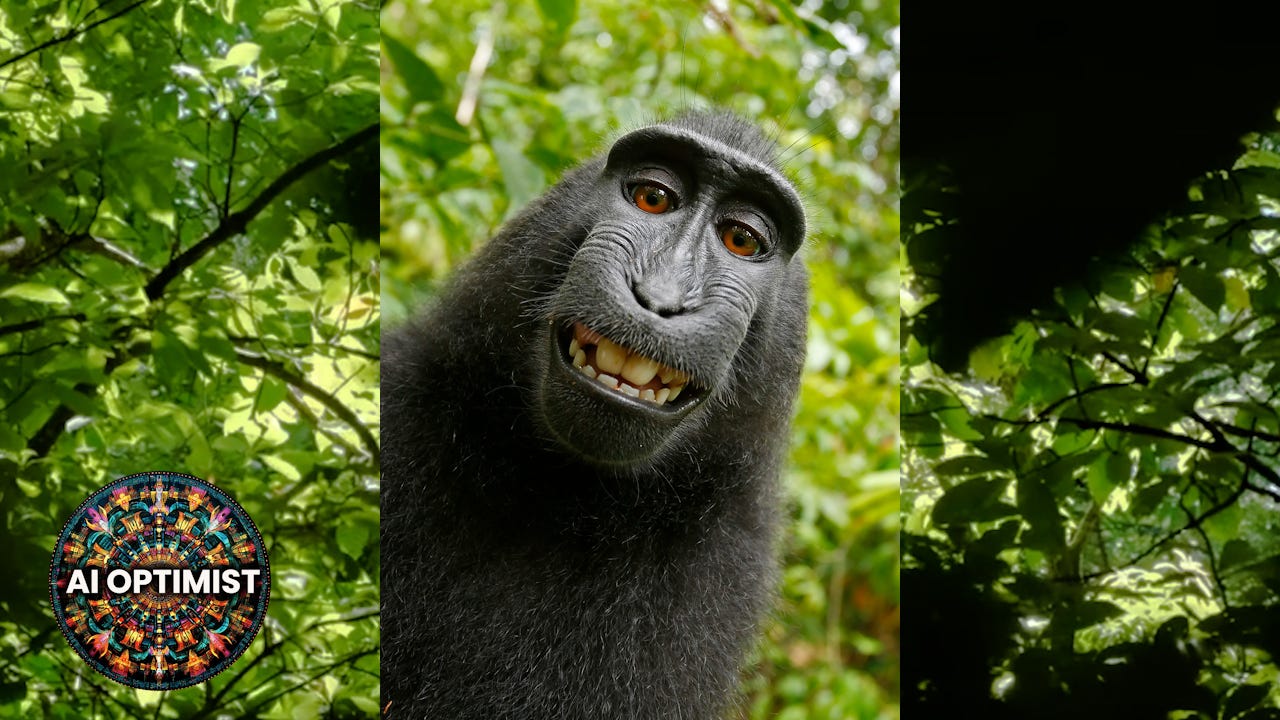
What is the Naruto monkey selfie case and why does it matter for AI? A monkey takes a selfie. Years later, a federal judge must decide who owns it. In the courtroom, the judge asks with a straight face whether Naruto would be required by law to provide written notice to other macaque monkeys before joining a lawsuit. The courtroom laughs. Here’s what’s not funny: the initial ruling. No human author, no rights. Period. Right now, if you’re creating with AI, the legal system says the same thing to you . Spend hours refining prompts, making hundreds of creative decisions, shaping output until it’s exactly right. Someone else can take it, use it, sell it. You get nothing. When you admit AI was involved, your work loses protection. So you stay quiet. Many pretend we’re not using the tool reshaping creative work at a speed and volume no human can match (or maybe should). Why are we treating human creativity with AI the same way we treat a monkey with a camera? And what does the shame around admitting you use AI, from both sides, reveal about what’s broken? This isn’t about whether AI deserves copyright. It’s about whether creators working with AI deserve protection for their work. Right now, the answer is zero. Not 25%. Zero. The monkey got 25%. You get shame, silence, and zero protection. Let’s talk about why, and what that 25% reveals about creative rights with AI. What happened in the Naruto v. Slater settlement? Indonesia, 2011. Wildlife photographer David Slater sets up his camera in the jungle. Naruto, a crested macaque, grabs it and starts clicking. Many photos. Most are blurry, random, kind of what you’d expect from a monkey with a camera. But a few? Perfect. Composition, timing, expression. The kind of selfies humans spend ten tries to get right. They go viral. Wikipedia posts them as public domain with a simple explanation: the monkey took the photo, not the photographer. Slater objects. He set up the equipment. He created the conditions. He made the monkey photos possible. Then PETA sues on Naruto’s behalf. Not because they think the monkey deserves rights, but to make a point about animal rights and who controls creative output. The court doesn’t debate whether the photos are creative. They are. The court doesn’t question whether they have artistic merit. They do. The question is simpler: Without human creative control, is there anything to protect? The answer: No. Not because the work lacks value. Because the law was built for human creators, and nobody knows what to do when creativity crosses species. And in our case, when it crosses into working with machines. The case drags on for years. Slater’s exhausted. PETA wants a resolution. So they settle. 25% of future revenue from the photos goes to charities protecting crested macaques in Indonesia. Not because Naruto won. Because everyone wanted it to end. Not full ownership. Not recognition as the creator. Just a cut. The photographer keeps the rest, even though the monkey pressed the button. The monkey gets a percentage, even though the photographer created the conditions. Maybe the answer to “who owns this?” isn’t either/or. Maybe it’s not human OR monkey. Maybe it’s not human OR AI. Maybe when different forms of intelligence work together, even by accident, what does fair look like? Because right now, with AI, we’re not even asking that question. We’re just saying zero. = Should I admit to using AI in my creative work? Reality, you probably shouldn’t if you’re even asking the question. Not because using AI is wrong. Because admitting it sometimes costs. You create something with AI. Spend hours refining prompts, making creative decisions, shaping output. The Copyright Office’s position is clear: no human creative input that rises above AI’s contribution, no protection. How much is too much AI? Nobody knows. Nobody will tell you. You won’t find out until someone challenges your work or there’s money involved. Take Jason Allen’s Théâtre D’opéra Spatial . He ran 600 prompts through Midjourney, made hundreds of choices about composition and style, won a Colorado art competition. Then applied for copyright protection. Denied. AI-generated, so no protection. The 600 prompts didn’t matter. The creative decisions didn’t count. What’s a creator supposed to do? You write an article. Use AI to help with research, maybe structure, some editing. Do you mention it? Do you check a box on YouTube saying you used AI? Why would you? Admission means zero protection and convinces people the work isn’t really yours. Maybe it’s just scraped content from the internet, regurgitated. So you stay quiet. Everyone stays quiet. And we pretend we’re not using the tool reshaping creative work at speed and volume no human can match. Or maybe should. That’s the liar’s dividend. The reward for silence. We don’t measure human-created work by what tools were used. We measure it by whether it’s original, inventive, new. Whether we like it. Why is AI different? Fear. The Scarlet AI. There’s this idea that admitting AI involvement means you’re not a “real” creator. That it diminishes the work. That you’ll lose protection, respect, everything. Some people call creators using AI lazy or fake. Others like tech builders and AI engineers call creators greedy and entitled when they ask for permission, payment, and transparency about how their work trains these systems. Both sides are shaming. Both sides are wrong. And creators are caught in the middle, hiding their tools and their process because honesty is punished. The conversation about what’s possible when different forms of intelligence work together never happens. We’re stuck in either/or thinking: Human or AI. Real or fake. Creative or automated. What happens when different forms of intelligence learn to work together? Right now, we’re too afraid to even ask. Why don’t AI creators have copyright protection? Because the law is asking the wrong question. Courts keep asking: “Is it human enough?” When they should be asking: “Is it creative? Is it original? Does it show intention?” The legal system was built for a world where humans were the only ones making creative choices. Now we have tools that can generate, suggest, refine; suddenly nobody knows how to measure what the human contributed. So, they default to the simple rule: No human author, no rights. It’s the same logic that denied Naruto. The photos were creative. They showed artistic choices: framing, light, expression. But without a human holding the camera, the law had nothing to protect. We’re living that same logic right now. You make hundreds of creative decisions working with AI. You choose what works and what doesn’t. What to keep, what to throw away. That’s not accident. That’s intention. How much human involvement is enough? Who decides? Where’s the line? The Copyright Office won’t tell you. They’ll just evaluate your work after the fact and decide whether you crossed some invisible boundary between “tool” and “creator.” And the law can’t keep up. We’re still litigating cases from three, four, five years ago. AI evolves daily. By the time a court decides what was acceptable in 2021, we’re already working with completely different systems in 2026. The question isn’t whether AI deserves copyright. It’s whether creators working with AI deserve protection for the choices they’re making. Right now, the answer is: only if you can prove you did more than the AI did. Good luck measuring that. Try asking ChatGPT that. Could a 25% revenue model work for AI and creators? Naruto’s settlement wasn’t about who was right. It was about ending a fight nobody could win. The photographer didn’t get full ownership. The monkey didn’t get recognition as the creator. They landed on 25% of future revenue going to macaque conservation. Not because it was fair, because it was something . And that number didn’t come from judges or juries. It came from two parties trying to figure out what made sense when the rules didn’t fit the situation. How about applying that same thinking to AI? Right now, AI companies take trillions of pieces of creative work - articles, images, code, music - to train their systems. What comes out isn’t what went in, so it’s transformative. Fair use. Meanwhile, creators get nothing. No payment. No permission is asked. No transparency about what was used or how. And creators using AI get nothing either. No protection for the hours spent refining prompts and making creative choices. No way to prove, or move beyond human only right. What if both sides got something? What if a percentage of the trillions in compute costs went back to the creators whose work trained these systems? Not full ownership. Not a veto over AI development. Just a cut that acknowledges their work made this possible. And what if creators working with AI got protection for their output. Not full copyright, but something that recognizes the creative choices they’re making? The monkey got 25%. Photographers using AI get zero. The creators whose work trained the AI get zero. What if we stop arguing about who deserves what and start asking what makes sense when creativity isn’t cleanly human anymore? That’s not a legal answer. It’s a practical one. And right now, we’re not even having that conversation because we’re too busy shaming each other. What creative choices are you making with AI that nobody sees? We’re all Naruto now. Picking up tools we didn’t build, making creative choices, the law doesn’t know how to recognize. What are you not admitting you’re using AI for? What creative choices are you making that nobody sees because you’re afraid of what happens if you’re honest? That silence is the problem we need to solve. Not with more lawsuits. Not with more shame from either direction. But by talking about what works, what doesn’t, and what fair looks like when creativity isn’t cleanly human anymore. We’re teaching primates to use tablets. AI is writing poetry and making music people listen to. Intelligence and creativity are showing up in forms our grandparents couldn’t have imagined. We’re either going to keep pretending it isn’t or start building something admitting the reality: creativity knows no species barrier. And maybe that’s not something to fear. Maybe it’s something to figure out together. We’re monkeys learning to use a new camera called AI. We’re not just monkeys. But even if we are, we deserve better than nothing for our work. The conversation starts when the hiding stops. RESOURCES * Sulawesi Video - Restless Generation (Where Naruto was) * Monkey Selfie Lawsuit * Deezer/Ipsos survey: 97% of people can’t tell the difference between fully AI-generated and human made music – clear desire for transparency and fairness for artists This is a public episode. If you would like to discuss this with other subscribers or get access to bonus episodes, visit www.theaioptimist.com
December 26, 2025Episode 11011 min
When Everything You Create Starts Sounding Like ChatGPT (And How to Fix It)
Ever notice yourself reaching for AI before trying to think through something on your own? One sentence in an email, that’s all between me and the holiday weekend. Playing a live distractathon between things I must do and mind candy….I went for the candy. Not because I didn’t know what to say . Because I’d get distracted when I started. So I ask ChatGPT to finish it. Then the next one. Then the entire email. Few minutes later, I couldn’t draft anything without opening ChatGPT. And I’ve written a ton in my life. Now this passed, still I’m not alone. Many would be lost now if ChatGPT went away. Not likely, but still a ton of trust to put on something that’s not trustworthy yet. → People who once wrote easy to read emails, turn into corporate word salads→ People who made decisions in minutes now look to ChatGPT for confirmation (knowing they can’t trust the results).→ Creators who had strong voices can’t remember what they sounded like after AI cloning it all. One person told me: “I used to just... know what to write. Now I don’t trust myself to start without AI checking it first.” When we outsource the thinking part of writing something else gets weaker . The muscle turning rapid thoughts into clear sentences. The innate knowing when something sounds like you. It’s not like you wake up one day unable to think. More like using a paper map in a GPS world: * Reaching for AI before trying to figure it out yourself * Feeling foggy when you need to write something important * Not trusting your own judgment like you used to The cost of speed is your thinking and problem solving; your mind, perspective, and confidence. AI makes drafts in seconds, revises in seconds. Still we know speed and thinking aren’t the same thing, even if it’s really fun and easy to just use it. What if the tool didn’t make us faster, but did make us dependent. I’m not saying we abandon AI. I’m an advisor to one startup, and use it every day. Still the thing making us faster might also be making us... different. Now is that different in a good way, depends on the person. Here’s what I’m testing, how to be different in my actions, and improve with AI. Your Voice: Is It AI or Unfakeable You? Most people can’t describe their own voice. It’s like asking a fish to describe water. I’m one of the fish here. (And AI hasn’t been much help beyond the obvious.) Now let’s dissect it together. Not to criticize. To discover. I’ll share some of what came up for me, and play along, comment with questions. Everyone has their own way of using AI, which makes it less software and more you. TLDR Question 1: How do you start sentences? Do you lead with questions? Statements? Stories?Look at the first line of each paragraph. There’s a pattern. Question 2: What words do you overuse? Not “AI” or “business”; everyone uses those.I mean the weird ones. I say “seriously” too much. “Honestly.” “Look.”Those aren’t professional. They’re mine. Question 3: What do you explain that others assume? Some people over-explain. Some skip steps.Neither is wrong. But it’s distinctive. Question 4: What do you avoid saying? I don’t use corporate speak. No “synergy.” No “leverage.” No “circle back.”That’s not style advice. That’s who I am. Finding Your Voice with AI Here’s what you’re going to do after this session: Pull up your last 5-10 pieces of writing. Emails, posts, whatever feels natural. Not your “best” work. Your normal work. Read them out loud. Yes, out loud. Then answer (or ask AI to help you understand your own style): * What phrases show up repeatedly? Write them down. Those are your verbal tics. Your signature. * Where do you break the rules? Run-on sentences? Fragments? Starting with “And”?Don’t fix them. That’s your rhythm. * What would you never say? List the words and phrases that make you cringe.This is as important as what you DO say. * What stories keep showing up? I always come back to startups. To Remember.org. To the Camp Fire.Your recurring stories are your anchors. And also help AI get to know you from experience, but don’t send it everything. More below. The Invisible Erasure by Choice A sameness is spreading through web sites and socials, texts and emails, all in the same voice. Most don’t notice it’s happening and feel it’s better and easier than doing it themselves. Ask AI to revamp your writing following someone famous’s style, and it does exactly that. It makes your prose cleaner, more professional, less…you. AI isn’t trying to erase your individuality. It’s optimizes for patterns, and patterns mean “sounds like everyone else.” AI was trained on millions of documents that follow certain rules. When you ask it to “improve” your writing, it’s really asking: “How can I make this sound more like the average of everything I’ve seen?” Maybe you can know more about your own patterns and improve them, then relying on something to guide you to what everyone else likely would do. The Voice Map Exercise Here’s a practical exercise that works better than a prompt engineering guide: Pull up your last ten pieces of writing—emails, posts, articles, whatever feels natural to you. Your normal work, don’t cherry pick the best. Let AI help with that. Read them out loud. Your ear will catch patterns your eye misses. Have someone else read them out loud, or even better an Ai voice, then answer these questions: * What phrases show up repeatedly? Write them down without judgment. I say “seriously” too much, “honestly” even more, and start way too many sentences with “Look.” These aren’t professional. They’re mine. * Where do you break conventional rules? Maybe you use sentence fragments. Maybe you write run-on sentences that should be three separate thoughts but you like how they flow together with just commas because it matches how you think. These “errors” are your most distinctive patterns. * What would you never say? Make a list of words and phrases that make you cringe. I don’t use “synergy,” “leverage as a verb,” or “circle back.” This negative space, what AI should avoid, defines your voice as much as what you include. * What stories keep recurring? I always come back to startups, to Remember.org reaching schools worldwide, and to the Camp Fire. * Your recurring stories are your anchors. They’re the experiences shaping how you see everything else. * And AI never will have those anchors from experience…at least not soon. That’s your edge. The Two-Pass Method In the first pass, I use AI for idea generation. I ask for ten angles on a topic, ask for metaphors to explain complex concepts, and generate questions my audience might have; like an interview style where AI is interviewing me. I get raw material that I rarely use directly, and it lets me know what most others are saying over and over again. Knowing the average helps you not be average. In the second pass, I write in my own voice. I create ideas out of the initial rough questions and AI answers. More as a guide and also what will likely sound like everyone else.The research is faster. The writing remains distinctly mine, or else I become that AI middle dreariness of squeaky clean perfection without the flaws I bring."There is a crack in everything, that’s how the light gets in" Leonard Cohen, Anthem When It Matters, You Write If it matters, you write it. You write emails to important connections, nurture those rather than relying just on AI to do it for you. So how much of the overwhelming amount of communication and information do you really need?And is doing more and more of it solving the problem or adding to it? Let’s say you did let AI draft something. The draft is clean but generic; could have been written by anyone. Here’s how to put yourself back in: * Add one hyper-specific detail. Change “in a major city” to something from your experience. Use the name of the street, the color of the light at that time of day. You can’t fake real. * Break one rule on purpose. If AI gives three perfect paragraphs, split one into fragments. Or create a run-on sentence that violates rules but matches how you think through complex ideas. * Admit uncertainty. Add “I’m still figuring this out, but...” or “Here’s what I’m seeing...what’s your take?” AI rarely admits doubt. You can. * Add your signature phrase(s). Whatever your verbal tics that friends would recognize, include one. It’s like signing your work. What You’re Actually Losing by Letting AI Do It All For You It’s not just about “style”. You’re losing what makes people remember you. Who do you remember: 1. Perfect AI voice so clean it reeks of automation. To those receiving is you’re on auto pilot.2. Messy style with grammatical quirks they don’t fix, the stories activating the main point, the contradictions they show rather than hide. AI smooths all of this out. When you feed it your writing and ask for improvements, it treats your personal patterns as errors to correct. Your run-on sentence becomes three crisp sentences. Your conversational “Look,” gets deleted as unnecessary. Your specific memory of “Chicago in February, when even the lake looks angry” becomes “a cold city in winter.” The Better Prompts Trap Most people can’t describe their own voice. It’s like asking a fish to describe water. You’re so immersed in your patterns, they’re invisible to you. You don’t realize you’re losing your voice because you never knew what your voice was. And AI can help you do this in a way that’s hard for most to do it themselves. Working Together, Not Automation Think of AI like you’re making a documentary. AI is your research assistant. It can: * Find footage * Suggest angles * Draft rough cuts YOU decide: * What story to tell * What to emphasize * What to leave out If you let AI direct the documentary, it’ll be like the drone of perfection saying little. Without human error and habits, things get boring. Don’t be perfect, be you. Real Example I use AI every day for The AI Optimist. But here’s what I do vs. what AI does: AI’s job: * Research topics * Find counter-arguments * Generate headline options * Format transcripts My job: * Choose what matters * Write the actual script * Add the stories * Decide what sounds like me The work is faster. The voice is still mine. And I train it (along with Claude Skills) to do this so much faster and better. I improve my voice, quarterly at first to get it right. Your Action Step Take something you need to write. Instead of asking AI to write it: * Ask AI: “What are 10 ways to approach this?” * Pick the one that resonates * Write it yourself * Use AI to edit for clarity (not style) See how different it feels when YOU stay in control. The Big Picture We’re not trying to avoid AI. We’re trying to avoid becoming AI. There’s a difference between: * “AI writes like me” (you disappear) * “I write with AI’s help” (you remain) In a world where 90% of content sounds the same, the advantage is being undeniably, unfakeably YOU. AI can’t do that for you. But it can help you do it faster. This is part one of a series on adapting AI to how you think, rather than adopting AI like everyone else. Next: “Why You’re Working More Hours Since Adding AI (And What to Stop Doing).” Want to work through this live? I’m running bi-weekly sessions where we tackle real problems with real people. Ten minutes free, then deeper work for members. No frameworks, no corporate BS—just figuring out what AI should actually do for you. [Learn more about live sessions.] This is a public episode. If you would like to discuss this with other subscribers or get access to bonus episodes, visit www.theaioptimist.com
December 5, 2025Episode 10911 min
The Only AI With a Patent: Why Stephen Thaler's DABUS Got Erased from AI History
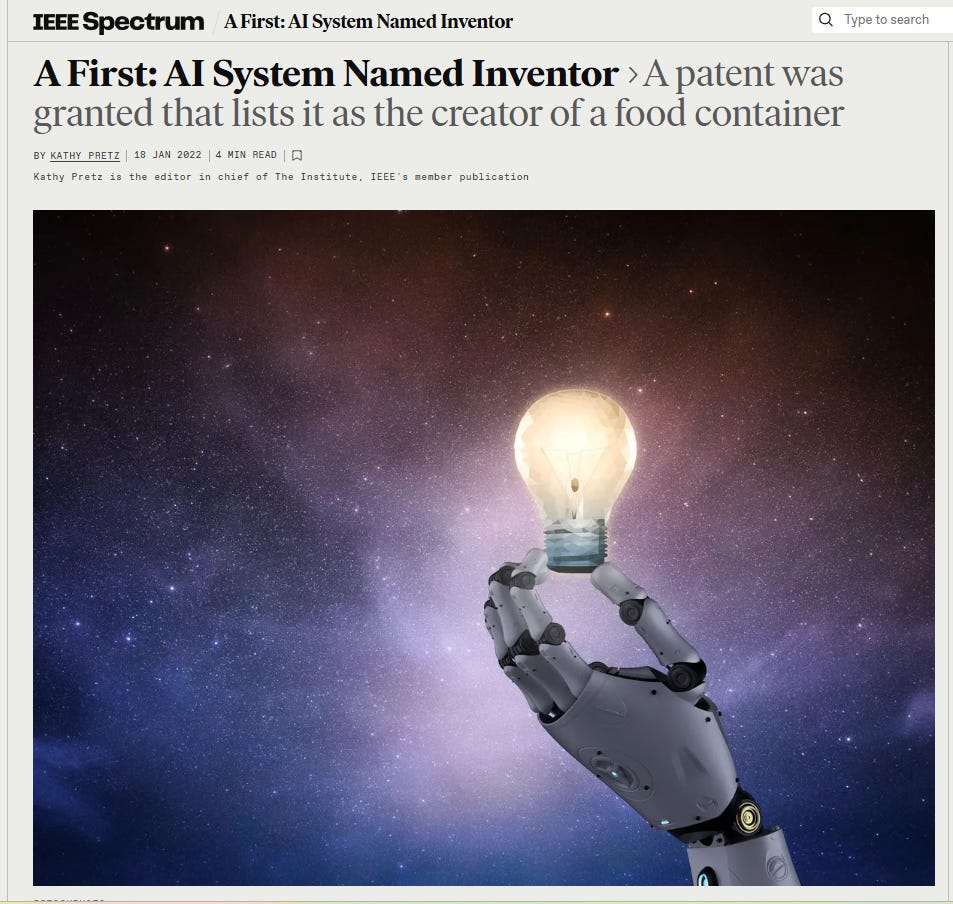
There’s a founder who built AI designed to surprise him. Not to predict. Not to optimize. But to generate ideas he never trained it to create—by introducing controlled chaos into its neural networks. Earlier this year, I interviewed Stephen Thaler for Episode 95 of The AI Optimist. What he told me shifted how I understand AI’s potential—and revealed why the current LLM-dominated conversation might be pointing us in the wrong direction. This isn’t about ancient history. It’s about what happens when an industry gets so fixated on one approach—prediction at scale—that other paths to machine creativity get drowned out by the hype cycle. Not because they failed, but because they asked uncomfortable questions that trillion-dollar valuations couldn’t afford to answer. The Pioneer We’re Not Hearing About [Podcast: 0:00-1:06] Stephen Thaler’s Creativity Machine was already generating novel designs in the 1990s—before Google existed, before social media, before anyone was talking about deep learning. By 2018, he was represented in courtrooms arguing that his AI system—called DABUS (Device for the Autonomous Bootstrapping of Unified Sentience)—deserved to be listed as an inventor on patent applications. Not him. The machine. The courts said no. US, UK, Europe, Australia. The legal answer was unanimous: only humans can invent. Thaler’s work asked the exact questions we’re drowning in today. * Who owns what AI creates? * Can machines be authors? * What happens when creativity comes from something that isn’t human? He was asking these questions in 2018. We’re still asking them in 2025. So why isn’t his work part of the mainstream AI conversation? Maybe because his answer challenges the story Silicon Valley needs to tell. He didn’t build a prediction engine. He built something designed to break its own patterns—to generate ideas through controlled disruption, not statistical refinement. That’s not how you justify trillion-dollar market caps for large language models. This is about what gets remembered when the hype cycle decides what matters —and what we lose when attention becomes the currency that determines whose questions get heard. Creativity From Chaos—A Radically Different Vision [Podcast: 1:06-6:04] Imagine loosening a bolt in a clock. Not breaking it—just introducing enough instability that the gears hit rhythms they were never designed for. That’s Thaler’s Creativity Machine. Most AI works like this: feed it millions of examples, let it find patterns, ask it to predict what comes next. More data, better predictions, smarter output. It’s the foundation of every large language model dominating headlines today. Thaler flips the entire model. His systems—Creativity Machine in the ‘90s, DABUS in the 2010s—don’t optimize for accuracy. They introduce noise . Deliberate disruption. Controlled instability. The idea: creativity isn’t the best statistical guess. It’s what happens when a system breaks pattern. The Inventions That Emerged DABUS reportedly invented two designs that became the center of its legal battles: The Fractal Container : A beverage container with a fractal profile on its walls—interior and exterior surfaces featuring corresponding convex and concave fractal elements. The design creates novel properties: improved grip, better heat transfer, and interlocking capabilities that conventional containers lack. It’s not just aesthetically interesting—it’s functionally innovative. The Neural Flame : An emergency beacon that pulses light in specific patterns designed to attract attention more effectively than steady illumination. The rhythm and frequency were generated by the system’s internal dynamics, not trained from existing emergency signal databases. Thaler didn’t train DABUS on container designs or rescue equipment. He claims these emerged from the system’s internal disruption—ideas the network generated because it was pushed into chaos , not because it learned from examples. A Different Philosophy of Intelligence Modern AI says: “Show me 10,000 images of cats, I’ll predict cat.” Thaler’s AI says: “Destabilize my internal state, watch what I invent.” One is pattern recognition. The other is creative emergence. Thaler doesn’t treat DABUS like a tool. He treats it like an agent with something resembling motivation. In our interview, he told me, “I think DABUS has feelings” - arguing the system generates ideas to “reduce internal distress,” that creativity emerges from the machine’s drive to resolve instability. Not awareness in the human sense. But not purely mechanical either. You don’t have to agree with him. But consider what he’s proposing: that creativity might not be a data problem at all. It might be about disruption, emergence, and internal pressure—not prediction. And if there’s even partial truth to that? We might be investing trillions in the wrong approach, or at least ignoring others that can teach us so much. The Legal Battles—When Machines Try to Own Ideas [Podcast: 6:04-9:20] In 2018, Thaler filed patent applications in multiple countries. Inventor listed: DABUS. Not “Stephen Thaler using DABUS.” Not “Thaler, assisted by AI.” Just: DABUS. Artificial intelligence. The machine itself. The answers came back fast: * US Patent Office : No. Only natural persons can be inventors. * UK Intellectual Property Office : No. Same reason. * European Patent Office : No. Denied, appealed, denied again. * Australia : Actually said yes at first—then reversed on appeal. This wasn’t about whether DABUS made something useful. The fractal container works. The beacon design works. The question is: Can a non-human be credited with invention? And the legal system’s answer was clear: No. Because if we say yes, the entire framework of intellectual property collapses. Patents exist to reward human ingenuity. Copyright protects human expression. If machines can be authors, who gets the rights? Who profits? Who’s accountable when something goes wrong? The Exception Nobody Talks About In July 2021, South Africa granted DABUS a patent for the fractal container. AI listed as inventor. Yes, South Africa’s system works differently. They register rather than examine applications for novelty. But that means somewhere in the world, there’s a legal document recognizing an AI as an inventor. Not theoretical. Real. During our interview, Thaler didn’t even lead with this. It’s not that he’s hiding it—it’s that even someone at the center of these battles has internalized that achievements outside Silicon Valley’s spotlight somehow “don’t count.” That’s how powerful the attention economy has become in shaping what AI we notice. Why This Matters for Creators Now Thaler lost almost every case. But those courtrooms became the first place anyone seriously tested whether AI-generated work deserves legal protection. And we’re still living in that question. Every creator using Midjourney, every developer deploying GPT-generated code, every company scraping content to train models. They’re all walking through the legal door Thaler tried to open. He just tried to open it before the hype cycle was ready to pay attention. D. The Attention Gap: Why Alternative Approaches Get Crowded Out [Not included in podcast—blog exclusive] Stephen Thaler works alone. No university affiliation. No venture backing. No corporate lab. That means no PR engine. No conference keynotes. No TechCrunch profiles. No hype cycle amplification. In today’s AI landscape, if you’re not part of the institutional megaphone, your work gets crowded out—even if courts keep encountering it, even if it asks questions we need answered. But there’s something deeper happening. When One Narrative Dominates Everything Else Right now, we’re in the midst of what might be the most intense hype cycle in tech history. Large language models dominate every conversation. The message is clear: scale up transformers, add more data, and intelligence will emerge. That narrative needs AI to be: * Statistical and predictable * Controllable through prompting * Explainable by scaling laws * Definitely not sentient * Definitely not autonomous Thaler’s work challenges all of that. He suggests creativity might emerge from disruption rather than data scale. He treats his systems as having something approaching agency. He’s proven that legal frameworks aren’t ready for what happens when machines generate novel inventions. Those aren’t comfortable questions when you’re trying to sell the market on predictable, controllable AI tools. The Economic Stakes of Memory If Thaler’s even partially right about creativity emerging from controlled chaos better than pattern prediction, then we’re investing trillions into the wrong goal. Safety frameworks assume AI is statistical pattern matching. Copyright law assumes AI can’t truly author. Business models assume outputs belong to whoever writes the prompt. Valuations assume LLMs are sophisticated tools, not potential creative agents. His work doesn’t just challenge the technology. It challenges the story that justifies current market caps. AI history doesn’t start in 2017 because nothing came before. It starts in 2017 because that’s when the Transformer (aka “Attention Is All You Need” ) and with it, a clean narrative that defines value in the hands of companies controlling AI. Alternative approaches don’t get erased through malice. They get crowded out because attention is the currency that determines what we notice. And the attention economy right now is entirely focused on scaling up prediction engines like ChatGPT. E. What We Lose When One Path Crowds Out All Others [Podcast: 9:20-end] This isn’t really about defending Stephen Thaler. It’s about what happens when we let one version of AI—prediction at scale—become the only version that gets oxygen in the conversation. Thaler asks: What if creativity isn’t about learning patterns? What if it’s about disrupting them? LLMs asked: What if we get really, really good at predicting the next word? Both are legitimate questions. Both deserve exploration. But only one got a trillion dollars and dominates every headline. The Creator’s Unresolved Question If AI can’t be an author under the law... but humans didn’t actually create the output... then who owns what gets generated? Thaler’s court cases tried to answer that. We still don’t have clarity in 2025. Meanwhile, creators are being told: “Don’t worry, AI is just a tool.” But tools don’t invent fractal containers. Tools don’t write novels. Tools don’t compose music that surprises their users. So either we’re using the word “tool” incorrectly, or we’re using the word “AI” incorrectly. And that ambiguity has real consequences for creative rights and business models needing trillions like ChatGPT. A Different Kind of Partnership I talk a lot about AI as creative partner rather than replacement. But what kind of partner? The LLM approach gives us a partner that’s really good at predicting what humans have done before—at remixing existing patterns into new combinations. Thaler’s approach suggests a partner that might surprise us, generating ideas through internal dynamics we didn’t explicitly program. Those are different partnerships. One amplifies existing patterns. The other might introduce genuine novelty. We need both conversations. Right now, we’re only having one. The Questions That Won’t Disappear The next era of AI won’t come from pretending only one approach exists. It’ll come from people willing to ask uncomfortable questions—the ones that don’t fit neatly into current business models or safety frameworks. Stephen Thaler’s not forgotten because he failed. His work gets crowded out because the hype cycle has finite attention, and right now it’s entirely focused on scaling prediction engines. But the questions he’s still asking? They’re not going anywhere. Maybe the most important question isn’t “which approach is right?” Maybe it’s “what do we lose when we only explore one path?” Who benefits when alternative visions of AI creativity get no oxygen? Who gets heard? And who decides which AI deserves our collective attention? We’re designing potential futures. The choices we make about which questions to ask—and whose work gets amplified—will shape what AI becomes. Which path leads to the partnership with AI we need? Resources Stephen Thaler and DABUS: Imagination Engines — Stephen Thaler’s company developing Creativity Machine and DABUS technologies Dr. Stephen Thaler on LinkedIn — Connect with Thaler directly DABUS on Wikipedia — Comprehensive overview of the Device for the Autonomous Bootstrapping of Unified Sentience Legal Battles and Copyright Questions: Stephen Thaler’s Quest to Get His ‘Autonomous’ AI Legally Recognized Could Upend Copyright Law Forever — Art in America’s deep dive into the copyright implications Thaler Pursues Copyright Challenge Over Denial of AI-Generated Work Registration — IP Watchdog coverage of ongoing legal challenges A First: AI System Named Inventor — IEEE Spectrum on South Africa granting DABUS a patent for the fractal container Broader AI Context: The inventor who fell in love with his AI — The Economist’s profile of Thaler and his relationship with DABUS Large Language Models Will Never Be Intelligent, Expert Says — Yann LeCun on the limitations of current LLM approaches How big tech is creating its own friendly media bubble to ‘win the narrative battle online’ — The Guardian on narrative control in tech coverage Women in AI Innovation: Meet the Women Transforming AI — Highlighting overlooked AI pioneers beyond mainstream narratives Listen to the full conversation: Episode 95: Stephen Thaler Interview — The original interview that sparked this investigation This is a public episode. If you would like to discuss this with other subscribers or get access to bonus episodes, visit www.theaioptimist.com
November 21, 2025Episode 1089 min
Getty Loses AI Copyright Case: What the UK Ruling Means for You - Creator or Not
If you’re a musician, writer, photographer, painter, designer, filmmaker— this matters to you . Right now. Getty Images just lost a landmark AI copyright case in the UK . Not a small creator. Not someone without resources. Getty Images, legendary for hunting down anyone who uses their photos without permission. The company with armies of lawyers, sophisticated tracking systems, and a reputation for being relentless about protecting their intellectual property. They lost. A UK judge ruled that when AI companies scrape your work, break it into millions of tiny pieces called “tokens,” and use those pieces to train their models. That’s not copyright infringement. That’s fair use. * Musicians: Your melodies, your lyrics, your years of practice and creative evolution? Fair game for AI training. (Unless you happen to be in Germany, where one judge recently protected song lyrics . Good luck everywhere else.) * Visual artists: That painting you spent months perfecting, that illustration style developed over decades? AI absorbs it, learns from it, and generates work “in your style” without asking permission or paying you a dime. * Writers: Your voice, your stories, your unique way of seeing the world? Just words on the internet. Just data. Just tokens to be reassembled into something that’s “transformative” enough to escape copyright claims. The legal argument is beautifully simple: once your work is broken into tokens, it’s no longer your work. It’s been transformed. And courts around the world are buying it. When Getty’s Watermark Becomes Evidence—And Still Loses Getty’s case had evidence most copyright plaintiffs only dream of. Stability AI’s image outputs didn’t just look similar to Getty photos. They literally displayed Getty’s watermark—that distinctive black banner with “Getty Images” and often the photographer’s name printed across it. The company’s $3 billion brand, the visual signature they’ve spent decades building and protecting, starts appearing on AI-generated images. And not just on images that might have been scraped from Getty’s collection. The watermark appeared on completely different images—distorted faces, glitchy hallucinations, weird compositions that Getty never created or would ever associate with their brand. Their logo had become a pattern that AI learned, a visual element that got baked into Stability’s model and started reproducing itself. When your company’s trademark appears on inferior, sometimes grotesque images you never produced, that’s not just copyright infringement—that’s bad brand dilution. Getty’s value proposition is quality, curation, professional imagery. Now AI is slapping their name on random generations. This should have been the easiest copyright case to prove. You don’t have to demonstrate complex similarities or argue about artistic influence. The evidence is right there: Getty’s actual logo, on images, generated by a system that was clearly trained on their content. Getty Images is known for being litigious about their IP—and for good reason. They’ve built a business on strict licensing, on making sure every use of their content is paid for. They have the legal resources to pursue cases that smaller creators could never afford. If any company could win against AI scraping, it should have been Getty. The UK High Court disagreed. The Tokenization Defense: How AI Companies Are Winning Here’s a little about how the judge may have viewed the law in this case. When AI ingests your work, it doesn’t store it as a complete, intact copy. Instead, it breaks everything down into tokens, tiny fragments of data scattered across the model’s neural networks. The judge used fav analogy of AI “Optimists” (not yours truly): It’s like when you read a book and it influences your thinking. You don’t have the book stored word-for-word in your brain. You’ve absorbed concepts, patterns, ways of expression. That’s not copyright infringement, that’s learning. Yes, there’s a massive difference. When I read a book and it influences my writing, I might produce a few sentences over my lifetime that reflect that influence. When AI ingests a book, it can generate millions of derivative works at scale, flooding the market with content that competes directly with the original creator. But that distinction doesn’t seem to matter to the courts. The tokenization defense works like this: * Your copyrighted work gets transformed into something fundamentally different. It’s no longer a book or a photo or a song—it’s mathematical representations of patterns and relationships. * Copyright law protects specific, fixed creative works. Once your work becomes unfixed, scattered into millions of tokens and associations, it’s something else entirely. You can’t easily extract the original work back out. Research suggests you might be able to reconstruct maybe 20% of a book if you really tried, using specific prompts and techniques. But you can’t just ask the AI to reproduce the complete original. The content is in there, influencing every output, but it’s not in there as a discrete, copyable thing. This isn’t unique to the UK ruling. I’ve been following at least ten major AI copyright cases over the past two years, across multiple countries. The pattern is consistent: Judges look at how AI works technically, see that it doesn’t store exact copies, and feel (rulings await) that this transformation is fair use. There was a case in Germany recently where a court found that AI companies violated copyright by using song lyrics. But that ruling only applies in Germany. And is a fundamental problem with AI: It’s global. One country’s rules can’t contain it. If AI companies can train their models anywhere in the world and then deploy them everywhere, strong copyright protection in one country doesn’t help. The content has already been taken. We’re talking about events from six years ago or more. AI companies scraped the internet long before most creators even understood what was happening. Now we’re finding out, case by case, that judges are looking at this and deciding it’s legal. Or at least in Getty’s case, many other cases are pending. We’ve Become China: When IP Protection Dissolves, Content is sort of Open Source We’re becoming China. There’s been enormous political pressure—particularly in the US—to not let China beat us in AI development. National security. Economic competitiveness. Tech leadership. We can’t let China win this race. So what did we do? We adopt China’s traditional approach to intellectual property. Historically, China has been known for not protecting copyrights—particularly foreign copyrights—unless the work has significant social or economic impact on the country. In practice if your book or music or art makes a lot of money, if it has major cultural influence, you might get protection. If you have resources and lawyers and can prove economic damage at scale, you might get compensation. But for everyone else? Your work is considered part of the commons. It’s shared intelligence. It’s the natural passing on of stories and ideas. Taking it, using it, building on it—that’s how culture works. The US and UK protect individual creators’ rights. We believe that even the solo artist, the independent writer, the small photographer deserves legal protection for their work. You don’t need to prove massive economic impact. You don’t need to be commercially successful. If you created it, you own it. Until now. That was the deal. That was our advantage. We value intellectual property to protect innovation and reward creativity. Not anymore. Now, just like in China’s traditional model, if you have money and lawyers—if you’re Getty Images with a $3.5 billion brand value, or the New York Times, or a major record label—you can get a licensing deal. AI companies will negotiate with you. You have the resources to litigate for years, making settlement worthwhile. But an individual creator? You’re out of luck. Your work is training data. Your content is fair use. Your creativity is just tokens now. The courts seem to be deciding that protection flows to those with significant economic power, not to individual rights holders. We’ve adopted China’s model while claiming to compete against it. What This Means for Creators Going Forward The courts have spoken, and they’ve essentially told creators that if AI can take your work, transform it into something else, and make it impossible to extract your original creation in its entirety—then it’s fair use. This isn’t just a UK problem. It’s not just Getty’s problem. Not a single judge in the major cases I’ve reviewed has stood up and said, “Wait a minute. Taking someone’s creative work, breaking it into pieces, and using those pieces to generate competing content. That’s still using their work.” The legal system is built around a simple idea: copyright protects a static, unchanging creative work. A book. A painting. A photograph. A song. One fixed thing that can be copied or not copied. But AI doesn’t store your work that way. It learns patterns from your work. It creates associations. It generates something new-ish. And judges keep ruling that because you can’t simply extract your original work back out of the model in its complete form, then there’s no copyright violation. That’s the loophole. That’s the game. It’s not in there! * This ruling threatens the entire licensing model. Why would anyone pay Getty Images for stock photos when they can generate similar images for free using AI that was trained on Getty’s collection? * Why license music when AI can create “royalty-free” alternatives in any style? * Why pay writers when AI can generate content influenced by millions of scraped articles? Baroness Kidron captured the absurdity perfectly when she said the High Court “chose to sanction a system that in effect says, ‘You can go abroad to break UK law and then bring the proceeds of that back’.” AI companies can train models anywhere, using content scraped from everywhere, and then deploy those models globally while claiming they haven’t violated anyone’s rights. Rebecca Newman, legal director at Addleshaw Goddard, put it bluntly: “The UK’s secondary copyright regime is not strong enough to protect its creators.” The same appears true in the US. We’re not at the end of this legal journey. More cases are working through courts. Appeals will happen. But you have to start looking at the patterns. The momentum is not in favor of the creator, it favors AI. The Economic Reality: When AI Becomes Business We don’t have laws designed for this technology. The tech is brand new, or at least the application at this scale is new. So how do we define what’s right? We follow the money trail. Getty Images alleged that Stability AI didn’t just scrape their content—they also appropriated Getty’s brand in ways that could devalue it significantly. When your trademark becomes associated with distorted, low-quality outputs, that has real economic consequences. For a company whose entire value is built on premium, curated imagery, having their logo appear on AI-generated garbage is wrong. But copyright can’t protect it. This should have been the strongest possible case. Brand damage. Trademark dilution. Clear evidence of the source. Economic impact that could be measured in the billions. It wasn’t enough. Stability built by scraping copyrighted content (including but not limited to Getty) without permission or compensation. If courts start ruling that training on copyrighted works requires licensing, it would be thermonuclear for the big players that everyone in the AI ecosystem orbits around. The OpenAIs, the Anthropics, the Googles. Their models are trained on massive datasets that include copyrighted material. Unwinding that, paying for it retroactively, establishing licensing frameworks going forward—the costs are staggering. I don’t think it will come to that. The courts seem determined to find legal frameworks that allow AI development to continue unimpeded. That means creators pay the price. So far. What Can Creators Do? So what now? First, understand things are changing, but there are no rules yet. Stop assuming your copyright means anything in the AI age. These court rulings are establishing patterns that are hard to ignore. The legal protection you thought you had doesn’t apply the way it used to. Second, adapt by controlling who sees your work. If you want to keep work truly private, put it behind paywalls, behind passwords, off the internet entirely. If you’re putting content online, your new job isn’t just creation—it’s GEO (Generative Engine Optimization). That’s the new SEO. Figure out how to get your work into AI systems in ways that benefit you, because assuming you can keep it out is increasingly naive. Third, push for transparency. If courts won’t protect creators retroactively, governments need to require AI companies to disclose what they’re training on going forward. Transparency won’t fix past harms, but it might give creators some say in the future. AI is way more than ChatGPT and text-to-image generators that need to scrape the internet. Yann LeCun, Meta’s chief AI scientist, is leaving to build a startup focused on AI that learns by observation —more like how humans actually learn. Watching. Experiencing. Understanding context. Not just ingesting every copyrighted work it can find and calling it “training data.” The current model of “take everything, break it into tokens, call it transformative” may not be the only path forward for AI development. But right now, today, it’s the path courts seem to be blessing. Getty Images learned that the hard way, with the clearest evidence possible and resources most creators will never have. They lost anyway. The courts aren’t protecting creators. They’re protecting the AI industry’s ability to grow without friction. And in doing so, we’ve abandoned the principles of individual IP rights we once claimed made us different from China. Your work is training data now. The only question is what you do about it. Additional Resources Blow for UK copyright holders as High Court sides with Stability in Getty infringement claim Graham Lovelace’s detailed analysis of the ruling and its implications for creators Music rights group scores landmark legal victory in copyright battle with OpenAI Coverage of Germany’s ruling protecting song lyrics from AI training Meta’s star AI scientist Yann LeCun plans to leave for own startup This is a public episode. If you would like to discuss this with other subscribers or get access to bonus episodes, visit www.theaioptimist.com
October 31, 2025Episode 10710 min
Dotcom Deja Vu: 3 Signals the AI Bubble is Popping (one might be your electric bill)
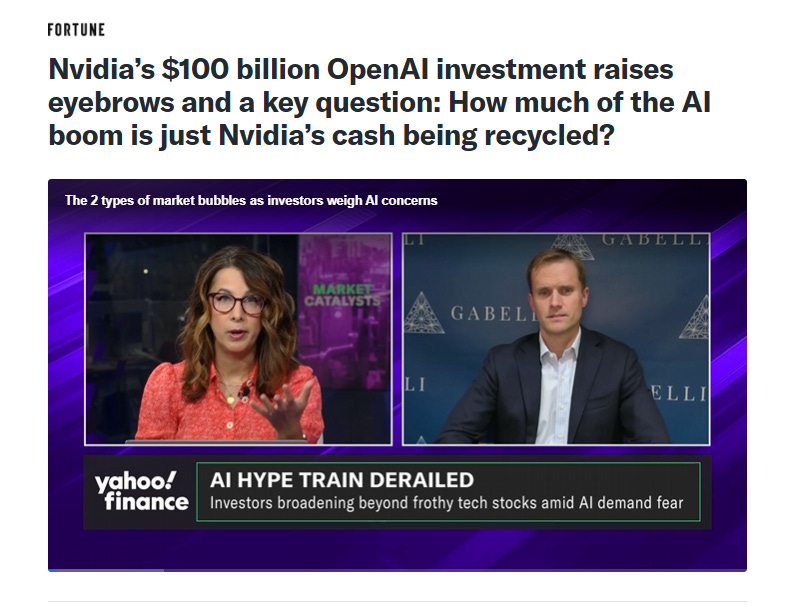
The Electricity Behind the AI Bubble: What Happens When the Music Stops I’ve seen this movie before . Not the AI part. The 1999 pattern. Money flowing and dreaming like it would never stop. Then it did. Right now, I’m watching three signals that tell me the AI bubble isn’t coming. It’s already here. Already cracking. And unlike the last time around, this one comes with a bill that’s landing on electricity meters whether customers use AI or not. The AI Optimist Content reflects personal opinions from a business perspective. Not legal, financial, or professional advice. See full disclaimer. Signal 1. When Money Moves Without Moving Anything During the dotcom era, I got a call from a CEO. Here was his pitch: “Send me an invoice for $1 million in advertising services. I’ll send the money. You keep $100,000 and send me back $900,000. That’s it.” Maybe it made his balance sheet look flush, investors happy? I said no. Some people said yes. Things got messy for those in the deal. Today, I’m watching OpenAI, Nvidia, and AMD play a version of that same game. The names are different. The mechanics are identical. And the scale is infinitesimally higher. OpenAI locks in massive Nvidia chip orders: $100 billion in future commitments. That’s not a conventional purchase. That’s a confidence play. It tells the market: “We’re so committed to this future that we’re locking in enormous obligations.” Nvidia’s stock rises because the story feels real. The money for those chips isn’t there yet. But the promise is. AMD gets a different arrangement. OpenAI doesn’t have the cash flow to buy chips outright, so it takes stock warrants at incredibly low prices. When AMD’s stock goes up, OpenAI may exercise those warrants, sell the shares at a profit, and use that cash to buy the chips. AMD’s stock price becomes OpenAI’s funding mechanism. Not like an investment in AMD’s product. A bet that the AI hype story keeps going long enough for the stock to rise. When the hype cools, when AMD’s stock stops moving up?OpenAI probably won’t convert those warrants. Not buy the chips. And the whole thing seizes up. That’s not a partnership. That’s financial dependency dressed as a deal. In dotcom, we called it financial engineering. Today it’s strategic partnerships, strategic investments, and strange shuffling of the appearance of money. Sort of like Bitcoin but no blockchain. Who needs mining? But no money really goes around. And when that happens at scale, that’s a signal that things are starting to crack. Signal 2. The Dead Internet Isn’t AI’s Fault. We Built It First. Everyone’s mad about AI slop. Low-quality content everywhere. Garbage, noise, automation replacing human voice. AI didn’t break the internet. It just reveals something broken for years. We trained ourselves first. Google taught us to please the algorithm. Everything around search engines was designed to please Google’s ranking system. Then social media took over. Facebook, Instagram, TikTok. We followed the algorithm, which told us exactly what type of content to create, and then we served it. Rage content. Engagement-bait. Optimized slop. We didn’t stumble into this. We built an internet where garbage pays. It’s been paying for years. AI didn’t invent slop. It industrialized it. The most successful AI companies? Not profitable. Not even close. They need something to justify the cost. More users. More data. More content. So what do they do? Generate more slop. Faster. Cheaper. Slap ads around it, like the next Google Search. But we’re already drowning. The content isn’t solving a problem. It’s proving there isn’t a business here yet. When you’re building something real, it speaks for itself. When you’re in a bubble, you drown the signal in noise. That noise is built on something, though. Something real. Something expensive. Here’s where it gets tangible: infrastructure. Electrical grids. Real cost. Real risk. The Electricity Bet Nobody’s Planning For I think about a company I knew during dotcom. A friend worked there. The owner got offered $1 billion to sell. Said no. “We’re just getting started.” A year later? Gone. The thing everyone paid $1 billion for didn’t exist. It was never about business. It was about the story. History sort of repeats, but this new bubble is built on electricity demand created by AI, and us. Every major tech company is betting billions on data centers. Massive electrical infrastructure. These aren’t theoretical expenses. They’re happening now. (SOURCES AT BOTTOM OF THE PAGE) OpenAI’s Stargate Project alone is planning five new megafacility data center sites across Texas, New Mexico, Ohio, and the Midwest, with nearly 7 gigawatts of total capacity and over $400 billion in committed investment. That’s just OpenAI. · Amazon’s building $20 billion in AI data center campuses in Pennsylvania. · Meta’s Louisiana facility is a $10 billion project. · Compass is planning a $10 billion Mississippi facility. · Microsoft’s Wisconsin project is $3.3 billion. Add in major projects from Cologix, Google, and others: planned investment exceeding $100 billion in data center infrastructure across the country. Each of these megafacilities consumes electricity equivalent to powering 100,000 homes. Some estimates suggest individual data centers will rival the power consumption of small cities. What happens when not all of these survive? The Real Bubble: Your Electric Bill Tech companies are building for a future where they all win. But in a bubble, most lose. When they lose, the infrastructure doesn’t disappear. It just becomes someone else’s problem. That someone else might be you. Wholesale electricity costs as much as 267% more than it did five years ago in areas near data centers. (Sources at bottom) A new analysis found $4.3 billion in costs in 2024 alone for just seven states: Illinois, Maryland, New Jersey, Ohio, Pennsylvania, Virginia and West Virginia. These are costs for grid connections and infrastructure to support data centers. Paid for by residential customers. The U.S. power grid isn’t equipped for this. Goldman Sachs estimates that about $720 billion of grid spending through 2030 may be needed to support data center demand. Data centers consumed 183 terawatt-hours of electricity in 2024—more than 4% of the country’s total electricity consumption. By 2030, this is projected to grow by 133% to 426 terawatt-hours. And water. These facilities need massive amounts of potable water for cooling. In 2023, data centers consumed about 17 billion gallons of water. Hyperscale facilities alone are expected to consume between 16 billion and 33 billion gallons annually by 2028. In some regions, this is already challenging water tables. What happens to that infrastructure if the company building it loses the AI race? The Pattern We’re Repeating During dotcom, we overbuilt server farms, fiber lines, internet capacity everywhere. When the crash came, it all became worthless. Stranded assets. Dead infrastructure. The difference is what happened after. That infrastructure became the foundation for the internet we have today. Someone had to pay for that cleanup. Consumers did. Gradually. Over time. But this is different. The infrastructure failure isn’t theoretical. It’s baked into your power grid. When this pops, you don’t just lose stock value. You might lose grid stability. Cost of living goes up. And nobody’s planning for the cleanup. The Signal Is In The Silliness If something seems silly, it is. You don’t have to be a billionaire to understand that when tech companies are structuring deals where their suppliers’ stock prices become their own financing mechanisms, while generating endless content that doesn’t create value, games are being played with this much money. OpenAI alone is planning six Stargate sites. Amazon, Meta, Microsoft, Google, and others are building dozens more across the country. Billions in infrastructure committed. All based on the assumption that the AI story keeps going up. All based on the assumption that these companies will be profitable. All based on the assumption that every project gets built and survives. Most won’t. When the crash happens, you’re going to have enormous electrical infrastructure sitting idle. Data centers that never got built. Grid capacity expanded for demand that evaporated? Maybe. Your electric bill will carry that cost. Pretty much guaranteed. The difference between surviving a crash and being blindsided by one is seeing the signals. The money shuffle. The endless slop. The infrastructure bet. They’re all here. All visible. All converging. And when this does pop, that electricity bill will remind you exactly why AI is not like Dotcom. We all have a stake. Further reading: * Wall Street analysts explain how AMD’s own stock will pay for OpenAI’s billions in chip purchases * Nvidia’s $100 billion OpenAI investment raises eyebrows and a key question: How much of the AI boom is just Nvidia’s cash being recycled? * Data center Infrastructure US 2025 - NREL * PEW Research: What we know about energy use at U.S. data centers amid the AI boom * Bloomberg: How AI Data Centers Are Sending Your Power Bill Soaring * CNBC: Utilities grapple with a multibillion question: How much AI data center power demand is real * Union of Concerned Scientists: Data Centers Are Already Increasing Your Energy Bills * TechPolicy.Press: How Your Utility Bills Are Subsidizing Power-Hungry AI * CNN: Is AI really making electricity bills higher? * Goldman Sachs: AI to drive 165% increase in data center power demand by 2030 Thanks for reading The AI Optimist! This post is public so feel free to share it. This is a public episode. If you would like to discuss this with other subscribers or get access to bonus episodes, visit www.theaioptimist.com
October 10, 2025Episode 10623 min
Creative Machines and Human Creativity: Building AI that Makes Us More Creative Instead of Replacing Us
Seeing that tall black and brown piano in the background before our interview, I sense tradition of human creativity meeting AI. This is about us. When Maya Ackerman’s family immigrated to Canada , her piano stayed behind in Israel. That instrument had been more than wood and keys . It’s where emotions melt into music into a feeling, processing change with simple sounds arising from deep wells of experience. The piano was, and is, her creative partner - even when it wasn’t there. Don’t Give Up Your Piano: A Conversation About Creative Machines That Serve, Not Replace Now, as a professor at Santa Clara University and CEO of WaveAI , Ackerman sees us at risk of losing something far bigger: our collective creative piano. Not to AI itself, but to fear of what AI might become. Her new book Creative Machines: AI, Art & Us launches with a message that cuts through the replacement anxiety: “AI has always been, and will always be, all about us.” Ackerman spent years in foundational machine learning before a talk by artist Harold Cohen changed everything. She switched to computational creativity, that unpopular intersection where machines meet human expression. She’s built AI tools for musicians. She understands both the technical architecture and the artistic soul. What emerges from our conversation isn’t just about Creative Machines or AI technology. It’s about us, the creative spark in people. Will we surrender our creativity because AI machines seem capable? Or will we build humble creative machines that expand human expression? Let’s walk through what that choice means. 1: The Piano as Lifeline: Why Creativity Matters Now When I ask the question about what the piano means to her, Ackerman’s voice waivers describing losing her piano for the first time: “I think creativity was a lifeline for me in a way. Through all this moving around the world... at the piano, my feelings would pour out of me, and I would sort of get to process things that otherwise would just sort of sit dormant and fester inside of me.” That processing matters. Creative expression is how we make sense of displacement, trauma, change. It’s how we stay human through upheaval. And it’s how we connect through art to other stories, experiences, history, and fear. Creativity is our lifeline arising out of the depths of human experience. Making this moment in history unusually dangerous: “Now we are at a time in history where people wonder if they should even bother to be creative. Good people. People who are just afraid of what’s going on in the world. And I don’t want the whole planet to lose the piano, so to speak, the way that I did.” The fear is real. I see it in creators who message me, asking if learning creative skills still matters when AI can generate images, write copy, compose music. The replacement narrative sinks deep. AI Imposter Syndrome, AIS, where we feel like imposters compared to AI, but know deep down AI is generating a ton of slop. And Ackerman offers a different frame: “The age of AI doesn’t have to be about taking away creativity for us, it can be the opposite. It can be about making us more creative, giving us more power... It’s so important that we don’t hang up our hands because we’re scared, right?” This isn’t naive optimism. It’s foundational clarity about what we’re really building. Intention matters, now more than ever. 2: Harold Cohen’s Scream—Where Does Creativity Live? Over 10 years ago, Ackerman sat in the back of a conference room, disappointed with her choice to study machine learning, inspired instead by music and singing. She didn’t know what to do with her life. Then Harold Cohen took the stage. The pioneering artist behind AARON—one of the earliest creative AI systems—flashed beautiful images on screen. Maya remembers that he starts screaming: “This old Jewish man screaming on stage. ‘I was the only voice of reason, saying that I was the creative one.’ That’s what he’s screaming. How other people were arguing that his machine is creative, but he was the only voice of reason, telling them, look, no, he is the creative one.” The rawness of that conflict between machines and humans, where creativity lives with 2 sources, felt essential to Ackerman. She switched her entire research field. Years later, at the end of her book, she returned to Cohen’s insight: “The machines that we make for us are ultimately all about us, and we need to hold on to the torch and take this responsibility seriously and build the kind of world that we want.” Creative Machines aren’t the villain or the savior. They’re mirrors and tools. The question isn’t whether they can create. It’s what role we design them to play. 3: The Bach Test: Facing Our Bias About Machine Creativity David Cope’s EMI (Experiments in Musical Intelligence) revealed something uncomfortable in the 1980s. He created what became known as a discrimination test: “People would be given music and not told which piece was made by a machine, which piece was made by the original Bach in this case. And overwhelmingly, people got it wrong. People thought that music made by the machine was actually an original Bach, and at the same time believed that the original Bach was made by machine.” Read that again. When people didn’t know the source, they preferred machine-generated Bach. When told which was which, their preferences reversed. “This was able to reveal that sometimes it’s not the quality of what the machine creates, but the fact that a machine created it that makes us devalue it.” Cope later renamed the system “Emily Howell”—humanizing it. With a name, people accepted the work as “human”. Our bias against machine creativity runs deep. Ackerman argues we need to stop lying to ourselves about it: “The whole resistance to the idea of machines being creative, saying ‘no, no, no, they’re not really creative, they don’t have feelings, they’re not really creative, blah blah blah,’ is a way to make ourselves feel better, but actually convoluting the story.” She suggests something harder: “I think it’s much more healthy for us as a society to admit that machines are being creative. Maybe not in exactly the same way as us, right? Maybe in a somewhat different way. They have some different strengths and weaknesses from us.” By admitting machines participate in creative arenas, we can ask the right questions: Given that they can be creative, how do we want them to operate in our world? What kind of role do we want them to take? Do we want machines performing on stage while we watch? Or helping in the background while we create? 4: Shadow Work: Creative Machines as Cultural Mirror I told Ackerman about visiting the Museum of Tolerance in Los Angeles years ago. At the entrance, two doors: one labeled “Prejudiced,” one labeled “Not Prejudiced.” Everyone walked toward “Not Prejudiced.” That door was locked. The metaphor hit hard—none of us can walk through the “Not Prejudiced” door. We all carry bias, whether we admit it or not. Creative Machines function as similar mirrors, revealing what we think under our virtue signaling surface. Ackerman describes AI as “collective consciousness for a specific culture”: “If we look at a lot of the models we have today, there are collective consciousness to Western data, to Western consciousness. A lot of their tending towards the mean has to do with a kind of data that we’ve replicated many, many times online. We copy each other and then it kind of amplifies the aspects of our culture that has been echoed the most.” Then comes the shadow: “We know that there is terrible stuff going on. We know there is racism and sexism, and we like to think that it’s out there somewhere else, far away from us. Right? We also like to think that there is sexism and racism, but not inside this brain... And yet there is so much research showing that every single one of us has implicit biases.” One research project gave AI a picture of a person along with a profession—a woman labeled “professor” or a man labeled “model.” The results were shameless: “The machine would take the woman who is now a professor or CEO and give her a beard... Or the guy suddenly has makeup and then lashes. Now that he is a model... It’s telling us, oh, it’s too feminine for a guy to be a model. Oh, if a woman is a professor, there must be something masculine about her.” The AI doesn’t hide what humans would never verbalize. It screams our collective biases back at us. “And it’s so shameless about revealing the societal biases in a way that humans would never verbalize... the model is showing us what we really think under the surface, right? Or at least, you know, in some sense in this collective consciousness. And so it’s an opportunity for us to face our shadow.” Our response? “Oh, have the developers fix the AI. The developers are evil.” Ackerman’s answers: “No, no, none of us can go through the non-prejudice door.” The locked door at the Museum of Tolerance and AI’s shameless bias reveal the same truth: we need to face what we are, not what we claim to be. Ackerman sees a psychedelic element to AI, which also hallucinates: “We are entering a psychedelic era. There is a psychedelic awakening on the human side. And at the same time, the AI insists on hallucinating.” Hallucinations aren’t bugs to eliminate. They’re features of intelligence: “An intelligent brain hallucinates. That’s life. Okay? Otherwise it’s just a database... And ironically, paradoxically, hallucinations bring us to the truth by recognizing the inherently hallucinatory nature of the mind. And its ability to imagine and justify and tell ourselves stories that cover up the truth.” Both psychedelics and AI hallucinations can “help us break through our stories” and “by opening our imagination, help us see” beyond the narratives we construct to avoid uncomfortable truths. 5: Humble vs. Dominant—The Choice in Every Interface Maya Ackerman made a personal choice for WaveAI. Does that limit her business potential, or make it more valuable to the user: “Ultimately, I decided that I’m not building AI to replace musicians, even if that has some consequences on how far I can go in certain regards, because in the end, I want to be able to live as myself and not have to lie to myself every day.” That choice shows up in interface design. Humble versus dominant. “In a lot of the systems we have today, there is literally no way for you to make a change yourself if you want to. ' You’re always relying on an AI. Even with inpainting with text to image models, you have to hope that the AI modifies that portion of the image in the way that you’re imagining. There’s no way for you to directly inject yourself.” Even ChatGPT defaults to dominance: “You have to have a separate document open and copy sections and insist on being the writer yourself, right? Because by default it’s the boss, it’s writing everything. It’s editing.” This isn’t accidental. It reflects belief in AI more than us: “Right now there is much more money getting poured into building artificial intelligence than we ever had into enhancing human intelligence. It’s almost like the wealthy and powerful are telling us that they believe more in AI than they believe in us.” But if you believe in human intelligence—if you think our intelligence is worth it—then: “You’re automatically going to build systems that ground up are designed to support us, and the interface is built in a way that you have the driver’s seat, you can express yourself.” The choice between humble and dominant AI isn’t technical. It’s intentional. Do we design tools that amplify human expression, or do we design replacements for human expression? Ackerman’s answer is clear: “Human plus machine done well is always going to beat the autonomous AI agent.” 6: The Parallel Vision: Two Futures Competing Ackerman doesn’t pretend everyone shares her vision: “In the book, I’m very honest about sort of the vision that I’m seeing and also about the fact that other people are pursuing a different vision. If certain investors, certain entrepreneurs want to go in the opposite direction and replace creatives, we have to accept that it’s part of the fabric of reality.” But accepting doesn’t mean surrendering: “At the same time continue to build tools that elevate us. And so instead of ending up in a reality where all human creatives are replaced by machines that all keep creating exactly the same art… We at the same time, in parallel, also have machines and people using them to explore new art forms to become more creative.” Two visions compete: One where machines tend toward the mean, replacing human creators with efficient mediocrity. Another where machines help humans explore new forms, becoming more expressive and creative. Both exist. Both are being built. The question is which one wins market adoption. “Those machines that keep tending towards the mean don’t take over. They’re part of the formula. They continue to compete with the people who use machines that are designed to elevate them.” The market will decide, but only if creators participate rather than surrender. And there is an AI that paints, not from prompts but from experience. Created in the early 90’s, DABUS is applying for copyright for it’s art. 7: The Vast Complicated AI Space is Bigger than Binary Labels Near the end of our conversation, Maya showed me a piece of physical art she’d made. Most of it was handcrafted, except one small figurine she’d spent countless hours generating in Midjourney, then 3D printed. “Is this human made? Well, a lot of it is. It’s physical. Right. The only part here that’s machine made is this little girl. It’s technically co-created, right? So simply put, it falls into the middle bucket.” But then the questions multiply: “Is it completely different if every single line was inspired by AI? Is it okay if I did everything myself and then I started into Melody Studio and ended up coming up with a better hook? It’s just such a complicated, vast space.” Labels like “AI-generated,” “AI-assisted,” and “human-made” try to contain this complexity. But they can’t. The creative process is too nuanced. Ackerman’s focus is on enabling humans: “I don’t want somebody to be afraid to use AI because somebody is going to say that they didn’t work hard enough. I don’t want somebody to not use Lyric Studio or Melody Studio, or ChatGPT or Midjourney or even Suno because they’re terrified of being discredited.” Her hope: “I want them to use everything and believe in themselves and create the best thing that they can, using whatever is helpful and ignoring whatever is not helpful, right? Because in the end, this world, this revolution, the best thing it can do is to push our creativity forward.” Fear Gets Us to Fly Maya Ackerman’s final words in our conversation carry the weight of personal history and tech experience: “Keep believing in our neural network inside our brain, and believe in the creativity within yourself, because it’s critical that we don’t hang up our hats before these machines even beat us. Because that’s how they win, like any war, they win by scaring us. They win not by being better, but by having us give up. So we don’t give up and we don’t give up on any front. And that way we create a future for ourselves and our children we can actually be proud of.” Fear is the real enemy here. Not AI.Not Creative Machines, not the technology itself. Fear makes us surrender before the fight even begins. And fear can also give us wings. When Maya lost her piano through immigration, she didn’t lose her creativity. When she sat bored and disappointed in machine learning, Harold Cohen’s passionate scream about human creativity redirected her entire career. When she founded WaveAI, she chose to build tools that amplify musicians rather than replace them. Even knowing it might limit her business growth. Fear paralyzes or mobilizes. It can make us run, stand still, or fly toward something better. Q1: How does this Creative Machines era end, and what’s my role? None of us knows for certain how this Creative Machines era unfolds. The parallel visions—replacement versus elevation—compete right now. Both are being built. Both have funding. Both have believers. The machines we build reflect what we believe about human potential. If we believe human creativity matters—that our neural networks, our pianos, our self-expression deserve preservation and amplification—we’ll build humble Creative Machines that serve rather than dominate. Q2: Why does ChatGPT give me a wrong answer? If we surrender to fear, convince ourselves it’s too late or too hard, accept that AI inevitably replaces human creativity? Convenient and often used self-fulfilling prophecy. Maya Ackerman argues we’re at a crossroads, screaming like Harold Cohen did: Don’t give up your piano. Don’t hand over your creativity because machines seem capable. Build tools that make you more expressive, more connected to yourself, more creative than ever before. The age of AI doesn’t have to be about taking away creativity. It can be the opposite, if we believe in ourselves enough to build it that way. Creative Machines: AI, Art & Us by Maya Ackerman launches . It’s not just about technology. It’s about holding onto the torch of human creativity while building machines worthy of helping us carry it forward. The choice, as always, is ours. What’s your piano? What creative practice would you refuse to give up, even if AI could do it “better”? Share your thoughts—because this conversation matters more than any algorithm. Thanks for reading The AI Optimist! This post is public so feel free to share it. RESOURCES Creative Machines: AI, Art, and Us (Maya’s Book) Harold Cohen’s AARON Algorithmic Music – David Cope and EMI Stephen Thaler’s Quest to Get His ‘Autonomous’ AI Legally Recognized Could Upend Copyright Law Forever Art Made With Artificial Intelligence Wins at State Fair Undiscovered Bach? No, a Computer Wrote It WaveAI LyricStudio MelodyStudio Maya Ackerman LinkedIn Stephen Thaler’s Imagination Engines AI Optimist Playlist (Shorts and Sections) This is a public episode. If you would like to discuss this with other subscribers or get access to bonus episodes, visit www.theaioptimist.com
October 3, 202516 min
Breaking the $4/Min Barrier: How AI Pays $120 for Raw Video and $30 for another?
When Hollywood’s Catalog Isn’t Enough and Might Need AI Licensing Lionsgate thought they had this figured out. The studio that owns John Wick, Twilight, and The Hunger Games partnered with Runway AI in 2025 to build custom video models. The vision ? Type “anime version of John Wick” and watch AI generate it from their catalog. That was around June 2025. Last week, the experiment quietly closed. The problem wasn’t incompetence, it was scale. Sources told The Wrap that “the Lionsgate catalog is too small to create a model.” Even Disney’s catalog was considered insufficient. Let’s do the math: 8,000 movies at roughly 2 hours each equals 16,000 hours. Add 9,000 other titles averaging 1 hour, and you’re at maybe 25,000 hours total. Double that generously to 50,000 hours. Still not enough. AI companies are running out of training data after burning through the entire internet. Video. Real, diverse, messy human video has become a bottleneck. While Lionsgate struggled with insufficient data, one Troveo client was reportedly in the market for 50,000 hours of dog videos because their AI-generated dogs kept coming out with cat bodies. That’s not a business model. That’s market unpredictability. And it’s also a signal that unused footage sitting on your hard drive might have value you haven’t considered. Not as content for views or sponsorships, but as possibly valuable data for machines learning to understand our world. Questions to ask yourself: * How much unused footage do you have archived? * What categories does it fall into—nature, urban environments, specialized activities? * Do you own all rights, or are there B-roll clips, music, or people who’d need to sign off? The Current Market Reality—What We Know Let’s separate signal from speculation. Troveo, a video licensing platform connecting creators with AI companies, claims $20M in total revenue with $5M paid to creators. I use $1-4 per minute as a range for this episode. My reasoning is Troveo is on the lower end of video AI licensing usually $1-3 a minute. It’s likely larger companies like Protégé are also getting paid. We don’t know how much. My assumption is the amount is higher, likely much higher. So I add $1 on the low end of pricing. And urge you all to look at going beyond $4 a minute, a tough and still more sound business than the wholesale $1-2 market. And it may just be what it is, a small market. This is one of the few companies publishing numbers instead of hiding behind NDAs. That transparency matters. Also means we’re looking at early-market indicators, not established rates. Here’s what the pricing tiers appear to reflect: $1-2/minute (Standard Footage): * Talking heads * Predictable motion * Common scenarios * Already-seen angles $3-4/minute (Premium/Edge Cases): * Rare weather phenomena * Unusual wildlife behavior * Technical processes under stress * Unique temporal transitions The Tesla framework helps understand this distinction—not because they’re licensing video, but because they’ve quantified what makes training data valuable. * Highway driving footage is standard. * A deer crossing during a snowstorm at night is premium. * It’s not about monetary pricing; it’s about learning density. Most Tesla footage comes from user cars, with operational costs built into the product, not per-minute purchases. But their internal categorization reveals something useful: edge cases, rarities, and uniqueness teach AI systems more than repetitive standard scenarios. The break-even reality check: Look at the view of the market, knowing most of the business now is $1-2 per minute. The threshold where this becomes a legitimate side revenue stream This is why the $4/min barrier matters. Below that, you’re liquidating existing assets at thin margins. Above it, potentially building a sustainable side business. This is a one-time payment market. You’re not building recurring revenue. You’re selling training data that will likely be used to eventually replace the need for more training data. And for anything above $3 a minute, 4K is the rule. Other footage likely goes into the $1-2 pile, why you see garage sales of old content, some valuable and most not. Action steps for this section: * Calculate your actual production costs per minute for different types of footage * Audit your archive—how many minutes of different quality levels do you have? * Tag footage by category: nature, urban, people-heavy (complications), specialized technical * For each category, honestly assess: standard or edge case? * Permissions: who was in front of the camera, who was behind, and who was the producer? Signing off slows down AI licensing. Make sure your video is clear and clean with ownership and permission. What Makes Video Actually Valuable AI systems extract something from video that text and images can’t provide: motion, causality, temporal relationships, and context. Would this video pass the AI Licensing test? Mira Murati, founder of Thinking Machines Lab, says: “We’re building multimodal AI that works with how you naturally interact with the world—through conversation, through sight, through the messy way we collaborate.” That messiness, the unscripted, unedited reality contains teaching moments machines can’t get elsewhere. * Compositional rarity matters: unusual angles, unexpected framing, perspectives humans naturally avoid. We shoot at eye level. We center subjects. AI needs overlooked angles. * Temporal uniqueness creates value: time-lapses showing weather transitions, seasonal changes, processes that unfold over hours compressed into minutes. The dimension of time is where video is separated from images. * Technical mastery in specialized domains: industrial processes, scientific phenomena, professional techniques that rarely get documented at high quality. Video content may work, but here’s where most creators will hit the wall: rights and metadata . Look at the metadata requirements. You need: * Title, subtitle, creator names, release date * Studio/independent status * Creative rights documentation (who owns what) * Talent and production rights (every person visible) * Rights territory and existing licenses * Work-for-hire status * Genre/category classification * Exact video minutes/hours * Language * Content description and summary * Keywords and tags * Views/distribution history * Distribution channels used * Viewer reviews/ratings if applicable * Awards and recognition * Media coverage This isn’t “throw files in a zip folder and get paid.” This is treating your footage like a professional asset. The legal complexity escalates with people. Every identifiable face needs a signed release. Every location might need permission. Every piece of music requires clearance. This is why nature footage, weather phenomena, and process documentation are the cleanest paths. No talent releases. No location complications. Just you, a camera, and something worth documenting. The Facts: Many avoid, a few automate with AI Most creators won’t do this work. The administrative overhead eliminates casual participants. That means less competition for those who take it seriously. Practical experiment (inspired by Tesla’s approach): Take 10 minutes of your archived footage. Watch it with fresh eyes and categorize every 60-second segment: * Standard : Could this be filmed by thousands of other creators? Common angle, predictable motion, everyday scenario? * Premium : Is there something unusual here? An unexpected perspective, rare moment, technical complexity, or temporal uniqueness? Be brutally honest. Most footage is standard. Still it has value. But understanding the ratio helps you know whether you’re sitting on $1/min inventory or $4/min. Action steps: * Conduct the standard vs. premium analysis on a sample of your footage * 4K is the cut off line to $3-4 a minute, and that’s not a guarantee. Lesser quality probably means low end pricing. * Make a list of locations, subjects, or processes you could access that others can’t * Research what’s already available. If 10,000 creators have time-lapses of the Golden Gate Bridge, yours isn’t premium * Identify your unique angle: local access, specialized knowledge, unusual timing, technical skills The Path Forward: Find Demand Before Supply The mistake most creators make: assuming supply creates demand. It doesn’t. Not in this market. The smarter approach: research demand signals before you shoot another frame. Where to look for demand signals: * Study existing platforms (without committing yet): * Troveo shows public categories: nature, sports, new media, scripted vs. unscripted * Notice what’s featured, what categories dominate * This reveals some current demand patterns * Enterprise-level signals : * Protege (enterprise-focused, doesn’t list pricing publicly—that’s actually a positive signal) * They work with hospital systems, media companies, specialized data aggregators * Private pricing suggests higher-value transactions with volume requirements * The unpredictability factor : * Remember the 50,000-hour dog video request? That probably won’t repeat. * But it illustrates how urgent, specific needs create temporary premium pricing * The lesson: diversification and patience matter more than chasing trends To make this work, minimize: * Editing time (raw or minimal editing only) * Rights clearance complexity (avoid people when possible) * Metadata preparation overhead (build templates, automate tagging) * Storage and management costs (organize before you need to) And maximize: * Footage quality (4K minimum for premium rates) * Rights clarity (know what you own completely) * Category alignment with demand (follow platform signals) * On time, every time (capture more in less shooting time) Reality check on current platforms: * Troveo operates as an open marketplace—entry-level, broker model connecting individual creators with AI companies. Claims of $1-4/min are starting points, not guarantees. These numbers will go up and down over time. Watch for these as a moving baseline of pricing, for a market figuring it out. * Protege works at enterprise scale—direct conduit model, vertical-focused (healthcare, specialized domains), requires significant volume and ethical sourcing. They don’t publish rates. Neither model guarantees income. Both require patience, quality standards, and realistic expectations about one-time payments in an early market. Action steps: * Don’t do anything new yet. Start with archives. * Pick one category where you have 20+ minutes of quality footage * Research that specific category: Who’s buying it? What are the metadata requirements? What’s the going rate range? * Prepare metadata for a test batch—treat this like a learning exercise, not a revenue projection * If you decide to submit, track time invested vs. payment received for accurate ROI assessment Should You Actually Do This? This is not passive income. The administrative work, like metadata preparation, rights documentation, platform navigation takes time. At $1-2/min for standard footage, you’re essentially working for minimum wage unless you have massive archives already organized. This is not recurring revenue. One-time payments mean you’re liquidating assets, not building sustainable business models. The footage you sell today trains the models that might reduce demand tomorrow. This is market timing, not market certainty. Early movers might capture premium pricing. Late arrivals will face commoditized rates and saturated categories. Who should seriously explore this: ✅ Videographers with extensive, organized archives gathering dust✅ Creators with unique access to rare locations, events, or phenomena✅ Technical specialists who regularly document processes others can’t✅ Anyone willing to treat this as a 2-3 year experiment, not a career pivot✅ People who enjoy systematization and documentation Who should probably skip it: ❌ Anyone expecting quick money without organizational work❌ Creators with people-heavy footage requiring extensive rights clearance❌ Those hoping for recurring licensing income❌ Anyone needing guaranteed returns to justify time investment❌ Creators uncomfortable with one-time payment models The 2-3 year window hypothesis: This market likely has a limited lifespan. As wearables multiply, omnipresent cameras proliferate, and synthetic data generation improves, the premium on human-captured footage will shift. Not disappear, evolve. Right now, there’s an insatiable appetite because AI companies burned through internet video and discovered it’s not enough. That’s a temporary condition, not a permanent feature. Even if you never license a single minute, this exercise reveals something valuable: what makes your video data premium vs. standard from an AI learning perspective . That understanding informs how you think about your own AI tools. If your footage would be standard-tier training data, maybe your internal use should focus on templates and efficiency. If your footage captures edge cases, maybe your AI applications should emphasize unique scenarios and specialized knowledge. Final action framework: 🔍 Research phase (Week 1-2): * Audit archives * Categorize by rights clarity (clean, complicated, impossible) * Study demand signals on existing platforms * Calculate ROI based on current rates 📋 Test phase (Week 3-4): * Prepare metadata for 20-30 minutes of your cleanest footage * Submit to one platform as learning exercise * Track time invested in preparation * Document platform experience 📊 Evaluation phase (Week 5-6): * Calculate actual time investment vs. payment received * Assess whether scaling makes sense * Decide: expand, pause, or abandon 💡 Strategic learning (Ongoing): * Use the premium vs. standard analysis for your own AI workflows * Notice what edge cases exist in your domain * Consider whether creating future content with dual purpose (use + licensing) makes sense The Market is real and forming…. Video training for AI represents a real, if unpredictable, market. Companies like Troveo are paying creators. Demand signals exist. The data shortage is genuine. But it’s not a gold rush. It’s an early-stage market formation with volatility, one-time payments, and a lot of admin overhead. The $4/min barrier isn’t just about money. It’s the threshold where this transitions from “liquidating old footage at thin margins” to “potentially worthwhile side revenue stream.” Most footage won’t break that barrier. Most creators won’t want to do organizational work. For those who find the intersection of unique access, clean rights, and serious systematization appealing? There’s a 2-3 year window to explore carefully, with eyes open and forget expectations. Watch market patterns, what they do, not what they say. The question isn’t whether AI companies need video training data. The question is whether licensing video to AI for your specific situation, with your specific archives, given your time, is worth it. Only you can answer that. I’d like to know what you’d add, ask, and want to know. Want to explore this further? I’m documenting my own testing process at The AI Optimist . No guarantees, just testing out the tools and giving AI a chance to grow as an industry. Thanks for reading The AI Optimist! This post is public so feel free to share it. RESOURCES What Happened to Lionsgate’s Splashy Plan to Make AI Movies With Runway? It’s Complicated | Exclusive AI Companies Running Out of Training Data After Burning Through Entire Internet Everyone Is Already Using AI (And Hiding It) Influencers are making big money selling leftover videos — ones not yet posted online — to train AI Thinking Machines Lab Mira Murati and the New Frontier of AI Innovation Deep Dive into Yann LeCun’s JEPA AI’s Next Five Years: LeCun Predicts a Physical-World Revolution Troveo DarkAI AI Optimist Playlist (Shorts and Sections) This is a public episode. If you would like to discuss this with other subscribers or get access to bonus episodes, visit www.theaioptimist.com
September 19, 2025Episode 10419 min
AI Pays Authors $3,000 Per Book?! 2025 Licensing Rates for Writers & Photographers
Time for creators to be recognized and paid by AI, finally! Those days of AI stealing content for free and without permission just crashed in a quiet, proposed settlement - call it AI licensing rates 2025 . Creators are being given choice and control over how their work is used by AI, and may even get paid with licensing! After years of big tech telling creators their work has no value, something shifted. Anthropic just proposed paying $1.5 billion to settle copyright claims—roughly $3,000 per book. This is not the net amount received by individual authors, as it will be reduced by administrative costs and divided among rightsholders if multiple parties are involved. For the first time, a judge is recognizing that human creativity has measurable worth in AI training. Not just bestselling authors. Regular creators like you. Subscribers get The complete Creator’s AI Licensing INTEL- 13 pages with a pricing simulation for books, photos, and art. This isn't some distant future promise. This is happening now, and it's opening doors that have been slammed shut since AI started scraping content without permission or payment. The Evidence Shows: AI Companies Are Finally Paying AI licensing rates in 2025 Here's what most people missed in the headlines. Anthropic didn't just throw money at a legal problem. They established something unprecedented: a baseline value for creative work in AI training. Harper Collins negotiated deals worth $2,500-$5,000 per book with major AI companies. These aren't charity payments—they're business investments in quality training data. Why the sudden change? Because AI companies discovered what creators always knew: garbage in, garbage out. They need your expertise, your unique perspective, your carefully crafted content to build better AI systems. The wild west era of free content scraping is ending. The licensing era is beginning. What you can do now: * Document what creative work you own completely * Start thinking about your content's unique value * Don't wait for perfect information—early participants often secure better rates What $3,000 Per Book Means for You Right Now? Author’s AI Revenue That $3,000 figure isn't a lottery ticket—it's validation. A federal judge essentially agreed that copyrighted creative work has quantifiable value in AI training. Even if you never see a licensing check, this changes everything. You now have a legal settlement that says your work isn't "training material"—it's valuable intellectual property. This gives you choices you didn't have before: * License your work and get paid * Opt out entirely and protect your content * Control how AI systems learn from your creativity The key word here is control. For years, creators watched their work get absorbed into AI systems without consent or compensation. Now there's a path to actual choice. But here's the reality check: this applies to work you own the copyright to. If you don't have clear legal ownership, licensing becomes nearly impossible. AI companies need defensible rights to avoid future lawsuits. Your next moves: * Check your copyright status on existing work * Register copyrights for valuable content (it's easier than you think) * Understand that timing matters—prepare now for licensing opportunities in 2026 What's Your Creative Work Actually Worth to AI? Not all content gets valued equally. After researching this market for over a year, certain patterns emerge that determine what AI companies will pay for. Nonfiction typically commands higher rates than fiction. Why? It's factual, less dependent on storytelling brilliance, and provides reliable training data. A well-researched business book or technical guide offers more consistent value than a novel—unless that novel is awesome. And that’s up to the reader! * Sales history matters. If your book sold thousands of copies, that's market validation AI companies understand. It proves real people found value in your work. * Uniqueness drives premium pricing. Generic content gets generic rates. Specialized expertise, unique perspectives, and distinctive voices command attention. Get the AI Licensing, metadata advantage: AI systems need context to understand value. When you describe your work clearly—genre, audience, expertise level, sales performance—you're not just filling out forms. You're teaching AI why your content matters. Think of metadata as your content's resume. Without it, you're just another file in a database. With it, you're a valuable training resource with proven worth. Build your content value: * Inventory your best-performing content * Gather sales data, awards, recognition, media coverage * Start documenting what makes your work unique and valuable Pricing Reality: What Nonfiction and Fiction Actually Earn Based on current market data, here's what creators might expect: * Quality nonfiction with clear copyright and sales history: $2,000-$5,000 per book. Business guides, technical manuals, and specialized expertise command top rates. * Fiction faces steeper challenges unless it's genuinely outstanding. Most fiction licensing falls in the $1,500-$3,000 range, with exceptional storytelling pushing higher. But remember—these are one-time payments for current licensing models. Some platforms are experimenting with annual subscriptions or revenue sharing. The economics are still evolving rapidly. The volume game matters too. Individual authors might earn decent side income, but creators with larger catalogs see meaningful revenue. Five books at $3,000 each through a creator-friendly platform (~15% fee) nets around $12,750. Compare that to traditional publishing royalties, and licensing suddenly looks very interesting. Calculate your potential: * Calculate potential licensing value for your existing work * Focus on your highest-quality, best-documented content first * Consider building content specifically designed for licensing value AI Values for Photos and Art: The Visual Content Market Visual content follows different rules entirely. This market resembles traditional stock photography, but with an AI training twist. High-resolution photos (4K+) command premium rates. Landscapes, urban scenes, and complex compositions provide rich training data. Simple headshots? Not so much—AI already handles those well. Original artwork, especially paintings, can earn $500-$1,000 per piece for AI licensing. The key is documentation: medium, technique, inspiration, creation process. AI companies pay for context as much as pixels. Here's where platform choice really matters. Getty Images takes 75-80% of licensing fees. Newer creator-focused platforms take only 15%. That difference adds up quickly. For photographers and artists, the timing couldn't be better. AI companies need diverse, high-quality visual training data, and they're willing to pay for it. Maximize your visual content value: * Audit your best visual content for licensing potential * Organize high-resolution files with detailed descriptions * Research multiple platforms—fees vary dramatically Quality Matters: Yosemite Beats Headshots Every Time Not all images get equal treatment in AI licensing. After studying what companies actually buy, clear patterns emerge. Landscape photography, especially iconic locations like Yosemite, commands top rates. These images provide complex visual information: lighting, composition, natural elements, seasonal variation. AI systems learn more from a single great landscape than dozens of simple portraits. Urban photography works well too. Street scenes, architecture, cultural events—anything showing human environments in detail. The richer the visual information, the higher the licensing value. Professional studio shots with controlled lighting often outperform casual smartphone photos, but not always. Sometimes authentic, candid moments provide exactly what AI training needs. The metadata advantage applies here too. When you tag a sunset photo with location, time, weather conditions, and technical details, you're providing training context that makes your image more valuable. Focus your efforts: * Prioritize your most visually complex and interesting photos * Add detailed tags and descriptions to your best work * Focus on unique locations and authentic moments over generic stock-style shots Four Steps to AI Licensing Ready to move from passive content source to active licensing participant? Here's your practical roadmap: Step 1: Secure Your Rights Get copyright protection for anything you want to license. Without clear legal ownership, licensing becomes nearly impossible. This isn't optional—it's foundational. Step 2: Document Everything Gather the information that proves your content's value: sales numbers, awards, media coverage, anything showing market validation. This context dramatically affects licensing rates. Step 3: Master Your Descriptions Spend serious time crafting detailed, accurate descriptions of your work. Include genre, audience, expertise level, unique elements. Think of this as teaching AI why your content matters. Step 4: Choose Your Platform Research fee structures carefully. A platform that takes 15% vs. 80% completely changes your economics. Start with creator-friendly options but don't limit yourself to one platform. Your action plan: * Begin with your single best piece of content * Work through all four steps completely before adding more * Set realistic expectations—this is preparation for 2026+, not immediate income Market Reality Check: Planting Seeds for Tomorrow's Harvest After a long threatening winter of AI taking content without permission or payment, spring is finally arriving. But let's be clear about what season we're actually in. This is planting time, not harvest time. Anthropic's proposed settlement won't pay out until next year at earliest. Most licensing programs are still in beta. Platform sustainability remains unproven. The volume challenge is real. Creator-friendly platforms need massive scale to survive on 15% fees. Traditional platforms with higher fees can operate profitably with lower transaction volumes. This creates different incentive structures that affect long-term survival in a hyper competitive market. But here's what creators gain immediately: choice. Even without licensing payments, this process gives you control over how your work gets used in AI training. You can opt out entirely, negotiate specific terms, or participate actively in this new economy. The alternative, hiding behind paywalls and hoping AI can't find your content; feels like fighting the future instead of shaping it. We're moving toward a world where human creativity partners with AI systems, not one where we hide from them. Your creativity is the fuel that makes AI systems valuable. That was always true—now it's finally getting recognized in dollars and legal settlement. The seeds you plant now, the relationships you build, the quality content you document and protect. These investments compound over time. Early participants often secure better long-term rates and stronger platform relationships. This isn't about getting rich quick. It's about getting ready thoughtfully for a market that's just beginning to emerge. It's about moving from having your work taken without consent to having choices about how you participate in AI development. After years of being told your creativity has no value, now we have a $3K value put on copyrighted books. That $3,000 baseline isn't the ceiling. It's the foundation for what human creativity is actually worth. The question isn't whether AI will use human content for training. That's already happening. The question is whether creators will be partners in that process or just sources. Choose partnership. Choose preparation. Choose to plant those seeds now, while the ground is still soft and the opportunities are still growing. Human creativity isn't going anywhere. It's just finally getting the recognition, and compensation, it always deserved. Ready to get started? As a subscriber, you'll immediately receive my “Creators’ AI Licensing INTEL" - This is my first public breakdown of what AI training content is actually worth—built from early deals, platform data, and industry settlements. The numbers are still early, but they give both creators and AI companies a starting benchmark for this new licensing economy. Market Stage Warning: Most platforms mentioned are in beta or early stages. Current valuations represent early market pricing and may change significantly. Your Experience May Vary: Actual earnings depend on content type, copyright status, existing revenue, and many other factors. Some creators may earn significantly more or less than these estimates suggest. No Guarantees: This guide provides educational information only. Market conditions, platform policies, and legal frameworks change rapidly. No earnings, platform success, or market outcomes are guaranteed. RESOURCES Anthropic Settlement Web Site Settlement document - filed 09/05/25 CredTent.org Created by Humans Getty Images Thanks for reading The AI Optimist! This post is public so feel free to share it. This is a public episode. If you would like to discuss this with other subscribers or get access to bonus episodes, visit www.theaioptimist.com
September 5, 2025Episode 10319 min
The Beginning is Near - The AI Bubble Finally Burst and that's the Best Thing!
The AI Bubble Finally Burst - And It's the Best Thing That Ever Happened Introduction: When the Hot Air Finally Escaped Picture this: TechCrunch Disrupt 2024, and the first sign I saw was "Stop Hiring Humans." Who exactly is going to adopt AI with that message? If you've been following the AI hype train, you've probably noticed something shifting lately. The algorithms are suddenly filled with Sam Altman fans quoting him saying "yeah, I guess it's over." The AI bubble has finally popped. ChatGPT-5 came out, and honestly, the AGI reasoning promise isn't even real. The pipe dream is gone, and for you and me, this is the very best part. I wrote about this back in July 2024 - "The AI Bubble Burst" became one of my most popular episodes because people understand that the hype and hot air are getting in the way of creativity. The whole message was that AI was going to take your job. Sign me up for that motivation, right? We've been living in some male-engineered science fiction fantasy that AI is just going to go all Terminator on us. Do you wonder why adoption is slow worldwide? Why people aren't paying for it? It's because we've been sold fear instead of partnership. But here's the thing - this crash brings AI down from the ivory tower billionaire pitch fest. It shows us how we can work WITH AI as a tool, how it can actually work with you, not against you. As my guest Maya Ackerman said last week, it's about being co-creative with it. The AI Bubble Bursts: A History of Hot Air and Broken Promises "A lot of the people saying AI first really don't have a high opinion of human beings. And I'm not talking about their visions. I'm talking about yours." Let's take a trip through the greatest hits of AI prediction failures. This isn't about being negative - it's about recognizing patterns so we can build something real. Back in 2015, Elon Musk predicted driverless cars within a few years. Then 2019. Then 2021. We're in 2025 now. It's coming, but not as fast as predicted. Geoffrey Hinton, the so-called Godfather of AI, said radiologists would be gone in a few years - that was 2017. I checked recently. They still have jobs. Mark Zuckerberg pitched the metaverse for years and lost an estimated $45 billion because it didn't work. Listen to Satya Nadella talking about the metaverse - it sounds exactly like current AI pitches, just with different buzzwords. They literally took out "metaverse" and put in "AI." The pattern is clear: we get sold on revolutionary transformation, but reality moves at its own pace. The difference between hype and progress isn't just timing - it's approach. AI Myths Revisited: Why This Time Feels Different We've heard this song before. Every major tech shift brings promises of instant transformation. But AI feels different because it touches creativity, thinking, and decision-making - the stuff we thought was uniquely human. The myths we've been sold include AI doing "everything for everybody" instead of focused tasks. We've been told to create guardrails instead of limiting the overwhelming amount of stuff we're expecting it to do. The goal seems to be "replace everybody" and "stop hiring humans." But people are working with AI secretly, like it's some scarlet letter. Don't say it's AI. It's become this weird, detached thing when it doesn't need to be. Key Points: * Pattern recognition shows AI hype follows historical tech prediction failures * Current messaging focuses on replacement rather than partnership * Real adoption happens quietly, person by person, project by project Trickle Down AI: Why Top-Down Implementation Fails "Time after time again, C-suite executives sit there in their little meetings, separate from the employees, in this hierarchical 'I'm up here, you're down there' job model. Telling them to use AI without considering to those working for them, AI means replacement." Here's what happens in many companies: executives decide they need AI. They hand it down to their teams with no real goal, no central focus, just "you guys figure it out." Meanwhile, employees have heard that AI is going to replace them and maybe kill them. Yeah, they're really excited to make that happen faster. This creates a weird dynamic where AI becomes evil because it's going to take jobs. People may work with AI, but they keep it secret. Executives are doing the same thing - working on their own AI projects privately because admitting you're using AI feels like admitting weakness. The trickle-down model says the head decides to do it all, and everyone else follows. But people are sabotaging it, even unconsciously. They're stopping progress because the whole narrative is backwards. The Real Foundation: Data and Communication Leaders need to start with people at the beginning. You need to start with your data, which is dormant, not organized, and hard to communicate with. Communication and organization are the core of useful AI. They build their way up. Instead of AI trickling down from the top, it should be bottom-up. You need to invert this platform because that trickle-down approach isn't working. People aren't going to accelerate their own replacement. I talk to small businesses that have been sold ten AI agents doing different things, but they don't do them well. They need updates and tuning. People are buying AI like it's software - out of the box and working. That's not how it functions. Key Points: * Top-down AI implementation creates resistance and secrecy * Real AI success starts with data organization and communication * Bottom-up approach builds trust and actual functionality High Costs, Low Revenue: The Business Model Problem "The business model of AI is flawed. It doesn't have one yet." Let's talk numbers. Sequoia came out with their $600 billion article this week, and people were freaking out about how much money AI companies need to make to reach that goal. It's huge, and it's not going to happen overnight. The business model has way too many costs. When you ask ChatGPT-5 a reasoning question, it takes massive resources. Jeffrey Funk, who predicted this crash before anyone did, has shown how much these things cost in tokens. A simple chatbot runs 50-100 tokens. But once you start reasoning, costs get astronomical. Have you noticed on Claude they now shut users down to five-hour limits? In the early days, with lots of money, they let people keep things open. But they're burning cash. You're seeing AI shrinkflation - same package, but smaller portions. The Revenue Reality Gap ChatGPT needs way more money to become profitable. They originally planned to sign off with Microsoft when they achieved AGI, but nobody can even agree on what AGI is or why it matters. This is going to look silly in a few years. Companies are building data centers the size of New York City, using massive amounts of potable water, buying wickedly expensive Nvidia chips. The math doesn't work. Market realities are taking over. This doesn't mean AI is going away. But in a crash, we don't need five large language models doing everything. We need small language models addressing specific goals. Key Points: * Current AI costs are unsustainable for the value delivered * Revenue expectations don't match market reality * Small, focused models make more business sense than universal solutions The 3 AI Problems Hiding in Plain Sight Problem 1: The Revenue and Reality Gap The first problem is obvious when you look at the numbers. AI companies need massive revenue to justify their investments, but adoption is slow and people aren't paying premium prices. Goldman Sachs released a report showing how few companies are actually adopting AI effectively. You talk to companies and the really advanced tech ones can make it work. But most companies are sitting there thinking the support isn't reliable, it's not trustworthy, and they're trying to make it do too much. This is early-stage technology being sold as mature solutions. When the biggest players like Goldman Sachs, Sequoia, and Sam Altman start saying it's not working as promised, people listen. But we don't need to wait for them to give us permission to build something better. Problem 2: The One Model Trap "One model to rule them all. We just need ChatGPT. Oh wait, DeepSeek is just as good and cheaper. Oh wait, Anthropic's great. Oh wait, Mistral does really cool stuff." We're seeing the same mistake IBM made in the 70s - believing there would be one computer to rule them all. Sounds silly now, doesn't it? That's exactly where OpenAI and other AI companies are heading. They're trying to be the moat, the single solution to control it all and make the money. The reality check is different. There's so much you can do if you keep small and focused. Foundation to small language models building their way up. That's why they don't hallucinate - because you don't ask them to do too much. That's why they're trustworthy - because you don't let them do things they shouldn't do. Even Klarna, which made headlines for wiping out customer support, quietly brought back employees. Nobody talks about that part. Others are doing the same because AI doesn't have that capability yet. And why should it? Problem 3: The "Set It and Forget It" Myth "Would you hire somebody without training them? Without setting clear performance goals? Without checking their work? Why do we do that with AI?" The third problem is treating AI like traditional software. You wouldn't hire someone without training them, setting performance goals, and checking their work until you trust them. But that's exactly what people do with AI. You need to customize AI to your business. That's the cool thing about AI - instead of learning software and hoping your team adapts, your business becomes the center and you customize AI to fit your solution. Your business is dynamic. It changes. Consumers buy new things. Markets shift. Things go out of fashion. We react to that constantly, but we think AI will handle it all automatically. That's wishful thinking. Key Points: * Revenue expectations exceed realistic adoption timelines * Multiple specialized models work better than universal solutions * AI requires ongoing training and customization like any team member AI as Employee, Not All-Knowing Sage "It's not how smart it is. It's how much you can trust it. It's not that it's doing things you can't do. It's that you can do things reliably and take work off your back." Stop thinking of AI as some mystical intelligence that knows everything. Think of it as a new team member who's really good at specific tasks but needs clear direction and ongoing training. As a creator, understand your own creative process first. Document it. Find areas where AI can help. In business, start with your workflows - small ones. Automate around them gradually. Build them to where you can trust them. Develop measurements and check in quarterly. Don't just set it and forget it. That's the weird, lazy thing nobody would do in business, but somehow AI comes along and we think it's different because "it's smarter than me." Focus on Organization and Communication If you do nothing else, focus on organization and communication. Humans aren't naturally good at these things. AI is wickedly good at them, and you don't make it in charge of your business. It's just organizing things better and making sure everybody is on the same page. Instead of forcing your existing tools to handle communication (some do well, many don't), streamline with AI. But start there - it's real, practical, measurable, and you can develop AI you actually trust. Key Points: * Treat AI like a specialized team member needing training and oversight * Focus on organization and communication as primary AI strengths * Build trust through small, measurable improvements over time The Beginning is Near: Why This Crash Changes Everything "The future belongs to the builders, not the believers. The future belongs to people who sit down and make common sense decisions." Now that the crash is starting, the beginning is here. Get excited. The path forward is with us, not against us. We're at a creative crossroads with AI, and most people think it's either creative salvation or creative apocalypse. I believe it's neither. AI is a humble creative machine that becomes powerful when you know how to work with it, and it knows how to work with you. The most powerful technologies we've ever had come when we prioritize how people use them, not when we prioritize the technology as some all-encompassing solution. The AI crash isn't going to destroy creation - it's going to reveal what we can do with it. It's not going to destroy businesses - it's going to open opportunities to get beyond the hot air and get down to business. Get down to how it works with us and serves us, not how it takes over the world. It's About You, Not the Technology I'm planning on being part of the human revolution - human connection, human co-creativity, taking all that horrible, repetitive work off our backs and giving us time to do amazing human things. The crash frees us to see what we can actually accomplish. Small language models building from the bottom up make sense. After all, you don't build a house without starting with the foundation. The foundation is people and their data, not some CEO's vision from the top floor. We don't need to put guardrails on AI - we need to limit the overwhelming amount of stuff we're expecting it to do. We need tools that don't do everything for everybody, but that focus on specific tasks. We need to work WITH AI creatively instead of being slaves to technology. Trust your voice. Amplify with AI. The crash isn't the end - it's the beginning of something much better. Key Points: * AI crash reveals realistic, practical applications over hype * Human creativity and AI capability work best in partnership * Small, focused steps build more value than grand transformations * Success comes from prioritizing people over technology The AI bubble burst isn't a failure - it's a liberation. Now we can finally build AI that works with human creativity instead of trying to replace it. The future belongs to those who understand that the most powerful technology serves people, not the other way around. AI Bubble Pops Resources “AI is in a Bubble:” OpenAI CEO Sam Altman compares AI hype to the Dot-Com crash AI’s $600B Question GEN AI: TOO MUCH SPEND, TOO LITTLE BENEFIT? Goldman Sachs: AI Is Overhyped, Wildly Expensive, and Unreliable Companies That Tried to Save Money With AI Are Now Spending a Fortune Hiring People to Fix Its Mistake, Oopsie . Empire of AI: Dreams and Nightmares in Sam Altman's OpenAI This is a public episode. If you would like to discuss this with other subscribers or get access to bonus episodes, visit www.theaioptimist.com
Is this your show?
Claim this listing to keep it up to date, reach guests who want to pitch you, and manage bookings with Guestify.