Find partners
TeleGeography Explains the Internet

TeleGeography Explains the Internet

Hosted by TeleGeography

Episodes

100

Latest episode

Jun 2026

Language

EN

About the show

Explore the global business of connectivity with TeleGeography’s Greg Bryan.

Listen to episodes

60 recent
June 11, 2026Episode 3451 min

Network Monitoring for the AI Era | TG Explains AI

The TeleGeography Explains the Internet podcast welcomes Jezzibell Gilmore, General Manager, Service Provider at Kentik. She discusses the profound impact of artificial intelligence on global network infrastructure, and how networks are evolving to handle new technological demands. Key topics covered: The Strain of AI workloads: The explosion of AI and GPU-heavy tasks is exposing the criticality of physical network infrastructure by demanding higher capacity, strict reliability, and ultra-low latency. The rise of network intelligence: As global networks become increasingly complex, the industry is shifting from passive monitoring to "network intelligence," which uses AI to synthesize massive amounts of data and provide actionable insights for operators. Shifting economic dynamics: The traditional expectation of constantly decreasing telecom prices is being upended, as the high demand and limited supply for AI-capable network capacity are actually driving prices up. Physical limitations and the future: Overcoming unchangeable physical constraints—like the speed of light and the distance to new power generation sites—requires extreme network optimization, ultimately pointing toward a future goal of fully autonomous, self-healing networks. Podcast HQ: https://www2.telegeography.com/telegeography-explains-the-internet-podcast TeleGeography Resources: https://resources.telegeography.com/ Our Research: https://www2.telegeography.com/en/our-research

May 28, 2026Episode 3347 min

Can Data Centers Keep Up With AI Demand? | TG Explains AI

Host Greg Bryan welcomes Phill Lawson-Shanks, Chief Innovation Officer at Aligned Data Centers. With several decades of experience in digital infrastructure, Phill has seen the industry evolve from mainframes and green screens to the massive hyperscale cloud platforms we rely on today. In this episode, we explore: The Shift in Data Center Geography: Why the "center of gravity" for networks is moving toward new power-rich zones and how the rise of AI is rewriting the rules of connectivity. The Engineering Challenges of AI: From floor loading for 6,000-pound racks to the transition from air to liquid cooling, Phill explains the "fungible" design needed for modern AI factories. The Infrastructure Bottleneck: Why AI is ultimately a network-dependent technology and how high-speed optical networking between buildings is pushing against the limits of physics. Sustainability and Power: How the industry is chasing power availability and pioneering new ways to build modular, carbon-traceable infrastructure. Podcast HQ: https://www2.telegeography.com/telegeography-explains-the-internet-podcast TeleGeography Resources: https://resources.telegeography.com/ Our Research: https://www2.telegeography.com/en/our-research

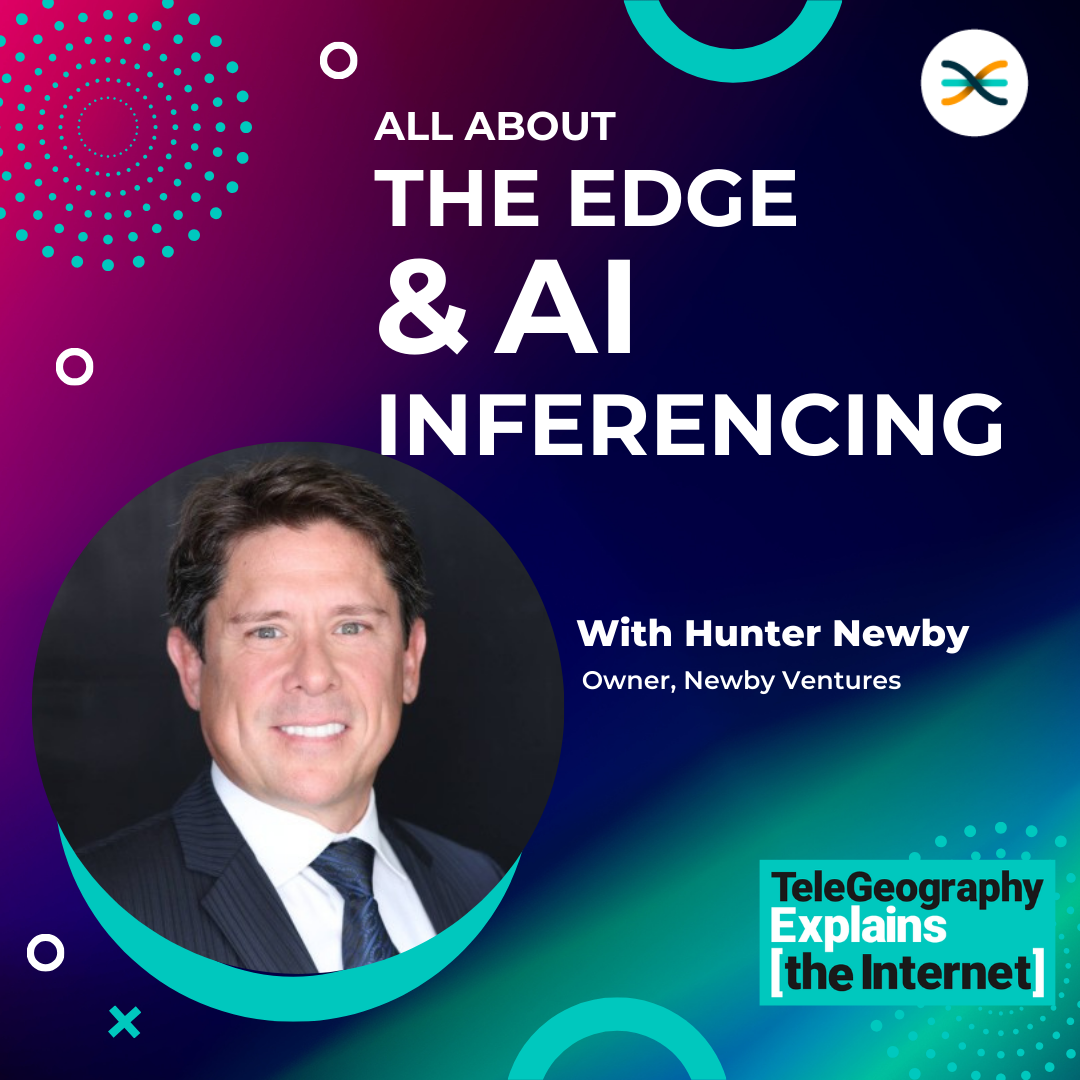
March 19, 20261 hr 0 min

The Edge and AI Inferencing | TG Explains AI

This episode features Hunter Newby, a veteran of the telecom industry with experience spanning from LDDS WorldCom to building carrier hotels and neutral internet exchange points. Newby discusses how AI inferencing is reshaping network infrastructure requirements and why geography still matters in the internet age. Key topics covered: Low-latency inferencing: Why AI applications require a fundamental shift from the old CDN model to distributed, proximity-based network architecture with deterministic routing in sub-millisecond "latency zones" Internet exchange gaps: How many U.S. states lack even a single neutral internet exchange point, forcing local traffic to backhaul hundreds of miles and creating economic development barriers Connected Nation Internet Exchange Points (CNIXP): Newby and Connected Nation are building purpose-built internet exchange points in underserved markets (125+ cities identified) to support enterprise needs and AI workloads, starting with aerospace companies like Airbus and Boeing. Beyond the data center: Why the industry needs to shift focus from power-first mega data centers to network-first interconnection facilities that enable local traffic exchange and support emerging AI use cases Premium routing opportunity: How carriers can move beyond commoditized transit pricing by offering guaranteed low-latency routing to specific zones—the "FedEx model" for data delivery From this episode: Akamai Boosts Inference With ‘Thousands’ of Nvidia Blackwell GPUs Podcast HQ: https://www2.telegeography.com/telegeography-explains-the-internet-podcast TeleGeography Resources: https://resources.telegeography.com/ Our Research: https://www2.telegeography.com/en/our-research

February 12, 20261 hr 7 min

Impact of AI on Transport | TG Explains AI

What are the real bottlenecks in AI infrastructure development? How is this infrastructure boom similar to the 90s internet boom? How do we overcome the pricing paradox in telecom transport where demand keeps rising and service prices keep falling? Today on TeleGeography Explains the Internet, we welcome Luis Colasante, Head of Procurement Strategy for Energy & Infrastructure at Colt Technology Services. Luis brings a perspective from the intersection of energy strategy, critical infrastructure, and capital markets. In this episode, we move beyond the "compute bubble" to discuss why physical infrastructure—from subsea cables to the power grid—has become the primary bottleneck for the AI revolution. Luis explains: The Energy-Connectivity Nexus: Why AI data centers require two to three times more power than traditional cloud facilities and how energy availability is now the ultimate gatekeeper for digital expansion. Shifting Investment Cycles: A look at the parallels (and differences) between the late-90s telecom bubble and today’s hyperscaler-led boom. Digital Sovereignty: Why governments are treating subsea cables as strategic national security assets, highlighted by the French government’s recent move with ASN. The Death of the "Toll" Model: Why selling raw bandwidth has become a deflationary commodity business and how the industry is pivoting toward intelligent service layers and "Network as a Service" 2.0. Podcast HQ: https://www2.telegeography.com/telegeography-explains-the-internet-podcast TeleGeography Resources: https://resources.telegeography.com/ Our Research: https://www2.telegeography.com/en/our-research

February 5, 2026Episode 3248 min

AI Adoption in Networking | TG Explains AI

Host Greg Bryan welcomes Jason Gintert back to the show. As the incoming President of the U.S. Networking User Association, Jason dives into the current state of AIOps in network management. This includes: Low Adoption and Key Challenges: Despite being a popular topic, AIOps adoption remains low due to concerns about trusting AI output (hallucinations) and the indeterminate nature of large language models. Data Integration and Security: The importance of integrating private data using methods like the model context protocol to make AI answers more deterministic. For security, Jason strongly recommends starting with a read-only, zero-trust mindset when exposing data to AI tools. Practical Use Cases: AI is most valuable for root cause analysis of common network problems (e.g., Wi-Fi authentication issues, circuit errors) and providing automated network summaries or predictive analysis. The Human Element: AI is seen as a powerful tool to increase the productivity of network engineers by handling low-level tasks, but it will not replace humans. Engineers remain crucial for exercising judgment and taking responsibility for service-impacting changes. Podcast HQ: https://www2.telegeography.com/telegeography-explains-the-internet-podcast TeleGeography Resources: https://resources.telegeography.com/ Our Research: https://www2.telegeography.com/en/our-research
January 29, 202646 min

The Impact of AI on the Network | TG Explains AI

Our latest pod series on all things AI continues with Seva Vayner, Product Director for Cloud Edge & AI at Gcore. Seva joins host Greg Bryan to tackle what is perhaps the dominant topic in telecom today: the impact of AI on the network. The pair distinguish between "AI for networking" and "networking for AI," and explore how AI training models are driving a dramatic increase in power consumption within data centers, with rack power capacity rapidly growing over the past few years. Seva explains how AI inferencing is creating a need for distributed network infrastructure, transforming the role of Content Delivery Networks (CDNs) from simply distributing content to enabling real-time interaction with AI models. He shares how Gcore is helping telcos and enterprises adopt AI solutions and exactly what that entails. We close out on the evolving definition of the "edge" as power becomes a bigger constraint than connectivity in facilitating AI workloads and what Seva sees for the near future of AI and networks. Podcast HQ: https://www2.telegeography.com/telegeography-explains-the-internet-podcast TeleGeography Blog: https://blog.telegeography.com/ Our Research: https://www2.telegeography.com/en/our-research

January 22, 202652 min

All About AIOps | TG Explains AI

It's a new year and the TeleGeography Explains the Internet team is kicking off a multi-episode series all about AI and its impact on global networks. To start, we're joined by Chalan Aras, Senior Vice President at Riverbed to discuss how the rise of Artificial Intelligence is fundamentally reshaping the way we think about the WAN. In this episode, we dive into: AI for Networking vs. Networking for AI: How Riverbed balances using AI to manage IT operations (AIOps) with the physical necessity of moving massive amounts of data to "AI furnaces" (GPUs). The AI Data Tsunami: Why data is currently growing faster than infrastructure can be upgraded, and why Time is the most critical metric for AI project success. The Shift from SD-WAN to "Data Fabrics": Chalan shares a view on why SD-WAN may be fundamentally changing or even declining as the industry moves toward more dynamic, densely connected AI data fabrics centered on the cloud and data center. Unified Observability: The importance of moving away from siloed tools toward integrated platforms that can correlate data across desktops, mobile devices, and the core network to remediate issues before users even see them. Podcast HQ: https://www2.telegeography.com/telegeography-explains-the-internet-podcast TeleGeography Blog: https://blog.telegeography.com/ Our Research: https://www2.telegeography.com/en/our-research

December 22, 2025Episode 311 hr 8 min

Cloud & Data Centers: What to Know for 2026

TeleGeography experts Jon Hjembo and Patrick Christian answer our biggest questions about recent data center and AI booms. In this final episode of our three-part pod series reviewing the year in telecom—and looking ahead to 2026—we cover: How many data center projects were we tracking in 2025? And where are they located around the world? What kind of constraints are those projects encountering, and are rumors of a bubble warranted? Did we see an increase or decrease in cloud region development? What is surprising about the geographic location of cloud development in 2025? Are CDNs still relevant in the hyperscaler dominated world? Is bandwidth demand really all that massive in the AI world?   Podcast HQ: https://www2.telegeography.com/telegeography-explains-the-internet-podcast TeleGeography Blog: https://blog.telegeography.com/ Our Research: https://www2.telegeography.com/en/our-research

December 18, 2025Episode 3047 min

Pricing & Enterprise Networks: What to Know for 2026

Welcome to the second episode in our three-part series catching up on the most interesting stories in telecom from 2025, and looking forward to what we expect in 2026.  Today's episode focuses on all things pricing and enterprise networks. We're joined by Rob Schult, who leads TeleGeography's pricing practice, and Brianna Boudreau, who manages our SD-WAN and NaaS research. These experts tackle questions like: Are we really seeing the most rare phenomenon – telecom pricing stability? What role is AI playing in this? Just how big are some backbone connections and how do those prices relate to lower sized circuits? Has SD-WAN become the norm in the enterprise networks world? Which SD-WAN players are left? Is SD-WAN mostly about security now?   Podcast HQ: https://www2.telegeography.com/telegeography-explains-the-internet-podcast TeleGeography Blog: https://blog.telegeography.com/ Our Research: https://www2.telegeography.com/en/our-research

December 17, 202540 min

Submarine Cables & Transport Networks: What to Know for 2026

What were the big cable headlines of this year, and what do you need to know about transport networks in 2026? To find out, we're kickstarting our three-episode review of What to Know in the New Year. Joining us for this submarine and terrestrial infrastructure review are friends of the pod Lane Burdette and Paul Brodsky. In this episode of the TeleGeography Explains the Internet podcast, these experts address: How much of a submarine cable boom was there in 2025 and will that continue into 2026? Where are new builds located around the world and why? Will all this new capacity lead to over-supply? Are fiber developers having to chase AI data centers into novel locations? How are terrestrial builds related to submarine cable bottlenecks?    Podcast HQ: https://www2.telegeography.com/telegeography-explains-the-internet-podcast TeleGeography Blog: https://blog.telegeography.com/ Our Research: https://www2.telegeography.com/en/our-research
Is this your show?

Claim this listing to keep it up to date, reach guests who want to pitch you, and manage bookings with Guestify.

Claim this listing

More Technology podcasts