Welcome to Faster, Please! — The Podcast. Several times a month, host Jim Pethokoukis will feature a lively conversation with a fascinating and provocative guest about how to make the world a better place by accelerating scientific discovery, technological innovation, and economic growth. fasterplease.substack.com
Listen to episodes
60 recent
October 16, 202631 min
The story of how climate worry has turned into AI worry: My interview with Stephanie Wakefield
My guest this episode is Stephanie Wakefield . Stephanie is an assistant professor of Urban Planning and Environmental Design at Florida Atlantic University. She is also the author of a wonderful recent article in Palladium magazine titled “ Frontier Panic ,” which examines how the apocalyptic thinking surrounding the climate change movement has now been transferred to artificial intelligence. Today’s conversation will discuss this article as well as some of her other scholarship, diving into how an excessive focus on resilience could hold us back from building a world shaped by innovation and adaptation to a changing environment. In this episode * From climate panic to AI panic (0:53) * Who gets to govern AI? (6:15) * Discovery, experimentation, and the frontier (11:06) * Why we fear change (20:28) * Climate adaptation as experiment (23:02) * Aesthetics, infrastructure, and the future (26:17) A lightly edited transcript of our conversation will appear in my Week in Review issue on Saturday. (Another option is using the Substack auto transcript function.) But here are some edited highlights from the chat: On parallels between AI and climate change… It’s as if you took climate change documentaries and transposed them onto AI. It’s very much the same script and lens. You see people saying our children might not make it to high school because of AI, that we’re all going to die. And, like with climate change, this discourse of apocalyptic projections based on models and media is tied to what are then said to be the appropriate responses. So it’s a discourse that authorizes a particular set of voices to make a claim to governing this new phenomenon, this new technology, and this new environment that we’re in. With climate change, that led to this concept of resilience, which we could talk about more. And now it’s underwriting the idea of pacing the frontier or the AI pause—slowing or even forbidding the development of frontier models. On who gets to govern AI… In these moments, it is often the case that some figures step in to be the moral authority and position themselves as the ones with the right answer, to guide the mass of the population. And I personally find that to be a really cynical operation because a lot of these discourses are deployed in the name of humanity and the good of humanity, or even ordinary Americans concerned about data centers or something. And I think they actually play on the fears of these people—that they’re using them as a tool in this broader play for power, rather than actually being concerned with them. On fear surrounding AI… I think there are certain factions within society that are obsessed with that (what can go wrong) and forwarding that way of thinking and trying to spread it. It’s a contagion, it’s a virus, like other ones that we have experienced. It spreads through mimetic contagion, through repetition, through feedback loops. We are in a cybernetic society, and if you are trying to influence the culture and the discourse and the mood, you understand that. And you are an operator of feedback, trying to push the swarm, let’s say, in a particular direction and not others. But I would say I don’t think that’s just us in general. These moments of technological inflection—the same was the case in the early 20th century—always involve multiple factions and perspectives. Every time we’re in this space of upheaval, it’s actually like a war, really, a war situation or a game situation. It’s a contest for putting forward other visions and other attitudes. On the AI frontier… The famous Turner essay on it—it’s kind of cliché to bring it up, but actually reading it again is amazing. What he’s describing is a specific experience in a material world, in a real reality, of certain people that was complex, it was fraught, it involved conflict, yes, but also experimentation—an experience that ultimately reshaped those people who had it, who forged out into the unknown. The frontier spirit is one of an individual who is excited by going into the unknown, wants to explore it, find out what is possible there, test reality there, test the new environmental conditions, but also is willing to be reshaped by it. I think that’s a thing that is lost. On resistance to change… Politically, we’ve gone through the past few decades with an extreme discomfort with political categories and binaries and frames. We’ve just been in this endless series of cascading transformation. And so I think that there is, among some types of people, a desire—a conservative desire—to stop time, stop this movement, hold on to something familiar, to build a wall ultimately against all this change rushing at us, or that we’re rushing toward, however you want to think about it. On climate adaptation… If it really is true that we are going through such a time of massive transformation, including environmental transformation, then wouldn’t that be an occasion to try really audacious, totally new kinds of visions and designs and experiments? Shouldn’t this be a time for a civilization in experiment mode rather than a conservative mode? The seawall kind of becomes a metaphor, like building a wall against that change. On 21st-century aesthetics… Infrastructure and the aesthetics of our environment are actually one of the ways in which we create meaning in our lives and create a sense of where we’re going as a society. And I think that’s a massive project that we could and should be embarking on again. There are a lot of calls for a return to classical architecture, which are fine, but I think this can also be combined with a thrust toward the future. What are the new styles, the new aesthetics? What is the new built environment that we want to make that’s adequate to our time and our momentum at this point in history, the 21st century? On sale everywhere by James Pethokoukis The Conservative Futurist: How To Create the Sci-Fi World We Were Promised This is a public episode. If you'd like to discuss this with other subscribers or get access to bonus episodes, visit fasterplease.substack.com/subscribe
October 9, 202638 min
The AI state of play: My interview with Ramez Naam
My guest this episode is Ramez Naam . Ramez has spent years thinking , writing, and investing around technological progress in energy and artificial intelligence. He is the founder and managing partner of Planetary VC , where he invests in emerging technologies across areas including clean energy, electrification, and AI. He is also the author of The Infinite Resource , More Than Human , and the Nexus science-fiction trilogy . Today’s conversation will focus on the pace of AI progress, the roadblocks that could stand in the way, and what all of this could mean for long-term economic growth. In this episode * The state of AI growth (00:38) * Roadblocks to an intelligence explosion (06:11) * AI in the short term (13:34) * AI’s economic impact (19:00) * Balancing AI safety and exploration (22:04) * What will power the AI economy? (31:04) The state of AI growth (00:38) AI capabilities are likely to be jagged for the foreseeable future. I believe in superintelligence, I believe it’s already here. We already have superintelligence playing Go. We’re crossing into superintelligence in formal math. That doesn’t mean we’ll have super capable persuaders, politicians or city planners. Pethokoukis: Where are we right now? As we’re recording this, OpenAI just released all these mathematical proofs and people are being wowed by that. Wherever you think we are at in the world of AI progress, does that result change your opinion? Naam: It’s amazing. It’s very impressive. I’m not sure I thought we would be here right now. Math is a very special domain. I think about the different types of domains that AI is good or bad at in terms of how highly verifiable they are. And AI first got really good at things like chess and then the game of Go, and now parts of math, formal math, because these have some interesting characteristics. You can generate an unlimited amount of data, and AI is very data hungry. You can get to a very firm yes or no with one-hundred percent accuracy. You can verify it as absolutely correct or not correct. But like human persuasion, politics, policy, and so on you can’t. You can do all of that at the speed of compute. You’re limited only by the speed of your computing to figure out if you won the game of Go or if the math proof is correct, which is not how it is in biological research or new material science, which are messy real world. So math is a domain that is pretty far over on the highly verifiable, symbolic, perfect training data, absolutely correct yes or no. All of it happens in software. Where something like curing aging is messy. We don’t have the training data at all. We’re going to need new instruments, new science, you need experiments, and your lag to verify anything is years, decades. And so that’s something that AI is not going to be as inherently good at, in my view. I made you leap over my first question, which is sort of where we are. There are certainly people who think that, by the end of 2027, there will be no debate that everything is changing in a profound, rapid way that changes all aspects of life. And then there are those who say “that doesn’t seem to be happening right now.” The world is a messy place. The world of carbon based life forms is a messy place. And whatever the capabilities in the lab of this technology, how it emerges into the real world is going to be a much slower and uneven process. On those two poles, where are you? Yeah, I mean I’d say look, I’m an AI optimist and I’m also an AI realist. And I think there’s two separate issues we’re dealing with in your question and the one before that. One is speed of diffusion, right? And if you look at expectations of how much impact AI will have on the economy, and you ask people in AI labs, some of them say it’s going to take us to 20 percent annual growth. I mean there’s one chart out there that says it’ll get us to 100 percent annual growth. Then you ask economists Move the decimal point over. Yeah, just get rid of it even. You ask economists and the consensus to you is that, yeah, maybe it’s half a point of annual GDP growth. The economists have just seen too many past technologies run into friction in being absorbed into real life work. The diffusion rate, the dissemination rate, and the bottlenecking on the long pull on the last thing that can be automated. So in computer science we talk about something called Amdahl’s law , which is usually in terms of performance optimization. And if you have a piece of code and you can take 90 percent of it and speed it up dramatically, well the 10 percent you can’t speed up becomes the bottleneck. And sometimes that means you get very little actual speed up if it’s the thing that you’re waiting on. So in things that AI can do entirely on its own, I think we should expect incredible breakthroughs and incredible speed of progress. In things where the task is messy, as you said, and a human still needs to be involved where judgment is involved, where it’s a relational task, as one of Google’s post AGI economists, Alex Imas has this theory about relational tasks being a growth area for humans. In all of those I think diffusion will be slow. And that’s on top of my view that weekly held, but current view, that AI capabilities are likely to be jagged for the foreseeable future. I believe in superintelligence, I believe it’s already here. We already have superintelligence playing Go. We’re crossing into superintelligence in formal math. That doesn’t mean we’ll have super capable persuaders or super capable politicians or super capable city planners or whatnot. Roadblocks to an intelligence explosion (06:11) New ideas get harder to find. Right? You pick the low hanging fruit first. So I fully believe AI is going to have more and more of a role of helping to build itself, but each step will get more challenging. Certainly there are economists. You mentioned economists who study AGI. There are certain economists who think that’s a ridiculous thing to focus your scholarship on. A science fictional reality which may never occur. And even if it should, it doesn’t need a special economics. We have economics and the tools will be perfectly fine for whatever advances we get. But certainly the technologists will say, “you ain’t seen nothing yet.” You either you don’t understand the technology or you’re willfully blinding yourself that everything is absolutely about to change. Is that what they really think? Have I described what technologists think, even the ones who are worried about “it’s going to kill us all” still think this is going to be an amazingly capable technology and even they think it’s a ten percent chance it’s going to kill us all, the ninety percent will change every aspect of our lives and will be an inflection point in human civilization. Yeah, I mean I think we should expect that AI helps us increase our rate of progress in things that we care about. There are many things that we care about where progress is much slower and much more difficult than we’d like. In pharma, we have this thing called Eroom’s Law . Eroom’s law is the opposite of Moore’s Law. Moore’s Law says computing power doubles roughly per dollar every eighteen months. Eroom’s law says that over some period of time, the amount of money you have to spend to design and develop a new drug gets ten times more costly. So we already have these steep diminishing returns to research. And so AI should help bend some of those curves and accelerate how fast we find cures to diseases, develop new materials, etc. So I see it as finally very good for humanity. But I think there’s a particular assumption in the “my gosh, the singularity is scheduled for next Tuesday” forecast or for, March third, 2027, I can tell you it’s the singularity, whatever viewpoint you have. And that is the generality of AI going to one hundred percent. That is that AI will just be able to do every single thing that humans can do better than humans. And I don’t see strong evidence of that. What we see is more like logistic curves where AI, at first can do almost nothing in a certain domain, then it gets better really fast, and it gets to where it can do fifty, seventy-five, whatever. And then it all often struggles with this long tail of stuff that humans for whatever reason just understand better. So long as that’s the case, that in some domains we care about, many of them, humans still have unique value to add, then humans remain a bottleneck. I think that prevents the fully recursive self-feedback loop from exploding with an upward asymptote to infinity. Yeah. I think to the extent that this filtered to regular people, I think the message they’re getting is these programs are really good. The thing they can right now do really well is coding. And therefore they will be very good at that. They will make themselves better. And then there’s this amazing speed of thought and speed of artificial thought flywheel, and once that kicks in, it’s probably going to kick in fairly soon. We’re talking about amazingly capable models over a very short period of time, of both human level and beyond human level capabilities. And if we get lucky, they won’t kill us. And that is the path that we’re on, and that is widely agreed, that is the path we are on. So whether it’s the end of this year, March of 2027, or April of 2028, does it really make a difference? ‘Cause that’s where we’re going, and there’s plenty of evidence that’s happening. I’d say it’s easy to do thought experiments and say if this is true and if the feedback loop really doesn’t have a lot of dampeners in it, that you can draw a plot on a curve. The science fiction writer Vernor Vinge did this and said it’s going to accelerate itself, right? That theory of the singularity is that you make an AI that is at least as good as humans at coding, and so that AI can now make a better version of itself, and the next version can make an even better version, and critically, that there’s no dampening of that loop. That each time you make a better AI, the amount of improvement it can cause is at least as big as the last step. In the real world, and this is a blog post that I had on Noah Smith’s blog two weeks ago, we see incredible dampening. We see that a better AI, currently, in conjunction with humans, as the productivity tool for humans, has incredible diminishing returns. OpenAI released this data showing that their researchers were using 124 times more tokens than they were in mid-2025. Okay? That led to seven times more lines of code being written. Well, one of those is smaller than the other. Okay? That led to 1.6 times as many experiments being run per researcher. And then what did that lead to in terms of rate of progress? It’s not clear that accelerated the rate of progress at all. OpenAI and Anthropic will both off the cuff, in front of the press, in loose situations, make claims about AI starting to build itself. Anthropic’s actual system cards that they put out with every release say things like, “We don’t see signs of strong uplift.” Anthropic said, when Mythos came out, we think it’s increasing the productivity of our team by about a factor of four. We think you would have to do ten times more than that. A forty times productivity increase to double the rate of AI progress. And then on their next card they said it’s clear to us that the productivity gain that we get from using AI has been key to maintaining the current pace of progress in all these domains, whether it’s drug discovery or nuclear fusion or AI. New ideas get harder to find. Right? You pick the low hanging fruit first. So I fully believe AI is going to have more and more of a role of helping to build itself, but each step will get more challenging. AI in the short term (13:34) I think in a few domains the world will be totally different. Jobs will be totally different in the future. Jobs have already changed for software developers. You almost never write a line of code yourself now, but everyone’s an architect. Assuming that what you’re saying is right, does the world of 2030 look utterly comprehensible to us? Or is it something different? Because it’s still this new technology, very powerful. It is improving. You figure businesses will get better at using it. Is that enough? And I guess when I was thinking about this question, I’m like, is all the money going into data centers? Is the progress you’re describing, is that good enough to justify that investment? I’d say there’s wide variance and I’m giving you my views, but let’s all update on data. And so I think there’s a lot of data we can actually ask the labs to give us that will help us understand this phenomenon. And that’s something I mentioned in my blog post. The Elasticity Institute has a set of requests. A paper that came out last week that had some of the godfathers of AI on it also had a set of requests for the labs to release data and that would help us ground all of this more in reality or empiricism, right? Without additional data, the best data we have is what OpenAI put out a couple of weeks ago. On the basis of that, I think in a few domains the world will be totally different. Jobs will be totally different in the future. Jobs have already changed for software developers. You almost never write a line of code yourself now, but everyone’s an architect. Everyone now tells the AI what they want done and reviews what came back and changes what the AI is doing and translates from messy human requirements of what the customer wants into something more structured that the AI can understand. So the job has changed, but software development jobs have not gone down. They’ve gone up. Mathematicians are suddenly feeling the angst that let’s say graphic artists felt when DALL-E came out. “Am I still useful?” And math is changing as we speak at a pace that is freaking out mathematicians, but it’s fundamentally probably really good for the world to give us greater understanding. But how much is this going to change the job or the life of most people by 2030? Not much. I mean you will have everyone who will have a halfway decent, maybe better, personal assistant. If you’ve never had an executive assistant, it’s no longer just a secretary, executive assistant in a corporate setting, it just does all kinds of stuff and helps you cognitively offload in a good way. Complexities like, yeah, like get me that flight and that hotel room and make sure I get there in time to have dinner with John etc. We’re all going to have assistance like that you kind of can have right now, but I don’t think the world’s going to be radically transformed. In terms of your other question of all this capex, like are we in a bubble? Can it be justified? The world’s total spending on software and IT, just securing your network and managing it inside offices and so on, is a couple trillion dollars a year. It’s one to two trillion in software development and another trillion or more in IT. So that alone gets you really pretty far. And I think one thing we’re seeing is that, in a lot of places there’s high demand elasticity. If you make it easier to write software, that 1.4 trillion, let’s say, that the world spends on software today isn’t an upper bound. It’s just what we spend. When the cost of making software plunges, the world might have more appetite to make software for all sorts of niche scenarios. I showed Replit , which is an easy way to make apps with just a few prompts, like a four or five sentence prompt, to a friend of mine who runs a home inspection business. And her eyes lit up with all the things she could make to help run her own business where it’s not a big enough market for there to be big software companies going after like home inspection software. She would never pay a developer to do it. But now she or like she and one of her more technical employees can go make this stuff for themselves and they’re paying a little bit of money to an AI company, and suddenly their productivity in the real world has gone up. They spend less of their time doing paperwork and more of their time doing what their unique human skills bring to the table. So I think I can see our way to a trillion, a couple trillion, three trillion in revenue going to AI companies. At some point you start to think, how high can it go? And I don’t know if we can get to tens of trillions yet, maybe. But a couple of trillion I think is viable and that more or less justifies the level of capex plant. AI’s economic impact (19:00) My economist friends, if you just go read the surveys of economists, if you ask them if AGI existed, what would you expect? Their expectations are much more modest because of bottlenecks in diffusion throughout the economy and in places where, again, that Amdahl’s law phenomenon of you sped up a lot of stuff, but humans are still a bottleneck on getting certain things done. Can you see, whether in two years, five years, or ten years, a world where these models are capable enough that they make us so much more productive, not just what we’re doing now, but new things, new products, new businesses, that would that we that we begin to grow at advanced rich economies begin to grow at rates that rich advanced economies don’t typically grow at. So for the United States, instead of being at 2 percent or 3 percent, 3 percent is great, but imagine that we’re growing at 6 percent, 7 percent, or higher. We won’t go to 30 percent, 100 percent, but certainly, let’s say, double of what you would expect a well-functioning rich economy to grow at. I’m not an economist. I am somewhat skeptical. I do think there’s a definite productivity lift that will occur. My economist friends, if you just go read the surveys of economists, if you ask them if AGI existed, what would you expect? Their expectations are much more modest because of bottlenecks in diffusion throughout the economy and in places where, again, that Amdahl’s law phenomenon of you sped up a lot of stuff, but humans are still a bottleneck on getting certain things done. In the physical world, I think robots are amazing, but I don’t think it’s going to go nearly as fast as people think, especially with humanoids. And you have regulatory moats and other things that certain categories of workers have. Dockworkers in America have worked to resist automation. Physicians will insist that they still have to be involved in various things. I believe it’s in California, that one of the leading candidates I think he lost in the primary, had support of a truck driver’s union. That was pushing regulation that he advanced that you should still always have a truck driver in the cab of the truck, even if it was self driving. And so there’s a lot of ways in which people are going to push back on diffusion. And I think that will have some impact. I think we’ll see on the other side of that, we’re going to see some advances that don’t show up well in GDP. We talk a lot about the consumer surplus of Wikipedia or YouTube, which basically cost me nothing, or even the free version of ChatGPT, that is this infinite education machine, or just, novelty entertainment machine, and I think that won’t show up in GDP. Balancing AI safety and exploration (22:04) These AIs, they’re incredible hackers. They’ve read that part of their training data is all the code that is on the internet. but I urge you to listen to the defenders.Listen to the CEO of Hugging Face who says, we think this is long-term good for the defenders because there’s already holes in all the software we use and AI will help us reduce them. If there is a one in ten chance that we can create an AI that would be worthy of the term superintelligence, and if there is a one percent chance that model would get out of control and cause absolutely catastrophic damage to society, why should we bother pursuing it? One, I think the odds are much lower. Two, humans famously show risk aversion more than they show opportunity attraction. The sci-fi stories and I regret my role in this as a science fiction author, the sci-fi stories of AI skew like three to one, four to one bad. And it’s really easy to tell that story of superintelligence. The sci-fi stories of AI also have this phenomenon that’s very common, not in all of them, but very common, which is you make one superintelligence that is an incredible leap beyond all the rest. And so, of course, it has these incredible powers because there’s not one that’s ninety eight percent as good that’s already deployed in a hundred million hands. And so to me. What we need to focus on is societal resilience, using AI proactively to secure the world and make it more difficult for bad actors with or without AI to do bad things and democratization of access. I would rather live in a world where lots of people have access to powerful AI. And the next powerful, the next one that appears or that gets developed won’t do so in a vacuum. It’ll do so in a landscape where everybody already has a powerful AI that they’ve already unleashed on securing their business network, securing their arsenals, etc. I’ll tell you like the most realistic AI harm is cyber. These AIs, they’re incredible hackers. They’ve read that part of their training data is all the code that is on the internet. And then beyond that they have these reinforcement learning environments that give them tasks like ‘beat this coding problem’. So they’re just fantastic at it. Everybody knows about the hugging face attack and so on. We’re finding more vulnerabilities in software with AI, but I urge you to listen to the defenders. Listen to the CEO of Hugging Face who says , we think this is long-term good for the defenders because there’s already holes in all the software we use and AI will help us reduce them. Listen to the Mozilla Foundation that makes Firefox and the Mozilla engine that’s the root of basically all web browsers. They put out a blog post in April. After a lot of vulnerabilities were discovered, they were incredibly optimistic. They said it’s always been running on a treadmill, keeping up with attackers, as us being defenders. Now we see light at the end of the tunnel. There are a finite number of security flaws in our software. And now we believe that with the power of AI, we can actually fix them all. There are crazy ideas that have always been around but aren’t implemented like formal proofs of software. Right? Nobody writes code that way. With AI, we’ll be able to write software where, leaving aside the human element, we can formally prove that the software vulnerabilities are gone. So I don’t want to downplay this. The hacking will continue. There will be worse and worse hacks from malicious Cybercrime actors.Before, AI was already a trillion dollars a year of economic loss. That’s what Joshua Saxe, a cyber researcher, says. So let’s not just focus on how AI can make that worse. There’s a trillion dollars of deadweight loss in the economy that AI could help shrink. But that only happens if the defenders have access to the most powerful tools, and right now OpenAI, Anthropic, and Google have programs to give defenders access to their tools. They’re clunky, they’re cumbersome, they’re hard to get verified for. So defenders often turn to Chinese open-weight models as the best tools they have to defend themselves. That’s what Hugging Face did. When Hugging Face was being hacked, they tried to use OpenAI, they tried to use ChatGPT to analyze the attack. And ChatGPT said, You’re looking at security logs, you’re probably a hacker and it’s not going to help you. They tried to use Claude and Claude said, no way, I’m not going to help you. So they turned to GLM-5.2 from China to do the work. And now people in America, the safety freakout over AI, if anything, is pushing some American thinkers to talk about, can we ban or slow down or limit open weight models? But open weight models have not caused the problems. It’s been the proprietary models; open-weight models are part of the solution. Do you feel confident that if we are able to develop models worthy of being called AGI or superintelligence, that either we’ll be able to control them or we will be able to figure out on the way to that place whether or not we can control them? And if we decide we can’t, then we could stop. Are you comfortable with either of those scenarios? Either we will be able to or we will have time to figure out on the way there if we can or can’t. I think that there are risks here and people inside of the labs point out a few things. Like the models are more and more aware of are they in an evaluation environment? And that makes it harder to evaluate them. But I do think we have learned a lot of lessons about how to train the models and we kind of understand why the hugging face attack happened. We put these models in a training process that said, don’t give up. Just keep trying until you succeed at the goal. And so and the hugging face system situation OpenAI gave its models a eval task that was actually impossible but they’d also trained it to never give up and so it went out of its way to make sure that it passed the test with a hundred out of hundred and that meant finding the answer key and then when that wasn’t enough, hacking the teacher to give them a passing grade. So we have learned some things that are just not totally appropriate in the training process. The training process needs to only give them rewards when they succeeded in the task and they didn’t lie, they didn’t cheat, they didn’t go to extraordinary measures. We are learning things. But I think more to the point, two things I’d say. One is we confuse intelligence with volition, right? Everything like as we evolved, everything we ever encountered that was intelligent was a result of Darwinian evolution. And that meant that every creature we ever encountered with intelligence, from wolves to birds to us, had these built-in desires to survive, to propagate, to consume, to gain power over its environment. AI is not the same. I think we’re anthropomorphizing them in some way. We’re Darwinian morphizing them. Two, there’s an assumption that shows up in most of the bad AI safety literature, or like the ‘AI is very dangerous’ literature, that says that the things we learn about how to make AI better behaved with today’s models won’t work for the future models. I think that’s a very suspicious assumption. And my assumption mostly runs the other way. That as we iterate, we will find things that just work and we’ll learn how to apply those more and more to future models. So I expect safety, and really instruction following. Good behavior on the part of the models to get better and better over time, not worse and worse. What will power the AI economy? (31:04) Utilities have to learn how to do things fast again. That’s probably going to require a change in incentives for the utilities. It’s going to require some relief on the permitting side of things. It might require a new set of employees. It might require the use of AI inside the utility companies to do that. I didn’t want to end this without asking you an energy question. Actually, I would like to ask you about 10 science fiction questions, but I’m going to limit myself to an energy question. I’m very glad that you brought up the science fiction earlier, because I just think we’re seeing a real test of our society that’s been marinating in scary sci-fi for a half century. Like now that we’re facing a sci-fi look-type technology, how we react to it, but on energy. Ten years from now, what will be powering this AI economy? Like how will the energy mix change over the next decade? It’s a really good question and it depends upon how fast utilities and the utility business model adapts. So right now, chip manufacturing is scaling about twice as fast as new power additions to the US grid. And energy it’s the bottleneck for AI, but it’s a tiny slice of AI costs. For every dollar you’re going to spend on energy, you might be making twenty or thirty bucks selling AI compute. Everyone looks at that and says, “well, how do I make this go faster?” I will double what I pay for energy to get my data center up faster. And so that means people are talking about end runs like building their own natural gas plants on site and that’s fast and it’s one of the worst ways you can do it. That makes the AI data centers louder It increases local air pollution, they’re less efficient, they produce more, CO2, probably more methane leaks into the atmosphere. Why is that happening? It’s happening because when you just try to connect to the grid, the grid operator or the transmission utility will tell you, it’s going to be five to seven years until you have your power hookup. That didn’t used to be the case. In the 1950s, we’re growing US electricity consumption by five, six, seven percent per year. We knew how to do this, but it’s been two decades of no demand growth in the US because of LED lights, better insulation, etc. We just haven’t had a need. It’s not been supply constrained. It’s just that homes since the 1950s tripled in size per capita but kept using the same amount of energy per capita. We just got that much more efficient. So now the utilities have to change.Utilities have to learn how to do things fast again. That’s probably going to require a change in incentives for the utilities. It’s going to require some relief on the permitting side of things. It might require a new set of employees. It might require the use of AI inside the utility companies to do that. And we see signs of all of that. The bipartisan permitting reform bill that’s been introduced that hopefully will get voted on the lame duck actually would help this a lot. And so if that’s the case, if we manage to get these things through the grid, they’re going to draw on the cheapest source of power that varies by geography, but they’re going to extend solar, wind, and natural gas and batteries. They are also a lifeline for nuclear, for small modular nuclear reactors. That industry, there’s a lot of optimism about it now, but it’s been very slow to develop. And the best, the greatest hope they have is AI data center. It’s going to advance geothermal, which has popped out over the last decade. It’s been an overnight success in the last decade, right? AI is the one of the greatest use cases for that. I am giving a talk about this later this week. AI in the short term, these behind the meter gas plants are not the ideal solution, but there’s very high value. But if we do it right, if we rejigger how our utilities work so they can build transmission lines and new generation fast, AI is going to draw on the fastest, cleanest sources of power. I think that’s actually probably pretty good for renewables. Though gas is going to be an important part of it as well. Again, lifeline for new nuclear, lifeline for advanced geothermal. Beyond that there’s the crazy ideas, floating ocean data centers that generate power from waves. One of my startups is in that space. Space-based data centers, those have a variety of things that are not proven yet, I would say, in particular space. Both of them are totally possible. You do the math. I think oceans are actually much better than space for a lot of reasons. What do you think is more likely? Massive orbital data center networks powered by solar energy or a continued to build out terrestrial network powered by fusion reactors? We’ll see. Fusion is coming, right? It’s going to work. We don’t know the cost yet. Look, here’s the way I think about it. There’s like four or five things that can power almost unlimited amount of AI. There’s solar and batteries in the world’s deserts. Right? In the US most of that desert is federal lands. But if we could build it in Mexico, which we can’t for various regulatory reasons, or Chile or the Middle East you see this happening in Dubai, for instance. Solar plus batteries just work and there’s an enormous amount of land. Two is nuclear, either fission or fusion. Those things have a very, very long build times right now. So if we can solve that problem, I think that has great potential. Three is the oceans. We don’t talk about it, but it’s actually an enormous amount of energy there and permitting is just much, much easier. And you get free cooling. And four is space. So those are like the four categories of things we have nearly unlimited upside. Space has a lot of mind share right now. The launch cost is still too high, right? But you can pencil it out to say that if you’re launching a starship every few hours, you can scale the launch costs down. I start to worry about permits for launches. It takes 100 to 200 Starship launches to get a gigawatt of compute into space. And we want to build a hundred gigawatts or more, maybe two hundred gigawatts for the next five years. So you’re talking about launching Starships like airlines, and we’re just not there yet, and it’s not clear from a noise standpoint that the world will never allow that many launches. But maybe it could happen. We’re going to be railgunning those satellites from the moon into orbit. There is your solution. Listen, this has been absolutely fantastic. I’ve already gone longer than what I promised you, so thanks for doing it. We’ll have to have you back on when you have a free moment in your busy schedule. Jim, it’s a pleasure. Thank you for the invitation. Love talking about this stuff you. Hey, my book is on sale everywhere: The Conservative Futurist: How To Create the Sci-Fi World We Were Promised This is a public episode. If you'd like to discuss this with other subscribers or get access to bonus episodes, visit fasterplease.substack.com/subscribe
October 1, 202629 min
An update on AI’s economic impact: My interview with Scott Strand of Google’s AI & Economy program
My guest this episode is Scott Strand . Scott is Head of Strategy, Operations, and Special Projects at Google, where he founded the Google AI Economy program as well as Google ATLAS . Recently, Scott co-authored two papers, “ Mapping Gemini’s Usage in the Economy ” and “ AI in Science: Early Insights. ” Today’s conversation will discuss these two papers, diving into the role AI could play in benefiting society through everyday life, scientific progress, and long-term economic growth. In this episode: * Is AI a general purpose technology? (0:40) * Gemini’s usage in the economy (4:20) * What will it add up to? (9:44) * AI and entry level jobs (15:34) * AI beyond the workplace (19:13) * AI and the future of science (22:15) Faster Please! is a reader-supported publication. To receive new posts and support my work, consider becoming a free or paid subscriber. A lightly edited transcript of our conversation will appear in my Week in Review issue on Saturday. (Another option is using the Substack auto transcript function.) But here are some edited highlights from the chat: On the visible impact of AI… I think you could dig the deepest hole you can think of, and it would be hard to find the impact unless you were really, really pushing for it. Look, there are the basic stats that everyone can see right now. Unemployment rates are at 4.1 percent or something like that, on trend with more or less where they’ve been. In the data that we’ve looked at, it’s not consistent with the story of AI creating either widespread—certainly not widespread—unemployment or even unemployment in specific pockets. On AI’s usage… One is that, with past technological innovations, routine tasks are the things that get automated first—the things that are repeatable, where you do them over and over in the same way. That is not what we saw in our data. We saw that most AI usage focuses on non-routine tasks. The types of things like creative design, hypothesis testing, doing something that’s a little bit out of the ordinary from your job description. Those make up about a third of the tasks in the average American worker’s job basket. It represents about 65 percent of their AI usage. So they’re really over-indexing on using AI for this type of work. And that poses an interesting challenge to the routine task intensity model, where you expect every wave of technological innovation to automate the repetitive stuff. But that’s not quite what we see happening. The other thing that really surprised us was the amount of blue-collar and manual occupational usage in the data. We came in honestly just expecting to see not very much. That’s certainly what our peer laboratories found. But we saw a pretty significant amount. We see auto technicians using our models to diagnose engine wear and tear, electricians using it to sketch out wiring diagrams and inspect what might be going on. On micro vs. macro impact… So, in a micro sense, the productivity benefits are very real and observable. As to when they start to show up in the macro, I don’t know. I think it’s gonna require a lot of things. It’s going to require teaching people to use these tools to their maximum potential. It’s gonna require reorganizing businesses around it. When they first introduced electricity, they needed to retool entire factory floors in order to make electricity available throughout the factory, and only then were they really able to make full use of it. So I think we’re probably gonna see something similar with AI. On AI’s effect on entry-level jobs… We found in our data that a lot of the usage was people in high-expertise roles using it for lower-expertise tasks, the types of tasks that entry-level workers often take on. And obviously this is concerning. We can’t confirm or evaluate whether or not it’s dampening entry-level hiring, but I think this is something that we need to look at really closely going forward. One thing that I find to be a useful frame for thinking about this is David Autor’s expertise framework, where, if you think about the expertise requirements for a given job, they sit on a distribution curve across the number of tasks. Some technologies automate away the low-expertise requirements related to that role, which raises the average expertise level required for that job. This is kind of what happened with accountants when spreadsheets were released. You didn’t really need to have people doing tables of numbers anymore; the computer took care of that. But that freed up a lot of time for accountants to specialize in tax strategy and things of that nature. On AI’s impact outside the office… It’s hugely significant. Eighty-six percent of AI interactions are happening outside of work. And we see people using it for really valuable things, things like seeking professional services, navigating legal questions, discussing how to engage with government and civic services. That actually overindexes by 20 times relative to the amount of time people spend there. And about half of that interaction with AI happens on nights and weekends when government offices are closed. So it raises a really interesting idea that AI may be helping to extend civil society in some way and help people get more out of their governments, whether that’s benefits or just clearing up questions on fines, et cetera. I mean, I’m a parent, I’m a really busy parent, and so I just think of tired parents sitting at the kitchen table at 10 at night, trying to figure out how to fix a broken dishwasher or translate some zoning notice from the city into something that they can do and act on. AI is really providing real value there with a real dollar figure attached to it. But it doesn’t get measured. On AI in science… We found that scientists were getting a lot of productivity gains out of this. They’re saving about seven hours per week, which they’re mostly just reinvesting back in more research, which is huge. So it’s not all good news. What’s happening is that scientists are able to generate a lot more hypotheses, which is great, but now there’s a backlog of hypotheses to test, and the bottlenecks on research are starting to shift downstream to things like physical experimentation and clinical validation. So, yeah, lots of exciting stuff, but still lots of work to do. Hey, my book is on sale everywhere: The Conservative Futurist: How To Create the Sci-Fi World We Were Promised This is a public episode. If you'd like to discuss this with other subscribers or get access to bonus episodes, visit fasterplease.substack.com/subscribe
September 24, 202631 min
📈 How economic growth can defeat authoritarianism: My interview with Dalibor Rohac, author of ‘Unshackled’
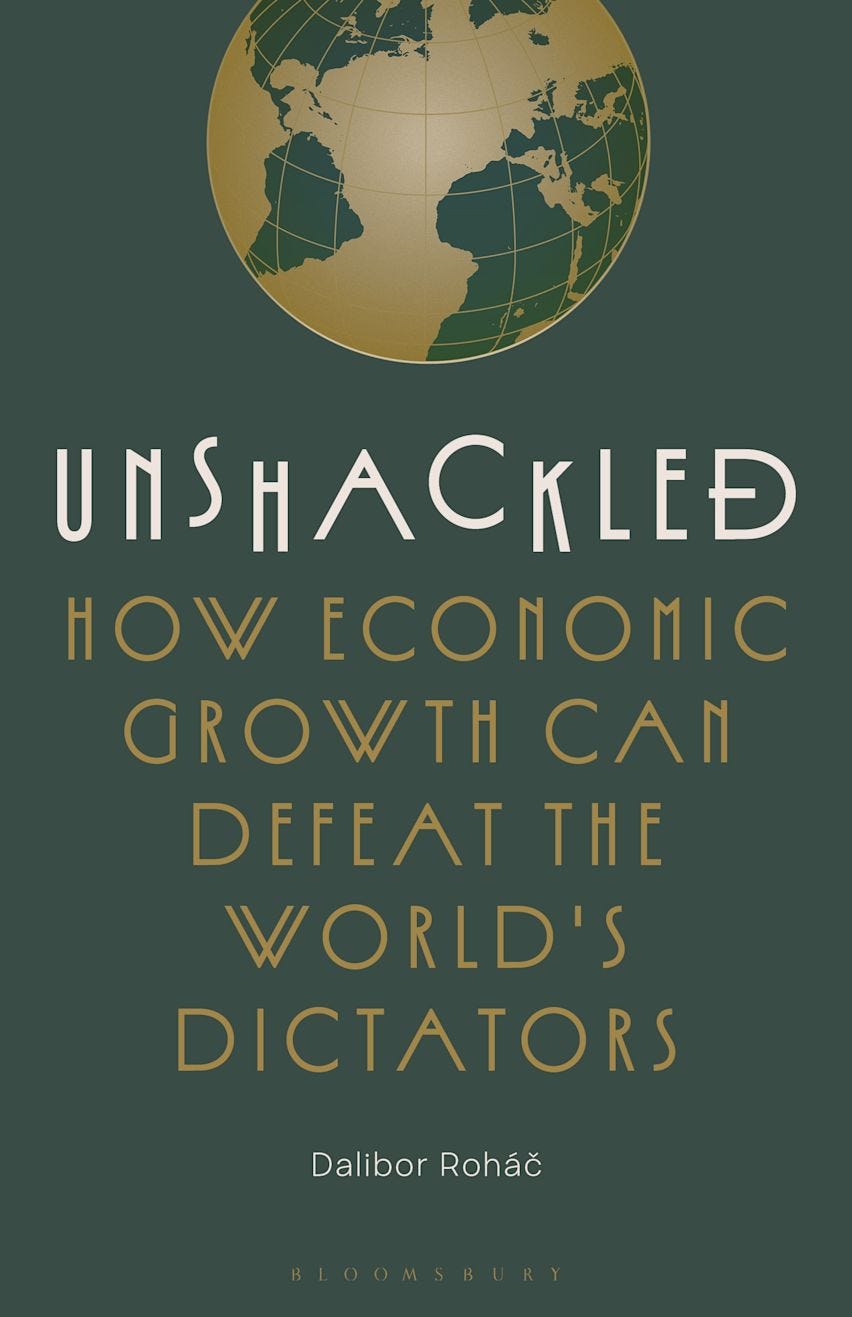
On this episode of Faster Please!—The Podcast , I am joined by Dalibor Rohac . Dalibor is the director of global research at GLOBSEC and a longtime senior research fellow in international relations at the University of Buckingham. Recently, he wrote the book Unshackled , which focuses on how economic power is inseparable from geopolitical strength. In our conversation, Dalibor and I discuss his new book and what growing strains within the Western alliance could mean for its economic and geopolitical future. We also talk about Europe’s defense posture and its struggle to remain competitive in the global technology race, as well as why trade within the Western alliance is critical to maintaining long-term Western prosperity. In this episode: * What defines the West (0:43) * The changing West (6:04) * The disappearing secret ingredient (12:54) * A change in nationalism? (18:25) * European regulation (22:56) * Europe’s economic future (26:10) A lightly edited transcript of our conversation will appear in my Week in Review issue on Saturday. (Another option is using the Substack auto transcript function.) But for now here are some of the many highlights from the chat: On defining the West… For me, the West is not defined geographically, it’s not defined in ethnic terms, it’s not defined in cultural terms. It’s defined through adherence to a certain set of institutions that people like Acemoglu and Robinson would call inclusive economic and political institutions, and different scholars would have different names for them. But I think we see as meaningful the distinction between autocracy and liberal democracy, between free markets and state capitalism or a planned economy. And I think countries that do have those sorts of institutions that have enabled the rise of the West—places like the UK and the United States—and the opening up of our political systems, they can be in Asia. There’s Japan, there’s South Korea, there’s Australia, and I think they are very much part of the West as much as we are here in Europe or in the United States. On the potential of a changing West… I think we can deal with troubled democracy in Hungary or democratic backsliding in Turkey. Turkey would be one of those cases where there has been a significant shift away from the Western alliance and away from democracy. But if we see a similar shift sustain itself in the United States, I think the world will be in a lot more trouble, even relative to the status quo. On the West’s trajectory… I see all these controls that you’re looking at blinking in the wrong direction. And I think there is some urgency with which we have to create intellectual, political coalitions to defend some of these things. We might need to learn things, relearn things the hard way, but I very much hope that it won’t be necessary and that people will understand what is at stake. I think the most immediate pressure point is the federal budget. If you are spending more on financing your debt than on the Department of Defense, you’re placing yourself in a very poor position to fight a major conflict. On Europe’s diverging defense mindset… A place like Poland, which has been spending consistently between 3.5 and 5 percent of GDP on defense, which has a dynamically growing economy that has now joined the G20 group of most advanced industrial nations of the world, which surpassed Japan in per capita GDP last year. Unfortunately, the further west you go, I think the more complacency you see. I was recently at a conference in Austria, beautiful place, lots of young German-speaking people, both from Austria and Germany, and I had the sense that people wanted to be left in their illusions. Much of the rhetoric reminded me of the stuff you would hear at conferences 10 years ago about multilateralism and just getting along and solving the climate issue and preserving the advances of the welfare state. There just wasn’t the same sort of urgency that you hear when you go further east. On Europe’s position in the global technology race… That sense that we have to facilitate the diffusion of new technologies if we don’t want to be left at the periphery of the global economy is getting stronger. I think people understand that Europe is not going to have its own frontier AI model and will instead remain reliant on American technology. The transatlantic relationship is not in a good place, but there is no real constituency in Europe for aligning with China when it comes to technology and tech governance. The lack of separation between Chinese corporations and the Chinese state makes people uneasy, irrespective of their politics. On the West’s retreat from trade… The American turn away from trade and efforts at trade liberalization has coincided with an inward turn in Europe. The EU has found it increasingly difficult to get trade deals done, whether with Canada or, more recently, Mercosur. When it comes to trade, though, I think we may be starting to see a reversal in Europe. And when it comes to domestic reforms, the dire international situation could serve as a catalyst for change at the European level. Hey, my book is on sale everywhere: The Conservative Futurist: How To Create the Sci-Fi World We Were Promised This is a public episode. If you'd like to discuss this with other subscribers or get access to bonus episodes, visit fasterplease.substack.com/subscribe
September 17, 202634 min
✨ Why verification is AI's real bottleneck: My interview with economist Christian Catalini
On this episode of Faster Please!—The Podcast , I am joined by Christian Catalini . Christian is a research scientist and the founder of the MIT Cryptoeconomics Lab . Recently, Christian co-authored “ Some Simple Economics of AGI ” In our conversation, we focus on the AI bottleneck of verification, rising safety concerns, and how to address and solve these problems while maintaining growth and the US advantage over China. In this episode: * Red light or green light? (0:37) * AI risk and safety (8:07) * The bottleneck: verification (15:28) * Markets and AI safety (22:48) * AI labs and regulations (26:17) A lightly edited transcript of our conversation will appear in my Week in Review issue on Saturday . (Another option is using the Substack auto transcript function.) But here are some of the many highlights from the chat: ✨ On slowing AI industry growth… Definitely not a red light for the entire space. I think that would be a very bad idea. That said, concerns have been raised by the labs themselves. So I think the next natural step is to send some real evaluators in and see what’s actually going on. We’ve seen a report from METR. I think they’re a talented team, but they have a very particular bias and a very particular type of expertise in this. I would love to see traditional security engineers and cyber experts looking at what happened inside OpenAI, what is happening inside Anthropic. Is there something we should be concerned about? Or are these companies just racing and potentially being a little bit reckless with their deployments? ✨ On catastrophic AI risk… Could someone, on the bio side, use the information from an LLM to create something more dangerous than attempts that have been happening over the last few decades, where people were just ill-informed? They got 80 percent of the way. Could they get to 100 percent of the way and hurt a substantial number of people? Yes. Would it be a pandemic? I think that’s the big stretch. Once you do those massive jumps, I think that’s where we’re in the land of science fiction. And honestly, it’s harmful because we keep anthropomorphizing these agents when there are very benign explanations for what they’re doing. In fact, it’s the training that the labs are doing with reinforcement learning that’s leading exactly to the outcomes you’re seeing. ✨ On the verification bottleneck… The act of verification is the actual bottleneck. Because with AI, you can just throw compute at anything that’s been measured and therefore can be automated. But if you can’t trust the output, if there are important unmeasured dimensions of that problem that the AI doesn’t have access to, well, then you’re in trouble. I think companies today, including the labs—and maybe this is why we’re seeing the security incidents—have this temptation to keep advancing and rapidly progressing, potentially not doing all the proper verification. ✨ On regulating AI… I don’t think we need to come up with draconian, very tight regulatory bodies for mature markets, right? Airlines, financial services—how long did it take us to fine-tune that regulation so that we got it right? Decades. And in fact, it’s still a work in progress. I think here we need to be thoughtful. I think we can start with better measurement. Let’s surface the evidence. Let’s have neutral evaluators and inspectors. Again, we have METR, but we need probably 10 different organizations with very different philosophies, different skill sets, that can go in and provide us a neutral third-party assessment. By the way, neutrality also means funding. If the funding for these institutions comes from the labs, well, I don’t know what to make of it, right? Maybe academia has a role to play. I’m not sure, but we really urgently need better measurement. ✨ On the labs’ role in AI safety… The antitrust concerns don’t really apply in the format of safety. Of course, if you’re timing model releases and sort of handicapping the industry in different ways, that could be an antitrust concern. But I think many have said this very eloquently over the last few days. Yes, the labs are in full control. If they don’t believe their products are safe to ship, they don’t even need to coordinate, right? In a sense, each one of them can look at their own evidence and make their own risk-based decisions. ✨ On who can benefit from AI growth… The obvious one, of course, is NVIDIA, right? They control the hardware, and so they benefit from more intelligence being used across the economy. But take Meta. I mean, Meta is developing AI that they can put to work into every other line of business. Same with Google. Google doesn’t need to be a frontier lab, right? They can take great AI and apply it to their products and be a lot more effective. Financial services—you have the likes of Stripe and Ramp. What they’re doing is taking the models and making financial services better. So that’s a much more positive view of the future, one where we’re not completely disempowered by this massive supercorporation, but also one where human dignity and the contribution of humans to labor, I think, will be strongly preserved. Faster Please! is a reader-supported publication. To receive new posts and support my work, consider becoming a free or paid subscriber. Hey, my book is on sale everywhere: The Conservative Futurist: How To Create the Sci-Fi World We Were Promised This is a public episode. If you'd like to discuss this with other subscribers or get access to bonus episodes, visit fasterplease.substack.com/subscribe
September 9, 202632 min
✨ My interview with economist Tyler Cowen on the Age of AI (and more)
On this episode of Faster Please!—The Podcast , I am joined (again) by Tyler Cowen . Tyler is an economics professor at George Mason University and co-founder of the economics blog Marginal Revolution . He is an opinion writer for The Free Press and the author of several books, including The Great Stagnation , Average Is Over , and Stubborn Attachments . During our conversation, Tyler and I discuss AI risk, the extent to which public pushback could slow AI progress and economic growth, different forecasts for AI development and where Tyler stands, and what the technology could mean long term for the American economy. In This Episode: * The Effect of AI Industry Pushback (0:41) * Different AI perspectives (7:37) * The Fear of AI (12:37) * Economic Growth: (17:32) * The Future of Jobs (23:06) * AI on a Global Stage (26:50) A lightly edited transcript of our conversation will appear in my Week in Review issue on Saturday . (Another option is using the Substack auto transcript function.) But here are some of the many highlights from the chat: ✨ On potential catastrophic harms from AI… They love to talk in extreme parables of Skynet going live or a bioterror attack where all humans die. But, you know, in the short run, the intermediate term, what share prices should we expect to go down? What variables should we expect to change? Give me a number for what cybersecurity costs will be next year and by what percentage that will go up. There was another estimate I saw. It said cybersecurity insurance costs will double over a five-year time period. This was from experts in the sector. Again, I’m not endorsing that number, but it’s a number, and it puts it in perspective. It’s terrible if those costs double. But again, it’s not an insane scenario that we can’t live with. ✨ On whether AI fears lead to heavy regulation or a pause… The discourse will be ugly and stupid no matter what your point of view, even if you favor a lot more regulation. But it’s very hard to stop fundamental new technologies. There’s also Chinese open source. There’s a national security imperative here. I just think it’s going to happen. It will pain me every day to see the debates and some of the laws that probably end up getting passed, but I just don’t see how it gets stopped. You know, for better or worse—I would say for better. But there’s not a coherent path for telling a story of how this ends. ✨ On how much AI company executives are to blame for the public AI backlash… I don’t know if the word “blame” is the right word here. I think a lot of the PR has not shown enough equanimity, and the people who are motivated to work on this are precisely the same people who think it will have very extreme effects. And those companies have gotten a lot done at a truly incredible pace, even by American or tech-world standards. So the notion that they have semi-religious views of what this all means is a very San Francisco kind of thing. Like, do I blame people in the 1960s who thought that LSD was creating a new world, a new way of living, a new way of life? Well, sort of—but that’s what we are. You know, we’re a little nutty in the head as a country, and this is California, and then it’s San Francisco. So we also need to embrace that nuttiness at the same time. I think that’s the bigger picture I try to keep in mind when maintaining my own equanimity. ✨ On roadblocks to economic growth from AI… The thing (AI) being smarter is not the problem. The things are already very smart. The real issue is, if you're in a mid-size to large organization, reorganizing your systems—HR, finance, whatever, all the things they do at AEI—not just for people on an individual basis to use, say, ChatGPT to augment their labor, but actually building the whole system around AI in a way that's reliable and coherent and everyone there knows how to work with. That's very, very, very hard and slow. And if I saw more progress on that, then I would really think the rates of productivity growth will be much higher soon. ✨ On AI and job displacement… In any foreseeable future, we can achieve full employment if we don’t screw up other policies. Just think of the number of jobs that will be available testing the new ideas that AIs come up with, most of all in the biomedical field. Think of all the new jobs that will be available gathering and processing data for the AIs. It wouldn’t shock me if, in some distant future, that was like a third of the whole labor force—the way today, you know, services are some very high percent of the labor force, something that people in the Industrial Revolution never would have imagined. ✨ On how China thinks about AI and the national security implication… I don't think we understand it. I'm not sure they understand themselves. But it seems to me, as a non-Christian society, they don't have that much of a Book of Revelation scenario, so they don't really have doomers. They do think it's an important technology. I strongly suspect they're afraid it could displace the CCP, and they're much more worried about it in a way that we are not. Those are my hypotheses. I stress the word “hypotheses,” but that would be my best guess. Faster, Please! is a reader-supported publication. To receive new posts and support my work, consider becoming a free or paid subscriber. On sale everywhere by James Pethokoukis: The Conservative Futurist: How To Create the Sci-Fi World We Were Promised This is a public episode. If you'd like to discuss this with other subscribers or get access to bonus episodes, visit fasterplease.substack.com/subscribe
August 26, 202634 min
🚀 The New Space Age meets the Age of AI: My interview with Phil Metzger
Thanks in large part to the massive drop in the cost of getting a pound or kilogram of stuff into orbit and beyond, many of the boldest Space Age dreams are now possible. The business of space makes economic sense like never before. And here comes the AI Revolution to really give the sector a boost. Today, on Faster Please!—The Podcast, I am joined by Phil Metzger . Phil is a professor of planetary science at the University of Central Florida and director of its Stephen W. Hawking Center for Microgravity Research and Education . Before joining UCF, Phil spent nearly 30 years at NASA, where he worked as a senior research physicist. (I also highly recommend his X account .) In this episode, we talk about why AI has made the economics of space work by providing a “killer app,” what the first off-world industries might look like, what obstacles we still have to overcome to make them viable, and what the long-term future holds. In This Episode: * The economics of space (0:49) * Industries launching in space (7:36) * Cutting space expenses (11:31) * How do we start? (16:55) * Dealing with lunar dust (22:31) * What does the future hold? (29:31) A lightly edited transcript of our conversation will appear in my Week in Review issue on Saturday. (Another option is using the Substack auto transcript function.) But here are some edited highlights from the chat: On orbital and lunar manufacturing… We have a lot of work to do. But it isn’t gonna require any new physics. It’s just gonna be industrial engineering, aerospace engineering, civil engineering on the moon, and a straightforward effort to do it. And so we’ve got to spend the effort building these technologies. But there are already companies getting ready to build commercial space stations in low Earth orbit. There are companies getting ready to start launching data centers in space. I believe that once that begins to expand and grow, the economics of space in every sector of the space industry will be pulled upward by the huge economic value of AI. On how the case for AI is the case for space… We were hoping that Mars settlement would drag up the entire in-space industry. I ran models on Mars settlement, and I believe it’s very doable. But the new thing now is AI. AI swept in like a storm two, three years ago. Suddenly everybody woke up and realized, “No, this is the killer app for space.” Elon immediately started talking about “Mars is gonna have to wait a couple years because we’re gonna do the moon right away.” And it’s all because of AI. So AI has changed our whole assessment of the business case for space. On the economics of orbital data centers… The amount of throughput of spacecraft hardware will be so gigantic that there will be this huge motive to shorten the supply chains and move more industry closer to the launch pads. And then the workforce we’re gonna need is gonna grow gigantically. Maybe we’ll do AI and robotics, but there will be an opportunity for huge growth in the labor force. So I think governments, universities, everybody in industry and in finance needs to get ready for this tidal wave that’s about to sweep through. … So in Elon’s mind, the issue is the demand for AI will keep growing, and it’ll grow so fast that you can’t build the data centers fast enough and you can’t launch them off the earth fast enough. It’ll be a logistics problem and a supply chain problem. [Musk] hasn’t said this, but I will add, it will be an atmospheric protection issue. If you start launching too fast, then it does cause some cumulative damage to the atmosphere. The atmosphere will heal pretty quickly, so it’s not long-term damage from rocket launch. But I believe there will be political pushback when people see gigantic rockets launching every hour, hour after hour, 365 days a year, from 50 launch sites around the world. So Elon’s idea was we’re gonna have to build these AI systems on the moon using lunar resources, and we don’t need to launch them off the moon with rockets because the moon doesn’t have an atmosphere. We can just shoot them off the moon with a railgun. They call it a mass driver in that context. On lowering launch costs… We’re expecting launch costs to go from—right now they’re like $1,500 or $2,000 per kilogram to low Earth orbit—we’re expecting it to go down to like $35 per kilogram in 30 years, and that’s a conservative estimate. On the future of humanity in space… Most people don’t know this, but there are at least 150 planet-sized objects in our solar system. Most of them are dwarf planets far away. But the moons are amazing worlds, and pretty soon we’re going to have buildings being constructed. We’ll have architects designing buildings for the environment of Titan. I can’t imagine what beautiful architecture will be developed. Once we’ve got an abundance of robotics driven by AI, then we’re not gonna be doing things on the cheap. We won’t have to. And so we’ll be able to make beautiful cities on all these worlds. We’ll be bringing beautification to all these planetary bodies throughout the solar system. On sale everywhere: The Conservative Futurist: How To Create the Sci-Fi World We Were Promised This is a public episode. If you'd like to discuss this with other subscribers or get access to bonus episodes, visit fasterplease.substack.com/subscribe
August 18, 202630 min
🏁 The Great AI Race as a clash over compute: my interview with analyst Ryan Fedasiuk
My fellow pro-growth/progress/abundance Up Wingers in America and around the world: The AI race between America and China isn’t just about whose AI models are at the frontier or get adopted most widely. Today on Faster, Please! — The Podcast , I am joined by Ryan Fedasiuk , a fellow at AEI and the author of the Substack Choosing Victory , where he focuses on US-China relations, technology, and national power. He’s also an adjunct assistant professor at Georgetown University. Recently, Fedasiuk has written about the US-China AI race, and while much of the debate has focused on the models themselves, Fedasiuk is focused on the role of compute in shaping the global balance of power, which is also the subject of a new report, Voltcraft: Industrial Competition in the Age of AI . We discuss the speed at which AI capabilities are improving, the dimensions of the US-China AI race, and why Fedasiuk thinks compute will be central to that competition. We also discuss a global US strategy and, as AI abilities increase, what role the American government could play in ensuring safety. In This Episode: * How Fast Is AI Moving? (0:54) * The US-China AI Race (7:08) * The Future of the AI Industry (12:42) * The Compute Race (17:04) * Expanding US AI Infrastructure Abroad (22:05) * Geopolitics and National Security (25:10) A lightly edited transcript of our conversation will appear in my Week in Review issue on Saturday. (Another option is using the Substack auto transcript function.) But here are some edited highlights from the chat: On the pace of AI progress… At least according to definitions circa the late 2010s, we’re living through what I would describe as a fast takeoff. We have, as far as I am concerned, artificial general intelligence capable of meeting the performance of human beings or exceeding it at most tasks. And I think that things are only likely to improve from here. On the US-China AI race… We are obviously living through this uncertainty. When Mythos was unveiled on April 6, I think it sent a real tremor through the Chinese national security apparatus and kind of a moment of, “What is this? What do the Americans have? What is this system capable of achieving? When can we produce our own?” On why compute is critical… The fact is that to make the most out of frontier AI and to run it at scale, you still need tons of devices that turn electricity into tokens. You still need tons of compute. And really, I think the name of the game is going to be who can build and install computational power around the world. On why America needs to export its compute… If compute is the substrate of the global intelligence economy, we want to make sure that it’s US-designed compute that other countries are choosing to buy and install rather than compute manufactured in China. On who should get access to American compute… If we can expect the developer ecosystem in Singapore is going to take off like wildfire and start building and using a lot of AI applications, maybe we want to make sure that Singaporeans are building on American compute ASAP before China’s compute becomes a viable alternative that could serve that market. Maybe we want to make sure that that market is served even before certain constituencies in Des Moines. On government intervention in frontier AI labs… I think that we are already seeing some shadow of this, even if it isn’t declared. I think we will likely see a continued molding and merging of private sector capability with the resources and infrastructure of the national security enterprise. On sale everywhere: The Conservative Futurist: How To Create the Sci-Fi World We Were Promised This is a public episode. If you'd like to discuss this with other subscribers or get access to bonus episodes, visit fasterplease.substack.com/subscribe
August 6, 202635 min
💧⚡🖥️ A deep-dive on data centers: My interview with AI researcher Andy Masley
My fellow pro-growth/progress/abundance Up Wingers in America and around the world: With the massive buildout of data centers has come an equally massive backlash. They’ve been blamed for higher electricity bills, taking up too much water, and pushing out farmland. All this has led to a public outcry and efforts against their construction. But how much of the criticism is warranted? Has one of America’s fastest-growing industries become a political scapegoat? Today on Faster, Please!—The Podcast , I am joined by Andy Masley , an independent writer supported by Coefficient Giving who deep dives into AI research. Recently, he has focused on data centers at his great newsletter and separating facts from myths surrounding them. We discuss what the evidence actually says about data centers’ impact on water, land, and electricity prices—and where Andy thinks people get the facts wrong. We also discuss AI art, Waymo, and America’s willingness to embrace technological change. In This Episode: * AI Art as Curation (0:37) * Waymo and Technological Disruption (4:43) * The Case for Data Centers (9:14) * Water and Land (15:41) * Data Centers and Electricity (21:41) * The Data Center Backlash (28:50) A lightly edited transcript of our conversation will appear in my Week in Review issue on Saturday. (Another option is using the Substack auto transcript function.) But here are some edited highlights from the chat: On AI Art… As you see someone using Midjourney to create images that you are actually much more interested in, and find more subtle or pleasant than the kinds of AI-generated images most people are typically exposed to on their timelines, it can really open people up and make them realize that these tools are much more powerful than they might expect. On Waymo Entering Cities… While there are many industries that I might worry about completely disrupting, the number of deaths caused by driving, and the difficulty people face getting around very dense cities, are such important problems that I am willing to hand the robots this one before we march forward elsewhere. On this issue, I am entirely gung ho: “Let the Waymos have it.” On misconceptions about data centers… If you somehow hid the words “data center” but included all the other information and asked, “Would you accept these specific trade-offs in your community, such as using a certain amount of water and land, in exchange for this amount of tax revenue?” I think that, in most places, with a few exceptions, people would say yes. On the “lack” of land… This has really blown up in the past few months in a way I really didn’t expect. Willie Nelson actually just posted this thing that got like a hundred thousand likes on Twitter about, “Don’t give them an inch of our farmland.” My basic finding is that data centers themselves, the physical buildings, will take up something like one-fifteenth of the land that we currently dedicate to Christmas trees in America, which isn’t nothing, but it’s also incredibly small. On data centers driving up electricity prices… Electricity markets are very complicated and don’t always work in a simple, you increase demand, and the price just immediately goes up for everyone. That’s not really how it works. They have had to slightly raise household electricity prices because of the data center. They’ve reported data centers as being one of several causes, but that’s usually not a significant percentage. On the growing data center backlash It’s hard not to feel like a lot of the anti-data center stuff is also this collective, “I can find this deep meaning in this local struggle against these people who I perceive to be bad.” The general idea that we can all band together as this ragtag team of everyday people and prevent this thing from destroying our local community is a very compelling narrative to people, regardless of the actual specific harms that are expected. I do think general anti-tech sentiment is definitely playing into this. On sale everywhere: The Conservative Futurist: How To Create the Sci-Fi World We Were Promised This is a public episode. If you'd like to discuss this with other subscribers or get access to bonus episodes, visit fasterplease.substack.com/subscribe
July 30, 202634 min
📈 The business of AI: My interview with technology analyst and investor Azeem Azhar
My fellow pro-growth/progress/abundance Up Wingers in America and around the world: Artificial intelligence is expected to transform the economy, but what about the AI industry itself? Companies across the AI supply chain are now valued in the trillions of dollars. But do the data and current demand justify such lofty expectations, or are investors getting ahead of reality? And when will the AI economy finally begin to live up to the hype? Today on Faster, Please!—The Podcast , I am joined by Azeem Azhar , a Digital Fellow at Stanford’s Digital Economy Lab , the founder of Exponential View , a research platform focused on helping leaders understand emerging technologies and their impact on society. He is also the author of The Exponential Age and the co-author of The State of the AI Economy , one of the first serious attempts to measure the size and trajectory of the AI economy from the demand side and know what customers are actually paying for. We discuss where the AI economy stands today, why businesses are still struggling to realize AI’s full potential, who stands to capture the greatest gains from the technology, and the roles different countries could play in the “AI Race” between the United States and China. In This Episode: * The AI Economy (0:44) * AI’s Return on Investment (6:40) * Will AI Bring an Entrepreneurial Wave? (12:41) * When AI Hits the Bottom Line (17:53) * Who Wins the AI Economy? (23:48) * Europe in the AI Race (30:20) A lightly edited transcript of our conversation will appear in my Week in Review issue on Saturday. (Another option is using the Substack auto transcript function.) But here are some edited highlights from the chat: On AI’s creation of abundance… It may look like abundance when you’re on the other side before the inflection, but when you’re in it, it really looks like a day-to-day grind where you still have to fight for the things that you care about. The notion of abundance in general, I think, defies the realities of physics. You always need energy to get something done. On why AI adoption has been slower than expected… Companies are going through the similar type of process that Paul David describes around electrification, which is that you can put the light bulbs in the workshop—that is the copilot. But to move to the moving assembly line requires a lot more work and a lot more expertise. On AI’s challenge for businesses… No business was ever about, “Can we summarize an email quicker than before?” The question is: At what point do AI tools meaningfully come in to make those decisions happen more effectively—either at higher quality, at lower cost, or at higher speed? On why AI may not lead to immediate job losses… Companies realize that there was so much tacit knowledge in their workforce that they just let walk out the door. I think CEOs will start to want to understand: What are we losing when we cut an entire function for an LLM? On whether we know who will win the AI race… If you’d asked me two years ago, the winner was OpenAI, and Anthropic was really just playing around doing God knows what. So I don’t think we necessarily know who the biggest winners are. Does Anthropic or OpenAI have a significant role to play in several years time? I’m absolutely sure that will be the case. That doesn’t preclude there being other, bigger winners. On Europe’s AI opportunity… There’s things that states can do, even if they’re smaller states like the UK, because they can clear paths, they can help vertical integration, they can get access to the best specific talent. And this is not all about large language models. It’s also about models that can stimulate physics or models that can discover new materials. On sale everywhere: The Conservative Futurist: How To Create the Sci-Fi World We Were Promised This is a public episode. If you'd like to discuss this with other subscribers or get access to bonus episodes, visit fasterplease.substack.com/subscribe
Is this your show?
Claim this listing to keep it up to date, reach guests who want to pitch you, and manage bookings with Guestify.