Find partners
The Enterprise Digital Podcast

The Enterprise Digital Podcast

Hosted by Barclay Rae and Ian Aitchison

TechnologyInterviews guests

Episodes

138

Latest episode

May 2026

Language

EN

About the show

Conversations on enterprise service management and digital transformation. Hosted by Barclay Rae and Ian Aitchison, the podcast explores the practical realities of modern IT and service leadership, covering technology, service management, people, governance, automation, and business change. Episodes usually include a short trivia segment and feature the podcast mascots, a cockroach and a mouse. Regular guests join the discussion and try to get a word in.

Listen to episodes

60 recent
May 27, 202617 min

Episode 134: SITS26, AI Saturation and the Missing Value Conversation

Barclay and Ian are back from the Service Desk and IT Support Show with their first reflections on SITS26. The industry looks healthy, the MSP side felt bigger and more established, and AI was on every stand, sometimes at the expense of the conversation about value.They unpack the survey result from their keynote, where 55% of respondents said AI capabilities had improved their service, and ask why that story isn't being told more clearly by vendors. The pitch too often leads with the feature rather than the time saved, the work made easier, or the value returned.Plus retro arcade games on the show floor, silent disco keynotes, and the industry's definitive sandwich preference.

May 7, 202616 min

Episode 133: A Pulse Check Before SITS26

Barclay and Ian are back with a preview of what's happening at SITS26 next week, and the pulse check they're putting out in the run-up.The Enterprise Digital Podcast has its keynote on day two, and rather than walk on with a fixed view, Barclay and Ian are using the survey to shape what they cover. They run through the questions in this episode, from the practical (how would you describe your organisation's ITSM maturity, has AI made any difference to the service you deliver) to the hypothetical (a hundred thousand pounds to spend on one area of service delivery, technology, people, or training) to the unexpected (best sandwich).There's no consulting stand this year. Instead, Barclay, Ian and Steve Cave will be at a dedicated interview area with a film crew, gathering views from visitors that will feed directly into the keynote. They'll also be on the SDI stand at points during the show. If you're attending, drop by.Trivia this week is the UK government's £2 billion commitment to deploying quantum computers at scale by the early 2030s. Cynicism aside, a positive direction.

May 4, 202645 min

Episode 132: The Experience Gap — Why IT still isn't listening the way it should

Sami Kallio, CEO and co-founder of HappySignals, joins Barclay and Ian to reflect on 12 years of measuring employee experience in IT — and what the data tells us about how the industry has and hasn't changed.The conversation covers why happiness scores alone don't tell the full story, and why lost time has become one of the more honest indicators of whether IT is genuinely helping people do their jobs. Sami shares early findings from the upcoming benchmark report, including the perhaps surprising persistence of local IT support as a top complaint, and emerging data on AI adoption suggesting around half of employees already feel more efficient as a result.There's also a candid discussion about the growing partnership between HappySignals and Nexthink, and what it means to combine perception data with technical telemetry. And Sami offers his view on where experience management needs to go: from something that happens after the fact to something that shapes service delivery from the start.

April 23, 202649 min

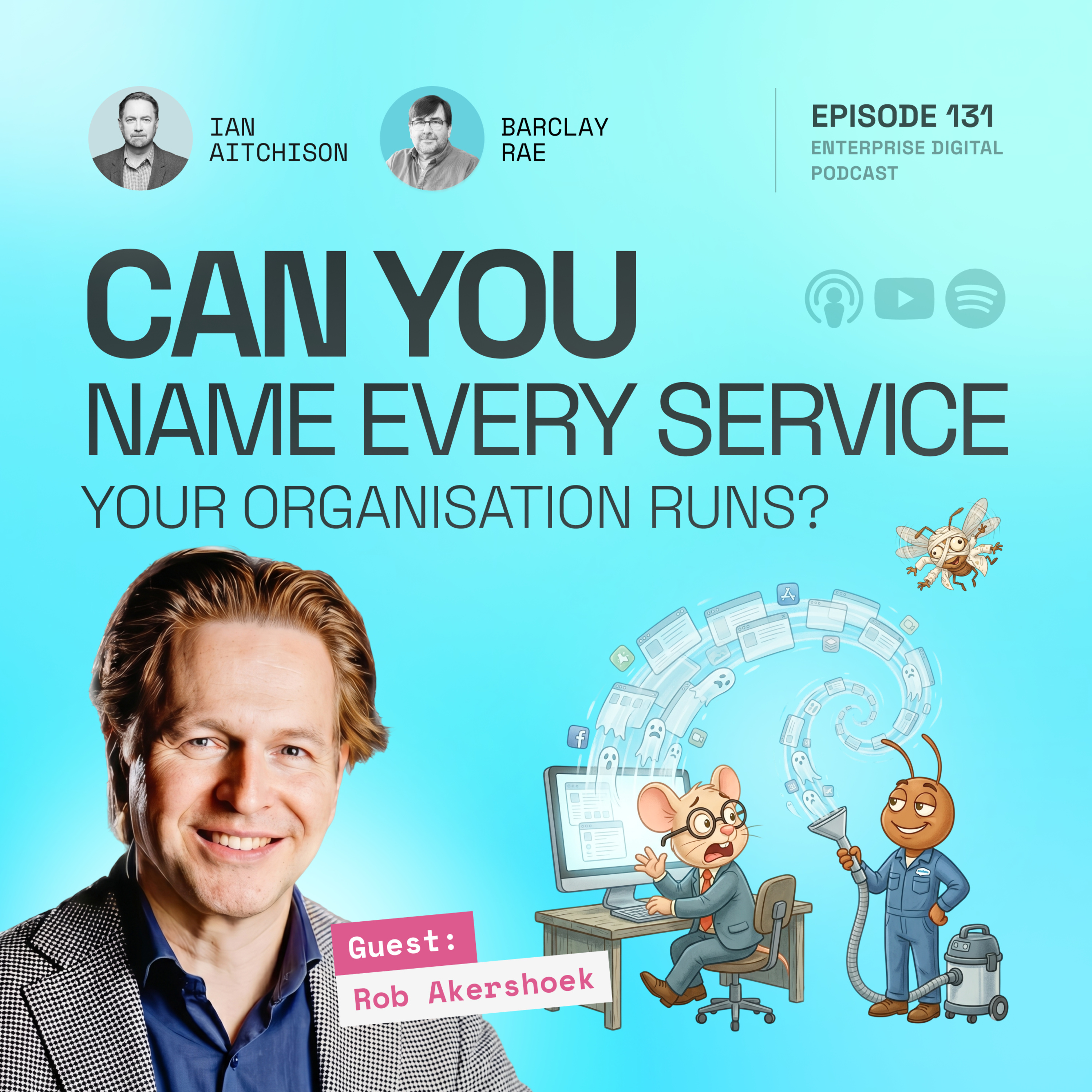
Episode 131: Can You Name Every Service Your Organisation Runs

Rob Akershoek joins Barclay and Ian this week for a conversation that will feel uncomfortably familiar to anyone who's ever tried to get a straight answer out of their organisation about what IT services it actually delivers.Most organisations can't produce a reliable, consolidated list of their applications and digital products, and that gap has direct implications for managing cost, risk, and value. Rob makes the case for treating the application portfolio as a foundational backbone, not an administrative exercise, and explains why the problem keeps recurring every time a new technology wave arrives, from SaaS to cloud to AI.The discussion covers why top-down and bottom-up approaches both have limits, how domain-based ownership structures can make the problem manageable at scale, and why the CMDB as currently used rarely does the job. Rob introduces the idea of a "licence to operate" for applications, a simple but effective policy mechanism that forces registration before contracts, infrastructure, or budgets can move forward.Ian brings his software asset management background to push back on whether discovery tools can fill the gap (Rob's view: they can't, not on their own), and Barclay draws on his own experience of organisations that have been circling this problem for years without resolution.Ian's trivia this week involves a digitally simulated fruit fly brain. It's relevant by the end. Just about.

April 2, 202624 min

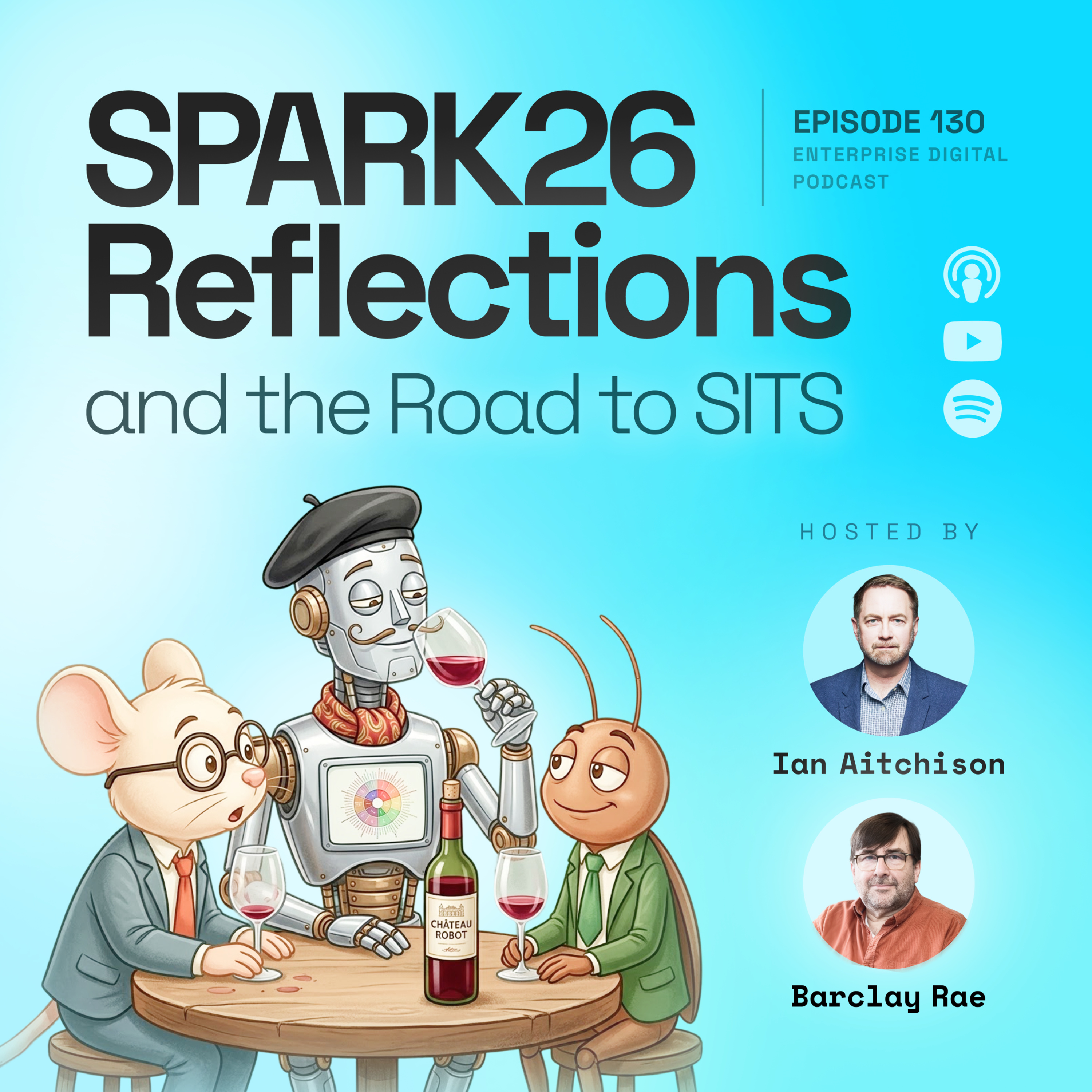
Episode 130: SPARK26 Reflections and the Road to SITS

Barclay and Ian are back this week, and after a brief detour into the world of AI-powered smell (yes, really), they settle in for a reflective look at the SDI SPARK26 show in Birmingham. What made it feel fresh? Which sessions stood out? And what separates a presentation that lands from one that doesn't?Ian shares highlights from four sessions, including Mark Boyer's case for why great service desks shouldn't exist, Roman Jouravlev's ITIL Experience session on experimentation and hypothesis-driven improvement, and Alistair Reid-Pearson on the power of storytelling. Barclay adds his own perspective on why stories connect where slides fall flat, and they're not shy about calling out the demo-as-keynote format that still, somehow, keeps happening.They round off with a preview of what's coming at SITS26, where the Enterprise Digital Podcast will be on stage for a keynote, and a film crew will be capturing interviews across the show. If you're going, come and find them.

April 1, 2026Episode 12952 min

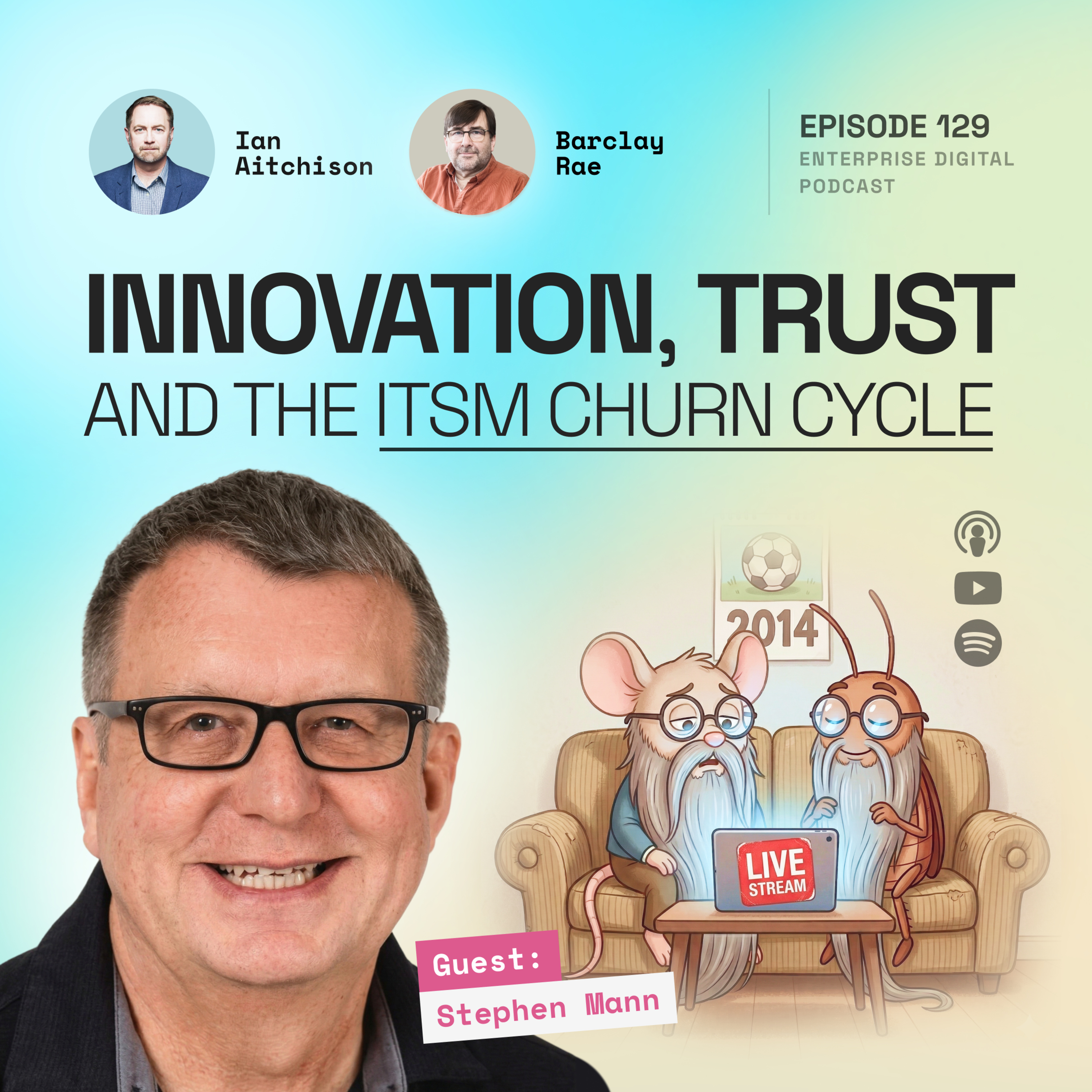
Episode 129: Innovation, Trust, and the ITSM Churn Cycle

Stephen Mann from ITSM.tools joins Barclay and Ian for a wide-ranging conversation about innovation, adoption, and why the industry keeps going round in circles. The discussion covers the gap between what emerging technology promises and what organisations are actually set up to receive.Why do organisations keep churning through ITSM tools rather than improving what they already have? Stephen makes the case, as he has since 2011, that real capability improvement often only happens when a new tool project creates the funding and focus to do what should have been done all along. At the end of the day, most tools do broadly the same things, and swapping one for another rarely solves the underlying problem. The group also picks apart the gap between selling a tool and retaining a customer, and what it means when those two things are handled by different people with different measures.The thread running through the whole episode is trust: trust in new technology, trust that the foundations are in place to make it work, and trust that the benefits will follow. Stephen's argument at the end is that the innovation most needed right now isn't in the tools themselves, it's in helping organisations get to a position where they can use them properly.

March 4, 202646 min

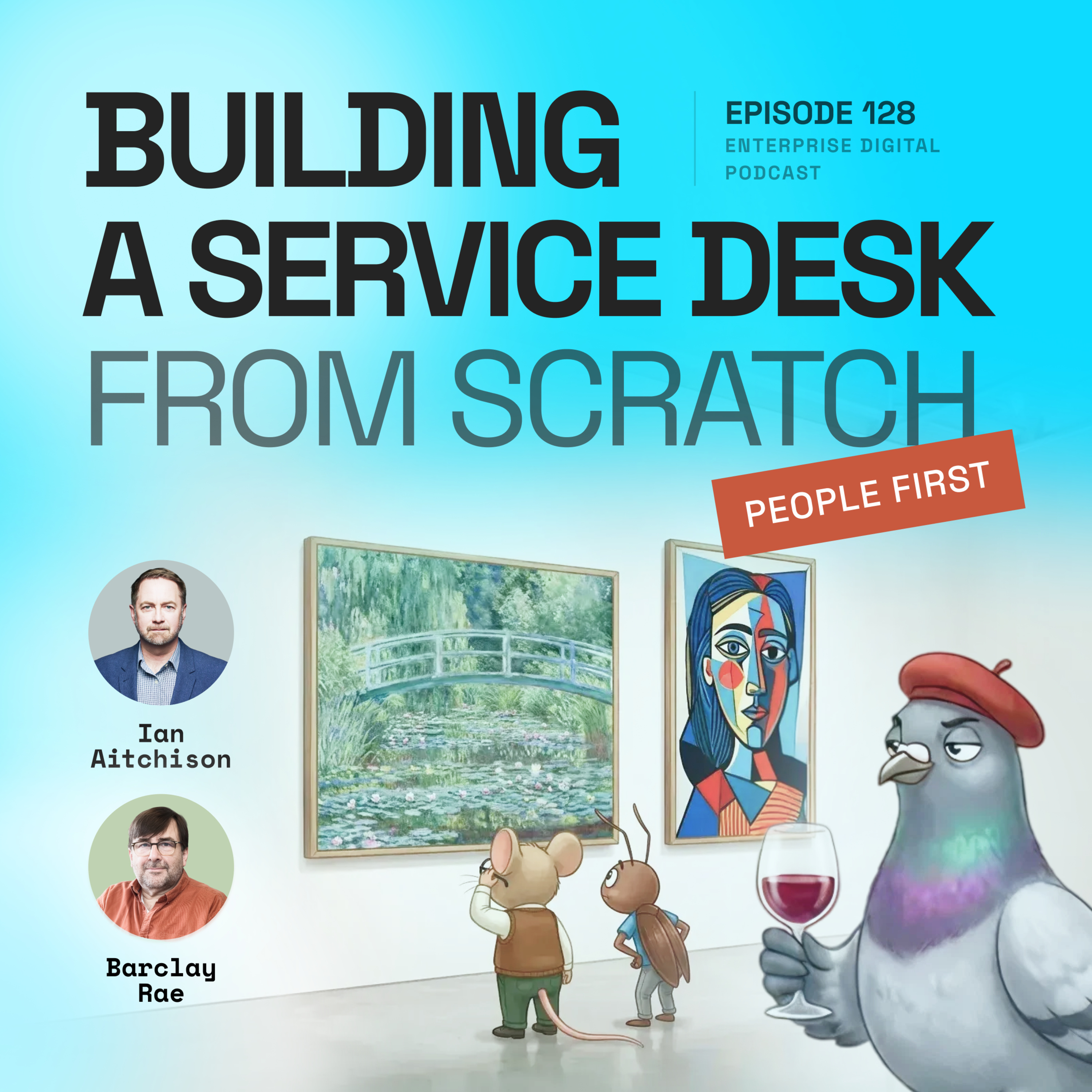
Episode 128 - Building a Service Desk from Scratch, People First

Episode 128 of the Enterprise Digital Podcast features Sarah-Jane Bulley, Service Delivery Manager, talking through what it looks like to build a service desk and ITSM operation from the ground up.Sarah-Jane is currently doing exactly that, designing and implementing everything from incident management and service request processes through to team structure, stakeholder engagement, and feedback management, all aligned with ITIL and delivered using an agile approach. She talks about where to start when there is nothing in place, why understanding your users and their specific needs must come before any process design, and how building your service desk as a brand within the organisation changes how other teams engage with you.The conversation covers the growing importance of major incident management in a world increasingly reliant on third-party cloud services, the balance between automation and human interaction, and what service empathy really looks like. Sarah-Jane makes a strong case that people will always be the heartbeat of any service desk, even as AI and automation take on more routine work.She also shares practical approaches to breaking down silos between the service desk and resolver teams, including shadowing exercises, shared feedback loops, and the importance of psychological safety across technology departments.This week's trivia explores whether pigeons can tell the difference between a Monet and a Picasso. Turns out, they absolutely can.

February 6, 202646 min

Episode 127 - Everything You Need to Know About ITIL (Version 5) So Far

Episode 127 of the Enterprise Digital Podcast is on the topic everyone in service management is talking about. Barclay Rae and Ian Aitchison are joined by Vicky Hunter, Portfolio Director at PeopleCert, to talk through the newly announced ITIL (Version 5). What has changed, what has stayed, and how it all came together.The big shift is a shared management lifecycle for digital products and services. Rather than treating product and service teams as separate disciplines with distinct languages, the new ITIL brings them together around a common way of working. Experience management, including employee experience, now sits as a layer across both.AI is in there, too, approached as a set of capabilities rather than a bolt-on topic. The seven guiding principles and all 34 practices remain, with minor updates to reflect the broader scope.The conversation also covers how the development team was deliberately built with a mix of long-standing ITIL contributors and people from outside the traditional ITSM community, and how early ideas were tested publicly before the formal announcement.This week's trivia explores whether tickling rats makes them more optimistic. Spoiler: it does.

February 4, 202647 min

Episode 126 - Neurodiversity in ITSM and the Workplace

Episode 126 features Faith Thomas, Lead IT Service Management Practitioner at the University of Birmingham, discussing neurodiversity in the workplace and how agile practices can create environments where neurodiverse teams thrive.Faith shares her personal journey through ADHD diagnosis, the relief and validation that came with it, and how understanding neurodiversity has changed her perspective on past behaviours and work patterns. She explains the advantages neurodiverse individuals bring to IT roles, particularly in problem-solving, empathy, and seeing solutions others miss, and why these aren't just nice-to-haves but genuine competitive advantages.The conversation covers how Faith's team successfully integrated agile practices like time-boxed stand-ups, structured retrospectives, and gratitude check-ins with service management, creating a framework that works particularly well for neurodiverse team members while improving outcomes for everyone. She emphasises the importance of awareness training for managers, the need to understand why people behave as they do rather than forcing them into rigid role definitions, and the risks that AI can perpetuate existing biases around disability, gender, and race.The episode also includes Ian's trivia on rising IT job demand and the discovery of chocolate honey made from cocoa bean waste.

January 21, 202640 min

Episode 125: Computing With Living Neurons, Rethinking How AI Is Built

Barclay and Ian are joined by Dr Ewelina Kurtys, advisor at FinalSpark, to explore biocomputing, using living human neurons as the physical basis for computing. Elina explains why modern AI is costly, how neurons process information differently from silicon, and why working with spikes in time and space creates both opportunity and challenge. The conversation covers what FinalSpark is building today, what could change behind the scenes of enterprise technology over the next decade, and why this work matters for energy use and long term AI accessibility.If it helps, when I was brainstorming the titles with ChatGPT it suggested the following prompt for design: The episode explores computing using living neurons rather than silicon. The cover should feel like discovery and curiosity, using our mascots encountering something alive and intelligent, abstract and biological rather than technical or sci fi.

Is this your show?

Claim this listing to keep it up to date, reach guests who want to pitch you, and manage bookings with Guestify.

Claim this listing

More Technology podcasts