Find partners
alphalist.CTO Podcast - For CTOs and Technical Leaders

alphalist.CTO Podcast - For CTOs and Technical Leaders

Hosted by Tobias Schlottke - alphalist CTO Podcast

Episodes

139

Latest episode

Jun 2026

Language

EN

About the show

This podcast features interviews of CTOs and other technical leadership figures and topics range from technology (AI, blockchain, cyber, DevOps, Web Architecture, etc.) to management (e.g. scaling, structuring teams, mentoring, technical recruiting, product etc.). Guests from leading tech companies share their best practices and knowledge. The goal is to support other CTOs on their journey through tech and engineering, inspire and allow a sneak-peek into other successful companies to understand how they think and act. Get awesome insights into the world‘s top tech companies, personalities with this podcast brought to you by Tobias Schlottke.

Listen to episodes

60 recent
June 4, 2026Episode 1391 hr 3 min

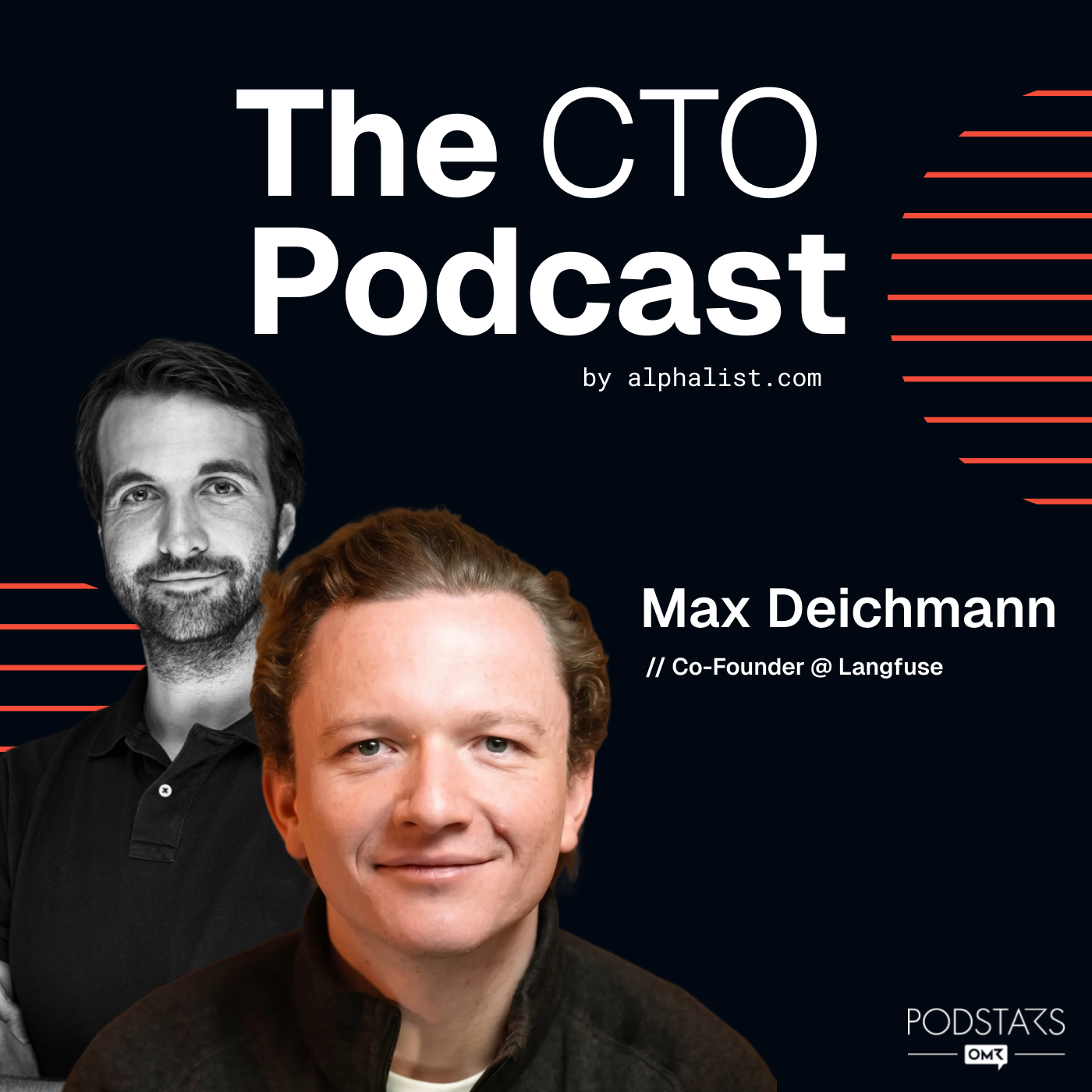
#139 Your Future Job Is a Decision Inbox — Max Deichmann Built the Layer That Gets You There // Co-Founder @ Langfuse

Max Deichmann is the co-founder of Langfuse, the open-source LLM engineering platform that became the observability layer of choice for teams building production AI agents, before being acquired by ClickHouse. He started as a business student who taught himself to code via CS50 on a beach in Singapore, pivoted through Y Combinator, fired his own customers mid-batch, and built Langfuse out of a Sunday night conversation about what they'd actually want to build if nothing was in the way. In this episode, Tobi and Max dig into what it really means to build and operate AI agents in production, not the LinkedIn version, but the 3 am alert, copy-pasted into Codex version. They cover the full loop: from pre-production experimentation and prompt iteration, to tracing, online evaluation, and the emerging architecture of agentic incident response. Max is unusually honest about where Langfuse itself still falls short, and what the next 12 months of the engineer's job actually look like. What CTOs will take away: a clear mental model for LLM observability vs. traditional observability, a practical blueprint for agentic on-call workflows, and a grounded view of where agents are genuinely working in production today, and where the hype still outpaces reality. Topics covered: Why traditional observability tools fail for non-deterministic AI applications The Langfuse loop: pre-production testing, tracing, online evaluation, and iteration How the ClickHouse acquisition happened, and the half-page doc that decided it Open source as a go-to-market strategy: adoption without a sales team Agentic on-call: how Max's team handles 3 am incidents with Codex today The "decision inbox" model, what the engineer's job looks like when agents do the work Where agents are genuinely succeeding in production (and where LinkedIn is lying to you)

May 21, 2026Episode 13841 min

#138 From Hacker News to W3C: How One Amazon Engineer Accidentally Shaped the Future of AI Browsers // Alex Nahas, MCP-B

Alex Nahas is 28 years old and has already initiated a W3C web standard. Working as a backend engineer at Amazon, he ran into a problem most enterprises face: MCP requires OAuth, but most enterprise infrastructure runs on SAML. His solution was elegant: run the MCP server in client-side JavaScript, letting AI agents use the browser's existing authentication context rather than rebuilding auth from scratch. What started as an internal tool became an open source project, then a viral Hacker News post published while under anesthesia, and ultimately an invitation from Google and Microsoft to help shape WebMCP as an official web standard. In this episode, Alex and Tobi explore what WebMCP actually is, why the browser is the most underestimated sandbox in AI development, and what the agentic web might look like two years from now. Topics covered: What MCP actually is and why it's just an RPC framework at its core Why OAuth is a dealbreaker for most enterprise infrastructure How WebMCP lets AI agents operate within existing browser authentication The Hacker News post that started it all, and why Alex doesn't remember posting it How Chrome is natively building WebMCP support The chicken-and-egg problem of standard adoption Real-time bidding for agents and what it means for digital advertising Why agents don't need their own identity Where the agentic web is headed in the next two years

May 7, 2026Episode 1371 hr 33 min

#137 - Only Three Search Engines Left Standing: One of Them Powers Your AI with JP Schmetz // Chief of Ads @ Brave

Most people assume the web runs on Google. The reality is more concentrated: only three companies on earth operate truly independent search indices — Google, Bing, and Brave. Jean-Paul Schmetz helped build one of them. In this episode, Jean-Paul traces the arc from writing appointment software in a Belgian Radio Shack in 1981, through founding and selling Clix — a European search engine backed by Burda — to his current role as Chief of Ads at Brave, where he now sells search infrastructure to the AI companies that need it most. For CTOs, this is a rare look inside an infrastructure layer most take for granted: how search indices are actually built, why it takes decades and hundreds of millions to do it properly, and why the entire AI grounding market quietly runs on infrastructure a small group of engineers spent their careers building. Topics covered: - Why only Google, Bing, and Brave have truly independent global search indices - How AI companies use search grounding — and what happens when Google and Bing cut them off - The SERP API gray market and why it probably has a two-year shelf life - What it actually costs to crawl and index the web at scale - The advertising model that will eventually come to AI — and why it's inevitable - Jean-Paul's Stanford years: machine learning with Andrew Ng, and what was obvious in 2013 that took until 2022 to matter - Build vs. buy for search infrastructure in 2025

April 23, 2026Episode 13656 min

#136 - AI Writes Code: Who Architects the Consequences? with Neal Ford // Software Architect & Author

Neal Ford: software architect, author, speaker, and independent consultant (formerly 20+ years at ThoughtWorks), joins Tobias to explore what happens to software architecture when AI agents write the code. We unpack the critical distinction between behavior and capabilities: why everyone focuses on what code does, but too few think about scalability, security, and responsiveness. Neal introduces architectural fitness functions as the essential guardrail for agentic systems, and explains why non-deterministic code generation demands deterministic tests. Finally, we dig into legacy modernization, the Dreyfus scale applied to LLMs, ephemerality as the new architectural dimension, and why AI is a multiplier, not a replacement, for experienced engineers.

January 29, 2026Episode 13537 min

#135 - From Legacy to Innovation: Yahoo's Modernization & AI with Lee Zen // CTO @ Yahoo

Lee Zen, CTO of Yahoo, joins Tobias to unpack what it takes to modernize one of the internet’s most iconic consumer portfolios—Mail, Finance, Sports, News, and Search—while operating with real legacy constraints at massive scale. We talk about Yahoo’s evolution from its public days to private equity ownership, how modernization actually happens (cloud, platform bets, experimentation), and why shipping velocity becomes the most honest forcing function when you’re rebuilding the engine mid-flight. Finally, we go deep on AI: where it meaningfully improves consumer experiences (mail catch-up, news takeaways, fantasy insights), how teams should avoid “AI labels” without user value, and what it means when AI becomes a tool—and increasingly a coworker.

January 15, 2026Episode 13454 min

#134 - From Inner to Outer Loop: Agentic Coding, Stacking PRs, and the Cursor Merger with Greg Foster // CTO @ Graphite

Greg Foster, Co-founder and CTO of Graphite (recently acquired by Cursor), joins the podcast to discuss the massive shift occurring in software engineering: the move from maximizing "Inner Loop" speed (writing code) to solving "Outer Loop" bottlenecks (reviewing, testing, merging). With AI generating code faster than humans can review it, the traditional Pull Request model is under pressure. Greg explains how "Stacked PRs" and agentic review workflows are essential for high-performing teams, and why he believes the role of the software engineer is evolving into an "architect of agents." We also cover the strategic rationale behind the Graphite/Cursor merger, the controversial "PRs per engineer" metric, and why he predicts that by 2029, manual code writing will be near zero—but demand for engineers will be higher than ever.

December 15, 2025Episode 13357 min

#133 - Build the Learning Machine: AI Adoption, Flow Metrics, and the Future of the CTO Role with Eric Bowman

Eric Bowman (CTO @ King.com, previously CTO at TomTom and VP Engineering at Zalando) returns to the alphalist podcast to unpack what “agentic engineering” really means in practice—and how to introduce it to teams without turning it into a mandate. We talk about the uncomfortable trade-offs behind “YOLO mode” tooling, why adoption should feel voluntary even when you set explicit goals (like “five AI-assisted commits” as a company-level key result), and why the real opportunity isn’t just faster coding—it’s building a learning system that relentlessly reduces time-to-learning and time-to-value. The conversation spans practical rollout patterns, DORA/value-stream thinking, Toyota’s Andon-cord mindset applied to software, multi-agent decision support with MCP, and why the CTO role may keep converging with product as AI pushes organizations to optimize for iteration speed over output volume.

November 27, 2025Episode 13254 min

#132 - Clarity Over Tooling: Velocity & Building Teams Without Drama with Loïc Houssier // CTO @ Superhuman Mail

What drives execution velocity—better tools or better clarity? Loïc Houssier, CTO of Superhuman Mail (post-Grammarly acquisition), argues that most velocity problems stem from unclear team missions, not inadequate tooling. From steering DocuSign's French acquisition through complex carve-out negotiations to building Superhuman's offline-first architecture with a 100-millisecond interaction rule, Loïc shares hard-won lessons about engineering metrics that actually matter (PR per engineer per week trends over absolutes), when to resist microservices (until it's genuinely painful), and why promotion frameworks determine product quality. Technical leaders will learn how vertical team alignment eliminates dependencies, why guild structures maintain consistency without blocking speed, and how European safety nets create under-appreciated opportunities for technical risk-taking.

November 13, 2025Episode 13151 min

#131 - AI Product Strategy: When to Build and When to Wait with Matthias Keller // CPO @ Kayak

Matthias Keller, Chief Product Officer at Kayak, shares hard-won lessons about AI product strategy and knowing when to invest in emerging platforms. With a PhD in computer engineering from ETH Zurich and 12 years at Kayak, Matthias has lived through multiple waves of AI hype—from Alexa voice skills in 2016 to today's LLM revolution. He discusses the strategic calculus of early platform bets, the painful lessons from experiments that didn't pan out, and how to recognize when technology has truly shifted. The conversation covers navigating distribution challenges when competing with giants like Google and ChatGPT, balancing first-mover advantage with execution realities, and how LLMs are democratizing AI development for engineering teams. Matthias emphasizes the critical framework: "if you build it, they may come—if you don't build it, they won't come."

October 16, 2025Episode 13053 min

#130 - From PhD Research to DuckDB: Building the Next Generation of Analytical DBs with Mark Raasveldt // CTO @ DuckDB

Mark Raasveldt, co-founder and CTO of DuckDB Labs, shares his journey from academic research at CWI Amsterdam to creating one of the most innovative analytical databases of the last decade. Mark discusses the technical challenges of building DuckDB from scratch, the philosophy behind embedded analytical databases, and why single-node performance still matters in our cloud-first world. He provides insights into open source business models, the evolution of data formats like Parquet, and how DuckDB is democratizing high-performance analytics for developers everywhere.

Is this your show?

Claim this listing to keep it up to date, reach guests who want to pitch you, and manage bookings with Guestify.

Claim this listing

More Technology podcasts