Small Podcast lessons (less than 9 minutes) with big value to help you plan, launch, and grow your podcast from Hall of Fame Podcaster Dave Jackson This podcast uses the following third-party services for analysis: OP3 - https://op3.dev/privacy
Listen to episodes
60 recent
October 16, 20266 min
What Podcasters Can Learn From Michael Jackson
I was messing around on Spotify when “Wanna Be Startin’ Somethin’” came on, and about halfway through it hit me: there’s no real chorus. It’s the same riff from start to finish, broken up only by a quick background vocal moment and that famous chant near the end. (Fun fact: when one of the background singers asked what they were singing, Michael told them it didn’t mean anything.) Put on headphones and give it a listen. The production is amazing, but underneath all the percussion it’s one simple riff doing its job. In this episode I share three lessons that song taught me about podcasting: Start simple. I see it on Reddit all the time: new podcasters asking about three-camera shoots, lighting rigs and neon signs. Then a few months later someone is selling that same gear because it turned out to be a heavy lift. When I auditioned for bands, I learned the few songs they asked for, not their whole 40-song set. Start with audio, or a phone on a monopod and a couple of wireless mics, and figure out if you like doing this before you spend $6,000. If it works, don’t change it. That one riff makes you bob your head and sing along. If your show is getting comments, emails or other signs of engagement, be patient and keep doing what you’re doing. Be creative. Michael found a way to insult the press that I’d never heard before or since. Find your own fresh way to say things. Links mentioned “ Wanna Be Startin’ Somethin ’” on YouTube Want help starting (or growing) your podcast? I’ve been podcasting for over 20 years, and I love helping podcasters. Join me at The School of Podcasting and use the coupon code listener on a monthly, quarterly or yearly plan. It comes with a 30-day money-back guarantee. I’m Dave Jackson, and I want to be your podcast consultant. This podcast uses the following third-party services for analysis: OP3 - https://op3.dev/privacy
October 2, 20268 min
Congrats, you just lost two copies. Learn a real backup plan
Back Up Your Podcast Before Your Hard Drive Decides For You My 4TB solid-state drive started disconnecting from my computer about once a day. Luckily, my podcast files were already backed up. In this episode I explain what a real backup is, which files are worth keeping, and why a hard drive failure is a matter of when, not if. In this episode: What counts as a backup. A backup means copies in two different locations . Your internal drive plus an external drive in the same house isn't enough. If your house burns down, you lose both copies. My setup. I keep my files on an external drive and back up everything, external drive included, to Backblaze . I also use iDrive as an extra cloud copy. How I organize my files. I have a Podcasts folder with a folder for each show. Inside each show are Production (intro music and similar files), Episodes (one folder per episode), and Finished (the exported final files). I record and edit from a saved Hindenburg template. What you can safely delete. In 20+ years, I've never gone back to rebuild an old episode from its raw files. I keep the project files for about a week in case someone spots a problem, like 10 seconds of dead air. After that, I keep only the finished episode. If your episodes are live, you haven't lost them. If they're still on your hosting platform ( Captivate , Buzzsprout , Blubrry , etc.), you can download them again. The files you used to make them are replaceable. Back up your files, not your software. You can always reinstall programs like Audacity. Back up what you create: audio, documents, spreadsheets. Hardware always fails eventually. My drive was only half full and about four years old. Cars, dishwashers and hard drives all wear out. Export your email list regularly. Your email list is one of your biggest assets, and there's no algorithm between you and your subscribers. Export it every so often in case something goes wrong with your provider. The bottom line: Keep one copy at home, on your computer or an external drive, and one copy online. Links mentioned: Backblaze (affiliate link) iDrive Hindenburg Audacity Want help with your podcast? Join the School of Podcasting at schoolofpodcasting.com and use coupon code LISTENER for a monthly, quarterly or yearly plan. Every plan comes with a 30-day money-back guarantee. This podcast uses the following third-party services for analysis: OP3 - https://op3.dev/privacy
September 11, 20268 min
We asked for feedback and heard crickets — here's why that's good
If you sent out a survey and got zero replies, that's actually an answer — it means you aren't connecting with your listeners or you asked the wrong thing. I know that stings, but hey, congrats, you found the sound of crickets. We need to sell the survey better, tell people how their answers will make the show better, and ask specific questions instead of "give feedback." Be persistent, offer a small prize, shout out anyone who helps, or take voicemails if forms feel stiff. I even tell a yellow-roses story to show that nice gestures alone won't cut it. If you want, I can help — we can fix this together. Takeaways: I put out a survey and got no answers, and that told me we are not connecting with listeners. We learned silence can be useful: it shows either a weak connection or bad positioning of the ask. I tell podcasters to sell the survey like an ad, explain benefits clearly, and ask more than once. I used the yellow roses story to show doing what you think is romantic can miss the point entirely. I advise asking specific questions, giving shout outs to responders, and using voicemail if forms flop hard. Links referenced in this episode: podcastconsultant.com schoolofpodcasting.com This podcast uses the following third-party services for analysis: OP3 - https://op3.dev/privacy
September 4, 20267 min
Are You AI-ing Yourself Out of Your Own Show?
Do You Know of a Tool? I was scrolling Reddit the other day when I saw someone ask if there was a tool they could use to write their podcast script. I couldn't help myself. "Yes," I said. "Your brain." Maybe that was a little snarky. Okay, it was a lot snarky. But I stand by it. Here's what I'm seeing more and more: people are "AIing" themselves right out of their own show. It usually goes like this. Someone finds a YouTube video that worked well for another creator. Instead of watching it and asking, "how can I do this in my own way and still sound like me," they grab the transcript, feed it to their favorite AI tool, and say "write this in my voice." And on YouTube, where the algorithm rewards volume over connection, it kind of works. Then they ask AI to whip up a thumbnail that looks suspiciously like the original, because on YouTube it really is all about the thumbnail. The problem is, the person doing this often doesn't fully understand what they're now saying on camera or on mic. Getting My Electronics Degree That reminds me of my lab partner Gary from college. My first degree, before I got into teaching, was in electronic engineering. I'm pretty sure I only got that associate's degree because of Gary. He was brilliant. I understood the math fine, but the electronics side threw me constantly, so Gary did the heavy lifting, I copied his work, and I walked away with a diploma and not much real understanding of electronics. That's exactly what happens when you let AI be your thoughts instead of your tool. You end up reading someone else's words with all the warmth of a bored McDonald's drive-through worker, then wondering why nobody connects with it. You can't be a thought leader on somebody else's thoughts. Think about how backwards that is. And if that approach ever landed you a speaking gig, then what? You'd have to ask AI to write the speech too. But AI Helps Me Do So Much More! I know the counterargument: AI helps you get so much more done, so much faster. I get it, I use it too. But think about two bowls of mashed potatoes. One came out of a box. The other is Grandma's, hand-mashed with a stick of butter and a healthy amount of salt. I grew up on the boxed kind. It's fast, it's easy, and it's fine. But nobody goes back for seconds on boxed potatoes. Grandma's bowl, you eat until it's empty and your stomach hurts. That's the difference. When you let AI write your content, you're serving your audience the boxed version, and they can tell. They Come For the Content and Stay For the HOST Here's the thing people forget: listeners come for the content, but they stay for the host. My very first podcast, years before the School of Podcasting existed, was called The Marketing Musician. I'd meet listeners of my current show who'd bring it up, and I'd assume they were musicians too. Almost every time, the answer was "no, I don't play anything, I just think you're funny." They didn't stick around for the topic. They stuck around for me. If you let AI take over as the host of your own show, you're left with nothing but AI. And if I don't need you anymore, I don't need your show either. I can just go ask AI the question myself. How I Use AI So here's how I actually use it. I don't let AI write my scripts. I let it help with research and organization. For my next School of Podcasting episode, I recorded my reflections on the Empowered Podcasting Conference by just talking into a microphone. No outline, just a brain dump, the way you'd brainstorm out loud. I ran that recording through Otter to get a transcript, then asked AI to pull out the main topics I'd already talked about and organize them in a way that flowed better, since I knew I'd circled back and added points out of order. I asked for a list of bullet points from what I'd said. Not new content, just my own words organized better. And honestly, it came out better than my original brain dump. I also lean on AI for images, because if I had to design my own graphics, you'd be looking at stick figure theater. Use AI for the things you're genuinely not good at, but keep yourself in your own podcast. Need Help With Your Podcast? If you're just getting started and thinking, "Dave, I don't even know where to begin with any of this," you know where to find me. Head to schoolofpodcasting.com and use the coupon code LISTENER for a discount on a monthly, quarterly, or yearly membership, and you can work directly with me and the community there. We've got step-by-step tutorials to walk you through everything. I've been doing this for over 20 years, I love helping podcasters, and I can't wait to see what we build together. I want to be your podcast consultant. Key takeaways Using AI to write your script in "your voice" strips out the one thing listeners actually stick around for: you. People come for the topic, but they stay for the host — lose the host, and you're just competing with AI itself. Use AI for research, organizing your own ideas, and things you're not skilled at (like graphics) — not for generating your content from scratch. A good process: record a brain-dump, transcribe it, then ask AI to organize and summarize your own words rather than write new ones. Links mentioned schoolofpodcasting.com — use coupon code LISTENER This podcast uses the following third-party services for analysis: OP3 - https://op3.dev/privacy
August 28, 20267 min
When an Interview Isn’t Good Enough to Publish
Should You Publish a Bad Interview? (Even If It Hurts Their Feelings) You just finished recording. The audio is clean, the guest showed up on time... and the conversation was completely forgettable. Do you publish it anyway, or do you tell your guest "no thanks" and risk an awkward, guilt-ridden conversation? A Reddit question kicks off this episode: a new podcaster recorded an interview that just wasn't interesting, and now feels guilty about shelving it. I break down why that guilt is misplaced, how to spot the guests who never cared about your audience in the first place, and the exact line you can use to say no without burning a bridge. In this episode, Dave covers: Why a "meh" episode is sometimes on you , not the guest — and the research questions to ask before you ever hit record How to spot a guest who wants to pitch himself to you instead of serving your listeners The pre-interview trick that saves you from wasting a full hour on a guest who isn't a fit The exact script to use when you have to tell someone their interview won't air Why setting the "I reserve the right not to publish" expectation up front makes the hard conversation so much easier The goalie mindset: why protecting your audience from mediocre content matters more than one guest's feelings A line worth remembering: "Do I want one stranger mad at me, or my entire audience going, 'Is it time to swipe left and unsubscribe?'" If you're building (or fixing) your podcast and want help with exactly this kind of decision, Dave's been coaching podcasters for over 20 years at School of Podcasting . Use coupon code LISTENER for a discount, backed by a 29-day money-back guarantee. This podcast uses the following third-party services for analysis: OP3 - https://op3.dev/privacy
August 21, 20269 min
I Let Claude Write My Show Notes — Here's What Happened
So Many Options I've been playing with AI (Claude, ChatGPT, Grok, and an all-in-one tool called Magi ) and I finally did the thing most of us avoid: I picked one and went deep instead of bouncing between tools. Hello Claude In this episode, I share what happened when I handed Claude a transcript and a few of my own blog posts and asked it to write my show notes, why I'm keeping AI on a short leash (folder by folder, not my whole Google Drive), and the bigger lesson underneath all of it: knowledge is only power when you actually do something with it. Whether it's AI, or finally plugging in that microphone that's been sitting in a drawer for three years, the principle is the same: knowing isn't the finish line. Doing is. On a Budget? I need to check and see what the difference of Claude in Magai, and a direct use of Claude. As Magai is $20 for a ton of tools, but much like many "all in one" systems, I may be missing some of the customizations. Key Takeaways Pick one AI tool and go deep , rather than chasing whichever tool looks coolest this week. They're all converging on similar features anyway. AI should polish what you've already created, not create it for you. I fed Claude a transcript and my own blog posts so the show notes would sound like me, not like generic "let's delve into a deep dive" AI-speak. Watching tutorials isn't the same as doing the work. I watch AI tutorials, then immediately try what I learned, and sometimes it's great, sometimes it flops, but either way I learn something. Start small and contained. I'm giving AI access to one dedicated folder on my computer, not my entire Google Drive, until I trust it more. The same principle applies to launching or growing your podcast. You don't need to know everything before you start. You need to plug in the mic, watch the levels move, and take the next small step. Resources Mentioned Magi , the all-in-one AI tool subscription I've been testing (~$20/month) Claude , the AI tool I chose to go deep with ChatGPT, Grok, other AI tools I've tested Wispr Flow , the voice-to-text tool I use to dictate show notes Craig Van Slyke, AI Goes to College : aigoestocollege.com Podcasting Observations newsletter: podcastingobservations.com Audacity , free recording software mentioned in the mic-setup example The School of Podcasting , weekly classes on growth and launching Work With Me I've been helping podcasters for over 20 years. If you've got the knowledge but haven't taken the next step, whether that's launching your show or finally growing it, that's exactly what I do as your podcast consultant. Head to the schoolofpodcasting.com to join a live weekly class, or reach out about working with me directly. From the Human I let Claude take a swing at the above show notes. I removed three of those stupid "M Dash" things, but the rest is AI. I'm not sold on how this is saving me time. It did write some social posts. This podcast uses the following third-party services for analysis: OP3 - https://op3.dev/privacy
August 14, 20268 min
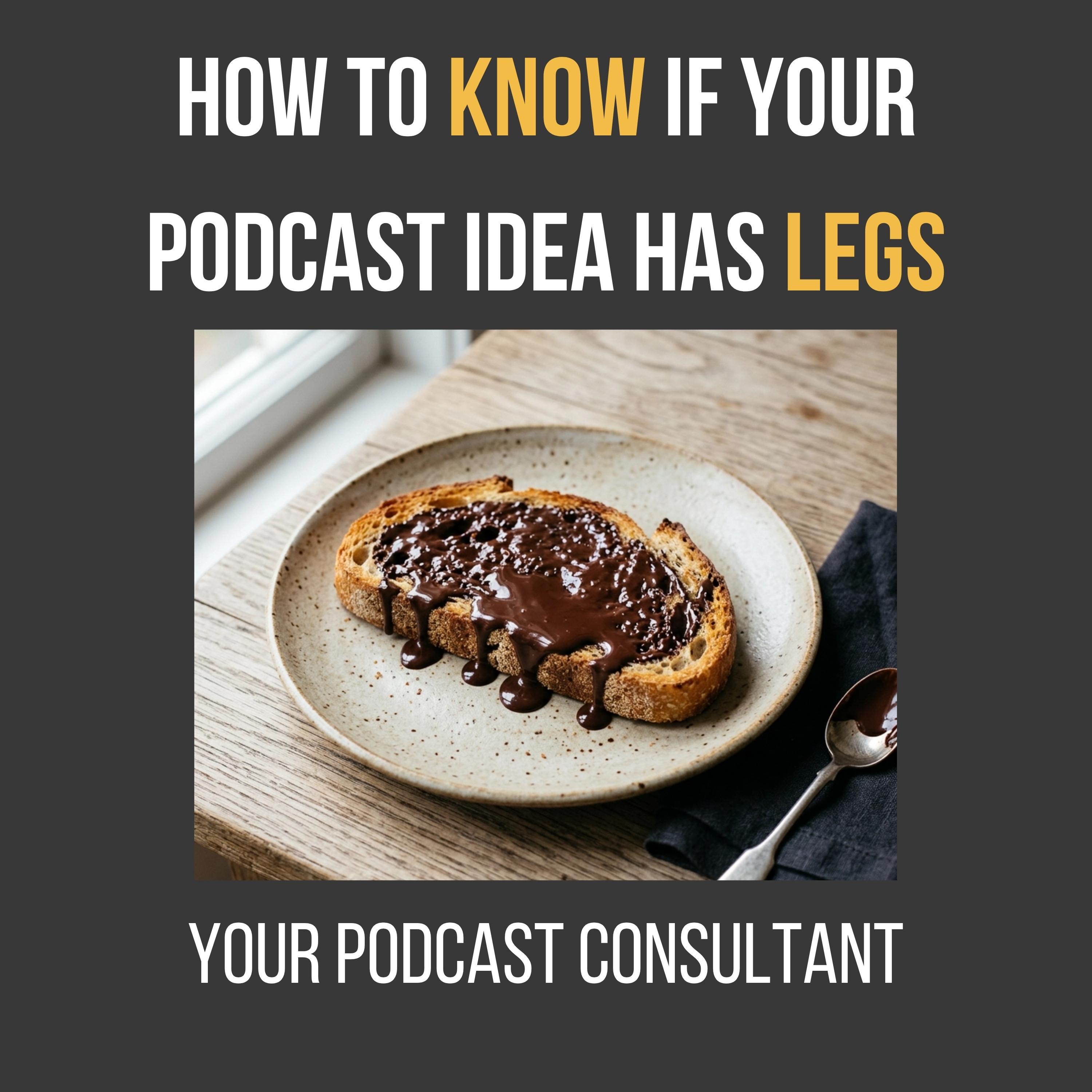
How to know if your podcast idea has legs
Does My Podcast Idea Have Legs? There's Only One Way to Find Out Most of the time, I cringe when I hear someone say "just start," because it usually sounds like advice from a person who isn't looking where they're going. Start what? For whom? Toward what goal? There is, however, exactly one situation where I will look you in the eye and tell you to just start your podcast, and it's the situation I keep running into over and over again on Reddit. Homework is Done - But Can't Press Record It shows up as a question that sounds reasonable but can't actually be answered: "Does my podcast idea have legs?" The person asking has usually done their homework. They've researched, they listen to plenty of shows, they have a format in mind and a list of episode ideas ready to go. What they're really asking is for someone to promise them their show will work before they ever hit the record button, and nobody on earth can make that promise. In this episode, I walk through why that question keeps people stuck, the chocolate toast test I use to think about any untested idea, and how to get honest feedback once you actually have something recorded. If you've been staring at the same pile of Post-it notes for the 400th time, this one is for you. Mentioned in This Episode School of Podcasting (coupon " listener ") Fix My Podcast (auditing service) This podcast uses the following third-party services for analysis: OP3 - https://op3.dev/privacy
August 7, 20268 min
Will This Help My Podcast? - An Email Answered
Will Joining the School of Podcasting Help Me? I got an email from someone who has been podcasting three months and they wanted to know if my "Grow Your Podcast" live classes would help them. Do I Need a Coach? Tiger Woods, Serena Williams, Oprah Winfrey, Kobe Bryant, Michael Jordan, Tom Brady, Bill Gates all had personal coaches. With this in mind having a coach is good (as I spotted three things wrong with your show after spending five minutes looking at it). I want to monetize eventually if it is possible but I’d say my podcast is more ministry focused right now Monetization? I wrote the book on it. Would there be other people in my space to have as guests or do podcast swaps with or are most of the people in your school more about business growth or AI growth etc.? Yes, we have collaborations with members all the time. I also have a resource list where you can find guests, etc. Examples, Dr. Craig Van Slyke is the host of AI Goes to College . Ralph Estep Jr. has been an accountant and business coach for decades. Would there be other things I need to invest in to be “successful” in your school? As always, "It depends" as I'm not sure 100% where you are, but for most people no if you're already going. In many cases you're just going in a slightly wrong direction. For example, yes YouTube is a discovery platform, but nobody is talking about how audio SMASHES video in audience 15 to 1 as there are many more opportunities to listen than to watch. So if you want to do video, do video, but you don't have to. Podcasting is simple (find out what the audience wants and give it to them in a fun and entertaining fashion), but not easy. I believe your downloads are equal to the value you deliver multiplied by your smart marketing efforts. I saw the creation of a podpage is free which I have thought about since I launched but still can’t decide if that is the best fit or a traditional website? Only if you want less headaches, more exposure, and a tool designed for podcasters (vs trying to squeeze your podcast into a yoga studio theme). I've been singing the praises of Podpage since I was hired by the founder back in 2020 (which got me in trouble at Libsyn where I worked at the time). I eventually left libsyn and joined Podpage because it's so amazing. Mentioned: School of Podcasting - Podcast Growth Course Dave's Private Coaching Podpage Takeaways: Joining the School of Podcasting can totally help you grow your podcast skills and audience. Monetization takes time and effort; you don't just slap ads onto a show and cash in! The community at the School of Podcasting is awesome for networking and swapping promos with fellow podcasters. Using tools like PodPage can save you headaches and help your podcast shine online, trust me! The Grow Your Podcast course starts on August 19th, and it's gonna be a blast! If you join now, you can participate in listener parties to get real-time feedback on your show. Join free with a money-back guarantee This podcast uses the following third-party services for analysis: OP3 - https://op3.dev/privacy
July 24, 20266 min
How Did Howard Stern Lose His Audience?
I Love Howard Stern I'm a huge fan of Howard Stern and have listened to him for decades. About five years ago, he said something that I didn't hear because I became very inconsistent in listening to him when he became very inconsistent in his schedule. His recent contract will have him broadcasting once a week, which, to me, just says, "Why not just retire?" This is how you lose your audience, though. How to Lose Your Audience I realized that some people like to talk about politics, and that is your choice, but just realize when you do, you're going to lose about 50% of your audience. This wasn't new to Howard. He would voice his opinion and explain who he endorsed for a candidate, etc., but there are politics and then there are far politics. By that, I mean far left and far right. When you go into far left or far right politics, you're going to lose a tremendous amount of your audience. Be a Sore Loser Then, throw on top of it that, when his candidate didn't win, he told his audience something that I still can't believe he said. If you want to lose your audience, follow Howard's strategy here, and you will. Want to GROW Your Audience? If you need help planning, launching, or growing your show, check out the School of Podcasting . If you have a show and you're frustrated by it's lack of growth, check out Fix My Podcast. Takeaways: Podcasting gives us the freedom to say what we want, but watch your back. Consequences are real, and sometimes they hit harder than a bad hangover. Talking politics in your podcast? Yeah, that might just lose half your listeners. Howard Stern's audience dropped because he told Trump voters he hated them. Oops. Staying neutral is key, unless you want to alienate half of your audience. Remember, the Internet never forgets, so think before you hit publish. This podcast uses the following third-party services for analysis: OP3 - https://op3.dev/privacy
July 17, 20265 min
Make Great Titles - But NEVER Do This
The Key To Great Podcast Episode Titles Episode titles can make or break your podcast’s appeal, but there’s one crucial mistake you must avoid: clickbait. In this episode, Dave Jackson explains what makes a great episode title. Start with the listener’s benefit, including relevant keywords, and, above all, being truthful. He shares why misleading titles erode trust and waste your audience’s most valuable resource: their time. Join Dave as he explains how to craft honest, enticing titles that draw listeners in without deception and keep your audience coming back for more. It Takes Years To Build Trust, and One Piece of Clickbait to Lost it You might be enticed to exagerrate when it comes to your titles and thumbnails, but we've all been there when you realize someone just wasted your time, and you can't get it back. Need Help With Your Podcast? Check out the School of Podcasting . This podcast uses the following third-party services for analysis: OP3 - https://op3.dev/privacy
Is this your show?
Claim this listing to keep it up to date, reach guests who want to pitch you, and manage bookings with Guestify.