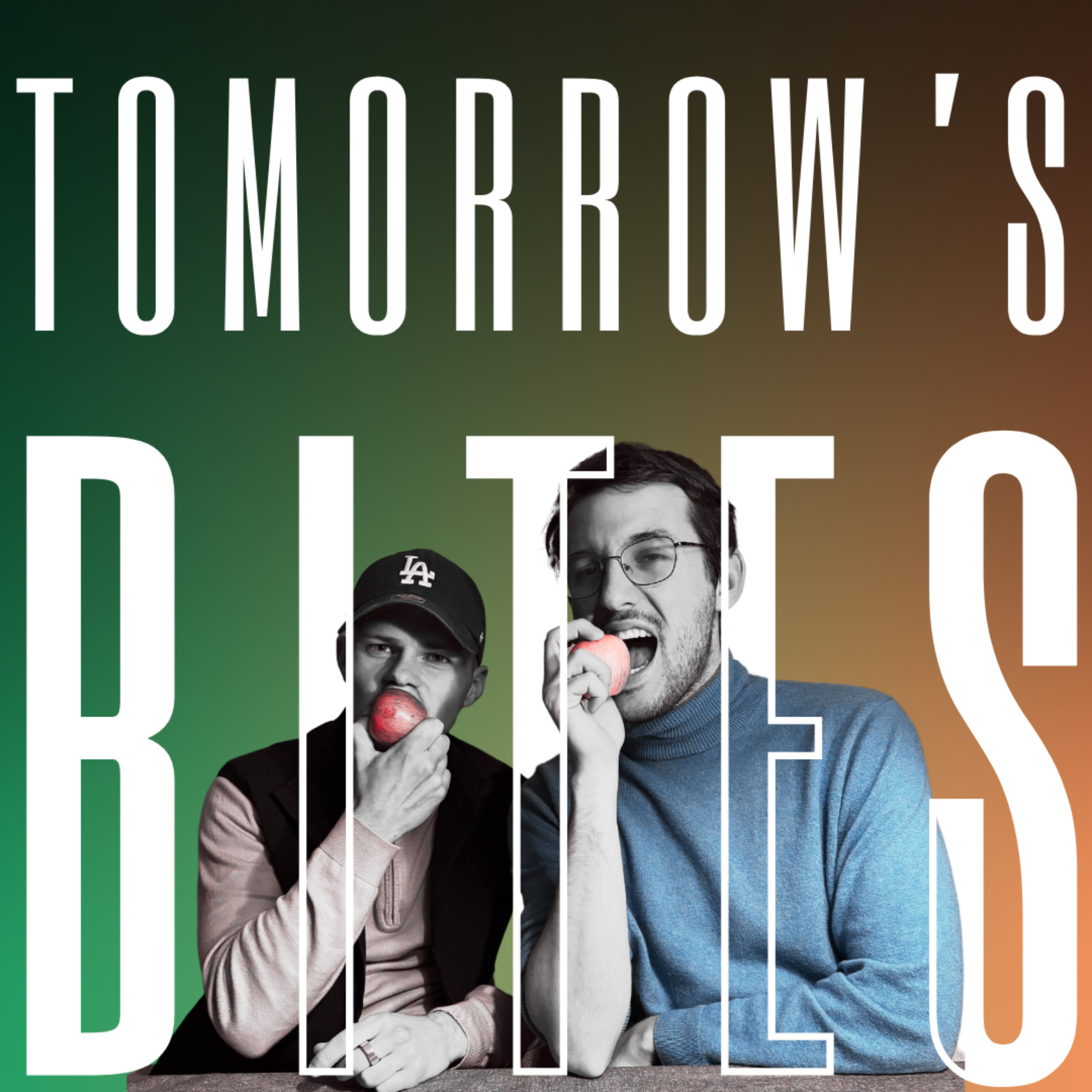
Food is a problem and this podcast is full of solutions. Hosted by Andrés and Sjacco, Tomorrow’s Bites takes you inside the minds of the food founders, experts, and investors building or supporting the food businesses that are shaping the future of food. Each episode, we open their playbook: the breakthroughs, the failures no one talks about, and what it really takes to turn a food business into a household name. If you’re making an impact in food, building a food business, or just hungry to understand where it’s all headed, this podcast is for you.
Listen to episodes
60 recent
September 9, 202612 min
The Part That Listeners Didn't Skip: Why This Tea Founder Refuses to Buy Anything He Hasn't Tasted at the Farm - from our conversation with Sergey Shevelev, Founder Moychay International
Sergey Shevelev learned Chinese so he could skip the middleman. Before smartphones, he communicated with his first tea supplier through broken English and clunky translation software. Then he went further. He left the markets behind and went straight to the farms, the fields, the forests. His rule is simple: he only buys tea he has tasted himself at the factory. Today he works with 25 to 30 farmers growing wild tea from plantations left unfertilized for decades, some from trees over a thousand years old. With Sergey, founder of Moychay International, we cover what quality really means, why clean soil comes first, and why the right technologist makes or breaks a product. In 13 min you learn how sourcing at origin builds a tea brand worth trusting.Listen to the full conversation here .
September 2, 202656 min
The Secret Retail Tactics This Ex-Category Manager is Using To Sell Healthy Cocoa Spreads in Every Supermarket - with Co-Founder of Orthonia, Olivier Laporta
For years, Olivier sat in the comfortable chair. As a category manager at Delhaize, he was the one giving suppliers a thumbs up or thumbs down, deciding what made it onto the shelf. Now he's on the other side of the table, sending emails that go unanswered for three weeks, waiting on a single order that his cash flow depends on. In this episode of Tomorrow's Bites, we sit down with Olivier Laporta, co-founder of Orthonia, to unpack what it actually takes to put a healthier cacao spread on a shelf already owned by one of the most beloved brands in the world. In this conversation, Olivier reveals what the two sides of the shelf taught him: The four P framework a category manager uses to decide your fate, and why your margin can kill you before your product ever gets tasted Why the same power he once held now feels horrible from the supplier's seat How he and Katharina bought machines, drove a small truck to a factory, and started producing themselves, then spent a 30-degree summer day under a broken machine to save a single order Why keeping production in-house is a pain that's also their protection against copycats The uncomfortable Nutri-Score A line they refuse to cross, even when a B would be easier The rebrand and the investor warning about calling something chocolate when there's no cocoa butter inside Why organic ingredients here cost three times conventional, not the usual 15%, and the split-range decision that tension is forcing This is a conversation about power, margins, shelf life, and the unglamorous mechanics of getting a better product into someone's hands. If you're building a food brand and trying to crack retail, this is the episode to hear before your first buyer meeting. Share it with a founder about to pitch a category manager. 🙏 LEAVE A REVIEW If you like our podcast please leave us a review on your favourite platform – even one sentence helps! Thank you for your support; it helps the show a lot and it helps others to discover the show! 👋 GET IN TOUCH WITH US 👥 Linkedin 📸 Instagram 🌎 Website 😊 The Guest: Olivier Laporta 🍫What he does: Orthonia
August 26, 202633 min
Building in Public #10: How To Negotiate Contracts On Your Terms With Investors (Without Killing Your Company) with Andres Jara Co-Founder of Favamole
The clause looked harmless. Sign here, get the money, keep building. But with a twist: sign it, and the company starts bleeding out before anyone notices. In this Build in Public episode of Tomorrow's Bites, Andres Jara is back after what he calls a crazy month, one spent buried in term sheets, convertible loans, and the small print that can quietly kill a startup. This isn't the polished version. It's the one where his confidence dropped through the floor, he stopped posting on LinkedIn, and a single clause held up his entire runway. The lesson underneath it all: before you negotiate with anyone, write a contract with yourself. In this conversation, Andres breaks down what that actually means in practice: Why knowing your non-negotiables before the first meeting makes investors respect you more, not less The "most favorable terms" clause that pitted his two investors against each other, and how he got them in a room instead of playing ping pong between them Why investors love to negotiate when you're under time pressure, and how planting a seed months earlier saved him The condition that trapped him: show 80% of the budget, but once the money lands, you can't borrow to cover the gap Where AI actually helped, and the one thing he'd never outsource to it before calling a real advisor Why an investor who wants a say in every decision is the moment you stop owning your company The difference between a scarcity yes and an abundance no when the runway is shrinking And the conversation with his mother, at nearly midnight on the worst day, that reframed the whole thing 🙏 LEAVE A REVIEW If you like our podcast please leave us a review on your favourite platform – even one sentence helps! Thank you for your support; it helps the show a lot and it helps others to discover the show! 👋 GET IN TOUCH WITH US 👥 Linkedin 📸 Instagram 🌎 Website
August 19, 20261 hr 17 min
He Said "NO" To Retail… Now His Food Brand is Growing To €2M/Year - With Renco Schipper Co-Founder Snack with Benefits
What does the journey look like of a €2M+ Snack Brand ? In this episode of Tomorrow's Bites , we sit down with Renco Schipper , co-founder of Snack with Benefits — a Dutch vegetable snack brand that built its way to €2 million in revenue without ever relying on retail. Starting with a dinner for a plant-based friend, a borrowed kitchen at Kitchen Republic, and his father driving cauliflowers from the field to Amsterdam every weekend, Renco built a brand that now supplies restaurants, wholesalers, and catering companies across the Netherlands — and is eyeing Germany next. The secret? He said no to the supermarket when the moment wasn't right — and doubled down on the food service channel that was already working. We explore: Why Renco walked away from a listing in 400 Albert Heijn stores — and why he'd make the same call again How a bag of potato crisp waste from a Frisian factory became Snack with Benefits' signature crunch — and saved over 300,000 packages from the bin The "IKEA recipe method" that protects your formula when you hand production to a manufacturer Why getting into a wholesaler is only the start of the game — and what actually drives orders once you're listed How Snack with Benefits went from producing cauliflower bites by hand on weekends to hitting 40% quarterly growth with a brand new sales team Why the snackification trend is bigger than the microwave revolution — and what that means for everyone working in food Renco also shares what it's like to build a company with your life partner, why co-founders who share the same deadline sleep better than most, and what it took to turn a €15 student investment into a 250-euro return — back when he was 17. 🙏 LEAVE A REVIEW If you like our podcast please leave us a review on your favourite platform – even one sentence helps! Thank you for your support; it helps the show a lot and it helps others to discover the show! 👋 GET IN TOUCH WITH US 👥 Linkedin 📸 Instagram 🌎 Website 😊 The Guest: Renco Schipper
August 12, 20266 min
The Part Listeners Didn't Skip: Why This Food Founder Said No To Scaling Fast Her Beverage Brand - from our conversation with Kamogelo Thumankwe, Co-Founder of Tsarona
An investor called Tsarona the next Oatly, the next Matcha. For most founders that's the dream. Kamogelo Thumankwe said no. Scaling fast that way meant betraying the mission the beverage brand was built on. Her business partner wasn't happy. A mentor told her to just do the milk and scale it. She turned it down anyway. With Kamogelo, co-founder of Tsarona, we talk through the real cost of choosing mission over fast money, why fitting in wasted her time, and what listening to actual customers taught her. In 7 min you learn how a mission-driven food founder decides when growth is worth it and when it isn't.Listen to the full conversation here .
August 5, 202658 min
How Food Scanning Apps Are NOW Reshaping Retail and What This Means to Your Food Brand - with co-founder of FLTRD, Anke Kuik
Half of all Dutch citizens live with a chronic disease. Anke Kuik looked at that number, then looked at the supermarket, where more than 70% of the products are ultra processed, and asked the question nobody was acting on: if we know this is making us sick, why is it still the easy choice? In this episode of Tomorrow's Bites, we sit down with Anke Kuik, co-founder of FLTRD, to unpack what it takes to build a food app that scores products on how processed they are, and to challenge the way we've all been taught to read food labels. Anke didn't come from food. She built and sold a data and privacy company one year before GDPR went live, then combined that background in data and technology with a new obsession: why healthy choices are so hard to make. Her first version tried to do everything. Recipes, education, shopping lists, all outsourced to an external tech company, all too expensive to change. She stripped it down to one thing that actually worked. The result is the Pure Score, a zero to 100 system validated by the University of Applied Sciences in Amsterdam, built on more than 5,000 individually scored ingredients. In this conversation, Anke reveals: The three mechanisms that actually make ultra processed food bad for you, and why "more than five ingredients" is the wrong way to think about it Why a fresh vegetable and a frozen one score exactly the same in her system How the same additive can score green in a tin of tomatoes and cost you points in a soft drink Why she won't give plus points for probiotics, even when the label brags about them What the Nutri-Score gets wrong, and why a red salmon score confuses everyone Why she's now licensing the score to the same supermarkets she started by scraping data from The uncomfortable trust problem waiting for her the day a supermarket becomes a partner Why 7,000 monthly users and a French app called Yuka convinced her the timing is finally right This is a conversation about focus, food literacy, and the messy reality of turning a health mission into a business people will pay for. If you build, brand, or sell anything people put in their mouths, this episode will change how you read the back of the packet. Share it with someone who scans labels and still isn't sure what they're looking at. 🙏 LEAVE A REVIEW If you like our podcast please leave us a review on your favourite platform – even one sentence helps! Thank you for your support; it helps the show a lot and it helps others to discover the show! 👋 GET IN TOUCH WITH US 👥 Linkedin 📸 Instagram 🌎 Website The Guest: Anke Kuik 🌱 Look into the company: FLTRD
July 29, 20268 min
The Part Listener's Didn't Skip: How Your Starting Food Business Can Beat Multinationals (Just like Oatly) - from our conversation with Assistant Professor Wageningen University Caspar Krampe
Oatly was oats mixed with water and oil. No patent. No breakthrough technology. It still took share from a dairy industry a hundred times its size. Caspar Krampe, food researcher at Wageningen University and co-founder of VGreens, explains why that happened. Big food companies rarely innovate. They defend, using standards and lobbying to keep smaller brands out. Startups have two ways through. One is co-evolution, trading knowledge for resources with an incumbent. The other is what Oatly did: start with a niche that has no alternative, then build the brand fast enough that the giants can't respond. With Caspar, we cover why this works in food and almost never works the way it does in tech. In 11 min you learn which of the two paths fits your food business. Listen to the full episode here
July 22, 20261 hr 13 min
Adam: How One Farmer Built 100 Products From One Crop, Without a Business Degree - With Adam Palmer Regenerative Farmer & Entrepreneur of the Honest Bean & more
What do you do when you realise at 19 years old that farming alone will never pay the bills and you have no business degree, no brand experience, and one crop to work with? In this episode of Tomorrow's Bites , we sit down with Adam Palmer , regenerative farmer and founder of Littleseed , Charlie & Ivy's , and The Honest Bean Company a man who built over 100 products from a single farm on the hills of the Yorkshire Wolds, entirely through trial, error, and the fearlessness of not knowing what he didn't know. Adam went fully regenerative in 2019, no pilot, no small trials, straight in. He stopped ploughing overnight, rebuilt his soil from scratch, and quietly became one of the last cold-press rapeseed oil producers standing in the UK after a market of 60 or 70 brands rose and collapsed around him. Along the way, he learned branding the hard way, watched a product fail because the label was dark blue, relaunched it and saw a 60% sales uplift without changing a single ingredient, and then turned a bucket of stolen fava beans from a neighbor's shed into a snack brand consumers genuinely love. We explore: Why Adam went fully regenerative overnight — no trials, no safety net — and what happened to his soil, his yields, and his bills How farming taught him that soil is an asset, not a surface — and why most farmers around him still haven't made that shift The 66-bottle farmer's market moment that convinced him to build a food brand from scratch What a brand consultant standing in a Scottish farm shop aisle taught him about why good products fail How raw fava beans sent to locked-down strangers on the internet became the research behind The Honest Bean Company This is a story about what happens when a farmer refuses to just be a commodity supplier and builds an entire ecosystem of value from a single piece of land. 🙏 LEAVE A REVIEW If you like our podcast please leave us a review on your favourite platform – even one sentence helps! Thank you for your support; it helps the show a lot and it helps others to discover the show! 👋 GET IN TOUCH WITH US 👥 Linkedin 📸 Instagram 🌎 Website 😊 The Guest: Adam Palmer Look into Honest beans
July 15, 202635 min
Building in Public #9: How To Win Essential Partnerships With Retailers, Wholesalers and Farmers with Andres Jara Co-Founder of Favamole
What if the real reason your retail partnerships aren't converting has nothing to do with your product and everything to do with how you think about the word "sales"? In this episode of Building in public , we check back in with Andres Jara , founder of Favamole , for another building-in-public update, and this one goes deep on the thing that nobody in food business school teaches you: how to actually build relationships across an entire supply chain, without ever reducing people to the role they play in your revenue model. From farmers to wholesalers to restaurant chefs, Andres has been learning — often the hard way — that every link in the food supply chain runs on the same currency: trust. And trust, it turns out, follows seasons, requires patience, and has almost nothing to do with a cold email. We explore: Why the "valley of death" for food startups isn't about cash flow — it's about whether partners believe you'll still be there next year How Andres thinks about wholesalers not as logistics partners but as ecosystem players — and why that changes everything about how you show up in a meeting The dinner that changed how he thinks about stakeholder relationships: inviting chefs, farmers, investors, and caterers to celebrate the supply chain itself Why the word "cold" in cold outreach is the real problem — and how reframing it shifts the energy of every message you send How timing within natural seasons should dictate when you talk to farmers, restaurants, and retailers — and why ignoring that rhythm costs you relationships What's coming after summer: a new retailer listing, a product rebrand, and a flavor born from subtraction, not addition 🙏 LEAVE A REVIEW If you like our podcast please leave us a review on your favourite platform – even one sentence helps! Thank you for your support; it helps the show a lot and it helps others to discover the show! 👋 GET IN TOUCH WITH US 👥 Linkedin 📸 Instagram 🌎 Website
July 8, 20261 hr 5 min
Vincent: How to Build a Winning Food Brand in 2026: An Investor's Honest Take - with Founding Partner of Gota Ventures, Vincent Kuiper
In this episode of Tomorrow's Bites, we sit down with Vincent Kuiper, founding partner of Gota Ventures, to build what might be the most honest roadmap for launching a food brand in 2026. Vincent has now covered over a dozen case studies of breakout CPG brands. Graza, Chomps, Upfront, Good Girl Snacks... What he found across all of them isn't what most founders expect to hear. Vincent started investing at 16. His father gave him a brokerage account with 50 euros as a birthday present and said: just play with it. Fifteen years later, he co-founded an international angel syndicate of 55 investors from 15 countries, many of them former insiders at Cargill, Unilever, and major beverage companies, built specifically to open a food industry he calls a closed ecosystem. What he learned from the inside is this: most food startups don't fail because the product is bad. They fail because they try to change how people behave. In this conversation, Vincent breaks down the full journey from idea to shelf: Why the most overlooked categories in the supermarket are the most interesting ones to build in right now The one metric he checks before anything else when a food brand lands in his inbox Why he would not invest in an electrolyte brand today, and what that says about copycat risk across the whole CPG space How Chomps reached 900 million in revenue with two or three SKUs, and what most founders do instead The manufacturing decision that founders always get wrong in the first year When D2C is a testing lab and when it becomes a crutch Why retail velocity matters more than follower count when he's doing due diligence What he thinks about Upfront's move into supermarkets, and why he's watching it closely This is a conversation about commercial reality, category timing, and the discipline it takes to build something that lasts beyond a trend cycle. If you are building a food brand or thinking about it, this is the episode to listen to before you make your next move. Share it with a founder who is about to scale before they are ready. GOT SOMEONE IN MIND? TELL US WHO WE SHOULD BRING NEXT. 🙏 LEAVE A REVIEW If you like our podcast please leave us a review on your favourite platform – even one sentence helps! Thank you for your support; it helps the show a lot and it helps others to discover the show! 👋 GET IN TOUCH WITH US 👥 Linkedin 📸 Instagram 🌎 Website 😊 The Guest: Vincent Kuiper Look into: Gota Ventures
Is this your show?
Claim this listing to keep it up to date, reach guests who want to pitch you, and manage bookings with Guestify.