Find partners
Thrivecast

Thrivecast

Hosted by By ThriveStack AI

Episodes

71

Latest episode

Jun 2026

Language

EN

About the show

Unlock the secrets of Product-Led Growth success and thrive with expert insights, strategies, and success stories in every episode! www.hybridgtm.com

Listen to episodes

60 recent
June 13, 202633 min

Life Maxxing in the AI Era

In this episode of ThriveCast, we speak with Dave Guttman, founder of Guttman Media and serial entrepreneur with eight- and nine-figure exits — who at 24 was misdiagnosed with terminal cancer and given six months to live. Dave shares why burnout is a leadership failure, how to build cultures that retain great people across companies, and why AI makes it easier than ever to build a genuinely great life. Essential for founders navigating the pressure of scaling without burning out.Key Insights* Burnout is a symptom, not the disease. If your team is burning out, Dave’s view is direct: that’s a leadership failure. People working 60–70 hours a week at his Forex trading company didn’t feel burned out — because they had autonomy, support, and equity. The work environment determines whether intensity energizes or destroys.* Fortune over specialness. Dave draws a sharp line between thinking you’re special and knowing you’re fortunate. Anyone born to the same DNA and circumstances would have achieved the same things. That reframe kills entitlement and keeps gratitude intact.* Hardships are the curriculum. Every positive quality Dave can name in himself traces back to something bad — dyslexia, a difficult childhood, a cancer scare. He doesn’t frame any of it as trauma. He frames it as things that happened, from which he learned. “You either win or you learn.”* Work-life integration, not balance. Balance implies trade-offs. Integration means doing things you like, with people you enjoy, in areas you find interesting. During his daughter’s childhood, Dave took fewer risks and prioritized presence. Once she left for college, his risk profile shifted dramatically. Life stage determines the model.* The CEO’s greatest leverage is the culture match. The closer your value system is to the CEO’s, the happier you’ll be in an organization. As the CEO, your values are the organization — which means your primary job is filling it with people who share your moral compass.* Absorb blame, deflect credit. Leaders who take full responsibility when things go wrong and hand credit to the team when things go right build teams that follow them from company to company. This is how Dave has had people work with him across five or six ventures.* Call them co-workers, not employees. The word matters. Putting co-workers first isn’t charity — it’s strategy. Dave’s 35 years of experience point to one consistent finding: when the team comes first, the company results follow.* Internal and external core values are different tools. Internal values (grit, discipline, integrity, curiosity) govern who you hire, promote, and reward. External values govern who you partner with and what you build. Both require team input to earn genuine buy-in — and the leader has to live them visibly.* Hire for humility and curiosity above all else. Capable people can develop ego. Curiosity is the quality that keeps the smartest person in the room learning. Dave’s standard: strong positions, loosely held. He reversed a business decision on the spot when his head of marketing proved him wrong — and said so publicly.* AI is non-negotiable to embrace. Dave’s verdict for every person he mentors, regardless of role: go down the AI rabbit hole and become an expert. “It’s either get on the bus or the bus is going to run you over.” At 60, he says he’s never been more excited about what’s possible.* Imposter syndrome signals healthy humility. Dave feels it constantly. His view: if you don’t feel any imposter syndrome, you’re probably lacking the humility you need. The only real measure of leadership is whether the people you lead think you’re a good leader.* Mentorship is mutual. The thing that surprised Dave most after 30 years of mentoring: he learns at least as much from the people he mentors as they learn from him.Actionable Takeaways* Audit your culture for inertia. If your culture hasn’t been deliberately designed, it’s just whatever accumulated through hiring and circumstance. Decide what it should be before it decides for you.* Define two separate sets of core values — one internal (for hiring, promoting, rewarding people) and one external (for partnerships, products, and client decisions). Involve the full team in selecting them.* Build a rotating core values award program. Award the first round yourself. Then make each recipient responsible for awarding it to someone else the following quarter, with a small monetary prize attached. This distributes ownership of the culture.* Give equity to every leader on your team. If they’re working 60+ hours, they should be building something for themselves, not just for the cap table. Equity converts effort into investment.* Reframe performance pressure conversations. When someone on your team is burning out, don’t treat it as a workload issue — diagnose the leadership gap. Are they getting autonomy? Support? Clear vision? Adequate resources?* Test leadership candidates on humility, not just capability. Ask for examples of times they were wrong. Watch how they react to being challenged in the room. Capability without humility is a liability at scale.* Live your values visibly and publicly. If you say integrity matters and then act without it, the value is worthless. Core values only work when leadership models them without exception.* Stop managing the scoreboard you’re winning. If your relationships are failing and your health is declining while the company grows, you’re optimizing for the wrong metric. Life Maxing means being excellent in multiple domains simultaneously, not sequentially.* Curate the people around you deliberately. Who you work with determines how work feels. If integration (not balance) is the goal, then hiring people you genuinely enjoy spending time with is a business decision, not a luxury.* Go down the AI rabbit hole — now. Dave’s instruction to everyone he mentors: it’s not optional, it’s not role-specific, it’s not a future priority. Start today.Resources Mentioned* GuttmanMedia.com — Dave Guttman’s company. (gutmanmedia.com)* RealDaveGuttman (YouTube) — Dave’s YouTube channel. (Search “Real Dave Guttman” on YouTube)* Dave’s TED Talk — About his experience being misdiagnosed with terminal cancer at 24. * LinkedIn Profile* Life Maxing (book) — Co-written by Dave Guttman and an 18-year-old mentee. If you're a Founder or Growth Leader feeling the pressure of building in the AI era, this episode is a recalibration. Dave Guttman's evidence isn't theoretical — it's 35 years of exits, failures, mentorship, and a near-death experience that rewired how he thinks about success. The goal was never to build a great company. The goal was to build a great life, and the company is part of it.🎧 Loved the episode?Subscribe to ThriveCast for more behind-the-scenes stories from the builders shaping the future of SaaS. This is a public episode. If you would like to discuss this with other subscribers or get access to bonus episodes, visit www.hybridgtm.com
May 9, 202644 min

Why Great Products Fail And How to Shorten the Adoption Curve

In this episode of ThriveCast, we speak with Holley Miller, Founder and President of Grey Matter Marketing — a strategist who sits at the rare intersection of market behavior, messaging, and product adoption. With 30 years spanning medical devices, pharmaceuticals, and SaaS, Holley brings a cross-industry lens to one of the biggest blind spots in innovation: why great products fail to drive adoption — and what founders and growth leaders can do about it. In this conversation, she unpacks the psychology behind why markets resist change, how to identify the "disgusters" that actually make people switch, and why belief, not features, is the true engine of growth.Key Insights* “Build it and they will come” is a myth. Two out of three products in healthcare fail due to adoption failure and not product failure. SaaS sees the same dynamic, only faster and more brutally.* Human brains protect the status quo. Regardless of industry or role, people are wired to resist change. Getting someone to switch is genuinely hard, and most companies underestimate this.* Solve disgusters, not just delighters. A four-quadrant framework - Delighters, nice-to-haves, annoyances, and disgusters, shows that loyalty and switching behavior is driven by eliminating disgusters, not by adding delightful features.* The problem is audience-specific. A canceled flight is a disguster for a CEO but an opportunity for a college student. The pain you solve must match the acuity of the audience experiencing it.* Lead with the problem, not the solution. Customers are searching for relief from a problem and not for your product. Websites and messaging that open with solutions skip the step of earning relevance.* The brain uses only three categories: must-have, nice-to-have, or not interested. You have 10 seconds or less to earn a “must-have” before you’re dismissed.* People don’t want a drill, they want a quarter-inch hole. Customers buy what a product unlocks for them, not the product itself. Most companies market the drill.* Preference ≠ adoption. True adoption means customers wouldn’t substitute you even if pushed. If they can replace you without friction, you haven’t created advocates just users.* One company captures ~76% of market share in almost every category. Everyone else fights for scraps. The path to becoming that company starts with owning a specific niche, not chasing a broad audience.* Numbers don’t buy growth, belief does. Belief is contagious. It spreads faster than features and compounds faster than revenue. Companies that tip markets create belief, not just products.* Simplicity is velocity. Learning velocity is the speed at which you test assumptions, refine messaging, and align your narrative to market reality is what shortens the adoption curve.Actionable Takeaways* Start with the problem, not the product. Audit your homepage: does it lead with a problem your audience is already experiencing, or does it jump straight to your solution?* Map your audience on the four-quadrant grid (delighters / nice-to-haves / annoyances / disgusters) and ruthlessly identify which disguster you can uniquely eliminate for a specific segment.* Identify your precise beachhead audience — the niche where the problem is most acute and your solution is most irreplaceable. Own that before expanding.* Question your launch assumptions. Before going to market, list the assumptions you’re making about customer behavior and explicitly test which ones could be wrong.* Create the conditions for inevitability: Is the problem urgent enough? What does the customer have to reject (their status quo)? Who are all the stakeholders that need to believe?* Build a narrative, not a pitch deck. Teach the market to recognize the problem, imagine the transformation, understand the criteria for a solution — then position yourself as the only one who meets it.* Use monday.com’s playbook for niching. Build targeted landing pages for each specific audience segment, experiment across dozens of niches, and double down on what gains traction.* Lead emotionally, justify rationally. Emotional resonance triggers the decision; data gives buyers the conviction to stand behind it. Lead with transformation, follow with proof.* Track learning velocity, not just revenue velocity. How fast are you testing messaging, use cases, and channel assumptions? Faster learning directly shortens your adoption curve.* Intersect with customers where influence lives — the right venues, voices, and communities where your target audience gets their information and makes decisions.Resources Mentioned* Grey Matter Marketing — Holley Miller’s firm, specializing in market strategy, messaging, and adoption acceleration across life sciences and SaaS.* Holley Miller on LinkedIn — Holley shares ongoing insights on product adoption, market behavior, and growth strategy.* Crossing the Chasm by Geoffrey Moore — The technology adoption lifecycle (innovators → early adopters → early mainstream → laggards) referenced in the episode as the blueprint every category eventually follows.* Theodore Levitt’s “Quarter-Inch Drill” concept — From the Harvard Business School professor who coined the famous insight: “People don’t want to buy a quarter-inch drill. They want a quarter-inch hole.” Foundational to jobs-to-be-done thinking.* monday.com — Referenced as a case study in niche-led growth: building hyper-targeted landing pages for hundreds of audience segments to find the ones that convert, then scaling from there.If you're a founder, product leader, or growth marketer building in a crowded market, this episode is a sharp reminder that adoption is not a byproduct of a great product — it's a discipline. The companies that win aren't always the ones with the best technology. They're the ones who understand human behavior deeply enough to make their product feel inevitable: solving an urgent, undeniable problem for a precise audience, in a way no one else can, and building the market belief that makes switching feel irrational. This is a public episode. If you would like to discuss this with other subscribers or get access to bonus episodes, visit www.hybridgtm.com
April 18, 202637 min

Beyond Vibe Coding: The AI Software Factory

In this episode of ThriveCast, we speak with John Kennedy, co-founder of Actual AI and a veteran Dev Tools leader (AWS, Acquia, Upsun), who shares how engineering teams are moving beyond manual coding into building “software factories”; by leveraging AI-managed Architectural Decision Records (ADRs), John explains how teams can eliminate “vibe-coded slop,” enforce architectural consistency, and unlock a new model of linear acceleration with enterprise-grade governance.Key Insights• Vibe coding often leads to inconsistent and unscalable code (“slop”).• AI-generated code can degrade architecture, security, and maintainability over time.• Slop is not just bad code it’s anything that slows down development velocity.• Individual AI workflows are powerful, but lack consistency across teams.• Architectural Decision Records (ADRs) act as guardrails for AI-generated code.• Most teams still rely on passive documentation, which is outdated and reactive.• AI can now analyze entire codebases and auto-generate architectural rules.• Software factories enable 24/7 autonomous development with AI agents.• Organizations using software factories can achieve 10x–100x development velocity.• The future of engineering is shifting from writing code to improving the factory itself.Actionable Takeaways• Avoid relying solely on vibe coding for production systems.• Establish clear architectural guardrails (ADRs) before scaling AI development.• Use AI to analyze and codify existing codebase decisions.• Shift engineering focus from writing code to improving systems and processes.• Invest in building a custom software factory within your own cloud (VPC).• Optimize for time-to-production (speed of idea → deployment).• Reduce token usage and iteration cycles through better upfront decisions.• Encourage engineers to become “software factory engineers” instead of coders.Resources Mentioned• Actual AI — Platform that helps teams build AI-powered software factories with guardrails, ADRs, and autonomous agents.• G-Stack (Gary Tan) — Open-source framework for rapidly prototyping AI-powered applications and workflows.• Gastown / GAST — Open-source software factory framework for building agent-driven development pipelines.• AI Tinkerers — Community of builders and engineers exploring practical AI applications and workflows.If you’re a CTO, engineering leader, or developer building with AI, this episode highlights that modern software velocity doesn’t come from writing more code it comes from building systems, enforcing architectural guardrails, and evolving your team into software factory engineers who can continuously accelerate delivery at scale. This is a public episode. If you would like to discuss this with other subscribers or get access to bonus episodes, visit www.hybridgtm.com
April 4, 202636 min

From Agency Hustle to an Exit: The AI-Native GTM Playbook

In this episode, Johann Nogueira shares his journey from building multiple ventures to exiting his AI-driven GTM platform. With over 20 years of experience, he walks through how he transitioned from a high-stress agency model to a scalable, product-led, and ultimately white-labeled distribution engine. The conversation dives deep into leverage, ecosystem-led growth, AI-first teams, and the future of work, offering practical lessons for founders navigating modern GTM.Key Insights* Leverage beats effort - systems that run independently create exponential outcomes* Distribution > product complexity - ecosystem access drove faster growth than feature expansion* Confused buyers don’t convert - simplifying to one core use case (lead gen) unlocked adoption* White-labeling is a growth multiplier - partners became the primary distribution channel* Value creation is the true scorecard - more value → more scale → more impact* AI amplifies output, not headcount - small teams can now operate at 5–10x capacity* Agent-to-agent economy is emerging - AI will transact, negotiate, and operate autonomously* Foundational skills still matter - tools are abundant, but execution remains scarceActionable Takeaways* Focus on one high-impact use case instead of building multi-feature products* Leverage existing ecosystems to unlock faster distribution* Build partner-ready assets (scripts, demos, guardrails) to scale indirect sales* Design your company for AI-first workflows before hiring* Optimize for output per employee, not team size* Use AI to compress execution cycles (proposals, campaigns, ops)* Avoid overcomplicating your pitch clarity converts faster than capability* Treat growth as a function of value delivered, not effort investedResources Mentioned* GoHighLevel — white-label CRM ecosystem enabling distribution* ZoomInfo — lead intelligence tool referenced for comparison* Clay — GTM automation and enrichment workflows* Manus AI — used for generating assets like proposals and brochures* B1G1 — platform for embedding impact into business transactionsIf you’re a B2B SaaS founder, growth leader, or GTM operator, this episode highlights that modern scale doesn’t come from bigger teams or more features—it comes from leveraging ecosystems, simplifying value, and embracing AI to multiply output. This is a public episode. If you would like to discuss this with other subscribers or get access to bonus episodes, visit www.hybridgtm.com
March 28, 202654 min

AI in GTM: Hype, Hope, and What Actually Works

In this episode of ThriveCast, we host a panel with Molly Bowden (GTM Operations Leader), Jonathan Carford (VP GTM Strategy at Momentum), and Gururaj (Founder of ThriveStack) to unpack how AI is actually changing go-to-market today cutting through the hype to explore real use cases, shifting buyer expectations, the importance of data foundations, and why most AI pilots fail without strong processes and strategy. Key Insights* Buyers now conduct AI-assisted research before ever speaking to sales.* Marketing website traffic is declining as AI search tools intercept discovery.* SaaS budgets are increasingly shifting toward AI-first tools and experimentation.* Many companies are automating broken processes instead of fixing them first.* AI delivers the most value when optimizing existing workflows, not replacing them.* Conversational intelligence is emerging as a powerful source of customer insight.* Sales ramp time can significantly improve through AI-driven coaching and role-play.* Poor data foundations remain the biggest barrier to successful AI adoption.* Many GTM teams are buying AI tools without strategy or clear ROI.* The future GTM stack requires unified data across marketing, product, sales, and customer success.Actionable Takeaways* Fix broken processes first before applying AI automation.* Invest early in clean, structured GTM data foundations.* Use conversational intelligence to capture real customer insights.* Apply AI to improve ramp time and productivity for GTM teams.* Avoid buying shiny AI tools without clear outcomes.* Build systems that unify marketing, product, revenue, and support signals.* Shift GTM strategy toward customer value creation instead of mass outreach.* Focus on improving the buyer experience, not just seller efficiency.Resources Mentioned* Momentum - AI-powered conversational intelligence platform that captures sales call insights and syncs them with CRM, product, and GTM workflows.* Clay - GTM data automation platform used for lead enrichment, prospecting workflows, and orchestrating outbound campaigns.* Sendoso - Sending platform that helps GTM teams personalize outreach using gifts, direct mail, and experiences.If you’re a B2B SaaS founder, RevOps leader, or GTM operator, this discussion reinforces a critical lesson: AI alone won’t transform your go-to-market motion—real impact comes from strong data foundations, disciplined processes, and using AI to amplify customer value rather than chasing automation hype.🎧 Loved the episode?Subscribe to ThriveCast for more behind-the-scenes stories from the builders shaping the future of SaaS. This is a public episode. If you would like to discuss this with other subscribers or get access to bonus episodes, visit www.hybridgtm.com
March 14, 202638 min

Product Got Easier. Distribution Got Brutal.

In this episode of ThriveCast, we speak with Matthew Whyatt, B2B SaaS growth advisor and founder of techtorque.co, who shares why the dynamics of SaaS growth have fundamentally changed while AI has made it dramatically easier to build products, generate content, and reach prospects, the real challenge today is distribution, as markets become flooded with automated outreach and AI-generated noise; Matthew explains why trust, specialization, and personal influence have become the true competitive advantages for founders trying to stand out and grow in the modern SaaS landscape.Key Insights* AI has dramatically lowered the barrier to building SaaS products.* Prospect data and outreach tools have made lead sourcing easier than ever.* Mass automation has created a tsunami of outbound noise.* Poor outreach often creates awareness but sends prospects to competitors.* Buyers now research extensively before ever speaking to sales.* Trust is built during the buyer’s research phase, not the sales call.* The companies publishing insights consistently win attention.* Narrow specialization builds stronger positioning than broad messaging.* Personal brands are becoming powerful distribution engines.* Execution and consistency matter more than perfect marketing tactics.Actionable Takeaways* Narrow your target market to become the obvious expert.* Expand your circle of influence within your industry.* Build trust through consistent insights and educational content.* Convert internal expertise and answered questions into public content.* Create low-friction offers that provide value before a demo.* Encourage founders or domain experts to build visible personal brands.* Focus on consistent execution instead of marketing perfection.Resources Mentioned• Velocity Selling — Bob Urichuck• The 7 Habits of Highly Effective People — Stephen R. Covey• The Greatest Salesman in the World — Og MandinoAbout SpeakerMatthew Whyatt is a seasoned sales strategist, Growth advisor, and podcast host who partners with SaaS and B2B tech companies (typically $1M–$20M revenue) to scale their go-to-market performance. With a mission to de-stigmatize sales and highlight its foundational value, Matthew brings insights from decades of selling, coaching, and leading teams across industries.🔗 Matthew Whyatt on LinkedIn🌐 Website: techtorque.coIf you’re a B2B SaaS founder, GTM leader, or product builder, this episode reinforces a critical shift: when everyone can build products and publish content, sustainable growth comes from specialization, credibility, and consistently earning your market’s trust.🎧 Loved the episode?Subscribe to ThriveCast for more behind-the-scenes stories from the builders shaping the future of SaaS. This is a public episode. If you would like to discuss this with other subscribers or get access to bonus episodes, visit www.hybridgtm.com
February 7, 202645 min

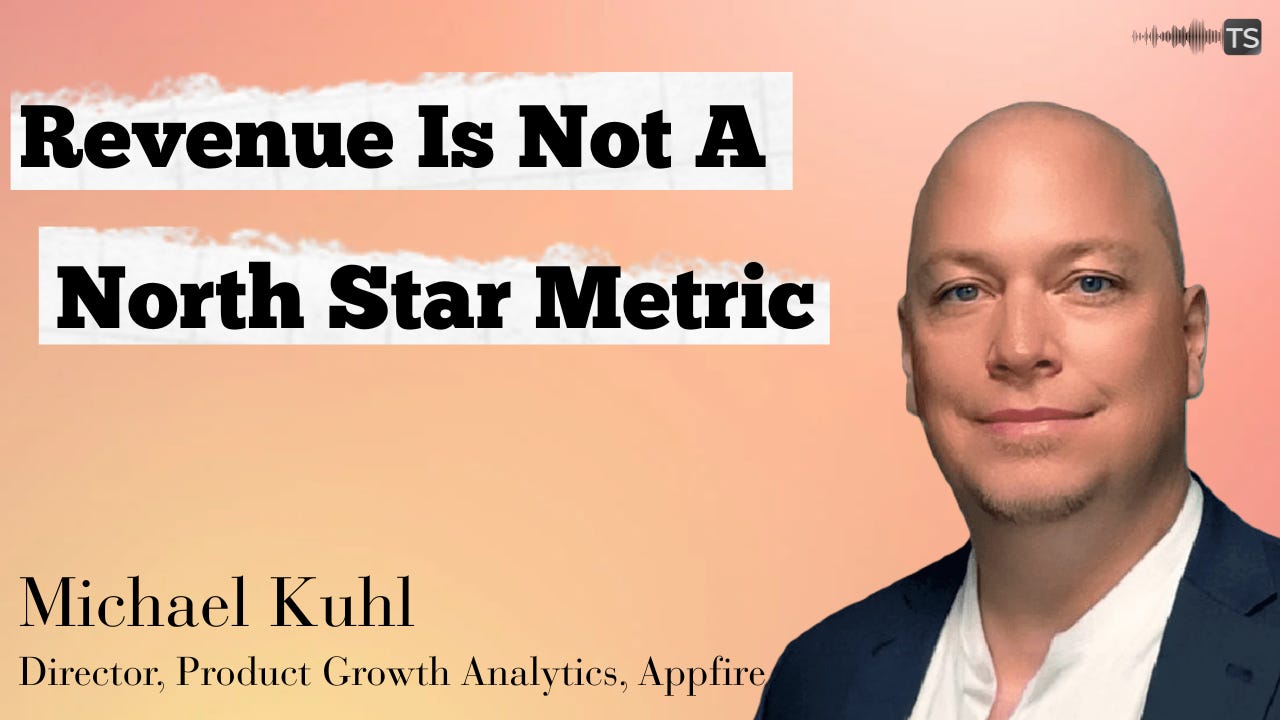
Revenue is not a North-Star metric

In this episode of ThriveCast, Michael Kuhl shares how AppFire shifted from obsessing over revenue and churn to building a growth engine powered by leading indicators. Drawing from AppFire’s scale—managing dozens of products—Michael explains how activation journeys, real-time signals, and cross-functional alignment became the foundation for predictable revenue growth.Key Insights* Revenue, churn, and conversions are lagging indicators—they explain what happened, not why* Activation is the strongest predictor of trial conversion and long-term retention* Growth starts with visibility, not optimization* A standardized activation journey framework enables scale across multiple products* Instrumentation should answer specific questions, not collect everything* Growth intelligence only matters when it leads to clear actions* Real-time signals are most powerful when shared across Product, Marketing, Sales, and Customer SuccessActionable Takeaways* Define a clear activation journey (signup → setup → aha → habit) before optimizing conversion* Instrument only what helps you understand why users fail to reach value* Treat growth data as actionable intelligence, not dashboards for reporting* Align GTM teams around the same real-time signals, not siloed metrics* Tie signals directly to revenue at risk or revenue opportunity to drive prioritization* Give every team a clear call to action, not just data to interpretResources Mentioned* Activation journey mapping frameworks* Growth experimentation playbooks* Real-time behavioral and firmographic signals* Cross-functional dashboards tied to revenue impactFor B2B SaaS founders, growth leaders, and product teams, this episode is a reminder that growth doesn’t come from more dashboards—it comes from understanding when users struggle, acting in real time, and aligning every team around leading signals that actually move revenue. This is a public episode. If you would like to discuss this with other subscribers or get access to bonus episodes, visit www.hybridgtm.com
January 31, 202649 min

How Cloudinary scaled from 0-$100M+ ARR

In this episode of ThriveCast, we speak with Sanjay Sarathy, VP of Self-Serve and Developer Experience at Cloudinary. Sanjay shares Cloudinary’s journey from a developer consulting firm to one of the most successful product-led growth stories in SaaS—scaling past $100M ARR while maintaining a strong self-serve engine and developer trustKey Insights* Cloudinary started as a consulting company before productizing a repeated developer pain* Developers were treated as the core growth channel, not just users* Early investment in developer support and documentation drove trust and word of mouth* Self-serve and enterprise were built as a continuum, not competing motions* Freemium created value first, revenue followed naturally* Word of mouth still drives a significant share of daily signups at scale* Simplifying signup and activation had outsized impact on growth* Not all product launches succeed, fast failure led to better product strategyActionable Takeaways* Treat your primary user persona as a growth engine, not a funnel step* Invest early in support, docs, and activation, not just sales* Let self-serve usage reveal future enterprise opportunities* Reduce friction relentlessly small changes compound at scale* Separate product experimentation from core revenue products* Build trust first; monetization follows naturallyResources Mentioned* Cloudinary self-serve and freemium model* Developer documentation and SDK-first onboarding* Activation and signup flow experiments* Product incubation model for new betsIf you’re a B2B SaaS founder, PLG leader, or developer-focused product team, this episode shows that sustainable growth doesn’t come from aggressive selling it comes from earning trust, removing friction, and letting value scale naturally across self-serve and enterprise journeys. This is a public episode. If you would like to discuss this with other subscribers or get access to bonus episodes, visit www.hybridgtm.com
January 24, 202641 min

GTM Growth Audit - by Marlena Sarunac

In this episode of ThriveStack’s podcast, we speak with Marlena Sarunac, an award-winning CMO and co-founder of Company Advice. Marlena shares her GTM Growth Audit framework, a practical, systems-thinking approach to identifying hidden bottlenecks across product experience, website messaging, and go-to-market execution especially for early-stage and scaling SaaS companies.SPONSOREDDemand & Expand is coming! Join 600+ B2B Marketers May 19 & 20, 2026 for the hottest event in San Francisco. Demand Gen, Growth, AI Marketing, Lifecycle, and Marketing Ops—This is your chance to be in the room for the biggest conversations shaping the future of modern B2B marketing. See details here: demandandexpand.com ThriveStack subscribers can save 25% off tickets with the code HYBRIDGTM.- Direct link hereKey Insights* Most growth problems are system failures, not traffic or UX issues* Effective GTM audits focus on product experience, website messaging, and growth loops* Onboarding fails when users aren’t guided to a clear first value moment* Websites should help the right buyers say yes and the wrong ones say no* Feature-heavy messaging kills conversion outcomes drive decisions* One-off campaigns hide problems; loops reveal where growth breaks* Misaligned ICPs across teams quietly create friction and churnActionable Takeaways* Audit time-to-value, not just onboarding screens trace friction back to promises made before signup* Write your homepage for one primary buyer ICP (not every possible user)* Translate features into buyer-level outcomes, not technical specifications* Replace one-off campaigns with repeatable marketing + product loops* Align Product, Marketing, Sales, and Customer Success on one shared narrative and activation goal* Treat content as a growth asset only if it actively helps users succeed in the productResources Mentioned* GTM Friction Finder Audit (Free) – Available via Company Advice* User interviews, product analytics, and cross-team narrative alignment* CRM-driven, branded lifecycle workflows (activation, nurture, expansion)Marlena Sarunac is the co-founder of The Company Advice, a growth and design studio that helps SaaS companies remove hidden friction across product experience, website narrative, and go-to-market execution. As a fractional CMO, she works closely with founders and growth leaders to diagnose where momentum is leaking and turn clarity, design, and positioning into measurable growth. Marlena specializes in product-led and early growth-stage companies that want to scale without piling on complexity.Thrivecast listeners can explore the GTM Friction Finder Audit, a lightweight scorecard that highlights the top friction hotspots across your company’s product, website, and funnel: https://www.thecompanyadvice.com/friction-finder-thrivecastIf you’re a B2B SaaS founder, growth leader, or product owner struggling with activation, conversion, or retention despite “doing all the right things,” this episode is a reminder: growth doesn’t break at the top of the funnel it breaks in the gaps between teams, tools, and promises.Fix the system, and growth follows! This is a public episode. If you would like to discuss this with other subscribers or get access to bonus episodes, visit www.hybridgtm.com

November 22, 202537 min

Rethinking the Funnel: How B2B Growth is Being Rewritten by AI

John Neeson — the mind behind the legendary B2B Demand Waterfall and Co-Founder of SiriusDecisions — joins Gururaj Pandurangi to trace the evolution of how companies create, measure, and grow demand. From pioneering the alignment between sales and marketing to forecasting how AI will reshape the buyer’s journey, John shares lessons that defined two decades of B2B go-to-market strategy.Key Insights* Origins of SiriusDecisions. John built Sirius to answer a simple CEO question: “I gave you $20M — what did I get back?” The firm transformed marketing from art into measurable science.* The evolution of the Demand Waterfall. What began as a simple lead definition matured into the classic, revenue, and demand-unit waterfalls — each mapping closer to real buying behavior.* From creating demand to activating it. Modern marketing’s challenge isn’t generating leads; it’s recognizing and activating intent across fragmented digital journeys.* Buyers are in control. Two decades ago, buyers met sales to learn. Today, they research independently and expect sellers to be context-ready from the first touch.* Product-led and sales-led models are merging. The best companies balance both — using data to harness existing demand while creating new demand through storytelling.* Alignment equals profitability. SiriusDecisions data showed organizations with tight sales–marketing alignment grew faster and retained more customers.* Analytics is the new OS. As AI transforms digital channels, analytics becomes the engine of visibility, efficiency, and retention.* AI is the next frontier. “We won’t be talking about digital marketing — it’ll all be AI marketing,” John predicts, as discovery shifts from Google search to AI interfaces.Actionable Takeaways* Redefine the funnel. Move from counting MQLs and SQLs to tracking buying groups and demand units that reflect collective intent.* Measure activation over volume. Lead quality and conversion velocity matter more than lead count.* Break functional silos. True growth comes when sales, marketing, and product teams share data, signals, and accountability.* Shift focus to retention. Expansion and renewal metrics are now the strongest indicators of sustainable growth.* Adopt AI early. Use it to identify intent, predict churn, and personalize engagement, while preserving human context and storytelling.* Build analytics fluency. Treat analytics not as reporting, but as a real-time strategic layer.* Prepare for AI-driven discovery. Tomorrow’s buyer journeys begin in AI chats — not search engines or inboxes.Resources Mentioned* SiriusDecisions Demand Waterfall – The original B2B alignment framework.* Winning by Design (Bow Tie Model) – Modern full-funnel framework linking acquisition and retention.* Crossing the Chasm / CASA Model – Framework for category creation and market adoption.* Gartner Hype Cycle – For assessing AI maturity and timing go-to-market bets.For B2B Founders & GTM LeadersFunnels are no longer linear, and demand is no longer created — it’s discovered, activated, and expanded through intelligence. In the AI era, alignment and analytics are the new competitive advantages.🎧 Loved the episode?Subscribe to ThriveCast for more behind-the-scenes stories from the builders shaping the future of SaaS. This is a public episode. If you would like to discuss this with other subscribers or get access to bonus episodes, visit www.hybridgtm.com

Is this your show?

Claim this listing to keep it up to date, reach guests who want to pitch you, and manage bookings with Guestify.

Claim this listing

More Business podcasts