The road to success for real estate agents is well-marked. The road to significance is not. Here, we help you to Think Bigger than just your business. We inspire you to seek success AND significance, income AND impact. We do that by interviewing the biggest thinkers and highest achievers in the real estate industry, extracting the secrets to having it all.
Listen to episodes
60 recent
April 7, 2026Episode 45815 min
The Final Episode: Think Bigger Real Estate
After nine years and nearly 500 episodes, Justin Stoddart reflects on the decision to end the Think Bigger Real Estate podcast—and shares lessons on growth, alignment, and the evolving role of trust. Tune in to gain almost a decade of insights in a fifteen minutes, and get a sneak peek at what comes next.
December 26, 2025Episode 45722 min
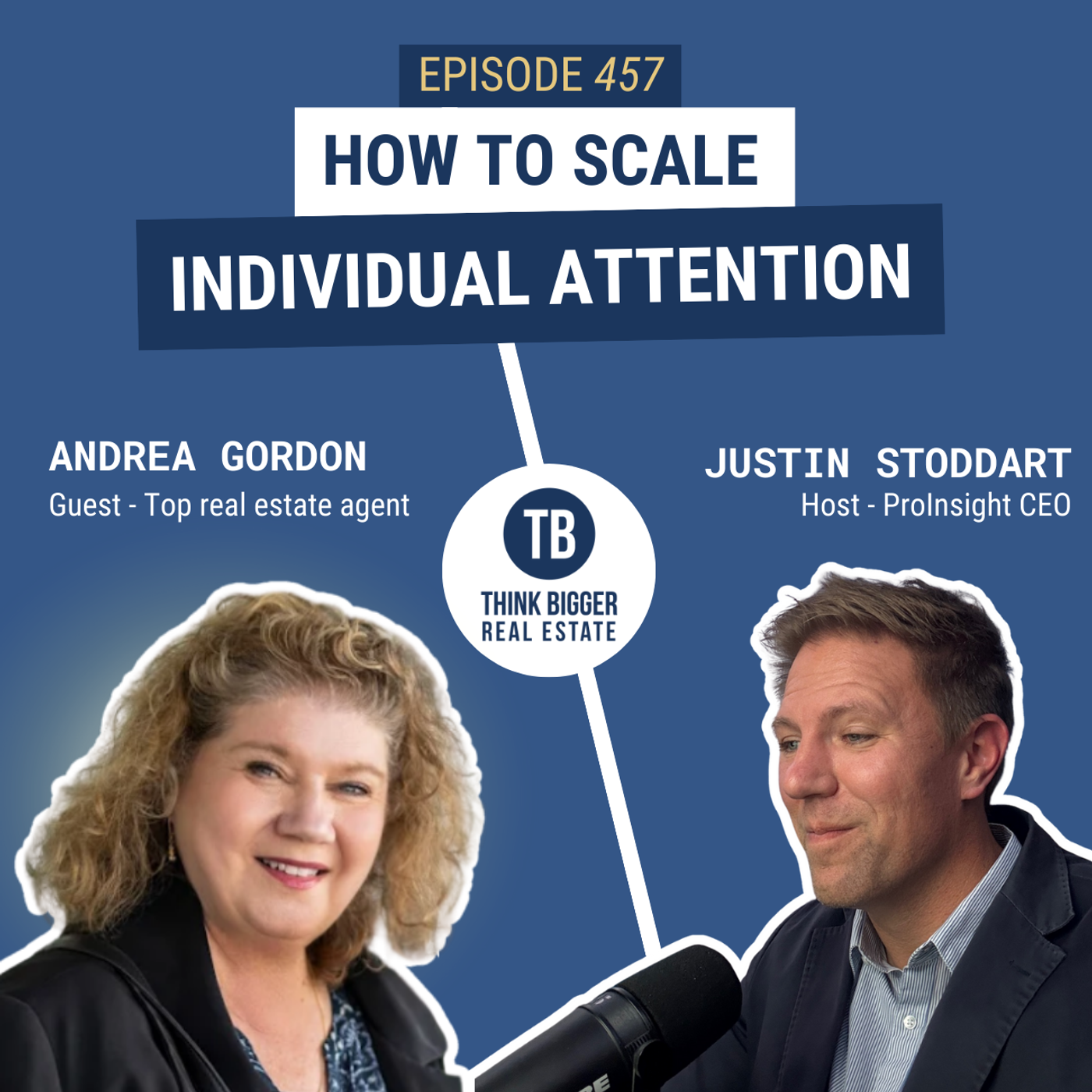
How to Scale Individual Attention
In this episode, Andrea Gordon shares her insights on how to maintain individualized attention while being a top-producing real estate agent.
December 11, 2025Episode 45636 min
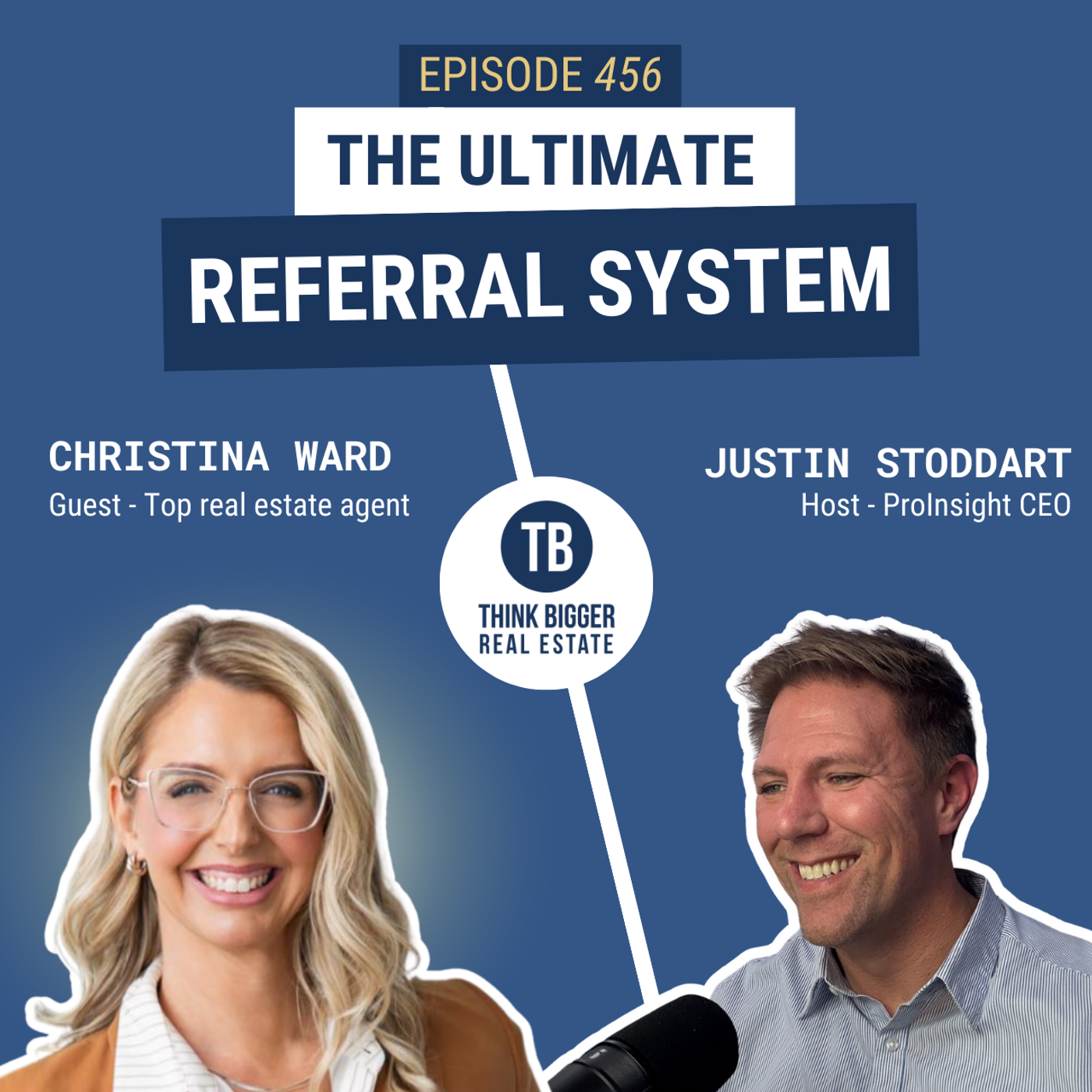
The Ultimate Referral System
In this episode, we sit down with Boise real estate powerhouse Christina Ward to unpack how she built a thriving business with an astonishing 86% referral rate. Christina shares the systems, mindset, and generosity-driven strategies behind her “ultimate referral system,” including her 52-touch plan, community events, home makeovers, and the art of teaching clients how to truly refer.
December 3, 2025Episode 45542 min
Growing Your Emotional Intelligence
In this episode, I sit down with Manhattan broker and bestselling author Scott Harris to explore why emotional intelligence—not market knowledge—is the real superpower in modern real estate.
November 26, 202531 min
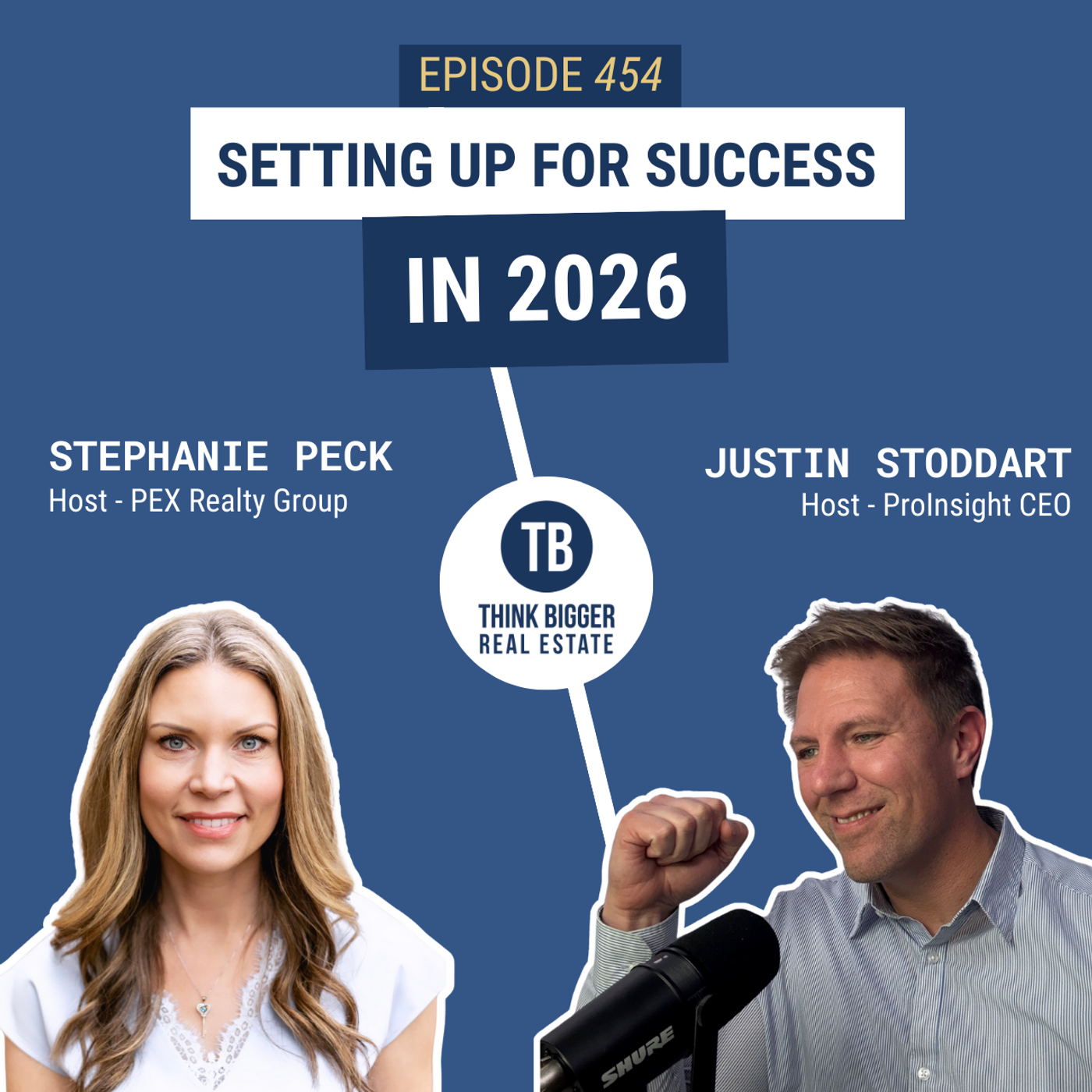
Setting up for Success in 2026
In this episode we break down what top agents are doing right now to set up a powerful 2026. From strategic holiday touchpoints and early pipeline building to Stephanie's “Costco strategy” and a 12-week planning rhythm, we share the relationship-driven actions that create real momentum long before January.
March 11, 2019Episode 2211 min
John Jayne- 2 things real estate agents must do to be safe
Welcome back to the Think Bigger Real Estate Show. Realtor safety--is it a real thing? Is it something that you need to be concerned about? That's today's topic. I'm passionate about this topic because I happen to have a lot of real estate agents that are very good friends and I don't know that the world that we live in is getting to be any safer. And so for today's topic I brought on an individual who has a very storied background in self defense. He's a former marine, a former police officer, a current private investigator and a security consultant. I'm excited to have him on the show. I met him a few weeks ago, and I was very impressed with him as I actually heard his presentation on Realtor self-defense that you're going to be hearing more about and are actually going to be receiving an invitation to attend. But in the meantime, I want you to be safe until you have a chance to attend that. So I want to welcome to today's episode, John Jayne. John, thanks for being on the show. Thanks for having me. I appreciate it. Yeah, so let's get into this. John is this hype? Are people blowing out of proportion the threats that real estate agents are facing? Absolutely not. No way. It's a, it's very real. It's very current and it's growing. Okay. Tell me some evidence behind this. What makes you say that? Is this your gut feel or is there some data to back that up? No, there's a lot of data out there. It's sometimes hard to access, but what I've found is the National Association of Realtors puts out a report every year on safety and statistics on attacks. A big surge lately, which isn't really my forte has been electronic data security. There's been a lot of identity theft, which has increased over the years. Forgeries, fraud, stuff like that whereas my expertise is in the physical security and those numbers are growing as well. When I first got into this topic, I started going through it. Let's talk about what some of those numbers are. I know there's 1.2 million real estate agents in the nation today. Is that number right? Correct. Roughly. Okay. Talk to me about how many of those on a percentage basis or actual number basis have felt some sort of threat. So, of those polled, 38% reported being threatened or had felt unsafe during a showing of a home or an open house, Thirty-eight percent!! So over one in three real estate agents at some point have felt a potential real threat. Correct. And that could range anything from just the hair on the back of their neck standing up, to an actual attack happening. Now I know we've heard of situations, actual homicides, terrible tragic stories--a handful of those we've heard about. I know that as you start digging into this to see if this really was a real area of need you uncovered, and not that I want to go into necessarily the gory details, but you found more than what you expected to find, didn't you? Way more than I expected to find. What really got me started in this area was I was hired to do some consulting for an apartment complex. They had one of their leasing agents attacked showing an apartment. So I kind of started delving into the statistics and some case studies. And then obviously, I know a lot of Realtors as well, and I started looking into this aspect of it. And the number of stories, the new stories, just if you Google real attack on Realtors, it's unbelievable how often this happens and how extreme the attacks are. Jeez. Okay--so it's real. I know having stayed close to a forum here that's a pretty popular one, Masters in Real Estate that it's not just in other parts of the country, right? There's stuff happening right here in Portland, Oregon. I know my audience extends beyond that and I'm sure that people outside of Portland can validate that as well, that it's happening all around us. I would say in part because of the rise of access to pornography and other things as I'm sure things other than just that it's increasing the number of predators out there. Would you agree with that? Absolutely. One case that I became familiar with while putting this presentation together, it really unfolded as if it were some sort of a kind of a pornographic fantasy where a real estate agent was showing a home, they made it up to the master bedroom and he attempted to seduce her from the bed as if he had watched this maybe in a video of some sort. And luckily that case didn't turn out to be the case that I used as an example of success. She had been trained, she had practiced and thought through tactics and mindset stuff to where she knew exactly what to do in that situation and made it out safely. But it could've been, it could've been much worse. So that we don't end on the downside, right, we're here to talk about how to prevent this. So let's give them two points, John. Let's, give them two key points. And obviously you have an entire training that they're going to be invited to in the very near future that will give them a much more kind of robust set of tools to defend themselves, but what are two things? If you had to choose two things to help people really feel safe or safer, what would they be? Well, it's hard to pick two out of so many that could be helpful. But the first thing that I would tell people is if it doesn't feel right, it's probably not right. Trust your instincts. Trust that little spot in your stomach. That something isn't right here and back out of the appointment, reschedule it. Safety first. And if it turns out that we've overshot the mark and it wasn't a big deal, we can always reschedule and everything will be fine, but you know, we've been given instincts for a reason and we just need to trust that instinct. If you feel that something is not right--don't ignore it. You're saying don't ignore that. Okay, good. Yeah. I think the most common thing that can happen is, "Oh, you know what? I'm probably just being paranoid." The moment we tell ourselves that, we're setting ourselves up to be a potential victim. As you dug into some of these more horrific stories where stuff unfolded, was there a pretty complete consensus of those where bad stuff did happen that they thought ahead of time, "This maybe isn't such a good situation" where instincts were warning them and they didn't listen to them? Well, unfortunately the most extreme cases of what I looked into where with somebody being deceased. We weren't able to get their feedback, but of the ones where it might've just been an assault where it ended up in a stolen purse or maybe a sexual assault, largely there was the feeling of "Something doesn't feel right." Yeah, pay attention to those. I love it. Great tip, John. Alright, what would be the second point? Let's say that they find themselves in a bad situation. Either they didn't get the instincts or they didn't listen to them and they find themselves in a predicament, in a precarious situation. What do they do? Yeah--Get out of the house!! Inside that house once you enter the home with the person that you're showing the house to or the client or whatever, or the bad guy, that door closes and it's like in the ultimate fighting championship when the octagon door closes. I mean it's a free for all in there. If something happens to go sideways, head out into the street and get out in public view and make a scene, yell, scream, get somebody's attention. The longer we're in that house, the more vulnerable we are to an attack. Throw a chair through the window or, I mean extreme, right?. Getting out of the house, cause a scene. Okay. Cause a scene. Get out of the house is the most important thing. To follow up on that, it could be hours before the next Realtor comes along or the homeowner returns. I mean, you could be captive in there for hours. Yeah, yeah--sobering tips John, but necessary ones to protect th...
February 23, 2019Episode 149 min
Pedro Adao- Missed Opportunity between Realtors and Financial Planners
Welcome back to the Think Bigger Real Estate Show. This is Justin Stoddart, your host and I'm really excited to be here tonight in Nashville, Tennessee at Funnel Hacking Live with a good friend of mine Pedro Adao. I even said it with a Portuguese accent. Wow, I wasn't expecting that. Tell them why you know that. So, I speak Portuguese. In fact, you're probably my best use of that for the past 20 years, meaning, I haven't used my Portuguese much at all. So this is going to be fun. He has good Portuguese enunciation. I was pleasantly surprised. He said my name right. It's very hard. It's a very hard name to say. Beautiful Man. So this guy, very, very successful financial planner and has achieved at some of the highest levels in his industry. He's also built a movement of Christian entrepreneurs. Maybe some of them in fact, who I've seen that have liked your page. You have some fans in Portland, Oregon. 100x Academy has hit Portland. Yes, 100x Academy. If you don't know what that is go take a look at it. Ben Rose, he was the guy in my area that I remember that had liked your page. Yeah, he's a videographer. He might be watching this and if not, I'm tagging him in this video. So Pedro, I'm going to talk tonight about financial planners and real estate agents. I work all day, every day with real estate agents, helping them have better businesses and better lives. And this guy, again succeeds at a really high level as a financial planner and as we began to talk, we realized that there's some commonalities, some common struggles and woes that real estate agents and financial planners face and some potential opportunities that you and I are talking about helping them to explore. Honestly, for me it makes no sense. This is like one of, probably the most under underutilized potential relationships. I know there's BNI and other networking type concepts, but like for real, if you're a Realtor, instead of having to go beg for leads from your mortgage lender, which if you have a lender that will do that--amazing. Alright, I mean that's, obviously still worth pursuing but also having two or three life insurance agents. Then you can network with and you can send them a lead, and guys, an insurance agent, a good insurance agent is in someone's home two, three, four, five times a week! And, and these are people, they obviously own a home or are looking to and they obviously met with their life insurance agent, which means they have some level of wherewithal. They love their family and care about their family and this is like ideal for a Realtor. I want to expound upon that. You think about when a life insurance agent is inside a home, it's typically when they're getting married, when they're having a new baby, when maybe they are getting ready to retire, all of which are triggers for real estate agents to say, Hey, somebody might be moving here. You're adding a baby to the house, you're getting married, you're thinking about life insurance and you're probably also thinking about a new home. Like there's often like a perfect connection here in that they need both of you at the same time. And what's happening now is there's a big industry called mortgage protection. Mortgage protection is a whole industry that the life insurance industry has created on the back of loan activity. There are life insurance policy companies that send direct mail to these homes offering mortgage protection. I get them like weekly probably. Okay. Hey, if something happens and you can't pay off your mortgage insurance. Most Realtors out there might not not know this, but most of these mortgage protection offers, they're not great plans. These are not awesome. Yeah. This is basically overpriced term insurance. So if you're a Realtor and you care about your client, if you sell them a home, what I would do is as they move, tell them, "Hey, by the way, you're going to get hit with direct mail for this thing called mortgage protection. Don't do that. Ignore those letters. I actually have so-and-so, he's an expert here in town. He'll go over all the options for you and get you the best product for you at the best possible prices." Because if you don't do that, your homeowner, is was going to go to the mail, open the letter--and this mail is very deceiving, these companies make their direct mail look like it's from a Wells Fargo or look like it's from Chase Bank. They literally make your mail look like it's from the lender. "Attention homeowner in regards to your mortgage in regards to your loan amount..." They make it look like it's the lender and in small print at the bottom it says "Not the Lender", but most homeowners are going to submit this form, which becomes a lead for the insurance company. They literally thought they had to fill it out. That's how deceptive this industry is, so if you're a Realtor or a loan officer, why would you not take one minute to give a heads up to your client and then actually refer them to an integral, high quality insurance agent in your town that can go serve them. And then that agent is going to be like, "Wow, thanks for the lead. What can I do for you?" Reciprocity, right? So stop chasing the mortgage guy because he's got 10 realtors wanting his business and there's 100 life insurance agents that no one's talking to. So there's a natural potential marriage here. And the fact is like there's no competition. It can be a great to be a great partnership and it's just instant. I don't understand why, to me, a Realtor, a life insurance agent and a financial planner, it's like peanut butter and jelly. Here's what we're going to do, for everybody that's in the Think Bigger Real Estate group, I'm going to get these scripts from Pedro and I'm going to put this in the group so that you can actually approach, new buyers of a home and know exactly what to say to them and then also how to approach life insurance agents and say exactly what you need to say to them to add big value to both sides. And then at that point it'll be pretty obvious that if you're working with a right person, there's going to be some reciprocation. I want to thank you for your time--killer stuff. Again, this guy does a great deal of business in life insurance. He's the guy that really understands this who is speaking from experience. There is opportunity here that's untapped by real estate agents. And guys, I'm from marketing, like I'm big into marketing and Facebook ads and sales funnels. I am at Funnel Hacking Live. I'm a two comma club winner and I believe in marketing, don't get me wrong. It's not like I'm recommending to just go to your warm market, warm market, warm market. I believe that you should be running traffic and should always be building your list. I mean like why not have a couple of these guys in your Rolodex that you're working with. I mean, it just makes sense. So yeah, I'll get those scripts to you. Awesome--thank you for tuning in. I really appreciate it everybody. Again, if you're not yet a member of the Think Bigger Real Estate group, go find it on Facebook. These assets will be there. And if this has been valuable, please share it out. Let's get this out to more people.
April 3, 2019Episode 3221 min
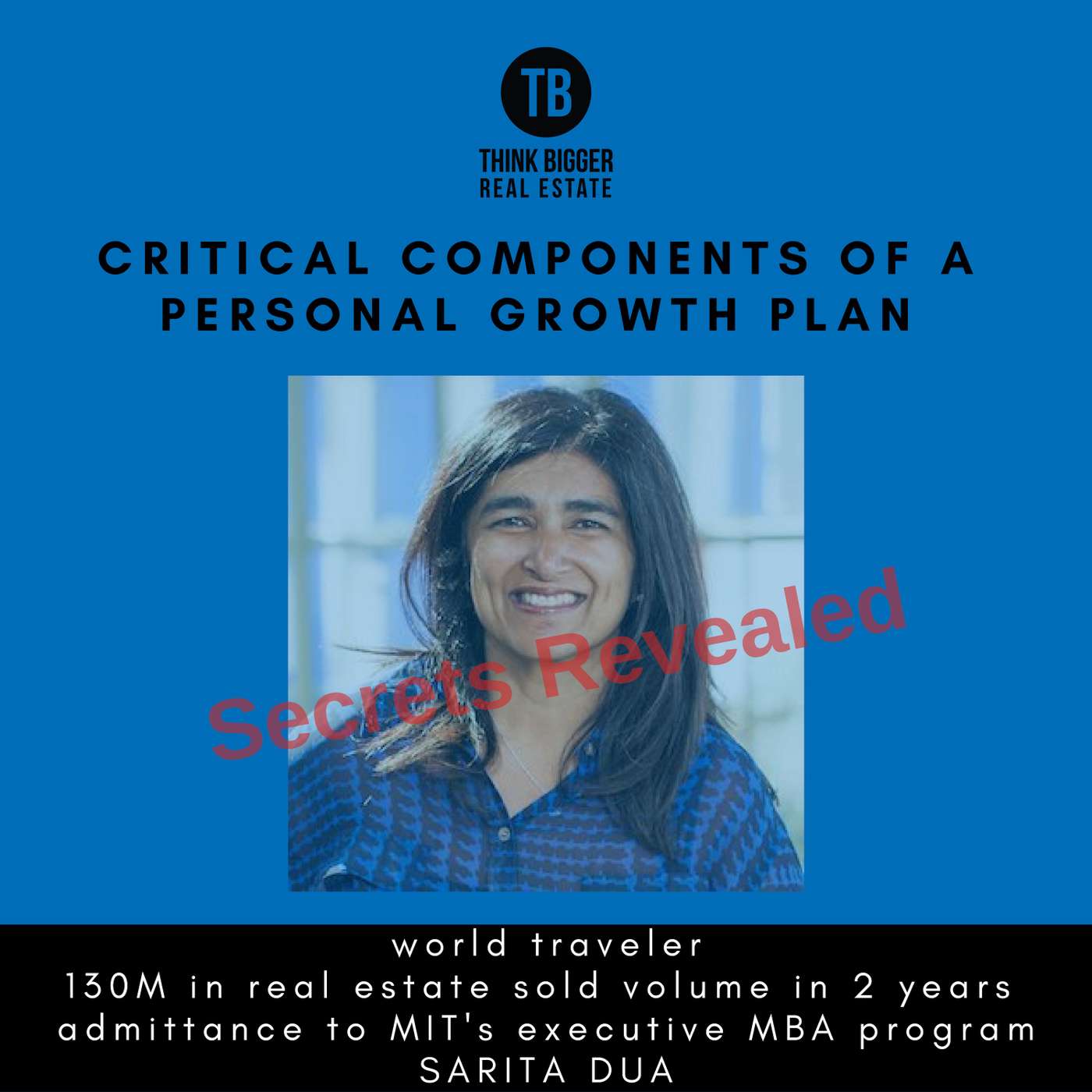
Sarita Dua- Critical Components of a Personal Growth Plan
Welcome back to the Think Bigger Real Estate Show. I'm your host Justin Stoddart and this topic today is very meaningful to me. Even having this guest on today is an exciting thing for me. I'll introduce her here in just a second. But here's the problem that I want this episode to help you solve, which is: There's endless amounts of tactics and strategies and ideas for real estate agents to grow their business. And the opportunity is most of them will work if you grow into being the right person. The challenge is if you don't grow as a person, none of them will work. So I have with me today, Sarita Dua. Let me first of all say Sarita thank you for coming on the show today. Thanks so much Justin, for having me. I'm excited to have you here. For those of you that don't know Sarita, let me give a little background on her and I know many of you do. Over the past two years, her team, a very small team, has produced over $130 million in real estate volume. Pretty impressive for a small team. In addition to that, she has entered into the executive MBA program at MIT. For those of you who are familiar with MIT, it's a very prestigious university and to be accepted in means a lot. She loves teaching and training. It's really a passion of hers. Maybe some of you have seen her on some of the biggest stages including Keller Williams big annual event, Inman Connect, the big event that they have multiple times a year. And all over the place on podcasts and other places. So I'm, again, fortunate to have you here today, Sarita, pouring into the Think Bigger Real Estate audience. Thank you for again for your attention and your time. Of course. I appreciate it. So let's, let's dive into how are we going to solve this now. I know Sarita, you have developed and followed a growth plan and you say that that is an essential component of helping you to produce at the level that you have and I want to talk through some of the things for you that are a part of this growth plan? And, uh, maybe let's start with something that you put into the growth plan first, which is your fascination with travel. Talk to us about that because most people think that has nothing to do with real estate. That's what you do when you're not doing real estate. But for you, that's been an essential component of helping you produce at the highest level. True? Yeah, absolutely. And if somebody asked me like what are the three things that mean the most to me and I can't put individual people in my family, then it would be honestly my family, education and travel. And one of the things I love about travel is that it's a perfect intersection between family and education because anytime we go anywhere, we're learning and we're together. And so it isn't this, you know, a quest to fill my passport, although I do love that part of it. What I found is as my kids were young and active and I was working quite a few nights and weekends, we realized that when we connect, the few times we have, let's say we had an hour here or like 30 minutes between appointments, I would try to connect with my family and guess what, they were busy. They'd have soccer games or lacrosse or birthday parties or whatever. So if it was a good time for me, it may not have been a good time for them. And what we realized is anytime we went anywhere, the four of us, and we reconnected, whether it was a long weekend or for a week, we would just come back synchronized and recharged. And then, my husband especially, he's a bit of a nerd and he loves like these educational field trips. So anytime we go on a trip, he's going to make us go see the largest ball of twine or how cashews are made. And we always, you know, the kids, especially "Daddy," and they roll their eyes. But the funny thing is we started playing this game called Trivia. We were at a restaurant, we were waiting for a two hour wait and I was trying to keep them awake. They were jet lagged. So I was like, "Hey guys, we visited Google today. What were the colors of their logo?" I didn't even know most of the answers. I was asking questions and I didn't even know the answers. Or, "What gate were we at?" Or, "What seats were we in?" Or, "Who was our flight attendant?" And it was so funny because my son was like maybe six or seven, "Momma ask me another question." And since we started doing that too, we've become very observant when we travel. And you're always learning when you're just looking around and your present. Right? So it really did bring our family together. So, one of the best coaches I've had in my career said, "Hey, you don't always have to have a goal of how many houses and what's your production. It could be [for me] how many days, how can you maintain your production and how many days out can you take?" So every year I start with what are all the days I'm going to take out and then I cram all my real estate in in those days that I'm not out of the office. Which typically is not how it works. If I have time this year we'll go on a vacation. What you're saying is "This is a big rock. Put the big rocks in first and then business will happen around it." Absolutely. And the cool thing is is that you have enviable production, Sarita. You would think that someone that started with that, "Let's go play first," they wouldn't have produced. What you're telling us is that actually helps fuel your ability to produce at a high level. Yeah. I mean I don't know if you guys remember when you were in school or when you have a deadline, the more you have to do, like if you have something due every night, you're going to have to time block and get it done. If you have a month to do it, like let's say taxes, right? There's a lot of us that are going to, probably on the 14th, "Shoot, I got to get these done." But if you don't have time and you have to slot a bunch of other things and you just get it done, right?! So I did find that it actually made me more efficient and more productive. I love it. An enticing deadline is what you've created. Let's talk about your speaking and teaching. This is part of your growth plan. Obviously you've agreed to come on today to really benefit this audience. You are on stages. You've been a MAPS coach in the past and that's really become a part of your passion in your life. Talk to us about why that's an essential part of agents becoming the person, growing into being the person, that can then grow a business to the level that they want it to. Okay, sure. I mean, everyone has a different reason. I'm not going to sit here and say, "Golly shucks." You know, I, you know, at the end of the day, like we all have reasons for doing things. Some people want the visibility, some people want referrals. For me, I'm focusing on getting comfortable with the idea of being uncomfortable, right? So the more uncomfortable you can be and start being okay with it, then you always learn. So for me, teaching and coaching has just, you know, there's that phrase, the teacher becomes the student. You actually get way more than you give. Even when I coach a client one on one who might be a newer agent and I'm talking to them about systems and models. I mean, who do you think is learning that? Like for me, it's very difficult to talk about how you should make your contacts and work your database and then I hang up and I don't do that? Then I would feel like a fraud. So for me, it's just another way to sharpen the pencil. I'm not the greatest public speaker. In fact, I do quite a few educational videos to my clients. And I used to really get nervous about, "Well, does my hair look okay?" and "I just flubbed this up," and I should retake it 10 times so that I sound like, you know, like an anchor woman or like the weather person" or whatever. And you know the more authentic, like when you actually screw up and you say, wait, I like lost my train of thought, let me rephrase and you're actual...
April 9, 2020Episode 12248 min
Referrals Without Asking with Stacey Brown Randall
Referrals without asking. That is exactly what author and coach Stacey Brown Randall teaches her followers and clients how to do. With real estate agents facing what may be the largest challenge of their career, Stacey’s advice on how to fill your pipeline in a comfortable and genuine way is needed now more than ever. Stacey defines referrals in two parts. The first is that when someone personally recommends you and trust in you is transferred from the referral source to the referral. The second part is that the person being referred has an actual need that your business can fulfill. Stacey shared that within all of the different types of business inflow, none are wrong, but some are more valuable than others. Referrals, as defined above, are the most valuable form of business in flow into your business. This then begs the question of how do you go about getting more referrals? Stacey outlines a 5-step process for doing this: Go back 2-3 years, if possible, and look at your sources of business. Identify who those sources of business actually are. Every time you get a referral, send them a handwritten thank you card. Give those people real value roughly six times per year… not value for you disguised as value for them. Language differently what they mean to you. They are not a means to your end. Systematize staying in contact with them while remaining genuine. Towards the end of the episode, Stacey shares that right now, she recommends that agents go to step one to start to identify who these people are. Then, start reaching out to them asking how you can help them with some idea in advance of how you might help them. At this time, people need leadership more than ever. The reality is that real estate agents know their customers on a more intimate level than most all other professions. You know where they live, where they work, everything about their home, roughly how much money they make, how many kids they have, what are their short, mid, and long term goals, what networks they’re a part of or would like to be a part of. Attimes like these you can use this information in order to provide real value to them to help them in whatever way they might be needing help. To help all agents get a better understanding of where they’re at along the getting referrals without asking continuum, Stacey has put together a simple quiz at: https://referralquiz.com . You can also find her book: Generating Referrals Without Asking on all of the major publishing platforms.
May 22, 2019Episode 5327 min
Bob Lachance- Outsourcing
Justin Stoddart 0:00 Think Bigger Real Estate Show, I'm your host Justin Stoddart thrilled about today's episode, I think it's going to give a lot of real estate agents a solution to a problem that they've always wanted to have solved, which is how do I get more time in my life? You know, there's endless coaching programs, endless ideas, even here on the Think Bigger Real Estate Show. We're constantly giving you ideas of how to improve your business and how to improve your life. And the reality is, none of those are any good if you don't have any time or capacity to implement them. So I want to welcome today's guest, Bob Lachance. Let me give you a quick rundown on him. And then I'll let him talk a little bit because he's the guy that actually you know, I listen to, he spent eight years playing hockey at some of the highest levels. And he both here and in other countries, got into the industry in 2004. He's founded multiple real estate coaching businesses. And he now does a lot of investment properties. He's done over 1,000 In fact, investment properties, over 700 short sales. And I'm one thing that he's really excited about that we're going to talk more about today is the company he founded called Reva Global, which is a company that helps real estate agents outsource things that they should not be doing so that they can focus on doing things they should be doing. So Bob, apologize for the long intro, but man, it's your fault. You've got too many accomplishments. So thank you for being on the show, man. Super excited to have you here. Robert Lachance 1:17 Absolutely. Well, I definitely appreciate you having me, you've had an incredible list of individuals on your show and I'm a huge fan so I really appreciate you having me. Justin Stoddart 1:26 Yeah, man. I appreciate that. That's super fun to hear. Let me start by this so so for those of you that are just tuning in Bob and I found that we have something else that we're passionate about beyond just the real estate industry which is that of being dad's you should have heard Bob light up his he started telling there are we start telling stories about kids growing up and having them experience kind of athletics. So, Bob, you played sports at the highest level. We're going to get to that here in a second. Let's talk first and foremost about what is your favorite part about being a father? Robert Lachance 2:01 I think it's probably teaching them and seeing them grow up. I know you have six kids, which is absolutely insane to me, I have three kids my oldest is 15. But I think it's teaching them the little things in lives and in their lives and also coaching them so I coach ice hockey for them all the youth sports grown up so it's really a pleasure to see them grow and teach them the little life lessons that you know I'm sure that you've you're teaching your kids as well. Yeah, Justin Stoddart 2:28 yeah, that's awesome man. I'm part of the mission of this show, is to not just help people have better lives are better businesses as a result of what we talked about, but better lives. And I think you know, one of the greatest impacts that people can have is within the confines of their own home and the impact they can have on the next generation so super love the fact that you are a committed dad I think that that says a lot about you so super. Thanks so much for sharing that. Let's talk about your hockey career again. We're going to start with all the good stuff. Everybody gets into real estate stuff at the end but you played all the way up to NHL level right? Robert Lachance 3:06 Yes, I got drafted by the St. Louis Blues who happens to now be in the Stanley Cup Finals against the Boston Bruins which is pretty cool. So it is my team I played in the-so the equivalent of the triple-A in baseball, I played triple-A and hockey for four years here I played one exhibition NHL game, proud to say point a game so that's pretty good. One is this one. And then I took that over to Europe. I played in Italy, Milan, Italy, Hamburg, Germany, Switzerland, core Geneva, Lugano, Switzerland, for the remainder of my career, and then I happened to jump in a real estate right after that. Justin Stoddart 3:49 How does hockey compare over there in Europe to here is it more popular as popular that's popular? Robert Lachance 3:57 It's in different countries. So I played on and obviously soccer as they call football over there and not our football but soccer is extremely, extremely popular. So hockey, not so much Germany a lot more. Switzerland, very, very popular. Justin Stoddart 4:13 Very cool. Now, tell me what's the biggest lesson that you learned from hockey that's benefited your real estate career. Robert Lachance 4:20 You know what I think the most important thing in any business is actually the work ethic, you have to have to be successful in anything. It's, you know, you put in hours an hour, it's kind of like, you know, if you're a Top Producing real estate agent, you just don't fall out of bed and be a Top Producing real estate agent. It takes the years of practice the years of creating systems, falling through those systems consistently and implementing those just like anything, right? You have all the training, but you also have to take the action and implement all of that training to be successful. So I think that is probably the biggest thing for me. Justin Stoddart 4:54 And I just saw that you say that the ratio of practice time versus playtime was pretty one-sided right? You practice and you like you said, you follow systems and processes in order to get better not to say that you should spend all of your time planning and prep right we learned that on our previous episode Justin Okay, that that's a bad idea. Robert Lachance 5:16 What a great episode too. Justin Stoddart 5:19 But this this concept of, of actually having a process and I'm sure that to become a hockey player at the highest level, you had to be organized, you had to have, like, just put in massive amounts of time to get to that level, which is what you're saying is very similar to get to the point to where now you've done over 1000 investment properties, those same principles carry through. Robert Lachance 5:42 Yeah, and here's one of the things I do want to say it takes patience to, you know, if you set a goal to sell, I don't know $10 million of real estate as an example, it's not going to happen in the first month. It's not going to happen the second month unless you live in I don't know San Diego or LA or something and you get that one deal that is lucky but to do it on a consistent basis. That is important for everyone to know that it takes the time it takes building and as you go along you have to build your team you build your partnerships, you know a lot of those the past episodes that I listened to from like Lars Hedenborg, I believe that's a say and Jim- yeah Hedenborg. So he talked a lot about for he's from the real estate B school, he talked about setting up systems in getting help in reference to implementing those systems and doing it consistently. I think that's, that was a really big takeaway took away from that. And he's 1,000%. Correct. Justin Stoddart 6:37 Let's talk a little bit about your passion for helping agents outsource and which is kind of down the path, you know that you're headed right now. Interesting. mentor of mine, Chris Suarez mentioned how NAR did a study that identified that real estate agents 80% of their time is spent on functionary activities. So 14 out of 15 hours right now spent doing activities that aren't fiduciary activities that don't necessarily require you...
Is this your show?
Claim this listing to keep it up to date, reach guests who want to pitch you, and manage bookings with Guestify.