
Find partners
The Regenerative Real Estate Podcast

The Regenerative Real Estate Podcast

Hosted by Neal Collins

Episodes

130

Latest episode

May 2026

Language

EN

About the show

A show that explores how land, capital, and community come together in practice. Hosted by Neal Collins, the show features conversations with landowners, developers, investors, and practitioners navigating the real-world challenges of regenerative development, including financing, governance, land stewardship, and long-term value creation. Rather than focusing on theory or trends, the podcast examines the tradeoffs, constraints, and decisions that determine whether regenerative projects actually endure.

Listen to episodes

60 recent
May 27, 20261 hr 0 min

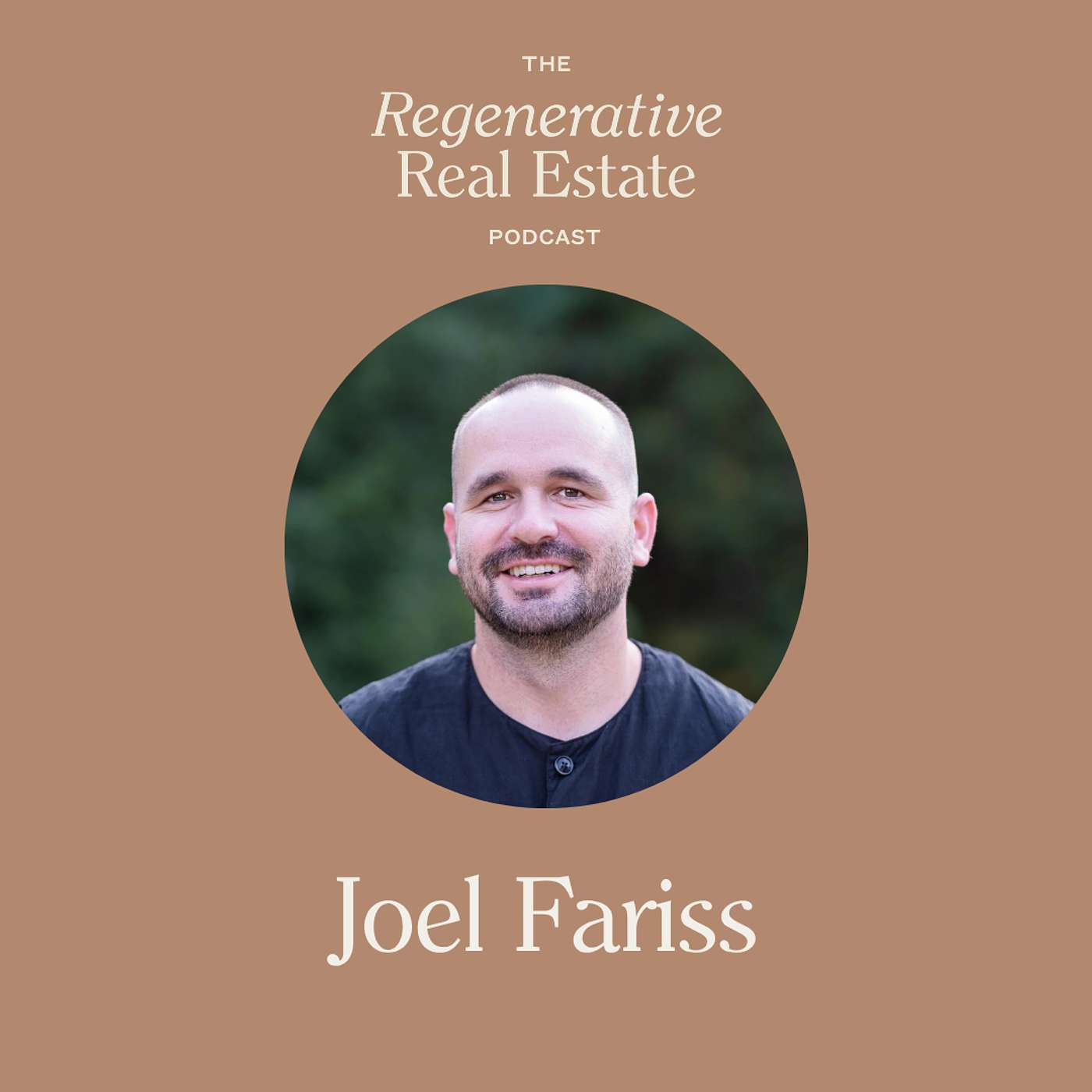
From Design Consulting To Regenerative Developer with Joel Fariss

Most real estate projects begin with a neat answer: a program, a typology, a unit count, a pitch deck that already “knows” what a site should become. In this conversation, we take the opposite approach and ask what happens when development begins with inquiry. Joel Fariss, founder of Sysoma Partners, joins me to explore how systems thinking, human experience design, and community relationships can shape projects that are financially viable, ecologically resilient, and socially meaningful.Joel shares his path from craft and philosophy into architecture, civic innovation, and seven years at Gensler, where he worked in applied research and strategic futures. We talk about what transdisciplinary teams make possible, why “start with the question” is more than a slogan, and how one workplace project revealed the power of reframing. What began as a simple request for more focus space uncovered a deeper need for autonomy and agency. That shift changed the design language, the stakeholder process, and the final outcomes—a lesson with real implications for placemaking, entitlement strategy, and regenerative development.We also get honest about the leap from advising developers to becoming one. Joel explains why the built environment is where climate, community, policy, and capital stacks all collide, and why moving faster sometimes means stepping out of slow institutions and into the arena. He walks through early Sysoma experiments in smart rural density, what he’s learning about missing middle and workforce housing, and the leadership practices he uses to build strong teams, from charters and emotional intelligence to a few comfort-zone-testing site rituals.If you’re interested in regenerative real estate, community-centered development, or simply asking better questions before drawing anything, this conversation will stretch your thinking and sharpen your process. Subscribe, share, and leave a review—and then tell us: what question should every project team ask before they begin?———————The Regenerative Real Estate Podcast is an independent show exploring the people, projects, and capital reshaping how land gets used and communities get built. Two organizations grew directly out of this work, and they're worth knowing:Hamlet Capital finances and advises on projects that integrate agriculture and conservation with mixed-use development. If you're building one or looking to invest, let's talk.Latitude is a real estate brokerage representing sanctuary properties rooted in nature, beauty, and meaningful living.
May 4, 202656 min

From Impact to Investable: Moving Capital at Scale with Alix Lebec and Julie Wilkinson

We're joined by Alix Lebec, Founder and CEO, and Julie Wilkinson, Managing Partner and CIO, of LEBEC, a woman-owned global impact investment and advisory firm. They share the capital allocator perspective on what actually makes a project investable, why “capital fluency” is often the missing ingredient, and how developers can better align with the realities of institutional capital.We dive into innovative finance strategies—from blended capital stacks to lessons drawn from microfinance in the water sector—and unpack how philanthropic capital can be used as a first-loss layer to unlock significantly larger pools of private investment.From there, we bring it back to the built environment: decarbonization, resilience retrofits, distributed energy, and the often-overlooked efficiency upgrades like HVAC that quietly drive both risk reduction and operating savings.We also explore their portfolio approach to impact investing, and how diversified private market strategies across energy, water, food, transport, and construction can reduce risk while funding the systems that keep the economy functioning.If you’re interested in climate finance, impact investing, regenerative real estate, and how to actually move capital at scale, this episode offers a clear and grounded look at what’s coming next.———————The Regenerative Real Estate Podcast is an independent show exploring the people, projects, and capital reshaping how land gets used and communities get built. Two organizations grew directly out of this work, and they're worth knowing:Hamlet Capital finances and advises on projects that integrate agriculture and conservation with mixed-use development. If you're building one or looking to invest, let's talk.Latitude is a real estate brokerage representing sanctuary properties rooted in nature, beauty, and meaningful living.

April 2, 202648 min

Building Organic Farms Inside Large-scale Housing Developments with Carmen & Tripp Eldridge

We sit down with Carmen and Tripp Eldridge of Convivial Foodscapes to unpack what it really takes to design, launch, and sustain farms embedded inside large scale residential agrihoods. We dig into distribution models, staffing realities, and why a neighborhood farm succeeds only when it is treated like essential infrastructure instead of a pretty backdrop. • Carmen’s route from family gardens to food politics, Peace Corps teaching, and statewide nutrition incentives • Tripp’s CSA “light bulb” and why restaurants and ecology led him into organic agriculture • What an agrihood is and why the model is “like an onion” with many hidden layers • How Arden was designed and staffed during early construction • Why they shifted from a fixed CSA pickup to a farm store with household currency • Land restoration challenges and the patience required to build soil and trust • The HOA funded amenity model and what it means for farmer autonomy • The importance of SOPs, operations manuals, and long transition runways • What Convivial Foodscapes provides: land vetting, design, budgeting, infrastructure, hiring, training, ongoing support • Upgrades from Arden to Carnes Crossroads including app based farm bucks and better resident experience • Why agrihood roles can professionalise farming while increasing “fishbowl” pressure • The talent pipeline problem and how agrihood jobs can lower the risk for new farmers If you're a landowner investor or developer exploring regenerative projects or if you're sitting on land and wondering what's possible you can learn more or reach out to the links in the show notes and if this conversation was useful consider subscribing or sharing it with someone working at the intersection of real estate investment and impact ———————The Regenerative Real Estate Podcast is an independent show exploring the people, projects, and capital reshaping how land gets used and communities get built. Two organizations grew directly out of this work, and they're worth knowing:Hamlet Capital finances and advises on projects that integrate agriculture and conservation with mixed-use development. If you're building one or looking to invest, let's talk.Latitude is a real estate brokerage representing sanctuary properties rooted in nature, beauty, and meaningful living.

February 12, 20261 hr 1 min

Listening to Children: Mara Mintzer on Designing Cities for Belonging

In this episode, I’m joined by Mara Mintzer of Growing Up Boulder for a deep dive into youth-led placemaking and what it reveals about how cities can look, feel, and function differently—often at a fraction of the expected cost. From five-minute neighborhoods and safe routes to school to water play, native habitat, and spaces that invite lingering, kids consistently point to choices that make places healthier, more social, and more sustainable for everyone.Mara shares how small, hands-on experiments sparked a citywide culture shift: children standing on a giant map to show what works and what doesn’t; teen consultants designing engagement for their peers; and preschool “picnics in the park” that use observation—not surveys—to uncover what little ones truly need. We explore the power of loose parts and nature play, including a $14,000 log-and-stone installation that dramatically outperformed a conventional playground costing many times more.We also get practical for planners, designers, and developers. Mara breaks down tools that build trust and reduce friction—Place It model-building, intergenerational walks, and clear “what we heard / what we did” updates—and explains how these approaches can actually accelerate approvals rather than slow projects down.At a systems level, we examine how child-friendly planning reduces car dependence, improves air quality, lowers injury risk, and tackles loneliness by making social connection easy and free. We talk about teen-friendly parks that prioritize autonomy over programming, affordable food options that give kids independence, and emerging “naturehoods” that link schools, libraries, and parks with safe, shaded routes and micro-habitats.If you’ve been told the only answers are ball fields and plastic slides, this conversation will challenge the brief—and expand what you think is possible.Resources mentioned: UNICEF’s Child Friendly Cities, Safe Routes to School, Green Schoolyards, and Growing Up Boulder’s new course on building a child-friendly city map with your community.Subscribe, share this episode with a planner or developer who needs fresh tools, and leave a review to help more people find conversations about making better places possible.———————The Regenerative Real Estate Podcast is an independent show exploring the people, projects, and capital reshaping how land gets used and communities get built. Two organizations grew directly out of this work, and they're worth knowing:Hamlet Capital finances and advises on projects that integrate agriculture and conservation with mixed-use development. If you're building one or looking to invest, let's talk.Latitude is a real estate brokerage representing sanctuary properties rooted in nature, beauty, and meaningful living.

January 8, 20261 hr 13 min

Redefining Luxury: Soil, Sovereignty, and Community with Thomas Patton of Lega Vera Farm Village

Modern life offers speed and convenience, but often at the cost of connection to the systems that sustain us. In this episode, regenerative rancher and developer Thomas Patton joins us from just outside Panama City, Panama to explore what happens when land, food, and daily life are brought back into relationship.Thomas shares the evolution of his family’s 7,000 hectare property from conventional agriculture to the Coquira Soil Project, and how that work expanded into Lega Vera—a farm village designed around soil health, food sovereignty, and community. This conversation explores regeneration as a practical pathway forward and a redefinition of luxury rooted in resilience, stewardship, and belonging.———————The Regenerative Real Estate Podcast is an independent show exploring the people, projects, and capital reshaping how land gets used and communities get built. Two organizations grew directly out of this work, and they're worth knowing:Hamlet Capital finances and advises on projects that integrate agriculture and conservation with mixed-use development. If you're building one or looking to invest, let's talk.Latitude is a real estate brokerage representing sanctuary properties rooted in nature, beauty, and meaningful living.

December 3, 202559 min

Cultivation as Connection: Jennifer Jewell on the Human Impulse to Garden

Gardening is often portrayed as a pastime, an optional extra woven around daily life. Yet across history and across cultures, people have shaped land for reasons that reach far beyond necessity. Jennifer Jewell, host of the acclaimed show Cultivating Place, has spent decades listening closely to gardeners and land tenders. Through those stories, she uncovers a pattern: cultivation is one of the most enduring ways humans connect to place, and its impact reaches well beyond the edge of the garden bed.On this episode, we explore why people cultivate and how gardening shapes land, community, and our relationship to place. From pandemic-era growing to the role of ecological landscapes in real estate, this conversation reveals how gardeners contribute to the health and resilience of the places they tend.———————The Regenerative Real Estate Podcast is an independent show exploring the people, projects, and capital reshaping how land gets used and communities get built. Two organizations grew directly out of this work, and they're worth knowing:Hamlet Capital finances and advises on projects that integrate agriculture and conservation with mixed-use development. If you're building one or looking to invest, let's talk.Latitude is a real estate brokerage representing sanctuary properties rooted in nature, beauty, and meaningful living.

September 30, 20251 hr 2 min

Building With Whole Trees: Rethinking Timber With Amelia Baxter

What if we could build with trees without milling them into straight, uniform boards? On this episode, Neal Collins is joined by Amelia Baxter, co-founder and CEO of WholeTrees Structures, a company reimagining timber construction by using unmilled, round timber as structural elements in buildings.Together, they explore how WholeTrees transforms the often overlooked “cull trees,” trees that would otherwise be removed as excess byproducts, from well-managed forests into beautiful, durable building components. The conversation goes beyond architecture and design to touch on stewardship, entrepreneurship, and how to invest for sector-wide growth of bio-based and natural building materials.From the fascinating origin story of the company, the technology and systems that they have developed that has allowed them to scale internationally, to the investment and growth path the company is on, this is a great story that invites us to reconsider how and what we build with. ———————The Regenerative Real Estate Podcast is an independent show exploring the people, projects, and capital reshaping how land gets used and communities get built. Two organizations grew directly out of this work, and they're worth knowing:Hamlet Capital finances and advises on projects that integrate agriculture and conservation with mixed-use development. If you're building one or looking to invest, let's talk.Latitude is a real estate brokerage representing sanctuary properties rooted in nature, beauty, and meaningful living.

August 19, 20251 hr 6 min

Billions for Nature: How Private Capital Is Funding Ecological Restoration with Adam Davis

Across every continent, degraded landscapes tell a sobering story: wetlands drained, forests cleared, tidal flats diminished. The tragedy isn’t that humanity lacks the knowledge to restore them—we know how to bring these ecosystems back. The real challenge lies in how to finance restoration at scale.In this episode we sit down with Adam Davis, co-founder of Ecosystem Investment Partners, a firm that has channeled over a billion of dollars into restoring ecosystems. The discussion dives into the world of mitigation banking, a financial mechanism that has unlocked private capital for large-scale ecological restoration. For many, it’s an unfamiliar concept, but as Adam explains, it has become a powerful tool for revitalizing degraded landscapes.———————The Regenerative Real Estate Podcast is an independent show exploring the people, projects, and capital reshaping how land gets used and communities get built. Two organizations grew directly out of this work, and they're worth knowing:Hamlet Capital finances and advises on projects that integrate agriculture and conservation with mixed-use development. If you're building one or looking to invest, let's talk.Latitude is a real estate brokerage representing sanctuary properties rooted in nature, beauty, and meaningful living.

August 4, 202553 min

Changing Finance By Financing Change: Jasper van Brakel on Regenerative Investing

Jasper van Brakel is on a mission to regenerate the world with the power of finance and business As CEO of RSF Social Finance, he leads one of the most innovative financial institutions redefining how capital can serve life—not just profit.In this episode, Jasper shares how his journey through the early days of finance and impact investing led him to the frontlines of the regenerative finance movement. He unpacks RSF’s bold embrace of the term “regenerative,” and the framework they’ve built to evaluate whether a business is truly healing people, planet, and place—by its very existence.We dive into:Why the type of capital matters as much as the investment itselfHow RSF is using fixed income and Donor Advised Funds to unlock high-impact opportunitiesWhat medium-return, deeply regenerative investing really looks like in actionIf you’ve ever asked, “How can my money do more good?”—this conversation is for you.———————The Regenerative Real Estate Podcast is an independent show exploring the people, projects, and capital reshaping how land gets used and communities get built. Two organizations grew directly out of this work, and they're worth knowing:Hamlet Capital finances and advises on projects that integrate agriculture and conservation with mixed-use development. If you're building one or looking to invest, let's talk.Latitude is a real estate brokerage representing sanctuary properties rooted in nature, beauty, and meaningful living.

July 23, 202557 min

Unlocking Abundance: How Rob Avis and 5th World Are Revolutionizing Site Planning

Rob Avis—designer, educator, and founder of 5th World—is using cutting-edge technology to transform how we design resilient and abundant landscapes. In this episode, Rob shares how his journey from petroleum engineer to permaculture leader inspired the creation of 5th World, a company that merges data intelligence with ecological design.After working with thousands of students and designing hundreds of properties, Rob saw a major challenge: critical site data—such as climate patterns, property timeline scans, ecosystem services, topography, soils, hydrology, solar exposure, and zoning—was expensive and difficult to access. With 5th World, that information, which once cost tens of thousands of dollars, is now available at a fraction of the price.This conversation explores:Why poor site planning can lead to costly mistakes and long-term problems.How data-driven insights can unlock better design decisions and regenerative lifestyles.The path to creating landscapes that are resilient, abundant, and regenerative.Rob’s vision for bringing ecological design into the mainstream.———————The Regenerative Real Estate Podcast is an independent show exploring the people, projects, and capital reshaping how land gets used and communities get built. Two organizations grew directly out of this work, and they're worth knowing:Hamlet Capital finances and advises on projects that integrate agriculture and conservation with mixed-use development. If you're building one or looking to invest, let's talk.Latitude is a real estate brokerage representing sanctuary properties rooted in nature, beauty, and meaningful living.

Is this your show?

Claim this listing to keep it up to date, reach guests who want to pitch you, and manage bookings with Guestify.

Claim this listing

More Business podcasts