Find partners
The IC-DISC Show

The IC-DISC Show

Hosted by David Spray

BusinessInterviews guests

Episodes

73

Latest episode

May 2026

Language

EN

About the show

Join host David Spray, as he interviews business owners and industry leaders about the IC-DISC program. Insights and anecdotes to help you increase your after-tax income.

Listen to episodes

60 recent
May 18, 202632 min

Ep074: Fifty Years of Precious Metals with Larry Drummond

The strongest industries are built on relationships that outlast individual transactions. In this episode of the IC-DISC Show, I sit down with Larry Drummond, Executive Director of the International Precious Metals Institute (IPMI), to talk about what fifty years of industry collaboration has taught him about trust, transparency, and building lasting business connections. Larry shared how IPMI started in 1976 when a group of New York-area scientists came together to share data across competing precious metals companies. After 25 years at Engelhard and a leadership role at Metalor, he came out of retirement in 2018 to lead the organization he had served as a volunteer board member and past president. What struck me most was Larry's description of an industry where someone can be your customer, vendor, and competitor at the same time. He shared examples of refiners picking up the phone to ask competitors for help during operational setbacks, knowing the favor would be returned without losing customers in the process. The conversation reminded me that even in commodity-driven businesses, transparency and verified trust create the foundation for everything else. With IPMI's 50th annual conference coming up in Orlando, Larry's perspective is a great preview of what makes this industry tick.     SHOW HIGHLIGHTS * In precious metals, the same company can be your customer, vendor, and competitor at the same exact time. * IPMI was founded in 1976 by New York-area scientists who recognized the value of sharing data across competing companies. * When operations go down, refiners call competitors for a week of help, knowing the favor will be returned without customer poaching. * Record-high gold prices flooded refiners with material, but financing costs and capacity limits turned some lots into losers. * IPMI memberships pay for themselves through the price discount on a single annual conference registration. * Portable x-ray guns have transformed the industry, letting even small operators verify what they have before shipping it up the chain.   Contact Details LinkedIn - Larry Drummond LINKS Show NotesBe a Guest About IC-DISC AllianceAbout IPMI TRANSCRIPT (AI transcript provided as supporting material and may contain errors) Larry Drummond: Unique things about this industry is that someone can be your customer, vendor, and competitor at the same exact time. Those relationships, even with your competitors, I can't say there's any kind of big precious metal company that something hasn't gone wrong in your operation at some point in time. I've personally been involved in situations where you could pick up the phone and call your competitor and say, "Listen, I need help for about a week." And they will handle some of your materials and not steal your customer because they know one day they may pick up the phone and call you. David Spray: Good morning, Larry. How are you this morning? Larry Drummond: Very good, David. Good morning. How are you? David Spray: I am great, thank you. So you are, I believe, the executive director of the International Precious Metals Institute, is that correct? Larry Drummond: That's correct. David Spray: And I guess the organization goes by the initials, right? IPMI? Larry Drummond: Yes. Everyone refers to it as IPMI. When we do legal documents, we use the full name, but for the most part we just use IPMI. David Spray: Okay. So can you just tell me a bit of the history of IPMI? Has it been around very long? Larry Drummond: Yeah. Well, we've been around very long and it's very appropriate we're doing this podcast today because we're celebrating our Jubilee year this year. So we were formed in July of 1976 and the history is that a group of scientists in the greater New York area where there was many major precious metal companies had formed, got together because they saw the need to share scientific data. And what's important about this is the pathway that they set still lives on today where people, member companies openly share a lot of information. Now again, they don't share their total trade secrets, but they share information where collectively the industry gets to benefit from that. David Spray: Okay. So Larry Drummond: It was started by a group of scientists and we've grown from there and we'll talk more about that during the course of the podcast here. David Spray: Okay. Well, that is great. And so when did you join the organization? Larry Drummond: So I joined in the late '90s, around 1997 I think was my first PMI. And the IPMI is really founded on volunteerism. There's actually only two of us that are employees and the rest are volunteers. So I was one of those volunteers and very early on got involved with the board of directors. I worked for Englehart Corporation for over 25 years and Englehart was one of the cornerstone founding members. Now it's owned by BASF. So in 2002, I joined the board and the executive committee and before we had term limits, I served on that for over 13 years as a. Oh, wow. And including all the officer roles and I'm also a past president of IPMI, which is a volunteer role. David Spray: Okay. And then at some point you shifted from being a member to being the executive director, is that correct? Larry Drummond: Yeah. I'm the past president for the Americas for Medalor Corporation, which is now part of Tanaka. And I retired in 2015 for a brief while and in 2018, I went back to work for the IPMI as the executive director. David Spray: I bet that must be great to be able to reconnect with all your longtime contacts in the industry. Larry Drummond: It's true. And it's really one of the key attributes of IPMI is really building relationships. If I could, if you look at our tagline, it's connecting you to the world of precious metals. And when I talk to people, especially people getting involved for the first time, I said, "Well, what does that mean?" I said, "We can boil IPMI down to really a few words and what they mean." It's connect, learn and build relationships. I was fortunate that I've spent essentially my entire career in precious metals, again, joining Ellhart in 1979. And some of those relationships that I've built over the years still exist today. So it's really one of the key things that we try and stress to people is to really build relationships. And the important part about that is that our industry, the transactions are very high value in terms of the precious getting transacted. And in many cases, you as a vendor are sending what you think to be a known amount of precious metals contained in some form that a refiner has to refine and produce fine metal out of. So there's a lot of trust involved. So building those relationships, it's trust but verified trust. Building those relationships is key and it's something that our members are very good at and personally that I've benefited from over the years in my career. And to this day, like you mentioned a few minutes ago, there's still many colleagues that I have that I've had relationships for over 30 years, you know what I mean? Wow. David Spray: Yeah, it's so interesting because on the surface it's a commodity. And so you would think that relationship wouldn't matter. You would think that just, "Hey, I'm buying two ounces of gold or a pound of gold and here's the price and we agreed on the price. And so what's the need for the relationship?" But I think you bring up a good point. It's because the seller may not know completely to the gram maybe how much material they have or the grade of the material. Is that kind of where that trust comes in? Because they think they're selling one thing, the refinery gets something and their team says it's slightly different. Is that what happens? Larry Drummond: Well, again, the trust comes in because many, I would say most of our member companies really have state-of-the-art laboratories, especially the big refineries and those are accredited laboratories. I David Spray: See. Larry Drummond: So there's techniques in terms of sampling and analytical procedures that really define how much metal is in particular a lot and it's not a perfect science, but it's a science that's been developed over the years. And so there's that trust, but it's verifiable trust. David Spray: Understood. So I imagine now when you came into the industry, did the people selling the material to the refiners, did they have that same type of equipment to know with that same precision or is that something that's just evolved as equipment has gotten more precise? Larry Drummond: Well, it's evolved over the years, particularly with the advances and the portable x-ray guns that now almost anyone can buy and afford. So if you're a very small company sending stuff up through the sort of food chain, if you will, of transactions, you can have a fairly good idea of what you have. David Spray: Okay. Okay. So what do you enjoy the most about this executive director role? Larry Drummond: Really, I think the thing I enjoy the most is really to see people building those relationships and I try and foster that. In other words, there's especially any new member or new attendee that comes to one of our events, there's an open door policy where, hey, if there's anyone you want to meet, myself or one of my colleagues will introduce you. And so I think really the thing I get the most out of it is really seeing those new developments in terms of relationships and then the fostering of the old ones. That's really what I get out the most. And one thing I want to highlight is we're going to be coming up to our annual conference. For any first time attendees at our annual conference, there is a kickoff social event on Saturday afternoon and it's by invitation for all first time attendees and myself, some of the officers, some key members, some past presidents are present at this social function and at this social function we just give some words of wisdom, if you will, on how to best navigate your first IPMI conference. And again, we'll stress this building of relationships and we'll also, again, stress this open door policy. If there's any particular person you want to meet, just let us know and one of us will make sure you get introduced. David Spray: I really appreciate that because I think you may recall that this will be my first conference. Larry Drummond: Exactly. David Spray: I saw that first timer event. And it's interesting because I've been a member of REMA, the Recycled Materials Association, also known as ISRI for 20 years or so. And I really just stumbled across one of your members as one of my team members who's doing some research trying to find more scrap metal people and they kind of stumbled on this person and they ended up becoming a client and they said to me, "Oh, you've got to be at the annual conference. We're happy to make some introductions." And yeah, it seems like there's a lot of similarities between that and the industry I know a little better the recycling scrap metal industry in terms of relationship, duration of relationships, networking. So yeah, I'm just so excited to attend. And I'm doing the whole thing. I'm coming in the day before on Friday so I can play in the golf tournament and go to that new timers, first timers event. I'm really looking forward to it. Larry Drummond: At the first timers event we started a few years ago now and it's really proven to be very worthwhile. We've gotten a lot of good feedback on it. So yeah, we're looking forward to seeing you and a bunch of other new people at that event. David Spray: Yeah, that sounds great. Are you doing anything different for it being the 50th annual or is it just business as usual like any annual conference? Larry Drummond: No. Well, again, we have our annual conference agenda, which is again, a combination of technical presentations and social events. And if I could maybe just expand a little bit on that for those that may not have attended, again, it kicks off technically we kick off Saturday night with an opening reception. We've developed an agenda to have pre-events prior to the opening reception and that's the golf event and we have another one at the same time as the golf event, a pickleball tournament for those so inclined to play pickleball. And then there's a session for the student meet and greet. So these are for the graduate student awards program that we have and the first time attendees. But then when we kick off on Sunday morning with the actual programs, it's designed basically to have technical presentations in the morning. There's usually one right after lunch, but then from about three o'clock on, there's a variety of social functions up through 10 o'clock at night each night. Culminate- David Spray: Yeah, to encourage that networking, right? Larry Drummond: Exactly. And a lot of our attendees have wall to wall meetings. I view my role in putting on this annual conference as offering sort of a smorgasbord of items in a combination of technical items, obviously the food and beverage and the social events, then everyone can pick and choose what they need to do. There are some members that will attend every technical session. There are others that may have 30 meetings set up over the course of. So again, what we try and do is provide that landscape, if you will, so that everyone can pick and choose what they need to do when they need to do it. David Spray: Okay. No, that makes sense. Yeah, like I said, I'm super excited to be there for the 50th. Let's see. And that'll be in Orlando at the Hyatt Grand Cypress Resort. Larry Drummond: Yeah. So we're at the Hyatt Grand Cypress and just a word to those who have not registered yet, you can register right up until the conference. The one issue we have is that the hotel is sold out on the Monday and Tuesday evening. So if you go on our website, you'll see we've put some alternative hotels. The one good thing about this location, we listed four or five, but there are probably 25 hotels within a five-minute Uber ride of the Hyatt because it's basically right next door to Disney Springs, so it's pretty accessible. David Spray: Okay. Well, that sounds great. Yeah, one of the questions I had was whether it was too late Larry Drummond: Not David Spray: To register. Larry Drummond: David, if I could, I don't think I fully answered the ... So for the 50th, so we have the presentations and the social events, but we're also working in throughout the days and evenings celebratory items of the 50th. So there'll be some videos playing. There's a lot of different graphics. So we're working a bunch of things in with the branding of the 50th, if you will. David Spray: Okay. Yeah, no, it's pretty exciting. In fact, I'm on the website. They have the countdown clock, 22 days, 23 hours, 42 minutes and two seconds. Did the attendees have to be a member of IPM or is Larry Drummond: There a David Spray: Guest option? Larry Drummond: No, no. You do not have to be a member. You'll see if when you go to a register, if you are a member, then you get the member price. So there's basically at all our events, the members get a discounted price, which is one of the benefits of membership. So there's a price delta, if you will, for non-members. And what we've done, you could see it's not much, but we've made it a little bit of a incentive, if you will, to take a couple of minutes out and join as a member because you can actually save more than what the individual membership costs. Corporate memberships obviously are a little bit more expensive, but for an individual membership, the price you pay for the membership is actually a savings compared to the price difference you'll pay for an event for one event. David Spray: Yeah, I noticed that. I joined I think about a year ago, nine months ago and this will be my first actual event and I noticed that. I noticed the price delta and I registered early. I have my hotel room and I noticed that. I'm like, wow, that membership's a no-brainer. It pays for itself if you just go to one event. Larry Drummond: Exactly. And we try to encourage that because again, some people maybe they just don't want to be bothered or have the time to take out. But the problem is even if you just go to one event by being a member, then you have access to all the information, the newsletters, the website. When we do have an event, then there's an app for the event. So you get all these other benefits as well. David Spray: Okay. And where is IPMI located physically? Is it in Orlando? No. Larry Drummond: So physically we have, it's myself and Sandra Orranz, who is our longtime administrative manager and she has an office in Pensacola, Florida. I'm working out of my home here in New Jersey, but physically we have an office in Pensacola. David Spray: And I must say Sandra has been wonderful to work with. I can't believe how ... She makes me feel like I'm the only member that she has to help and I know I certainly am not. So yeah, she is so impressive. Well, that explains it that she's been doing this for a little while. Larry Drummond: It's a funny story. One of my predecessors, and it's the reason we're in Pensacola, by the way, he was an executive that retired from Roman Haas in Philadelphia and he retired to Pensacola and he was the one that they hired to be executive director at the time, this was over 25 years ago. And so he was looking for office space in Pensacola and he happened to go into this office where Sandra was working, which that particular business was going out of business. Oh, really? David Spray: Well, Larry Drummond: The office space became available and they hit it off, had a great conversation. As you could see, it's very easy to talk to. So the joke is the internal joke that we have is Sandra says that she came with the furniture. David Spray: Now, will she be at the conference? Larry Drummond: Absolutely. That's great. David Spray: I look forward to finally meeting her in person as well as meeting you physically. Larry Drummond: She'll be there manning the registration room, which is front and center. You'll see once you arrive at the hotel and we'll be there in force. David Spray: Now do you have the latest registrar headcount? Is it in the several hundreds? Larry Drummond: Yeah, we just pressed it over 500 the other day. So we generally are in that 500 to 525 range, so we will probably exceed that this year. Despite the discounts that we offer, you'd be surprised at how many people still register rather late. David Spray: Yeah, I guess some people, their schedule is just harder to commit to that far out. Now you said you're in New Jersey. Are you from New Jersey originally? Larry Drummond: Yeah, I'm born and raised in New Jersey. And again, starting back with back in the late '70s, which was New Jersey based headquartered New Jersey and like I said, now BASF. So no, I've been in New Jersey in my entire life. David Spray: Okay. Yeah, there's some beautiful parts of the Garden State. I've got several clients in New Jersey and especially the Jersey Shore is ... Yeah, it's just so funny because I'm in Houston and Houston has elements that remind me of places in New Jersey in terms of if your only experience in Houston is just driving through town on Interstate 10, or if you've only flown into the airport, your perspective is, oh, it's industrial, there's a lot of manufacturing, chemicals, and it seems like not a great place to live. But when you get off the beaten path and you get into the real neighborhoods and the rural areas, you realize just how beautiful much of the state is. Larry Drummond: New Jersey is very much like that. A lot of people have the perception that everything is like how it is right around Newark Airport there and I could tell you it's not. When you get 30 minutes outside of that area, as you probably know, there's so many beautiful areas. David Spray: Yeah. So what about the future of the organization? What are you and the board excited about over the next five to 10 years? Larry Drummond: What we're excited about and what we've been working on is really to try and expand a bit to what I call sort of underserved segments and not optimally served geographical areas. So yes, we are the International Precious Metal Institute with heavy membership from North America and Europe, but we also have a lot of member companies from Asia. So in terms of the underrepresented segments, we've been working with the jewelry industry to try and expand the members and the attendees that we get directly from the jewelry industry. We have a bunch of people involved from the jewelry scrap side of things. Actual jewelry manufacturers were trying to expand on that. And so we've collaboratively joined forces, if you will, with CJO, CIBJO, which is basically an association of associations of the jewelry industry and we have an event. They're actually celebrating their hundredth year this September in Italy and we'll be attending that event. So we've been attending for the past couple of years now to try and build on that. And geographically, one of the key areas, again, we're trying to work on a bit more and again, collaboratively in the Asia Pacific area with different organizations there to try and, again, cross fertilize it a bit as best we can. As an example, we have people speaking at conferences there and vice versa, inviting various people to speak at our event. In fact, you'll see it's pretty predominant. On the Monday morning we have a session called the World of Precious Metal Finance Gold and Silver, and we have three different speakers from Asia as part of that gold and silver panel. David Spray: Oh, that is great. And I noticed that on the agenda. I plan to go to as many of the events or the educational things just to learn as much as I can. But like you mentioned, I think my assistant already has me tentatively scheduled for about 15 meetings while I'm there. So it'll be a balance. Larry Drummond: One of the things I wanted to mention about, and this is, I think, important for those, especially people coming for the first time, is we've consciously adjusted these agendas over the past few years. If you go back in time, some of the IPMI meetings from many years ago, it was technical sessions all day long and then people just felt the need for meetings. Then there was three to four hour sessions for a bunch of years, but what I've done since I took over is we've really changed the timing of the sessions to be either 75 or 90 minutes, some are 60 minutes so that someone like yourself, they have 15 meetings and there's some people that may have even more meetings than that, you can pick and choose when you're doing, say, "Listen, all right, I really need to go to that golden silver one or this one." So when you're scheduling your meetings, you can then take that 90 minutes and just block it out so that you can attend certain sessions that you really feel that you want to. The other thing I've mentioned too is in the case that you just simply can't make those sessions, all attendees get a complete prospectus of all the presentations That are made after the conference. And the only asterisk I'd put on that is that we have to get authors permission to release their presentation to everyone. But I can tell you from past experience, it's like 99% of those presenting give us the authority to send it to all attendees. So that's another benefit that you have that if you are tied up in meetings that you still will get access to those presentations. David Spray: Well, that is great to know. And I think you said you joined the industry, you joined Englehart in 79, is Larry Drummond: That David Spray: Right? Larry Drummond: Yes. David Spray: So you've been involved with IPMI for almost its entire time of Larry Drummond: Being? No, I wouldn't go that far because again, I came up through finance. I was a very young accountant for hard back and David Spray: Stuff. Oh, okay. Larry Drummond: But as I grew into mid-management, if you will, by the mid 90s, that's when I started to get more involved with things like the IPMI. David Spray: I see. Okay. So you've only been involved about half the time that Larry Drummond: It's- Yeah, so just slightly more than half. Yeah. David Spray: Okay. And I'm just curious, since you've been involved in the industry, what comes to mind as one of the one or two biggest changes in the industry since you've been involved? Larry Drummond: I think really what's developed over time is this, I saw it when I first got involved, but it's much more so today, is the openness and transparency. So again, going back to what I said on the earlier part of this podcast about these building relationships, it's a two-way street obviously for everyone. But one of the unique things about this industry is that someone can be your customer, vendor, and competitor at the same exact time. David Spray: Isn't that interesting? Larry Drummond: And so I think that's what I've seen develop more and more as time goes on is this real sort of congruence of those kind of relationships. And as you'll see, when you attend the events, there's a lot of critical and detailed information exchanged. And obviously in private meetings, there's even more, but I think that's one of the key things that we've seen is that real transparency. David Spray: No, that sounds great. And it sounds like what maybe hasn't changed is just the importance of the relationships. That probably sounds like that's been consistent over the whole time. Larry Drummond: That's key. And those relationships, even with your competitors, I can't say there's any kind of big precious metal company that something hasn't gone wrong in your operation at some point in time. Let's just say you're taking an inventory and you're supposed to be back up in operation next Monday and something happens and, "Hey, listen, you're going to be delayed a week." I've personally been involved in situations where you could pick up the phone and call your competitor and say, "Listen, I need help for about a week," and they will handle some of your materials and not steal your customer because they know one day they may pick up the phone and call you and say, "Hey, listen, we had a power failure, we had this, " whatever the situation was, but that they may need a helping hand too. So that's one of the key things that's really great about those relationships. David Spray: What about has the center of the gold industry shifted more to the Middle East or the Middle East role? Has that changed over time? Larry Drummond: Well, obviously there's a lot going on in the Middle East, but there's a big shift in that into the Asian market and that's one of the reasons why we have a predominance of Asian presenters and panelists as part of that golden silver session. David Spray: Okay. These record high prices, what's the impact of that on the industry other than I would assume ... Well, why don't I just ask you, what's been the impact of that? Has it been a good thing, a bad thing? Is it neutral for the industry? Larry Drummond: Well, I'd say overall for a lot of our members, it's a good thing, but it's a good thing that didn't also come with a lot of pain, if you will, along the way. So yes, generally speaking, the higher prices are better, but there was also a tremendous increase in the financing costs. And so as an example, if you think about the sort of supply chain of gold scraps, so this we buy gold stuff. So there's a corner store in a little shopping center where you live, we buy gold and that sells to another person who sells to another person who sells to maybe depending on the size of that operation, a couple of steps involved before we get a member company buying bigger lots and then it winds up going to the ultimate, what I call primary refiners or smelters where they're taking in scrap and their output is fine gold that's deliverable to the various exchanges like the London, Abullion Market Association, things like that, or into New York. But because so much material came out when this price came up, many of the refiners were getting filled up in terms of their capacity very quickly. And in this sort of refining gold business, it's a beat the clock kind of situation where you're settling with your customer and then you're transforming that metal into fin metal in your operation and then selling it to the marketplace. And So from the time you settle with your customer, which there's generally a preliminary settlement for almost the whole value of the lot upon receipt or day or so, a couple of days after receipt, you're financing that medal. So what a lot of member companies found was just inundated with material. And the issue is yes, even though you could possibly make more money because of the higher prices and the very slim percentage that they contractually get to retain as part of their commercial transaction, if the finance costs and the operation costs exceed that, then you're losing money on that lot. So there was a period of time where everyone along the line from the small guy all the way up, the financing cost and the timing of free capacity affected the situation. David Spray: Wow. Wow. Well, Larry, I can't believe how the time has flown by. Was there anything I didn't ask you that you wish I had? Larry Drummond: No, I'll just maybe put one final plugin for our annual conference. Again, for those of you who have never been to an IPMI conference, this would be a very good one to start your IPMI journey on. So again, June 6th to 9th in Orlando, Florida. There's still time to register if you go to wipi.org. All the information is there for you to see. And David, perhaps I can send you a link as well that maybe you can put at the end of the register registration link at the end of the podcast. David Spray: Yeah, please do that. And we also can put it in the email body itself that goes out to our email recipients and then in the show notes as well. Larry Drummond: Okay. David Spray: Well, Larry, thank you for your time. And like I said, I look forward to meeting you in person in a few weeks in Orlando. Larry Drummond: Okay. Look forward to seeing you. Thank you very much, David. David Spray: Thank you. There we have it. Another great episode. Thanks for listening in. If you want to continue the conversation, go to iciscshow.com. That's icy-d-icow.com. And we have additional information on the podcast, archived episodes, as well as a button to be a guest. So if you'd like to be a guest, go select that and fill out the information and we'd love to have you on the show. So that's it. We'll be back next time with another episode of The Icy Disc Show.

April 27, 202654 min

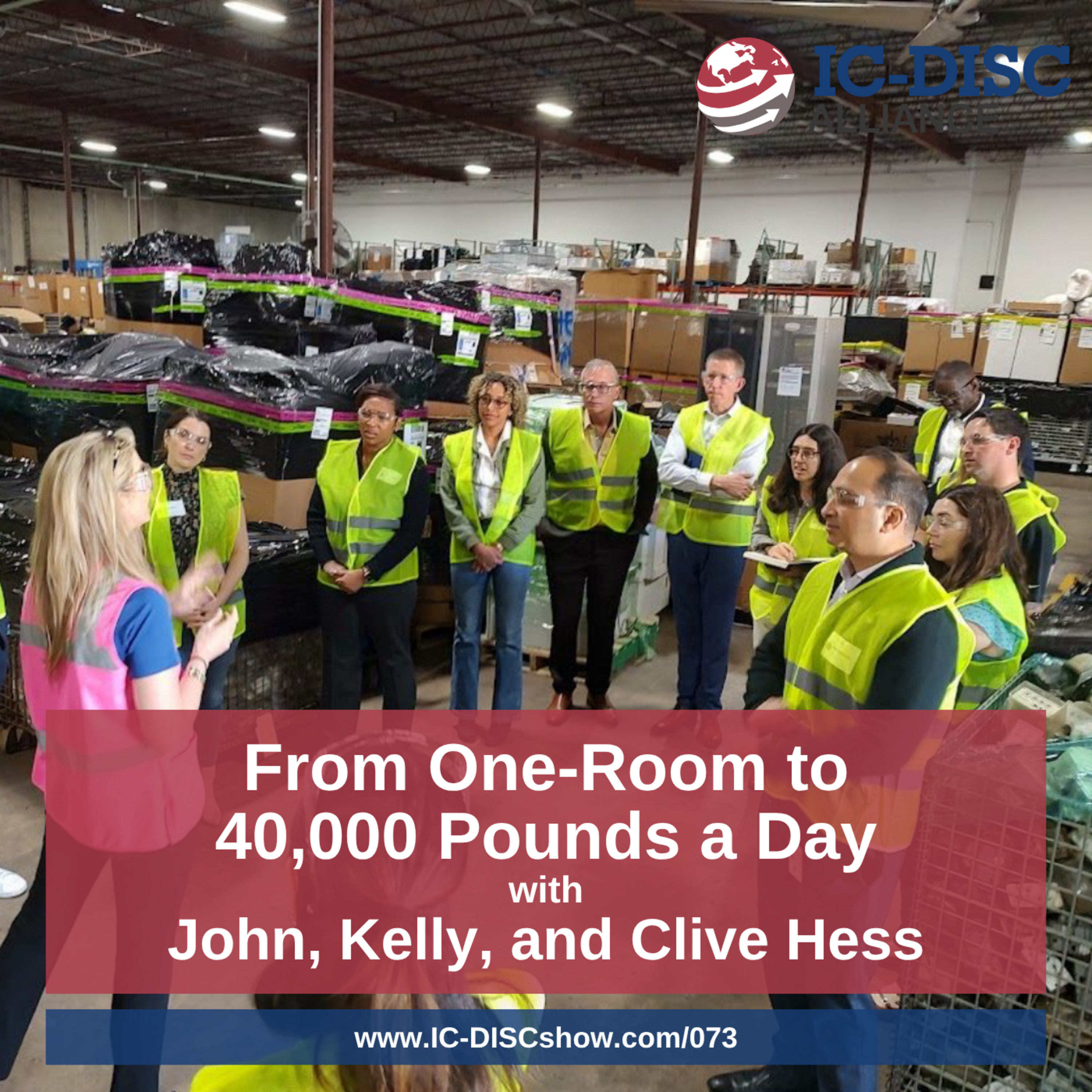
Ep073: From One-Room to 40,000 Pounds a Day

Today on the IC-DISC Show we're talking with John, Clive, and Kelly Hess from CompuCycle in Houston. John started in the metals business in South Africa back in 1966, came to the US in 1986 to run a brass and copper distribution company, and spun off a small scrap division that eventually became CompuCycle. Clive joined in 1996 fresh out of U of H. Kelly came aboard in 2013 from the nonprofit world and now runs the company as CEO. Three decades later they're processing 40,000 pounds a day and hold more certifications than any other electronics recycler in Texas. In this conversation, the Hess family talks about the moment the Basel Accord shut down their entire plastics market overnight, why they think scrap metal companies handling electronics is now a liability risk for corporate customers, and how they built their own plastic washing line to solve a problem the rest of the industry was still struggling with. Kelly also shares a partnership they've built with Pearland ISD that turns scrap dismantling into job training for autistic students ages 18 to 22. Whether you're in recycling or not, the Hess family's thinking on running a multigenerational business, earning certifications most competitors won't bother with, and treating customer problems as a moat instead of a cost is worth your time.     SHOW HIGHLIGHTS How John Hess went from manufacturing copper ingot in South Africa in 1966 to building Houston's largest electronics recycler Why being R2 certified isn't enough, and what Compu-Cycle did after watching certified downstreams still send material to landfills The day the Basel Accord shut down their entire plastics market overnight, and how they engineered their way out Why scrap metal companies handling electronics has become a liability risk for their corporate customers The partnership with Pearland ISD that turns scrap dismantling into job training for autistic students What changed when Kelly came in from the nonprofit world and the family started hiring people smarter than themselves   Contact Details LinkedIn - Gordon Driscoll LINKS Show NotesBe a Guest About IC-DISC AllianceAbout CompuCycle   John HessAbout John Kelly HessAbout Kelly Clive HessAbout Clive TRANSCRIPT (AI transcript provided as supporting material and may contain errors) Dave: Well good morning. So this is my first time. I've had three guests on the podcast at one time. We have John Hess, we have Kelly Hess, and we have Clive Hess. So where are you all, calling into from today? what part of the world are you all in? Where now? John: We, I'm a responder. We're in Houston, Texas. Dave: Okay. And so am I. So that's, that is good. what I wanna talk about, and the reason we're doing the three person interview is the company Compus Cycle has been in business a little over 30 years, is that right? Kelly: 30 years to this? 2026 is our 30th anniversary, so we're really excited. Dave: That is awesome. and so what I wanna do, I want to go to the far origin of comp cycle, which really starts with John. So what I'd like to do is just start off with a little background on John and his entrance and experience in the scrap metal industry. So John, where are you? What part of the world do you hail from? John: Originally South Africa and have been in the metal business all my life. started in, at the age of 23 in 1966. Go back a long way. Dave: Okay. And, and then you're in the metals business, Ferris, non Ferris, John: right? we, I was, we were ingot manufacturers. We manufactured copper and aluminum based ingot for the foundry industry. And, got into the. Computer business, way back in about 1975 when we imported a, a machine for stripping cables and Okay. This machine also had the capability of shredding,computers of the old mainframe computers. Of course, there were no PCs at that time. Yes, of course. So that was my introduction to computers. Dave: Okay. So you're,you're getting into the computer, so we're talking if I'm doing my math right, that was about 50 years ago that you're involved in the shredding, chopping cable, shredding mainframe computer components. Is that about right? John: That's about right. Yep. Dave: Okay. And then how did we get from there to Compu cycle? John: Well, in 19. In 1966, I was offered an opportunity to come to, sorry, I'm getting myself messed up. It was 1986 that I had an opportunity to come to the United States to manage a company that distributed bras and copper bars and rods. Dave: okay. John: And we, while whilst there, I started a scrap division and that scrap division eventually became Compus Cycle. Okay. Right. Dave: Okay. So did, so was Compus Cycle like a literal spinoff from that company or was, did the idea come to you while you were there and you started a completely separate company? John: Well, we started it as a spinoff of that original company and, after a few years of running that business, I decided to leave the parent business and, get comp cycle going on its own. comp cycle started in the 1990s, as, A computer processing facility. Dave: Okay. And what does the name mean? John: What, what would the, what does the name mean? Dave: Yeah, I'm guessing it, it's like computer recycling that they John: kinda, yeah, computer cycle. we were largely in the scrap processing business at that time, but occasionally found product that was resalable and. okay. We actually repaired that and resold it. and that is how comp cycle began its existence, and it become a whole lot more sophisticated, over the years. Dave: Okay. Now, when you launched it, were Clive and Kelly involved at that time? John: Clive became involved. Clive, I can't remember the year. When was it? Dave: Yeah. Clive: I was involved, Kelly in 1996, I believe I was involved. Yes. And Kelly became involved in 2013. Was it 2013? Kelly: It's in 14 years. Believe it or not. Clive: Yeah, Kelly: 14 years. Dave: yeah, Kelly couldn't have, obviously Kelly couldn't have been involved from the beginning because she would've been in elementary school 30 years ago. Kelly: Well, no, I was that when he said, John said 50 years. I was like, okay, well that's exactly my whole life livelihood. And then, but yeah, no, Clive, I think, funny enough, we were dating when you were involved in Compu Cycle, but It was great though because Clive graduated. Well, you tell your story. You graduated from U of H and then jumped in. Clive: Yeah, I graduated, got involved and, we were, as my dad mentioned, primarily doing electronic scrap. and it evolved. it was really interesting. Back then there were very few companies doing what we were doing. And so not really knowing how to do what we were doing, we could survive and, we, we were scrapping mostly for the metal and precious metal recovery. Okay. Dave: And Clive: evolved into harvesting components, reselling the components, and then the refurbishing of equipment. On a very basic level, reselling it. And,as mentioned today, we are far more sophisticated than what we used to be 30 or 25 years ago. so it, it's, it, it grew from a very small business into a, today we're, we are a very. nice mid-size company. In our industry, John: we like to think of ourselves as the most dominant computer processing facility in, certainly in Houston and probably in Texas. Dave: Okay, so Clive, when you joined. I'm guessing it was a cushy job. You're the boss's son. You probably just sat at a desk with your feet on the desk, smoking a cigar all day, I'm guessing. Is that, was that about right? Is that kind of how it worked out? Clive: I would love to agree. family businesses are very unique, Dave, and, it, it, I'm very blessed. I'm very grateful for what I have. but it, that, I wish that was the case. No, we were certainly, yeah. Very involved and very entrenched. And, and,it's been a, it's been wonderful working with my dad and, it's been. more wonderful working with my wife. Kelly: He's just trying to be nice. That's a whole other podcast, Dave. Dave: Sure. Yeah. And obviously, and oh, and obviously I was joking with you, Clive, because usually the story is that when you're the boss's son, it's hard. Your life is harder because you're held to a different standard. Sometimes your dad has to go the opposite way and be even harder on you than the other employees. Clive: Yeah, he was actually,I will say,very easy with me. and,but it's, it, I was working for John: him getting clever aboard. Definitely took us to a higher level than we were when I was here on my own. And getting Kelly aboard gave us, a further injection to the extent that we've over the last 13 years since Kelly's arrival com cycle has matured enormously, it's become from simply another scrap, another computer scrapping business. To a sophisticated computer, refurbishing and scrapping as well. our scrap division has grown enormously with the addition of a shredding plant for computers and more recently a shredding plan for plastics, which, makes us unique in terms of having abilities that others simply do not have. Dave: Okay. No, that I get that. What, so I'm a chronological thinker. I'm an accountant. And so what I'd like to do is let's go back 30 years. You touched on it, John. Let's think about like the big milestones. So it, the company started in 96, if I'm doing my math right, in 1996. And what year did you join Clive? Clive: in 96 I was Dave: Okay, so the same time. Clive: Yeah. Dave: So as you think back, what was like maybe the first significant milestone? If we're thinking like in five year kind of impli or increments, like any major things that happened in those first five years that were, meaningful to where we got to today? Clive: If, gosh, going back 30 years, I can't go back three years, but,it's, bringing on. Large accounts. I think the first large account that I recall bringing on, would be Texas Children's Hospital. Okay. And,when we, that was a significant account that we brought on recycling the electronics, I think I, that would be a, certainly a milestone. and then going back to 2000,this is further ahead by 2010. We became the first certified electronics recycling company in Houston. And that was certainly a very large milestone because we were the only,for quite a few years, and that brought on additional accounts. what does takes life? Yeah. What Dave: I'm, I don't mean to interrupt. what does certified mean? Clive: So in, in our industry, there was no benchmark or there was no qualifications that one would have, one could have to identify themselves as a responsible electronics recycling company. Okay. And, corporations were familiar with the ISO certifications and Yeah. In 2008, the EPA. Stakeholders, created a certification called the R two, which stands for Responsible Recycling Practices Certification. Okay. And in order to achieve that, companies had to, follow a certain practices. Had to be certified just like companies who are ISO certified. Okay. We through the process of becoming certified, and it, it takes about, six months to a year to achieve that certification where you are, monitored. you have to recycle materials in a certain manner. you have to, adhere to the practices. You cannot just export products overseas anywhere to anybody without any, okay. Standards. And so we achieved that certification, which was,at that time extremely difficult, especially, a small company that did not have, Processes, policies, procedures that were documented in a sure professional manner. So that was, I think our, a very large step, moving in the right direction. and David, today we have the most certifications of any electronics recycling company in Texas. okay. So we, we have, I think seven certifications. Which would be the ISO 9,001, 14,001, 45,001, 27,001 certification. Then R two certification. E Steward certification, na AAA certification. so we have certifications, that, the scrap metal companies have zero. so scrap metal companies recycling electronics, is actually a. it is a,a liability risk, to corporations who may be sending the electronics to scrap metal companies for recycling because they don't adhere to any certifications. where we, we have seven that we have to adhere to. So when you're recycling with compute cycle,your products are handled in a very professional and, Very secured manner, especially today with where we are compared to back then. Dave: Yeah, I can, no, thank you for pointing that out. Because I can tell you, so I've been fortunate enough to be a, a donator of computers to your company through the years. I suspect I'm not your largest account. but of course my biggest concern was the confidentiality of the data. Okay. Because, I'm not a computer expert. I don't really know how to wipe a hard drive. And even if you wipe a hard drive, somebody who really knows what they're doing can still, I'm told, can still recover data some way. So I was looking for a way that I could just give you guys my laptop and be confident that data was never going to find a home elsewhere. Clive: Yeah. Dave: so is that the biggest concern of like your large corporate. providers or customers. Clive: Yeah, it's, and, let me just, one other milestone I'll say Okay. That I want to throw in was certainly, Kelly joining Comp Cycle. And, it's, over the years I've delegated, responsibilities or responsibilities have been removed from me and, Kelly is the CEO of comp cycle. And truly, Kelly is, an incredible leader of comp compute cycle. I'm, I, I always tell people that, and I've mentioned earlier that I'm truly, I'm blessed and, Kelly is phenomenal. And working with Kelly,is extremely rewarding for me, because of what we've accomplished. and we continue and we have the most amazing team at Compu Cycle. Company culture in this at Compute Cycle is extraordinary and it's because of Kelly and the team. So I think I'm gonna bow out now and I'm gonna pass. Okay. Kelly: Yeah. No, but hold on. Because they don't give themselves enough credit in the sense of where we've gotten to. where I came in about 2012 was our kids had, I came up from the nonprofit world. That was my life after graduation. And,I did a public relations psychology communications degree. Okay. Fell in love with nonprofit world and the fundraising of it and development directors of various different nonprofits. And, almost 25 years ago, October, Clive and I got married and Oh wow. Had, our two beautiful daughters. When I was working, I decided to stay home and raise the girls, but was doing some marketing and communications that really wasn't existent at the time for comp cycle while I was working at home. And, it was an amazing company for me because both John and Clive created this company that was really green before it was even cool to be green. And, wanted to really try to see how we could maximize what we were doing because the growth had been. Flat and we were, they were doing well, but we needed some type of growth in business development. So that's where I decided I was gonna come in for a couple years and try to just build clients, try to find new business. Okay. And we were, very blessed and lucky that we did, where we were able to get some very large accounts. And a lot of these accounts we were working with were saying, we don't understand why you're not a women-owned business. Okay. Like this there, obviously in this world, in this niche of the business we're doing, there's not a lot of women-owned businesses, okay. And what a growth possibility or opportunity it might be if you become women-owned. Okay? that is where it all started. And so 10 years ago I signed the dotted line and decided to see, okay, I'm really gonna see what we can do and build with Compus Cycle. but. I would definitely say yes, I've been able to grow the business with business development and accounts, but where the growth has really come is getting the right people on our team. It has been the strength of the,our management team. the actual managers of our company are, we have about a hundred employees right now. And Oh, wow. Yeah. And all of them are so dedicated. They're loyal. We've had some with great tenure with us, but it was really us realizing we had to start hiring people smarter than us. And that if we wanted to really grow, Dave: and Clive was the first one that made that hire. When he brought Kelly: Well, and then I've had to make, and then as a team, we've definitely hired a few more of those, which, has really been what has got us to this next level. and It's exciting to see, but I think what I'm most proud of with Compi Cycle as our company and what we've been able to create is, I am so proud to say when it comes if to looking for the most responsible, the most secure, the most sustainable and circular solution, you cannot do better than Compe Cycle. And we have such great differentiators of especially being here in Houston. I mean it when I say it, David, there is you. No reason why any company in Houston should not be using Comp Cycle. 'cause we are the only one that can truly show and guarantee responsible recycling because we're not only that recycler, most recyclers are sorters. They're going through the equipment. What can they reuse and what can they resell? Sure. And being a certified company, we are so proud to be dual certified with that R two and E Steward certification. But in my opinion, being certified is not enough because certified companies have to use certified downstreams. But being in the business for 30 years, we have unfortunately learned the hard way. And it's those Downstreams certified or not. Which is unfortunately where a lot of the landfill, the exporting and finding your three things on eBay happens. Okay? So we said as a team, no more, and we put in our processing facility next door and a multimillion dollar shredder where we're now, everything that comes to us, if we're not able to reuse and resell, which we're gonna give value back to our customer if we can resell it. But if not, it's gonna go next door to that processing plant and it's gonna turn directly into its raw materials. The steel, the plastic boards, aluminum, copper, and it goes directly to the mills smelters and refineries to be recycled. So that's like the biggest difference where, you know anyone, any company that uses us can sleep at night knowing that it's being done the right way and things aren't leading comfy cycle. And that is like what I am most proud of. And then we took it to the next level with putting in the plastics plant because epl, most electronics are made about 60% plastic and the EPL is dirty. So we created a sink float system where really the plastic gets about four different bath. And we're able to separate the plastic and then as well as separate it with an electrostatic machine that breaks. Its down to its A, B, S, and PS form. So we can create domestic solution now for the plastic. So that's where we Dave: got Kelly: the most circular. But what's really been amazing is us being able to see how Compi cycle is really that last piece of having an effective cybersecurity plan. If a company's gonna put all this money in protecting themselves from with the cybersecurity. But at the very end, they're not taking care of their equipment in the disposal, then it means nothing. So we've really tried to pose ourselves as like really the most critical, essential piece to the end of that plan because we wanna make sure things are done the right way. Dave: No, that. That is great. So by the way, I just wanted to clarify something with Clive. So one thing you and I share, Clive, is we both married way over our head and we're both married to rockstar wives. So when I say that. you married someone smarter than you. I can say that being that I'm in the same boat. So I'm just letting you know, I'm not really picking on you. I'm more, commiserating with you that we,we really, got way over our head with our spouse, selection. Clive: David. I agree. we certainly did. And, I, I have three women in my life and believeing me, they're all smarter than I. but I wanted to just, add on what Kelly mentioned. for me, my, my goal with Compute Cycle was to have a solution to our clients that was a completely secured solution. And where chain of custody remains with Compus Cycle. So when we, and we invite our clients, we've, we invite all prospective, clients to visit Compute Cycle. To see the process. To understand the process. once you see it, it's very easy to understand it and any questions that, or concerns that you may have. You mentioned earlier you wanted to make sure that if you drop off your product at Compute Cycle, you are mostly concerned about your data and how do you know? That it's gonna be handled correctly. So when we bring clients into our facility and our facilities, our access controlled facilities, we have security on site. So it is very secure. But when you go through the facility and we show you, we walk you through where it arrives and how it's processed. Any questions, concerns? we have companies that will audit us. We have their security departments, visiting compute cycle. we have cameras in our shreds where you can see the product being shredded. we, we show people how it's been done and it is absolutely a closed loop solution, which is exactly what I've always wanted. And we have that process today to offer to our clients, which is a major, we talk about, what would be the milestones, that is a milestone that we've actually achieved today where there is nobody. There's no other electronics processor in Houston. We are the third or fourth largest,city in the United States, and we are the exclusive processor in Houston. very proud of doing that. And in Texas, we're the exclusive electronics processor separating plastics into single polymer plastics. Okay, if clients are always concerned about data. Cybersecurity. We are the only electronics processor in Texas that's ISO 27,001 certified. so we can check the cybersecurity just through that certification. But we do these things because we wanna be a leader in the industry and we also want to protect our clients throughout the entire process. Dave: Yeah. So let's So by the way Kelly: Yeah. The right way. Dave: Oh yeah. How long has it been since you moved across the street to your current facility? Like three years ago, but I'm pretty sure it's been longer than that. Clive: 20, 20 18 we moved into. This facility and in 2019 we opened up the processing facility. Kelly: But I think it's important to note that in 2018, that facility was 40,000 square feet. When we moved here, it was 80,000 square feet, so we doubled our size and that next year we bought next door for our processing plant, which is now another 50,000 square feet. Yeah. So truly tripled our size. In one year. And so the good news is we have capacity, we to do more, which we'd love. In our processing plant, we do about 40,000 pounds a day of processing. Oh wow. But we could do 60. and I would love to get us to two shifts. we'd love to always get more customers and we'd love to be able to show prospects and customers to tour our facility. We're so proud of what we're doing and how we do it, and we're very transparent, so we encourage any prospect to schedule a tour with us. And something off also that we offer just more is less a community service, but also because it's the right thing to do is residents can bring their equipment to us five days a week and drop off, and we'll be happy to recycle it free of charge, destroy all their hard drives, so residents don't have to worry about their data. Dave: that is great. It sounds like I'm overdue for a tour because it's been, it was probably 2020 that I was last there. It was probably right after the Shrider got started. Yes. Certainly I've not seen the plastics recycling. So talk to me to the extent that you're comfortable discussing in general terms, because you made the comment that depending on the value you can extract from the machine, some of that value may go back to your customers. Can you gimme just a general sense, like let's take some company that. Recycles a thousand computers a year. What's the general process? Do they deliver 'em to you? Do they have a big container? Do you go pick 'em up? Like why don't we just start at the beginning? How does it work, Kelly? Kelly: Yeah, no, and I'll let Clive go into more of the pricing. He's the pricing guru for us. But really what you know, what's so great is that we can accept material. We have 3 24 foot box trucks driving. I call 'em my walking bill, driving billboards. They're going around the city all day long, picking up equipment. And so we bring stuff here directly to us, but also companies can ship things directly to us. Dave: Okay. Kelly: And or if there's locations outside of Houston and they want us to either white glove service to pack it and or we can ship it. We have our own logistics where we can bring and a arrange. So really from anywhere in the United States, we can handle collections. But what's the process really is once a customer is in our system, Clive or myself are the only ones that are able to develop a contract for that company, and it gives us the exact instructions of what they want. Some companies need everything destroyed. Some things will allow us to give value. So depending on the contract, we have specific instructions. But what we're also so proud of is all the data bearing devices come in and we put our own asset tag on that equipment. Okay. So we'll be able to track that equipment as it comes into Compu cycle and we can see exactly what happens to it, where it goes, where it is in the process. But our customers can also, so they can, oh wow. Serial number of a machine. They can be able to see exactly when it was recycled. This online portal holds our certificates of data destruction, certificate of recycling. So all of these things our customers can access at any time. But when it comes to value, usually our baseline is anything five years and younger, and that has this working condition. But I'm gonna let Clive take over at this point. Clive: Yeah, it's, so where we can. Refurbished product for reuse, we give value back to the customers. Okay? So typically if product's five years old or younger, we gotta give value back to the customers. We are gonna destroy the data. we sanitize the data using Department of Defense Compliance Software, our reporting, we will report the mate model, serial number, capacity, of the hard drive and include in the report. The parent's serial number that the drive,belongs to. So very detailed reporting, drives that fail the process. We physically shred. we have some clients, as Kelly mentioned, we have some clients where a hundred percent of the equipment coming in here has to be shredded. We have camera surveillance throughout the entire facility, so you can witness the,the process in person, or you can witness the process via camera. but where we can repurpose and reuse, we give value back. our sales channels, we sell to various verticals, depending on the age of the equipment. so we sell product domestically. We sell product internationally. we actually, have launched and we, David, I think we are the only company in our industry. we have online sales where our customers. Can actually witness the sale of their products and see the value that we actually are getting for their products. So we are Oh wow. Truly transparent, where our clients can see what the value of the product is. We have a lot of clients that ask us how do we know we getting the maximum value? So we now have a way for them to see what the value is, and then we are selling that on a revenue share basis. Where based on what we sell, they'll get X and we'll get Y. Okay. So we are trying to maximize the value, for our clients and whatever we cannot resell. We process through the shredding plans. Kelly: Ooh. I have to mention, I love also that one of our biggest buyers too is ISDs across the country. Dave: Oh, really? Kelly: Okay. We can buy three systems for the price of one, and we sell with warranties. So I'm so proud that we're able to provide school districts across the country with the affordable equipment for the students. Dave: No, I, I like that. So I'm curious,you're the only, computer recycling, client we have and so I'm more familiar with a traditional yard, so like a scenario where there's like a manufacturing facility. And they have like turnings and scrap metal that comes from the processing facility that's clean. Now, my understanding is that type of material, the recycler is actually paying for that material. Now, I would imagine in the computer world it might be different if a client wants everything destroyed. Are they, do they tend to pay you or are you still paying them because of the scrap value? Clive: it's both. so yes, we do give scrap value. but there, there are items where there is a cost for us to, it's not like a scrap metal company where you're bringing in clean aluminum, dirty aluminum, steel, copper, et cetera, et cetera. TVs for example, when we are processing TVs, inside the TVs, there's products that there's a cost for us to disposal. If it's the lamps, the glass, the panels where there is a cost for us to process and dispose of that. So if, a company just had cable and we brought in the cable, yes. We'll give them cable value, just like the scrap metal companies we'll pay for For that product. So it's a combination of both. that,and, depending on the volumes, we will price it that way. So we do have manufacturers, that need their products shredded and we will then,there's a cost for us to process and there's value that we give for that material too, and we will. we will, we'll share that, certainly the value with them as well. Kelly: And David too. What I think is so important is that we also provide incredible environmental scorecards and sustainability reports for our customers. Okay? So we're actually able to show them what has been diverted from landfill. What is the reduction of carbon footprint? And especially having that processor next door, we can actually break it even down to the actual metals of what, what it is that's been recycled. What's been reused, what has been resold, so we can provide all that data to them to make them be able to show their corporate sustainability departments what difference they're able to make by using a company like Comfy Cycle. Dave: Okay. So and so your customers, are they like across industries? I'm guessing you guess some oil companies as clients. Kelly: Healthcare. The healthcare and oil and gas here in Houston obviously are very heavy, but we handle companies of all sizes, all industries. And, what's Dave: the minimum size that it makes sense for them to have a conversation with you? do they need like, a hundred employees or thousand employees or Clive: Yeah, the, the, so companies can, they can deliver their product to us. Dave: Okay. Clive: or we can, so small companies,there, there are very small companies that will bring their product to country Cycle to. To be processed. Dave: like the way my company does it. Clive: Yeah. Dave: we just drop it off. We don't pay you anything. You don't pay us anything. You just take care of it. Clive: Correct. so yeah, it's, it really is any size, most importantly,is how we process the material. And that is not going to a landfill, that we are not exporting it, overseas to. any to a downstream that is, that, that is not to third world countries that cannot recycle the product correctly. we have to adhere to very strict regulations and, hence we open up our processing plants where we can shred into the raw materials. and so we are not exporting. Products overseas. We process, we processing it domestically. And what we do export is the raw material. So yes, we can, well, the steel we sell domestically, but the aluminum and the copper and the boards and the plastics, we can sell that domestically or we can sell internationally as the raw material. Dave: Okay. Clive: Yeah. Dave: So talk to me about the plastics recycling. Before you started doing that, was that product just going to the landfill? Clive: No, so the plastics industry, the plastics, the plastics were being shipped to Malaysia. the Malaysia is the largest plastics market for,I'm going to for low grade plastics material and John: Okay. Clive: In. appro approximately five years ago, the Basel Action Network. so the Basel Accord passed a law regarding recycling of plastics and certain low grade plastics, had to be,recycled in accordance with the Basel action. John: okay. Clive: Accord and really what that came down to with electronics, plastics is that you could not, Malaysia, which is, which ratified the Basel action Accord, was not allowed to import mixed e-waste plastics. Okay, because the United States has not ratified the Basel Action Network. It was not illegal to export other United States, but it was illegal for them to import into Malaysia. Okay? And so the Basel Action Network put a lot of emphasis on monitoring what was leaving the US and what was going into Malaysia. so it basically went from plastics. All the e scrap guys selling plastics to Malaysia, to, there's no market to sell the plastics. There's no value in the plastics, and what do you do? And that became a massive problem in our industry. Fortunately, we decided many because we were shredding electronics and were generating the plastics. We wanted to further process plastics and we wanted to extract the metals, excuse me, from the plastics. So we added on to our processing line, a plastic washing and sorting system so we could remove the metals, have clean plastics, and get more value for the plastics. And the timing was just, it was wonderful because we just happen to do this at the right time. So today we have a solution for the plastics. We can sell plastics domestically. Or we can sell plastics internationally. In order to sell it internationally, you have to separate the A, b, S and PS plastics, which we can do, or we can sell it domestically mixed. So we have a plastic solution. the plastics, I'm grateful. We not in the, we, we always tell our clients we're not in the plastics business. We don't want to be in the plastics business. we just happen to generate plastics. The plastics markets. at the moment are very depressed markets. Kelly: so I always say it's sustainability over profitability, but it's Dave: okay. Clive: Yeah. Sorry. and that's why we are very grateful. We are not in the plastics business, but it is a,today the virgin plastics actually,are it's the recycled plastics. The virgin plastics prices are so low right now that the recycled plastics is not a needed plastic. in Europe, they are mandated to use a certain percent of recycled plastics, the manufacturing of equipment that does not exist in the United States. So there's a much stronger demand for the plastics internationally than there is domestically. hence we can sell the plastics internationally. but it's a wonderful, it's wonderful that we can offer this to our clients. it has opened many more doors to compute cycle because clients who are concerned about the environments, who do want to do the right thing, who wanna make a difference and wanna make an impact. they are using compute cycle because of our capabilities. Dave: Okay. Clive: Yeah. Dave: Well, I, I just looked at the clock, man. Time flies when you're having fun. as we're rounding the home stretch, I just have a few more questions. so Kelly, so you and Clive and John have done a great job of explaining it. Why? Comp is uniquely positioned to serve companies, especially in Houston and Texas. but I'd like to flip the question. Can you share a customer story or two as far as what your customers tell you that they love about comp? Can you think of like a couple. A couple examples, like where somebody had a different solution that was problematic, then they found compus and Compus, really made a big difference. Can you think of a couple examples? And you don't need to mention the company's by name if it's Kelly: not Yeah,no. I think one of the things I'm most proud of with, Compus Cycle is that we are not a cookie cutter approach. We really create tailored solutions for all of our companies because working with companies of all sizes, all industries, all of the needs are different. So we've really been able to tailor solutions to what their needs are. But I really think what's amazing is John, Clive and myself, what pride we put into our customers. And they're able to see that as owners of the business, that we actually, how much we're involved and how much we care. I give every potential customer and customer my cell phone. If there is ever a concern, a problem, an issue that they're having, they can call me directly. We have a great sales team, but if they're not getting what they need or if there's a problem, I want to know so they can call me directly. And we really work on having the personal relationship with our customers of, and again, of all sizes. okay. Every customer we have means something to us. And I think like that's one of our great selling points, and something that's important to us. But I also think too that, we love to grow. We're all about continuous improvement. So we challenge our customers that if they have projects or different types of equipment, that they're not sure if it's something that we can process or do. Send us a picture. Tell us what your project is, let us see if we can do it. If we can grow our services, because that's what, how we grow as a company, and then we can offer more to our other customers. Okay. So we really challenge them to see what else can we do to help them. Clive: Yeah. I, Dave, let me add that, the feedback that I get from a lot of our customers is how responsive we are. If you email compute cycle within 24 hours, you'll have a response. you need something done, we get to it. they are amazed at how efficient we are at what we do. large corporations where typically they're waiting three or four or five days, we get back to them immediately and then their pain points. We had a client a week ago that, it's a very large client. They're international clients that needed a solution for, certain hard drives and certain devices,that are very,important devices that they do not want to leave their facility. They want to be able to, just wipe these devices individually themselves. we are very easy. They use our license, they wipe the device and they send the device to us. So we can electronically do that, where they can just log in through the portal, click a button, and it will erase the data from the device. Dave: oh Clive: wow. It's, we have solutions. We work with our clients to make their lives easy. We make their lives so simple. we have a team that does data center decommissioning. So we go on site, we decommission the data center Kelly: all over the Clive: country. We do that all over the country. Oh, wow. And it's a very experienced team. And the feedback that we get is. You guys can do it in a week. The last company that we used, it took them three weeks. So we are very efficient, and we are very transparent. I mentioned when we selling your product that you can see the value that we selling your product. It's just we are so good at what we do and when we can prove that to our clients. We never lose clients. once you come on board with Compus Cycle, the experience is unbelievable. And, we truly are the expert in our industry, because this is exactly what we do. And yes, we have much larger competitors, but we are very streamlined, we are very efficient, we are very nimble and we get things done very well. and so we are so excited 'cause we are growing. We really are growing within this industry and our capabilities are unbelievable and we continue to improve. right now, we focusing on data, we focusing on ai, we focusing on how do we become more efficient at what we doing. within these two facilities, we are processing the same amount of material, 50%. More efficient than where we were two years ago. So really Dave: That's Clive: amazing. we need to move into another facility today. Kelly: today we just need more equipment. Clive: Yeah. it's just incredible. So we continuously, we set goals and we continuously, achieve those goals. and,we're, we are growing and we're. Kelly: But really to be a family owned business, which we are, and what John, started for all of us is what is, what's amazing is that we still haven't lost that We can now do what all the big boys do and our processes and procedures and services, but we also are still very much. A family owned business in the sense of I hope our customers realize how much we care and that we're available to them and our team cares. And I just hope that says something that we haven't lost that. Clive: Yeah, we're not a mom and pop organization, but we are, we treat our clients with the same respect as we would like to be treated and we treat our employees. Like they are, family to us. we, and our facility is clean. Our facility is dust free, our facility is safe. Our employees have the the PPE that is required. we are always looking out for employees. I was actually at a facility yesterday. that I, yesterday I came home to Kelly and I said, I've never seen something so dusty. And disgusting and how they would allow the employees to be in that environment. When I left that facility for an hour, I was copying and it was just, it was awful. And we would, it's just not who we are. And this is an international company. I could not believe it. And we will never treat our employees. wow. in that regard. Dave: So it really sounds like the philosophy that your relationship with your customers is more than just a vendor, customer, that it's truly a partnership. Kelly: Absolutely. Dave: Right. and that you are, you work together, you're always, trying to improve things. And then it also sounds like the relationship with your employees is somewhat similar, that it's a partnership. Y'all are in this together and you play different roles, but everybody's important and, Does that kind of summarize that? Kelly: Yeah, no, we definitely know, see people for their strengths and and maximize them to what they're good at and what they have a passion for. And it's worked. It's an Dave: equation works. So I have one more question and it's for each of you this, so it's the same question to each of you and you can't copy one another's answers. Okay. Okay. I'm gonna start with John. So John, at this point. In your career, in the evolution of Compus Cycle, what do you enjoy the most as far as your role these days with the company and with Clive and Kelly? what brings you the most enjoyment? John: Okay. So I'm at the stage of my career, right at the end stage of my career. what I enjoy most. Is watching the success of Kelly and Clive, which I find so remarkable. And the, when I look at the company now and relate where it's at to where it was when, they came on board, the differences like chalk and cheese, the difference is massive. volumes of business that we doing. the relationship with employees, the relationship with customers, all of these things has metastasized into so much more than it used to be. Okay? So that is what I'm proud of, and that's what I enjoy most. Dave: Yeah, that, that answer doesn't surprise me. I. I see you more frequently, socially than I do Kelly and Clive, and I've always had that sense that pride, in just the how gratifying you found, you find that you started this thing and that Clive and Kelly have really just taken it to a whole new level. So that, that makes Kelly: sense. But don't let him pull you. He's here every single day. And a door is always open. And really a consultant of consultants when it comes in helping us with our scrap metal side still of the business and everything. So he's here every day. Dave: Well, that, that is great. I'll go to Clive next. So in your current capacity, what do you enjoy the most? What gives you the most satisfaction? Clive: Yeah. I, Dave, I enjoy. also watching the growth and the success of country cycle. But I think what's, I enjoy doing things that make me happy, where I used to have to do everything. I now can focus more on establishing partnerships, focus more on, working on the business,instead of the nitty gritty little things that I used to be so bogged down on. I don't have that anymore. So it's helping salespeople be successful. putting quotes together that are,very difficult, because of the experience that I have. So it's, it's that's,it's, that's what I enjoy. Yeah. Dave: Awesome. Kelly last stop Clive: and watching loves. Kelly: Yeah. So I have to say, I can this answer, I can finally give you confidently. 'cause I probably, if you asked me the last few years, I wouldn't be able to say so confidently. because now by having a sales team, I'm not always having to focus on finding the new business. And also being able to not be in the nitty gritty as much and be more at a higher view. But I have finally gotten my nonprofit life back and been able Oh John: yeah. Kelly: Yes. And combine both. So there's two things I have to tell you that we're doing that I'm just Dave: sure Kelly: beyond proud of. The first thing just happened recently and we've been trying for years to make this happen, but we have a partnership with Goodwill Houston. Dave: Oh, you do? Okay. Kelly: Yes. And so Goodwill Houston, you know their mission is to empower lives by work. And to employ people by work. And the way they do that is by having all of these donation centers, people donate and then they're able Put their money into the career development. Well, we wanted to be able to have a place where people could donate or to give their equipment. So when Goodwill accepts electronics, if they can't sell those electronics, we're gonna take them, and then we're gonna pay them for the scrap value. Oh Clive: wow. So Kelly: we're one responsibly handling all the stuff they can't sell. And two, be able to provide money back to them where they can put it into their programs. So I'm very proud that's a partnership we have here in Houston and that's developed just recently. And then we also have a partnership working right now with Pearland ISD that we're trying to now replicate within other ISDs. And I have to give Clive credit for this because he's the one that really created a training facility for individuals at school that are, That I No, that no. That have,the gift, like really the children that are on the spectrum of autism. So they have, from 18 to 22 years old at schools, those students that have somewhat graduated high school but still need time to develop, we've created a job track, a training facility where they're able to dismantle the equipment. Oh wow. John: We Kelly: to then pay, it's the equipment that they're dismantling is their school's equipment. We're then picking it up as scrap. We're paying them for that scrap so they can keep the program sustainable. As well as pay some of their students as interns. They're getting job training, which I can now bring over to Goodwill. Have them go into the job piece of work. Wow, that's amazing. Not only are we circular solution and recycling, but my goal is to create a circular solution and community impact. Dave: That is awesome. That is awesome. That's what Kelly: I'm excited about. Dave: That is awesome. Kelly: So it's doing things like that, that I'm really hope that as we grow, that we continue just how can we collaborate and make more impact in the community as well as the responsible sustainable recycling. Dave: No, that is awesome. Congratulations. Goodwill is my paternal grandmother worked at, Goodwill for like 40 years in, Sioux City, Iowa. Kelly: You're kidding. Dave: Nope. 'cause I know you're from Iowa, Kelly: right? You get my whole family, my mom's side. Yes. All, oh, the plow. Dave: Yeah. so Goodwill, they started a church at the Goodwill Facility. And anyway, so I'm a big fan of Goodwill, so I appreciate, I That's strange, that connection. John: Yes. Dave: so I can't tell you. So I want to thank you all for two things. One, I want to thank all three of you for taking the time to come on and tell the story. I really appreciate it. And secondly, more personally, I just wanna tell you how much I appreciate having had the chance to serve you all,on our services. the team always tells me that they always enjoy working with your team. And it's been fun to watch the, from our end to watch the progress of the company over time. So thank you for having that opportunity to be your partner in the tax services that we do. Kelly: No, we appreciate everything you do for us, David. Thank you. We enjoy working with you. Dave: Well, thank you. Well, you all have a great day and we'll talk soon. Kelly: Great. John: Thank you David. Kelly: Thank you. John: Bye. Special Guests: Clive Hess, John Hess, and Kelly Hess.

March 17, 202642 min

Ep072: Software as a Competitive Advantage with Gordon Driscoll

Today on the IC-DISC Show we're talking with Gordon Driscoll. Having spent his early career at Goldman Sachs investing tens of millions into metals companies, he kept noticing they were running their operations on Excel spreadsheets and software from the 1980s. That gap became Green Spark, a cloud-based platform now in over 900 scrap metal recycling locations. In this conversation, Gordon talks about what it took to break into an industry where relationships go back generations, why he thinks most business owners are thinking about software wrong, and how his team earned credibility by acting more like a partner than a vendor. He also shares a customer story that stuck with me about a scale operator who got his first lunch break in six years. Whether you're in scrap or not, Gordon's thinking on sustainable growth, earning the right to disrupt, and treating technology as a competitive advantage rather than a cost center is worth your time.     SHOW HIGHLIGHTS Why a Goldman Sachs investment banker left finance to build software for scrap yards The massive technology gap Gordon kept seeing in companies handling tens of millions in materials How Green Spark grew to 900+ locations by acting like a partner, not just a vendor The customer story about a scale operator getting his first lunch break in six years Why Gordon believes you have to earn the right to disrupt an industry, and what that looks like in practice The mindset shift from treating software as a cost center to using it as a competitive advantage   Contact Details LinkedIn - Gordon Driscoll LINKS Show NotesBe a Guest About IC-DISC AllianceAbout Green Spark Software   Gordon DriscollAbout Gordon TRANSCRIPT (AI transcript provided as supporting material and may contain errors) Gordon: And I think that a lot of folks, candidly, just because they're not used to either our model or what technology can do today, they don't realize, which is changing, they still view software as a cost center. And ultimately the tools that we're seeing and the applications that we are pushing to the industry, a lot of our customers view as a competitive advantage. Dave: Good morning, Gordon. So where are you calling in from today? Gordon: Hey, Dave. Appreciate you having me on. I'm in Brooklyn, New York today. Dave: Oh, okay. That is great. So I must say, I know a lot of folks in the scrap metal industry, service providers, yard operators, brokers, but you seem to have a particularly unique background. So why don't you tell the story from the time you graduated college? Sounds like you spent some time in investment banking in New York. And what caused you to have this epiphany that you wanted to go provide software in the scrap metal industry? Gordon: Yeah, no, of course. It's worth an explanation because looking at my background on paper from finance to scrap software, it doesn't make much sense. So yeah, started my career in financial services, spent a few years in investment banking at Goldman Sachs and then moved into private equity investing, but all of that centered on natural resources, broadly speaking, but specifically the metals industry. So spent a lot of time up and down the value chain, anything from box site refineries in Australia to working with the biggest mills in the country like Cliffs or JW Aluminum or things of that nature. And then in the investing side, spent really just as much time on what I'll call the kind of conventional resource as I did the technology. And I quickly realized the businesses that we were at times giving tens of millions or hundreds of millions of dollars were either using Excel spreadsheets to run their business or platforms that were based in or founded in the '80s, '90s and 2000s, and ultimately saw similar patterns in the recycling industry. And by no means is using a system like that wrong by definition or inherent, but ultimately saw a massive opportunity to bring an industry that is deceptively huge that no one really pays attention to outside of the folk in the industry and folks who we saw it when we started in 2020 who are quite literally essential workers, bringing that technology to them. And it's been an awesome six years. It's been very exciting. I think that what we wanted to do, clearly the market has responded well, which I'm sure we will get into. And what's really exciting for me is not only working with the folks in this industry on a day in and day out basis, and I can talk to my relationship to the industry and general thoughts, but also specifically as technology has not really progressed linearly over the last couple years, but obviously I had some step changes with AI, being able to innovate alongside this industry and partner with our customers to bring those step changes to an industry like this. It's been super exciting. Dave: Now, well, thank you for that background recap. So let's talk about the founding of the company. So where did the name come from, Green Spark? Gordon: Yeah, great question. I unfortunately can't take credit for it. That has to be my co-founder, but we wanted to pay respect to where the industry came from in addition to one of the overlooked elements of the industry, at least from a public perception per perspective. So green in and of itself is a call to, this is the sustainability of the industry. Again, I think that metal recycling is done, especially around the work that Rema's done has done a great job over the last couple years with, let's say, public perception and really educating folks on not only the importance of this industry, but the benefits of the industry from an environmental perspective, hence the green. And Spark actually comes from something that folks used to do without XRF analyzers or without technology. And the irony is not lost on me. So 50, 60, 70 years ago, and still obviously doable today, when you spark different types of metals, the color of the spark actually denotes the greater the quality. So a yellow spark versus a red spark. So again, we wanted to, again, combine the importance of the industry with a callback to what folks used to do without all of this new technology. Dave: Okay. No, well, thank you. I was really curious about the name, and that makes a lot of sense. It's both looking at the future and still remembering the past of the industry. I like that. So you and your co-founder, did you all bootstrap this or did you tap into some of your investment banking contacts and raise money? Gordon: Yeah, so we started that way and quickly realized to do what we wanted to do at the pace that we wanted to do it would require outside capital. So yeah, we ended up talking to folks in our network in addition to capital partners that not only understood what our thesis was, which is, again, it's relatively straightforward. At GreenSpark, we want every single scrapyard and metal recycling facility on planet Earth to use our platform. It's not necessarily easy, but it is straightforward. And we realized the kind of pace that we wanted to move. And candidly, given what customers are used to in this industry, i.e., One platform that spans a large part of their business, in addition to the dynamics in the industry, which is us against folks who have been here for 20, 25, 30 years who have lazed the trail for folks like us, we realized to close that gap, we wanted to partner with folks with the capital to scale the team and scale the product relatively quickly. Dave: Okay. Yeah, that makes sense. So what, and I don't want to get too technical, but I do want to get technical enough for this to make sense. So what was the differentiator or the different approach you were taking? I'm guessing you're cloud-based instead of on- premise. Is that a safe assumption? Gordon: Yeah, 100%. And yeah, I won't get too in the weeds, but I also think it's important to understand what our thesis was. Back then, what's changed over the last couple of years just given what's happened in technology? So yeah, I think from the jump, there are a couple just clear reasons why we felt good about the idea so far. Number one, we are entirely web-based. And I think importantly, we are web or cloud-based fully natively. So rather than trying to either acquire a business that's already been existing or partner with an existing software in the industry, we built everything from the ground up. It's entirely cloud-based. And I think that outside of the benefits just to this industry, really what we've seen resonate is one, the mobility of a platform like this. So the way that we describe it is every single time you touch the material, it costs you money. So if you can distribute technology and bring it closer to the material, things like scanning licenses right from your phone, things like mobile grading and inspection, things like cloud-based driver apps. You're able to cut down on those costs because you're actually bringing technology to the material, not the other way around. Number two is integrations, increasingly, which to zoom out a little bit is certainly not true two decades ago, but was true five or 10 years ago. Increasingly, customers like ours don't have the overhead to have a full-blown IT team to have developers on staff, and you're left with a bunch of one, either one system that can't do everything perfectly. So you have one system that other does stuff well, or you have a bunch of these disconnected systems that we call it this latent integration tax. It's not something that kind of hits you over the head, but when you have four or five or six systems, you have folks spending hours a day reconciling data between those two systems, making sure that you can get information from one to the other. And from day one, GreenSpark was really built as the modern connector in the industry. And again, back to our thesis, getting in every single scrapyard in the world, we want to focus on what this industry needs, and we want that focus to be super narrow. And if someone does something better than us, we just want to integrate with it. So whether it's native integrations with ERPs like QuickBooks and NetSuite and Microsoft Dynamics or CRMs like HubSpot and Salesforce or even, I don't know, things like Google Maps, which kind of auto completes address and powers live navigation directly in the driver app. I'd say folks are using more technology generally speaking versus less. And what we want to do is make sure that all of those systems can push and pull in the right places together versus either having our end customer do it or having our end customer require resources to connect those systems manually. Now, over the last year or two, a lot of that's changed with the admin and increasingly the maturity of artificial intelligence. And I think that's where this gets really exciting. Obviously being built on a fully cloud-native tech stack allows us to leverage that technology very quickly. And I think that the way that our team is set up, not just on the technical side, but also on our customer facing side, our ability to rapidly iterate with our customers and rapidly get feedback from our customers on how we're applying things like AI and Agentic AI to their workflow has been really invaluable over the Dave: Last year or two. Well, that is, boy, I've got a bunch of questions. So that's great on the native interoperability or interconnectivity with other apps, but help me understand the ... Because I've seen some companies in this space that maybe have focused on trying to have as much native to the app as possible. So try to do financials within the system and other things. So give me a sense of how you describe the core features of the product and where it ends and where an integration with an ERP CRM or financial software fits in. Gordon: Yeah, that is a great question. That line always changes based on what our customers want to do, but at its base, we want folks running their entire business out of GreenSpark. The way we think about it outside of the integrated GL that is on the come, which I can touch on later, is that we want to be the customer's operational system of record. So everything that they're doing on a day-to-day basis from receiving, paying, managing inventory, managing contracts, customers, outbound shipments, invoices, documentation, both over-the-road dispatch and exports and logistics tracking, in addition to our reporting suite, we want all of that to happen directly in GreenSpark. Now, to be clear, that obviously comes with the obligation, honestly, or the need to ensure that the operational and financial systems of record move in lockstep. So again, wherever someone is already working in an accounting system or a CRM, we want to push and pull data to and from those systems, but we want to really cover as much of that workflow as possible. The product has expanded both in breadth and in depth recently, and I think that there is a desire in this industry to have everything under one hood, not just from the product capability side, but folks in this industry are used to and want to work with people that they trust and that they can rely on. And I think a really important part of anyone, especially as a relative outsider, like either our business or me personally, I think it's the obligation of any vendor in this industry to emulate how the industry operates. So outside of just product capabilities, a lot of folks want to, again, work with teams that they trust and teams that they can rely on, teams that they can pick up the phone and talk to if something's wrong, which is something that we spend a lot of time and resources doing. Dave: Okay. So let's say, and this may sound like a hypothetical question, but I see it all the time where there's consolidation in this industry that's been going on for 20 years, yet the total number of scrap yards out there seems to keep increasing. And from my own personal experience, it's because some small yard gets acquired by a big company, the people who sold get disappointed with how the integration of everything works. They get through the earnout, they set out a non-compete, and then it seems like there's two more scrapyards that populate from every one that's sold because one group goes off and starts one and one another. So say somebody was starting an operation from scratch and they said, Gordon, we want to do as much in Greenspark as we can. Can you all do financials? Can you function as a CRM? Could they really run the entire business just in your single product suite? Gordon: Yeah, 1000%. We like to ... So it's funny you mentioned that. We've seen the same thing. We probably onboard what we call startup yards. We probably onboard eight to 10 of those a quarter, which really speaks to the just kind of organic growth in the industry, broadly speaking. And the way we market it is it's you and GreenSpark. Those are the two almost full-time employees at the business as you get this off the ground, you can run everything within GreenSpark. Typically, a yard like that will use something like QuickBooks, and especially for yards that are starting out, we try to be as consultative as possible because there are so many moving pieces. And candidly, in many respects, internally, we are still a startup and we know what it's been like to see the cash in, cash out every single day to have way more problems than what you do with when you're starting a business. So candidly, we love working with folks like that, and we try to extend our reach from anything from software to the scales and cameras that you should be getting, connecting that yard with other folks in our network. But to answer your question, again, we are typically the kind of second employee that folks hire because it's such a comprehensive platform that you can run your entire business out of. The other thing that I think that folks have really benefited from is process standardization. What we try to do at GreenSpark is not only give you the tools to succeed, but really the best practices, standard operating procedures and workflows built around our product that have been hardened by hundreds of customers throughout the industry. So whether it's staying on top of inventory, working the kind of physical flow of the yard out when you're going to get different pieces of information to keep trucks moving. And ultimately, what folks in that scenario should be looking at on a day-to-day, week-to-week and month-to-month basis to understand the trends in their business, we try to make that as out of the box as possible versus just giving you a set of tools and saying, "Hey, go ahead and figure it out. " Dave: No, that does make sense. Okay, that's a good overview. What's your iteration cycle like? How often are you doing point releases, major releases? Gordon: Yeah, great question. I think that again, this is one of the biggest differences between us and some of the other folks, or said another way, this is one of the main benefits of being a more modern player. We're releasing daily. So literally four or five times a week, we will be releasing new updates on the platform. Sometimes you'll never know. It could be increasing storage for image capture. Other times, you 100% will. About two weeks ago, we released a fully new module that includes live container tracking for your export containers. So if you're shipping on a CIF or a CFR basis, you can see in real time where that container is on the water with live ETA updates. So we don't need to get too deep into that use case, but I think it's a good benchmark for what those releases look like. We have the ability to obviously turn on or off any of those changes for any of our customers. Change management is obviously a huge part of the industry, broadly speaking, and obviously customers' relationships with technology. So said another way, we don't really try to change for change's sake, especially when folks are running their business in very well-defined workflows. So we're really big on communication upfront for what's going to change, if anything is going to change. And we have a really robust early access period where we'll work with, in that example, we'll identify folks who are already shipping on a CIF or CFR basis, trial that live container tracking, let's say, with 20 or 30 folks beforehand before we roll it out to the rest of the group. So we like to push updates quickly, get feedback early, and then ultimately give the users or our customers the agency to opt in or opt out based on what's most important to them. Dave: No, I can really appreciate that update frequency. I've been for about five years owner of one Tesla or another. And one of the things I really appreciate is the frequent software updates. I've also owned Rivians and they also are very good. But when you compare that to the legacy automakers, they just can't do the most basic over the air update. You have to bring your car into the dealership. And so I can appreciate the benefit of that rapid iteration. So talk to me about customer support. What kind of metric and process do you all have? If a customer has an issue, how do you triage the importance of it? How do you escalate it? What's the metrics you use for response times? Just whatever there you're comfortable discussing. Gordon: Yeah, no, that is a great question. I'd say a couple things. As I mentioned, vendors in this industry need to emulate how the industry operates and people operate in different ways. Some folks want to figure something out themselves. So we have a really robust help center within GreenSpark that has over 120 articles on how the product works. That's paired with a full online academy. So we like to get ahead of any support questions by giving folks the tools they need to succeed and equip them with as much information as possible. That said, whether something goes wrong or whether they need to talk to someone, we want to create every channel available. So whether it's phone, email, or our in- app messenger, some folks don't want to speak to someone, some folks do. So we want to make sure that we're really meeting our customers where they are, depending on what they are used to. I'd say overall for support, a lot of folks in this industry and a lot of folks in software generally speaking, always look at response time. They say, all right, yeah, we want to get back to everyone within a minute or two, or we pride ourselves on acknowledging you. That's obviously important. And our response time is under a minute. It's about 56 seconds these days. So we do want to obviously emphasize that. We care about resolution though because folks don't want to be talked to. They want their problems to be solved. So the main kind of success metrics we look at on the support side, outside of just saying, "Hey, I'm seeing what you're seeing as well," which is an important part of it. We really focus on the overall resolution. We also really focus on transparency. No one wants to shoot a message or shoot an email into a black box and not know where they stand. So average response time is under a minute. If something is wrong, we typically try to keep folks updated every 15 or 20 minutes, especially if it's a critical issue. And our average resolution time is just under an hour as well. So really trying to focus on the kind of outcome in addition to making sure that folks know exactly where they stand. Dave: Okay. Wow, I don't know the numbers from the other companies, but that seems pretty remarkable. So I've been in this industry for about 20 years and I've been going to the REMA conferences for about that long. And it seems like when I go walk the trade show at REMA, that it seems like there's just a software company on every row. And so I'm curious, I would've been, if somebody asked me, "Hey, I want to start a software business or company for the scrap industry," I would've said, "Wow, it seems super crowded, lots of competition, doesn't seem like a great place." What was the opportunity you saw that what I would call a crowded space didn't scare you? Gordon: Yeah, that's a great question. I think, again, back to the original thesis, just given the vintage of our software platform relative to others, I think that at a super high level, we felt really good about our inherent competitive advantage given our modern tech stack, the ability to leverage web-based integrations, the ability to leverage the mobility that other folks candidly structurally can't do given their tech stack and given how they're set up as a business. And again, no disrespect to anyone else in the industry. The way that I think about it is they've done a lot of the heavy lifting of educating the market on the benefits of technology and candidly taking this industry from spreadsheets and DOS systems into the 21st century. But I think that there are, as I mentioned, a lot of different ways to differentiate in this industry. And I think that especially with older products, you're never in a good spot if you are a dynamic business and Scrap is a very dynamic industry using a static software product because inherently the software that you're using or the technology that you're using is not going to be able to adapt to the changes in the industry that you require as a very dynamic business. Now, over the last couple of years, obviously with artificial intelligence and what folks can do with AI, that's opened up a multitude of possibilities on how folks can use that in their business. And it's a really interesting space, I think, in the market because everyone I talk to, whether it's someone like you, whether it's the owner's son who might be taking over the business or it's a 76-year-old truck driver, it seems like everyone's used ChatGPT or some sort of tools. It could be anything from analyzing their mortgage to asking what the weather's going to be tomorrow. But I think that's a fundamental difference between, let's say, cloud computing, which has happened over the last 10 or 15 years and what's happening now. And the reason I bring that up is there are so many advantages to using AI, not just every day, but for core business applications. Folks are used to these technologies given, I don't know, they've been in the news for the last two straight years, and if folks can use them for consumer applications, and all of those advantages really accrue asymmetrically to a platform like us. So I think when you think about the kind of advantages and it being a relatively crowded market, we view things a little bit differently because when you look at the market itself, yeah, there are a lot of players and that was born out of regional and territorial compliance differences, obviously founders relationships with folks in specific territories. But when you look at businesses that can leverage that technology that you can reliably think you can use in 2050, not 2027, and folks really are thinking that long-term in this industry, given these are generational family businesses or folks are in this for the long haul, we feel really good that the number of prospective players that you could reasonably think could run your business in 2050 is actually much smaller than the overall market. Dave: Yeah. So whereas a layman, I saw crowded market, you saw market ripe for disruption, bottom line. Gordon: Yeah. And I think people love to think about disruption in technology. And I think that the way that I think about our product and what we're looking to do, you need to earn the right to disrupt an industry. And I think that we tried to come in with a lot of humility and a lot of respect for the industry. We wouldn't have succeeded if we came in and said, "Hey, I read a 50-page PDF report on the scrap industry. You guys are doing it wrong. Here's GreenSpark." That's obviously not going to work at all. So I think that what we really try to focus on again is meeting folks where they are, evolving their workflow and then being very targeted in places for disruption. So for example, let's take dispatch. Folks are used to either a whiteboard or an Excel spreadsheet or they're using some system that might not have capabilities for a mobile driver app or candidly doesn't have the power with respect to dispatch to scale integration or a modern load board where you can drag and drop trips around. That I would say is evolving someone's workflow from what they're used to to using GreenSpark. By the same token, our dispatch AI agent actually integrates directly with folks' emails and phone systems to collect that information and autonomously create tickets on user's behalfs that all they need to do is approve, modify, or reject that dispatch request. That's what I would say is something that is disruptive to that yard in a very positive sense. But I think that understanding where to evolve versus where to disrupt given what the industry's used to is a really important part of the story as well. Dave: Okay. No, that is very helpful. And it looks like you have a milestone occurring next month. Is it your five-year anniversary? Gordon: It is my five-year anniversary. So yeah, sorry, go Dave: Ahead. So I'm just curious, how's it going? Have you been able to get even one customer? How's the thesis worked out for you? Gordon: Yeah, still waiting on number one. No, kidding. Yeah. So as I mentioned, a lot of work's gone in and the market's responded, I'd say very well so far. We're in over 900 locations right now, primarily in North America, but also internationally with yards of every shape and size. So we work with folks who are doing 50 or 60 transactions a day on the retail side up to anything from 400 to 500. We have folks who are buying specifically from dealers. We have folks who have both demo and scrap operations. We have folks who have 35 locations up and down the Eastern seaboard. So it's a really fun position to be in to have access to the feedback that we have in terms of what direction to take the product. And our focus is in the overall businesses to continue scaling both with larger customers, providing the best experience for some of our single location operations and then moving internationally. And I think that, again, keeping a really narrow focus just on metal recycling and specifically just on the tools that this industry needs and being able to leverage the integrations to, again, partner with best-in-class accounting softwares, best-in-class route optimization, best-in-class CRMs has allowed us to keep that really narrow focus and serve this industry on what they specifically need, not more generalizable parts of the technology stack. Dave: Okay. No, that sounds great. So what was the question I was going to ask you? Oh, so I know when you shared your business plan with your investors, every business plan always shows the same hockey stick growth, especially in Gordon: Technology, Dave: But your growth rate seems pretty impressive. How close did it come to your projections? Was it close? Were you behind? Are you actually ahead? How's that worked out? Gordon: Yeah, no, it's a great question. And we try to stay away from hockey stick growth like that because what we want to do is, again, we want to grow sustainably in this industry and we want to make sure that, again, we're going to be here for the next four decades, not the next four years. In terms of overall projections, we obviously race to that kind of million dollar revenue mark relatively quickly. I've been able to triple that two years ago and then double that last year. And I think that, again, it's come from the reception we've gotten in the market. It's also come from our ability to scale the team to support that. So whether it's on the engineering side or on the post-sales side, I think that there's a bit of a misnomer in folks' perception of software companies, specifically when it comes to companies with outside investment that people only care about growth. Growth is obviously an important part of the story. Hopefully everyone that listens to this wants to grow their business, but ultimately the software business model breaks if we have a customer for a year. There are high customer acquisition costs in terms of sales and setting up environments, setting up instances, and ultimately our model only works if we have folks for 10, 20, 30 years. And what we try to do is create customers for life very early on in the overall cycle. So said another way, we wouldn't have been able to achieve the growth that we are achieving if our retention wasn't as high, if not higher than our kind of new business growth, and it's something that we probably ourselves on because ultimately our customers are the lifeblood of this business and no one really wants to switch software because it's a pin in the butt. But what we try to do is again, keep those customers for life so that we can grow sustainably rather than continuing to fill a leaky bucket so to speak. Dave: No, that's one of the things I really love about the scrap metal industry. As somebody who's serving that industry like you are and I am, is one that industry tends to be incredibly relationship driven and your reputation is everything in this industry because there's two degrees of separation between every person, at least in the US scrap metal space. It's like two degrees of separation and the relationships people have last decades. I have clients, and I'm sure you do too, where the grandson is buying and selling from the grandson of another company where they've been doing business together for 70 years. And I was in a client's office early on and this guy said, "Hey, I need to take this call." And he just did a deal to sell a million dollar scrap load to somebody. And it was just on the phone call. I'm like, "Oh, do you need a moment to document that? Do you need to get the contract out? " And he's like, "No, it's done." I'm like, "Well, don't you need payment?" Because literally he was like, ship the product five minutes later. He might've called somebody and said, "Hey, ships up so- and-so." I'm like, "Well, what do you mean? You don't have a contract, you don't have a PO, you didn't get payment upfront. How do you know you're going to get paid?" And they're like, "Yeah, because I've been doing a business with him for 30 years and he's reputable and he wouldn't do that. And if he did screw me, he'd be done in the scrap business because I'd just tell Gordon: Everybody Dave: I know. " So I really appreciate that because I've found that if you're a reputable long-term thinking company, it's actually easier to get traction in this kind of industry than a business that's not that way. And they all seem to think long-term, like you said, multi-generational, the relationships last decades. So yeah, so speak a bit more to that from what you've seen as far as the importance Gordon: Of the Dave: Relationships and the reputation. Gordon: Yeah, 100%. I think back to the point about getting blackballed, we always joke, a happy customer tells, I don't know, maybe three people, if we're lucky, pissed off customer tells about a hundred. So by the same token though, I always joke with my sales reps, I don't care how good you are at selling GreenSpark. If David, you owned a yard and you were excited about GreenSpark, you're going to be our best sales rep. So again, back to the retention story, it's a double-edged sword because obviously their reputation is very important in this industry. At the same time, to maintain the growth rates that we've had, this isn't really an industry where if you triple your sales team, you triple revenue because of the network effects and because of the connectivity in the overall industry. And I think that what we really try to pride ourselves on is not just being a software company, but a partner to these businesses. So I already talked a little bit about with startup businesses, we'll consult on scales and cameras and we'll send over EMAC item list so you can get started very quickly. One of our sales reps just connected Azorba buyer with one of our new shredder operations to help grow that business. Over the last three months, we've brokered six different sales of businesses that are either using Greenspark and are looking to sell or are using GreenSpark and are looking to buy in the broader market. So outside of just being a software company, again, as I mentioned, vendors in this industry need to emulate how the industry operates. And I know that I'm probably beating a dead horse with that, but understanding how our businesses operate and trying to be the best partner to them outside of just their technology layer is really important. You'll also see us at conferences, I'm probably on the road two or three times a week, either visiting existing customers or prospective customers, and whether it's our onboarding team getting onsite for go live or same thing with renewal conversations, we try to build that relationship as much as possible because as you mentioned, that's how the industry does business. And I don't think you can be successful in this industry, whether you're buying and selling scrap or selling stuff to folks who do that if that's not core to your overall business model. Dave: No, that makes sense. I can't believe how fast the time has passed. I've just got a couple more questions for you. One is share some things that your clients have told you about why they've been really happy with the software, happy they implemented. What are the kinds of things they say to you? Is it that we really appreciate that your salesman took me out for drinks three different times? What are the things they tell you that they just really appreciate about your company? Gordon: Yeah, that's a great question. It runs the gamut based on different user roles, and it's going to be different whether it's an executive or an owner, an operations manager, a commercial buyer, or someone on the logistics team. But again, typically it is around the people that work here because those relationships are so important. So I think in terms of overall feedback, I'm actually just pulling up, we do what's called a net promoter score. And so we send out ... Yeah, exactly. And I'm just going to read you the last five, honestly. We have one owner feedback of all of these, our last six are all 10s, and the inventory tracking is unbeatable. It's user-friendly and the support team Greenspark has is the greatest of all time. Yeah, we were pretty fired up with that one. Another owner in Kentucky, I like the web-based interface. I also like the progressive attitude the company has in regards to being a leader in the space. Another one out of Texas, it is so easy to use. Another owner out of Texas, the transition was smooth. The assistance for help has been great, and so far the product delivers what was promised. And I think that ... Yeah. And again, these are all of our customers on unprompted feedback when we send these emails out. So I'd say it's a really good example of that. We're getting a lot of traction from a bunch of different people within the actual yard. So anything from, again, the scale operator to the owner is looking at different reports. And I think outside of that, we take a lot of pride in helping the folks on the front lines. We had one customer down in Louisiana, I don't know, about six months ago, we were on site and the operator said to our onboarding rep, "I can't thank you guys enough. This is the first time I've had a lunch break in six years because I can finally manage all the work that I'm doing right, right at the scale." And I'm not naive enough to sit in my ivory tower and think that we're changing the world with a scrap software, but stuff like that really does matter to folks. And making a difference, not just in the overall business growth, but for the people on the ground that are using this every single day is super rewarding. Dave: That is awesome. And then so the last two more questions. One is, so what do you enjoy the most about your role within the company that just gives you the most just enjoyment, satisfaction? Yeah, Gordon: A couple things. I'm just a huge nerd, man. I love commodities. It's the coolest thing ever. The entire world's based on resource scarcity. I think we were talking about this before, whether it's what's happening in Venezuela, what's happening with tariffs, what's happening in Greenland. Everything is about resource scarcity and everything is about being as efficient with the resources you have as possible. So talking with customers, and I think not trying to have the answer all the time, but working with them to solve their problems is really fun. I don't know, two weeks ago, copper ripped to 660, and I was some of our customers first calls. They're like, "Hey, what do we do? How do we respond so quickly? Where in Greenspark can I tie things to benchmark prices so I'm covered? What are other customers doing with these movements?" And I think that it's obviously been an uphill battle, just given you need credibility, you need a reputation in this industry, but over the last six years, getting to know the industry really well, getting to know our customers really well, and candidly, being viewed as a partner in their businesses is really exciting. Internally, ramping new employees is so fun because There's always that moment of like, "Oh, I'm not sure I knew what I got myself into with this whole industry." And I think that a lot of people, whether it's on the technology side or the actual yard side, if you haven't grown up in it, you might not know the, it's called nuances, how business is done, which is super exciting. And then third, on the product side, it's a privilege to be able to not just hear feedback from our customers, but actually be able to deliver them the new technology that we're seeing in the market. Historically, product development has been very bilateral. Customer says, "Hey, I need this field for this reason on an outbound ticket software company, build that field. The field gets built and you can go on in and do your work." The paradigm shift of what we're seeing in AI just changes all of that. So now I get to sit in my seat and pretty much say, "Hey, we can take any document in your business, ingest it, and turn it into something else." Whether it's a rail car notice that we turn into a pending load, whether it's a consumer PO that you can upload and automatically create a sales order. And we get to sit here and I get to have conversations with customers all the time and say, how would you want to apply this new tool or this new technology to your business? Hey, we can use AI material recognition to better understand how good your guys are at grading quality. Hey, we can spin up a voice agent to take phone calls and immediately surface to a buyer if someone has a load over a certain size to sell. Would that be helpful? How do you want this to work? And ultimately, what value do you see to these kind of big new categories of software? It's so fun. Dave: Wow. Yeah, your enthusiasm comes through. So my last question, is there anything I didn't ask you that you wish I had? Gordon: I don't know. I don't think so. I think we're in a really fun spot and I'd say that the folks who are listening to this, what I recommend, especially with new technology is one, obviously keep an open mind, but we have a lot of folks who traditionally approach software transitions or software generally is, do I need to do this or what is the worst that would happen if I went through a transition? And I think that a lot of folks, candidly, just because they're not used to either our model or what technology can do today, they don't realize, which is changing really in real time, they still view software as a cost center. And ultimately the tools that we're seeing and the applications that we are pushing to the industry, a lot of our customers view as a competitive advantage. And they might not love me saying that, but I would because then that'll go away over time. But I would really challenge folks to think about how they can use software and technology as a competitive advantage rather than just a record keeping system. Similarly, how they want their business to run, not just today, but in 2030, 2040, 2050, and really challenge themselves to think whether or not the systems that they're surrounded with can support that. And I think that when folks apply that framework and then take a look at businesses like ours, it becomes a decision that is not super difficult. Dave: Well, I think with that, I think that's a good stopping point. Gordon Driscoll of GreenSpark Software, thank you so much for coming on the podcast. Just a really lot of great information, and I know our listeners are going to enjoy it. Gordon: Awesome. Dave: There we have it, another great episode. Thanks for listening in. If you want to continue the conversation, go to icydiscshow.com. That's icy-DISCSOW.com. And we have additional information on the podcast, archived episodes, as well as a button to be a guest. So if you'd like to be a guest, go select that and fill out the information and we'd love to have you on the show. So that's it. We'll be back next time with another episode of The Icy Disc Show.Special Guest: Gordon Driscoll.

January 29, 20261 hr 0 min

Ep071: IC-DISC from Start to Finish: The Complete Setup and Compliance Guide

Setting up an IC-DISC the right way can mean the difference between maximizing tax savings and having issues down the road. In this episode of The IC-DISC Show, I sit down with Brian Schwam, IC-DISC specialist and tax attorney, to walk through the complete IC-DISC setup and compliance process from start to finish. This conversation was inspired by a CPA request for a comprehensive guide covering every step of the IC-DISC journey. Brian breaks down the entire process chronologically, from the initial consultation to determine if a business qualifies, through the critical formation steps that can make or break your IC-DISC. We cover proper capitalization requirements, the infamous 90-day election window, why non-interest bearing bank accounts matter, and the draconian 60-day payment rule that catches many businesses off guard. He explains the difference between simple and transaction-by-transaction calculations, sharing an example where detailed analysis increased a client's commission from $4 million to $17 million on $100 million in export sales. Whether you're a CPA learning about IC-DISC for the first time or a business owner considering this strategy, Brian's systematic approach demonstrates why working with a true specialist matters when navigating these complex regulations.     SHOW HIGHLIGHTS A detailed transaction-by-transaction calculation increased one client's IC-DISC commission from $4 million to $17 million on the same $100 million in export sales. Missing the 90-day election filing window requires a private letter ruling costing $35,000-$40,000 to fix, making it cheaper to just set up a new IC-DISC. The 60-day payment rule requires paying at least 50% of your estimated commission in cash or promissory note within 60 days of year-end to avoid disqualification. Setting up an IC-DISC with no par value stock is a fatal error that will cause the IRS to reject your election, regardless of everything else done correctly. A non-interest bearing bank account is essential because even $1.50 of interest income can disqualify your IC-DISC if no commission is paid that year. Export sales typically need to reach $3-5 million before an IC-DISC makes economic sense, though exceptions exist for businesses with exceptionally high profit margins.   Contact Details LinkedIn - Brian Schwam LINKSShow Notes Be a Guest About IC-DISC Alliance Brian SchwamAbout Brian TRANSCRIPT (AI transcript provided as supporting material and may contain errors) Dave: Good morning, Brian. Welcome to the podcast. Brian Hey, good morning David. Good to be here. Dave: So I, I now refer to you as the Bob Hope of the podcast because I believe that Bob Hope holds the record for the most appearances on the Johnny Carson Show. So that's why you're like the Bob Hope of the podcast. You have more appearances than anyone else with today's appearance. Brian That's good company to be in if you're of a certain, if you're of a certain age. Dave: Yeah. And I'm not even sure you and I are quite old enough to even be of that certain age. Brian I probably never saw him on Johnny Carson. Dave: Yeah, me too. So this is an episode that was requested by a CPA of one of our clients who was retiring and he had a new. Partner taken over and he said, Hey Dave, can you send over a link to the episode that just goes through all the details of the IC disc from start to finish? And I'm like, well, we don't have that episode, but it's a great idea. So that's what's behind this. So let's start at the very beginning. Somebody calls you up and says, Hey Brian, I need an IC disc, or I want an IC disc. What's the very first step? Brian Very first step for me is to say why. Dave: Okay, Brian tell me about your business. Dave: Okay. Brian You know, do you have qualified export receipts? Do you have qualified export property? That those are very complex areas. And some people might think they do when they don't, and others might think they don't when they do. Dave: Okay. Brian And more likely than not, they heard about IC disc from. Somebody they met at a, you know, business leader meeting or something and somebody said, oh, hey, I have an IC disc. You should have one. Dave: Okay. Brian And not everybody can utilize one, but there's many out there that can utilize 'em that do not. Dave: Okay. And do you charge anything for that consultation? Brian No, because to me it's just a fact finding. Dave: Okay. So step one, figure out if their fact pattern warrants having an IC disc. Brian Right? Right. Well, it's, it's actually, that's one step. If you deter, if we determine that yes, an IC disc makes sense because they do have qualified export property, they do have qualified export receipts, then we have to talk about volumes. Because, you know, if you have 500,000 of export sales, most like more likely than not. Disc isn't gonna make sense. Dave: Economic sense when Brian you factor Right. Economic, the Dave: costs Brian not right. There's not enough benefit to offset the cost at that, at that level, most likely. Of course. It [depends on what, what it is they're selling. Dave: Sure. Do you have a rule of thumb you typically use? Is it like three or 5 million where it typically makes sense or every case Brian For most, for most businesses, that's sort of the range that where it starts to make sense, but there are always exceptions to that. Dave: Sure. Brian So like I had a client that had, you know, 600,000 of export sales, but their bottom line profit was 80%. Dave: Okay. Brian So in that instance, hey, it made sense, but for most companies that have 600,000 of export sales, it, it probably doesn't make sense. Dave: Okay. So let's say they have 5 million of exports, good margins, looks like it makes economic sense. What's the next step then? Brian Well then we talk about what is the tax structure of that exporting company? Is it a flow through entity? Is it a C Corp? And how is it owned? Sometimes [00:04:00] it's owned by a foreign company that makes things way more complicated. Okay. It's owned by a combination of different shareholders, some of which are individuals, some of which are corporations. So that can be complicated. And sometimes it's just a, it's just a pass through entity that's owned by, you know, let's say it's an S corporation that's owned by a family owned. Dave: Sure. Brian You know, so you, you can have a lot of different fact patterns and that will dictate a lot of things with, with respect. Dave: Okay. Brian To how the disc is organized. Dave: Might that also be the time? You inquire as to whether multiple discs might make sense for their structure, or do you typically just focus on kind of getting the initial disc in place and then exploring that over time? Brian Probably the latter. Dave: Yeah. Brian Initially I, you know, the goal is, you know, do you have enough activity? Do you have the right kind of activity? What kind of benefit is it that you think you can, we can get for you? And then, okay, if the answer to all those are in the positive, then it's like, okay, how should this disc be owned based on what we're trying to achieve and where should it be set up? Because that also can have a lot of negative surprises if you set it up in the wrong place. Dave: Yeah. So let's say and I think there's some rules of thumb like if if the. Exporting company is a C corp, you typically don't want the C Corp to own the disc, is that correct? Brian That is, that is correct. And that's because a C corporation pays tax on a dividend. It receives from the IC dis, so effectively there's no benefit. Dave: Okay. So with a C corp, typically it would be the individuals, individual or [individuals that Brian are Oh, the, the shareholders typically, Dave: yeah. Brian You know, possibly a management group could be involved as well, but typically we're talking about the shareholders of the C corporation. Dave: Yeah. And the shareholders of the disc do not necessarily have to mirror the shareholders of the C corp. Right. Brian That is sort of up in the air. I, I prefer that to be the case, but it doesn't have to be the case. Dave: Yeah, like in a simple example, census C Corp owned by one person and when they set it up, they wanna add a couple key employees to it. Brian Yeah. That, that, that's probably fine. You know, there's some old revenue rulings out there from the early 1980s that have a bad fact pattern, which the IRS held that the structure created gift tax issues, but that was like a mom and a dad and a son and a daughter, and mom and dad set up a disc and then gave the stock to the son and the daughter. And, and so that, that's, I see that's a bad fact pattern. What you described is a completely different fact pattern. There's no donative intent in that fact Dave: pattern. Yeah. Okay. In Brian fact, that I have a client that started out where the disc and the C Corp was. It did have mirror ownership, but over time, that has changed dramatically. But still, there's no donor of intent because we have all these unrelated families that own shares in the company in this quote company. And when there have been redemption opportunities over the years, they have the choice redeemed, the disc shares redeemed. The, the C corp shares redeemed them both. So some of like kept their dis shares, but gotten rid of the C Corp shares and vice versa. But really without the donative intent, plus some court case you know, precedent, I, I'm not [00:08:00] so concerned about that issue. Dave: Okay. Now let's switch gears and let's say it's a flow through an S-Corp partnership et cetera. Do you typically want the individuals to own it in that situation? Say that the company has three shareholders, would you just make them the three owners of the disc? More often than not, no. Okay. And why is that? Brian Because it, you get the same benefit by making the disc a subsidiary of the S corporation without some of the extra complexity associated with having the disc be owned by the shareholders. Now that, that's, that's preferred, but there are also situations where that doesn't make sense. Dave: Okay. Brian So let's say the, the S corporation is in California and the shareholder lives in Texas, or Florida. Or Nevada. Dave: Okay. Brian So they might want that dividend income flowing directly to them so that there's [00:09:00] no state Oh. So that there's no state income tax on the dividend. Dave: Sure, sure. Brian Okay. Okay. Yeah. So again, it's just another fact you need to uncover in the process of trying to figure all this out. Dave: Okay, so you've met with the client, you've figured out a disc makes sense, you've dug further you figured out the ownership structure of the disc. That makes sense. So then I guess you have to figure out where to incorporate, huh? Brian Yeah. And that again, there are good states and bad states. Dave: Okay. Brian Some states will tax an IC dis as a regular C corporation, you wanna avoid those states. Some states don't have an income tax at all, and those are good states to deal with. Dave: Okay. Brian And the three, you know, I'd say there's three states that are predominantly viewed as positive, and that would be Delaware, Texas, and Nevada. Okay. They're all fairly similar. For filing. And, and none of them have a corporate income tax on the dis so that's, that's all good in terms of not adding additional costs to the, the structure. Dave: Okay. So I'm in Texas and thus you, it seems like most of my clients end up incorporating in Texas. Do you just so here we are January 8th. We're recording this of 2026. So do you just do you just get around to doing it anytime before the end of the year and then you could use the disc the whole year? Is that how it works? Brian It's not how it works. It's generally a prospective opportunity. So you wanna get that entity formed as quickly as possible. Dave: Okay. Yeah. I've had people, I've heard [00:11:00] people say that if you don't do it on January 1st, you just have to wait till the next year. Brian No. That, well, that's certainly not true. And from any date forward that you set it up, you can certainly get benefits or shipments. Okay. That they, but one other item that I forgot to mention earlier, they also like to ask if the, if the related supplier entity, which is the exporter, if they're an accrual based company or a cash basis, Dave: ah, Brian that's an, that's an incredibly important issue Dave: Sure. Brian Dealt with. That's why. Dave: Okay. Brian Because the disc is an accrual base taxpayer by default. Dave: Yeah. Okay, we'll get into that when we get further around the, Brian okay. Dave: I think about when I was a kid, there was a, there was a Saturday morning TV series I think called schoolhouse Rock. And one of the episodes was how, how a bill becomes a Law [00:12:00] And there's the whole steps, the Brian episode, everybody remembers. Dave: Yep. Yep. So everybody our age at least. Okay, so you've got the disc set up and say you do it in Texas and let's say they make the decision January 8th, takes a few days to, you know, just kind of get stuff, you know, information from the client set up. And let's say you get it set up January 15th, so then they're good to go, huh? They can just start using that disc and away we go. Anything else? Ha. That has to be done Or is it, is it that some Brian on the, on the surface, yes, that's true. Dave: Okay. Brian But beneath the surface, there's other things that have to take place. Dave: Okay. What's the next thing that has to happen after you've formed the disc? Brian Well, you have a, there's a 90 day window to file a disc collection with the IRS. That's probably the most critical thing that has to happen. You have to file an actual paper form with the IRS to elect disc status for the company, because the company, when you set it up, it's just a corporation. Without that election, it's not a disc. Dave: And that election, is this the famous form 48, 76 dash a, is that said election, Brian famous or infamous in some cases, Dave: yes. Yeah. Okay. So you have to, so you just well, you just go to the IRS website. Download the form, send it in, bing, bam. Boom. You're done. You're good to go. Brian Not exactly. Dave: Okay. That's the Brian first Dave: step. Brian Skip. That's the first step. But the I mean, first of all, when you're setting up the disc, you have to make sure you incorporate it properly. Dave: Okay. Brian I kind of glossed over that. Dave: And what are some of the elements of proper incorporation? Brian Well, for example, when you go to a, the Texas website or any other secretary of State website to organize the company, because it can be done all online, [00:14:00] like the default is always, you know, no par value stock, right. Brian If you just select the default, you are going to have a problem because Okay. Dis rules require, you know, par or stated value of $2,500 on the, issued an issued an outstanding stock of, of the disk. So I had a client that came to me years ago. They had set up a company in, well, they used Wyoming, which is also possible to use, and it's not a bad jurisdiction. And they had, he had his quote unquote friend that who was an attorney, set it up for him. And there were some issues with the DISC collection and it went back and forth and then ultimately took a look at the articles of incorporation and it had, you know, $1 power stock, 1000 shares. Dave: Ah, that's a problem. Brian That's, [00:15:00] yeah. So no matter what happened with the disc election and the back and forth with the IRS, the disc election was ultimately never approved because the entity didn't meet the requirement. Having enough outstanding capital stock. So you have to have one and it can only have one class of shares. So there are, you know, there are some hoops you have to jump through in terms of not doing things incorrectly or doing things correctly. So you have to make sure there's one class of stock, $2,500 par value. There can't be foreign sales corporation in the same patrol group, which years ago was a big deal, but now it's not really a big deal because those have been gone for many years and almost nobody has one left. Not, not really an issue there. And what, you know, those are the formation matters that, that mattered, that are important to make sure you, you meet when you form the entity. Okay? If it's formed wrong, right from the get go, you have a problem. If [00:16:00] it's formed correctly, then the next step is yes, file a disc election. Dave: And, but before you file the disc election, there's a step we're missing, right? Doesn't the DISC election require. To put the corresponding EIN for the distance. Oh yes. I mean, I just assumed we, yeah, you obviously you have to apply for an ID number for the new entity that does not come automatically with the incorporation. Brian 'cause that's done with the state as opposed with the IRS yes. Dave: Yeah. And that's become more challenging. It used to be pretty easy to get an EIN you could apply under a corporate name or Brian yeah. But there, there's a, you know, there is an online portal with the IRS to get an EIN for a domestic company. So it's not, it's not Dave: terrible. Yeah. Brian It's not terrible. Dave: Yeah. So you have the EIN that you need for the 48 76 ae. Brian Right. Dave: You have you have 90 days, Brian you have the proper capitalization. Dave: Yeah. Brian You figured out who's gonna own the disc because the, the disc collection is. Signed, you know, it's not just made by the disc entity. It's made by the disc entity, then consented to by the shareholder. So you have to make sure that all that takes place. I can't tell you the number of times where somebody filled out part one, the disc signed it, and then the shareholder forgot the consent to it. And if you don't do the 48 76 dash eight correctly, you get it filed timely. It's an extremely expensive fix to try and get that Dave: rectified. Brian Generally, you have to try to get a private letter ruling, which will grant an extension of time to file the late disc collection. Dave: Okay. Brian And that's that's an expensive process. It's a 25 to $30,000 exercise to [00:18:00] file the private letter, really. Plus you have to pay a user fee to the IRS of 10,000, 11,000. Dave: Wow. Yeah. It seems that seems inconvenient at, at best. Brian And for most companies, they're better off just setting up a second dose Dave: Sure. Brian As opposed Dave: to process, Brian because how much volume there is. Dave: Yeah. Yeah. And I understand the IRS itself refers to these as a, a paper entity. So I guess since it's a paper entity, that's it. No need to fuss around with a bank account or actually have to capitalize it with actual money is there. Brian It's, it's recommended, but you're right, it's not required. There's no requirement in the disk rules to set up a bank account. Dave: Okay. Brian So there it could simply have. A receivable receiv for the capital stock. And that can be, its working capital doesn't have to have a bank account, but that's sort of a misnomer that people think it must have a bank account. Okay. In the original regulations, that was a requirement, but when the regulations are finalized, the requirement was removed. Dave: Okay. But practically speaking, it you probably wanna have a bank account. Brian Yes. Practically speaking, it makes all the sense in the world to have a bank account, a non-interest bearing bank account. Dave: And why is the non-interest bearing important? Brian Well, it, it has to do with one of the annual requirements of a disc. That 95% of its receipts have to be qualified export assets. I'm sorry, receipts. And so let's say in a year the company decides. You can't always decide not to use the DIS even though you've got it in place. So let's say the company says, well we're not gonna use the, this year we had a loss. In our business there's no using. Dave: Okay. Brian We say, okay, and then the DIS bank account earned a dollar 50 of interest income. Dave: Okay, Brian well 100% of the receipts are now not qualified receipts. Okay. Income and no other revenue. If there was a non-interest bearing bank account, it would just have no receipts and then it would be fine. But the earning, the dollar 50 of interest would disqualify that. Dave: Okay. So non-interest bearing account and then I guess the dollar amount in the bank account, what you start with, $2,500 initially. Brian Yeah, pretty much keep it there forever. Dave: But, but it doesn't matter if you end up, oh, if you're a little lazy and you forget to distribute all the money and you end up with 50 grand at the end of the year, that, that's not a problem, is it? Brian It is. Dave: It is. Everything's a problem Brian with you, Brian, because everything, 'cause the, these rules are draconian and everything can become a problem. So a commission dis anyway, a comm, [00:21:00] you know, a paper entity commission dis doesn't need $50,000 of working capital. And the IRS would hold that, that that's not a qualified export out. Like having too much working capital in DIS will cause it to fail. The other test, which is the 95 qualified export asset test 2,500, you know, an amount of cash equal to the capital stock is fine. Dave: Sure. Brian Amounts above that start to, you know, raise questions as to whether. That's reasonable working capital or not? Given that the entity's a paper entity, it doesn't really have any expenses. Maybe some bank fees. That would be about it. In most cases, it really doesn't need cash sitting. Dave: Yeah. Yeah. So maybe 3000, 3,500 to account for some bank fees or, Brian yeah, at most, yeah, we start getting about 5,000. It really starts to [00:22:00] look questionable. Dave: Okay. Oh, I just realized, I think in the initial assessment there was a step we forgot and that's, do they want to make it a buy sell disc or a commission disc? What percentage of your clients are commission discs? Mine a hundred percent. That's Brian 99%. Dave: Yeah. So we're just stepping ahead assuming that it would be a commission disc, Brian right. I mean, the only time you would really have a buy sell disc. 'cause if you have a business where. They're buying inventory from unrelated parties. And all the inventory is manufactured in the US and all of it is export. Dave: Yeah. Brian Okay. That, that, that I do have, like I said, two clients that have adopted that structure. One was commissioned disc with an S-corp and they converted, they merged the S-corp into the disc and just became an operating disc. You know, and that's a little different than a buy sell disc. I mean, an operating disc. People think of buy, sell dis an operating disc for the same thing. They're really not. I mean, 'cause you could have a, the equivalent of a commission disc, but have it be by sell where it could buy product from its related exporter and then export it. Dave: Okay. Brian It's possible that, that, that tho that fact pattern, I don't have any clients in. Dave: Okay. Brian It's possible. Dave: Okay. So we've got the election filed and then at some point the IRS will send the taxpayer letter approving the election, right? Brian Correct. That is, that was true. Dave: And then so we've got the, the B and usually it makes more sense to have the disc bank account at the same bank as the operating company, right? Brian It typically does, Dave: yes. Yeah. And we'll get into that when we get further into the operation of the disc. Okay. So it's all set up. And elections filed, election approved. So now certainly we're done with incorporation and government governance matters, right? Brian No. No, Dave: not yet. Brian Not yet. Not yet. Okay. We still have to make sure there's a a call, a related supplier agreement or disc commission supplier agreement in place between the, the exporting entity or entities and the disc itself. This document is, it's not, again, it's not required in the regulations, but it is recommended. It gives the related supplier a lot of flexibility in how it uses the disc and if it uses the disc and it gives it unilateral powers to decide not to use the disc. It also lays out the, you know, sort of boil legal boilerplate language about an inter intercompany agreement between the two business. Dave: So you could just go to chat GPT and have them spool up a one page sales agent agreement. Is that right? Brian Maybe. I don't know. I haven't tried that 'cause I don't wanna teach chat GPT how to, how to do that, but because every time you ask it a question, you teach it, right? Dave: Sure. Brian General, no, it's a pretty specific agreement and it has very specific provisions in it. Provisions and so somebody that knows what they're doing really needs to draft them. Dave: Okay. Okay. So this is kind of pointing away from just having your general corporate attorney who's never heard of a disc, do all that quote paperwork. Brian Yeah. I never recommend. I always recommend that a specialist do it, namely myself take care of it. Dave: Okay. Yeah. 'cause you are, in addition to having an accounting background, you're also a tax attorney, correct? Brian Correct. Dave: Correct. Okay. Brian Yeah. And you know, some of the documents that need to be created, yeah. That can be done by a general corporate attorney like bylaws and those as well and or other organizational documents that aren't disc specific can only be done by any attorney. But but if, but really it doesn't make sense to split that work up amongst different attorneys. Dave: Okay. Sure. Brian It all sort of be done by the same party to make sure that it's, that everything gets taken here. Dave: Okay. Brian And timely because there's a 90 day window to get this, in my opinion, to get this all done. Dave: Yeah, to co to coincide with the election filing. Brian Right. Because typically I don't provide any of the documents, including the election, to the, to the client until all these things are done. Dave: Yeah. Oh, I see. Sure, sure. Because then there's, Brian you know, they have to sign the disc election and there's all these other documents they need to sign and put in a minute book. And so rather than piecemeal it, we just give it to them all at once. Dave: Okay. So they've got their binder with all their signed documents or a signed copy of the 48 76 A that was filed a copy of the approval from the IRS. So now finally, are we ready to get started using our disc? Is there. Brian Collection the I. Yeah. As you've probably seen in the news, things are changing at the postal service as far as postmarks and what they can be relied on as when something was considered filed. So they're not promising the postmark things that they, you drop them in the mail anymore. Dave: Oh, really? Okay. I hadn't heard that. Brian Yeah. So it's recommended to go, like, walk it to a counter and have it hands stamped with [00:28:00] a postmark. Yeah. But more importantly, and unfortunately not everybody listens to this, send the form certified mail return receipt requested. 'cause many times document is sent to Kansas City and they lose track. Oh, we never got your dis election. We can't process your dis return, whatever. And then there's proof that it was sent and then they have to, you know, find it basically. Dave: Okay. Or Brian at least accept it, maybe even if they never find. Dave: Yeah. Brian But there's one other thing about the disc and that we didn't talk about and, and I'm reminded of it because something you asked me in passing last week, which is something about the year end of the disc, the year end of the disc must coincide with its principal shareholder. So if I have a C corp that's a fiscal year, but the owners of the disc aren't gonna be [00:29:00] individuals, that disc will be a calendar year disc. Dave: Sure. Brian Not be a fiscal year company. And you know, if. It's owned by, let's say an S corp that has a fiscal year, then the disc will have a fiscal year. It, it must have the same year as its principalship. Dave: Okay. Yeah. Good. Thanks for the reminder of that. Brian And sometimes the disc collection gets filled out incorrectly. Somebody assumes one thing and, and then when a return is filed, the IRS, they're like, they, they dunno what to do. Yeah. Yeah. Okay. Alright. Now finally, do we have a little bouncing baby disc to be delivered to its proud parents? I think so. Dave: Okay. Okay. Okay. Brian And that's usually, it's usually about three to five months after it was formed. Dave: Okay. Brian Is when it started eating solids. Dave: Okay. Alright, so now we've got the disc set up and 9:45 AM I'm, I'm sorry, I keep touching my watch and it says the time, apparently it's time to just take off my watch. Okay. So now, so let's just say that they have not yet set up the bank account. They've done everything else, and now it's time to set up the bank account so they, you know, call their local banker. They get it set up at the same bank, so it can be on the same online banking platform. And then they fund it. And does it matter where the funding comes, comes from for that bank account? Can they just like say the company. I mean, can just anybody fund it? Say there's three shareholders, can just one shareholder write a check for $2,500 to fund it? Or how does that all look? Brian Well, I mean, there, there will be a subscription agreement that shows how much each shareholder owes for their shares, and each shareholder should pay for them. Okay. Can't just be one. Dave: Okay. So we have the bank account set up, we're ready to go. And so now we're at the end of the year, or approaching the end of the year. Let's say we're in November of 2026. Anything we need to do before the end of the year Brian for an accrual based taxpayer? No. Okay. There's nothing paid to do, but before the end of the year. Dave: And what about for a cash basis? Brian For a cash basis, taxpayer, if we want a deduction in 2026. We need to pay the DIS in 2026, so Dave: we Brian would need to gather information in order to estimate a DIS commission for 2026 before the end of the year. Dave: Okay. So cash basis, that's what we need to do by the end of the year. Accrual basis. Basis, no. Do I need to do [00:32:00] anything by the end of the year? Brian You don't need to. You have an option to, if you'd like to, if you wanna have an idea of what the disc commission might be, or you actually wanna pay it before the end of the year, but there's no requirement. Dave: Yeah. And if you don't, and if you don't pay it by the end of the year, you get a deferral benefit Brian possibly. Dave: Yeah so say, say you did a hundred million of exports and your commission was $20 million. You just get to defer that whole thing till the next year, right? Brian No, Dave: no. Brian, all you say is No. Every good idea have you just say No. Brian It could defer 10% of it to the next year because only the income related to 10 million of export sales can be deferred, and it'd be a little less than 10% because the disc wasn't there the whole year. So we'd have to prorate that 10 million for the number of days the disc existed. And then some sliver can be deferred, but the rest of it is gonna be taxed to the shareholders as a deemed dividend Dave: in the current year. In the Brian current. Dave: Okay. Brian Then not taxed when physically distributed in the following. Dave: Okay, so we have an accrual tax payer. We get into the to 2027, and let's say they're extending their corporate return and they're planning to file that in August of 27. So we're done. We don't have anything else to do before August. Right? Brian That's not true either. Dave: Brian, Brian you're Dave: killing me. Brian Yeah, well, it, I mean, it depends. If nothing was done before the end of the year, then something needs to be done within the first 60 days after the accrual base taxpayer. Or, you know, let's say the cash base taxpayer says, I don't [00:34:00] care if I get my deduction next year, so I'm not gonna pay anything this year. Something needs to be paid at this within 60 days of the end of the year. Dave: So is this one of those things like the sales agent agreement, that that's just recommended? Brian No, this is required. Dave: Required. Okay. Brian Yeah. This is required. This is, this is one of the hot buttons the IRS will try to use to disqualify your disc. Dave: Okay. Brian So the disc accrues a receivable at the end of the year, even though it doesn't know the amount at the end of the year for all, for, for disc purposes and books an an accrual for the income at the end of the year. That accrual or the receivable is only a qualified export asset if, if the payment rules around that receivable or satisfy. Dave: Okay. Okay. Brian One Dave: rule Rules. Rules. There's always rules. Brian Yeah. It's very draconian. You have a 60 day rule and a 90 day rule. 60 day rule says you must pay a reasonable estimate of the disc commission to the disc within 60 days of the end of the year in cash or. It could be cash, it could be a note. Dave: And reasonable is just any old amount. You just put your finger in the air and ah, I think a hundred dollars is reasonable. Brian Again, that's not the case. There is a safe harbor for what is reasonable, and that safe harbor is f at least 50% of the final commission amount that you Dave: determine. But how do you know that in February Brian you have, Dave: if you're not preparing the corporate, Brian you have to try to compute an estimate before the end of FE Dave: and you have to nail it exactly at 50%. So if you think the commission's gonna be $1,217,412, you need to pay exactly 50% of that, Brian at least. [00:36:00] Dave: Oh, at least. So you could pay more. At Brian least you could pay more. And we always recommend maybe paying 75 to 80%. Dave: Okay. Brian Because if you pay whatever you pay. That amount is gonna be your limit. So if you thought it was gonna be a million and you paid 500,000 and it turns out to be 1,000,500, too bad. So sad, you only paid 500,000, you're capped at a million. Dave: Okay? I mean, that's the safe harbor. I suppose there might be circumstances where, where one could argue that they maybe the first year of the disc, and you know, they, they, Brian you can argue it, you can try to argue it, but there's no guarantee that the IS will accept any of the arguments. And the private letter rulings that exist from the 1970s would imply that they, they're really not going to accept just about any rationale for being reasonable other than that 50% bright [00:37:00] line safe harbor. Dave: Okay so you make the payment, Brian make that payment, and. Dave: Can you just book a journal entry? Do you, do you actually have to really move the money? It sounds like a hassle. Brian I mean, in, in general you have to, you have to either create a note or move cash. Dave: Okay. Brian Okay. Dave: But that might be a lot of money though. Like what if, what if it's like $2 million and million? The company only has a million dollars in the bank. Brian They could use the same capital multiple times. Dave: Oh, okay. Brian And roundtrip the money as many times as they need to, or like I said, use the, use the promissory note. Dave: Okay. Brian Short term promissory note to satisfy that requirement because it does say cash or property. Dave: Okay. So we get through February, we've made our, our 60 day payment. We've, we've, you know, sh sh we've, we, instead of doing 50%, we did about 80% of what we thought it was gonna be to give us some cushion, and now we can go take a vacation till the till the corporate returns ready. Brian Yeah. I, I, I think so. Dave: Okay. Brian I think so. Dave: Okay. So it's time to now. So it's time. Now, if they extend that corporate return, I guess they're gonna have to extend the disc return as well. Brian Well, the disc return is due September 15th as a matter of course. Dave: Oh, Brian are handy. There are no extensions. So really as far as the disc and its compliance goes, once you make that 60 day payment, there's really not much you can or should do or are able to do until the related entities tax return. Prepared. [00:39:00] So a lot of times they'll say, well, that's not gonna be done till September 15th, and we have to have a discussion about how that doesn't work because the disc return has to be done by September 15th, but in order to do the disc return, you need to basically a completed within it supplier returns. So then we have to work backwards from September 15th to figure out like when's the latest they can have that, that other return done in order Dave: to Brian get the disc return done. Now that's relatively easy in the past through context because all those pass through returns are also due September 15th on extension. Dave: Sure. Brian Whereas a C corporation, it's not so easy because the extended due date for a C corporation, if it's a calendar year is October 15th. So it may be that you have to file a disc return with a made up number on time and then amend it after. Okay. After September 15th. I've done that a number of times. Dave: Okay. So that makes sense. Brian Because as is good as CPAs are, they're deadline driven. So if a return is due October 15th, they're unlikely to have it done by the end of August. Dave: Yeah. Okay. So it's time to file the disc return. I assume the CPA firm probably has that disc return and their standard tax software with all the other forms. So you just have the CPA go ahead and prepare the disc return. I've looked at it, it's a short return. It's like 10 pages long. So you just go ahead and have the CPA prepare the disc return, then bing, bam, boom, you're done. Brian Could do that. Dave: Okay. Is there a drawback to doing that? Brian Yeah, it would probably be wrong. Dave: Okay. Why do you say that? Now, remember [Brian, we have a lot of CPAs who we have very good relationships with that we share clients, you know, saying that they're probably gonna do it wrong. I mean, heck, I don't really wanna annoy all my great CPAs we work with Brian Well, okay, but it, well, it's just a fact. It'll probably okay Dave: be Brian wrong because they might see one or two or three a year. They, they think they know what all the different terms on the district return mean, but they're not as familiar with that as they are with a S Corp return or a partnership return, or 1120. So they do what they think is right, and it may be right, it may not be right. So again, I, in my opinion, you want a specialist preparing the district return. Dave: Okay. Brian Okay. Because we know exactly how it's supposed to be filled out. And then if, if the calculation is done on a transaction by transaction [00:42:00] basis, there's this schedule P that gets attached to the return. Well, if you don't do a T by T, there's one Schedule P. If you do a T by T, there could be thousands of them. So I don't think CPAs and their software are equipped to complete thousands of schedule Ps and attach Dave: Yeah. Brian To the district. Dave: No, good point. And you're, you're getting your your enthusiasm to get to T by t had me, you got a little ahead of me. 'cause I was gonna ask, so client says, Hey, we have a desk. Our accounting department's busy. What's just the bare minimum of information we need to send you? What's the bare minimum? Brian Bare minimum would be qualified export sales. Dave: They just need to send you a number. Brian Yes. Dave: Then you take that number and how hard can it be? Right. Just take the, Brian it's not, it's not necessarily that hard at that point. Dave: Yeah. But say the profit on those sales [00:43:00] is the average profit of the company and taxable profit. And you compute the disc commission, you go through the Schedule P and compute the disc commission and pick the higher of the two numbers that you, that you compute. So you would just be like the final draft, corporate return and that total export number, you know, dollar amount for the year. And, and that's really all you need to, to do. That's Brian the bare bone. That's the bare bones, yeah. Dave: Okay. And that's what some people would call the standard calculation or a simple calculation, Brian I'd call it simple. Yeah. Dave: Okay. And that's also known as the 4% 50% calculation in some circles. Right. How does that work? Brian Well, it's also known as the safe harbor calculation in certain circles as well. Back to that, Dave: back to that safe harbor again. Brian Yeah. But that's actually not a safe harbor, so that's why I bring that up. Dave: Okay, well Brian that's the safe harbor calculation. I'm like, no, it's not. It's just the [00:44:00] calculation. There's nothing safe harbor about Dave: it. Okay. Brian Okay. It's just the rules that are found in the code and regs for computing and disc commission, and they're the two predominant methods. 4% of sales and the 50% of net profit, Dave: you just cherry pick whichever one works better. Brian Yeah, but the 4% method has limitations. So Dave: more limitations probably. Why? Why can't this just be simple? You said it was the simple calculation and now you're already telling me there's inherent complexity. Brian Even if it's simple, it's not totally simple. Dave: Okay. Okay, Brian so the, and I've seen this done wrong. Millions, well, not millions, hundreds of times, and I can say it is hundreds of times. Client computes the 4% method just by choosing 4% of sales. They don't look at what their net income is on the, on the [00:45:00] activity. They just say, oh, I'm allowed to use 4% of sales. The limit there is you cannot create a loss. There's something called the no loss rules. You can't create a loss with a disc commission if one doesn't already exist. So if the profit on, say, on the sales are 2% of sales, you can't take 4% of sales. You're limited to 2% of sales. And if, for example, you have a loss of the company, you're limited to zero. But I've seen situations where that's completely ignored. Dave: Okay? Brian Properly computed this commission of 4% of sales, but it should have been something less or possibly zero. Dave: Okay? So more complexity, but the good news, that's the extent of the complexity. One, schedule P, 4%, 50%, you know, make sure you, you don't create a loss. Now we're, we're all done. Pop. You [00:46:00] know what, what? Dusted and dusted and delivered we're, we're good to go. They've maximized their dis commission, right? And we're all done. They have a nice 10 page return to send to the IRS. Which by the way, can they file that electronically, that return? Brian Fortunately, there are no provisions for electronic filing of the disc return. It must be, Dave: what is this, the 1970s or something? Brian Pretty much Dave: Okay Brian with, with regard to the disc? Yeah. And, and some other forms. Yeah. But the, the, the benefit of that, here, I'll give you a benefit. The benefit of the fact that you must file a paper return is they can have an electronic signature on it. Okay. It doesn't have to have a wet signature. Dave: Okay? Okay. Brian So you could theoretically, for example, send your client the return using DocuSign, have them sign it. You print it, you file it for, Dave: okay. Okay. But, but now we're finally done. It's signed, it's done. And they say, boy, thank you very much, Brian. You've done, your team did a great job, and boy, I really appreciate, you know, we had 10 million of exports. We have all kinds of variability in our profit margins. And, but thank you very much. You, you created the amazing $400,000 or you calculated the 400,000 disc commission. Thank you very much. I couldn't imagine you went above and beyond. I couldn't imagine you could have done anything more. And then what do you say? Do you graciously say, oh, you're welcome. It was our pleasure. Brian I would graciously say, you know, we, we've just computed your minimum disc commission. Dave: Okay, Brian not your maximum. Because you have Dave: vast, lemme guess. Lemme guess. There's more complexity coming. Brian More complexity, which relies on more data being. Pulled from the client's [00:48:00] records to, to allow for a calculation of the DISC commission at a more detailed level, ideally at a line item by invoice level, Dave: line item. That sounds like a lot of work. Brian It can be. Can be a Dave: lot. What if the client says, our accounting department's busy? Sounds like we're gonna have to spend weeks gathering all this data for you. Eh, it's just, we're too busy, it's not worth it. What do you say then? Brian I gu I almost can guarantee you it will be worth it. Okay. Because looking at the detail is likely to cause at Disconnect commission to be anywhere from 50 to three, 400% higher than what it otherwise would've been. Now, unfortunately, in that first year, since you've already filed with a certain number, you're limited to two times what you paid in that 60 day window. But going forward. You know, there's no limit. Dave: Okay. Brian Whatever we compute can be your disc commission. So different industries have different amount of variability and t and transaction by transaction calculations have different impacts depending upon the industry, the profitability of the business, how many products they have, who they sell to. But it can vary. But I'll give you an example of one that we worked on recently where company had a hundred million of export sales. They took 4% of sales, and they've been taking 4% of sales year after year, after year, after year, after year, Dave: okay. Brian They brought us in like three weeks before the district return. Dave: Okay. Brian And we went through the calculations and we actually calculated 17 million Dave: as opposed to 4 million. Brian As opposed to four. Dave: [00:50:00] Yikes. That's a big difference. Brian It's a huge difference. And fortunately they were, you know, well, I mean they were very pleased with the result. And so now on a going forward basis, we're not doing 4% of sales. Dave: Okay? But you still have this. But if they were able to get a $17 million commission, then that means their corporate taxable income must have been at least 17 million. 'cause didn't I hear you say the disc commission cannot cause a loss. Brian It cannot cause a loss at the level at which you're computing the commission. So there's no, you're killing me, Brian. Just more complexity. Yeah. Well, it's very complex area. There's, there's no overall no loss rule. Like if you, you can, as long as you're meeting the rules as they're written, you can cause your entity to go into a loss position. Now, this particular instance, it did not do that, but [00:51:00] you could do that. Dave: Okay. And then if you get into a loss position, there are other non disc complexities that come into play that impact whether you want to maximize the loss in that entity or you want to target a particular loss in that entity. And that's not something that we get involved with, but we're certainly sensitive to it. Sure. Sure. And so you're saying for this client, even though I've heard some people say you've got the simple calc and then the hard calc. And so you'd wonder why would anyone do the hard calc? Well, it's because their commission went from 4 million to 17 million, which saved them hundreds of thousands of dollars. You created hundreds or millions of dollars with additional tax savings. Brian Right, right. Dave: Okay. Brian And by the way, after the first conversation we had with them, they said, oh [00:52:00] yeah, this is not something we can do. The accounting department said, this is not something we can do. Then the owner said, this is something you're gonna, Dave: it's funny how that, how that works. Okay. And then I'm guessing this extra work. You, you're probably gonna have to create another schedule P or two. So now the disc return, it's gonna be 10 pages. It's what? 20 pages? Is that kind of a typical page count? Brian No, it could be Dave: no. Brian Thousands of pages. Dave: Thousands. I mean, Brian, a ream of paper is 500. So thousands would be reams of paper. Brian Yes. I've had some returns that have like 15 binders of paper. Dave: Yikes. Brian Yeah. Just goes in a big box and I'm sure the IRS types, all those schedule Ps into their, Dave: I'm sure they do. Okay. So the return gets filed, so the return's ready. You take that box, you just slap a you print off a postal label online, drop it off at the post office. And you're done, right? You just give it to carrier, Brian understand, Dave: carrier, carrier your house or whatever. Brian Well, you can send it via FedEx. You can send it via UPS. And actually, in some ways, I think that might be better these days than the postal service. Dave: And why do you have to do that? Can you just slap, I mean, if you have your 15 binders, couldn't you just put a hundred stamps, you know, on the, the box and ship it in because they'll get it, right? I mean, it's not like they're gonna lose it or anything. Brian They might, they could very well lose it. And you definitely want proof of delivery and you want proof of mailing. So again, it's a certified mail if you're using the postal service or if you're using a private carrier like FedEx, you know, you get all that documentation about when it was shipped and when it was delivered.[00:54:00] Dave: Okay, well now at least we're finally done. Right? You ship it off. The CPA pulls the numbers from the disc return, puts it on the corporate and shareholder returns. Now we're done. It's gone to the IRS. We never have to think about it again. Right. Brian I'm not sure if that's a trick question or not, but in some ways that could be true, Dave: right? Yeah. But it, but I guess you could get audited, right? Brian Could get audited by an agent who has no idea what they're doing, which is typically the case. Dave: So that's why you want your CPA defending you in that case. 'cause then it's like the blind leading the blind. Brian No, I think it's better if someone with site is involved. So again, the specialist who did the disc work should represent the taxpayer or be involved with the representation of taxpayer in the case of the audit. Dave: Okay. Brian And the should be involved. Because really what's under, what's really in question is the [00:55:00] deduction on that entity's tax return. The dis itself doesn't pay tax. So they rarely audit a dis quote. Dave: Okay? So if I break it down, you to do it really right? You need a specialist to guide you on the initial structure of the disc. You need another specialist to set up the, the disc. You need another specialist to do all the paperwork, make sure the document's correct another specialist to prepare the return, and then another specialist to defend you. So is that about right? So do you need like five different people to make sure everything's done right? Brian? Isn't there some way that you could just have one person that could just do it all for you and be done with it? Brian Well, of course. Dave: Okay. Finally, finally, I get a simple answer, Brian right? So if you, if you engage a disc specialist, that [specialist should be able to do all that. Dave: Okay? Brian Okay. Now, not every disc specialist is created equally. Dave: Sure. Brian You know, I brought up during our conversation that there are some non disc things that can also add complexity to the situation. Not every disc specialist will be sensitive to those things. Not every disc specialist will understand those things. So the benefits that like our organization brings is that. Least myself in particular, I didn't always just do IC disc work. I, I, I have a well-rounded knowledge of all of the, of the tax world. And so I am sensitive to non disc things. You know, for example, you know, another example, oh, a company has a lot of export sales. You would think it's a no brainer. They should have a dis, they should use the dis. They should, they, they should want to convert that ordinary income to qualified dividend [00:57:00] income. Well, what if the S-corp is owned by an ebit? What if there are passive shareholders? All of those things impact whether the disc commission actually helps or hurts their tax situation. And I would get, I would venture a guess that, you know, if you went out and Googled, you know, I see this specialist, you would find a handful. At most that understand all that stuff and how all it all interplays together as opposed to the multitude of those that won't understand any of it. Dave: Okay. Brian So I think a, a disc specialist that is sensitive to all the other tax rules is, is definitely something that is valuable. Dave: And you probably want someone with some experience who's done maybe, you know, what a dozen disc returns in their career, maybe 50 if they're really good. Like how many, how many have we done organization wide? Probably Brian probably 10,000. Dave: 10,000? Well, that's a lot more than 50. Brian Yes. Over the years it's probably close to that number. And we've probably claimed billions of dollars of just deductions and saved clients, hundreds of millions of dollars of tax. And, and I'm proud to say that every dollar we've ever claimed we've. Okay. Dave: So Brian I've never had an adjustment from the IRS. Dave: Well, that sounds like a, a good a good record. So bottom line, Brian that's, that's the best you can come up with a good record. I'd say it's Dave: well, I didn't wanna say a perfect record. I didn't want to jinxy. Brian No, but it's, it's, it's, it's pretty outstanding record. Dave: Yeah. It's a, it's an impressive record Brian because there are also just providers out there that say, well, you know, Dave: it's the Wild West. Brian The wild west, the IRS doesn't really understand it, so let's be as aggressive as possible. And, and that's not the way we approach it. Dave: Yeah. Wow. Well, this has been this has been a lot. So really it's that simple. So the person who wants to just do all this themselves, we've laid out the whole playbook for them. Brian Yeah. The only simple thing they have to do is call us. Dave: There you go. That is it. Yeah. And, and oh, the other thing, not only are you the Bob, hope you now have moved from number two to number one for the most experienced icy disc guy. I know now that Neil Block is retired. Brian Well, that's, I don't know if that's a plus or not. Whether I'll take it just means I've been doing it a long time myself. So Dave: yeah, Neil was, I think my second, first or second guess. And and I was just happy. 'cause his billing rate back then was like $1,500 an hour. I was just glad I didn't get a bill a month later for him being on the podcast. But he, [01:00:00] he did it for exactly 50 years at one firm, baker and McKinsey in Chicago. He had one office, one phone number, like the whole 50 years. Brian Yeah. That's, Dave: that is something you don't see much anymore. Brian Definitely not, no. It's, but it's very, that's. That's very cool. And Neil is a very, you know, is a very intelligent savvy guy. Dave: Yeah, that is for sure. Well, Brian, anything else that we didn't cover that you can think of? Brian I can't think of anything. I think we covered a, a great deal here. Dave: Okay. Brian Can't think. Dave: Well, I, I'll let Brian we omitted. Dave: Well, great. Well, hey, thank you so much for your time. Really appreciate it. And I'll let you get back to your, your exploration of your yard there. Brian Yeah. I feel like, it's funny I shrunk the kids. Dave: I know. Well, hey, well, well again, thanks again, Brian. We all appreciate your time. Brian You're welcome. Have a good day. Dave: You too.

December 12, 202552 min

Ep070: IC-DISC Myths, Mistakes, and Opportunities with Brian Schwam

Avoiding simple mistakes with the IC-DISC can mean the difference between maximizing tax benefits and leaving money on the table. In this episode of The IC-DISC Show, I sit down with Brian Schwam, National Managing Director of International Tax Services at WTP Advisors, to talk about the most common IC-DISC misconceptions that trip up practitioners and the underutilized opportunities many businesses are missing. Brian walks through the critical timing rules that confuse even experienced CPAs, including the 60-day and 90-day payment requirements that many practitioners misapply. He explains how the reasonable estimate safe harbor actually works and why paying the minimum amount can accidentally cap your commission at twice that figure. We cover the ordering rules for distributions, the often-misunderstood $10 million threshold, and why the transactional calculation method isn't nearly as impossible as people think. Brian also clarifies that IC-DISC dividends are subject to the net investment income tax, despite what some practitioners might believe. The conversation shifts to creative structures most companies never consider. Brian explains how multiple DISCs can fund executive bonuses at qualified dividend rates instead of ordinary income rates, saving both employment taxes and up to 17% in federal tax for recipients. He describes evergreen dividend resolutions that eliminate the stress of year-end cash movements and shared-DISC structures that make the strategy economical for smaller exporters with under $3 million in sales. These approaches work for both flow-through entities and C corporations looking to avoid double taxation. After more than three decades in international tax, Brian brings clarity to a strategy that looks deceptively simple on paper but contains hidden complexity at every turn. This episode delivers practical guidance you can use immediately, whether you're a practitioner helping clients or a business owner evaluating your own structure.   SHOW HIGHLIGHTS Paying the minimum 50% under the 60-day rule accidentally caps your total IC-DISC commission at twice that amount, limiting flexibility. Companies with export sales over $10 million can still use an IC-DISC—the cap only limits income deferral, not eligibility. Multiple DISCs can fund executive bonuses at qualified dividend rates, saving up to 17% in federal tax versus ordinary income. The transactional calculation method isn't impossible—most companies in 2025 can pull the data needed to maximize their IC-DISC benefit. Evergreen dividend resolutions eliminate 60-day and 90-day payment stress by automatically distributing commission rights on December 31st each year. Shared DISC structures let exporters with under $3 million in sales split compliance costs while each partner keeps their full tax benefit.   Contact Details LinkedIn - Brian Schwam LINKSShow Notes Be a Guest About IC-DISC Alliance Brian SchwamAbout Brian TRANSCRIPT (AI transcript provided as supporting material and may contain errors) Dave: Hi Brian Welcome to the podcast. Brian: Hi Dave. Thanks for having me. Excited to be here. Dave: Yeah, my pleasure. So quick intro, Brian is, what's your title with WTP? Brian: National Director of National Managing Director of International Tax Services, which encompasses export incentives as well as more general international tax consulting. Okay, Dave: And that's at WTP advisors? Brian: Correct. Dave: And you and WTP advisors are founding members of the IC-DISC Alliance along with my firm and myself. Brian: That is correct. Dave: And so are you brand new to this international tax business? Did you pick it up last year or something? Brian: That's funny. I don't think I look like I picked it up last year. I've been been full-time international tax since 1992IC, and prior to that I spent a few years as a generalist, which I think makes me a better international tax person, but it's been a few years, been around the block a few times. Dave: Well, I think it makes you better. I always introduce you as the IC-DISC guru. Now that Neil Block has retired, I think you can now take over the mantle of godfather of the IC-DISC, Brian: Right? Or the step godfather. I don't know if anyone can ever replace Neil. He had a lot of knowledge, has a lot of knowledge in this area and a lot of experience, and I'm just kind of flattered to be compared to him. Dave: Well, Neil was, I think my inaugural or second guest, and I think he's only been on the podcast once. So I think you're trumping Neil with this either your second or third visit. Brian: I think it's the third visit. And Neil's retired and joined the Good Life and I'm not, so that's probably why I've beaten them as far as number of appearances. Dave: There you go. Well, today I want to talk about IC-DISC. I want to talk about misconceptions and maybe underutilized opportunities. So the IC-DISC is straightforward as can be cut and dried. Anybody can prepare the return, anybody can do the calculation. Easy peasy. There's nothing to your toe on. Is that accurate? Brian: That's far from accurate. Okay. Strength. Yeah. A lot of practitioners think that is the case, but I've seen more than a handful of IC-DISC returns and IC-DISC calculations done by generalists that definitely have a flare for not knowing what they're doing or not understanding the rules. And for a six page tax return that looks very straightforward. You'd be surprised how many of them are completely incorrect. Dave: Yeah, it's kind of deceiving, right? Because even the instructions for the return are only a handful of pages, right? Like six or eight pages. Brian: And then there's a couple of lists of codes and things that make 'em a little longer. But yeah, there's not much to it. But I mean, initially there are some statutory and regulatory things that have to be done, have to be done the correct way, and the rules are very draconian. If you don't do it the correct way, there's really no way to remedy the fact that you set up, you just deal with the consequences of having a disqualified IC-DISC, which means you've lost your IC-DISC benefits prospectively and you set up a new one or you forego the benefits No in between, really? Dave: Yeah. Brian: So some of these misconceptions that I've run into could lead to a IC-DISC being disqualified. Dave: So what's the first one that comes to mind? Brian: The first one that comes to mind really for me in practice is how does the 60 day rule and the 90 day rule work, this has to do with when do I have to move money to the IC-DISC? And some people don't understand it and they do things that make it not a problem. Other people do things, they don't understand it and it becomes a problem. So the 60 day rule basically says you must fund a reasonable estimate of the IC-DISC commission to the IC-DISC within 60 days after the end of the IC-DISCs year. It sounds very straightforward, but some people ignore that rule and some think they have to pay it all before the end of the year, but they don't have a 60 day window after the end of the year to accrue that IC-DISC commission and pay a portion of it. The other thing I see people do with the 60 day rules, they don't have all the information. They estimate a number. They say, oh, let's say the commission's going to be a thousand dollars and they pay $500 to the IC-DISC by the end of the 60th day. Well, what have they just done? Well, the 60 day rule says, yeah, you have to pay a reasonable estimate in the regulation. There's a safe harbor that says a reasonable estimate is at least 50% of the final IC-DISC commission. So by moving the least amount of money possible, they then limit their potential IC-DISC commission to two times that number. So rather than saying, oh, I think my IC-DISC commission's going to be a thousand and I'll pay 800 so that I have flexibility to go up to 1,600, they pay 500 and it can never be more than a thousand because there's a lot of information that's going to come out after the end of the year that's going to affect taxable income. And they generally don't know those things within the first 60 days after year. Dave: And what about for, I think this is for accrual basis taxpayers or accrual basis related suppliers. What about if it's a cash basis related supplier? Brian: Well, if it's a cash basis related supplier, now we're outside the DIS rules, but we're in the tax accounting. And in order to get a deduction, the payment does need to be made before the end of the year. If the payment is made after the end of the year, within that 60 day window, you've now pushed the deduction to the subsequent year, which really most people wouldn't be happy with. They want the production in the year that the exports arise, not in the subsequent year. So the other rule having to do with the moving of the cash is the 90 day rule, which says that you have to pay the IC-DISC any remaining commission within 90 days after the commission has been finalized. Well, finalized really means when did I file my IC-DISC return? And so it's an original return. It can be filed as late as eight and a half months after the end of the year. So you really have 11 and a half months from the end of the year to pay the remaining amount. So if we assume calendar year, that's a September 15th filing and a December 15th funding deadline for the remaining commission. I see a lot of practitioners out there that think the 90 days ends on the filing of the IC-DISC return, not starts on the filing of the IC-DISC return. So then they rush to pay that money and then they think they have a problem if they haven't paid it by the time they file. So I mean, there's no harm in paying it early, but that's not how the rule works. And then if someone's determining and amending a IC-DISC return and they owe more funds to the IC-DISC, they have 90 days. So when they file that IC-DISC return, amended IC-DISC return to make that extra payment to the, now, the other misconception is, well, what happens if my 60 day payment was greater than the final commission? I overestimated. So then the 90 day rule says if the IC-DISC received too much under the 60 day rule, it has 90 days that same 90 day window to pay back the overage back to the related supporter. So most people don't understand those rules and they do things that either potentially cause a problem or they create a lot of self-induced anxiety. They think they have to do something sooner than they have to do it. Dave: And speaking of the due date, if somebody wants to file their IC-DISC return in September, do they have to file an extension like to do their corporate return by March 15th? Brian: Nope. That is no, eight and a half months is the due date. There's no extension for a IC-DISC return. That is just the due date. Dave: And then what about if somebody wants to electronically file the IC-DISC return? How does that work? It doesn't. Okay. Brian: And why is that? Dave: Can't you electronically file Brian: Everything? Unfortunately not the IC-DISC, the 1120 IC IC-DISC is still a return that requires a paper filing. And sometimes clients don't realize that and they forget to file. And the good news is there's only a hundred dollars penalty for a late filing. But the bad news is if you keep continually don't file the IRS could. They could terminate your IC-DISC election. But yeah, there's no electronic filing. And then there's, there's another form. You also can't electronically file that relates to the IC-DISC, that it's the form 84 0 4, which relates to an interest charge that a taxpayer who owns a IC-DISC may have to pay if income is deferred to the IC-DISC and not distributed out as a qualified dividend to that shareholder. There's a lot of misconception around that form. And the first misconception is sometimes they think the IC-DISC needs to file that form and pay the interest. That is not true. That is not true. And so many times I'm asked to file that and I'm like, I can't file it. I can't prepare it. I don't know the information that goes on. And it's based on the shareholder or the disk. And if the shareholder is S corporation or a partnership, it's not based on that entity, it's based on its shareholders or partners. And there could be multiple 84 oh fours filed. And then oftentimes there's a surprise like, oh, I have to pay interest. I didn't know I had to pay interest. Well, it is called an IC IC-DISC, and the IC stands for interest charge. So that should not come as a surprise, but it often does. Dave: Okay. Wow, Brian: Go ahead. Yeah, so we're still on moving cash around. So there's also timing of when the shareholder of a picks up dividend income. So a lot of people think that if they pay the IC-DISC within that 60 day window after the end of the year and pay the dividend in the same 60 day window, somehow the dividend is recorded as though it happened on December 31st, and there's no deferral of the income in the IC-DISC. That's just flat out wrong. A dividend is taxable when it's declared, and most likely it's not going to be declared as of the end of the year. Dave: So that's like a miss application of the age old matching principle in accounting? Brian: Yes. Yes, definitely. Or a misapplication of someone thinking they have a evergreen dividend resolution, which I won't get into at the moment, but it's something that is used to accelerate dividends so that they do match the deduction of a IC-DISC. And you can't just match it because you have to match it because there's some reason to match it or there's action that's taken that would cause it to be matched. Dave: And I've heard some professionals maintain that because they're basically accelerating the dividend income to the current year, thereby bypassing the inherent deferral. That's okay, because why did the IRS care if they got paid a year early? Do you think that's, what's your opinion of that? Brian: I think that's a nice practical approach to that issue. I use it myself. I don't think that the IRS would audit a taxpayer and say, oh, by the way, you picked up that dividend too early. I'm going to write you a refund check. Dave: Yeah. Brian: Plus interest, I don't think, Dave: Now what if there was an audit though, and you had an issue where the audit period it covered had a mismatch so that if there was a year that you say it was the 2022 tax year and the dividend income should have been recognized in 2023, but they recognized it in 2022, and then let's just say they did an audit from of 2023 in isolation, and then let's say in 2023, the client didn't use the IC-DISC or had a much smaller commission amount, could the IRS potentially say, we don't care about 2022. In 2023, you should have recognized the dividend income. Brian: They they certainly could. And then they'd say, well, 2022 is closed. We can't adjust that. So it's always better to not fall into that fact pattern, but it happens. Definitely happens. Dave: So it Brian: Sounds like the good news is there's not a lot of IC-DISC audits that go, Dave: Yeah. So you're saying it sounds like when in doubt, just follow the rules, it sounds like. Brian: Yeah. Dave: When Brian: In doubt follow the rules, don't make up your own rules, for Dave: Sure. Yeah. Well, and I think part of the problem is people may not be aware of the rules. Brian: They're not, and then they just fill in the blank. Their brain fills in the blank with what they think makes sense. Dave: Yeah, because a lot of be a lot of differences between the IC-DISC and say an S corp, right? Like the election to be treated as an S corp does not have the same deadline urgency as the election be treated as a IC-DISC. Is that correct? Brian: I'm not a hundred percent sure, but there might, yeah, I am a hundred percent sure. Because if you miss the deadline for the S selection, there's automatic relief available for the S selection to be made late. There is no automatic relief available for a IC-DISC election. Either you've met the requirement to file it within the first 60 days of the corporation its existence, or you haven't. Now, there are exceptions, and we have written some private letter ruling requests in the past to get be granted relief for missing that 90 day window, but that's an extensive Dave: Miss. Yeah, understood. And then some other, Brian: And you may not know for two years whether you're going to get the relief or Dave: Yeah, I know I've had CPAs tell me that they frequently will just include the form 25 53 S corp election with the filing of the initial S corp return. Brian: That's allowed. And that's allowed, Dave: Yeah. Obviously you can't do that with the IC-DISC return. Brian: No, no. So then on the topic dividends, there's also some misunderstanding or misconception of whether a dividend from a IC-DISC is subject to the net investment income tax, the 3.8%. Dave: Oh, yes. I've heard people take that position that it's not subject to. What are your thoughts? Brian: Well, my thoughts are that many years ago, like 11 years ago, the IRS came out and said, it's definitely subject to the commission IC-DISC paying a dividend. That dividend is definitely subject to the net investment income tax. So I personally don't get involved in individual returns, so I don't know what people are doing, but if I'm ever asked, that's what I'll tell somebody. And I say, you can take whatever position you're comfortable taking, but this is the position I know the IRS would take. Dave: Okay, that makes sense. What other pitfalls do you see or misconceptions Brian: People have? So when I see IC-DISC, there's a $10 million, let's call the $10 million deferral cap with regard to a IC-DISC. And what that means is any IC-DISC commission related to export sales made by the related supplier, which are greater than 10 million above that $10 million threshold, create what's called a deemed dividend. You're not allowed to defer any of that income in the IC-DISC. Well, in practice or in the real world, people think, oh, I can't have more than 10 million of export sales. If I go over 10 million, I can't use the disk. That's clearly not true. I have clients that have seen clients that have billions of dollars of export sales. They just have a very large deep dividend that goes along with the IC IC-DISC commission. There is no limitation on the amount of export sales, the limitations on how much of the income you can defer the IC-DISC if you have more than 10 million of export suit. Dave: Okay. Brian: I've also seen related to that issues where someone's exporting military property. So military property, half of the income is a deemed dividend automatic under the rules. And then I've seen where they then add, and let's say the sales were over 10 million, they've added, they made an additive, they took half of the commission on the military property, and they said, oh, my sales are more than 10 million. I have additional deemed dividend as well. That's not how it works. The way it works is you compute your deemed dividend on the sales in excess of 10 million, and then from that you subtract the deemed dividend related to the military property. And so the most your deemed dividend can be is related to that $10 million cap. Dave: Okay. Yeah, I was less familiar with the military aspect of it. I don't think any of my clients are exporting military property. Brian: That's just an example. I mean, there's other things that give rise to deemed dividends as well. For example, one way you can defer income in a IC-DISC is to loan the money back to the related supplier. Under a producer loan arrangement, there's very specific facts that support the ability to use a producer loan. But then each year, the interest that's earned on that producer loan is a deemed dividend. Dave: Oh, sure. Brian: Whether it's paid or not. So whether the interest is paid, and then when the dividend is actually paid, it's not taxable because we've got a lot of ordering rules in the IC-DISC about when things get paid out and how they get paid out, and I don't have all day, but that's another area where I think there's a lot of misunderstanding. Dave: Okay. Brian: Oh, well, so I can focus on one small part of that is the IC-DISC in year one has the income of a hundred. In first quarter of year two, they pay out the 100 to the IC-DISC and the DIS pays the dividend. And in year two, it earns $300, and that gets paid in year three. Well, I hear all the time, well, I don't have any income deferred to the DIS because I earned the a hundred dollars in year one, I paid it in year two, and I paid the dividend in year two, and then I had income for year two of $300 that I paid in year three. Well, it doesn't work that way. In the DIS world or in the tax world in general, current earnings are always considered to be distributed first. So that a hundred dollars that gets paid out in year two is really coming from the year two earnings. And the year one earnings are still sitting in the deferred, thus giving rise to the interest charge that someone thinks they're avoiding. Dave: Okay. Brian: So there's some misconception about how that works. Dave: So I have one I just thought of, and I've heard this is the one, the misconception I've probably heard the most. Under no circumstances can the IC-DISC commission create a loss at the related supplier level? No matter how you do the calculation, it's Brian: Impossible. That's a big misconception. Dave: Yeah, Brian: There's no rule. There is no rule like that. Okay. So the rule is actually applied at the level in which you're computing the IC-DISC commission. So if you have exports with a profit, but overall your company has a loss, you can still compute a IC-DISC commission on those export sales because they have profit. Now, you can't cause the profit on the export sales themselves to become a loss. So let's say your export sales are making 2% bottom line, but overall, your company loses 3% bottom line. Some people will think, I can't get a IC-DISC commission. I have a loss. That's not true. You can claim a IC-DISC commission, but it cannot be more than 2% of the export profit because then makes the profit on the export zero, but it can't go below zero. Dave: And that's if you're using what we would call the standard or simple calculation. Brian: That's the simple calculation. Now, if you're doing something more detailed and you're calculating a IC-DISC commission on a product or product line or a transaction, you apply that no loss rule at that level. So you can have a number of transactions that are profitable, you can have a number of transactions that are not profitable, and then different rules apply. There's really people think, oh, there's two methods to compute a IC-DISC commission. That's probably another big misconception. There's really 18 methods to compute a IC-DISC commission, and you can choose one that allows you to get a commission but doesn't create a loss, and in some cases does actually allow you to create a loss. Dave: And is that methodology difference? I can't think of the technical accounting term, like where if you change your inventory method, you have to notify the IRS or you make an accounting change. This isn't like that, right? You don't have to each year notify the IRS. We used the 4% method last year, we're using the 50% this year, or we're doing other methodology. Correct. Brian: So you technically notify them by checking various boxes on the IC-DISC return, but it's not like a change in the accounting method where you have to apply for a change and have it approved or have an automatic change. This is considered a change in facts. And however your facts bear out, you can claim whatever commission you're allowed to claim. Dave: Now, when you do that transactional calculation, another misconception I hear is that it's just impossible because there's all this data that the company doesn't have, and it's so complicated to do it that just nobody has the ability to do it. Nobody can do it. Nobody wants to do it. Talk to me about that. Is the data really impossible to get from the clients? There no client that can provide any data that can be used. Brian: There may be handful that can't, but by and large, most companies have the ability in 2025 to obtain that data. When the rules were written in 1972, I'd say it was probably flipped where only a handful could probably get that information. And the vast majority of companies would never be able to get that information. But somebody wrote the regs that way back in the early seventies, and with the idea that you could get transactional information and compute the dis commission transactionally as opposed to at a higher level where everything's grouped together or a simple calculation. But in 2025, it's very, I have a hard time determining conceiving of a company that can't get some information pulled together. And that's the other, there's a related misconception. Oh, I have to tie out every dollar of my cost of good sold before I can tell you I have cost of good sold data for a transaction. Well, that's just not true because in the real world, companies make journal entries adjusting the cost of good sold. They don't do it at a transactional level. There's other things that schedule M'S on a tax return that affect cost of good sold. And so no, you don't have to nub that out to the last dollar to say, I have transactional data. You have to be able to identify what you can and what you can't identify gets allocated or apportioned across all the transactions. And if you think about it, if you say, I can't get anything, you're really apportioning all of the costs over everything anyway. That's the ultimate in apportionment. There's not even any allocation. You're just saying, oh, every one of my transactions has the same margin as a result, which is really factually never the case. Dave: Well, and I just thought of another one, and this isn't maybe a misconception as much as it is a misinterpretation. I can't tell you how many IC-DISCs I see that the related supplier is a flow through entity, yet they have the individuals own the IC-DISC. Have you seen this before? Brian: I've seen it. And sometimes they think that's the way it had to be. Sometimes they hadn't really thought of. It depends how they're using it. But the real downside to that is the IC-DISC commission reduces the income of the flow through entity, thus reducing the basis they have in their shares of that flow through entity. And then the dividend gets paid to the individual and there's no basis increase the dividend income. And unless they contribute the funds back to the business, they're eroding away their basis stock, which ultimately will result in a higher gain if they ever sell their business. Dave: When the ownership of the IC-DISC matches the ownership of the related supplier. Can you think of a scenario where it is actually beneficial for the individual shareholders to the IC-DISC instead of the related supplier? Brian: Yes. There are situations depending on where this shareholder lives. So let's say the shareholder lives in, say the company is operating in a state with a state income tax, but the shareholder lives in a state that doesn't have a state income tax. It's possible to get that dividend to the shareholder tax free, where maybe if it went through the S corporation or the partnership, it would not be tax free. Dave: I see. And you're talking about tax free at the state level? Brian: Yes. Federally, I don't really see in a regular IC-DISC that's just been used to pay dividends to the owners of the supplier. I don't see, unless it's a C corporation, in that case, you don't want the IC-DISC owned by the C corp, but if it's a flow through entity, you generally get the same tax answer, whether it's owned directly by the flow through entity or directly by the shareholders. Dave: Okay. Oh, I just thought of another misconception. It's funny, when we started this column, I only had a handful of misconceptions. But the more we talk, the more we think of. So here's another one. Say you have a flow through as the related supplier yet for whatever reason, you want the IC-DISC to be owned by the individual shareholders. Well, I've been told several times that the ownership of the IC-DISC must match the ownership of the related supplier. There is no option to do otherwise. Is that accurate? Brian: That's a fairly strong statement. So the answer to that is no, it's not absolutely not required. Now, if the shareholders are related to one enough FAMILIALLY related, and there appears to be donative intent. So if mom and dad own a company and set up a IC-DISC and transfer it to the kids, there is some old IRS guidance out there that says, Hey, when a IC-DISC commission's paid to that IC-DISC, mom and dad are making a gift to kids. So that's a pattern you want to avoid, which is pretty easy to avoid, frankly. Dave: And you would avoid that by just setting up a new IC-DISC that the children would Brian: Set up initially and not get transferred by Dave: To the right and where the kids are making the capital contribution to Bible stock and Brian: Right. Exactly. But that's the one little gray area. Otherwise, there are some people out there that set up a IC-DISC to fund bonuses for executives. And we've kind of transitioned here away from misconceptions to underutilized opportunities because really that's an opportunity where you can use a IC-DISC to fund bonus payments to key executives and owners, or not owners, and it doesn't save the company any money, but it certainly saves the recipients a good amount of tax because if they get bonuses, they're paying tax, whatever their ordinary rate is, let's just say 37%, where plus there's payroll tax of 3.8%, whereas if it's funded through a IC-DISC, they pay tax at the qualified dividend rate plus the 3.8%. So it's a 17% rate differential on that type of income between the wages and the qualified dividend for the recipient. Dave: And I guess it would also save the employer portion of the employment taxes as well, right? Brian: Well, it saves the employee and the employer, but it's replaced by the Obamacare net investment income tax. So they're both 3.8%. Dave: But if you had a simple example where an employee had a base salary of a hundred thousand dollars and they had a $20,000 bonus that was paid through the IC-DISC, that would've been subject to Brian: Fica. I'm thinking about people that are making more than Dave: Understood, Brian: But you can save FICA tax as well, Dave: And the Brian: Employer and the Dave: Employee, and that's kind of what I was thinking of. And even when they get above that limit, there's still the 1.45% that I think has no cap. Brian: Right. But again, that's the employer portion. Then there's the employee portion together that's 3.80, Dave: Right, which is the, Brian: So you've got the Obamacare tax. Gotcha. Dave: Well, that reminds me of another misconception that you had alluded to, and that is that a related supplier can only have one IC-DISC affiliated with it. Is that true? Brian: That is not true. Related supplier could have a thousand IC-DISCs if it wanted to. Dave: In fact, that option you mentioned of the employee owned IC-DISC, I usually see that as that being an additional IC-DISC kind of in addition to the primary IC-DISC. Is that usually how you see it? Brian: I see that way as well. Yeah, for sure. Or I see IC-DISC A is going to fund bonuses for the C level executives, and then IC-DISC B is going to fund bonuses for middle management. And so middle management IC-DISC has a targeted amount, and the upper level IC-DISC may not have a targeted amount. It might just be unlimited. Dave: Now, the drawback is if you have multiple disk, the combined commission amount for all of them cannot exceed what it would've been if you had just one IC-DISC. Right. It's not a mechanism to create larger combined Brian: That definitely can't, doesn't work. Yeah, it definitely would. But yeah, you can definitely set up different structures to fund bonuses for different people, or if it's a C corporation, and we don't see a lot of C corporations with IC-DISCs. But if you're a closely held C corporation, you can have a shareholder owned IC-DISC, and if you're in the habit of paying dividends, you can pay commissions to a DIS instead of paying those dividends, Dave: Avoiding the double taxation in Brian: The corporate layer. Exactly. So that's an underutilized opportunity in my opinion, because there's got to be more closely held C corps out there than the amount that are using IC-DISCs. Dave: And I guess another one, we touched on this earlier, but the evergreen dividend resolution, what's this all about? Why is this an opportunity? What are the benefits of Brian: It? So the evergreen dividend resolution basically says the IC-DISC is going to distribute, its right to receive a commission each year on the last day of its year. So that accelerates the dividend into the same year as the commission expense. That alleviates the need to move money under the 60 day rule and 90 day rule. There's no reason to move the money if you're not trying to qualify a receivable. That's what those rules relate to, whether you're as receivable as qualified or not. So that's a benefit. It also can guard against the law change where the rate on the dividend income would go up in the subsequent year. You can avoid that. But a lot of practitioners treat their IC-DISC like they have an evergreen, but they don't actually have it. And that's a problem in my mind. But if you have it, it just makes everything a lot easier. You don't have to try to figure something out by the end of February. You figure it out once and you just treat it like it all happened at the end of the year. And I know that that works because I had a client years ago that was in tax court in the great state of Texas. The issue came up. I wrote up a brief for the client, and the tax court accepted the evergreen as a viable dividend resolution Dave: Because in a way, didn't the tax court almost defer that to the state rules? Brian: Well, they just fall under. So you can have a dividend, you can create a dividend under state corporate law just by writing a resolution, but you have to have the income to support the dividend, to have a dividend for tax purposes. So if you have the resolution that says, I'm declaring a dividend on December 31st every year, then based on facts, you either do have a dividend or you don't for tax purposes depending on how much income you have. So it just falls back on that probably one other underutilized Dave: Opportunity. Well, Brian, before you move, I just wanted to talk about the evergreen, I guess is the biggest drawback that the taxpayer would miss out on the deferral. Brian: That's one of the drawbacks. The other drawback has to do with the interplay between all of this and this 4 61 L limitation, which limits how much of a flow through loss a taxpayer can deduct in a year. So you could have a situation where the IC-DISC dividend on a transaction by transaction basis becomes so large, the commission becomes so large, it creates a loss and the flow through entity, the shareholder can only deduct a certain amount of that loss, but they would have to potentially pick up all the dividend income Dave: And then Brian: Deduct that loss at a later point in time. Now, personally, I'm still getting a permanent rate benefit out of it. So if I'm not going to sit on this loss for years and years, I think it's okay. But if I'm going to sit on that loss year after year after year and not utilize it, then I don't want to be picking up those dividends that I can't utilize the losses. So it just requires some additional coordination between the CPA and us and the client to determine exactly what the right commission should be. Dave: Okay. So you're about to, Brian: And that's another misconception. Dave: Yeah, go ahead. Brian: Yeah, like, oh, my commission has to either be whatever I compute or zero can't be anywhere in between. That's a misconception because I can target an amount, and as long as my IC-DISC commission agreement gives the related supplier the unilateral power to include or not include a IC-DISC export sale in the IC-DISC calculation, I can pick and choose whatever number I want that to be so that I don't have a 4 61 L problem, or I don't have the number be bigger than I can utilize. In other words. Dave: And that's because the IRS does not require you to capture every export sale. So that's basically limit the IC-DISC commission to a specific amount and back into which of the export sales you'll basically exclude from the calculation. Brian: Right? Right. Exactly. Exactly. But again, also we like to see that supported in the IC-DISC commission agreement. And then the last underutilized opportunity has to do with G there. Having a IC-DISC does have some cost. So if I don't have at these 3 million of export sales, it might be questionable whether I can really benefit economically benefit from a IC-DISC. When I look at the cost and the benefit, well, there are structures out there that we'll call a shared ING IC-DISC where partner like small exporter can invest in a partnership. That partnership owns a IC-DISC. Maybe there's five or six investors in the partnership. They're all unrelated. They all have, let's call it a million dollars of export sales. And on a standalone basis, there'd be too much cost for setting up the disk compliance to offset the tax benefits, but it'd be greater than the tax benefits. But if I can use a shared disk, then I only have to share a portion of the cost, the annual cost of the IC-DISC, but I still get my tax benefit. And really what happens with the other partners? So the partnership owns the IC-DISC. The IC-DISC earns that commission from the related supplier, then the IC-DISC pays all of its dividends to that partnership, and the partnership can then allocate the dividends back to the individual exporters based on their contribution. So it's a way for smaller companies to still get a tax benefit out of it. And I seen very few of these out there. So there's got to be thousands of companies that export that just don't export enough to have their own IC-DISC. Dave: Yeah, yeah. No, that's an interesting opportunity. And I agree based on my experience. I mean, I've talked to so many people in the past, or I did talk to so many people who exported $2 million or less, and I'd have to say to them, it's probably not worth the time and the cost because there's time on their end and then there's hard cost to have the work done. Brian: Yeah. I've had the same conversation countless times with companies as well. It's really something that both exporters and their CPAs should be aware of because the CPAs are in the best position to know that their clients are doing some level of export. Dave: And I just thought of another misconception, and that is that the virtually from the day after the IC-DISC rules were enacted, prognosticators started saying that the IC-DISC is going away. It's just going to be a short-lived thing. And even in the two decades I've been involved in IC-DISC work, I've heard this from so many tax practitioners, oh yeah, this thing's going away anyway, why bother? Brian: Yeah. Well, it really, for it to go away would fly right in the face of current policy in the administration. So I don't think it's going away anytime soon. Some of the benefits have been whittled away over time with some of the other provisions that are coming into play, but it's really not going to get repealed anytime soon. Certainly not in the next four years after that, who knows. But certainly it's good for the next four years. But it's funny, in 2003 with the Bush tax cuts, they brought in this concept of qualified dividend income, which really revitalized the use of the IC-DISC for a lot of pass through businesses. One of the big four firms said, oh, it's going to be a technical correction, and the qualified dividends are not going to include the dis dividends. Well, here it is 22 years later, I'm still waiting for that technical correction out of Congress, but I guarantee you that they've advised their clients to use the IC-DISC, even though they were out there saying, oh, no, no, no, no, no. This is an error. It's going to go away. Dave: Well, I had this conversation, I think it was in 2009. I think the preferential dividend rate was IC-DISCussed going away at the end of 2010. If I have my time horizon. And I remember it was late summer of I believe oh nine, talked to the potential client, they connected me to the CPA, and this was the international tax partner of a top 50 CPA firm. And she said to me, quote, I think you're being reckless even bringing this idea up to my client. I said, why is that? She said, are you not aware of house resolution such and such that hadn't been passed, but the resolution was going to ever go away? And she said, if this is passed, then this will not be usable beyond the 2010 tax share. And she said, we think it's reckless and not even sure why you'd want to bother with it if you can only at max use it for a year and four months. And I remembered saying, I appreciate that. You may not think it's worth it, but I wonder if the client, when he does the ROI calculations, if they might think it's worth it. Because even if they only used it for a year and a half, it still might be worth the cost to set it up, the compliance cost and the cost to shut it down. Brian: That whole analysis took place in 2007, 2010, 2012. I remember, I'm not proud of this, staying up late on New Year's night of 2013, so I could watch Congress vote because they let the qualified dividend rate lapse and then they had to reenact it the next day. And they did it on January 1st, and I sat in front of the TV watching. I was fairly invested in whether they were going to vote for it Dave: Or not. Yeah. Well, I think that's appropriate. You're a little bit like the soup Nazi from Seinfeld. He is got such passion for his customers. Brian: There you go. Yeah, I definitely am passionate about what I do because I love what I do. I couldn't imagine not doing it. Dave: Yeah, I find the same. Brian: And I love helping taxpayers legitimately reduce their tax burden. Dave: Well, and the clients that we help tend to be entrepreneurial type companies, they're not Fortune 500. And I've seen where this can legitimately make a difference in freeing up cash to buy more equipment, hire more people. It's quite a stimulus. Brian: Also not a misconception is Fortune 500 companies can't use a IC-DISC. It's really for private companies. Dave: Yeah. Brian: It's not something that you'll see a lot of or any private public companies utilize. Dave: Okay. Well boy, we've covered a lot. Anything left to cover? Any other misconceptions or opportunities you can think of? Brian: Nothing that I don't think we've IC-DISCussed. Dave: Okay. Well, I have one final kind of fun question. So with the benefit of hindsight, if you could go back in time and give advice to, say your 25-year-old self, what advice might you give to yourself? Brian: It's going to be completely non-tax related. Dave: That's okay. Brian: If you tear a ligament to your knee, get it repaired. I did that and I didn't get it repaired. And ultimately I got a new knee, which works just as well as the original with a lot more probably pain in the interim. Dave: Gotcha. Okay. Well that's good advice. So the takeaway, if you're 25 years old and you have a ligament tear, don't wait 30 years to get it fixed Brian: Or to not get it fixed at all and just get an artificial knee. Dave: Yeah. Understood. Well, Brian, thank you so much. This was really fun. I mean fun by a couple of IC-DISC nerds. I guess not everybody would consider this conversation fun, but I thought it was a lot of fun and I appreciate the expertise that you bring to this matter. Brian: I appreciate the opportunity to be here and chat with you about it. And maybe in the future there'll be some more topics we can talk about. Dave: Yep. I would enjoy that. We should make it an annual tradition. Brian: That sounds like a good idea. Dave: Alright. Hey, have a great day, Brian. Brian: You too, David. Dave: There we have it. Another great episode. Thanks for listening in. If you want to continue the conversation, go to ic IC-DISC show.com. That's IC dash D-C-S-H-O w.com. And we have additional information on the podcast archived episodes as well as a button to be a guest. So if you'd like to be a guest, go select that and fill out the information and we'd love to have you on the show. So it we'll be back next time with another episode of the IC-DISC Show.Special Guest: Brian Schwam.

November 21, 202553 min

Ep069: Subscription Pricing Success with Raffi Yousefian

Success in professional services isn't about doing more—it's about doing less, but doing it exceptionally well. In this episode of The IC-DISC Show, I sit down with Raffi Yousefian, CEO of The Fork CPAs, to talk about how extreme specialization transformed his accounting firm from a general practice into the leading restaurant and bar controllership service in the country. Raffi shares the counterintuitive journey of deliberately shrinking his client base to accelerate growth, ultimately tripling revenue within 18 months of selling off 30% of his practice. We explore how Raffi evolved from serving three industries to exclusively focusing on restaurants and bars, and why weekly financial reporting creates competitive advantages that monthly statements simply can't provide. He breaks down the economics of restaurant operations, explaining why 2% savings in food costs can represent an entire profit margin when you're working with businesses that operate on 5-7% net profits. The conversation reveals how subscription pricing combined with deep industry expertise solves the profession's labor shortage by making firms more profitable and attractive to talent. What strikes me most is how Raffi's specialization philosophy mirrors successful models in other industries, from medical concierge services to dating apps. If you've ever wondered whether narrowing your focus could actually expand your opportunities, this conversation provides a compelling roadmap.   SHOW HIGHLIGHTS Raffi sold off 30% of his accounting practice to focus solely on restaurants and bars, then tripled the remaining 70% within just 18 months. Weekly financial reporting in restaurants isn't a luxury—it's survival, since a 2% swing in food costs can represent your entire profit margin. The Fork CPAs moved from "insecure niching" with three industries to hyper-specialization, proving that doing less actually accelerates growth when done with expertise. Restaurant operators typically process 300-400 invoices monthly for a $3-4 million location, making specialized systems and processes non-negotiable for profitability. Subscription pricing in accounting solves the labor shortage by making firms more profitable, allowing them to pay better and attract talent to the profession. Specialization creates resonance with ideal clients who say "you sound like my soulmate" rather than casting a wide net and hoping something sticks.   Contact Details LinkedIn - Raffi Yousefian LINKSShow Notes Be a Guest About IC-DISC Alliance About The Fork CPAs Raffi YousefianAbout Raffi TRANSCRIPT (AI transcript provided as supporting material and may contain errors) Dave: Good morning, Raffi How are you today? Raffi:: Good morning, David. I'm doing well. And yourself? Dave: I am doing great. I appreciate you coming on the podcast. Just a formal introduction, you are Raffi Yousefian, and you're the CEO of the Fork CPAs. Is that correct? Raffi:: That's correct. And I appreciate you having me. I'm excited to have a conversation with a like-minded individual in the accounting industry. Dave: Yes. I've been looking forward to this for some time. So what part of the world are you calling into from today? Raffi:: I am in Brooklyn, New York City. Dave: Okay. Raffi:: Specifically Williamsburg Greenpoint, which is meant to be the hipster capital of the world in case you're interested. Dave: Yeah, I have heard that name. For that reason, I don't think I've ever been there. I haven't been to New York in about 15 years, and I think I rarely have ever been anywhere but Manhattan. So I'll have to be sure to check that out the next time I'm in town. Raffi:: We would love to have you. We're right across the East River. Dave: Okay, Raffi:: Great. Great nightlife scene, great food scene. A lot of sighting. New concepts are popping up every day, bars, restaurants, so it's a great place to be. Dave: That sounds awesome. Well, first of all, let's get to the name. What the heck does The Fork CPA's name mean? Usually the CPA firm is named after the founder or the partners. So what's the fork? What's the meaning of the fork? Was one of your partners named Fork or talk? Raffi:: No. So the fork, I have a 15 slide presentation on it. Maybe I can walk you through it one day. But the fork represents a tool that is highly agile with very sharp and fine edges, and it also relates to the restaurant industry and represents us and our values as a firm. So that's where the four comes from. That's the, in a nutshell description. And then the CPAs, you add that to clarify that we're doing accounting and tax, so that's where work branding comes from. Actually, we launched the brand in 2022, so it hasn't always been our name. Dave: Okay. Well, I really like it. So are you a New York native? Raffi:: I'm not. I'm actually from dc so lived in DC for about 10 years. That's where I started the firm, and I moved up to New York in 2021. Dave: And you went to college in Maryland? Raffi:: Yes, university of Maryland College Park. Dave: Okay. And then you graduated and you went the big four route with ENY? Raffi:: That's right. I worked at ENY for about three and a half years, and then moved to a smaller firm for about a year and a half, two years after that. And this was in 2016 when I launched the firm that I currently have right now. Dave: And you just started it from scratch? Raffi:: So initially the firm was called ROYCA LLC, and I just used my initials with CPA at the end just to get started. Okay. I started it from scratch. At the time I had the potential opportunity to acquire a restaurant bookkeeping business, and that is really what initiated me or catapulted me to taking that leap from moving from a W2 job to starting my own business. The acquisition actually never ended up panning out to be anything. It ended up being more of like a referral relationship. So it was good in that it incentivized me and motivated me to actually take the leap. But as we started from scratch, didn't end up buying any book of business or anything like that and just grew from there January 1st, 2016. Dave: And is that how the restaurant and bar capability started, was from that referral relationship with that bookkeeping firm then? Raffi:: Yes. Well, the referral relationship was a result of me taking over my brother-in-law's finances, and he had a restaurant and catering business. Dave: Oh, I Raffi:: See. And so his accountant was ending their relationship because he was moving on to be the CFO of a big fast growth restaurant group. And so I asked to meet with him. I said, can I meet with the former accountant? Maybe he has a book of business that he wants to sell or get rid of. That's not where the interest in restaurants started, but that definitely had an impact on moving towards that restaurant niche at some point. My first real client was a restaurant business. Dave: Okay. Raffi:: Yeah, Dave: That is great. You've got your CPA firm, it's growing. And then at a point you realized you had a concentration in the restaurant bar business. Now, conventional wisdom says when you have a concentration like that, whether it's client industry, you need to fix it by diversifying, but you decided to go in a different direction, right? Tell me the story. Raffi:: Yeah, so initially the purpose of the firm was to provide an alternative and frictionless experience to traditional public accounting. And this was 2016 when web-based apps were all very new, and even the cloud firms were very server-based. You log into this server and it wasn't very web-based, so even cloud modern firms were still very clunky, and the client experience was terrible. So the idea was, okay, replicate the public accounting model just in a more modern and frictionless way. And so we were still providing a lot of the traditional services you get in a small public accounting firm, 10 forties, monthly bookkeeping, annual bookkeeping, industry agnostic, and one of the first moves. So that was, people love that, right? It was new cutting edge, modern virtual CPA firm. And then I think by year two, we decided we had to narrow down what we were doing. Raffi:: Again, we were trying to be everything to everyone just in a more modern way. And so I think the first change we made was limit our service offering to monthly services only. So value-based billing, fixed fee. It was a mix of value-based billing and fixed fee at the time. So we basically told all of our annual clients, mostly 10 40 clients, sorry, if you want to work with us, you have to have a business, and we have to own the entire accounting process from monthly all the way through your business tax preparation. So that was the first change we made. We didn't specialize just yet. Dave: And what year was this? 2017. Raffi:: I think this was around 2017 or 20 17, 20 18 then. So that worked really well. That allowed us to scale and grow much faster. Now everybody's on a monthly fixed retainer. You're not doing all this work during tax season, those three months trying to do 12 months of books. So there's no bottlenecks during tax season. For the most part, 10 forties are still very much a bottleneck. And in 20 19, 20 20, we decided to narrow down even further and say, okay, we're going to service three industries. And I like to say this is the insecure way of niching down. And so we narrowed it down to, I believe it was restaurants and bars for sure. Nonprofits and professional Dave: Services. Raffi:: And so that helped again, even better. Now we can scale and grow even faster with more efficiency. And then 2022, we were at a point where the restaurant and bar industry vertical was growing much double, triple what our other verticals were growing. And I believe it was just a natural result of our passion was behind that vertical, the professional services and nonprofits, great clients, low volume, easy to work with, very professional. But yeah, just stagnated the growth that stagnated. I wasn't as much interested in those verticals as I was in restaurants. And so we decided to launch the for brand in 2022 and in 2023. So in 2023, the restaurant practice was about 60 to 70% of our revenue. And so we spun off the 30%, which was nonprofits and professional services, and merged it slash sold it to another firm. And since 2023, March of 2023, we've been solely fork CPAs, Eileen niched down into restaurants and bars under the fork CPAs brand. Dave: Okay. I love the story. And then I believe, did Brandon Poe help you sell that practice? Raffi:: Yes, exactly. I think this was probably the first spinoff maybe that they did spinning off a niche and selling it to another firm, and then continuing as a, so it was new to them. And we actually did a podcast about this with Brandon. And yeah, I think it was, like you said, it sounds counter intuitive to specialize versus diversify, but to provide some context, that 70% between March of 2023 and end of 2024, I think it grew like 250, 300% our revenue. So we were basically triple the size that we were when we did the spinoff. Dave: So I have to put some numbers on this. So let's pretend the firm did a thousand dollars a year of revenue. So $700 of it was restaurants and bars. You sold off the $300 practice and then using that multiple, the firm today now is doing 200 or $300. Raffi:: Well, not today, within a year and a half, within a year and a Dave: Half, Raffi:: Within a year and a half, it was at like 2000. So you were at 1000? We were like 2100. So that 700 became 2100. Dave: Wow. Raffi:: And I think a big part of it had to do with, I actually retained my staff that was part of the nonprofit and professional services vertical. So that was about four people. And so that also helped because you need staff to grow into. Dave: And Raffi:: It did hurt our valuation because a lot of the times when firms are acquiring, they want to acquire the staff, one of the biggest problems when, Dave: Yeah, they're just buying the clients basically. Raffi:: So we took a hit on the valuation, but if we hadn't retained our staff, they wouldn't have been as easy and efficient to scale and grow within that year and a half. Dave: So why is it, so it appears based on what you're saying, that there was a underserved market in New York restaurants and bars. That's the only conclusion I can really come to have that kind of a growth implies that the market was not being well served. Is that assumption accurate or was there something else in play? Raffi:: So we definitely have competitors, but I would say underserved in a sense that the level of service and quality is just not there. It's a highly commoditized service offering restaurant bookkeeping. And so our value proposition is not just restaurant bookkeeping, it's restaurant controllership. Raffi:: So for the same price as a bookkeeping service, maybe a little bit more of a premium, 20%, 15, 20%, you can get a more comprehensive service offering under a subscription model to a controller. And the controller owns your entire accounting process. And in addition to that, we also have a tax department that will take care of the tax compliance at year end and quarterly. So I don't think we have any actual competitors that do exactly what we do. However, we have at least 40 to 50 competitors nationally. So it is underserved in that sense, but it's not something super unique or cutting edge that we're doing. It's just a different approach, a different way of doing it. Dave: And your client's all in the New York area? Raffi:: No, it's all, it's nationally. Mostly East coast. Yeah, mostly dc, Maryland, Virginia, New York City, metropolitan areas, urban areas, but it's pretty much all over the country. We can serve clients nationally. Dave: Now, when you pick up a new client, what percentage of the time is it a brand new restaurant and what percentage of the time are you taking over from another provider? Is it mostly taking over from another provider? Raffi:: I would say it's about 70% taking over. It depends. For example, we might have a restaurant group that has 10 locations and now let's say 10 franchises, and they're forming a new group and they're starting from scratch with a new concept. So there's some of that. I see most of them are fast growth. So they have the goal of, Hey, we just opened our first location and we want to be at five locations in three years. That's where a solution like ours really provides maximum value because we can help you get from zero to five in as fast as you want because you're not sitting there concerned about hiring accountants and building an accounting department. And so we take care of the back office for you through that growth stage. Dave: And what percentage of your clients are franchisees? Raffi:: It's not a large percentage. It's mostly independent operators, probably five to 10%. We have competitors that focus solely on talk about hyper specialization. They do restaurant bookkeeping for McDonald's franchises, but it gets pretty specific. And that's not necessarily our target market. Our target market is more independent operators, smaller franchise groups, 15 to 20 units, but we're not like a volume commodity shop. Dave: So I can relate to your business in so many ways, and it's why when I heard you on Brandon's podcast, I just was dying to talk to you. So as I think I told you, so all we do is icy disc work, and we're the only firm I know of that does nothing but icy disc work. We manage more than anyone else. So all we do, we live, eat and breathe it. But within that space, our largest sector by far is the scrap metal business. And what's interesting, and I hear this all the time from our clients, is that I'm the only advisor they've ever had who understands the scrap metal business, that when they have a banker that they're interviewing new banks or a new CPA, it's always the same thing. They come out and they're like, wow, I thought this was going to be Sanford and Son's junkyard. This is a whole different business. And they get so frustrating. And I've frustrated, and some of 'em have asked me to find CPAs, find them a new CPA, and one of the first things they want is somebody with scrap metal experience because it's so frustrating for them having to, every year there's a new staff person and every year they have to explain all over again how the whole business works. I'm guessing it's similar in the restaurant business. Is that right? And kind of dive into how your expertise manifests itself when you're talking with an Raffi:: Potential Dave: Client? Raffi:: Yeah, absolutely. Having an accountant in the entire spectrum of accounting services, whether that's your tax preparer, your controller, your bookkeeper, your CFO, having that industry specialization is completely invaluable. And I think the, in any industry, restaurants aside, the consumer is starting to realize that and the level of insight you can provide as a specialist and the value you can add is way beyond what a generalist can do. And sometimes people will hire generalists because of a referral or a trust that they have with this person. And I think that's really the only time where there's any justification in hiring a generalist, to be honest with you. But even that, it's okay, well, sure, this might be your dad's accountant or your family friend accountant that everybody trusts, but is that really providing any value? If you can't trust your service provider, then what's the point? Raffi:: So yeah, the level of value you can provide, and just to give you some examples, if you have three locations as a restaurant and you want to add another location, you should be able to go to your accountant and say, here is what the landlord is asking for rent. Here's what I'm expecting to do in sales. Is this a good investment? And the accountant, if they're specialized, they should be able to tell you very quickly just by reviewing your projections, your performa and saying, yes, this is an investment that we're not investment advisors, but if your projections actually pan out to be what they say, then yes, we want your occupancy cost to be 8% of sales, and you're showing that in your projection. So yeah, if this spot that you've identified can actually generate that type of sales and your prime costs are going to be this much, your bottom line is potentially going to be this, then your ROI will be X. And therefore, yeah, it's a good investment. Now, a generalist might be able to do that by doing some research, Raffi:: But that example can be applied to so many different things. When we sit down and analyze p and ls as a controller, we need to be able to look at trends and identify, wait, why do we lose money this month? Very quickly, right on a call, oh, it's because your labor was 35% and it's usually 32%. And in restaurants, it's typically 32, 33 is the ideal number. Just being able to throw out numbers off the top of your head and being well-trained in a specific vertical, it just provides so much value. And we talk about in the accounting industry about how we have to become advisors. This is like AI is going to take over all the compliance overseas hiring and all the bookkeeping is going to be automated. And so now we have to become more advisors and just data entry people and compliance providers. And the only way you can really do that, in my opinion, if you want to be a true advisor, is to niche down and specialize. Otherwise, how much value can you really add as a generalist? Dave: Sure. Well, and I was just thinking, I would imagine having come up through the accounting side, I couldn't imagine a worst controller or bookkeeper job than being the bookkeeper or controller for a restaurant. I can just picture it. There's some a closet basically that's your office, and especially if it's in the facility itself and it's not noisy and there's just all this stuff going on, and if it's a bar, all the actions in the evening, and I just couldn't imagine a worst working environment or work environment than that. So it makes even more sense to just have that outsource. And I'm also guessing my clients, probably 20% of the owners of my clients actually have an accounting background just for whatever reason, that was how they ended up there. But I'm guessing that's perhaps even lower in the restaurant business. I just imagine the average restaurateur bar owner is not a former ENY tax person. Raffi:: Right. So it's funny you bring up the bookkeeping role in a restaurant closet that they put the bookkeeper in traditionally speaking with all the stacks of invoices. So just to provide some context, a restaurant that does three to $4 million in revenue will have anywhere from three to 400 invoices minimum per month. Dave: Are you serious? Raffi:: Yeah. They need to get inputted into the accounting system to get true accrual basis accounting. Dave: Wow. I thought you just bought everything from Cisco and payroll and called it a Raffi:: Day. Well, the franchisees, yeah, the franchisees are all different. They work with a Cisco or usb, and then they have less invoices, but still very high volume. So the role of the bookkeeper 10, 15 years ago was show up to the restaurant, get all these invoices and put them into QuickBooks. And if you're not a specialist, even if you're following the traditional model from 15 years ago, there's no way to make money doing this type of work, especially when restaurants are super low margin. They don't have big budgets for accounting. And so the only way to really make it work is to specialize to have a fixed system process, tech stack around restaurant bookkeeping that allows you to process this high volume and still leave some room to make money as an accountant. So I'll just throw that out there. And then your other question was related to what kind of persona do you get, what kind of demographics do you get on the restaurant industry side, and it's mostly blue collar, a lot of creatives. So I think once you get to the groups, the restaurant groups that have five to 10 people, a lot of 'em start hiring more office workers. More people can sit at a computer and do numbers, which helps a lot on the admin side. But if you're working with a single unit operator or two to three unit operator, you're dealing with somebody that's always on the run. They're always busy, they're in the kitchen, they're wearing multiple hats. Raffi:: Most of the time they're creatives, they're chefs that created a concept, and that's their strength. Their strength isn't numbers, so it makes it even harder to get information out of them and to keep them organized. And that's really what an accountant bookkeeper does. It just helps somebody stay organized and provides them and helps digest their financials. And a big part of it's just helping them stay organized. So you can first count the numbers, put them into the system, come up with a good workflow. But yeah, it makes it very challenging to work with those types of clients. Dave: Sure, I can understand that. Now, my understanding is the restaurant and bar business has one of the highest failure rates of any type of business. Is that true? And what is the failure rate? What percentage then fail in 1, 3, 5 years? I'm sure you have some numbers around that. Or Raffi:: Actually, believe it or not, there actually is no number and the number is What's your Dave: Guess? What's your guess? Raffi:: They say the myth has always been nine to 10 restaurants fail, something like that. And I've researched this multiple times, and it's really just a myth. There's no hard evidence about that. I don't think it's wrong or it could be very much accurate because it's very high. But any industry, the reason for the failure rate is because of the supply and demand. Everyone wants to open a restaurant, the barrier to entry are low. It's easy to raise money to open a restaurant. Everyone wants to invest in a restaurant. It's just a sexy business. And when you have such a high supply of any type of business, it could be restaurants, it could be filmmakers, it could be musicians, like how competitive the music and film industry is, you end up having an overage of service providers or suppliers or restaurants in this case. And therefore it makes it extremely difficult to generate a profit. Raffi:: And it is a difficult business to run for sure as well. But I think that's the biggest challenge is once you start making a little bit of money, 10, 15%, boom, another competitor comes in and opens a similar concept down the block or a competing concept, and now there's limited amount of residents or consumers in that neighborhood. So now they go into that restaurant, and especially in cities like DC right now, DC's very competitive. There's just so much money being pumped into restaurants and such a limited amount of guests and consumers. So it's the same, let's say 10,000 people that are going to the same restaurants, let's call 'em upscale, casual restaurants. And every week there's a new restaurant opening. And then you could have the best concept in the world, but it only lasts six months because as soon as you're not the hottest thing in town, another one rolls right in and takes your customer base. So it's very competitive, very low margin, and that's why it makes the financial analysis so much more important. Dave: Yeah, I would think so. Is it safe to assume that the failure rate of your clientele is likely lower than the industry average? If you had to guess? Raffi:: Probably. Yeah. Yeah, our failure rate is pretty low. And I think which might also be overlooked, that insight into your finance is a huge competitive advantage for operators, for restaurant operators. Dave: Yeah, I would imagine. Raffi:: Because even 2%, they're mostly high volume, high revenue businesses, they're top line businesses. So an average full service restaurant probably does three to $4 million in revenue. And so even a 2% savings on your food costs, that can be your entire profit margin right there. So the average restaurant does between three, it used to be like five to 10%, now it's three to 7%. But needless to say, it's pretty low, the profit margin. So if I can provide weekly reports that give managers insight into their labor and food costs, that in itself helps them reduce food and labor costs two to 4%. And it's key to do this weekly, not monthly, right? Because monthly it's already too late. You don't know what you did four weeks ago to be able to tweak and adjust the levers in your business. So yeah, I think it's a competitive advantage. Hey, if I can save you two to 5% just by monitoring the financials, forget all the time savings that I'm going to give you automatically you've added a lot of value and you've maybe even saved that restaurant from going out of business. Dave: So I'm curious, just what are the typical expense breakdowns like in a restaurant, how much, what are the food cost percentage range typically in labor and brand, whether, Raffi:: So it depends on the type of concept, whether it's a pizza shop, whether it's a quick service restaurant versus full service versus steak versus seafood. But generally 60 to 65% is your prime cost. So that's your cost of goods sold and your labor. Raffi:: And so anytime we see, for example, for quick service, it's about 60%. So anytime we see, hey, this quick service restaurant is doing 63%, it's a red flag, and we bring that up to the operator, you need to adjust. And sometimes they can't adjust something they can't control. The sales are low because scaling of labor, when you have sales fixed labor and the rest is pretty much, it's about eight to 10% occupancy costs, rent, real estate, taxes, insurance, and then the rest is overhead, operating expenses, supplies, GNA, office supplies, things like that. And then that leaves about five to 10% profit at the end if it's run well. Dave: Wow, it sounds like a Raffi:: Terrible business. It sounds like a difficult business to run profit. Very difficult. Yeah. I get a lot of people that come to me and say, Hey, I'm thinking about investing in a restaurant, or I want to open a restaurant. I'm like, run, don't do it. Dave: Yeah. There's a joke. I forget how it goes and what industry it is. How do you become a millionaire in the oil and gas business? You start as a billionaire. It's kind of the same in the restaurant. How do I end up with a million dollars restaurant? You start with $10 million. Raffi:: Exactly. Dave: So talk to me, do you have everybody on the same accounting system? For example, all of your Raffi:: Clients? We more or less, we have two tech stacks that we support. So QuickBooks plus Margin Edge, that's one Tech Stack. And then the other Tech stack is a accounting software called Restaurant 365. Dave: Okay. Designed just for the restaurant business. And they're both, and so I know QuickBooks pretty well is the other one. Raffi:: Yes, everything is web-based. The Margin Edge is just a plugin. It's an app for QuickBooks to essentially convert it to providing restaurant. It's the bridge between the restaurant and the books. Whereas Restaurant 365 already integrates all of that, the plugins into one platform, which is really nice. Dave: Have you seen that one is a better fit for most of your clients, or do you have a preference for one over the other? Raffi:: It depends on the concept for sure. Okay. For example, we have Dave's Hot Chicken. I'm not sure if you've heard of it. The franchise, one of the fastest growing franchises in America. They have a, I'm not sure if it's an agreement, like a franchise agreement or some type of agreement with the restaurant 365, but basically as a franchisee, you get Restaurant 365 templates as part of your, Dave: Not Raffi:: Templates, but it's almost pre-configured so that it makes it very easy to use Restaurant 365. So in those cases we're like, it's going to be much easier to implement this off the shelf solution versus having QuickBooks and Margin Edge and setting it up for the franchise and all that. So it really just depends on the concept. Dave: Okay. Raffi:: Yeah. Dave: What are some of the things clients tell you, or what's the feedback you get after six to 12 months? I have to imagine that your clients are really happy with your service. What are some of the things that you hear from folks? So this is your chance to really brag about your team and your business model. What are some of the things you hear? Raffi:: Typically, it's not so much. The feedback we hear is so-and-so is so great. You have an invaluable resource for our team and our growth. We have a lot of testimonials that we get from clients. They provide so much peace of mind. Now I can focus on what I do best without having to worry about are my bills getting paid? Am I profitable? What are the numbers that I need to look out for? But really we see the results most of the time because you see a restaurant operator that has one location or two locations, and they have maybe an internal person that is a partner in the business that is overseeing the financials. And we do a discovery call with them. We find out they're spending their whole week just getting receipts from employees and uploading invoices to the accounting software. And then we're like, you spend your most of your time on this. And we tell 'em our value proposition, and it's hard for them to believe. And then within seven or eight months, they're out there scouting new locations, improving their margins, really working on the business rather than spending their time doing admin work. And that's extremely rewarding to see. Raffi:: And not all of them do this. Some will not take advantage of what we provide. Some of them, just like the time savings when we see, okay, this person was stuck at two, three locations, and now they have the time to really focus on growth and building systems and processes and focusing on their vision, and we're just essentially handling their entire back office. They're reporting and providing all the analytical information they need to make these decisions about their growth. That's really nice to see both from their perspective and our perspective. It's a nice partnership to have. Dave: And I can imagine that weekly reporting is critical. I can just imagine there's a lot of restaurants that it's a part-time person. It's their accounting firm that does it. It's one of the partners. And basically they get their financials two or three weeks after the month ends. So they're looking at six and seven week old data. And I could imagine that if you have a problem and you're losing money and you don't realize it until after you've lost money for seven weeks, I can see where that could be a problem. Raffi:: Yeah, exactly. And you're looking at your p and l 15 days after the month ends and you're saying, wait, how do we get 27% labor? Who was doing the scheduling that week? Who was doing the inventory count? What did he change? What did they not change? And when you're doing it weekly, you know exactly what affected or impacted the numbers in your reports. Whereas if it's, and this can apply to other industries as well, not just restaurants, but in restaurants and bars, it's specifically very, especially very important. Dave: Yeah. What do you enjoy the most about your current role in this business that you've built? Raffi:: I really enjoy the growth aspect of it, the vision setting, the vision, setting the goals. We follow the EOS framework Raffi:: And I love that kind of stuff. Working on the business, setting the goals, as I said, and holding your team accountable to achieving those goals. And it's crazy how quickly you see results when you really commit to it. And I'm still trying to figure out whether I'm a visionary or integrator and I don't know. But I like both. I like ops and I also like sales and marketing and being the CEO, so I'm still trying to pinpoint that. But we have a director of operations and she runs the operations for the most part. But I love setting the vision for operations. Hey, it would be awesome if in a year we can reach a stage where every client is following the same AP process, for example, or something like that. And yeah, I really enjoy that kind of stuff. Dave: So let's say we're talking three years from now, and in fact, I may just make a note to have you back in three years. I've never asked a guest this question, and it's probably because I just was in Strategic Coach session last week. If we were sitting down three years from now and looking back over those three years, what would you have liked to have happened both personally and professionally to have been pleased with your progress? Or even just professionally, what would you like to accomplish over the next few years? How do you see the business going? Raffi:: We have ambitions to grow very quickly, and our mission, I know sounds generic, is to achieve proud employees and happy clients. Raffi:: And so I'm obsessed with great businesses, which pretty much provide that proud employees that love where they work, they want to do a good job, and the customers and clients are all promoters of the business. That's the ideal goal. So we want to grow while maintaining that. We don't want to become one of these, again, commodity shops where we're just bringing on clients for the sake of bringing on clients and adding numbers to the top line revenue. I think of acquisition as a big part of that. I probably see that in the cards in the next two to three years in terms of us acquiring another firm. And it really narrows down your goal when you're trying to focus on restaurants and bars. So just trying to replicate what we do, providing that controllership level service, maybe acquiring the bookkeeping, restaurant bookkeeping service, and deploying our model so that people paying the same price for bookkeeping can essentially get a much higher level of service. And then thus complimenting our mission, our purpose, which is proud employees, happy, happy clients. Dave: I love that. Proud employees, happy clients. That was always Herb Kelleher's philosophy. The founder of Southwest Airlines is he viewed employees as his customers that if he made his employees happy, then they would do a good job with their end customers. Raffi:: Yeah. Yeah. The Southwest stories pretty amazing. But I think we debated our leadership team debated about the happy employees versus proud employees for a bit. Raffi:: And I think we very specifically and adamantly decided that we want proud employees because it's not, as soon as you pay happy, nobody's ever a hundred percent happy. We want the clients to be happy and satisfied, but we want our employees to, there's going to be tough times and they're not always going to be happy, and times are going to be tough, but as long as you're doing what you're proud of and it feels rewarding, at the end of the day, it's a job. So we're not expecting everyone to show up to work and be super happy about what they do, but at least we want them to be proud. And I think that comes with passion. If you don't have passion for what you do, you're most likely not going to be proud, and you're probably not the best fit for our company. So it attracts a certain type of employee, but it also pushes out a certain feeling amongst your team. Dave: I like it. Well, as we're wrapping things up, I can't believe how the time has flown by. If we could go back to 2011 when you were graduating from the University of Maryland, if you could go back in time and give yourself advice, your 22, 20 3-year-old self advice back then, what advice might you have given yourself based on the experience you've had over the last 14 years? Raffi:: I like to say I would have niched down earlier, but it's hard to say that's what I would've done if I had done it differently. I'm just not sure because you learn so much by not niching down early on, and Raffi:: You have to generate revenue when you first start out your firm. So in theory, that's what I would've probably have done niche down earlier. Maybe I would niche down three years earlier, four years earlier, not maybe from the beginning. But in terms of other advice, yeah, I would've probably taken accounting more seriously earlier on because I had so many little businesses at that time when I was in college, I was just still trying to figure things out, and I knew accounting was potentially one of them, but I had a, well before that in college, I had an eBay business where I was selling, going to stores, finding things for cheap and selling them online. And then I had a welding business, and then I had a DJ business. And so I was still trying to figure out, I was very on the fence about do I pursue accounting versus something else, and I would've probably told myself to take it, focus on the accounting much earlier. Dave: That is so interesting. I asked that question to a lot of guests, and they almost all have the same answer. But when I asked you the question as I was asking it, I was thinking, oh, that's a dumb question. Most of my guests, they waited 20 years before they started their own business, and their price themselves would've been, be afraid, take the leap early, but you really couldn't have taken it much earlier. You were an employee for five years. You needed to learn the industry, and obviously you had those entrepreneurial tendencies early on, but that is interesting. You wish you had taken the accounting more seriously since that you didn't know then that this is what your future was going to be. Raffi:: Right. I knew it was going to be in entrepreneurship, growing a business, starting a business, but in hindsight, again, if I hadn't done all the DJing and the parties and the events, I wouldn't have been exposed to how marketing really works and how PR really works. So I don't know. It's hard to say. Dave: Yeah, that makes sense. Well, is there anything I didn't ask you that you wish I had asked you? Raffi:: Yeah, I think when we've talked in the past, we talked about the pricing model when it comes to niche services, I think that's also very relevant. You want to share, Dave: Do you want to share how that works or is that something that Raffi:: Yeah, I think Dave: Standard pricing on or whatever your, I didn't want to get too much into pricing. I didn't want you to feel obligated to share anything you didn't want to share. Raffi:: Yeah. I think another aspect of niching down that is valuable and necessary as it comes to our industry and accounting is the pricing model. So there's various forms of pricing and professional services. You have hourly billing, the traditional hourly billing, you have the value-based pricing, you have fixed fee, and then you have subscription. And the trend, I believe, is moving towards subscription. It was value-based. Hourly is the old model that hopefully most people aren't following anymore. But the subscription model for the industry I think is going to be the best because we have problems in the industry right now. They talk about the shortage of labor and all that and the need to adapt advisory services. But I think it's not just, you can't look at labor in a vacuum. You have to look at why do we have a shortage of labor problem? It's because we have a value proposition problem and we have a pricing problem, Raffi:: In my opinion at least. And I think subscription pricing is going to change that. And subscription pricing is beneficial to our industry because it prices the relationship and not just the scope of work and value-based pricing the customer. How do they see the value that we're providing? And you price based off of that. But I think once you move into subscription, it completely revolutionizes and changes the value of public accounting and the accounting service in general. And if we want to solve the labor shortage problem, we need to make the industry more profitable and pay people better so that they're incentivized to pursue an accounting degree and get a CPA. And subscription pricing, I believe, really does that in order to provide subscription pricing you to don't need to. But it really helps by niching down, because the whole concept of subscription pricing is you pay this fixed price and we do everything for you. No hourly billing. There's no scope of work. We do everything for you that is in our wheelhouse that we can do under our roof. And when you provide that type of peace of mind and frictionless experience for clients, all of a sudden, I think the potential for profit and paying your better skyrockets. Dave: So yeah, Ron Baker would be so proud of your transition. Raffi:: Yeah, I think it's a little too early. I think he wrote his Times Up book like three, four, or maybe, yeah, three, four years ago, something like that. Something like that. So it might be a little too soon to tell whether it's going to work in practice. It's worked for us, but it's very difficult to implement subscription pricing if you don't niche down Dave: Well, and I think the monthly work also helps, like a CPA firm who all they're doing is just the annual tax return. How do you justify a subscription billing? Right? Certainly a month in subscription billing, there's more of a disconnect, but with what you're doing, the tax return is, I don't want to say an afterthought, it's just a inevitable outcome of what you've done throughout the year. Raffi:: I think the most similar example that's been tried and tested is the medical concierge. So one time medical, one medical, the subscription based medical office that Amazon acquired, I dunno, what was it three, four years ago? So I think it's very similar because you have an annual checkup, so think of that as your tax return. So you pay Amazon, it's a very low price. I don't know what it is, but I dunno, maybe a few hundred dollars a year for your subscription to one-time medical or one medical. And a lot of the medical concierge services work like this, they range anywhere from $50 a month to $300 a month depending on the Raffi:: Level of service that you're getting. And that gives you unlimited access to a primary care physician. So if I want to go see them every week, it's included in my a hundred dollars a month subscription, and I can get that once a year tax return done or that once a year physical done, but that doesn't really change anything. It doesn't change my subscription. That could be the only thing that I do with them, but just I'm paying for that peace of mind. I know if something happens or if I'm planning for something, I can just call that primary care physician or that accountant and run it by them for no extra charge. And so I think it works well. Maybe it's a little too soon to tell for the accounting industry, but I think it's generally worked with the primary care medical world. Dave: No, I think the accounting profession is perfect for it. So are most of your clients now on a subscription basis? Raffi:: Yeah, it's pretty much all subscription. We have what are called add-ons, Dave: So Raffi:: Our general subscription is controllership services. But anything that they need, for example, IRS audit, gap audit, notice defense, maybe they're pursuing a valuation or a deal, and that's something that we can handle. It's in our wheelhouse. That's all included in the subscription. But when you don't niche down, it's hard to Dave: Exactly. Raffi:: It's hard to limit what you offer. So that's why I think when you say we're very clear that we don't do budgets, so that's not in our wheelhouse. We don't really have anybody on the team that can do budgeting for restaurants. We can get on a call and talk through it with you based off of what we know, but we won't prepare a projection and budget. We're not a CFO service. We're a controllership service. So it's hard to be clear about where you draw the line with your, what's in your wheelhouse, because technically, yeah, I could learn how to budget. I'm an account. It's not that difficult. But again, you can't promise everything. Then you want to try to promise as much as possible so that your subscription has value, but there also has to be safeguards in place. Dave: Well, that is a great way to wrap things up. I'm glad that you'd mentioned the pricing. I really appreciate that. Well, I really appreciate your time. Like I said, when I reached out to you, I love your specialization approach. I just think that's the problem with specialization is you have to say no to everything else. And that's so emotionally difficult for people, especially if you have a scarcity mindset then, Raffi:: Right? Accountants basically. Dave: Yes. Yes. So I think that's great. It's no surprise to me, and I really would, if you're up for it, I'd love to check in with you in three years and see how things have gone. Raffi:: Yeah, I'm definitely up for it. And I also love, you're hyper specialized. That's the IC-disc. I think you mentioned to me how many there are in the country, and it's very limited. Yeah, a few thousand. So that's even more specialized, but it's great. The more specialized, in my opinion, the better. Right? Dave: I tell you this quick story. I've learned niche specialists, that niche and specializing firsthand. When I was internet dating in 2000, the infancy of internet dating, and I think I was 35 years old. And what I noticed that most guys did, they had an approach of casting a wide net. And it was, I'm looking for a woman between the ages of 18 and 88, any religion, any hobbies, anybody type. And I think their attitude is, I'm going to cast a wide net. I'm going to get all these fish in the net, and then I can just cherry pick the ones I want. So I'm like, I'm going to try something different. And so let's say I was 34. My criteria was they had to be a year older to two years younger. They had to be tall, athletic Christian, dog loving women with a commitment to excellence. And my friends are like, you're not going to get any response. Dave: And I'm like, yeah, you're probably right. And they were right. They were almost right. I got almost no response. But what happened when I did get a response from a woman, it's the same reaction you get. There was resonance because the woman would say, oh my God, you sound like my soulmate. I'm 33, I'm five nine. I used to play college volleyball. I have a golden retriever. And so what would happen is, I think when they were talking to the guys with the white net philosophy, they'd have dinner and the guy would say, wow, you're amazing. You're exactly what I'm looking for. And they're like, no, you're not. Your profile is 18 to 88. It wasn't really, but that's really where I learned it. And I think it's the resonance that you get with specialization, and it worked dating and it worked in my business. Sure. You hear the same kind of resonance thing from your new clients, and you're like, wow, I didn't know such a service existed. Raffi:: Exactly. Yes. Yeah. It's like a perfect match for both sides, right? Dave: But it takes a certain amount of courage and a certain amount of abundance mindset to be able to pull the trigger. The other thing is it's hard to refer people who don't specialize. If you meet an attorney and you're like, what do you specialize in? You go, well, mostly wills. We do the occasional divorce, occasional criminal defense. If you get a speaker sick, you give me a call and you're like, I can't help you. But if they specialize in speeding tickets in one county in Texas, and that's all they do, I talk to somebody, a party, and they say, oh, I got a speeding ticket. I'm like, oh, it's Raffi:: The first person that comes to mind. Yeah, exactly. Dave: Yeah, Raffi:: It makes a big difference. Dave: Yeah, it's great. Well, hey, Raffa, I really appreciate your time. This has been a lot of fun and keep up your work and let's come back in three years. Raffi:: Thank you, David. I appreciate you having me. Dave: There we have it. Another great episode. Thanks for listening in. If you want to continue the conversation, go to ic disc show.com. That's IC dash D-I-S-C-S-H-O w.com. And we have additional information on the podcast archived episodes, as well as a button to be a guest. So if you'd like to be a guest, go select that and fill out the information, and we'd love to have you on the show. So it we'll be back next time with another episode of the IC Disc Show.Special Guest: Raffi Yousefian.

October 22, 202533 min

Ep068: Beyond Banking Silos with Randy Gartz

In this episode of the IC-DISC Show, I sit down with Randy from Trinity Bay Capital to talk about how specialized capital advisory bridges the gap between growing companies and the financing they actually need. Randy spent 17 years in traditional banking at First City and other institutions before moving into capital finance in the mid-1990s. His transition came from frustration with banking silos that prevented common-sense solutions for growing companies. After traveling extensively as a capital finance professional and later serving as president of a bank, he launched Trinity Bay Capital to help companies access everything from asset-based lending to purchase order financing. His approach differs from typical brokers because he pre-qualifies deals using his banking expertise, then targets just three carefully selected lenders rather than shotgunning dozens of institutions. What makes Randy's work compelling is how often he solves problems without charging fees. One client I referred received three competitive term sheets that gave him leverage to renegotiate with his existing bank, getting everything he wanted at no cost. Randy's focus on matching companies with conventional banks whenever possible, even when capital finance would pay higher fees, demonstrates how his business model prioritizes client outcomes over transaction volume. His internal 48-page reference guide of specialized lenders reflects decades of relationship-building across oil and gas, maritime, manufacturing, and distribution sectors. Randy's philosophy that "I don't need to work, I do this because I enjoy it" explains why 75% of his pipeline comes from Texas energy companies that conventional banks won't touch, and why he celebrates when clients find better deals elsewhere.     SHOW HIGHLIGHTS Randy turns down fund management opportunities that would pay more because accepting them would recreate the banking silos he left to escape. Trinity Bay Capital targets just three carefully selected lenders per deal instead of shotgunning 12-20 institutions, achieving 95% term sheet success rates. A construction mat company couldn't get financing because their primary assets wear out quickly, until Randy found lenders who advance directly on depreciating equipment. Randy helped a frack pipe manufacturer secure $30 million after eight conventional banks declined, simply by knowing which bank was allowed to do oil and gas deals. One client found a better deal independently, and Randy celebrated it instead of pushing his commission, telling him "as long as I can work with you, that's awesome." Randy's success fee from conventional banks is often reduced compared to capital finance companies, but he always takes clients there first because it's what they deserve.   Contact Details LinkedIn - Randy Gartz LINKSShow Notes Be a Guest About IC-DISC Alliance Randy GartzAbout Randy TRANSCRIPT (AI transcript provided as supporting material and may contain errors) Dave: Good morning, Randy. How are we today? Randy: We're doing great. How are you? Dave: I am doing great. Thank you. Where are you calling in from today? What part of the world are you in? Randy: Houston, Texas. Dave: Okay. Me as well. So I was just trying to think, how long have I known you? I think it's been over 20 years. Randy: It's been since the mid nineties. Dave: Has it been that long? Wow. So more like 30 years. Randy: Yes. Dave: We're getting old, my friend. Hey, I look a lot older than you did. That's subjective. So I've got some questions for you. Some I think I know the answer to, some I don't. Why don't we start? I'm a sequential learner. Let's start at the beginning. Where are you from originally? Are you from Southeast Texas? Originally? Randy: I'm an Air Force brat and I was born in El Paso, Texas. Dave: Okay. Randy: And we moved about every two years after that until I was in high school. Well, actually in high school I was at three different locations. And then starting from college on Texas a and an, I've been in Houston ever since. Dave: Why did I forget that you're in Aggie? Because where I went to school and I guess we've been able to get past that. Randy: I don't talk about that much. It's probably one of the main reasons a and m was good to me, but in my past. Dave: Yeah, no, I hear you. I'm just having fun with you. So I suppose moving every two years, that will help you learn rapport, building interpersonal skills, I suppose. Randy: Absolutely. That helped me go to city to city when I was traveling for capital finance companies and just introduce myself about a problem and just, hi, how are you? Who are you? What do you do? So yes, absolutely. Dave: So your degree from Texas a and m? Finance. Randy: Finance. And then I went to U of H and worked on an accounting degree. Dave: Okay. So what was your first job out of college? Randy: Oh, it was at credit training program for First City and Texas. Dave: Oh wow. They really had a great training program, didn't they? Randy: Two years long. Yeah, absolutely. We were working sometimes seven days a week and Saturday and Sunday the air conditioner wasn't working, wasn't on in building. And it's enough like it is today. Dave: No, I remember when I was at Arthur Anderson working one of our clients' weekends, those high rises had air conditioning on the weekends. You had to pay for it and we were not, were deemed worthy of air conditioning on the weekends. Randy: That's right. That's right. Dave: So you started out at traditional banking, Randy: Started at traditional banking, did that for about 17 years. First City and all of its precursors. First city in bank. Bank one, they finally sold to Chase. And then right after they sold to Chase, my manager at the time had gone to a capital finance company and he asked me to follow 'em. And that's when I got involved with Capital Finance. That was back in mid nineties. I enjoyed it. I enjoyed being on help companies. It wasn't like you're in silos at banks and the regulators can only allow you to do so much that there's so much more out there for companies to be able to provide them with growth capital, turnaround capital, acquisition capital that most people, most CFOs don't even know. And so I really enjoy that. I went back to conventional banking when I'm woman by the name of Mary Bass and I think you might know her. Dave: I know Mary. Yeah. Randy: She followed me for two years trying to get me to go to Redstone. Randy: Redstone was a small little bank. I didn't want to have anything to do with it. I didn't want to go to back to banking after I'd gone to Capital Finance and after two years of her calling me every two, three days a week when I was traveling three and a half weeks out of every month for four years Earth saying stuff like, rainy, where are you? When's the last time you saw your son pitch? When's the best time you were with your wife? What'd she do tonight? It's like, Mary, I'll interview. I've got to know that if I say no to this interview, you're not going to call me anymore. Well, I went on an interview, I met with David Chin Decker and he got me to go back to conventional finance and it was a good thing at the time, both he and Bob Hendrickson, who was president at the time of Redstone, had both grown up in the national division of First City's asset-based lending. Dave: That's Randy: What they were trying to bring over to this very small bank. We grew that bank from 58 million to 1,000,000,002 in three years. Dave: That is serious growth Randy: And most of those customers are still there. So it worked. But when you go on to other banks and all the silos that they have, you can't grow. You can't help companies as much as you would like if you know what's available. And I don't mean that to be mean to conventional bankers. Conventional bankers, I have all their respect or I respect them tremendously, but I just think that don't know what's still available. So Dave: It's Randy: Right going out there and trying to educate them to know, Hey listen, if you can't do this, here's what we can do. Dave: Yeah, no, I get it. And I know that as is typical in the banking business, most bankers don't serve at one bank for 40 years. There's always movement. And what I'd like to do though now is I'd like to skip forward to your May gig. I mean, I think the bottom line takeaway was your career was split between traditional corporate lending from the banker level all the way up to senior executive level. You've done the capital finance piece. It sounds like you wanted to create a new combination, new offering to the marketplace. So talk to me about what prompted you to start Trinity Bay Capital. Randy: I think, and I won't name his name, but I had just come back one day from booking an $85 million deal. I was by myself. I was doing all the settlement work. I was there for eight hours at this closing. And when I came back to the bank with all the paperwork and I walked in and I was really happy we got a large deal done, which eventually turned into a much larger deal. The first words out of my president's mouth was, Randy, any more deposits well understand. But this was a pretty good deal. And that together with all the silos that conventional banks have, the inability to do things that should be done, common sense things, but just conventional banks can do because of the regulators and because you can't put a hundred bankers out there and just let them be run out there and do everything they want to do. You can't do that makes conventional bankers conventional. But after being an capital financed group and also being at Redstone's Mezzanine and Equity Group, it taught me all the additional options that we have out there to be able to provide. So I thought at the time I was 63 years old, do I want to go to another bank? Am I tired of these silos? Yes, I am. I decided to just start my own company. I've been asked to take on funds and be able to lend our own money, but that would put me right back in the silos. Dave: Sure. Randy: I just enjoyed helping companies. It just makes me happy. And I wake up every morning, I come upstairs to my third floor office overlooking the bay and no silos, no having to sell every little credit card option that's out there. It just makes me happy. And so I know David, I don't know what I'd do if I retired. I never even considered it. I am enjoying what I'm doing now. I'm happy where I'm at and I'm happy making people happy. Dave: That is awesome. So help me understand who's like your ideal customer? What are the characteristics of the person you can help the most Randy: Fast growing companies, I mean, when you think of me as a broker, which I hate the term, there's 55,000 brokers out there. I trust five. Understood the difference. Lemme first start with the difference. The difference is that I've run credit departments, I've been on credit committees, I've been ping a bank. I know what banks can do and what they can't do. So when a bank can't do something, that is who should come to me, Dave: That Randy: Is who the banker should send me to. And it's not just because it's turnaround, it's not because they're in trouble. Maybe they're growing too fast, the lines of credit are going to be diminished, convince somebody just can't liven to leverage themselves up to the extent they need to take on the growth that they're seeing, acquisition growth where they're going to have to leverage your company with asset base collateral. Those are the type of things that we can do so we can actually help really good companies. For example, and unfortunately I say unfortunately for me it is, but 75% of my pipeline is oil and gas. I've been in Texas for 45 years. Oil and gas just follows here in Houston, Texas. And so just they call me that and maritime. So those two industries really can run our business alone. Although I would much rather have a lot of other manufacturer distribution and service companies than a lot of those companies. A lot of those CFOs owners of the companies, they have no clue what is available out there or why they can't get financing at the time. Maybe that's changing today, but at the time a lot of banks weren't allowed to venture into oil and gas. Oil and gas is a very cyclical industry, Randy: The ups and downs. If you don't do an oil and gas company in an asset based selection, you're bound to have trouble later on when the SLE falls because a lot of those assets can disappear. Randy: But on an asset based business, conventional banks can't do that. But not a lot of conventional banks are allowing their asset based lenders to do it today. So for example, I had a company that was a pipe manufacturer. They supplied from the pipe all the way to the dynamite and they had gone to eight different conventional banks, been declined every single time. When they came to me, I asked them, who'd you go to? Well, none of those guys have been to your deal because they're not allowed to. Their ownership was not allowing to do it. Took 'em to the first bank that I knew would do it, and we got that deal closed this year. A 30 million line of credit was with a $20 million accordion and well potential accordion they didn't need at the time because they were on the downhill run. But that bank knew how to do it. That bank, that lender knew how to do it. We knew who to go to. That deal got done. Dave: So let me just take a step back to make sure the audience understands. So your company doesn't actually yourself lend money. You're basically an intermediary between the capital markets, I guess primarily debt markets. Do you guys do any equity? Randy: We do some equity on the oil and gas side. I don't have that many providers on manufacturing distribution service, not oil and gas. Dave: It's mostly, yeah. And impart of what makes you unique is that you have, because of your background, you're able to match up the deal with the bank and want it simple Randy: For probably over 35 years. 35 years ago, a man by name of John Flatow at that time was at Briggs. Dave: Yeah, Randy: Put out this spreadsheet for me. And on the vertical column it had all of his customers on the horizontal column. It had everyone they could refer him to. What that did for me was realize that in the capital finance side where I was traveling throughout the United States, Canada, and sometimes Mexico, I was relating with so many financial providers and I've started taking down names and I've got a book, single page, probably 48 pages now of who does what likes, what their rates are, what their structure is. And so what makes us different than most other brokers is that, number one, I know what a bank can do and what they can't do. Randy: And when banks, we put together or I request all the financial information, all the documents that a banker would need in order that a financial officer would need, we put that together. We do our own pre-flight, which most all bankers now need to do to get credit to allow them to offer term sheets. We decide where the risk level is of each one of our customers after we decide if we can help 'em or not. Some customers don't have cash flow, they don't have collateral. Those two items combined make it a tough deal, impossible deal to do. But if they haven't waited too long, they're still survivable. There's so many options. We put together a pre-flight and then I go to that book and then we decide three up to three opportunities to take these financial providers. The difference between most brokers is most brokers don't know what they're looking at, don't know what's available, and they just chunking it out to 12 or 20 different institutions hoping something sticks. Randy: We go to three 95% of the time, we'll get three term sheets. Those are going to be at the right rate that the customer deserves and they're going to be the right structure. And then we take the closing and after closing, we help them negotiate or before closing, we help them negotiate the documents. We help 'em negotiate their term sheet and we get them through the entire process. Because most CFOs, well, I'm not going to say most, it's surprising how many CFOs don't know what's possible, don't know why a conventional bank can't help them and don't know why this other opportunity that's going to be 2% higher or more if the company's risk level is higher, why they have to do that. Many times, David, we'll have someone say, no, we're not going to take any of those term sheets. They're just too high. That that just doesn't make any sense to us. The structure's too tough, the administration's too tough. Okay, well get to more banks, go to more conventional banks, see if you can get your loan and if you can't come back, and that's where it's an education. It's an education that these CFOs need to go through it and they need to understand it to instruct their owners why they're doing what they're doing. Dave: And so you only get paid if you're able to successfully, Randy: We only get paid at closing at the closing table. We'll either obtain a success fee if it goes to conventional bank because if it goes to conventional bank, that's where I'm going to take it. That's what the client deserves. And it's always going to be a lower rate. It's always going to be less administration. And if I can do that, that's a win. Even though our fees are a lot of times going to be reduced because it's going to conventional bank and for that banker to be competitive, they can't pay our full fee. But if it goes to a capital finance company, the capital finance company is who's going to pay us. So the other doesn't have to pay us. If it goes to a capital finance company Dave: And if it goes to a bank are they Randy: Say bank, we need a success fee agreement Dave: From the Randy: We're going to be able to invoice the bank and at closing they'll pay us. Dave: Okay. So my listeners like stories. So let's talk about some examples. And again, I'm sure the client name will be anonymous, but give us just some stories to give us a sense of the types of deals that you guys can do. Randy: David, I'm going to throw out one that you referred to me yourself in front of some of your clients Dave: And Randy: We had a nice little discussion and at a later date, one of your clients called me for help. Dave: Yep, I know who you're talking about. Randy: Well, what we ended up doing is finding three other banks that could have helped him. Conventional banks. The client was definitely bank worthy, but his existing bank wasn't really working with him as much as they should have. While the client wanted the release of his personal guarantee at the size level that he was at, I had to educate him and convince him that since you're making every decision, you rule the company, you can do whatever you want to do with the company. They're going to want your personal guarantee to make sure that you stay in long. Randy: But that on the side, he deserved everything. He was, everything else he was asking for. He deserved a lower rate. He deserved a re amortization. So when he received the three term sheets that we provided him from other conventional banks, he went back to his existing bank and said, this is what I've got. And he got everything he was asking for the release of his personal guarantee. Well, he offered to pay me. There was nothing I could, I didn't do much. I didn't do anything extraordinary. It didn't take long to realize who he should be working with. So no charge. He went back to his original bank, got what he wanted and everybody's happy. So that's point. Dave: I know he was very appreciative of that. And that really goes to show the power or the ability you have to help clients. I mean, you effectively made a couple phone calls, I'm simplifying it, but you reached Randy: Out, it wasn't much more. Dave: You reached out to a couple people. You told 'em, Hey, this is a bankable deal. Their current banks may be taking advantage of 'em or doesn't see how bankable they really are, and this may be an opportunity for you. They threw out some turn sheets that was a wake up call for his current bank and they went ahead and because of the leverage he had of the other term sheets, his current bank suddenly became more reasonable Randy: And for no cost at all. He didn't have to get any appraisals, he didn't have to go through the underwriting process. The existing bank helped him. And yeah, bank that he was at is known as one of the most conventional banks in Texas. That's where he deserved to be because he deserved it. Dave: And I know of which bank you speak. Okay, well that's helpful. What about a deal, an example of somebody who wasn't as bankable and yet to go to the capital finance markets. Do you have an example of a deal like that? Randy: Sure. And it's not just because, I mean the company was doing well, but they were a provider of construction mats. So in other words, utilities are being put in, it's really muddy. It's been rainy. They provide their huge construction mats, large yellow equipment can go over, can drive over and not get stuck in the mud. Those mats are not that usable as collateral because they wear out real quick. Sure, sure. So who's going to do that? So we found a few companies that were willing to advance on those mats directly. Their existing company wasn't, their existing bank was not going to give them any more availability. If this company is growing and once we found them additional availability, the company has been able to grow. It's been able to find additional equity if they want it because once it started growing, they exists, said, I'm happy you're uncle and hunting. So they didn't want to do everything that we expected them to do was to go out and acquire other companies. We could have helped 'em grow to 200, $300 million. Dave: I've got you. Randy: Leon owner Dave: Just wasn't interested in Randy: All of a sudden the pressure was off his shoulders. I've got a great family, everything's taken care of. We're good. Dave: Okay. Randy: Now the issue with that is during the next dry season, he's not going to have the working capital to continue what he's doing. Dave: Right, right. Randy: He'll come back. Dave: Yeah. Randy: We expect that he'll come back. Dave: Okay. Randy: Is that what you were looking for? Dave: Yeah, yeah. Yeah. So I think you've kind of answered this question indirectly, but let me just ask you directly. So what is it that you enjoy the most about serving your clients in this capacity with your own gig? What do you enjoy the most about it? Randy: Well, even in my conventional bank days, I've always enjoyed ringing the bell and a deal gets done when we get a customer what he wants. And that is always endless. A struggle thing I can do. Dave: Yeah. Yeah. I knew that's what you were going to say. I know you John Flatow me, my wife. I mean we all relish serving customers in helping solve business problems for them. So that answer does not surprise me. Randy: Great. Dave: So that's coming from your perspective, what makes you different? What do your clients tell you about what makes you different? What are some feedback you've had from your clients? Randy: Well, we have an existing client right now that we're going to help him get purchase order financing Dave: And Randy: We're going to provide him an asset base loan and they purchase order facility on the side. And he found a conventional bank that agreed to do his deal that no other conventional bank would ever done at a fantastic rate, gave him 15 million instead of the 5 million he was asking for. Dave: Wow. Randy: Yeah. But he went there and he called me to tell me, Randy, I'm sorry I got bad news for you. I said, no, you found a great deal. As long as I can work with you. That is awesome. We'll get you the PO financing you take care of closing that deal at that bank and if they can't service it in the future, we'll take you back to through the banks that want to do it. Fact. That's great. That's still fine. So before he hung up, he said, Randy, you've really surprised me. I knew you wanted the sale of the asset based loan, but you're happy for me. You got the deal you wanted. I don't need to work. I do this, I enjoy it and it's I going to get the company the best thing I can get 'em. That kind of goes back to why did I start my own company, the stand my own company? Because conventional banks can't always do the common sense thing that the company means or we're doing it here. Dave: No, that is awesome. Yeah. I remember when you reached out to me and you started, I remembered thinking what a great fit, what great service you're offering that you're able to bring all of your expertise and because really what they're paying you for isn't your time, it's your knowledge is what they're really paying you for. They're not paying you for your time to reach out to 20 banks. A less the experienced person would do it is like the joke about the factory machinery that was down and they called in an engineer the story and he looked at it and he turned one screw, like half a turn and then gave him a $10,000 invoice and the owner was flabbergasted, why so much money? I need a detailed invoice. And his detailed invoice was turning the screw $1, knowing which screw to turn, $9,999. It's kind of the same way. Right? They're really paying you for your knowledge and your relationships, right? Randy: Correct. Absolutely. Dave: So what else, as we're kind of wrapping up here, what did I not ask you that you wish I had or I should have asked you? Randy: David, you're very good at what you do. You've asked me all the right questions. I've been able to tell you what we offer, why we're different, what we do. You've covered it. Okay, Dave: Well good. Well, I know you have helped many of my clients over the last 30 years in all of your different capacities, so I just wanted to thank you for that. You've always made me look good with my clients when I say, Hey, let me introduce you to Randy. Randy will take care of you. And that always makes me look good like this client, you had mentioned that you basically gave him leverage to renegotiate with his current bank. He'd been working on this problem for years and just was kind of hitting a wall because he sensed he could get a better deal, but he didn't really know how to go about that. He didn't really have the time and he didn't know if he just starts in the Yellow Pages. Well, I guess we don't have the yellow pages, but just starting at the eighties and just start calling all the banks. And then the problem is who you call at each bank. You can't just go to a retail branch and talk to the retail branch manager. So yes. Anyway, I appreciate over all these years you making me look like a star. Randy: You are one. David, I promise. Thank you for this opportunity. Dave: So I've got just one, two more questions and they're both fun. One is, if you could go back in time and give some advice to your 25 or 30-year-old self, what advice might you give to yourself Randy: And do what I'm doing now earlier? Dave: Yeah. That's the number one answer I get from my entrepreneur clients because almost, or my guest, almost all my guests had a similar path. They didn't just graduate from college and start their business. They didn't know, they didn't have any experience that always worked for somebody else for a while. Then they went on their own and they always have the same regret. They wish they'd been more courageous and done it sooner. So last one more. We're in Texas TexMex or barbecue? Randy: TexMex. Dave: Yeah. Randy: But worthy, I'll probably have both every week. Dave: Yeah. What's really good is if you find a place that's got great brisket tacos or brisket enchiladas, that kind of gives you a sense of both. So here's what a guest told me that I would have to agree with. He said it depends if it's average, I'm going to take the Tex-Mex. He goes, if I know that the option is too the barbecue place that's exceptional, and a Mexican restaurant that's exceptional, I take the barbecue because he said Tex-Mex has more capacity, more tolerance for average use, right? I mean, average Tex-Mex is still good, but average barbecue, not so much. Randy: I agree you 100%. Dave: That is great. Well, Randy, I really appreciate you taking time and I'm really excited to hear about what you're doing now and hopefully this episode will cost some people to reach out to you. We'll have your contact information in the show notes. So thanks again, Randy. Really appreciate it. Randy: Thank you David. Really appreciate it. Dave: There we have it. Another great episode. Thanks for listening in. If you want to continue the conversation, go to ic disc show.com. That's IC dash D-I-S-C-S-H-O w.com. And we have additional information on the podcast archived episodes as well as a button to be a guest. So if you'd like to be a guest, go select that and fill out the information and we'd love to have you on the show. So it we'll be back next time with another episode of the IC Disc Show.Special Guest: Randy Gartz.

September 18, 202535 min

Ep067: Highest and Best Use with Mike D'Onofrio

Every business transaction has hidden tax opportunities waiting to be discovered, if you know where to look. This week on the IC-DISC podcast, I spoke with Mike D'Onofrio from Engineered Tax Services, who's spent 17 years helping business owners maximize their tax strategies through engineering-based specialty tax services. Mike joined ETS after working in corporate M&A and private equity, where he first recognized the critical need for specialized tax expertise during business transitions, and what struck me about Mike's approach is how his firm combines professional engineering expertise with tax strategy to deliver comprehensive solutions. They handle everything from cost segregation studies and energy incentives to insurance optimization, processing hundreds of cost segregation studies weekly across every property type imaginable. Mike's philosophy centers on what he calls "HABU" - highest and best use - focusing on their core expertise while partnering with specialists like us for complementary strategies that create immediate opportunities for businesses to improve cash flow. The conversation reinforced something I've noticed across successful advisory relationships: the best results come from specialists who stay in their lane while building collaborative teams. Mike's emphasis on maintaining human intelligence alongside technology adoption resonated with my own experience that relationships still drive business success.     SHOW HIGHLIGHTS ETS processes hundreds of cost segregation studies weekly, from single-family rentals to NFL stadiums, proving tax strategies scale across all property types. The recent bonus depreciation bill plus R&D tax credit enhancements now allow 100% first-year expense capture, creating immediate cash flow opportunities. Mike's "HABU" principle (Highest And Best Use) drives their decision to stay specialized rather than compete with partners in overlapping services. Engineering expertise combined with tax strategy creates unique value—ETS knows roof types, electrical systems, and construction costs that insurance carriers demand. After recognizing insurance as clients' second biggest pain point after taxes, ETS launched a complementary insurance division leveraging existing property data. Mike advises his 25-year-old self to surround himself with people much smarter, crediting uncomfortable situations with experts as his greatest learning opportunities.   Contact Details LinkedIn - Mike D'Onofrio LINKSShow Notes Be a Guest About IC-DISC Alliance About Engineered Tax Services Mike D'OnofrioAbout Mike TRANSCRIPT (AI transcript provided as supporting material and may contain errors) Dave: Good morning, Mike. Welcome to the podcast. Mike: Good morning, Dave. Great to be here with you today. Definitely. Dave: So where are you located at the moment? What part of the world are you in? Mike: Yeah, well, I'm in my home base today in Charlotte, North Carolina. Dave: Okay. Mike: Yeah. I've always liked Charlotte, a pretty part of the country. Charlotte's a beautiful place, man. I grew up in Cleveland, Ohio. Great school, high school, college, so I know the Midwest and I still love Cleveland, of course, a Browns fan and a Indians guardians fan and Cavs. But moved to South Florida right after that, right after college and was living in Fort Lauderdale and West Palm Beach, and we're still based there. Our corporate acres is there, but my wife and I had originally met in Charlotte, and we love the seasons. I love the ability to, I see those mountains in your background. I love the ability, we don't have the same type of mountains as you do, but love getting out to the Blue Ridge and Smoky Mountains, seeing the fall, the leaves, and can get to the beach, can drive down to Wilmington or Charleston in a couple hours. So we're right in the middle. We're bus to be here and have the Dave: Options. Yeah, it's a great location. You have four seasons and a slightly milder winter than Cleveland, Mike: That's for sure. It seems like winters have softened up a little bit in Cleveland, but man, I remember the mornings going out to the bus when I was a little kid with snow piled up over my head and the drifts up on the side of the house. I'll never forget those days. That was awesome. That was a real winter. But now in Charlotte, if we get a dusting of snow or a little bit of ice, it's usually gone by noon. Dave: Yeah. I was born and spent the first 13 years of my life in northwest Iowa and was the oldest of two boys. So I remember having to get up an hour early to go shovel the driveway just so mom and dad could get to work in that. So yeah, my saying is the worst Texas summer is still better than the best Northern Winter is my theory. Mike: You got it, man. High five to those of us that have shoveled snow driveways, walkways, figured out a snowblower with the chains on the wheels and all that fun stuff that comes with winter. Dave: So by some people's interpretation, we come from the same place because I've discovered people not from the Midwest, they think Ohio, Iowa, and Idaho are all the same place. Mike: Yeah, Dave: They're just all somewhere up there. Yes. It's up Mike: Somewhere up there in the Midwest. Folks like myself grew up in Ohio and Cleveland and Detroit and Chicago. I mean, definitely they think that's the heart of the Midwest, but they forget about the Midwest. Goes pretty far west. Right. Dave: It does. All the way to the mountains. So, well, let's get into it. So when did you join engineered tax services? Mike: Wow, it's been a big part of my life. Exciting journey. Like I said, after college I moved down to South Florida and my background was in more corporate m and a private equity working on the finance side of things in transactions, in private equity back in the day, they would call it kind of strategic intermediary work where we would either work on the buy side or sell side with the client. So I worked with a lot of clients and business owners that were maybe interested in transitioning out of their business. Maybe they were a food manufacturer or distributor. And interestingly enough, one of my mentors in life, his name is Bruce. Bruce was one of the first international CEOs with McDonald's corporation. Oh, really? Yeah, one of Ray Croc's, first five or six right hand key people. Before McDonald's had any international business, the first place that they went outside the US was to Latin America and the Caribbean. And I met Bruce in South Florida my early career, and we really saw an opportunity together, old school style, to go through his Rolodex and be like, man, I have a lot of relationships within the McDonald's and the finance ecosystem. So we started working with many different company owners, like I said, distributors, producers of different things, and we had some great success. And along the way I saw that there was really a need to understand specialty tax credit and incentives and strategies depending on who the client was, whether it was the seller of a company or a property or buyer of that was really to dig into the details of, Hey, what's the best way to make this transaction as tax efficient as possible? Tax was always the first pain point, either from the seller's point of view, maybe there was a big potential cap gain situation, how to structure that deal or from the buyer or investor's point of view, how to maybe capture some additional credits and incentives that they hadn't thought about, like research and development tax credits, or maybe there was a big piece of real estate or property involved in the transaction, like a manufacturing facility or office buildings or retail locations. So while digging in deeper in some of those transactions, I met Julio Gonzalez in Engineered Tax Services. She's going on 17, 18 years ago, and it was a small boutique firm at the time, engineered tax, and we were very focused on serving CPA firms nationally as that specialist. And I saw a great opportunity to really become a more diverse, focused specialist, and not only help CPA firms, but help private equity, the real estate investor, anything in that transaction to really help understand the tax code for the bonus depreciation or energy credits and incentives. Sure you do. Maybe they do domestic or international type of trade in that business, and there's a structure that might be a little bit more savvy than they're familiar with. So man, 17, 18 years ago is when I started with ETS, and we've grown substantially over the years from a handful of people in a small boutique firm in downtown West Palm Beach, Julio, and myself and Kim and Heidi and others, though I think pretty well, and we've really expanded, and so now not only still working with those CPA firms nationally, to be that specialist working with other professionals like you of really just how to maximize each transaction, understand the inevitable changes in the tax code with the different administrations. There's the Tax Cuts and Jobs Act, Trump 1.0, 2.0, what happened just now in July with a big beautiful bill, but the CARES Act, the Path Act, the previous tax Cuts and Jobs Act, the CHIPS Act, whatever the stimulus plan or new tax incentive of the day was. That was our job to really dig into that, be a great job educating around that and bringing it as proactively and transparently to the CPA community as well as the investors and owners. Dave: Yeah. I became acquainted with ETS and about the same time you did, and Julio invited me to South Florida and gave you the tour of the cool office building that you all rehabbed. Mike: Yeah. Then he was Dave: Kind Mike: Enough to, was that the one on a Vernia Street when he had just purchased it? Was it, Dave: I forget the street. It was like maybe a six story old building Mike: That's still his building and our corporate headquarters on the corner of Vernia and Olive for any of you that are down in West Palm Beach, and we'd love to show you around. It's a cool building. Dave: And then he was kind enough to host me at a Dolphins football game. Mike: I remember those days. Right. Dave: And for whatever reason, he was considered a bit of a VIP by the Dolphins, so I was able to go down on the field before the game, and I think I even had a photo taken with a Dolphin's cheerleader on each side of me that for whatever reason, it never made it up on the wall in our house. I'm not sure why, if that would've been a problem with my wife or now with a photo of two Dolphins cheerleaders hugging me, Mike: Dave, I think I have different versions of the exact same picture with myself and some friends. I have a great one with myself and my dad. Maybe we'll use some technology and pop some of those pictures up for others to see when you publish this podcast, or maybe we'll just keep those private for ourselves. But yeah, we used to Julio's involvement with the Dolphins and the family behind the scenes. We did. We did some amazing, not only professionally working with those types of property owners and venues, we did the cost segregation study on the Miami Dolphins Stadium when it was renovated. Dave: Oh, Mike: Yeah, I remember that. And a lot of others, Broncos, Cleveland Browns, Miami Dolphins. I did some work on the Bridgestone Arena in Nashville, the Superdome in New Orleans, the Raiders facilities, the Buffalo Bills not allowed to give out any confidential information, but everybody's looking to save in tax and take advantage of whatever strategies are available in the code. But personally, obviously, we love sports and entertainment and being able to build the relationships with our clients, so we had a very cool double founder suite there in those early days that we used to all meet in West Palm Beach, have some fun on the Saturday, take the bus down on the Sunday morning. Yeah. We did that for years, and we still do some of that in Miami and in some different cities. I'll be doing some of it in Charlotte. But yeah, man, those were fun times. We really built amazing relationships still with clients today that actually, I saw a client yesterday that said, Hey, Mike, I was at the Green Bay game. I remember when we were down on the field and one of the Green Bay players said, hi. He is like, Hey, man. That was a childhood legend of mine that I'd always wanted to meet. And then of course, that's really cool. Sometimes we got to meet what Dan Marino and folks down in the tunnel in the Dolphins. Dave: Well, the other cool thing was Julio intentionally picked a Monday night game that he invited me to, so that made it even more fun. National game. Mike: Oh, yeah. Makes for a late evening getting home, that's for sure. Dave: It does. And so I just have to warn you, Julio was a guest on the podcast about three or four years ago, so he set the bar pretty high, so no pressure my Mike: Oh, yeah, none at all. But I Dave: Know being a former athlete, you're probably a little bit competitive, so I'm sure you'll want to point out to Julio that you think you did a better job. Mike: Yeah, just a little bit, Julio, and we spend a lot of time together. We were together yesterday in Fort Lauderdale at an event with a great mix of clients and we're real competitive from a business aspect, obviously wouldn't be great for our clients. He was a wrestler in his younger days. That was also a wrestler, really just to stay in shape for baseball. I was a baseball player. I think you had asked me before, I always keep a couple baseballs around my desk. I like to futz with them when I'm working here in the office, but think about the different strategies, whether you need to throw the curve ball or the fast ball or the riser, whatever it is. I think about just those different grips and strategies. So yes, I'm a bit competitive, to say the least. Dave: Sure. I know the firm has grown. What's your elevator pitch today? When people ask who ETS done, who ETS is and who do they serve? Mike: Well, engineered Tax and Advisory had the advisory portion of it as well, because that's engineered tax services been around a long time. We're really good at doing the specific engineering based services that the CPAs or the property owners need to get the bonus depreciation or the energy credits and incentives onto the tax return. So that's doing the cost segregation study as a licensed professional engineering and specialty tax firm, we've been doing those for going on 24 years or doing the energy analysis or helping with, like you do, calculate the construction costs, the transfer costs, the sales tax, the property tax. That's what engineered tax services is excellent at doing as that specialist as that. Dave: I'm sorry, that's more than just cost segregation though, right? Mike: Oh, yeah. Yeah. There's cost segregation and bonus depreciation available on real estate, new construction purchases, renovations. So we're very involved. We do hundreds and hundreds of cross segregation studies a week across the country on all different types of assets from smaller single family investment properties and VRBO to manufacturing facilities and multifamily and apartments and hospitality and everything you could imagine up to different sports and recreation stadiums. But that's one subset of what engineered tax does that. Then there's the energy incentives and credits, the 1 79 D, the 45 L, the investment tax credits for renewables like wind and solar and geothermal and turbines and other types of things. But on the advisory side, we work it backwards. That's more the consultative approach with the clients to figure out what is the need. Maybe there's a liquidity event with a business owner that's selling a business. Maybe there's a capital need from an acquisitions point of view or an expansion point of view where some of the IC disc strategies might come in. Maybe they're wondering about opportunity zones or enterprise zones or historic tax credits or preservation and conservation type strategies, or buying equipment or a jet and aviation strategies. Because all of those things that I just mentioned, there's either a specialty tax component with bonus depreciation or section 1 79 or an actual tax credit, like research and development tax credits. We help bring it all together as a very experienced and comprehensive specialist around the tax code, anything available, federal, state, local incentives, credits, rebates, working with the CPAs, working with professionals like you, working with the high net worth or the company owner. That's what we pride ourselves in, is being very comprehensive depending on what the opportunity and the need is for the client. Dave: Okay, and speaking of clients, do you think of the CPA firm as your client or the actual end user or both? I think because done a really good job cultivating those CPA firm relationships. Mike: Yeah, Dave, that's a good question. I first and foremost see the CPAs as our client, but also our strategic partner because remember, we're a specialist. We don't do the full accounting audit and tax filing work for the client. We sit in the specialist seat. I explain it all the time to my friends and new clients when they're trying to figure out what we do. If I was in the medical profession, we would be a brain surgeon or a heart surgeon or some other type of specialist within medicine that works together with the general practitioners and others in medicine on the tax code and helping with the tax literacy, the tax strategy, the specialty credits and incentives like icdisc. How do we bring up those types of situations and opportunities? Usually it's working with that CPA firm to identify the client need and then being comprehensive and entrepreneurial with that client. So long-winded answer to that is both. I see the CPAs as both our client and our strategic partner in situations, but definitely once I work with the company owner or the investor, they're also ultimately our client. So I need to deliver at a high level to both the CPA and both the client, or if I meet the client directly and you are the company owner that's asking us questions about a situation or a strategy, we push to be introduced to the CPA to make sure that we're collaborative, attacking that strategy from the beginning and become a great compliment to the CPA service so they can focus on what they do best, the accounting audit or tax type or bookkeeping type work that they do, and then just like you really helping to layer in that specialty strategy that maybe they're not as familiar with or really just need some help from a bandwidth perspective. Dave: Sure. I've come across other firms that do some of the same services you all do. And what do your clients and CPA firms tell you that makes ETS different and why they have chosen to partner with ETS over another firm? Mike: First of all, I think about that all the time. That's a question that comes up often. When we started 24, 25 years ago, there was very few firms that were doing some of the things that we do there. There were CPA firms that did cost segregation studies, but usually that was the higher level firms, the Deloitte, the KM KPMGs, the E and Ys, excellent high level firms, but they were really only doing it for their higher level corporate type clients as we democratize the tax code and brought that tax strategy to middle market type businesses, entrepreneurs and investors, the strategy there was really to work as comprehensively with different types of as possible. And the difference to me is first of all, our longevity and our professionalism and our diversity of the type of services that we're doing uniquely as a licensed professional engineering firm that also does specialty tax credits and incentives. That's one of the biggest differentiators to me is we are a licensed professional engineering firm. The type of engineering that we do is cost engineering, looking at the cost of an acquisition, the cost of a purchase, the cost of a new construction of a property, and be able to break that down into accounting and tax format that the CPAs can then use. So that's where the hybrid of the engineering expertise and specialty tax expertise, so that unique structure of our firm, that unique ability to do multiple things and also have the energy incentives team in-house where if it's a new construction of a property or a big value add, repositioning, not only can we do that cost segregation study, we can comprehensively do that energy tax credit and incentive analysis. We have to do energy modeling. That's pure engineering type work, doing the energy incentive modeling to see what the energy efficiency of those components are. Or on a renewable energy project. We have a client that's building a really big mixed use project that has some geothermal investment tax credits there. Those are pure engineering and energy efficiency type knowledge that we're able to bring comprehensively. So it's really the comprehensive approach of bringing engineering specialty tax energy incentives and credits. We also have an insurance division, which is very unique for our industry because I knew years ago that the second biggest painful point for our clients after tax figuring out tax minimization strategies is how do they lower costs and make sure they're protected from an insurance standpoint? And we do have a part of our firm that is engineered insurance services to compliment engineered tax services. We already have all the, Dave: Yeah, tell me about the insurance company because I'm less familiar with that, and when did you start it? Are you licensed in all the states? Mike: Yeah, we are. We've been quietly developing that over the last couple of years. I said, my background's from Cleveland, Ohio. Coincidentally, the firm that we partnered with is based in Cleveland, Ohio. When we formed a new entity together, engineered insurance services, went back to all the different carriers and got relicensed with all the top national carriers, all the names that folks would know well. So now as a nationally licensed insurance agency and brokerage firm, we focus on property casualty liability, cyber risk, flood, E and O, D and O, all the things that every company and every property owner needs. But we can do it comprehensively and uniquely because we're already doing the cost segregation studies on a lot of these properties. So we know what the cost basis is, we know what kind of roof it is, we know where it's located. We know the age of the electrical system and all the situations with the property, and also that owner, how they operate that property. That's what, just like the IRS with cost segregation study, they want to see the details and then yes, you can capture the benefits of bonus depreciation. The insurance carriers, they want to write insurance policies at very competitive rates, but they want to see it in detail. They want to understand that building. They just don't want an estimate that a broker submits to them. So we've had amazing success over the last year and a half of rolling out that program, doing it comprehensively with what we're already doing for that client. Dave: That's really, Mike: That's the other reason that we're very unique compared because there are some great firms that do cost segregation or that might do an energy analysis or that might do a research and development tax credit study, but very few firms, if any, that know about really take that comprehensive approach to be able to do tax energy insurance and the specialty consulting with engineered advisory with what we're doing, And it resonates. It really resonates with clients because I feel like they really need someone that is, first of all, thinking entrepreneurially like them, because sometimes they're not getting it from maybe their legal team or their CPA team or their other advisors that they're working about taking that entrepreneurial approach, taking that proactive approach before the end of the year or before that renewal term for that insurance policy or before that building gets purchased or before the renovation happens, what should they be thinking about? And that's what I really try to work on with our team and our clients is be very proactive, be very transparent of the good, the bad, the ugly of different situations that clients should consider and then always be thinking entrepreneurially like our clients do because they appreciate it with your business and what you do with IC disc. Sometimes folks just haven't heard about it or they don't understand it, or they didn't do something proactively and now they're trying to unwind a situation, but I'm really excited about what we do. If you can't tell, I think, No, it definitely comes, the future is very strong, especially with the passage in July of Trump's, I call it the big beautiful bonus depreciation tax bill because bonus depreciation and section 1 79 enhancements for equipment and other things and other things that will be, I think, expanded with opportunity zones and research and development tax credits. The way that they also just enhanced that program as well. Many folks don't understand it yet because there was a requirement to amortize some of the expenses of r and d over five years, but now you get the research and development tax credit plus a hundred percent of the qualifying expenses being able to be captured year one, so that's very powerful for US companies. Dave: Yeah, no, that is great. And one of the other things that I appreciate about you all is that you all really stay in your lane. I feel like on the tax side, there's other firms that do cost and r and d that have just broadened their tax focus even more broadly, pick up things like the IC disc. So it's hard for me to get excited about referring a cost segregation study to a firm that does IC disc, so I've always, Mike: Yeah, it's a bit of a competitive overlap in those situations. Dave: Yeah, yeah. It's a less comfortable introduction. Mike: We have a saying within our organization, we call it habu, right? Highest and best use, what is my highest and best use? What should I be focused on doing for that client? My highest and best use is not trying to understand and replicate your service around icdisc. The best situation is for me to recognize opportunities and then bring in David and his team to implement a strategy for the client and the CPAs like that as well, because we're not trying to do what they do. We're just trying to compliment different situations, be a specialist at what we're really good at, and in our engineered advisory platform. That's where I can bring in you for the IC disc. I might have someone else that I'm working with if that client's buying an aircraft, for example, of how to legally structure it correctly, how to maximize the tax benefits, and I want to be an amazing, whether you want to call it an offensive coordinator or quarterback, that I might be throwing the ball sometimes. Other times I might be passing it off to somebody else, but I want to build a great team so that we're successful at the end for the client. Dave: Sure. No, that's certainly been my experience with you guys. What do you love most or enjoy most about your current role with ETS? What really gets you excited? Mike: Well, my title, I'm not big on titles, but it's managing Director of Engineered Tax and Advisory. So technically what that title means is I direct and I manage, I direct high level client relationships and strategic partnerships and strategies and new product development. I also help manage our, I work together with our executive team to help manage our executives across the country, either if they're in business development, some of them obviously are in engineering or other specialties within our firm or the legal team that does some structuring work for clients, but that's what I do. My favorite part of what I do is the relationships that I'm building with the clients. It might be a brand new relationship. It might be one from 15, 20 years ago, but it's watching that. Yeah, it's watching that CPA firm grow or helping that CPA firm grow and expand or diversify their services or meeting that entrepreneur that has a business and they're trying to understand the tax code, how to lower taxes, how do I increase cashflow? What are the risks or pitfalls, and really working with that entrepreneur or that business owner together with that ccp. That is my most favorite part of what I do, because I'm an entrepreneur at heart. I got it from my family, my mom and dad. Were always very entrepreneurial, but it's hard. You can't do it yourself. It takes a great team. I mentioned a couple of mentors that I worked with. I hope that one day I can be a mentor to some of these people that we've worked with over the years, and maybe it is the specialty tax or the energy incentives or the structuring or strategy, but also personally, we learn a lot about our clients and we share a lot personally with them. But that's absolutely my most favorite is the relationships that we've built, the stories and the journeys that we've had together. And if we do a good job, we actually do very little marketing and advertising out there. Of course, I speak at some events and do some sessions around the country, but largely our business has expanded very successfully because of those relationships and those referrals and that organic growth. Like, Hey, have you heard about engineered tax? And do you know what Mike does? You should give him a call. I watch my emails every day, and that's what makes me so happy is I remember that relationship. I remember that Miami Dolphins game, whoever it was, or the dinner that we might've had, or the beer that we might have shared somewhere where we personally built that relationship, And that's something that I'm even more so focused on right now because our world is now moving very fast in terms of technology and ai, and I think that's great, and we are a tech enabled company that we utilize those things to deliver our services and strategies as efficiently as possible for the client. But I think even more so right now, it's all about, hi again, human intelligence. We want to talk, just like you and I are doing right now, folks want to meet, yes, they want tech enabled strategies and AI to help us do things better. I think that's great, but I have, and we have a renewed focus on the human intelligence, the human relationship, the human strategy together, because I think we can do so much more if we get back to the old school relationship building strategy, building together at the human level, and then of course we'll utilize technology to make that better, faster, stronger. Dave: Yeah, no, and that's certainly that. Those relationships are certainly my favorite part of the business. The clients, the CPA firms, the other advisors, lawyers, you guys. So man, I can't believe how the time has flown by. So as we're rounding the home stretch, I have just a couple more questions. Mike: All right. Dave: If you could go back in time and give advice to your 25-year-old self, what advice might you give? Mike: Continue to surround myself with people much smarter than me. As I look back, the biggest opportunities that I had was being in what I thought at the time was uncomfortable situations with people that like, wow, this person really knows what they're doing with real estate, or This person really knows what they're doing with finance. But now looking back those situations of surrounding myself with really smart or savvy people or someone much more experienced than I was, that's where I really learned the opportunities around real estate development, around relationship building, around strategy, and structuring. Those mentors that I spent time with. I would tap myself on the shoulder and say, do more of that. Do more of that. If there's people that are wasting my time or going down avenues that really aren't good for me professionally or personally, don't waste time with that. Put myself in the room at the table in uncomfortable situations with people much smarter than myself. And even today, I try to do that every day is with some of the new technologies around AI or crypto or finance or strategy or real estate. Who are the innovators? Who are the people that really seem to be leading? I try to put myself in those situations, so that's what I would remind my young self is to take advantage of mentors, because you can really learn, and sometimes it's not until years later that you realized what you learned. Dave: Yeah. I think that's great advice, not only for your 25-year-old self, but any 25-year-old and probably any business professional who's still trying to learn and grow. Mike: Yeah. One other thing. Dave: Yeah, Mike: One more thing. As Steve Jobs used to say, don't focus on, I would tell myself not to focus on what I think the path is at that point, because the path is going to change the strategy, the job course of action, the winds are going to change. Ebb and flow, I always say is my personal mantra. The tide comes in, the tide comes out, but you can always learn to surf. You can't stop the waves, but you can always learn to surf. So don't try to be too tactful in the direction that you're going, because things will change. Companies will change and expect that change is what I'm trying to say. So expect the change that will continue to happen in our lives. Dave: Okay. Well, yeah, I like that. Thank you very much. So as we wrap up, I really just have one more question, and that is, is there anything I didn't ask you that you wish I had asked V? Anything we didn't talk about that we should have? Mike: You asked some really good questions. It sounds like we could talk all afternoon if we wanted to. The only thing you didn't ask me is about my family, and actually the thing I'm most proud of, I mentioned I live in Charlotte, North Carolina. My wife Laura, has been an amazing force in our relationship for stability and really helping me to do what I do because being on the road, it's very challenging. But my son Rocco and my daughter Lucia, are getting old and driving now as later stage teenagers. It's having those rocks behind me that really help with this ability to allow me to do what I do with our clients nationally. So I really appreciate them, and that's my other, that is my most favorite accomplishment in life of what I've been able to achieve with my family and do this professionally with engineered tech services and advisory. Dave: Yeah, understood. Yeah, because ultimately it's about relationships, both professional and personal at the end of the day. Well, anything else we didn't cover or shall we go ahead and wrap it up? Mike: I think we covered enough for now. I think we might have more to talk about. Again, I have some other ideas of topics we should talk about coming up here in the fall. There'll be some new things that we're doing. Dave: Let's do that. We'll have you back, not too distant. Future for a part two. Mike: All right. Dave: Well, Mike, I really, really appreciate the opportunity to work with you and the whole team, and you guys have taken great care of our clients. We really appreciate that and we appreciate the trust you all have placed in us to serve some of your clients as Mike: Well. Thanks, Dave. I appreciate you.Special Guest: Mike D'Onofrio.

August 7, 202549 min

Ep066: From Silicon to Steel with Ronak Shah

In this episode of the IC-DISC show, I sit down with Ronak Shah to discuss his transition from a corporate career at Intel to entering the scrap metal business, to founding a successful scrap metal business in New Caney, Texas. We talk about the motivation behind his career shift and the mentors who guided him along the way. Ronak opens up about the challenges he faced while transitioning from a large corporate environment to a smaller, more hands-on business. We also explore Ronak's decision to sell his business and the unexpected opportunities that arose from that choice. He reflects on the experiences gained throughout his career, emphasizing the importance of taking calculated risks and adapting to change. His story offers insights into the value of connecting past experiences to current ventures, even when the path isn't always straightforward. Finally, we discuss navigating today's fast-paced digital world and the importance of maintaining a low profile on social media. Ronak's journey highlights the balance between professional growth and personal fulfillment, making this episode a thoughtful exploration of entrepreneurship and resilience.     SHOW HIGHLIGHTS I explore Ronak's remarkable transition from a corporate role at Intel to establishing a successful scrap industry business in New Caney, Texas, emphasizing his desire for more tangible work and the influence of key mentors. The episode delves into Ronak's career progression at Schnitzer Steel and Alter Trading, where he gained critical insights in non-ferrous recovery and learned the importance of agile, smaller teams in driving technological advancements. Through journaling and introspection, Ronak clarifies his professional desires, leading to the creation of Levitated Metal and reflecting on personal challenges, including his late wife's battle with cancer. We discuss the financial strategies Ronak utilized in his entrepreneurial ventures, such as leveraging IC-DISC tax advantages and aligning financial decisions with personal values. The conversation highlights Ronak's leadership insights, his decision to pursue a smaller business for personal fulfillment, and the impact of selling his business on both his professional and personal life. Ronak shares reflections on his entrepreneurial journey, touching on the lessons learned from his career, the importance of taking risks, and the role of hindsight in connecting the dots of his experiences. The episode concludes with a discussion on navigating the complexities of the modern digital landscape and the importance of maintaining a low profile in a rapidly changing social media environment.   Contact Details LinkedIn - Ronak Shah LINKSShow Notes Be a Guest About IC-DISC Alliance About Levitated Metals Ronak ShahAbout Ronak TRANSCRIPT (AI transcript provided as supporting material and may contain errors) Dave: Hi Ronak, how are you today? Roank: Good David, Nice to see you again. Dave: Likewise, and where are you calling into from? Where are you in the world at the moment? Roank: I'm at my factory in New Caney, Texas, just a little bit northeast of Houston Great. Dave: Now are you a native Houstonian. Roank: I'm not, so I moved out here in 2019 to build this factory and start this business. I think I've been to Houston once in the prior year to visit for the first time and never before, other than perhaps through the airport. So, I didn't know a lot about Houston. I'm not saying that I know a lot about Houston now, but it's been a great place to build a business. It's been a fine place for my kids to grow up. Dave: It's been good it's been a fine place for my kids to grow up. It's still good. Yeah, it's. Uh, it's kind of a, it's kind of a hidden gem in a lot of ways. Uh, you know houston is, it's got a lot going for it that if your only experience is just driving through town or going through the airport, you know, I mean you hear traffic, humidity, heat, urbanl and you're just kind of like, you know, yeah, it doesn't sound like my kind of place. Roank: Yeah, well, it would be a lot more believable if you did not have a Breckenridge background behind you. Dave: True, yeah, that is the Breckenridge background for sure. So where did you grow up then, if you didn't grow up in Houston? Roank: I grew up in upstate New York so my dad was one of the many immigrants that came over in the late 60s, early 70s. They were looking for people with medical training and background. So he came over from India, lived in New York. I was born in New York City but very soon after grew up in the middle of the Finger Lakes. We moved to Syracuse when I was in middle school and then I went to Boston for undergraduate and I bounced kind of between Boston and London and back to Boston, then to Portland, oregon, which is where I came into the scrap industry and lived for some time in St Louis. I lived there for about nine years and from St Louis to here. Dave: Okay. So what made you get into the scrap business if you didn't have a family history in it? Roank: Yeah, it was just very random, my interest in the scrap industry. I think, the truth of the answer is probably the more interesting one. So after mba I was working, I was an operations guy and I was working at intel corporation in portland, near portland oregon, and loved being in portland. It's a fine place to live. But intel was, I mean, a huge company, right, 80 000 people, and just like the process of making something that was about this big, the the size of the core diet, multiprocessor, microprocessor this wasn't sufficiently interesting to me and I was too far from it, as well as my chain organization. Yeah. It didn't feel tangible enough, and so that was one part of it. But then the other part of it as well was you know I was there as a worker bee, you know, in a reasonably senior job for someone of my age, but then, you know, in a reasonably senior job for someone of my age, but then you know intel was having difficulty. So they bring in bane and company to kind of work on strategy or whatever and so two of the guys that I went to school with that, I knew well, were like literally working literally seven layers in the organization above me, and I'm like what? and so I just hit that, I tapped out, I extracted, I was like this is just some horse crap. I, this isn't the place for me. I need to go somewhere where I'm, you know, in a, in a smaller pod, where I can really touch and feel a thing. And so I just started throwing resumes out and wound up at Schnitzer Steel. Now really, yeah, and oh really. Yeah, and it was great. It was a time of transition for Schnitzer. I don't know if it was a great transition time for Schnitzer. They were transitioning from an older style scrap company to a more professional slash corporate company of the style that it is today. So they had parts of the parts of their business were both things and for sure I liked the old thing a lot and just tons of fun being in places like Boston and Portland scrapyard when they were building big mega shredders and new factories and driving the continuous improvement process there and trying to get metrics around things. It was really a good time. I enjoyed a lot of it. I came to Alter Trading in 2010 and that was wonderful right, I owe so much of my career everything I learned everything to the team at Alter, to Jay Rabinovitz and Rob and Michael Goldstein. I learned a lot there. I did a lot of really fun stuff for them that helped transform the company into the highly successful privately owned scrap company it is today. Dave: Like on the technology side, correct yeah. Roank: So I built a few factories, non-ferrous recovery plants to process not steel non-ferrous portions of the shredder and extract more metals out of stuff that would otherwise have gone to the landfill. And it was you know, exciting to do that, and it wasn't just building the factories but really growing out the entirety of the division that became, you know, a kind of center of excellence around that function, and it's an area that you know Alter remains very strong in today. Dave: Okay, well, I am excited to get into the next part of your story. So you're living in St Louis, working at Alter, being involved in some cool stuff and forward thinking technology. So how did from there? How do you end up starting a company in New Caney, texas? Roank: Yeah, so it's no reason not to be as open and honest about it as possible. So Alter was amazing. For the first six or seven years I was there, the job was like a nine and a half out of 10. I remember I was in New York going to make this time up sometime in 2013 or something like that. I've been there for three years and the Powerball was like some huge number, like a billion dollars, and so me and some buddies that were in finance, we all bought Powerball tickets and we talked about what we would do if we won the money, and I remember I determined to say I don't know if I would necessarily quit my job, right, like I really love what I do. I still think about that today. Dave: Did any of them have the same thought? Roank: No, they thought I was just completely crazy and they weren't necessarily wrong. I think I think perhaps again I loved it, but the point of it is I really enjoyed it. It was fulfilling, I had impact, things were changing. All of that when I struggled is as that phase of what Alter needed ended and I needed to move and assist alter with other things, primarily helping them grow a tier of management that had come from the art management level into being the next business leaders of the company. Just, you know, it's kind of standard transition planning type stuff and succession planning. I struggled with doing that successfully, a role that perhaps would have been viable or successful or satisfactory for me to do had it occurred during a standard line management. You know, hierarchical management structure was hard for me to find value in fulfillment, in and I would say success in doing. Yeah, as a matrix manager, you know, as a, as a guide, as a internal consultant. I just didn't love it. I hate to put it that way. I just sure, sure and at the same time, alter was going through a certain amount of a a ton of growth, right, a lot of growth that I participated in through acquisition and internal growth as well disbanded organic growth. But it was going through a lot of growth and so the company that felt small and familial at 40 yards suddenly felt just large and 70 for me. Dave: Too much like it felt too much like Intel. Roank: Nowhere near that level. There's nothing like that. It remains a really effective, well-directed company today. But, it felt different for me and I also realized that I wasn't good at that bigger company stuff. You know, my way of thinking about things didn't scale successfully to that level. I would not be the right guy at that level and this is an unfortunate thing to say. But I chose to. I did not want to change. You know, I thought about so. My boss for many years there was Jay Rabinowitz, who was, until he retired recently, the CEO of Alter Trade. He was fascinating. His ability to grow into the mindset required, the management rank that he was in at the time, or growing into, was phenomenal. And so a guy that if you only knew him 30 years ago was a rough and tumble scrap guy was and you've seen him on podcasts and things like that. It became and presents fully as and fills the shoes of a methodical, thoughtful, mature and a CEO who does a great job of leading A 1,200, 1,500 person organization. You would have never thought that if you only knew him 25 years ago perhaps, but his ability to grow was really phenomenal. For, by choice or by capability or whatever it was, I did not have or want that and so I wanted something dramatically smaller. Dave: Okay. Roank: And so I spent a bunch of time not just thinking about it but literally journaling about it. Because when you just think about these type of problems in your mind like hey, what do I want to do professionally? Yeah, you can just ping pong in your brain. And what I found helped me through the process was writing it down. And if you remember, back in high school, your English teacher would tell you to you know write a draft of the story, or an outline, and then a draft and then the final essay. I mean, I don't know about you, but I would never do any of that crap. But I did this time and I found that, like the first draft was, you know, just vomit on a page of orally thought out concepts and beliefs. And so I wrote it again and it was clear. And I wrote it again, it was clear. It helped me really understand what I liked and didn't like and what I wanted and didn't want from the next phase. And it was a time when, you know, my kids were just about to graduate middle school. If I was ever going to leave St Louis, this was the time to do it. It was not going to be easy. It was not easy for them to leave St Louis, but that's when. That's how I made that choice. I was uncertain as to what I would do. Right, I was out there both looking at shredder yards to buy as well as businesses. To start, I looked at a wire chopping plant. I ultimately built a heavy media plant. I did look at and made successful offers on a couple of different shredders, but none of that actually panned out and in the end I raised a bunch of money, moved out to Houston, built this thing. Dave: That is a great story and your kids ended up adjusting okay to, because I believe you live in one of the really nice master plan communities around Houston. Roank: Yeah, and they've adjusted well. I think my son is glad that we moved down here. My daughter is a little bit on the fence, but she was younger when we moved. Both my wife my late wife and I in many ways would have probably preferred where we lived in. Dave: St Louis, it was a small town in Kirkwood. Roank: You're familiar with it, but here it's been great. The Woodlands is a, you know, magical little bubble of a place to live. It's got everything you need. It's 25 minutes to the factory. All of it has been, from that perspective, just fine. When my wife got cancer, we were right here at MD Anderson. You know a lot of that stuff worked out. Dave: That is great. So tell me what your business premise was for Levitated Metal. So maybe give just a little background. What does the company do? Roank: Sure, so we're a heavy media flotation platform. What we do is we buy a thing called Sorba and we make aluminum Twitch. But stepping back from that to people that don't know what any of those words mean, our suppliers are the largest scrap metal processors in the region. Right, the states who will buy something like an old 2008 ford 500 sedan that's at the end of its life, yeah, shred it into fist size and smaller pieces, extract all the steel out with a magnet and then extract all the other metals like aluminum from the engine, copper, brass zinc, die, cast through other technologies. That aluminum, copper, brass zinc all is mixed up together in little pieces in a giant pile and that product is called a made up word Zorba by the industry. They make lots of it inside of houston. probably 15 million pounds to 18 million pounds of it is made every month right I buy that it's useless the way it is because you can't melt it, because it's got too many different types of metals in it and it doesn't make a useful alloy. But if you can get the aluminum out, that aluminum is super valuable because that aluminum you know used to be the engine block of a old car. It's a pretty tight chemistry match to the alloy required for the engine block of a ford f-150 a 2005. So through a density flotation process using water and ferrosilicon, we can change the density of that water so we can actually float the aluminum out. Dave: Hence the name levitated. Roank: Yeah, it's not a novel technology. I buy the equipment from some dude in Italy. There are well over 100 of these kind of plants in the world, maybe a little less than a dozen when levitators started up in the united states and a very what it sounds like a simple process is a royal pain in the rear. That actually managed because it's a very analog system with all sorts of weird chemistry and other things involved and a challenging plant to rot. But you know, we do a pretty decent job of it. Dave: Now, why did you pick New Caney, texas? I've been to St Louis, in fact, I was just there last month. They appear to have plenty of land around that place, you know, especially across the river in uh, is that illinois? That's just east so why? Didn't you just buy some land and do it up there? Roank: so where these plants, where the competitive plants exist, are relatively close to where their consumers, the aluminum smelters that would buy the recycled aluminum, are, and that's generally already in that area. So there are plenty of plants in that area. Dave: Okay. Roank: Down here in Houston. What was the case when I chose to move down here it became very quickly not the case, because two other people also built plants was that there was a large market in Mexico that did not have access to this type of material because there were no media plants in Texas or along the Mexican border. And aluminum manufacture in Mexico was growing incredibly well, much like the rest of their economy, and so what I saw was a consumer need right mexican heavy media plants, a set of suppliers in the texas area that did not have a domestic buyer for their zorba and so good supplier footprint and, at the time, a relative lack of competition. But I didn't realize. So, like two months after the financial raise was done and everything like that was, there were in fact, two more plants that were in the process of being built. They both started, you know, six to 12 months after mine did not so far away. There's one up near dallas, there's one up in arkansas so it became a little bit more competitive, though in truth that has not really changed the calculus on anything in a great way. It hasn't really improved the deal too much. Dave: Okay, and it was you started with, just a green field, right? Roank: Yeah, it was some trees and dirt and 10 acres. It was some trees and dirt and 10 acres and I started with dirt work and stormwater and concrete and buildings and equipment and built the whole thing. Dave: What year did you? Roank: start COVID 2020. Oh, it was the heck of a time. Dave: That was the construction was during COVID yeah. And when did you open? Roank: Then we started processing. At the end of December we shipped our first 2020 and we started shipping material in full January 2021. Dave: Oh wow, that really was in the midst of COVID. It was Most of it wasn't? Roank: that big a deal. There was some delay in equipment delivery because it came from Italy, and so if anybody had a rougher time COVID wise, it was Italy. So it came from Italy, and so if anybody had a rougher time COVID-wise, it was Italy. So it came from Italy but that might have only cost us a couple months. What was really frustrating and challenging and ultimately we were able to get through it was simply the difficulty of bringing process experts from Europe to the US during the COVID timeline. You know, like I can't tell you how many voicemails I left at the US embassy in Milan to sorry the US consulate in Milan to try to, you know, accelerate the review of the visa for the texts to come in from Italy, but I can tell you how many times somebody probably listened to it with zero, so just a royal pain in the rear. You know, just because the pain in the rear to get that all done, it got done. But those were challenging times. Dave: So started January of 2021 and, uh, at the time, had you given any thought to how long you might want to, that you and your investor group might want to run the business or own the business? Did you have any thought when you started it about what I honestly thought? I? Roank: would run it and own it for like nearly 10, 15 years years and grow it over time and continue to be in the space, et cetera, et cetera. It was meant to be a longer term cashflow, not one necessarily built on an exit strategy of selling at some point in the future. That was the original intent. Dave: How did that-year plan end up working out for you? Roank: Well, it turned out to be much shorter than that. So, as it turned out, in 2023, we had an unsolicited offer from Murfrees Industries to purchase the business assets. Dave: Wow, just two years later. Roank: Yeah, two years of operation later. Yeah, and for a number of reasons, it was the right choice for me and my investors to do the sale and it's been absolutely phenomenally good, I think, for both sides. The transaction itself, you know, from my perspective, great because you know it was an accelerated exit, but an exit nevertheless, and it still gives me the opportunity to continue to do the same job in the same office every day that I really enjoy doing that. I find great fulfillment and mental stimulation and sense of purpose in without the undeniable and underestimated stress of being a business owner. Dave: Yeah. Roank: So that's been absolutely great. It occurred at a time when my wife was battling cancer and took a lot of stress off. Taking that business stress off the table Sure Just made it easier to get through that entire process. Yeah, and it's just been a good. I think it's been fun for everybody. You know Adam and Michael Mervis were the you know fourth generation. Perhaps Adam and Michael Mervis we're the fourth generation perhaps owners of Mervis Industries enjoy having the levitated team in their company. We enjoy being part of it. Both of us have to do better together. It's been really just great. Dave: That is awesome, because not all transactions work out that well. Roank: Yeah, I'm sure there's some number out there that I would have sold the company at, knowing full well that I would not have wanted to work there afterwards. I'm sure there is, but I'm glad I didn't have to. Dave: Because you were I'm guessing you were the. Were you a minority shareholder? Did your? I was a minority shareholder. Roank: Oh, you were the majority, okay. Dave: So it was ultimately your call Correct and your but the the deal clicked, checked all the boxes and and were your investors disappointed that they were going to lose their cash flowing business. Roank: No, they were very pleased with the cash they got all up front. They were fine. That is great. Coincidentally, I did this math when we were doing the sale. I think that the net result of it was the same. Dave: IRR or plus or minus one within 1% of the IRR. Roank: That was in the financial presentation for the business itself. Really, yeah, very unexpected. Yeah, again, nothing more than a coincidence yeah what do you, what do you enjoy most? enjoy the most about the business is building and growing things. What I have realized is that is not sufficient to be a great leader. Right, there's building and growing things. A great leader right, there's building and growing things. But there's also all the other things that a leader should gain and find value in a business that I'm just not personally built to enjoy nearly as much. Right, I enjoy growing the skillset for the people that work for me. I enjoy seeing them be successful, but I don't think I enjoy it as much as I really should, or that a leader really should. In many ways, I think what I've discovered is I almost enjoy being an individual contributor more than. I enjoy being a leader and in in many ways, that's why I enjoy being at such a small company. Right, yeah, here the leadership I have to do is very direct. It's in the office, with people that are no more than 15 feet away from me right now. It's a very old style of working. You, you know, I have one remote employee and thank God she is very self-directed and capable and intelligent and proactive about reaching out to me, because otherwise she would be really disappointed and I would suck at that job. And so when we talk about you know what do we like about the job? I enjoy the improving of things. I enjoy the new thing to be done. That is not as much of it's not that much of running a business as you would want it to be. Sure, it's not like about a small business, though are just the variety of stuff I get to do I wear slightly fewer hats now than I did before the acquisition, but I was the CFO. I was, unfortunately, the lead IT guy, even though portions of these functions were outsourced as well. I sold all the metals. Having never sold a pound of metal in my life prior to levitated metals, I sold all the amount and then I was the president. I was the lead on any plant improvement projects of great size that we had again support throughout the organization on all these little pieces. But that's a lot of little hats to wear okay, okay. That a bigger company would have a head underneath every one of those hats. Sure, so I enjoy being able to do the breadth of those activities. I think it's rare that people can do the breadth of those activities. You and I talk about ICDIS stuff all the time and I would wager at a level that maybe less than five company owners that you interact with are able to discuss the situation. Is that probably correct, or am I? I think it's probably less than three yeah. Dave: And I can't think of who the other two are, so you might be in a class of your own. Roank: Yeah, I enjoy that thing right when I think about things that I would have been in a different life. Perhaps tax accountant could be one of those. But man, this is a very different life than tax accountant. Dave: Yeah for sure I think you made the right call. Well, as we're kind of rounding the home stretch, I've just got a few more questions. One is when you were leaving Intel, if you had a time machine, or maybe right after you left Intel and you had a time machine that you could go back and have a conversation with the younger Ronak 20 years ago, what might you have told yourself? What advice might you have had? Roank: or wisdom that you might've wanted to share. I don't think I would've shared anything. Dave: No, wouldn't want to, but I would've wanted that. Roank: With the exception my wife's death, there is not a single thing that I would have changed that is a you're. Dave: I asked that question on my guest and you're probably the only one who's ever answered it that way. Roank: So I would say, yeah, what type of things do people say? Oh, you know the number one, because I'm not just saying that because I don't want to watch other podcasts, I just yeah, well, no, I can give give you the rundown. Dave: The most common answer is they wish they would have taken a risk sooner. They wish they would have started their company sooner. They wish they'd been more willing to take a chance. Now, granted, many of my guests are self-made first-generation entrepreneurs like you know, are, you know, self-made first generation entrepreneurs like you are meaning? You know they formed the company, but some of them may have worked at other companies. In hindsight they realize, oh, I should have done this five years sooner, you know it. Just, it would have only been better if I'd done it five years. That's kind of. The most common answer is just, they wish they'd played it less safe. You know, they wish they'd taken, you know, more risks in college. They wish they. That's kind of the most. But that one is consistent with what most people say near the end of their life they don't regret the things they did, they regret the things they didn't do. So that tends to be the answer. But that, to me, is a really good. That's a really good answer for somebody who's pretty content with where their life is. Roank: Yeah, other than you know your wife, obviously, and I see what everybody else describes, but I feel that everything I did, I was learning something that became foundationally valuable. Dave: Yeah. Roank: You know there was a period of time I got laid off from Schnitzer in early 2009. And I didn't start up at Alter Trading until, you know, about a year later. But I did some consulting in the middle for a wonderful company, Steel Pacific Recycling in Vancouver Island, Victoria, British Columbia, and I was there for three months and it was a magical time because we were there in the wintertime. The whole family moved up. My kids were very young. We had an apartment right in Victoria. I rode a bicycle to work to the scrapyard. But I did a bunch of really interesting financial cost accounting structure set up that helped them understand their business better and those were super useful skills when I had to do a chart of accounts setup for levitated metals. We were able to slice and dice our financials. You know extremely well and I don't know if I would have used an erp system nearly as well as I do here had I not had all those little formative experience things in the end I think for me at least. I don't feel like I had a lot of wasted years throughout any of that time I learned steve jobs, as you say. Dave: Steve jobs has the saying that you can only connect the dots when you look backwards, that at the time you can't. It's not like you had some grand plan, I'm guessing you know when you left intel. It just you know. Because steve talks about. He took this calligraphy class that he audited in college and, uh, you know, and that influenced everything at apple design and fonts and and other stuff that it only makes sense looking back so that's. Roank: That's interesting. Yeah, I can. I can see that, and it is hard to connect the dots until yeah until you look back so. Dave: So here's kind of a fun one. I think you've been a like me, you're a. Well, I consider myself a naturalized texan. My wife's a native texan, so, uh, you know, if you you know. So you're also a non-native texan, but I think you've been here long enough for this question. Tex-mex or barbecue. Roank: Barbecue makes me fall asleep. I'm not saying Tex-Mex, I've always loved Tex-Mex. So yeah, we've got some great barbecue. Actually, right near the plant Rusty Buckle is some great barbecue. Near my house is Corkscrew, which just got a Michelin star, which. Dave: Oh nice. Roank: Yeah, which I still struggle to understand how that all plays out. But Texas I guess you get a star. But I love me some Lupe Torquillo yeah yeah, I am with you. Dave: Well, is there anything I didn't ask you or we didn't talk about that you wish we had or we should have? Roank: No, but I'll do you a favor and I'll plug a little bit the IC disc. I know that's not the goal of this podcast, but it is why we know each other. Yeah, so I'll tell this story if I may. Yeah, absolutely, the IC disc and levitated metals. Yeah absolutely, yeah, absolutely, disc and levitated metals. So I called you on my birthday, three months before I, a little bit before I sold the company, and I had talked to you many times previous to that about setting up an icy disc. We, like many scrap companies, are well suited to the icyDIS because the profile of our sales are high margin exports and lower margin domestic sales, and the value of, as a pass-through entity, being able to translate ordinary income into dividend income, has great benefits to the investors of a company. I think there's probably some advantages, even if you're a C-corp, but you can detail that kind of At most. I think there's probably some advantages, even if you're a C-corp, but you can detail that kind of stuff out. I don't really know. Dave: Sure. What was? Roank: interesting when we talked about it is I was in the process of selling the company and when you sell a company that's done a bunch of bonus depreciation because it built a big factory, there's always depreciation recapture that shows up as ordinary income at the time of the sale and so whatever normal ordinary income there would have been that year it was going to be much, much higher because we would have clawed back a ton of depreciation. I put a recapture on depreciation. It's ordinary income. We, like many scrap companies again, have an IC discable kind of amount of headroom of income translation from ordinary income to dividend income Well in excess of the ordinary income we normally make in any particular year, and so, like most scrap companies, there should be no reason to pay ordinary income tax. Dave: Right. Roank: Again, most scrap companies that are Nazi corpse or whatever. But in the year of the sale, all that extra headroom suddenly became valuable because I was going to have this abnormal ordinary income from the depreciation recapture, and so what would have been X million dollars of ordinary income that would have turned to dividend income wound up being something like 2.5, x, yeah, all of which I was able to use because I had so much ordinary income, yeah. And your shareholders as well. Yes, absolutely yes, I and my shareholders. And that was phenomenal. And then on top of it, I think I got to. The ICDIS lets you defer some of that dividend income into the following year. So just sat there in our bank accounts making 5% or whatever we chose to do with that money for another year more than a year, excuse me. Just truly phenomenal. The impact of the ICDIS in my space. Not an easy thing to kind of think through. You and I were just spitballing stuff. We popped it up as an option. You had to go back and think about it, but it looks like it works. And I don't know if you have done it before. Dave: No, yeah, it was just such a unique fact and it was mostly because of how new the business was. Right, if the business had been open for 10 years, we would have started the IC desk probably in year four or five it was coming, and then you would have been using it and then you would have had that transaction, the depreciation recapture, and it would have given you a bigger benefit. It would have happened anyway. It was just your circumstances were so unique is how it all fell out, and I doubt we'll ever see that. That circumstances, because it's so rare to start a business and sell it so quickly, you know I think the takeaway of it is the one. Roank: So one of the takeaways I have from this is I should have started the ICS earlier, because of the bonus depreciation as a startup of the company and the complete depreciation of the entire factory. In the first year, I and investors had a ton of NOL and net operating losses that were just going to take a while to turn into a cumulative net gain and before that happened we sold the company. I was planning on doing an IC disc in 2024, I think was my expected timeline, which is when we would have clicked over to a game and then suddenly there would have been income that I wanted to translate over into dividend income. But I really should have just done it before into dividend income but I really should have just done it before. Dave: So the question I should have asked you was if you could go back in time two years and do anything different. Give any advice to yourself. What would it have been? I mean, it's a joke, right? You would have said start the ICDISC sooner. Roank: The real advice I would have given would have been understand how your NOLs work so that you can do a donor advice fund for the ordinary income you thought you were going to. But outside of that, in truth it's a minor esoteric thing that doesn't really matter. Dave: And so, since you brought it up I rarely talk about this. Since you brought it up, just a couple quick questions. One, because the cpa firm you use actually has some icdisk expertise and you know you could have used them. So do you recall what aspect of our I remind you. Roank: Yeah, because you're, I see this guy. Okay, and the thing that I was talking about felt esoteric enough that I didn't want to click just on a cheap bastard. I didn't want to click over, you know. CPA for billable hours while they tried to figure it out and roll me in a show or something like that. That's not how I want to play now, but the truth is I just needed something done quick and fast because every day that I waited to do the icy disc was another day of revenues that I couldn't utilize. And the second reason is, you know there's a time there's time it takes to create an icy disc and set it up and all that kind of stuff. You have that down to a science and had a method to kind of quickly get me rolling on it. While you and I both know you made a bunch of money on that transaction for a couple of years of work on it, it was completely worth it to me and a very satisfying business and personal relationship that tested both of our intellectual capabilities to kind of put together and work on. I enjoyed doing it right, like when we talk about what we enjoy and work. Dave: Yeah, that was a fun thing it was, yeah, no, it was for me too, because so yeah, so few of my clients, you know, know, have that much interest, you know, getting into the weeds there, and it caused me to think of some things I hadn't thought about in this. And again, since you brought it up, in the experience, you know, the team was the responsiveness Good, I mean, was the? Is the experience been positive? Oh yeah, it's been great, yeah what about coordinating with your CPA firm, because sometimes a CPA firm who has an ICDIS practice will sometimes say things like yeah, but it'll be more seamless if it's all under one umbrella right. Umbrella right, I mean, it's the. Did you get the sense that? That it created a lot of of extra work by the cpa firm, or that balls got dropped because you didn't have one entity doing it all? Roank: I don't think I got that sense, because the cpa firm is made up of multiple people too. That, oh, it's a good point, right? I mean, it's not like the ICDISC person is the CPA that you're working with, right? Dave: You know, I hadn't thought about that, and you're right, and there's some level of communication that is required regardless. Roank: Yeah, and that. Dave: IC-DISC practice, if I recall, for that particular firm. I think it's out of a different office. Roank: Anyway, I don't think, even if they were next to each other right which are of course not next to each other because they all work remote Even if they were next to each other, still two people having to talk, and so there's still coordination that has to happen, and you know what you're talking about. In the end. There is enough esoterica on optimizing the ICDISC usage, that especially trying to maximize the ICDISC capability that I don't think others really understand and not all of them need to understand it. But what I mean by that is for many companies they can just use the stupid simple approach for doing ICDISC and it'll still let them translate all the income they have right. In my particular case, it was important to look at the transaction by transaction optimization capability of the ICDISC in order to fully utilize and maximize the amount of income I could translate to dividend income. I use shared logic as my ERP system. There is literally an ICDISC button that creates the report that you care about. Dave: Right, and so that's one of the benefits of not to interrupt you, but people ask me because, like my, our IC disc business is almost impossible to sell. In fact your CPA firm even talked to me a few years ago about buying the ICDIS practice. The problem is we're not very sellable. We have a huge, we have a concentration risk because it's all tied to one part of the tax code. So they wanted to discount that, or they would have wanted if the conversation on that far. And the second problem is I'm a craftsman, I have the primary relationship with all of the clients. So they would have made me stay around for three or five years and I'm like you know and it would have been tied to some kind of an earn out because they're going to say well, what if the IC just goes away next year? You know we want you to basically keep some of that risk. So I don't know what got me off on this tangent of that risk. Roank: So I don't know what got me off on this tangent. I hear you, and I've thought about that question on your behalf as well, because from my perspective I think your job is kind of interesting and fun. Right, you get to visit a lot of different scrap yards, talk to a bunch of different scrap dudes about a thing you're very knowledgeable about that you know really could trans dramatically improve their financial position, and yet it's still a tough sell. Right, it should be like selling. You know it's not like selling ice cream to eskimos, and yet sometimes it probably feels that way. It is that way, yeah, yeah, and also the question of how to. Because you have a couple of people, I think that work for you, right, at least? Dave: one, yeah, yeah, there's a whole team, yeah. Roank: And so, yes, if IC-DISC went away, it would be I don't know what else you guys do, but pretty close to the end of the company and that's a rough gig. And you know, the low-grade communist in me certainly is shocked, shocked by all the awesome and incredible tax code optimization tools that exist for business owners tools that exist for business owners. Dave: I mean between the IC-DISC, new market tax credits opportunity zones right Bonus appreciation just it's Cost segregation, research-. Roank: Absolutely phenomenal, right, I am now a W2 employee like a putz, you know it's just phenomenal. But if that went away then, yeah, this does die. It's a really difficult thing to try to sell, right. It's the type of thing that, I don't know, if you can't keep some level of skin in the game or risk on it. It feels like the type of thing that if you have the right person in the organization that could be the face, should be kind of employee acquired in some capacity. Dave: Well, and that opportunity exists Some of my partners, I mean I have a standing offer to basically sell my part of the business and in many ways are you familiar with the inside. Roank: I am the. Dave: There's a deep dive of tax yeah, yeah, the structure for us I've already looked at it just doesn't. It doesn't really, it's not not the right fit, but yeah, I thought this thing. You know the funny thing about the disc it's been around since 1972, but it's been quote going, going away since 1973. So I've been doing this 20 years, and I thought I might have five years before this went away or there was a change. But the key, though, is that and that's true the concentration risk is there, but on the flip side, there's also a premium. You get a specialization premium that comes along with it. It's the reason if you look at a lawyer, the more specialized they are, the higher their billing rate, and so there's a premium that comes with that specialization. I know what I was going to say, and then I doubled down further where we have a concentration of risk within the scrap metal industry. But the benefit of that, though, is that when I show up to a scrap metal conference, I'm the only one there talking about IC disc, and I'm the one that well, a scrap guy introduced us. I mean, in fact, I won't mention him by name, but I call him my best unpaid salesman. He's referred as multiple clients. For a variety of reasons, they don't use us, but he's still a big fan of uh, of the work we do. So, yeah, and then the. Finally, there's this concept that has not caught on with a lot of americans. But there's this concept of saving Like you don't have to spend all your income in any given year, so there is this concept of you can make money, put it away and then, if the business goes away, you have this thing called like a nest egg, or you know. So People should think about it, yeah, but yeah my clients, my clients who I have a relationship with, that's. Oftentimes they'll ask me hey, dave, I'm a little worried about you, like as a friend, what happens if the IC disc goes away and I'm like I'll just spend more time there? That's what will happen. Roank: If it makes you feel better, I don't worry about you. I just think it's a very interesting company sale situation. I just think it's a very interesting company sale situation. Yeah, and you know, when you look at the environment today, you could be a tweet away from getting doged. Yeah, yeah, exactly yeah. So one of the you know, keep your head down and stay quiet, kind of things which appears to be the standard business approach to today's situation. Dave: It does seem to be. Roank: Well, hey Ronak. Dave: I can't believe how fast the time has floated. This has been a blast. I really appreciate it and I hope you have a great afternoon. Thank you, it's good to talk to you. Special Guest: Ronak Shah.

July 11, 202557 min

Ep065: From Family Venture to Industry Powerhouse with Matt Kripke and Scott Chaffee

In this episode of The IC-DISC Show, I delve into the journey of Kripke Enterprises from its humble beginnings to its current status as a leader in the scrap metal and recycling industry. Founded by a husband-and-wife team in 1993, the company has grown significantly with the involvement of their son, Matt. They discuss the strategic moves that helped propel their business forward, including key acquisitions like Mid-South Aluminum and a strong focus on aluminum trading. Matt and Scott highlight the importance of relationship building and trust in the scrap metal industry. They share insights into how their reputation and values, like keeping promises and problem-solving, have been instrumental in their success. The episode delves into the symbiotic relationships they have fostered with aluminum suppliers, emphasizing the value of maintaining strong personal connections in business dealings. We also hear about the transformative leadership styles within Kripke Enterprises. The discussion covers how innovative thinking and diverse perspectives, including contributions from those outside the traditional industry, have reshaped the company's culture. Matt and Scott talk about the balance between a hands-off leadership approach and active collaboration with executives to navigate industry changes. Finally, the episode touches on the future of the recycling industry, highlighting the role of technology and innovation. The Kripke team shares stories of employee growth and empowerment, including unique programs aimed at helping employees become homeowners. They reflect on the potential of a younger workforce and the exciting developments in material sorting and AI within the aluminum sector.     SHOW HIGHLIGHTS In this episode, I delve into the inspiring transformation of Kripke Enterprises from a small family venture into a major player in the scrap metal and recycling industry, led by brothers Matt and Scott. I explore the strategic acquisition of Mid-South Aluminum and discuss how building trust and maintaining strong relationships have been key to Kripke's success, emphasizing the unique dynamics of their coil distribution business. We discuss the innovative leadership styles within the company and how they've transformed company culture, with insights into how diverse perspectives, especially from non-traditional industry backgrounds, contribute to their growth. There's a focus on employee empowerment and personal growth stories, such as Eric Phillips' rise from warehouse manager to COO, highlighting Kripke's commitment to fostering leadership and financial education for employees. I cover the positive outcomes from switching to a specialized service provider, which resulted in improved efficiency, response times, and significant tax savings, underscoring the value of expertise in business operations. Advice is shared for younger generations entering the workforce, emphasizing the benefits of starting a career in smaller companies for broader exposure and discussing the impact of technology, especially AI, on the industry. The episode wraps up with a reflection on the excitement surrounding JJ Spahn's US Open victory and the anticipation of future events, providing a light-hearted end to a comprehensive exploration of Kripke Enterprises' journey.   Contact Details LinkedIn - Matthew Kripke LinkedIn - Scott Chaffee LINKSShow Notes Be a Guest About IC-DISC Alliance About Kripke Enterprises Inc GUEST Matthew KripkeAbout Matthew Scott ChaffeeAbout Scott TRANSCRIPT (AI transcript provided as supporting material and may contain errors) Dave: Good afternoon, scott and Matt. How are you? Matt: Fantastic. How are you doing? Dave: I am doing great. I get to talk to one of my favorite scrap metal company representatives, so it's always a good day for me. So let's get started. Where are you guys calling in from today? Matt: We are at Crypto Enterprises headquarters in Toledo, Ohio. Dave: Okay, and I believe that's made famous by the Mudhens right. Isn't that Toledo's claim to fame? Matt: That is correct, the Mudhens which Jamie Farr in MASH used to wax poetic about. Dave: Yeah, his character was Slinger, I believe. Matt: Yeah, you're showing all of our age that. That's how we're starting this interview. We're referencing a show from the 1970s and early 80s, agreed, agreed. Dave: Well, hey, matt, why don't you give us some background? What's the history of kripke, what year was it founded, who founded it and kind of how we got to today? Matt: sure, so kripke enterprises was started on january 4th 1993, which that date is important because that was my mom, or is my mom's birthday. Next year, on January 4th, it will be the 30, let's see 33rd anniversary of Kripke Enterprises and at the same time my mom will be turning 80 years old that day. She'll be thrilled that I shouted out her age in the beginning of this podcast. But the company was founded by my mom and dad. They started out with the two of them and one administrative assistant and the goal was to create a non-Ferris brokerage company where my dad could just put food on the table for him and my mom. They had their third kid at the time in college. Two of their kids had already graduated college and really not very grandiose ambitions. It was just going to be a small little trading company to capitalize on what my dad's career had been, which had been in the scrap metal. I know we call it the recycling industry today, but back then we did not. We called it the scrap metal company Sure, but back then we did not. We called it the scrap metal company Sure Industry and that was their goal and plan. I don't think that really in his mind he was ever going to grow it beyond those three people and I joined them in October of 1994. So the company was a year and a half old at the time. I had no intention of ever joining the company but my my dad got very ill and I came in and kind of kept the company going while he was spending 60 days in and out of the hospital and, um, at the end of 60 days we agreed to find a position for me and then he said to me point blank he said I really don't want to grow this company, but if you ever decide you want to grow it, I'll support you. It's just you have to do it. And okay, that was kind of the beginning and it took a while for me to get the confidence to begin to grow the company. But that process started from me being the fourth employee and today we're just under 70 employees and locations in Toledo, Jackson, Tennessee. We have a trading office in Florida and then we have a few people that work remote in different cities around and what's your commodity focus? Our specialty is aluminum, but we do trade in most metals, but still 95% of our volume is aluminum. Maybe even Scott's going to correct me with the numbers, but maybe even 98 percent is aluminum okay, does that sound right, scott? Dave: yeah, actually 99 okay, that sounds, that sounds good, and so you've had quite a bit of growth. Matt: Yeah, I think you know I would attribute a lot of it to just finding good people and then ultimately getting out of the way. You know, as an example, scott, who's in this interview. He came in in 2011 with us and was instrumental in setting up systems so that we could scale our business, and you know, one of the things people take for granted is that you really need to. You really need good systems in place in order to scale. You really need good systems in place in order to scale. You can grow your business a little bit at a time if you're doing it with spreadsheets and duct tape and super glue and you're MacGyvering it together, but you really need a good CFO and you really need a good IT person in today's day and age as well. Scott: Yeah, and to piggyback off of that, I mean the infrastructure is so important, whether it's the IT infrastructure, the bank line of credit, I mean there's a number of different things and once that's in place, I mean it becomes fairly easy. And I would say that you know we've been able to do that several times now. You know we acquired Mid-South Aluminum in 2017. And the single biggest thing that we were able to help out there was the infrastructure, the line of credit, the system, the line of credit, the system. We were able to, you know, bring them onto our system, and you know it took a company and we were able to increase that at quite a multiple so the hopline sales number when we acquired Mid-South in 17 was about what Scott? Call it about 30 million, and we were able to take it after we joined forces. We were able to take it all the way up to like about 150 million. Dave: Wow, in a short period of time. That is amazing. And so, Scott, how did you end up here? Did you grow up with a lifelong desire to be in the scrap metal business? Matt: He did Next question. Scott: No, go ahead, Scott. You know I can still remember the day. Yeah, so I've been here since 2011. You know, I tell people all the time it was the best move I've ever made, Including marrying his wife. Well, yeah, I'd worked for three large corporations, three international corporations, and even did a lot of international travel. For, and you know it, I can remember I had a mutual friend with Matt and Larry and I can still to this day remember going out to breakfast with them and at the restaurant here in Toledo, and from there I knew, you know, it was a good feeling. You could just, you could tell, I mean, it's got a, we got a great culture here that comes from there. I knew, you know it was a good feeling. You could just, you could tell, I mean, it's got a, we got a great culture here that comes from the top and makes all the difference in the world. Sure, yeah, Sure. Dave: So tell me more about this Mid-South acquisition. What was it about it? Acquisition, what was it about it? Because you know, so many times you do acquisitions, mergers, and you have these grand plans of all the synergies and growth and everything, and oftentimes it doesn't come to fruition, but it sounds like it did in your case. Matt: What would? Scott: you say, made that transaction so successful. What do you think, scott? Well, I, you know, I, I think I think there was a lot for both of us to benefit from. You know it was. The company was basically run on Excel spreadsheets at the time and you know we we had, we had access to a large line of credit with the banks, and so we were able to, you know, tap into that. We had the infrastructure, we brought them onto our system. I think that was probably the relationship that we'd had, or I should say the relationship that Larry and Matt had with the Salih family, and that went back many, many years. I don't know Matt how far back? 20 years before that yeah. Matt: Yeah, I think that's where it really started. So I think Scott tapped on what made it work from a logistics point of view logistical point of view. But that relationship piece is, you know, when you get into a negotiation, a lot of times they stall out because you start the conversation and people get a little freaked out about well, wait a minute. I'm just not sure that I want to do this because I don't know that I can fully trust you and we both had this longstanding trust of each other. We had been business partners for a long time. What made it really interesting to us was, you know, if you think about Mid-South Aluminum is a coil. It's an asset light coil distributor, which essentially means coil broker. But where I say coil distributor, our niche is we buy mill finish coil, bare coil, and we have relationships with various paint lines paint lines and we will get it painted to specific colors for our customers and then ship them. You know painted coil that would be used mainly in the bnc market, sometimes into producing signs, and sometimes mill finish that might go into like hurricane shutters or florida rooms or things like that. Where it's interesting for us is if you think about where coil is sourced from. Those are the same people that we're selling recyclable aluminum into. So we become customers of theirs, supplying them on the scrap side of the business. And then we're a customer of theirs on the other side of the business, buying coil from them. Oh wow, full circle. And so there's times in the cycle where they treat us really well because they really need us to supply them with scrap. And then there's times in the cycle where getting scraps easy but they really need us over here to help them out to take out quill. So interesting we've, because, you know, we kind of have a little bit more leverage, um, in those relationships. And that's become, you know, now, when we acquire mid-south, we, oh, this is going to be great, we're just going to do a ton of tolling. Well, that doesn't always work and, as a matter of fact, more often than not the tolling piece doesn't work. But when it does, it's great, for you know, two different parties. Now that's great. Dave: And this is one of the reasons that. Now, that's great and this is one of the reasons that you know I picked up. You probably know my very first scrap metal client, Arnie Gashman. You probably know Arnie. Everybody knows Arnie, Right. I think he was in college, at TCU, when his father or grandfather became ill. It may have been his grandfather, Maybe his father wasn't very interested in the business, and then I believe his grandfather passed somewhat suddenly. So Arnie was kind of thrust in to take him the place over at like 22 years old. So yeah, and same thing, he stuck around. But one of the things I love about the industry and I've I tried telling friends who aren't in the industry that I said I've never seen an industry where your reputation matters more than in this industry. And I said and I tell them, I said I believe my clients will buy and sell a million dollars of scrap metal on a phone call, like no formal contracts. I mean there may or may not even be an email, that that that documents it. But I said, can you, can you believe that they do transactions just on a handshake? And it's one of the things that I find just great about the industry. Matt: That is a hundred percent true. You know, I would say you know we have three core values that we run our business and we run our business on them, and everyone in our organization can recite them, and they also know that every decision they make needs to be filtered through these three things okay, one is. One is we do what we say, which you're referring to. You know your reputation. That's how you build your reputation by following through on what you say. Two is we provide solutions. And you know where we try to differentiate ourselves is people are used to at least in the recycling side of the business. They're used to rejections and downgrades. I mean, things go wrong and my dad's big thing was always don't call up a customer and say, hey, you got a rejection down in Kentucky, because that's what everyone else does. He said let's differentiate ourselves. Instead of saying that, let's call them up and say, hey, we have an issue, a little bit different verbiage, but before you call them already have worked out two to potentially three solutions of this, and they'll keep it. Two is we ran the freight to bring it up to our warehouse in Toledo is blank and we'll go through and clean it for you and evaluate the load. And a third option is we found this other place that is willing to buy it. If you go that direction. We're still going to owe this metal on the original contract, but this gives you an opportunity to. You know, get out of this loop. And that's the second one. The third one is also what you're referring to. The third core value Relationships are the backbone of our business. Backbone of our business and I think, while unique when we discuss other industries, that is not unique in the scrap metal industry. You know that we will put relationships ahead of making money, that we will say to you know, our employees, employees hey, if you have an opportunity to cement a relationship, don't worry about whether you make money on that particular deal, it'll come back to us many times playing the long game, playing the long game well. Dave: And I just find life's more fun when you do business with people you know as a customer or supplier. It's just more fun when you do business with people you like and trust. And, just like my wife and I have a saying we don't do transactions, we only do relationships. And that even means because everybody wants like a customers, right, don't complain, pay your bills right Easy to work with. Like a customers right, don't complain, pay your bills right Easy to work with. But my wife and I's theories we aspire to be a customers for all of our vendors because we just find it's more fun when you have a problem and the vendor calls you back right away because you're one of their better customers. And it's just more fun when you're you have great working relationships with your vendors, rather than them feeling like you're going to beat them up on price every time you talk to them. Scott: Right, but that's another relationship, you know, it goes way back and there is a lot. I mean, it can't emphasize enough how important relationships are. You know, this weekend I listened to a couple of the podcasts that you've done and there was somebody else that mentioned the importance of the relationship, and it is. I mean, that is definitely the case in everything that we do, even with the banks, like, for example, you know, we go through periods where, okay, maybe we're carrying a little bit more inventory than what we typically carry, or maybe the price is a lot higher than what it was six months ago. It's great to know that we can pick up that phone and say, okay, we've got a temporary situation, maybe it doesn't quite work with our reporting, what can we do? And we'll start talking, talking through some, some options, and I think, because we have a relationship like that with our banks and and others, I mean it makes it makes business a lot easier to do too. And the other thing you touched on was, uh, you know the integrity that is so important and we do what we, you know. And that goes back to another one of our three core values that Matt mentioned is we do what we say. I can remember when I started years ago, larry always used to say, okay, pay on time, pay on time, pay on time. Because, that is a really important thing. It builds trust, it builds a relationship, adds to the integrity. I mean it is really important and you know it goes a long way. Matt: That's the other thing, that pay your bills on time. You know it's's. Yes, there's many industries where that is an issue. But when I have friends and in other industries and I'm like, oh yeah, we pay our bills on time, they look at me like why is that unique? You know, everyone pays their bills on time. Dave: I'm like not in our industry. Matt: I mean there's, you know there's, unfortunately, uh, you know the road is littered with um, a lot of people who give you the highest price and then make you chase them for, uh, that last dollar and, um, you know, that's one of the. You know, if you say, what is our secret sauce and why do people like to do business with us? One of those things is they never have to track our CFO down and say why am I not getting paid? I mean they, they can set their clock to when the payment comes. Dave: Sure, well, you talked about the relationships. I remember when I ran into you guys in San Diego last month, you know, I had a chance to introduce you to a professional who might be able to help you all in a way, and then I happened to sit down and have breakfast with you guys and you were, you all were kind enough to introduce me to some, some guys who I didn't know and some others who I hadn't talked to in a long time. So, uh, yeah, in fact I leave tomorrow to go to san antonio for the gulf coast regional event. Matt: Yeah, I do my guess is there'll be some people from our. I don't even know anymore who goes to which event, but my guess is we have some people who are going to that event. Dave: I would suspect. So I also suspect it'll be warm, so that's my other suspicion. So, Matt, I believe that a few years ago you kind of changed your role with the company. Is that correct? Matt: That is correct. So, in trying to think of the year that we named Chad the president, was that three years ago, so 22. So, so for a number. So let me backtrack a little bit further. In 2012, I worked out an agreement with my dad that was going to be a 10-year buyout of his and my mom's shares in the company. As part of that we agreed that I think right before then I took over as president of the company and my dad became the CEO of the company and he maintained that CEO role almost all the way through that buyout, even though I would say the last five years I would call him he was much more of like our lovable founder than he was really leading the company strategy anymore. Everyone would love when he would come back from Florida and come in the office and and spend time here. I took over the CEO role maybe in 2019 or 20 and was president CEO for a few years, and then we identified my cousin, chad Kripke, as president, or that we're developing him to become the president of the company. Chad is really really strong at risk management and a lot of the. I mean he was one of our rainmakers probably towards the end of his trading career, our largest rainmaker and would put together these monster deals and really good at building relationships. He, you know, I say to people all the time I felt like I was a really good president of a company for a long time, but Chad is 14 years younger than me and Chad is so much better than I ever was at that age I mean he's he's probably better than I was towards the end of when I was president, but he's still learning. He's still learning many things, but he's done a great job in really leading the day-to-day of the company. I'm still learning what it means to. You know, I've been really, really careful about not wanting to step on Scott's toes as CFO, not wanting to step on Andy Golding's toes as our chief strategy officer, eric Phillips as our COO and wanting to give Chad the freedom to lead. That I probably have erred too much on, you know, kind of a laissez faire attitude of you guys make all the decisions and some of them, actually, almost every single person has come back to me and said, hey, we see what you're trying to do. We'd like you to maybe stay involved a little bit more than you have been and we'd like you to voice your opinion a little bit more forcefully than you have been, and it's a tough mix to figure that out, so I'm still learning what that means to lead more on the longer-term strategy side and less on the day-to-day side. But it's really been fun and then, also in 2022, I told you January of 2023, these guys that I mentioned, they all came in and wrote a check to buy some equity in the company, and they are now my partners in the company, which has been fun as well, and you know it's. Dave: that's been a learning experience too, because my only partner prior to this was my dad, okay, oh, that's that is great, and, and I believe that andy is on track to be, uh you know, the chair of uh rima in a couple years right, or three years next year, next year, next year, yeah, okay yeah, so so next, next year, uh, andy's reign of terror begins and, yes, you, I think that it will be very exciting for the industry because Andy thinks differently. Matt: The reason that he's so valuable to us is, I think, very black and white. Yeah, chad is pretty creative, eric is very black and white, scott is very black and white, andy thinks in all these different technicolor ways, okay, and he is going to bring that to the entire REMA board and it will be uncomfortable. I can guarantee you this. The board will be uncomfortable for a couple of years because he will push the boundaries and will get them to think of hey, yes, I acknowledge we've done it this way forever, or we've done it this way for a long time. I just think this is a great idea over here and I'm going to challenge everyone and there's going to be a lot of people that are going to be very uncomfortable, but the industry is going to be better off for it and I can tell you our company is certainly better off because of how creative he is and the way that his mind works. Dave: Yeah, because what do you think about that? Matt: although Scott's the CFO, and I will tell you that sometimes those creative types are not the best at details. What do you think, scott? Scott: It's funny, andy and I have have like a long running joke that you know he always jokes. He'll say, well, I'm extremely detailed, I'm not, you know, we laughed about it. So, but, yeah, I, you know, I think, I think Andy's going to be great for rima. I think that, uh, you know he's gonna, he's gonna bring a lot to the organization and uh, uh, they'll probably be looking at a lot of things a whole lot differently when, uh, yeah that's into the chair position so, matt, you know, I I believe that that Andy does not have a traditional scrap metal background. Matt: What was it? Dave: about him that made you think kind of outside the box and bring in somebody from outside the industry. Matt: Well, in 2004, my dad and I so 2001, we hired our first trader who was not family and that was Marvin Finkelstein in Florida, and Marvin is our senior vice president of domestic sales and trading and Marvin's been with us since 2001. And Marvin's been with us since 2001. 2004, we had a guy hired who was supposed to start like essentially January 1 of 25. And he called us. I think Christmas Eve, called my dad and he said I really appreciate the offer, I really appreciate getting to know you guys even better. I've gotten cold feet and I have this other opportunity and I'm going to take the other opportunity and I think that's the safer way for me to go. And so we knew that we needed to add someone. At the same time, andy was part of a family business that unfortunately ran into some tough times. They were in the auto glass industry and, similar to the way that, like doctor's reimbursement, changes on the whims of the way the insurance companies want to treat different procedures, that industry was having a seismic shift and they were a big enough company. They couldn't move quick enough to get out of the way, and so andy was uh, andy at the time, in september of 2004, had twins, so he then had four kids under four years old and his family business was kind of disintegrating and and I knew andy, we, we had known each other since we were kids and and, um, my dad had known andy probably since close to when he was born and I I pulled my dad aside and I said, hey, this, this thing with this other guy didn't work out. You know, andy is out there looking and he doesn't have any experience in our industry, but this guy is really creative and could be a great sales guy for us. My dad said if you think you can work with him and you don't, and you're not nervous about your friendship getting ruined, then bring him in, let's talk to him. And by February of 2005, we had an agreement worked out. He started and he was was. I mean, he had to learn the metals, he had to learn the industry, but one thing he didn't have to learn was how to be a salesman and how to be creative and okay it. It probably took me maybe three or four years until I started getting comfortable with his crazy ideas. That and they weren't. They weren't crazy, they were crazy to me. But once I got comfortable with, hey, this stuff that he's suggesting it's working. Maybe we should, maybe I should get out of the way and maybe I should get out of the way, and, and you know that success and him being successful encourage us to add Eric Phillips and encourage us to add Chad Kripke. And then we grew to the point that we needed a real CFO and, you know, instead of my dad just coming back from Florida and saying, all right, what do you guys, you know, where are we at, what should I do? And so that, really, you know, starting with Marvin, going to Andy and then adding the others, those were all key moments and, um, a lot of the people we've added did not have, uh, scrap metal or recycling experience prior to joining here, and I think that has actually worked a lot to our advantage to get fresh eyes on things. And instead, instead of someone saying, well, here's the way you do it in your industry, someone coming in and saying, why do you do it this way and can we do this differently? Dave: No, that makes sense. I can appreciate that different perspective that he was able to bring Scott. What do you enjoy the most about your role with Kripke? Scott: Well, I'll tell you what I mean. I think you know I mentioned my background and you know it's just, it is so refreshing to be here compared to, I mean, we're, you know, we got a great culture. I mean we stress that all the time. You know it's so different than you know, what I had previously. I mean we're still, you know, we're still, you know, reasonably small in the grand view of things, so we can change on a dime, you know, we're, we're, we're nimble, we're, you know, and that's the great thing. So we find, we find that if something isn't working, let's, let's do something, try something else. And you know, I I would say between between being able to to quickly change and, you know, I would say, between between being able to to quickly change and, you know, have make a real difference, um, that in just being someplace where the culture is so important, you know and and people feel part of the team. I mean, I, I, you know. I would say that that those are probably two of the biggest things that I enjoy, you know, working here. Dave: So OK, that makes sense. Scott: It goes throughout the entire organization. Dave: So, yeah, I like it. So, Matt, how about you? Same question to you in your current capacity what do you find most enjoyable or satisfying or gratifying in your current role? Matt: I love seeing growth in other people. I love seeing people grab opportunity. Seeing people grab opportunity, and you know I love the stories of someone coming in as a. You know I'll use Eric Phillips as an example. Eric Phillips, in 2008, gets hired to be our warehouse manager. As we decided we were going to move more into. You know, on top of the brokerage, we were going to concentrate also on having a physical operation for reworking and consolidating loads. And he comes in and within probably eight months, my dad pulled me aside and said you know, we really need to bring him up front. He needs to be a trader. He's got everything. He's got all the skills to do that. My dad was really, really good at warehouse manager. You know currently is a COO and a partner in the company, and you know I love seeing that. And then you know we have some other programs that are a little bit unique. We have we want to make people's lives better, not just our customers, but I'm talking about, you know, where Scott references the culture. We put together a program five years ago, I guess, that we put together a new homeowners program and we want to help any of our employees who have never owned a home. We want to help them get a home, and so we put together a six-month financial education course where they do, like these, lunch and learns, and we have a local credit union that comes in and leads these classes, and as long as they go through those courses and as long as they've been with us for one year, then we'll uh, we'll, give them a twenty five hundred dollar uh, at least they have to put up at least twenty five hundred themselves, which, of course, you're gonna have to do that to buy a home, but we'll match up to $2,500 and then we'll give them a hundred dollars a month for three years towards their mortgage. How cool is that? So, you know, keep in mind we're we're pretty small, but we've had five people in the program. We currently have another four that are in classes right now in a series of classes, and of those, I believe that as soon as three of them, as soon as they're done with the course, are going to be ready to buy their first home. So it's, it's exciting and you know, you know, of course, the side benefit of that is it does act a little bit as a golden handcuff. Sure, you know, let's face it, someone's not staying on a job for 100 bucks a month. Yeah, but it does give them something to think about. These guys help me with this and, and if they help me with this, what else are they going to help me with down the road? Dave: Now, that's awesome. So did all five of that first group buy houses then? Matt: We have, we've done. I think this is our fourth different class yeah, so we've had, we haven't had. Sometimes we've had people go through it and say I just want the financial education piece of it because I don't really understand. I hear people talk about credit score, but I don't really understand what it is or how I could affect it. That might be one of them. I hear people talk about what a mortgage is, but what is a mortgage and how does it work? And you know, and then some other people. One of the classes is how do you set up a budget so that you don't, you know, you, you, you don't think getting the house is the finish line. The finish line is making sure you can afford the house. Dave: Yeah, of course, of course. So you have had some people buy houses from the program. Matt: We've had five people. We have five people that we have put in new houses. Dave: Yes, that's awesome. I mean heck, that's almost 10 of your workforce yeah, that's, uh, that's a little under that. Matt: Yeah, a little you know, I would hope you're an account you. You do our icy disc. Your numbers have to be your. Your math skills have to be better than that, david. Well, that was a bit of. It's about seven percent. Well, that's where my that's where my marketing angle came in right. Dave: Just it sounded more appealing to say nearly 10 there you go. But if we look at, but if we look at the percentage of your employees who'd never bought a house before. Now we're talking, you know 20, right? Because some of your employees you know already owned a house before you know they came to work here. I think that is awesome. So, scott, I'd like to just digress just a bit. And so you had another service provider for the IC desk before we came along, and I think I you know, we talked to you for several years. I'd known Matt for a long time, and one of the things we talked about was that I thought we could do a better job from service, kind of turnaround time. And then I also said that we bring a more thorough kind of calculation to the table. And I'm just curious I know this is kind of unscripted, but how and this has been a few years how has that been? Did we live up to the expectation? Is there anything that you were disappointed by? Scott: Yeah, no, for sure, I mean we, we, we can't thank you enough, dave, um, if, if I think back, I think we have. We moved our icdiscs over to you. What three years ago I can remember, we met in nashville yeah, something like two years ago, and I think you'd already had our disc for a year at that point. Does that sound right? Dave: Yeah, I think so. Scott: Yeah, so you know we, I know that you and Matt had been in touch. I think I, you know we, I think you and I had been in touch. You know, before we made that move for for some time move for, uh, for some time, we, you know with, with our previous provider, you know, maybe the response times weren't quite what we had been looking for or expecting and okay, you know we had a couple years of that and uh, and then I can remember matt and I started talking and uh, um, I remember I, uh, I, and I remember I sent you a note at some point and then we started the discussions then and you know we made the move and it's worked out really well for us, not only with the response times and, you know, moving quickly through all the work that needs to be done, because you know it always comes up, the disc always comes up around around the tax deadline date of April 15. So you know it a little bit of a time crunch of the turnaround you know with your firm is is great, but the other, the other important thing here is the additional calculations that that you've been able to do the last couple of years. We've it's it, it. It takes a little bit more detail, but you take it to the next step and you're able to find some additional tax savings with those additional steps that you do Over the years going back, yeah, since 2011, our tax savings with the ICDIS has been anywhere from, say, a few thousand dollars up to the $60,000 to $70,000 range. Okay, and it's been interesting since you took it over, dave, we've been. The last two years have been in the $60,000 to $70,000 range for tax savings. Matt: So I do think it's interesting. I referenced that Scott became a partner in the company right around that time, dave. So I think, now that some of his money, his personal money, is at stake, look at what he's doing. He's really trying to, you know, maximize all these relationships to make sure so it worked. Dave: It worked, matt. It worked exactly like you hoped it would Well. Thank you for your kind words. The team will enjoy hearing that. Your kind words. The team will enjoy hearing that. I know when we were first talking, you'd said that the turnaround time with the prior provider was maybe as long as several months, and I told you that our guaranteed turnaround time is one week from the time we get all the data, and I think you were skeptical One week. Matt: Yeah. Dave: I think the most recent year with some of the more detailed stuff. It may have been a little more back and forth, but kind of from the time we get the final numbers we uh until we turn around the disc return because you know it's kind of like paying your bills on time, right. So we manage over 500 ic discs and whether we take a month to do them all or we take a week to do them all, it's still the same amount of work. The only difference is if we take a week, our clients on average get the work done three weeks sooner than if we take a month. Just like when I was in college I had these friends that were always paying their bills five days late and I'm like you know it costs the same amount of money to pay them five days early Actually less, because you know there's no late payment fees and stuff. So yeah, no we and the other provider, I believe, didn't specialize in just the IC desk. When all you do is one thing, you know, you develop some efficiency. So then anyway, I don't want to make this too much about me. Thank you again for your kind words and your feedback. And you know anything ever not to your satisfaction. You'd be sure to let me know. I can't believe how the time is flying by. I've got a couple other questions as we wrap up, guys, and I'll start, I'm going to start with Scott first. That way you can't steal Matt's answer. So if you could go back in time and give advice to like your 25-year-old self, Scott, what advice might you give yourself, knowing what you know now? Scott: yeah, it's, it's for myself personally. Uh, our, our younger daughter is going to be graduating maybe as soon as a year, and she graduated from college with a finance degree, not not. I have an accounting degree a little bit different, uh-huh. Um, my, my advice to her is probably don't start out with a large corporation I would. Actually I would. I've had a discussion with her a couple of times. I think there's can learn a lot more working at a smaller company whatever, whatever kind of company that is you get. You get a lot more exposure to, uh, to different things. I mean if, if I were to say to do one thing differently, I'd probably say that that would be, uh. Dave: My advice is go to work to my my younger, 25 year old self is to maybe don't over uh, don't over in index on large companies because that's their pitch. Right, you'll be exposed to more stuff you can rotate around, but that you might have considered a smaller operation sooner. Is that about? Scott: something, yeah, exactly. Dave: No, great great advice. Scott: Okay. Dave: Mr Kripke, how about you? What advice might you give to your 25 year old self? Matt: So I would say, I would tell my 25 year old self that in 2025, you should bet the farm on JJ Spahn to win the US Open to when the US opens, no one will have seen it coming. You'll make millions of that. Just mortgage the house, do everything, whatever you can throw at it. The real answer would be don't worry so much. I think we all have a tendency when we're young that everything feels like a big deal and everything feels like the end of the world, and things just have a way of working out. It doesn't mean that life is perfect. It doesn't mean that you're not going to have challenges. You know, kripke Enterprises had its share of challenges over the years that we've had to fight through. My wife and I have had our share of times where we had to band together as a team to get our family through difficult times and those aren't easy. But don't worry so much. Things have a way of working out as long as you put your, you know, as long as you put your nose down and go to work, to work through it. Dave: That's great. I think it was Mark Twain that said I'm an old man and I've known a great number of troubles, most of which never came to be Something to that effect. I've always loved that. Well hey, what did I not ask you guys that you wish I had? Matt: um, I would say I thought you did a really, uh, good job as an interviewer. I think maybe, if we want to talk a little bit about the, the future of the industry, yeah, let's do that. The the other thing that I'm, you know, obviously, obviously technology, you know, not just AI, but AI is going to change every industry, including our industry. People are going to find a way to harness it and put it to work and technology is going to change our industries for the better, which is exciting. Scott: Change our industries for the better, which is exciting which is exciting, but yeah, it's exciting but scary. Matt: The way that we're going to be able to. You know, the dream for years, at least on the aluminum front, has been the ability to really dig deep and really be able to sort material to the nth degree, it back to specific alloys, and it feels like we are almost there. We're really. We're probably 90 to 95 percent of the way there and I think that is going to be really awesome for aluminum. Scary, because any change is scary, and but there's always going in. People say well, you know what does that mean? Does that mean that there's going to be the haves and the have nots? People can afford this new technology and people who can't. My guess is that's what they were saying years and years ago about shredders and years before that about whatever the new equipment was that the industry is constantly evolving. It has to evolve to get better from a technology perspective. What I'm very excited about is, over the last I'd say, six, seven years, scott, we've really added some new traders and most of them are younger than you know. We had an older trading team and most of these people are younger, so good, and so they learn things so quickly and they're interesting and they really the future is bright. And because they're so young, I've gotten to know the people that they meet in the industry who are also younger, and I know a lot of times we're guilty, as I was at one point that young, hungry guy. Now I'm the guy with gray in my beard and no hair in my head and um. And a lot of times we are guilty as old people saying the young people, they don't like to do this or they don't do this sure. I will tell you there may be things that they don't do, but there's so much better and so many other things and I think the future is bright for our industry. We've got really good young people who have entered it and are leading it now. Dave: Oh, that is. That is great. Thank you for for adding that. It was actually on my list and I think I just was sidetracked. Scott, how about you? Anything we should have talked about or that you wish I'd asked you about? Scott: Yeah, I mean you know Matt touched on it briefly I mean, I think the whole AI thing is going to make a huge difference. Maybe five years from now, seven years from now. We're not there yet, but but I mean I see that being a huge, a huge change for us in the not so near future. I mean it's you know, some of the stuff that they're working on right now it's going to get us there. But you know, on the financial administrative side, I think that is going to be the biggest change that we're going to see in the future. Dave: And we see it and we all see it every day. And since we drive the same brand of cars, you know I drove, I drove a,400 mile trip with my wife a couple of weeks ago and this was the first time ever that she sat in the passenger seat the whole time. She didn't need to spell me to give me a break and I people don't believe me I drove about four miles of the 2,400 miles and that was probably a dozen times that I intervened for five to 10 seconds, mostly for convenience and politeness. You know I needed to get over three lanes and the exit was a mile away and I just, you know, wanted to just make it happen. But yeah, we've all seen that AI firsthand, haven't? We Sure have Well, excellent, Well, guys, I really appreciate your time and I also really appreciate the trust that you've shown in us and our team, giving us a chance to demonstrate the value, and just really want to let you know how much we value the relationship. So I really appreciate that right back at you. Matt: We value the relationship with you. Thanks for giving us a chance to talk. Dave: Today was fun yeah, that that sounds great. Well, you guys have a great day. In case the listeners haven't figured it out, so yesterday was the US Open, the JJ Spahn victory that Matt was talking about. What an amazing, amazing win that was. That was exciting, that last after the rain delay was. Matt: I mean it wasn't. I'm sure it wasn't fun for any of them, but boy was that fun to watch. Dave: It was. It was at that, well, hey. Well, thank you guys very much, and if I don't see you sooner, I'll see you in St Louis or in Las Vegas next year, all right, Great Thanks. Dave. Special Guests: Matthew Kripke and Scott Chaffee.

Is this your show?

Claim this listing to keep it up to date, reach guests who want to pitch you, and manage bookings with Guestify.

Claim this listing

More Business podcasts