Readings of brilliant articles from the Flying Frisby. Occasional super-fascinating interviews. Market commentary, investment ideas, alternative health, some social commentary and more, all with a massive libertarian bias. www.theflyingfrisby.com
Listen to episodes
60 recent
October 18, 20261 hr 10 min
Gold Isn’t an Investment. It’s Money | James Turk
It’s my pleasure to sit down with with the man who “gold pilled” me back in the day with his book, The Collapse of the Dollar . James Turk , founder of GoldMoney, has spent five decades working in banking, finance and investments, making the case that gold is not an investment or another commodity, but money in its purest form. We discuss why he believes the US can no longer repeat the Volcker rescue of the 1980s, the relationship between sound money and liberty, and why he expects gold eventually to return to the centre of global commerce as technology changes the way money moves. James’ latest book is Money and Liberty and you can find his IEA paper here . This interview was brought to you by The Pure Gold Company If you live in a third world country such as the UK, I urge you to own gold or silver . The pound will be further devalued, as will the euro and dollar. The bullion dealer I use and recommend is The Pure Gold Company . They deliver to the UK, the US, Canada and Europe. More here. You can either watch the interview above or listen via your favourite podcasting app. And, in case you missed it, here is this week’s commentary. Thank you for being a subscriber to the Flying Frisby. Until next time, Dominic This is a public episode. If you'd like to discuss this with other subscribers or get access to bonus episodes, visit www.theflyingfrisby.com/subscribe
October 14, 20263 min
Silver’s Brutal Reversal, and the Mine I’m Betting On
This is a free preview of a paid episode. To hear more, visit www.theflyingfrisby.com After an extraordinary run which started in 2022 below US$20/oz and ended in January this year at US$122, silver has been working its way downwards. We have had a correction of almost 50%. Today we’re at $58/oz having been as low as $55 in July. We are almost certainly going to go back and retest that low, I would say, and silver is very much in a downtrend. $50 has been a huge line in the sand that goes all the way back to 1980 and for decades silver could not get above that number. Then, late last year, it cut through it like butter. What was resistance becomes support is one of the technical analysts’ guiding mantras, and there is every chance $50 will do just that. However, if there is one thing I have learnt about silver over the years it is that has an unrivalled propensity to let you down, which is I suppose my way of saying it could quite easily go a lot lower. It’s silver after all. However, the fundamentals favour silver. The market remains in deficit. The Silver Institute’s latest World Silver Survey forecasts a 46.3 million ounce deficit in 2026, which would be the sixth consecutive annual deficit. Never mind jewellery and investment demand, silver finds an enormous amount of industrial demand (~60% of annual demand), especially in electronics, because it is such a good conductor of electricity. The sudden increase from solar panel demand a few years back is thought to have triggered the recent run, although manufacturers are reducing the amount of silver used in each panel. Bear markets are a time to build. As an investor, you research the companies you might want to buy - there is no need necessarily to rush out and buy them - start building positions when nobody else wants them, make the purchases on your own terms. There is no need to rush. With that in mind, I am going to tell you about my largest silver position today. I even have an interview with the boss. It was a big winner for readers in the last cycle going from below 30c north of C$3, rising more than 1,000%. With the falls in the silver price it has now come back more than 50%, and I think it is worth taking a look. Its CEO is both young and competent and he is growing the company in an admirable way so that in 3 to 5 years time you are going to see something much bigger.
October 11, 20261 hr 2 min
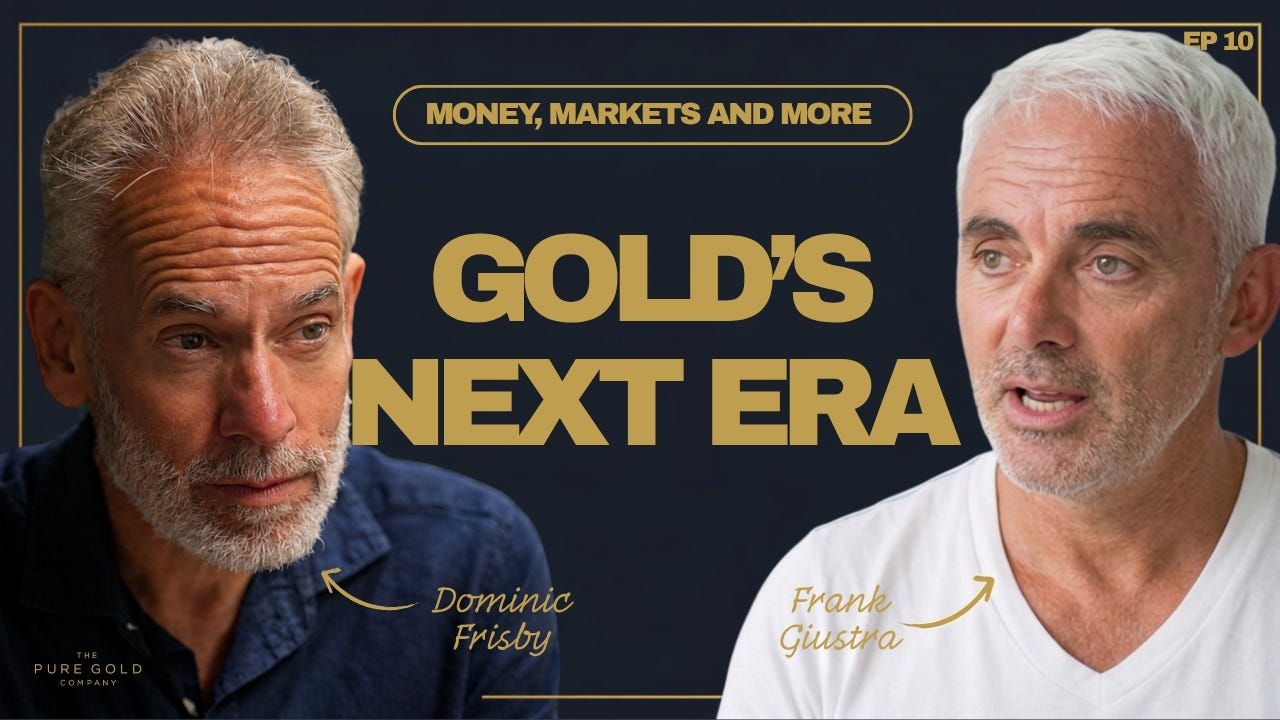
Gold Will Do Things You Can't Even Imagine | Frank Giustra
Good Sunday to you, We have a fantastic interview for you today. I sit down with legendary Canadian investor Frank Giustra to discuss gold, government debt and why he believes the world is entering the most dangerous geopolitical period of our lifetime. You can either watch the video or listen as a podcast via Spotify et al.Frank made his fortune in mining and natural resources, before founding Lionsgate Films, the world’s biggest independent film studio. His track record as a businessman and investor is superlative. We discuss why he believes this is no ordinary metals bull market, the accelerating shift by central banks from government debt into physical gold, the risk that another round of quantitative easing could trigger a dollar crisis, and whether gold may ultimately need to be revalued higher, dramaticically higher. We also touch on China, financial repression, critical minerals and why, of everything Frank owns today, gold remains the asset he is most excited about. Money Markets & More is the interview series from Dominic Frisby, exploring money, markets, gold, economics and the ideas shaping the world. 🥇 The programme is brought to you by The Pure Gold Company If you live in a third world country such as the UK, I urge you to own gold or silver . The pound will be further devalued, as will the euro and dollar. The bullion dealer I use and recommend is The Pure Gold Company . They deliver to the UK, the US, Canada and Europe. More here. 📘 Here is a link to Frank’s book: The Money Dilemma: My Unlikely Path to Wealth, Philanthropy and Peace . And you can follow Frank Giustra on X Thank you for being a subscriber to the Flying Frisby. Until next time, Dominic PS Here is this week’s commentary in case you missed it: PPS As Frank and I mentioned it, here is a link to The Secret History of Gold which is getting rave reviews and is available around the world at all good bookshops . The audiobook is especially popular. This is a public episode. If you'd like to discuss this with other subscribers or get access to bonus episodes, visit www.theflyingfrisby.com/subscribe
October 8, 20262 min
The Problem With Owning Anything
This is a free preview of a paid episode. To hear more, visit www.theflyingfrisby.com I don’t know if it’s my own little online bubble, but every time I open my phone at the moment I am being swamped with bearishness and negativity. Never mind all the political and social stuff, it’s financial as well. The problem I have is that a lot of the bearish arguments are well reasoned. In a nutshell: too much concentration in the S&P 500, which under the surface is looking very mucky, bond yields too high and too much government spending. Given that governments everywhere are running such unsustainable deficits, the chances of a sovereign debt crisis are very real. The cost of their debt, aka bond yields, is rising across the western world, and higher yields will suck liquidity out of every market, be it real estate, precious metals or equities. There is risk everywhere you look. It’s easy to say the words sovereign debt crisis. It’s also easy to say that we actually need one: we need governments to default and reset because, unless they do, we will just continue as we are, sinking further and further into socialism and atrophy. But an actual crisis, followed by a default and a reset, is, to put it mildly, not a pleasant experience. It is not an easy thing to get through, and the rollercoaster ride that asset prices will go through can be seriously damaging to your wealth. If you live in a third world country such as the UK, I urge you to own gold or silver . The pound will be further devalued, as will the euro and dollar. The bullion dealer I use and recommend is The Pure Gold Company . They deliver to the UK, the US, Canada and Europe. More here. There is a problem with owning anything. Let’s go through it. And we’ll start with real estate. Rising yields push up mortgage rates, which lessens affordability. That means prices have to fall to reflect that. Maybe not straight away, but I think yields have to go higher, even with financial repression . In the UK, shoved along by higher taxes, it’s already happening: people are finding it very hard to sell property.
October 4, 202613 min
You're Poorer Than They Tell You
This is a free preview of a paid episode. To hear more, visit www.theflyingfrisby.com Good Sunday to you, I have a lot of charts for you today, and fascinating ones too, but we begin with a little story. John James Cowperthwaite was the financial secretary who oversaw Hong Kong’s extraordinary growth in the 30 or so years after World War Two. It was one of the greatest periods of economic expansion the world had ever seen. I’m not sure it has ever been equalled. In the span of little more than a generation, this tiny territory with no significant natural resources to speak of went from shanty town with a refugee problem and a GDP per capita below $300 to become the world’s busiest port, an international manufacturing and financial powerhouse, among the ten richest nations in the world with a per capita GDP above the US and the UK’s. Its population would grow by over ten times. Cowperthwaite was asked by an African president what poorer countries should do to turn their economies around, as Hong Kong had done. The first thing he said was ‘abolish the office of national statistics’. Cowperthwaite was an acolyte of Adam Smith: it is said he slept with a copy of Wealth of Nations by his bed - presumably because it got him off to sleep. And he despised government statistics, not just because they are so frequently flawed, but because he knew governments would use them to meddle. He was, in the words of his successor, Philip Haddon-Cave, a ‘positive non-interventionist’, who felt that (his words) ‘clumsy bureaucratic fingers’ should be kept out of the ‘sensitive mechanism’ of the economy - far better to rely on the ‘ hidden hand ’. ‘A multiplicity of individual decisions by businessmen and industrialists will . . produce a better and wiser result than a single decision by a Government or by a board with its inevitably limited knowledge of the myriad factors involved, and its inflexibility.’ John James Cowperthwaite When British officials came to find out why unemployment data was not being collected, he sent them back on the first available flight, and when his own Legislative Council demanded GDP figures he filibustered them away year after year. Such figures, ‘do not have a great deal of meaning,’ he said. ‘That other countries make use of them is not, I think, necessarily a good reason to suppose that we need them.’ In 1962, Cowperthwaite came under such pressure to provide GDP numbers and other such statistics that he hired a professor to do the necessary research. He then declared that he had set up study to look at the feasibility of collecting the information. For seven years he sent back the poor professor ’s drafts: either something needed further clarification, or it needed investigation, or it needed development. By 1969, still no data was forthcoming. He explained that the professor was having difficulties coming to closure on how it should be collated. The poor academic had been set up to be a fall guy. I’ve always loved this line of his: ‘ Due to our low tax policy, [government] revenue has increased.’ John James Cowperthwaite Take note Andy Burnham. Take note John Healey. Right. Park that story for a moment as we turn our attention to thread two of this argument. If you want the full story of Cowperthwaite and Hong Kong’s breathtaking economic success, it is one of many you can read or listen to in my grand opus, Daylight Robbery: How Tax Shaped Our Past and Will Change Our Future . And that brings me to another of my opera, on the subject of gold. Long time readers/sufferers will know that gold is the great constant. “Neither rust nor moth devoureth it,” to use the words of some ancient Greek bloke. (Pindar). Gold been about since before our solar system was formed, never mind Planet Earth, and it’ll be around long after it’s gone, which can’t be too far off if we continue on this current trajectory. And in all that time it never changes, because it is inert. You can’t destroy it either, not by natural means anyway, so all that gold that has ever been mined still exists. Nothing is as constant as gold. It’s scarce too. That makes is both a wonderful store of value and a wonderful unit of account. What does change is the above ground supply: the more we mine, the more there is. Gold supply grows at just below 2% per year. For most of history the gold supply has grown at the same rate as the human population. It is Nature’s money. In fact, since 1850 and the various gold rushes, and the improved mining techniques which have followed, gold supply has grown marginally quicker than the human population, going from a historical average of roughly 2/5 oz per capita to 4/5 oz today, albeit gradually over a 175 year period. This is likely to continue as population growth has sunk to ~1%. As you know, money has three functions. To be: * A medium of exchange * A store of value * A unit of account. And it is the third, overlooked function that is our focus today. We use our national currencies - pounds, euros and dollars - as our unit of account because we must pay taxes in those currencies and we are obliged to account in them by law. But they are rotten units of account, because the unit of account changes all the time. A pound or a dollar today is not the same as a pound or dollar twenty years ago. Just since 2020 the pound has lost 40% of its value . Money supply growth around the world varies enormously between countries and periods, but ~7-8% is a reasonable average to use. That means the unit is increasing at ~7-8% annually, or doubling every 9 to 10 years. Gold makes a much better unit of account for all the reasons stated above: it is constant. Its physical supply cannot simply be expanded at the stroke of a government pen, so the unit itself does not get diluted. If we are trying to compare economic performance over long periods of time, that matters. If we are trying to reach the truth, then we should account in gold. So now we are going to take a proper unit of account to government statistics. Ever get the feeling that, despite the government telling you the economy is growing, and that, despite your income going up, you’re actually getting poorer? That’s because you are. I shall explain. Every year some government body will tell you what Gross Domestic Product (GDP) is. Really they should be leading with GDP per capita, as that is the more relevant figure, but they don’t. They want headline numbers that flatter them and with mass immigration, GDP will always grow, even if a flood of cheap workers from overseas pushes salaries down for locals. In the UK in 2023, for example, GDP grew slightly, while GDP per capita fell. Leading with GDP and not GDP per capita gives them a better number to boast about. Put bluntly, it enables them to lie. No wonder Cowperthwaite so loathed government statistics. What is worse is not just that they are used to lie and to meddle: the numbers that inform the policy (meddling) are flawed, which means the meddling/policy is inevitably misguided. How abominable the record of the UK’s statistical bodies such as the ONS and OBR is no surprise given the flawed nature of their methodology. if you are looking to appreciate the full scale of the clusterfook: this applies to all government policy everywhere when it is based on a flawed unit of account. It is literally all misinformed. Sorry I rarely use capitals or italics but I couldn’t help myself. If you are measuring GDP in a unit that is increasing at 7-8% per annum, then of course GDP will grow. Official growth figures are adjusted for inflation, but by the government’s own inflation measure, which understates how fast the currency is being debased (~3% vs ~7%). As I am fond of saying, gold tells the truth, however - and we are going to come to that in a moment. But first here is GDP in the UK and the US over the last 50 years. Wait, what? UK GDP has grown by more than US over the period. Is that a function of the sorry state of affairs in the UK in 1975 and therefore a lower starting point? In part. It might be a function of higher proportional immigration? No! It’s because we are comparing different units. The pound began 1975 at ~$2.40. Today it’s $1.32. It has almost halved over the period. In real terms US growth has been more impressive, but the UK’s growth look more impressive mostly because the pound was debased faster than the dollar. This is precisely my beef.Now here is GDP per capita over the same period. You can see that the increase in GDP per capita is much lower than the increase in GDP - which is why politicians tend to focus on GDP. Now here is GDP in gold. Oh, look. Measured in sound money, GDP has actually fallen - down 32% in the US and 44% the UK. That is a very different story to the official narrative. Must be all that outsourcing of manufacturing. (That does not necessarily mean the quantity of goods and services has fallen. It means the market value of those goods and services, expressed in gold, has fallen). And now here is GDP per capita in gold over the same period. Down 57% in the US and 55% in the UK. These are declines we can all sense, but cannot prove. Conventional economic measures conceal them, but they’re very real once you start using a proper unit of account. Just how radically the picture changes when you stop measuring economic progress in a currency whose supply can be expanded by governments and central banks.Gold tells the truth. If only governments and government bodies started using it. Cowperthwaite had the right idea. Don’t let governments anywhere near statistics. They produce them not because they are true but to justify what they want to do. For all you chart nerds out there, at the bottom of today’s article I’ll post charts for the above, which go all the way back to 1900. Interesting viewing.Here is this week’s commentary, in case you missed it: on the ongoing collapse in the government bond markets and what it means for your money. This is not just a UK problem, but worldwide. We could be in the early stages of a global sovereign debt crisis. Printer is coming. Thank you for being a subscriber to the Flying Frisby. Until next time, Dominic If you live in a third world country such as the UK, I urge you to own gold or silver . The pound will be further devalued, as will the euro and dollar. The bullion dealer I use and recommend is The Pure Gold Company . They deliver to the UK, the US, Canada and Europe. More here. Here are those charts:
September 30, 20263 min
Trying to make sense of everything
This is a free preview of a paid episode. To hear more, visit www.theflyingfrisby.com The yields on 10-year US treasuries are rising. They’ve hit their highest level in nearly 20 years. What does that even mean? And more importantly what are the implications? A lot of people are getting their knickers in a twist. And why has gold’s promising little rally hit a wall? And what about UK gilts, they’ve rocketed slap bang in the middle of the Labour Party conference, when they’re all promising more spending. Make it make sense. If you live in a third world country such as the UK, I urge you to own gold or silver . The pound will be further devalued, as will the euro and dollar. The bullion dealer I use and recommend is The Pure Gold Company . They deliver to the UK, the US, Canada and Europe. More here. US Treasury yields are not just a US problem. They put upward pressure on the entire developed-world bond market, and the UK is particularly exposed because its own fiscal position is already so precarious. Today, the yield on a US 10-year Treasury is around 5.25%, the UK 10-year gilt hit 5.44% on Monday, its highest level since 2007. At Tuesday’s auction, the government paid an average yield of 5.38% to borrow for ten years, the highest yield at a UK 10-year gilt auction since 1999. Even a small increase in the cost of borrowing puts governments in trouble. Where are they going to find the money to pay the interest? They’ve either got to raise taxes, cut spending, let the deficit grow, pray for growth or all four – and in the case of the UK in time for the Healey budget on October 28. As US rates rise sterling comes under pressure against the dollar – it will no longer be propped up by the relatively high rates we have been offering - hence sterling’s recent declines. So we get higher inflation, especially energy, because of increased import costs. Investors around the world need a reason to hold a UK 10-year gilt. Previously the higher rates we were offering were a reason. If a US 10-year Treasury offers, say, 5.25%, why hold gilts and carry the sterling risk without a much higher rate to compensate? The US Treasury market effectively sets a large part of the global opportunity cost of capital. Higher US rates thus put upward pressure on UK interest rates. So debt gets even more expensive. Our fiscal position deteriorates. Higher rates hurt remortgaging, housing affordability, commercial property, corporate borrowing, infrastructure financing, private equity and so on. Another point to note: the UK 10-year gilt is now yielding 5.4%, despite the Bank Rate being only 3.75%. That gap is telling you that the bond market is pricing a considerably higher long-term cost of capital than the overnight policy rate alone would suggest. The really worrying configuration for Britain would be US real yields rising, US inflation expectations rising, sterling falling and UK gilt yields rising faster than Treasuries. How will all this impact Gold and bitcoin?
September 27, 20267 min
The 2.5% Deposit Trap
There are so many ways to bring down the cost of new build in the UK, chief among them reduced regulation, planning and taxation. So I was most disappointed, putting it mildly, to see Prime Minister Andy Burnham’s new initiative, Your First Home, which will give government-backed equity loans of 20% to first time buyers, who will now be able to buy new build property with just a 2.5% deposit. Initially, that 20% will be interest-free. This is just another means to saddle young people with debt. As if student loans weren’t bad enough. Unlike period property, new build struggles to keep its value. It’s often because people overpay for new build - the so-called new-build premium. You’re buying a brand new product and somebody, you, has to cover the developer's margin, marketing costs and all the other costs wrapped up in that shiny new flat. Meanwhile, there is no longer the buy-to-let investor to prop up the buy side. The government has already seen to that. The risk of in the inexperienced first-time-buyer overpaying is high and the likelihood of them falling into negative equity is immense. Look at the problems those who went down the Help To Buy route are now having with London flats, where prices are down 20-30%, with owners in negative equity, unable to sell without taking huge losses, and unable to move up the property ladder. Trapped. Help to Buy artificially inflated the prices of new-build flats. Developers knew buyers had government backing, so they charged a “new-build premium,” which effectively captured most of the subsidy. It handed money to people who already had it. Of course building companies will welcome Burnham’s scheme this time around. Now that the Help-To-Buy subsidy has ended, new buyers must purchase using normal mortgages, which has caused prices to “normalise”, ie fall 30%. Meanwhile, there are the problems of skyrocketing service charges and the fallout from the cladding scandal, both of which have also made flats hard to sell. The main people Help To Buy helped were the large building companies, and Andy Burnham’s new scheme will do just the same. It is yet another demand-side intervention in a market where the fundamental problem is that housing is too expensive to build. It is a terrible and misguided thing to do. Builders can (and will) overprice their deals, and trap buyers, who, as first-timers will be naive, in punitive leasehold deals. It is no more than a subsidy for building companies. It does not address the many causes of Britain’s unaffordable housing. It exacerbates them. You are creating more of what caused Britain’s affordability problem in the first place. This is new builds only. So happy days for the likes of Barratt Redrow, Vistry and Taylor Wimpey, never mind the cowboys, who will take the money and run, and leave you holding the bag of poor construction, leasehold and unsellability. Builders’ shareprices will rise on the back of this. Loads of people will be suckered into buying because of the easy affordability now, and thier desperation to own a property. “Oh, it’s better than renting” “Oh, we only have to pay this much.” But if you or anyone you know is tempted by this, I urge you or them to please avoid it at all costs. As a rule flats, particularly new build, are to be avoided because, there is so much beyond your control that you end up being financially responsible for, from basic repairs and maintenance, to problems in the actual build, such as cladding, only found years later, which have now become your unsellable asset. A 2.5% deposit is just too much leverage. It’s fine if you know what you are doing, but most don’t. You could overpay for your property by 5%, which is easily done when you have the carrot of easy affordability now being dangled in front of you. Prices could fall 10%. Or you lose your job. Heaven forbid prices should fall 20-30% as they have with Help to Buy. There are so many routes to negative equity. It is going to ruin people. Do our policy makers never learn? Never mind Help to Buy, what about the US subprime crisis? And then there is 1989-94 and the loose lending that preceded that crash. All the evidence of where this goes is right there in living memory, staring them in the face. There is also the issue that interest rates today are much higher than they were when Help To Buy was introduced. Yet again the government is addressing the problem of unaffordable housing by making it easier to borrow more money to buy unaffordable housing. In other words, it’s finding more ways to bring money into the system when the problem is too much money. This will absolutely screw people. And it’s all dressed in this great guy, true Northerner, trustworthy kids TV presenter, helping you out language with no mention of the risks. It is proper gaslighting. It’s like the friendly chap outside the school playground with the gateway drug. There are times when I think this country’s leadership and administration is just superlatively incompetent. There are times when I actually think Satan might be at work and this is one of them. And you wonder why I can’t stand governments! Share this article with a friend. If you’re interested in the subject of unaffordable housing, you might enjoy this classic from the archives Finally, but perhaps most importantly, here is this week’s commentary. I urge you to read it, if you haven’t already. Thanks for subscribing to the Flying Frisby. Until next time, Dominic If you live in a third world country such as the UK, I urge you to own gold or silver . The pound will be further devalued, as will the euro and dollar. The bullion dealer I use and recommend is The Pure Gold Company . They deliver to the UK, the US, Canada and Europe. More here. For my readers on the other side of the pond, let me also plug next month’s New Orleans Investment Conference , which runs from October 28-31. I’ll be there and there is an array of great speakers. This is a public episode. If you'd like to discuss this with other subscribers or get access to bonus episodes, visit www.theflyingfrisby.com/subscribe
September 23, 20268 min
They’re Coming for Your Money. Don’t Let Them Take It.
This is a free preview of a paid episode. To hear more, visit www.theflyingfrisby.com Good morning to you and a big welcome to the many new subscribers, both paid and unpaid, who have joined the Flying Frisby this week. We are now the Number One riser in Finance and Number Two in the UK , so we must be doing something right. If you have not yet received your Britain On Sale report, you can access it here. (Any issues getting hold of it, DM me or reply to this email - paid subscribers only). BTW the subscription price goes up at midnight tonight, so if you want to lock in the current rate, now is the time to upgrade . So to today’s piece, and an important one, I think, as this is going to be a big theme over the next few years. The government is coming for your money. You’ve earned it. They haven’t. Don’t let them confiscate it from you, is my advice. I’ll explain all. The same situation applies across the western world, but I am going to focus on the UK today. We begin with this Russell Napier interview with Peter McCormack. If you haven’t already watched/listened, I urge you to. It is well worth your time. Napier’s forecasts, which chime with my own, have grave implications and you are going to need to protect your capital. Napier is a market historian of the old guard, highly respected and, I might add, with good reason. He gets a lot of big calls right. He describes the situation in the UK and indeed most of the West, which we all know. Public sector finances are a mess: bloated, wasteful, deep in debt, an accident waiting to happen. To give you an idea how bad, here’s Dan Hannan, Director of the Institute of Economic Affairs: But before you go all out and despair about the decline of Britain, Napier also describes a private sector which is in good shape, lean and hungry. This is an observation we have also made on these pages and why we have been beating the drum that now is a good time to buy British stocks. Hence this report. Britain needs growth, if it is to get out of its mire of government debt, but is not going to get growth while taxes are high and regulation is heavy. All that is required is to unleash growth is government to get out of the way. But it is incapable of doing that. Indeed this current lot shows no sign of wanting to lower tax or lighten up on regulation, so we are caught. Nevertheless, there is this lean beast waiting to escape and that is a positive thing. Moreover, the country needs a huge amount of investment as it moves away from dependence on China for its manufacturing - which must happen for strategic and political reasons. The balance sheet is there in the private sector, says Napier, to make that investment. It might be that some kind of pragmatist comes to power or, more likely, that someone is forced to be pragmatic by the bond market. But we are not there yet. That’s the backdrop. Let’s come now to Napier’s forecast. Our current total debt, public and private sector, stands around 235% of GDP. We are bad but by no means the worst. (Napier is particularly bearish on France, by the way). There are five ways in which we can lower that debt: growth, default, austerity, repression or inflation. You’d need 4% growth which he sees as unlikely, even with the productivity boost that is coming from AI. Austerity is also unlikely because of the Labour backbenches and the numerous promises made and obligations it carries. Default would take too long to recover from (Napier uses the example of Greece). That leaves financial repression, with inflation doing much of the work. Repression and inflation is easiest solution, because it affects fewest people visibly. Visibly is the point. As we know, politicians always choose the path of least resistance. What does repression mean in practice? There are pots of wealth in savings, in insurance and life funds, and in pensions, and the government is coming for it. The biggest victims or targets of this will be old people, for the simple reason that they have the most money. That is where the capital is. Governments will go where the easy capital is I would also add houses to the mix as they are tapping that market too. This wealth grab is all happening quicker than we realise. Mansion taxes are coming, as we know, and word is the threshold will be now brought down from £2 million to $1.5 million . (Talk about mendacious language - anyone know where I can buy a mansion in London for £1.5 million? You can barely get a terraced house for that in Zone 2) Meanwhile, last week the Bank of England did not put up rates, as it should have, were it to honour its mandate to bring inflation down below 2%. Their measure of inflation is 3.1%! The Bank also announced that it will no longer sell the gilts it printed the money to buy through Quantitative Easing (the ones it started selling the day before the Liz Truss Kwasi Kwarteng budget) but instead hold them to maturity. This will considerably reduce selling pressure on the gilt market. If I were Liz Truss or Kwasi Kwarteng, I’d be fuming. But both moves mean yields payable - ie the cost of debt - will not properly affect real inflation or market forces. But who actually understands the sleight of hand that is taking place here? Napier uses the example of a French 50-year bond bought in 2021, as having lost more than 75% of its value. The debt was bought by pensions. The individuals that effectively owned it through their pensions don’t even know that they bought it because it’s hidden in balance sheets, locked out of reach. That’s how this particular raid can effectively be kept a secret. The government is going to force people to buy these bonds. Many will not even know they are doing it, as it will happen remotely via pension funds. Napier calls it “the power of the mandate”, a great term. The UK government already has this power to some degree, through changes to the regulatory framework which can influence what pension funds are permitted or encouraged to hold. (Governments elsewhere in the world that do not currently have this power will soon acquire it, don’t you worry). By forcing people to buy bonds, they keep interest rates down, and so the government will be less beholden to “the market” when it wants to borrow and spend. There is plenty of previous for this, bond sales during wars being a prime example. Some kind of regulation will be imposed that demands safe investments and of course bonds and gilts will be deemed safe. This repression will be enacted, effectively, by stealth, and governments will get away with it because it will happen, as both Keynes and Lenin famously observed, “in a manner which not one man in a million is able to diagnose.” Imagine a government that just cut taxes and spending instead. We can but dream. It’s all so dishonest. That’s what I hate about it. I was always taught that saving was a good thing, but saving will be villainised. This immediately makes me think of the US in 1933, a story which I cover in the book. When Roosevelt introduced the gold surrender programme, he villainis ed hoarding gold and blamed hoarders for America’s woes during the Great Depression. But hoarding gold was just saving and that’s what people do. Saving will be somehow villainised, and we will all be required to “play our part” as Andy Burnham put it when imposing illegal immigrant camps on rural villages which don’t want them. The subscription price goes up at midnight tonight. If you want to lock in the current rate, now is the time to upgrade. So what can you do? And how do you protect yourself? Where on earth do you put your money?
September 20, 20264 min
Odyssey, Bitcoin & the Three-Pinter
Good Sunday to you, I finally went to see Odyssey last night. I’d been intending not to, after everything I’d read on X, but my daughter persuaded me, and I actually quite enjoyed it. Maybe not an A+ movie, but a pleasant enough way to spend a few hours. I didn’t feel violated by all the casting, in the way that purists were, although Helen should have been stunningly beautiful, which she wasn’t. To use the parlance of the incel rugby player, she was a three-pinter. And what people see in Zendeya, who plays Athena, remains a mystery to me. Given that Athena is the Goddess of Wisdom I would have advocated casting someone who at least looks like they might have a high IQ. If anything, the greater violation was the proliferation of American accents. I love an American accent as much as the next man. I want to live in the US. But to me, maybe I’m just biased, anything classical or mythological always sounds better in an English accent. During the first scene with Tiresias, the blind prophet of Thebes, I thought I was going to hate the film. I turned to my daughter and said as much. What’s the point of prophesying stuff if people can’t understand what you’re saying. But after that, it was OK. It’s amazing, though, that with the mightiness of modern sound, engineers often can’t get the mix right, so that spoken words, especially by actors with poor diction (eg Zendeya and whoever played Tiresias, though they were by no means the sole offenders), get lost. Even my daughter, whose hearing remains intact, complained that she couldn’t make out what they were saying. Note to actors: being natural does not mean being incomprehensible. I sound like my dad. In other news, bitcoin staged another welcome and unexpected rally this week, with the companies I mentioned last week seeing gains of 15-25% or more. A bitcoin bull market in which you don’t have a position is a deeply frustrating experience, and not one I recommend. So don’t miss this next one. I show you the easiest way to play it here , a way that avoids the complexities of cold storage and the bureaucratic rigmarole the FCA has imposed on UK investors. The jury’s still out on whether we get one more retest of the lows before the next bull market, but it’s looking increasingly unlikely. The next bull market may already have begun. In other news, in case you missed it, here is this week’s piece. It is a whopper of a report on gold miners and well worth a look if gold miners are your thing. It was very encouraging to see gold rebound in the wake of last week’s interest rate rises by the Fed. The inference, as far as I’m concerned, is that the lows for gold are now in, just below $4,000. We’re still in consolidation mode, and I doubt we see new highs before next year, but it looks like we now have a base. Turning to an ongoing theme on these pages, being the decline of Britain, how about these for some stats? The pound has lost 40% of its purchasing power since 2020 (partly due to Covid money printing), according to Truflation measures . With all that debasement and the increased money in circulation, the number of millionaires “should” have increased. But it has actually declined by ~60% since 2021, reaching its lowest level in 20 years. The wealth destruction taking place in this country is staggering. The US is growing its number of millionaires at 1,200 per day meanwhile, and has created over 1.6 million new millionaires since 2020. Americans are much better at debasing their currency. We must be the only country in history to have printed this much money and still seen declines in nominal wealth. I know I am mixing data sets but you get the point. Thank you for being a subscriber to the Flying Frisby. Until next time, Cheerio, Dominic If you live in a third world country such as the UK, I urge you to own gold or silver . The pound will be further devalued, as will the euro and dollar. The bullion dealer I use and recommend is The Pure Gold Company . They deliver to the UK, the US, Canada and Europe. More here. PS I appeared on the New Zealand Every Day Investor podcast this week. Here is the interview, if you fancy it. This is a public episode. If you'd like to discuss this with other subscribers or get access to bonus episodes, visit www.theflyingfrisby.com/subscribe
September 10, 20264 min
How to Play the Next Bitcoin Cycle
This is a free preview of a paid episode. To hear more, visit www.theflyingfrisby.com Bitcoin is both volatile and cyclical. You get periods of extraordinary gains. But then you get periods of extraordinary losses. But … If you can buy during low points in the cycle, that volatility can work in your favour. And the house view is that we are within a month or two of the low point right here and now. It might be that the very low was on July 1st at $58,000. It might be that we need to give that price one more retest this autumn. Either way you want to be sure that by November-December, if you haven’t already, you have your long position in place, ready for the next run. There is nothing worse than watching others enjoy a bitcoin bull market while you’re on the sidelines. I have made many mistakes over the years, but I do get some things right, and last time around, in August 23, I wrote up Microstrategy, now Strategy (NDX.MSTR) close to the lows, and some readers made twenty times their money. It made me very popular. I am planning a similar coup this time. Today, I want to explain the bitcoin cycle, where I think we are in it and how I would get exposure. If you are one of those people who didn’t buy Bitcoin at $500 or $1,000 and have spent the years since telling people how you could have bought it, but missed out, now is your chance to move on from that story. And if you are one of those people who says, “I don’t understand it,” and uses that as a reason not to invest, I’m going to address that too. For the avoidance of doubt, I have some history here. In 2014 I wrote what was, as far as I am aware, the first book about bitcoin published by a mainstream publisher. I have been following this thing for a long time. “Read it and glimpse into the future,” said Sir Richard Branson. Though it’s not clear he did actually read it. Bitcoin: the Future of Money? by Dominic Frisby is available at all good bookshops . The audiobook , which had particularly good reviews, has now been re-released. UK version here . US version here. I have a target of $200,000 for the next cycle, perhaps 2.5x where we are today. (Bitcoin currently sits around $78,000 But I am going to show you a simple way to play this where the returns could be much, much greater than 2.5x. So let’s get into it. The four stages of the Bitcoin cycle The bitcoin cycle goes something like this * Quiet accumulation. * Rampant bull market and blow-off top. * Monster correction. * Frustrating consolidation. Then the process starts again. This cycle is remarkably consistent and quite easy to identify. I think we are currently somewhere between stages 4 and 1, and that is when you want to be getting positioned. The high came at $128,000 a year ago. Bitcoin was on the front cover of every paper. The US was going to adopt a bitcoin standard and fiat money was on its way out. Something like that. It duly crashed. Now it’s going to be destroyed by Quantum computing or something. All the talent has left bitcoin for AI. Nobody is talking about it any more. And now, with the Coldcard disaster followed by the Blockstream hack, we have had the requisite failures in major players which mark bear market lows. The great difficulty with bear markets is psychological. It is easy to buy when it is going up. You get sucked in. It is much harder to buy when everyone is telling you it is finished. Another simple, but eerily accurate way of playing the bitcoin cycle is the 500-day rule. Buy 500 days before the halving and sell 500 days after it. A bitcoin halving is when the rewards paid to miners reduces. This happens every four years, and the next one is due around April 2028. We are perhaps 580 days before the next halving. (One thing I have noticed is that when everyone knows about a cycle, they tend to come earlier, hence my alerting you to this one now and not in 80 days time). Again it means you want to be positioned before December.
Is this your show?
Claim this listing to keep it up to date, reach guests who want to pitch you, and manage bookings with Guestify.