
Find partners
The Founder to Fortune Podcast

The Founder to Fortune Podcast

Hosted by Michael Raybman & Vidya Raman

Episodes

34

Latest episode

Jun 2026

Language

EN

About the show

The Founder to Fortune Podcast unpacks how great companies—and fortunes—are built. Hosted by Michael Raybman, CTO for early-stage technology companies and VC and former AI product leader Vidya Raman. Each episode unravels real-world insights from founders, execs, and investors shaping the future of startups and enterprises. www.foundertofortune.org

Listen to episodes

34 recent
June 3, 202644 min

Is the CTO Irrelevant for Early-Stage Startups?

Title: Is the CTO Irrelevant for Early-Stage Startups?Episode Summary: In an era where generative AI can write code instantly and stand up software out of the box, what is the actual role of a technical co-founder? In this episode, we sit down with Vlad Pick, former technical co-founder of Tone Messaging and current Engineering Manager at Attentive, to unpack the massive existential shift happening in startup leadership.Vlad pulls back the curtain on how he navigated a high-stakes enterprise acquisition, why he believes pure "code-writing" engineers have an immediate expiration date, and why the modern CTO must completely reverse the classic management playbook by getting more in their team's way more. Whether you're a non-technical founder building a solo MVP, a veteran CTO navigating AI autonomy, or an engineer trying to stay employable, this episode is a blueprint for the future of tech.What We Discuss in This Episode:The 3-Year Expiration Date on Code Writing:The 3-Year Expiration Date on Code Writing: Why software engineers who define their value purely by writing syntax will be completely unemployable within three years.Why the Modern CTO Must Interfere: Why the democratization of code means technical leaders can no longer just "get out of the way" and must instead step in to consultatively audit design choices and manage business context.How to Legally "Hack" an Acquisition Deal: How Vlad and his co-founder skipped abstract financial slide decks and broke through a stalled negotiation by hacking a prototype directly on top of their buyer's actual live user interface.The All-or-Nothing Exit Clause: Why Vlad kept his acquisition entirely a secret from his 11-person team until the final 45 days, and how he got the acquiring firm to extend job offers to every single operator on his payroll.Building the Ultimate Learning Machine: Vlad’s unique hiring framework that bypasses traditional CS resumes to filter exclusively for three un-automatable human traits: willingness to learn, willingness to grow, and human kindness. The Contrarian Advice for Aspiring Founders: Joining a chaotic, early-stage startup is an operational trap, and why working for a successful medium-to-large corporation is actually the absolute best training ground to learn what "good" looks like. Books & Resources Mentioned:Reboot: Remembering Your Humanity, Loving Your Time, and Leading with Innovation by Jerry Colonna.Connect with Us:Follow Founder to Fortune on your favorite streaming platform so you never miss an episode.Leave us a 5-star review on Apple Podcasts to help other builders find the show! This is a public episode. If you would like to discuss this with other subscribers or get access to bonus episodes, visit www.foundertofortune.org
April 28, 202645 min

Flow States and High Stakes: How a human performance optimizer does agentic coding

The “traditional” engineering org chart is a relic of a time when code was the primary bottleneck. For technical founders today, the challenge has shifted from managing human velocity to orchestrating agentic systems and defending product taste.In a recent Founder to Fortune conversation, Clayton Kim, CTO of FlyKitt and professional aerial acrobat, broke down how he transitioned from managing dozens at Wayfair to running a “wizard-led” team of three that outpaces traditional squads.The Death of the Middle ManagerClayton’s thesis is clear: the industry is over-correcting toward a flattened organization. The “middle management” layer—those whose primary output is consensus—is being rendered obsolete by agentic workflows.For the technical founder, this means:* Hiring “Wizard Architects”: You need ICs (Individual Contributors) who can manage five simultaneous Claude Code sessions, making high-level architectural trade-offs rather than just writing functions.* The Soft-Skill Paradox: As technical tasks are offloaded to agents, the value of cross-functional “buy-in” and “commanding a room” skyrockets. Your best engineer must now be your best communicator.“Taste” as the Only Defensible MoatWhen any PM can “vibe-code” a functioning prototype, feature parity becomes instant. Clayton argues that taste—the ability to manifest a cohesive, delightful design opinion—is the only thing preventing your product from becoming generic “AI slop”.* Regulatory Complexity: In industries like health-tech (FlyKitt’s domain), the moat isn’t the feature; it’s the underlying legal and insurance infrastructure that an LLM can’t replicate.* Human Behavior Psychology: AI coaches fail because they lack social accountability. Clayton’s insight: “People will ignore a notification, but they won’t ignore a Navy SEAL on a Zoom call”.The Tactical Hack: Lock Picking and Flow StateThe most provocative part of Clayton’s workflow is how he manages the “micro-downtime” of agentic coding. Traditional “flow” is disrupted when you have to wait 20 seconds for a bot to finish a PR.* Avoiding the Doom-Scroll: To prevent the cognitive drain of Twitter or Slack during these gaps, Clayton uses lock picking.* The Benefit: It’s a short, tactile, high-focus activity that keeps the brain primed for deep work without shifting into “passive consumption” mode.The Takeaway for FoundersDon’t build a team to write code; build a team to orchestrate systems. Success in the next 18 months will belong to those who can maintain a “design opinion” while leveraging agents to handle the “boots on the ground” execution.Listen to the full episode with Clayton Kim on Founder to Fortune podcast. This is a public episode. If you would like to discuss this with other subscribers or get access to bonus episodes, visit www.foundertofortune.org
March 26, 202655 min

DevTool Founder-mode: Hiring for Grit, Reading Code, and Building Trust

DevTool Founder-mode: Hiring for Grit, Reading Code, and Building TrustGuest: Ajay Tripathy, Former CTO of Stackwatch (exit: IBM)Episode Summary: Is the era of the "coder" coming to an end? Former Kubecost CTO Ajay Tripathy joins the show to discuss why the next generation of founders must pivot from writing code to owning business outcomes. We explore his "grit-first" hiring filter, how to engineer for business outcomes, ideal co-founder relationship and so much more.Timestamps:[01:01] – The Google Origins: Life inside the Borg project and the "Life is Short" catalyst for leaving.[06:14] – Vibe Coding & Early Days: Writing vanilla JavaScript in Nano and building the first prototype.[14:20] – The T-Shaped Partnership: How a technical founder and a product founder divide and conquer.[23:40] – Weaponizing the Roadmap: Why your first 10 customers should be your only product managers.[33:15] – Open Source Strategy: Using community adoption to de-risk experimental software.[43:30] – Hiring for Grit: Why Ajay hires Iron Man finishers and swimmers over "qualified" resumes.[53:00] – The 2030 Prediction: The shift from "writing" code to a 100% "reading and review" workflow.[01:05:00] – The IBM Model: Why the enterprise market cares about trust and outcomes over features.[01:21:00] – Moore's law for LLM: A technical look at maximizing hardware yield for AI workloads and what that could look like.About the Guest: Ajay Tripathy is a developer-tool founder and engineering leader. He was the co-founder and CTO of Stackwatch, where he led the creation of Kubecost. Following the company's acquisition by IBM, he now leads engineering initiatives focused on cloud optimization and AI-driven business outcomes. This is a public episode. If you would like to discuss this with other subscribers or get access to bonus episodes, visit www.foundertofortune.org
March 4, 202635 min

Engineering Capital: Investing in Technical Risk

Episode: Engineering Capital: Investing in Technical RiskGuest: Ashmeet Sidana (Engineering Capital)Host: Vidya Raman — Founder to FortuneEpisode overviewIn this episode, Ashmeet Sidana breaks down what it means to invest in technical risk—the “can this even be built?” kind—and why it creates leverage when founders get it right. We talk about what he looks for in first meetings, how to avoid PMF “progress theater,” why founders must learn sales, and what early-career investors can do to be genuinely valuable.Key takeawaysTechnical risk vs consumer risk (Google vs Facebook)Founding is not a job; the motivation bar is (intentionally) extremePMF: the only signal is paying customers; beware “playing house”Sales is a learnable skill — and non-optional for foundersEarly-career VC: do the work; on boards, talk lessLearning compounds; companies grow at the speed the CEO learnsChapters 00:00 — Opening + what to expect02:10 — Defining “technical risk”04:13 — What Ashmeet wants in a first meeting07:46 — The founder mistake that quietly kills outcomes17:54 — PMF: signals vs noise22:16 — Why founders must learn to sell24:06 — “Do the work” (for investors)27:34 — Boardroom calibration (talk ~1%)34:00 — Learning as the compounding advantageAbout the guestAshmeet Sidana runs Engineering Capital as a solo GP and is typically the first investor in companies taking technical risk. This is a public episode. If you would like to discuss this with other subscribers or get access to bonus episodes, visit www.foundertofortune.org
February 14, 202630 min

Your Co-Founder Relationship Is Your Startup’s Biggest Risk

Conflict between co-founders is inevitable.Letting it spiral out of control is optional.In this episode of Founder to Fortune, Vidya Raman sits down with Dr. Matt Jones — licensed psychologist, co-founder coach, and author of The Co-Founder Effect — to explore why the co-founder relationship is the single most under-managed risk in startups .Matt works exclusively with founding teams to improve communication, teamwork, and decision-making. In this conversation, he shares both deep psychological insight and highly tactical tools founders can implement immediately.Key Topics Covered • Why the co-founder relationship is the floor and ceiling of execution • The concept of emotional debt — and how it erodes trust • How to contain conflict so it doesn’t contaminate the business • Co-founder syncs vs. co-founder dates • Meta-communication: working on the relationship, not just in it • The dangers of rigid stories and confirmation bias • When you need co-founder coaching (and why waiting is risky) • Rethinking 50/50 equity splits • Recognition gaps between technical and business co-founders • The three relational languages: operational, psychological, archetypal • Power dynamics in complementary founding teams • The pursue/withdraw cycle • Why 3-founder teams add exponential relational complexityRapid-Fire Toolkit for Founders • Use breath to regulate before responding • Replace “you always…” with “I feel X when Y…” • Call for pauses in spiraling conversations • Repeat back what you heard (reflective dialogue) • After high-stakes meetings: debrief, regulate, then repairIf you are building a venture-scale company, this episode will change how you think about risk.Because most startups don’t fail from lack of intelligence.They fail from unmanaged relationships. This is a public episode. If you would like to discuss this with other subscribers or get access to bonus episodes, visit www.foundertofortune.org
January 26, 202629 min

The #1 Risk First-Time Founders Always Underestimate (It's Not Technology)

Most first-time founders believe startups fail because of bad ideas, weak technology, or poor timing.In this episode, Tarang Vaish argues that the real failure mode is far less obvious—and far more dangerous: people risk.Drawing from his journey across hardware, data infrastructure, SaaS, and AI, Tarang shares hard-earned lessons on co-founder dynamics, solo founding, risk stacking, and founder mindset. He also offers a practical mental model for using AI effectively—by treating it like an intern, not magic.This conversation is for founders who want to think more clearly about risk, leadership, and what actually determines success in the early days.🔑 Key Topics & TakeawaysWhy people risk is the most underestimated startup riskWhy solo founding is exponentially harder—especially fundraisingHow first-time founders accidentally stack too many risks at onceWhy technical brilliance rarely saves a startup on its ownThe importance of co-founder complementarity, not similarityWhat “realistic optimism” really means for foundersWhy being transparent about founder ambitions can build trustLessons from building across hardware, storage, SaaS, and AIWhy data and security remain evergreen startup categoriesHow to use AI effectively: treat it like an intern, with structure and feedback⏱️ Episode Chapters00:00 – Why most startups fail (and why it’s not technology)01:01 – Tarang’s background: curiosity, IIT, Stanford, startups03:23 – Early startup lessons from hardware and tight constraints05:45 – Why ML and SaaS are harder to productize than they look07:20 – The cloud tradeoff: easy to start, hard to scale08:17 – Being upfront about wanting to become a founder09:12 – How Granica emerged from real operational pain12:21 – Signal vs noise: compression, AI, and learning efficiency16:50 – Who actually buys AI and data infrastructure today20:53 – Why everything eventually becomes a data lake23:58 – Why data and security are evergreen founder bets25:28 – 🔥 The #1 risk founders underestimate: people risk26:10 – Solo founding, fundraising, and risk stacking27:10 – Staying sharp as a founder28:05 – Using AI like an intern (with a practical prompt tactic) This is a public episode. If you would like to discuss this with other subscribers or get access to bonus episodes, visit www.foundertofortune.org
December 2, 202531 min

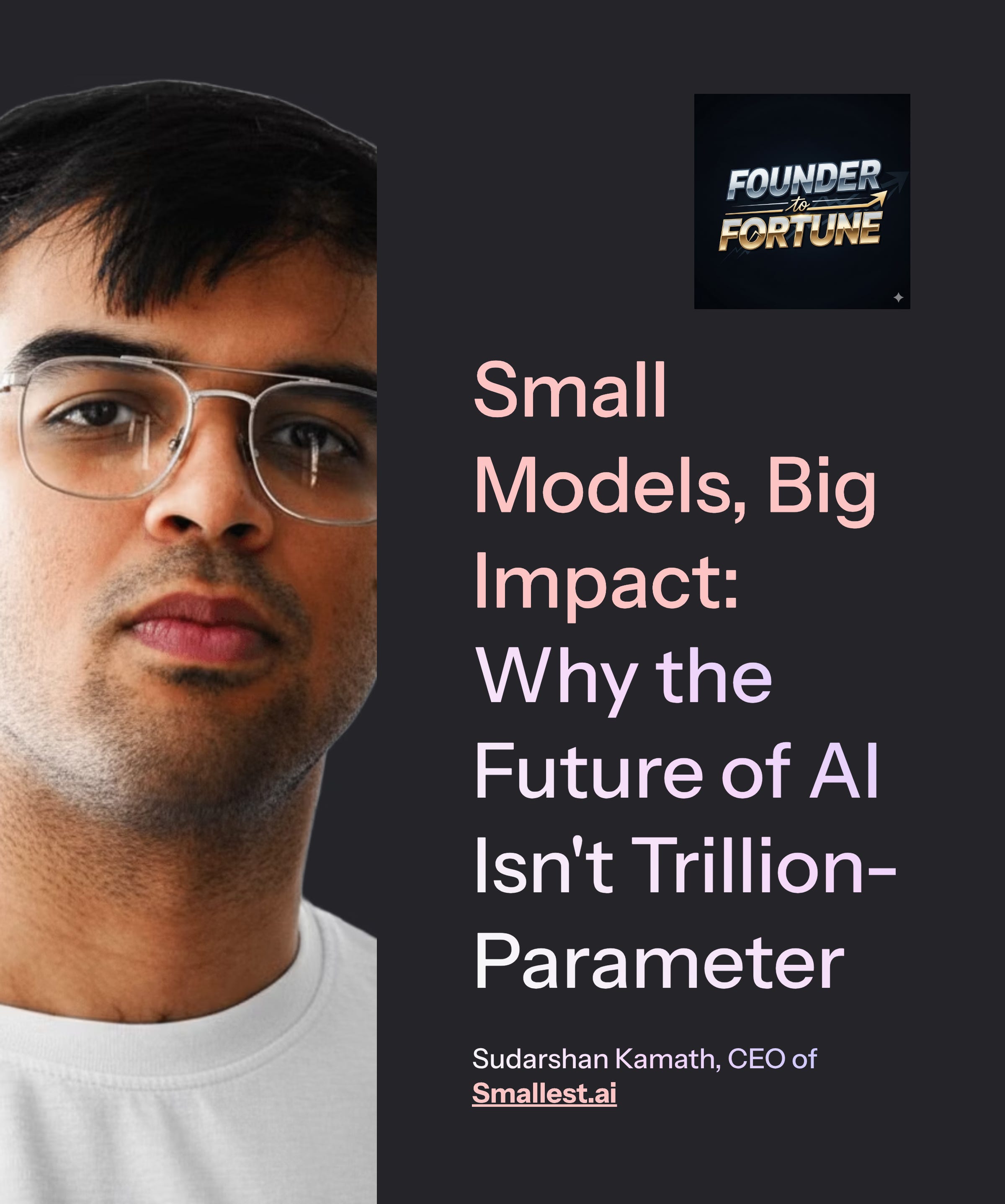
Small Models, Big Impact: Why the Future of AI Isn't Trillion-Parameter

Episode SummaryMost AI conversations start with parameter counts. This one doesn’t.In this episode, we go inside the origin story of smallest.ai, a company built on the contrarian belief that true intelligence can be achieved with compute-constrained, smaller models — especially when the goal is real-time speech intelligence that can run actual workflows in production. Sudarshan shares how his background in self-driving vehicles shaped his thinking on reliability, active learning loops, and why 90–95% of the work lives in data and labeling, not model training. We then zoom into real-world enterprise use cases like collections, outbound calls, and multilingual customer support, and talk through how CIOs can actually start with voice AI in a messy legacy stack. In the second half, we switch gears into his founder journey: using LinkedIn and Discord as core distribution and learning channels, building the largest voice AI community, and his unfiltered advice on cold outreach, selecting whose advice to listen to, and running asset-light experiments before raising large rounds. If you’re a founder building AI for the enterprise — or an executive trying to separate hype from deployable systems — this episode will give you a grounded way to think about small models, agents, and voice AI.Key Topics- Origin story of smallest.ai and the shift from self-driving to speech AI.- Why “small vs large models” is the wrong framing — and how to think in terms of specialized vs general-purpose agents instead- Building one of the world’s fastest text-to-speech and speech-to-speech systems- Emotional information in audio vs traditional speech-to-text → LLM → TTS pipelines- Handling multilingual, code-switching conversations (Hinglish and Spanish/English) in real-world deployments- The hidden 90–95%: data collection, labeling, and active learning loops inspired by Tesla’s approach- How CIOs and CTOs can actually start: quick-win use cases in collections and outbound calling with simple Excel-based feedback loops - Why legacy call center software is optimized for human agents, not infinite-capacity AI agents- Who ends up making the buying decision: CEOs, CIOs, heads of AI transformation, and VPs of collectionsBuilding a founder-led growth engine:- 30K+ LinkedIn connections- The largest voice AI Discord community- Leveraging community feedback to shape product and GTM- Founder advice: cold outreach, whose advice to ignore, asset-light validation, and benchmarking yourself against the bestNotable Quotes“We should stop talking about intelligence in terms of models. We should always talk about intelligence in terms of agents that do end-to-end tasks in the economy.” “Training is actually very quick. 90–95% of the work is the data — labeling it, fixing label errors, and feeding it back through active learning loops.” “For enterprises, start with quick wins. Collections is a great one — run outbound calls, compare the agent to your humans, and only then worry about integrating deeply into your systems.” “I wouldn’t take pitch deck advice from someone who’s never raised from a tier-one VC. Or engineering advice from someone who hasn’t written code in five years.” “Talking to a lot of high-agency people is a superpower — and social media is one of the fastest ways to make that happen as a founder.” About Sudarshan KamathSudarshan Kamath is the founder & CEO of smallest.ai, a company focused on building compute-efficient, real-time speech intelligence and specialized voice agents. Prior to smallest.ai, he worked on deploying deep learning systems for self-driving vehicles, building safety-critical systems that cannot fail. About Founder to FortuneFounder to Fortune is hosted by Vidya Raman, an investor and former operator who helps founders crack the enterprise market. Each episode dives deep into the realities of building, selling, and scaling products for enterprise customers — with operators, founders, and researchers who’ve actually done it.Subscribe on Spotify, Apple Podcasts, or YouTube, and leave a review if this episode helped you think differently about AI in the enterprise. This is a public episode. If you would like to discuss this with other subscribers or get access to bonus episodes, visit www.foundertofortune.org

November 11, 202537 min

Why 99% of Partnerships Go Nowhere (and How to Build the 1% That Win)

What if your biggest partnership was actually holding you back?Pankaj Dugar, who helped scale Databricks and drove strategy at AI21 Labs, joins Vidya Raman to share why partnerships fail right after the Press Release — and how to build ones that actually sell.This episode breaks down the uncomfortable truths behind partner ecosystems, the role of technical integration, and why “boring is where the money is.”If you’ve ever thought a partnership could change your startup’s trajectory — listen before you celebrate. This is a public episode. If you would like to discuss this with other subscribers or get access to bonus episodes, visit www.foundertofortune.org
October 24, 202531 min

Is UX Dead? How Vibe Coding is Rewriting the UX Playbook

What happens when PMs, designers, and AI all start speaking the same language?In this episode, Vidya Raman sits down with Hailey Nevins (Director of UX Foundations at MongoDB) and Wenbo Wang (founding designer and former Databricks/Cloudera product designer) to explore how vibe coding is collapsing the old boundaries between design, product, and engineering.You’ll hear how GenAI is forcing UX to evolve—from pixel pushing to taste-driven orchestration—and why the best design teams now operate at startup speed without sacrificing rigor.We go deep into:* How “vibe coding” changes collaboration between PM, UX, and Engg* Why the new frontier isn’t just design systems—but design velocity* The rise of hybrid roles like “design engineer” and what they signal* How to build guardrails and evals for GenAI-powered products* When chat interfaces work—and when they absolutely don’tAnd just wait till you hear their hot takes on AI “killing” the wrong kind of design work, why hallucinations can actually make UX better, and what founders get wrong about hiring designers too late.If you care about product velocity, UX craft, or what “taste” means in an AI-first world—this conversation will challenge how you think about building.Relevant links:Hailey Nevins on LinkedInWenbo Wang on LinkedInOpen Lovable This is a public episode. If you would like to discuss this with other subscribers or get access to bonus episodes, visit www.foundertofortune.org

October 10, 202534 min

Playbook for the AI-Native Chief Marketing Officer

In this engaging conversation, Kady Srinivasan, CMO of You.com shares her journey from software engineering to becoming a marketing leader across various industries. She discusses the importance of defining an Ideal Customer Profile (ICP) in B2B marketing, the impact of AI on marketing strategies, and the evolving role of marketers in a fast-paced environment. Kady emphasizes the need for discipline in narrowing down ICP, the significance of content creation, and the necessity of hiring the right marketing talent. She also highlights the importance of judgment in marketing and the need for continuous learning in the ever-changing landscape of marketing.Takeaways* Defining a clear Ideal Customer Profile (ICP) is crucial for B2B success.* Discipline is necessary for narrowing down ICP and avoiding distractions.* AI has drastically increased the speed at which marketers must operate.* Multi-threaded marketers can drive outcomes across various disciplines.* SEO is not dead but GEO and AEO are becoming vital.* Content creation is still table stakes for differentiation in the market.* Hiring the right marketing talent depends on the go-to-market strategy.* Judgment in marketing comes from experience and learning from failures.* Sales leaders should be prioritized in early-stage startups with outbound strategies.* Continuous learning and adaptation are vital in the marketing field.Relevant links:Kady Srinivasan on LinkedInYou.comFounders of You.com: Richard Socher and Bryan McCannSome links to the resources that Kady referred to:MavenGrowthXEvery.toWatch us on YouTube here. This is a public episode. If you would like to discuss this with other subscribers or get access to bonus episodes, visit www.foundertofortune.org
Is this your show?

Claim this listing to keep it up to date, reach guests who want to pitch you, and manage bookings with Guestify.

Claim this listing

More Business podcasts