Find partners
The Dr. Claude Kershner Show

The Dr. Claude Kershner Show

Hosted by Character & Process Before Talent

BusinessInterviews guests

Episodes

102

Latest episode

Jun 2026

Language

EN

About the show

The Dr. Claude Kershner Show empowers students, professionals, and scholars by offering practical examples of Strategic Entrepreneurship. In a series of teachings, interviews, and stories, we confidently provide evidence-based tactics to take teams and organizations through life cycle transitions.

Listen to episodes

60 recent
June 16, 202628 min

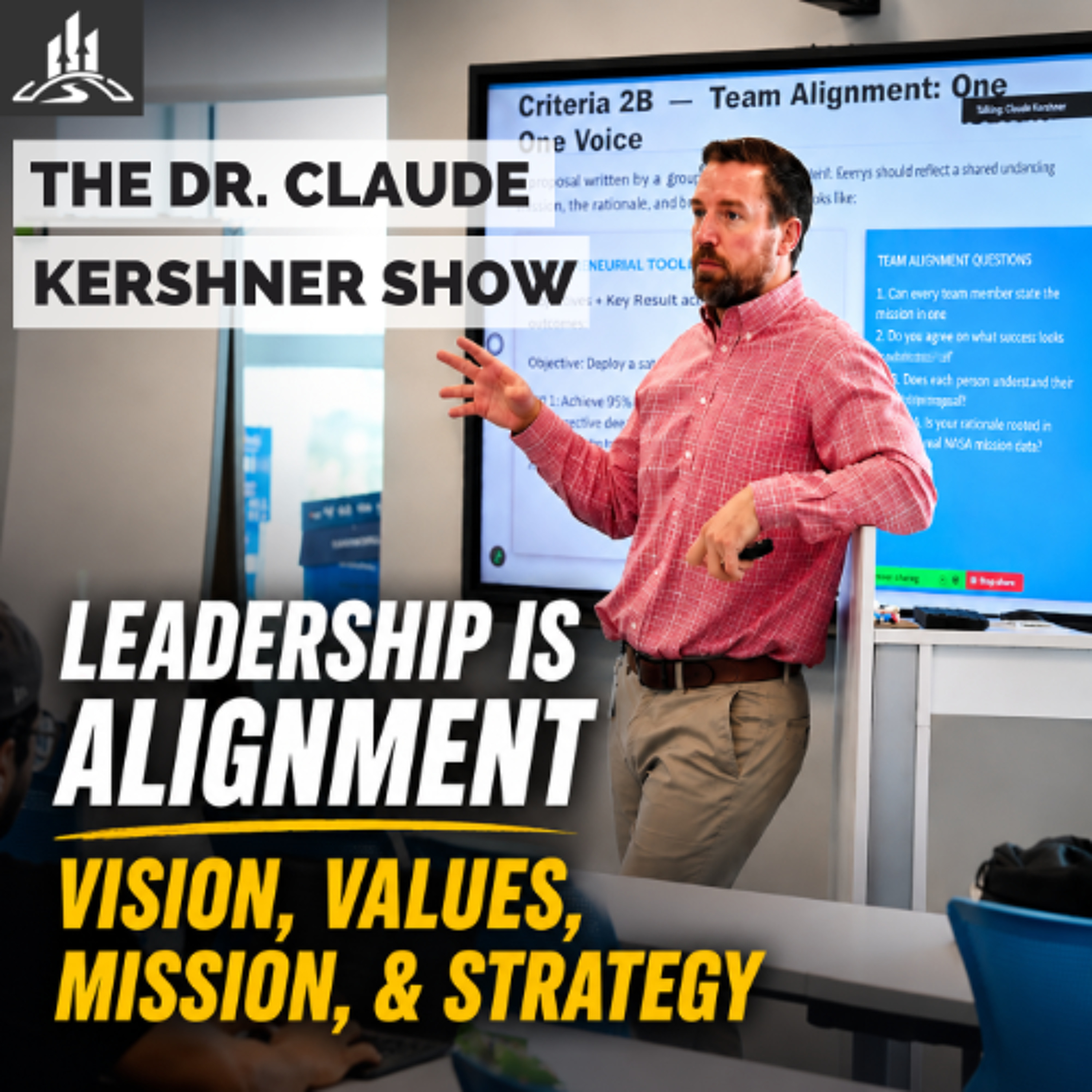
Aligning Purpose, Vision, Values, Mission, and Strategy

What separates great leaders from everyone else? It's not authority. It's not charisma. It's not even intelligence. Great leaders create alignment. In this leadership session, we explore one of the most powerful influence tools available to leaders: the ability to align purpose, vision, values, mission, and strategy. Using the remarkable turnaround story of Best Buy and former CEO Hubert Joly, we examine how leaders create clarity, inspire commitment, and help people connect their daily work to something bigger than themselves. Whether you're leading a business, a team, a nonprofit, a classroom, or your own life, these five concepts provide a practical framework for creating meaningful impact and long-term success. In this discussion: • The difference between purpose, vision, mission, values, and strategy • Why people follow purpose more than products • How Hubert Joly transformed Best Buy through leadership and clarity • The role of strategy in turning vision into reality • How leaders create commitment rather than compliance • Applying these concepts to your own leadership journey Remember: Purpose gives meaning. Vision gives direction. Values create trust. Mission creates action. Strategy creates results. The future is not built by accident. It is built by leaders who know where they are going and are willing to help others get there.

June 12, 202624 min

Ocean Reef Club Golf Cart Learner’s Permit Study Guide

In this episode, we walk young Ocean Reef drivers through the basics of preparing for the Ocean Reef golf cart learner’s permit written test. Designed especially for children around 10 years old who are beginning the learner’s permit process, this audio study guide explains the responsibility that comes with driving a golf cart, the importance of safety, and the key ORCA rules every young driver should understand. Listeners will learn about learner’s permit expectations, adult supervision, where golf carts may and may not be driven, stop signs, school zones, pedestrian safety, right-of-way, hand signals, parking rules, safe following distance, passenger safety, accidents, and violations. More importantly, this episode helps young drivers understand that earning a permit is not just about passing a test — it is about becoming someone the Ocean Reef community can trust. This study guide is based on the Ocean Reef Community Association Golf Cart Test Manual for Students, ORCA golf cart rules, and Ocean Reef Club guidance regarding the youth learner’s permit process. Families should always confirm current requirements directly with ORCA Public Safety before testing. Good luck to every young driver preparing for the written test — drive safely, respect the community, and remember: the best golf cart drivers are the ones everyone feels safe riding with.

April 22, 202635 min

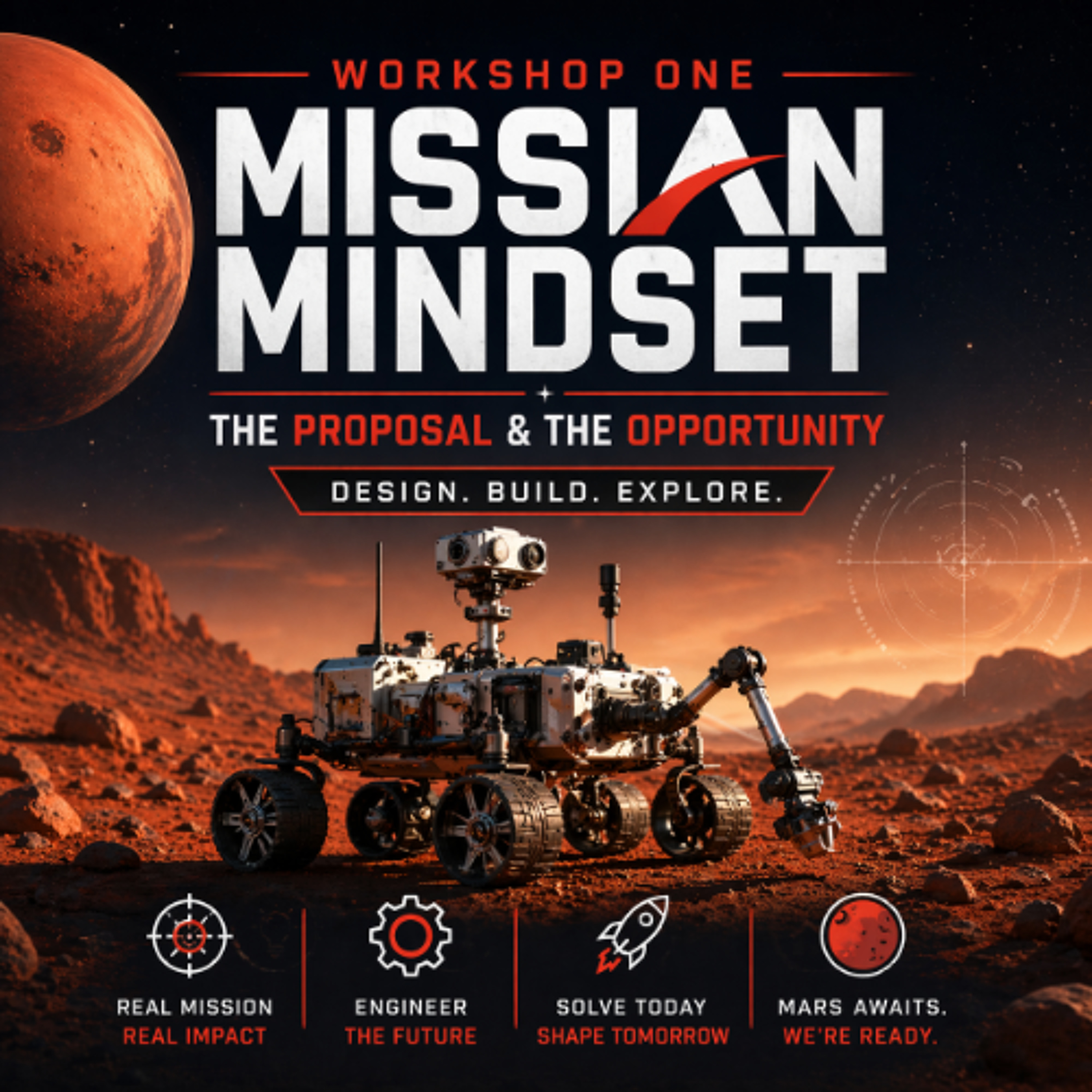
Mission Mindset — NASA Proposal & The Opportunity

Welcome to Workshop One: Mission Mindset — The Proposal & The Opportunity. In this opening session, students are introduced to the bigger purpose behind the NASA-inspired robotics competition and what it truly means to think like a mission team. This workshop explores where NASA is today with Mars exploration, why robotic systems matter, and how future breakthroughs often begin with students who can recognize opportunity and solve real problems. Listeners will learn how strong proposals are built, how winning teams align around a clear objective, and how innovation requires both bold imagination and disciplined execution. This episode sets the foundation for the seven-week journey ahead as teams prepare to design, build, test, and present a prototype rover capable of supporting scientific objectives on Mars.

April 10, 202649 min

When Ethics Collide: Business, Government, and Global Power

In today’s interconnected world, business doesn’t operate in a vacuum—it operates across borders, cultures, and political systems. And with that comes a fundamental challenge: what happens when different societies define “right” and “wrong” in completely different ways? In this conversation, Dr. Claude Kershner explores the deeper tensions behind global business ethics—where culture, government power, economic systems, and human values intersect. From capitalism vs. socialism, to individual freedom vs. central control, to real-world examples from the United States and China, this discussion breaks down why ethics becomes both simpler—and far more complicated—at a global scale. We examine: -How political systems shape business decisions -Why companies face pressure from both markets and governments -The difference between economic power and political authority -What happens when innovation meets regulation -And why global business is ultimately a balancing act between competing values This is not just about business—it’s about how systems shape human behavior, opportunity, and outcomes.

April 3, 202632 min

Tragedy of the Commons in Organizational Culture

This talk explores how the classic concept of the tragedy of the commons applies directly to organizational culture and ethical behavior in business. Traditionally, the tragedy of the commons describes a situation where individuals, acting in their own self-interest, gradually deplete or damage a shared resource—even when it is in everyone’s long-term interest to preserve it. In organizations, culture is that shared resource. When individuals prioritize personal gain, short-term results, or convenience over collective standards, they slowly erode trust, accountability, and ethical norms. No single decision destroys the culture, but over time, small compromises accumulate and become normalized. This creates environments where unethical behavior is not necessarily intentional, but becomes embedded through group norms, incentives, and leadership signals. The talk emphasizes that organizational culture is both powerful and difficult to control. It is not dictated solely by policies or statements, but by behaviors, expectations, and reinforcement systems that develop over time. Left unmanaged, culture drifts toward self-interest and fragmentation—mirroring the tragedy of the commons. Therefore, leaders carry a critical responsibility: to actively define, reinforce, and protect the culture. This requires aligning incentives, modeling behavior, holding individuals accountable, and creating systems where ethical standards are shared and sustained collectively. Ultimately, solving for the tragedy of the commons in culture is not optional—it is a central leadership mandate. Organizations that get this right build trust, resilience, and long-term performance, while those that do not risk ethical breakdown, reputational damage, and internal dysfunction. Key Concepts (Quick Breakdown for Framing) Tragedy of the Commons (Definition): A situation where individuals acting in self-interest degrade a shared resource over time. In Organizational Culture: Culture = the “shared resource” Small unethical decisions = incremental damage Group norms = reinforcement of behavior Leadership signals = permission structure Core Problem: Everyone benefits from a strong culture… but individuals are tempted to take shortcuts. Leadership Challenge: Culture is hard to control Culture is constantly evolving Culture must be actively owned and reinforced Why This Matters Culture determines how decisions actually get made Most ethical failures are not dramatic—they are gradual If leaders don’t shape culture, it shapes itself Long-term success depends on collective discipline, not individual shortcuts

March 20, 202628 min

Guerrilla Marketing & Leveraging Resources: How Small Businesses Win Without a Budget

What they actually need is a different way of thinking. In this session, we break down guerrilla marketing and resource leveraging—two of the most powerful strategies entrepreneurs can use when money is limited. Instead of relying on expensive advertising, this approach focuses on creativity, relationships, and using what you already have to generate real traction. We walk through practical, real-world examples including: • The Enterprise Rent-A-Car “donut strategy” • Sidewalk chalk marketing that drives foot traffic • Leveraging partnerships instead of paying for resources • Turning everyday interactions into growth opportunities This is not theory. These are strategies used by entrepreneurs who had to figure it out without large budgets or teams. If you are building a business, leading a team, or trying to create momentum with limited resources, this mindset is essential. The question is not “How much can you spend?” The question is “How creatively can you think?”

March 12, 202642 min

Business Ethics and Sustainability: Is Business the Problem or the Solution?

In this classroom discussion, Dr. Claude Kershner explores a central question in modern business ethics: what role should businesses play in addressing environmental sustainability? Scholars, policymakers, and business leaders often approach this issue from different perspectives. Some argue that corporations bear a direct responsibility to reduce environmental impact and integrate sustainability into their operations and decision-making. Others suggest that businesses contribute most effectively by continuing to innovate, produce efficiently, and generate the economic resources that enable technological progress and environmental solutions. This conversation examines these differing viewpoints and considers the broader institutional landscape in which sustainability challenges are addressed—including firms, markets, governments, and specialized organizations focused on environmental problem-solving. Topics discussed include: -The concept of sustainability in business ethics -The role of markets, innovation, and economic growth -Corporate responsibility and stakeholder expectations -Resource use, energy systems, and environmental pressures -Competing perspectives on the role of business in society The goal of the discussion is not to settle the debate, but to help students better understand the ethical and economic arguments that shape how businesses engage with sustainability challenges.

March 6, 202625 min

Prestige and Dominance: Leadership Lessons from Pericles and Julius Caesar

What drives people to follow a leader—admiration or authority? In this episode, we explore the leadership of Pericles of Athens and Julius Caesar of Rome through two enduring pathways of influence: prestige and dominance. Prestige emerges when people follow a leader because of reputation, wisdom, skill, and trust. Dominance appears when leaders assert authority through decisiveness, power, and control of outcomes. Pericles rose to prominence in democratic Athens largely through prestige. His influence came from persuasive speeches, strategic thinking, and the confidence citizens placed in his judgment during Athens’ Golden Age. Julius Caesar, while also admired for his intelligence and military brilliance, demonstrated how decisive authority and bold action could reshape a political system during moments of crisis. His leadership combined admiration from followers with the unmistakable power of a commander willing to act. By examining these two historical figures, we explore how effective leadership often blends both prestige and dominance in different proportions depending on the environment. From the civic assemblies of Athens to the battlefields of Rome, the stories of Pericles and Caesar reveal how leaders build influence, inspire loyalty, and make decisions that echo through history.

January 15, 202633 min

Motives to Lead: Power, Personality, and Why People Step Forward

Why do some people step forward into leadership—while others, equally capable, hesitate or opt out? In this talk, we explore the motives to lead and the deeper psychological forces that shape leadership emergence. The discussion examines why people seek leadership roles, why some are drawn to power and influence, and how personality traits and experience intersect to shape leadership motivation over time. We break down the core motives to lead, including: -Affective-identity motivation – enjoying leadership and identifying with the leader role -Social-normative motivation – seeing leadership as responsibility, duty, or service -Non-calculative motivation – willingness to lead despite personal cost or sacrifice A major focus of the discussion is the power motive, one of the most misunderstood drivers of leadership. We explore: -The difference between personalized power and socialized power -Why some leaders are motivated by control of resources, decision authority, and influence -How prestige, legitimacy, and status shape leadership behavior -Why power itself is not inherently negative—but how it is used matters The talk also examines the relationship between personality traits and leadership motivation, including: -How drive, achievement motivation, and vigor increase the likelihood of stepping into leadership -Why extraversion is often associated with leadership visibility and influence -Why lower agreeableness (within healthy limits) may make it easier to assert authority, make difficult decisions, and tolerate conflict -How confidence, resilience, and assertiveness amplify the desire to lead Importantly, this session moves beyond the simplistic “born vs. made” debate. While some leadership motivation is trait-influenced, much of it is developed over time through: -Skill acquisition and growing competence -Career and leadership experiences -Increased confidence and credibility -Repeated exposure to responsibility In many cases, people become more motivated to lead because they are the most capable person in the room—not because they initially sought power. This conversation is designed to help viewers: -Conduct a meaningful self-assessment of their own leadership motives -Better understand why other leaders behave the way they do -Recognize how leadership motivation evolves across a career If you’ve ever wondered why certain people step forward—and why others don’t, this talk offers a deeper, evidence-based lens on leadership motivation.

November 25, 20251 hr 19 min

Small Business Marketing: How to Make Sales and Drive Transactions

In this session, Dr. Claude Kershner IV delivers a practical and powerful breakdown of small business marketing—focusing not on surface-level tactics, but on the real activities that help entrepreneurs make sales and drive transactions. This talk reframes marketing as anything that moves a customer closer to saying “yes,” and it gives small business owners a clear roadmap for understanding their customers, communicating value, and standing out in a crowded market. Dr. Kershner walks through how to identify your true target market using segmentation, how to position your business intentionally in the customer’s mind, and how to understand what you really sell through the four levels of a product. He also covers the full marketing mix—the 4 Ps of product, price, promotion, and place—and explains why these elements must reinforce one another to create a consistent and compelling offering. The lesson dives into the psychology of how people buy, comparing the buyer’s journey with the entrepreneur’s selling process so you can guide customers from attention and interest all the way to action and loyalty. You’ll learn how the promotional mix works—including personal selling, advertising, publicity, and sales promotions—and how to apply each tool effectively at different stages of the decision-making process. Dr. Kershner uses relatable examples such as the Nintendo Wii’s positioning strategy, Calvin Klein designer jeans’ premium pricing model, Snap-On Tools’ customer insight, and Apple’s value-driven branding to illustrate how real companies build trust and differentiate themselves. This video is ideal for small business owners, new entrepreneurs, students, and anyone preparing a marketing plan or business plan. It provides a clear, practical foundation for attracting customers, communicating value, and designing a marketing strategy that reliably drives real sales—not guesses and not luck. Dr. Kershner brings together teaching, consulting, and real-world experience to help you build ventures that serve others and create lasting value.

Is this your show?

Claim this listing to keep it up to date, reach guests who want to pitch you, and manage bookings with Guestify.

Claim this listing

More Business podcasts