Board Governance Best Practices and Stories/Experiences Shared
Listen to episodes
29 recent
October 15, 2025Episode 2845 min
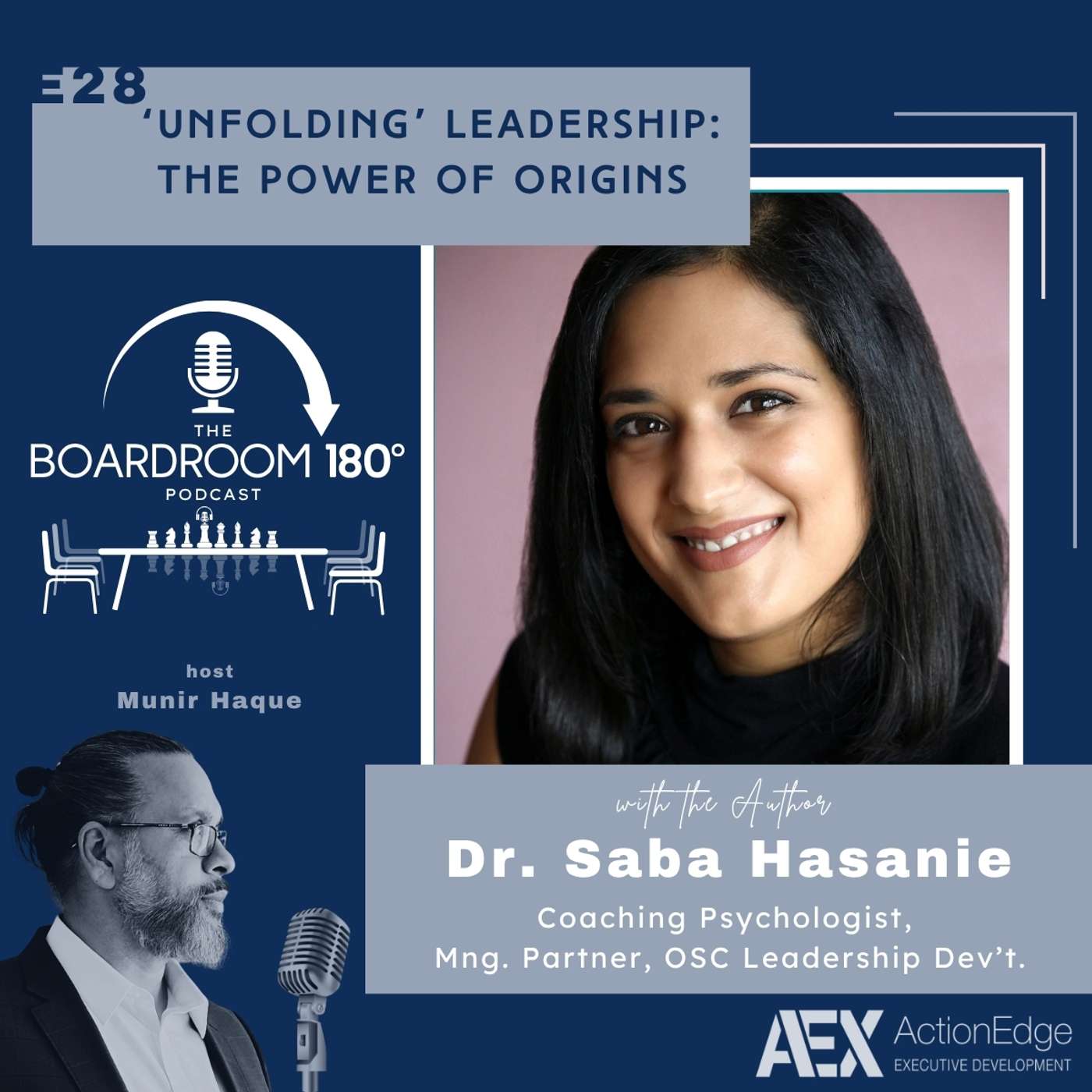
Unfolding Leadership: The Power of Origins with Dr. Saba Hasanie
In this episode of the Boardroom 180 podcast, host Munir Haque engages with Dr. Saba Hasanie, a renowned coaching psychologist and global leadership advisor. They explore the profound impact of our past on leadership and decision-making, diving into Dr. Hasanie's pioneering research and her Origins Framework. This framework highlights the significance of biographical influences in coaching psychology, offering a fresh perspective on how our histories shape who we are as leaders. Listeners will gain insights into leadership maturity, the necessity of psychological training in coaching, and the transformative power of understanding our origins. Dr. Hasanie shares her journey and the development of her framework, emphasizing the importance of integrating personal narratives into professional growth. Tune in to discover how embracing our past can lead to real, sustainable change within organizations. About the Guest: Dr. Saba Hasanie is a distinguished coaching psychologist and global leadership advisor, known for her innovative work in integrating biographical inquiry into coaching psychology. As the author of "Unfolding," she has developed the Origins Framework, which emphasizes the importance of understanding personal histories in shaping effective leadership. Dr. Hasanie's expertise lies in bridging the gap between psychological insights and practical leadership development, making her a sought-after voice in the field. Contact Munir Haque | Action Edge Executive Development Website: AEEDNow.com LinkedIn: Action Edge Executive Development Inc. Podcast Production Recorded at Pushysix Studios. Thanks for listening to Boardroom 180. Follow, rate, and share to help more leaders turn struggle into success.
August 20, 2025Episode 2755 min
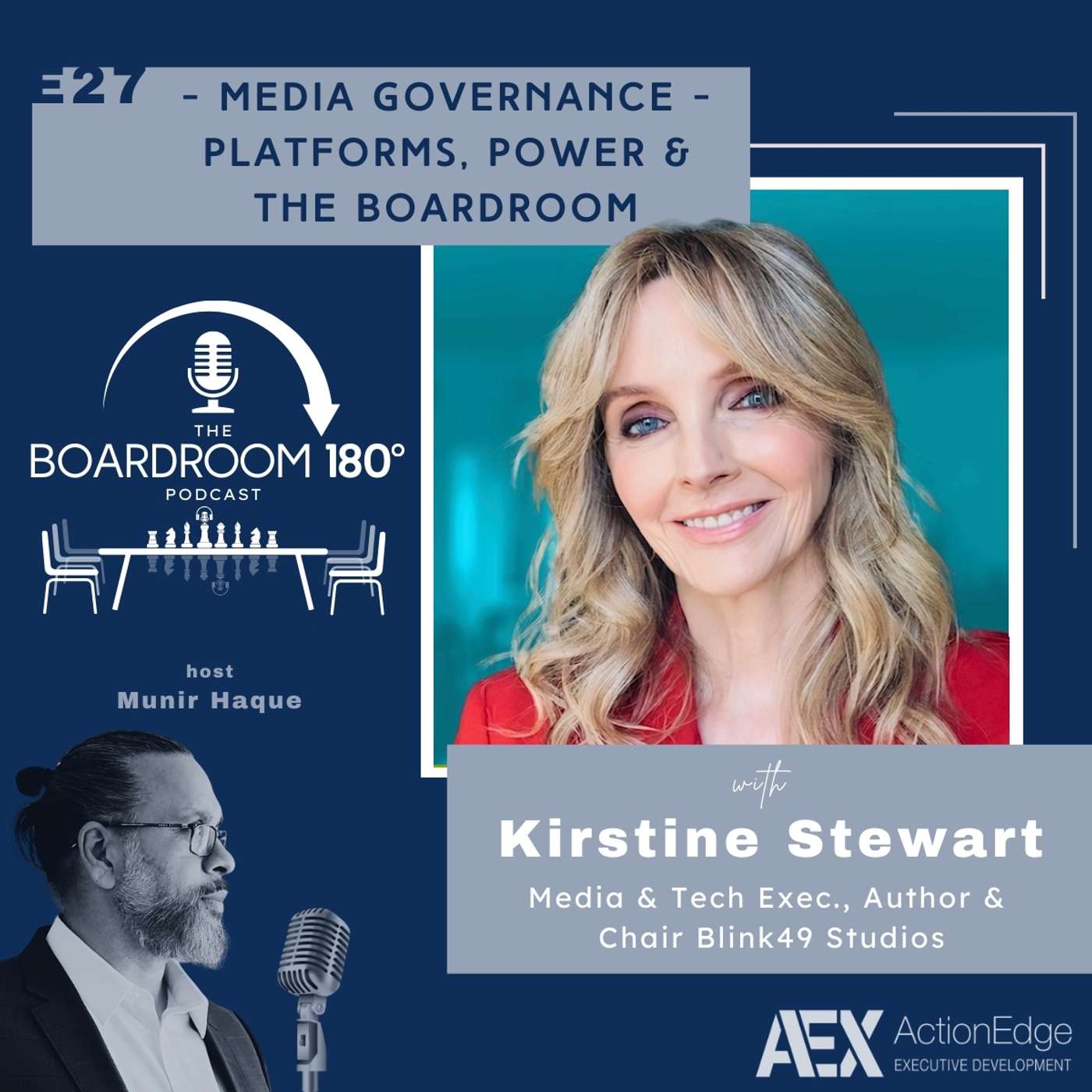
Platforms, Power & The Boardroom: Kirstine Stewart on Media Governance
In this episode, host Munir Haque sits down with Kirstine Stewart, an internationally recognized executive at the intersection of media, tech, and innovation. From transforming Canada’s public broadcaster to leading Twitter’s expansion across North America, Kirstine’s journey offers a masterclass in navigating disruption, driving change, and staying anchored in purpose. The conversation traces Kirstine’s dynamic career—from overseeing brands like HGTV and National Geographic at Alliance Atlantis to modernizing CBC as head of TV, radio, and digital. She shares the behind-the-scenes realities of building Twitter Canada from the ground up, later stepping into a VP role across North America during a time of immense platform growth and scrutiny. Kirstine also reflects on her global work at the World Economic Forum, where she shaped the future of media, entertainment, and sport alongside industry giants like Facebook and Procter & Gamble. With honesty and clarity, Kirstine unpacks what it means to lead through influence, why inclusive leadership is more than a buzzword, and how her board work with Blink 49 Studios and Ingenium reflects her values around storytelling, science, and Canadian identity. Whether you’re scaling a startup, building public trust, or navigating your own leadership chapter, Kirstine’s story is proof that real influence starts with clarity, courage, and conviction. About the Guest Kirstine Stewart is a globally respected leader across media, tech, and innovation. She was the founding head of Twitter Canada and later served as VP of Media for North America, helping shape the platform’s trajectory on a continental scale. At CBC, she spearheaded a bold transformation as head of TV, radio, and digital. Kirstine has also served as head of future media, entertainment, and sport at the World Economic Forum, working with global brands like Facebook, Global, and Procter & Gamble. Earlier in her career, she was SVP at Alliance Atlantis, overseeing a portfolio that included BBC Canada, National Geographic, and HGTV. A bestselling author of Our Turn, Kirstine is a passionate advocate for inclusive leadership and currently serves as board chair for Blink 49 Studios and Ingenium in Ottawa. She has been named to Canada’s Top 40 Under 40, Person of the Year, and one of the country’s most powerful businesspeople. ••• Contact Munir Haque | Action Edge Executive Development Website: AEEDNow.com LinkedIn: Action Edge Executive Development Inc. Contact Kirstine Stewart LinkedIn: linkedin.com/in/kirstinestewart Website: https://ourturn.vip | https://kirstinestewart.com/ Podcast Production Recorded at Pushysix Studios. Thanks for listening to Boardroom 180. Follow, rate, and share to help more leaders turn struggle into success.
August 5, 2025Episode 2646 min
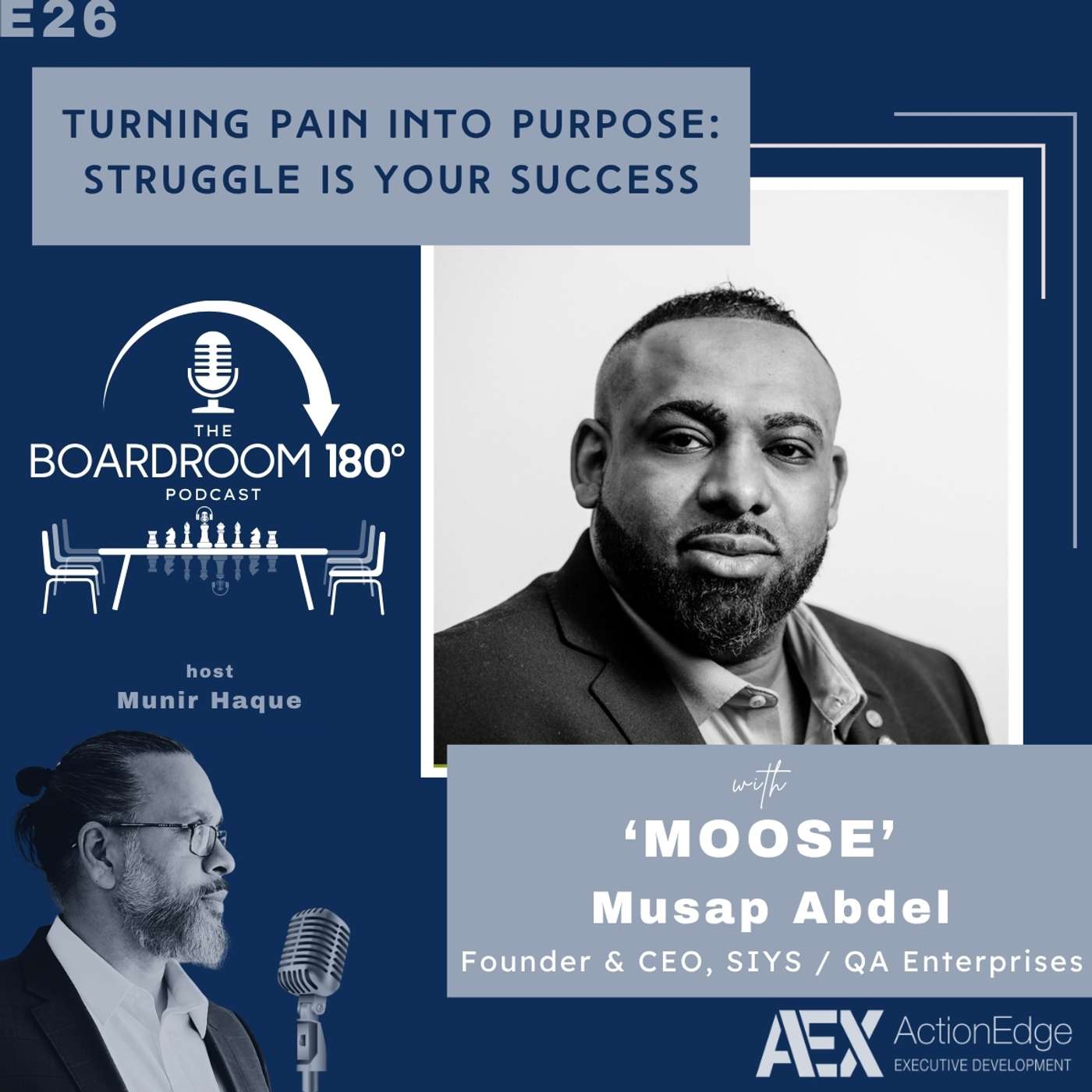
Turning Pain into Purpose: Struggle Is Your Success w/ Musap “Moose” Abdel
In this episode, host Munir Haque sits down with Musap “Moose” Abdel , a social-impact entrepreneur whose journey from systemic barriers to award-winning changemaker reframes what purposeful growth really looks like. Moose explains how he built QA Enterprises to guide companies on AI governance and literacy while running Struggle Is Your Success (SIYS) , a nonprofit that turns lived experience into mentorship for underserved youth. The conversation moves from crafting ethical AI strategies that respect data ownership to designing nonprofit boards that balance accountability with mission. Moose shares why journaling, disciplined calendars, and a values-driven advisory network keep both his for-profit and nonprofit ventures aligned. He also describes serving more than 500 young people and outlines plans to digitize programming and open an innovation hub that places community at the center of succession planning. Whether you’re leading a board, launching a social enterprise, or mentoring the next generation, Moose’s story proves that sustainable impact starts with humility, strategy, and relentless consistency. About the Guest Musop “Moose” Abdel is the founder of QA Enterprises , a Calgary-based consultancy that helps organizations navigate AI through a lens of governance and growth, and the founder of Struggle Is Your Success (SIYS) , a nonprofit empowering youth through entrepreneurial skill-building. His leadership philosophy—rooted in empathy, action, and resilience—has guided public, private, and nonprofit partners across North America. Moose’s work highlights the power of combining disciplined strategy with community-first purpose. ••• Contact Munir Haque | Action Edge Executive Development Website: AEEDNow.com LinkedIn: Action Edge Executive Development Inc. Contact Musap “Moose” Abdel Websites: QA-Enterprises.com | SIYS.ca | https://www.linkedin.com/in/musap-abdel/ Podcast Production Recorded at Pushysix Studios. Thanks for listening to Boardroom 180. Follow, rate, and share to help more leaders turn struggle into success.
July 22, 2025Episode 2555 min
Building an Innovation-Ready Culture with Ed Bernacki
In this episode of Boardroom 180, Munir Haque sits down with innovation strategist Ed Bernacki to challenge the traditional assumptions around innovation. From international consulting to developing idea journals used by thousands, Ed shares how innovation isn’t about flashy tech or radical disruption, it’s a disciplined mindset rooted in trust, collaboration, and a deep understanding of problem-solving. Together, they explore why service-based innovation is often misunderstood, how cognitive diversity drives better decisions, and what it really takes to create value in new ways. Whether you're a board member, leader, or curious thinker, this conversation will reshape how you view innovation in your organization. Innovation Isn’t Disruption, It’s Discipline" About the Guest: Ed Bernacki is an internationally recognized innovation strategist, writer, and developer of practical tools that help leaders turn ideas into action. Based in Ottawa, Ontario, Ed has worked across Canada, New Zealand, Singapore, and Australia—guiding both public and private sector organizations to build their capacity for innovation. He’s the creator of the Navigator Journal series, has trained over 4,000 professionals in innovation skills, and has worked with governments, cities, and global leadership programs to design systems that support meaningful change. Ed is also one of Canada’s most published voices on innovation—and a passionate advocate for reframing innovation not as disruption, but as a discipline rooted in mindset, structure, and trust. ••• Contact Munir Haque | ActionEdge Executive Development: Website: AEEDNow.com LinkedIn: Action Edge Executive Development Inc. Contact Ed Bernacki: Website: http://www.navigatorjournals.com/ Podcast Production: Recording: Pushysix Studios Transcript: innovation is more than improvement. (...) I mean, improvements are important, but innovations are like a quantum improvement that breaks new ground to create value in new ways. (...) And I thought this is just brilliant because it starts a conversation. (...) Hey everyone and welcome to another episode of the Boardroom 180 podcast. I'm your host Manir Haq, an executive coach and senior board strategist. I've partnered with Action Edge Executive Development to lead their governance and political acumen division.(...) In each episode we meet with governance leaders and step into their boardrooms where decisions shape the world around us. Today's guest is Ed Bernanke, an internationally recognized innovation strategist, writer and developer of practical tools that help leaders turn ideas into action. Based in Ottawa, Ontario, Ed has worked across Canada, New Zealand, the Middle East, Singapore, and Australia, guiding both public and private sector organizations to build their capacity for innovation. (...) He's the creator of the Navigator Journal Series, has trained over 4,000 professionals in innovation skills, and has worked with governments, cities, and global leadership programs to design systems that support meaningful change. Ed is also one of Canada's most published voices in innovation and a passion advocate for reframing innovation, not as disruption, (...) but as a disciplined, rooted in mindset, structure, and trust.(...) So welcome to the boardroom. Ed, how are you doing? Well, thanks very much. It's doing well, thank you. Sounds good. (...) So I just start a little bit like you were introduced to me and suggested to be on the podcast by Don Jones as he was on our last episode,(...) I think it's episode 24, and he talked a little bit about kind of the human potential. And I think that might be kind of a good segue into the stuff we're working on talking about today. (...) As well, I think during our pre-interview, he kind of said it as a bit of a small world that you knew one of my previous guests as well,(...) Bruce Anderson. Yeah. Yeah. (...) So Bruce Anderson, he was in episode 14, and he talked about nonprofit, (...) kind of nonprofit governance. (...) So are you telling me how, I think there's a bit of a story there on how you know each other and might lead into kind of our first line of questions. (...) Okay, sure. (...) Man, I have to say it's an extraordinary coincidence that two of your previous speakers were in fact, we all went to university together. (...) And all of three of us were in the sports management program at Laurentian University.(...) And basically we went there because it was the only place in Canada that in those days that actually offered a program in sports management. I mean, I had an interest in sport, but I knew I didn't wanna be like a coach. That just wasn't my thing at all. And what we studied essentially was a four year commerce degree. (...) And then on top of that, all our minor courses were essentially the business of amateur and professional sport. (...) And so you kind of learned about associations, nonprofit management. (...) And I think once we got out of there, people kind of went in different directions, but I have the same sort of background. I started with, as Bruce did, is working in the nonprofit sector for five years and my was in soccer association. (...) And then many years later, Don Jones and I collaborated on a project in the 2000s. (...) I kind of create these innovation journals(...) and we collaborated on pretty one for some of his programs. (...) So it's amazing. Well, we'll get into that a little bit later, hopefully.(...) So you kind of started out your career, it sounds like in sports management and kind of led up into kind of where your focus is today on innovation. So why don't you tell us, as I say, a little bit of your evolutionist or innovationist kind of origin story. (...) Well, I was kind of thinking about this idea. (...) Now looking back, I was always kind of the ideas guy, whether it was in university or high school, But I learned two things. My first job with the soccer association, (...) my boss got it and he started to harness that. So he would give me like little thinking jobs, thinking about improving this next year. There were five ways that we could do this. (...) And I would just go away and think about this up and give him a list of probably 10 things to do.(...) And I realized that I'm really good at doing this. (...) But second story was though, after book five or six years, I thought I need to more like get a real job. I ended up joining one of those big international consulting firms,(...) sort of a national marketing role. (...) And I was all enthusiastic about this.(...) And I certainly realized that not every organization wants you to be an ideas guy. (...) My Tiffany was going into a strategic planning session for our group.(...) And the director looked at the plan we did last year and all the things that were accomplished and said, you know what, this is all great. Let's just do it all again next year. (...) And I sat there and I was just dumbstruck because at a whole list of things that I thought could improve what we're doing. (...) And so I started to really explore some of these issues about what it's like, like why people think so differently to me. I didn't have a clue then, but this was what started getting me interested. Now, same time, because it was an...
June 3, 2025Episode 2451 min
The Architecture of (Human) Potential
In this episode, the host’s guest is Don Jones, a human potential architect and experiential learning pioneer who has designed immersive behavioral simulations for more than 40,000 leaders in over 70 countries. The conversation delves into the concept of “Human Potential Architecture” and how organizational systems, culture, processes, and structure, either amplify or suppress individual and team potential. Don explains why most companies remain stuck in an industrial-era model, limiting agility and engagement, and outlines how immersive simulations (like Mission Possible) allow leaders to confront real-world challenges in a safe yet high-stress environment. They discuss the pitfalls of large-scale technology transformations that overlook employee insights, the importance of reducing friction between insight and impact, and why AI can’t replace a thriving, well-architected human workforce. Through real-life examples, from a Fortune 500 tech-upgrade that wasted over a billion dollars when employees were excluded, to the transformational story of a public utility that used simulation to rewire its culture, listeners hear practical lessons on redesigning systems to unlock creativity and adaptability. Don also shares a powerful vision for re-centering humanity in the age of AI by “putting Marissa on Time Magazine’s cover” as a metaphor for valuing every person’s innate brilliance. This episode challenges executives to rethink governance, job design, and leadership frameworks to create environments where people thrive rather than simply execute. About the Guest: Don Jones is the founder and chief experience designer at Experience It, Inc., where he has spent over three decades crafting story-driven behavioral simulations and distributed immersive reality experiences for clients such as Boeing, Microsoft, Cisco, and American Express. He is the author of the forthcoming book The Architectural Potential , a researcher on organizational design, and a sought-after speaker on human potential, leadership, and experiential learning. ••• Contact Munir Haque | ActionEdge Executive Development: Website: AEEDNow.com LinkedIn: Action Edge Executive Development Inc. Contact Don Jones: Website: ExperienceIt.com Podcast Production: Recording: PushySix Studios Transcript: Today on the Boardroom 180 podcast, I'm joined by Don Jones, a pioneer in experimental learning and human potential design. For over three decades, Don has been crafting immersive story-driven behavioral simulations that have transformed leadership development across the globe. He's the founder and chief experience designer at Experience It, Inc. (...) And he's a thought leader, author, and keynote speaker whose work has shaped how Fortune 500 companies think about human systems and transformation.(...) Don, welcome to the show. (...) Thanks so much, Manera. It's a pleasure to be here. I appreciate meeting you and the team actually. (...) Well, thanks. You know, I, you know, as I often do with previous guests, I reach out and ask who they, who would they suggest? And, you know, your recommendation came from Phil DeMont.(...) You know, he's episode, I think he's episode 16. (...) And, you know, Phil's a freelance broadcast journalist. In fact, I actually heard him on the radio this morning. So did I. Talking about Tesla sales and Fortnite, yeah. Okay, heard him this morning. He does a very nice job of that. I listened this morning as well. Yeah. (...) And what he, he said two things about you. He said, reading it verbatim, really smart, dot, dot, dot. Also world ranked sailor.(...) So like Phil, I kept your introduction relatively short. And I thought I would let you unpack it a little bit. I mean, maybe that maybe to kind of lead off what I want you unpack is I went to LinkedIn and I looked at, you know, essentially what your profile tag is, or, you know, kind of the description that you use right at the top of the page. And it says, (...) human potential architect, 30 years creating behavioral learning simulations and distributed immersive reality experiences for global clients. So there's a bit to unpack there for those of us who, you know, don't understand all the lingo here. Sure. So, I mean, the question is like, (...) what's that mean? (...) Sure. First of all,(...) yes, Phil's a long time friend of mine and we used to play a lot of basketball together. And I do not sail at all, zero. (...) Would like to. So I am not, I am neither a world-class sailor or really smart. So I would like to be one of those, but let's just start base level. He never said you were highly ranked. He just said you were ranked, maybe you're ranked at the bottom. Yeah, listen, (...) I really loved basketball, played it a lot of my life, worked for Canvas Olympic teams, did a lot of stuff that was interesting before I started my company. But to your great question, what does all that jargon mean on LinkedIn, human potential architect? You don't hear that every day. And honestly, I started my business over three decades ago. And I always cared deeply about human potential, whether it was kids, you know, doing well in school, or people starting their own business, or me developing my own potential in what I wanted to do. And I started a company to design behavioral simulations. And that took off and we ended up working in 40 countries digitally, (...) physically, and then 70 plus countries digitally, working with Fortune 500 companies like Boeing, GE, Microsoft, Cisco, American Express, and others. (...) And we designed behavioral simulations that allow people to see their own behavior and grow and develop. (...) But over the years, I realized, well, what's the core of what it is that I care about and that I am trying to in some way improve my craft around? And it was around human potential. But the reason I developed the idea of human protection architecture, which my book is called "The Architectural Potential" that I'm writing right now, (...) and have been researching and will talk about, (...) is that I always used to think as human potential as individual, Manir, like you have a number of kids and you want them to develop their potential. And we want them to have the will to do that, the security to grow and develop. But also, as I've grown older and been around this profession a long time, I realized the architecture matters. And one of the basic premises of my research is that architecture is never neutral.(...) It's either amplifying or suppressing your potential. (...) And so I realized that the architecture of potential is a great determinant of many people's success. Yes, we need individual initiative, absolutely. And I admire that more than talent, actually. But we also need an architecture. And what is architecture from my perspective?(...) Well, architecture, let's say in the workplace, are the systems, the processes, the culture, the environment that you're in, is the architecture. And it's either amplifying your potential, you individually or your team's potential collectively, or the organization collectively, or it's suppressing it. And quite honestly, my research says the organizations today are mostly suppressing it. They've never been set up, designed for the amplification of human potential. They've been set up really an industrial era model. (...) That it was always designed to limit potential, keep you in a box and stay within a cogs relationship to other cogs to make the whole machine work. W...
May 20, 2025Episode 2344 min
AI Governance, Board Risk, & The Innovation Imperative w/ Yusuf Azizullah
In this episode, the host’s guest is Yusuf Azizullah, a board governance expert and advisor who works with companies and directors around the world on the fast-moving landscape of AI oversight and organizational risk. The conversation explores the growing responsibilities of boards as artificial intelligence transforms every sector, from finance and healthcare to mining and entertainment, and how leaders can strike the right balance between innovation and compliance. Yusuf outlines the key pressures facing directors today: reputational risk, litigation exposure, ethical AI use, and the need for clear oversight of data, vendors, and autonomous systems. They emphasize the importance of AI literacy at the board level, the role of AI ethics officers, and how even smaller companies need to think critically about transparency and bias mitigation. Drawing on real-world examples from Royal Bank of Canada, Deep Genomics, and Aramco, the conversation illustrates how emerging technologies are reshaping strategy, governance, and even merger and acquisition valuations. This episode challenges boards and executives to stop lagging and start leading—and to understand that AI oversight is no longer optional. About the Guest: Yusuf Azizullah is a global advisor on board governance, artificial intelligence, and risk oversight. His work includes direct consulting with public companies and nonprofit organizations, and the development of over 120 training programs focused on board responsibilities, AI governance, ESG, and cybersecurity. They are the founder of Global Board Advisors and BoardroomEducation.com, offering on-demand governance education for directors and executives around the world. ••• Contact Munir Haque | ActionEdge Executive Development: Website: AEEDNow.com Linkedin: Action Edge Executive Development Inc. Contact Yusif Azizullah Website: BoardroomEducation.com Podcast Production: Recording: PushySix Studios
May 6, 2025Episode 2253 min
Leadership & Organizational Mental Health Strategy w/ Stacey Adelman
In this episode, Munir Haque’s guest is Stacey Adelman, an organizational psychologist and mental‑health advocate whose work reframes resilience and vulnerability in leadership. She joins the show to explore the hidden costs of “surviving” in high‑stakes roles—from the panic that strikes before every presentation to the isolating myth of “bouncing back.” Stacey reveals why traditional resilience advice can leave leaders feeling alone, and how simple acts of recognition can spark genuine connection and adaptive change. Stacey Adelman describes how executives often feel they must “be strong all the time,” even under pressure. She challenges the notion of resilience as a return to “normal,” reframing it instead as ongoing adaptation and growth. Stacy highlights the critical role of psychological safety. About Stacey Adelman: Stacey Adelman is an organizational psychologist who consults with boards and executive teams on mental‑health strategies and culture change. She developed the “Rose Call” recognition strategy to foster connection and well‑being in high‑pressure environments. Her research and practice focus on reframing resilience as adaptive growth rather than mere recovery, and she speaks widely on leadership vulnerability and psychological safety. ••• Contact Munir Haque | ActionEdge Executive Development: Website: AEEDNow.com Linkedin: Action Edge Executive Development Inc. Contact Stacy Adelman: Website: https://joshuatreelearning.com/meet-stacey/ Linkedin: ( linkedin.com/in/stacey-adelman-31539288 ) to learn about her programs. Podcast Production: Recording: PushySix Studios ••• Transcript: You know, when we think of resilience, and how do people, you know, work through or, you know, difficult things in their lives, you will often hear the term bounce back, right? How do we bounce back or how do we push through, for example, and I don't always see resilience as that. I think that's a bit of a myth. I think we need to look at it more in terms of adaptation and change, rather than bouncing back to to the way things were. (...) I'm your host, Munir Haque, an executive coach and senior board strategist. I have partnered with Action Edge Executive Development to lead their governance and political acumen division. In each episode, we meet with governance leaders and step into their boardrooms where decisions shape the world around us.(...) We'll guest today is Stacey Adelman, (...) a registered psychologist and expert in mental health and education with a master's in education and special education and intensive experience in both clinical and school settings. Stacey has spent her career supporting individuals across all ages, helping leaders, employees, and students navigate psychological challenges. (...) She has worked as a teacher, mentor, and coach, and her expertise spans psycho, psycho-educational assessment, counseling, and organizational mental health strategies. (...) Stacey is passionate about breaking the stigma about mental health, particularly in leadership and corporate settings. And she brings a wealth of knowledge to how organizations can better support their people. (...) Stacey, welcome to the boardroom one eight podcast. Good morning. Thank you so much for having me. Well, thanks for, thanks for making the time to be with us today. I know that one of our mutual connections, Subi had reached out and she's a supporter of the podcast and highly recommended that I, that I reach out to you and, and set up a, set up an interview with you. And I'm glad that, glad that we had the opportunity, we have the opportunity to do this. (...) Yeah. That's, it's great to connect with you. And she's spoken very highly of you as well, in the near. That's good.(...) I paid her well. Yeah. (...) Anyway, so we're here to talk a little bit about mental health and I, you know, admittedly I probably fall into that category of somebody who has never been overly comfortable talking about it. I find, I find now that my, my, my children are getting older, that it is something that is talked about a lot more. Yes. And, and you say, you know, when you're, when you're dealing with, with your kids as the age, you see it more, you know, from their perspective, or from your perspective as a parent. (...) And, you know, I've, I've been in organizations and, and had had to deal with, with staff that had, you know, whether, whether it's, you know, kind of mental health issues or other personal health issues, you see, I saw over time that, you know, it became something more talked about. (...) And, you know, as it is, as it is becoming a kind of less, less taboo and acceptable,(...) you have to talk about these in business settings. (...) But, you know, from your perspective, how have you seen it change over the last, you know, decade or so? (...) Oh, I would agree with you. I, I think this younger generation is light years ahead of us. And I get really excited when I talk with youth, because they have so much awareness and knowledge now that we just never had when we were growing up. Right. And so I think the future is really bright. There's a lot of great changes happening, a lot of wonderful insights and a lot of advocacy and, and breaking the stigma around mental health for sure. (...) And you think that is what's kind of driving that shift or is there, is there more, more behind it? I think we're learning so much more than, and when we, when we know better, we do better. So over the years, there's just been so much research and knowledge gained. And I think we're just learning the impact,(...) a very significant impact mental health has on our overall wellbeing, both, you know, personally, professionally, it's affecting every facet of our communities, our schools, our businesses.(...) And we're just starting to really, truly understand the impact of that. And so as we learn more, as we've come out of, you know, the COVID pandemic, for example, and major changes that our generations have endured,(...) we're starting to learn more about the significant effects of mental health on our wellbeing. (...) So while we are, you know, people are getting to be more open about it and have those discussions, but there are still some barriers and barriers that are preventing people from talking about that. Do you want to spend a minute or two talking about those? (...) Absolutely. What do you see some of the barriers still are? I think there's still definitely a fear, a fear of being judged for maybe experiencing difficulties with mental health. I know we certainly see that with employees, for example, a real fear that they may be seen as incompetent or not being able to complete the job. So there's a real hesitancy to disclose that. (...) I don't know that there's, you know, we have different generations with different amounts of education, background and experiences. And so(...) there's still a lot of learning that's happening about, you know, different things people are experiencing. (...) There's a lot of research happening that we're learning about. So I think there's still so much we have left to learn as, you know, multi-generations working together. So there's definitely some barriers. I think there's also some accessibility issues with mental health that we need to address in terms of, you know, maybe langu...
April 22, 2025Episode 2145 min
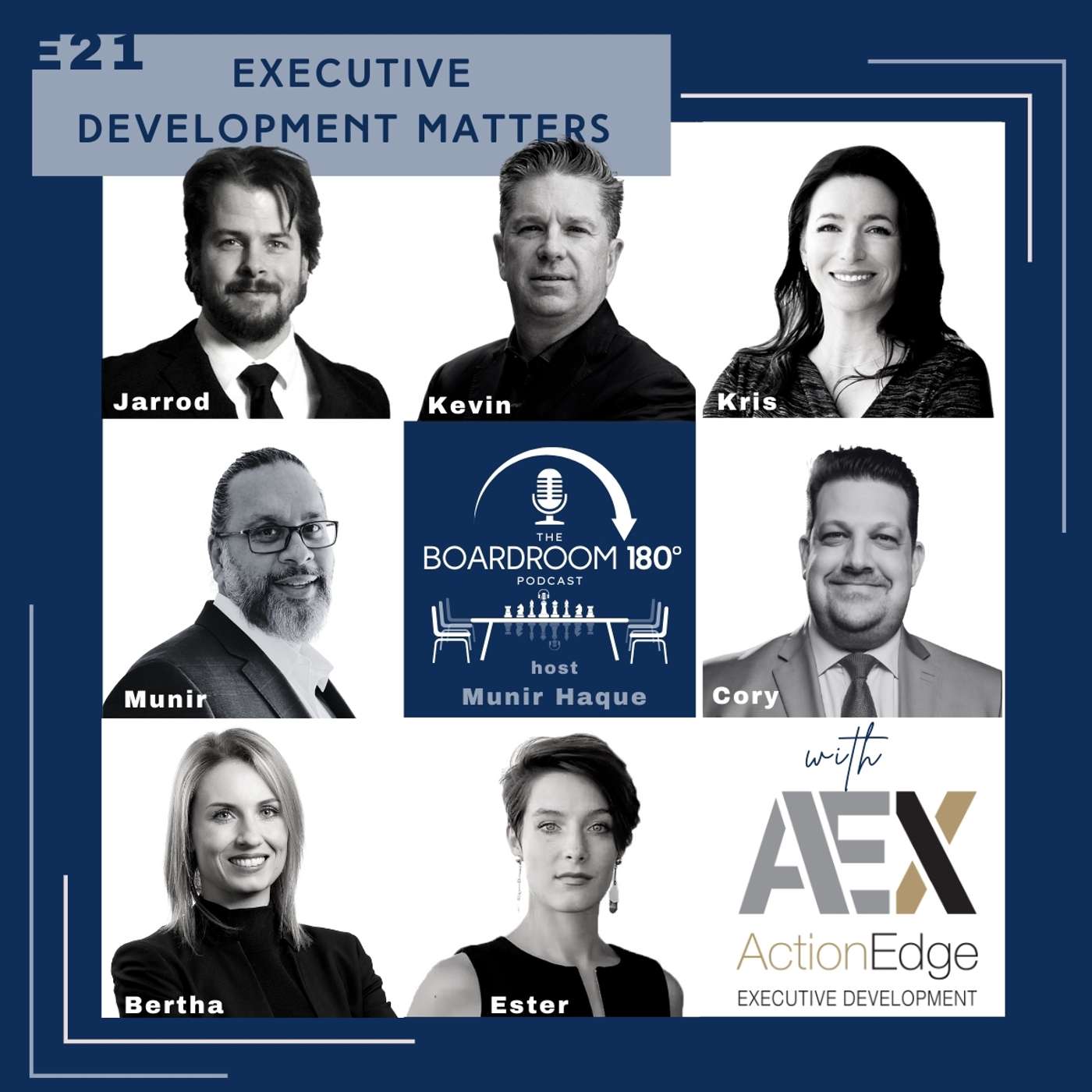
Executive Development Matters w/ ActionEdge (AEX)
In this episode, host Munir Haque’s guests are members of the ActionEdge team who work in ActionEdge Business Development, ActionEdge Executive Development, and ActionEdge Coach. Munir talks with managing partners Kevin Simpson and Jarrod Stanton about the origins of ActionEdge and the passions they instill into the business. He speaks with Cory Dyrland, Ester Pike, Kris Segmeth, and Bertha Taylor to learn more about each of them, what they bring to their roles, and what clients can anticipate with ActionEdge Jarrod and Kevin talk about their working history together and highlight the culture and values that make ActionEdge the powerhouse company that it is. Jarrod shares stories of his aunt, who really inspired and inducted him into the world of coaching, and Kevin highlights not only the valuable structure of the coaching but also the honesty that drives real results. Cory tells Munir details of his journey from being an ActionEdge client to becoming one of their coaches. Ester explains how her business psychology background informs her work and how key action takeaways form the foundation of client success. Kris discusses her work history, the variety of clients she has worked with, and how she defines success through the ActionEdge lens. Bertha shares how her roles, including quality control and quality assurance, help contribute to the ActionEdge difference and what she learns in client follow-ups. This episode shines a light on why ActionEdge is such a powerful business and how the individual team members contribute to the company's quality and visible positive changes for clients. About Action Edge: Kevin Simpson: Managing Partner Kevin Simpson is an award-winning coach and professional presenter with the #1 business coaching firm in the world – ActionCoach and is ranked globally in the top 50 list of best business coaches. Jarrod Stanton: Managing Partner Jarrod is the co-founder and managing partner of Canada’s number one performing business coaching firm, and has been coaching, presenting, facilitating, and training business leaders, executives, and owners for 14 years. Cory Dyrland, SCMP: Executive Business Coach Ester Pike: MSc.Occ.Psy, GMBPsS, Executive Business Coach, Organizational Psychology and Psychometric Assessments Lead | Senior Facilitator Kris Sigmeth: Executive Business Coach, Performance Catalyst and Facilitator Bertha Taylor: CODA, Director of Client Results — Contact Munir Haque | ActionEdge Executive Development: Website: AEEDNow.com Linkedin: Action Edge Executive Development Inc. Contact ActionEdge: ActionEdge Business Coaching: ActionEdgeBusinessCoaching.com ActionEdge Executive Development: AEEDnow.com — Transcript Ester Pike: [00:00:01] The higher up that you get in a lot of these corporate organizations, or larger entities, the harder it is to have somebody there in your corner that you can bounce ideas off of, that you can have some form of feedback with, and somebody who can look at you from that external perspective and provide you their experience and their perspective on how you're doing. So that is the one area of business psychology where, individually, it assists. Munir Haque: [00:00:33] Hello everyone, and welcome to another episode of The Boardroom 180 Podcast. I'm your host, Munir Haque, an executive coach and senior board strategist. I have partnered with Action Edge Executive Development to lead their governance and political acumen division. In each episode, we meet with governance leaders and step into their boardrooms where decisions shape the world around us. Munir Haque: [00:00:53] Hello everybody, today I thought we'd do something a little bit different on the podcast. I wanted to turn the tables and talk a little bit more about Action Edge business coaching, Action Edge Executive Development. They are the sponsors of this, and I want to tell you a little bit more about my team, the people I associate with that are responsible for bringing this podcast to you. Right now I have with me the, I think your terms are, managing partners and owners of Action Edge Executive. Jarrod Stanton is with me, and Kevin Simpson. Welcome to the podcast, gents. I'm a little bit light on the history of the company, so I thought I'd have you guys on, first to talk a little bit more about that. Jarrod, you've been doing this for a long time. You're nearing the 20 year mark or so? Jarrod Stanton: [00:01:50] Yeah, that's right. Coming into my 19th year here. Munir Haque: [00:01:52] I want to talk a little bit about our origin story at Action Edge, so why don't you tell us a little bit about how you got into the business and how you launched Action Edge and what you've seen over the years. Jarrod Stanton: [00:02:09] Taking it back even further than that, our parent company was founded in 1993, in Brisbane, Australia. So we're over 30 years now. My aunt was one of the pioneer business coaches in North America under that brand. She started telling me about what she did for a career. I think she knew I was somewhat entrepreneurial, had a little bit of an inkling towards teaching and coaching through school and sports growing up, but also a strong interest in business. It was 2005 we started discussing the idea and I started learning a bit more, and it was September of that year that I reached out to Action Coach to get the certification. Munir Haque: [00:03:03] What was happening in the world at that time that made you think it was the right time to launch something like this? Jarrod Stanton: [00:03:09] Nothing, actually. It was a bunch of worry and fear and concern and "what am I doing?" A lot of my friends at the time were starting families and buying houses. I spent all the money I had and borrowed all the money I could to try to convince my family to lend me some money to buy a piece of paper that said I was able and certified to help business owners in this community. I wouldn't say nothing was really aligning, I had a bit of a sense of adventure. I desperately wanted to get into business, and it was mainly just on account of my aunt's confidence in me and her showing me the attributes I had, the skills I had, and how it related to what she did day in and day out with her clients. She allowed me to shadow a few sessions, and I instantly was amazed at how revered and respected and admired she was, and the sentiments I was hearing from the clients on how the course of their life had been changed. It really gave me an added depth of understanding and appreciation of what she did. Munir Haque: [00:04:28] You're talking about clients a little bit here, so in the early days, what kind of clients did you have and what were the services that you were providing? Jarrod Stanton: [00:04:38] Not a lot different from today. We have never really targeted clients in terms of industry or specialty. I think we're pretty strong minded about the difference between a mentor and a coach. We often joke, but are also often dead serious in the sentiment that one of the biggest benefits we bring to a company is being outside of their industry. There's never...
April 8, 2025Episode 2042 min
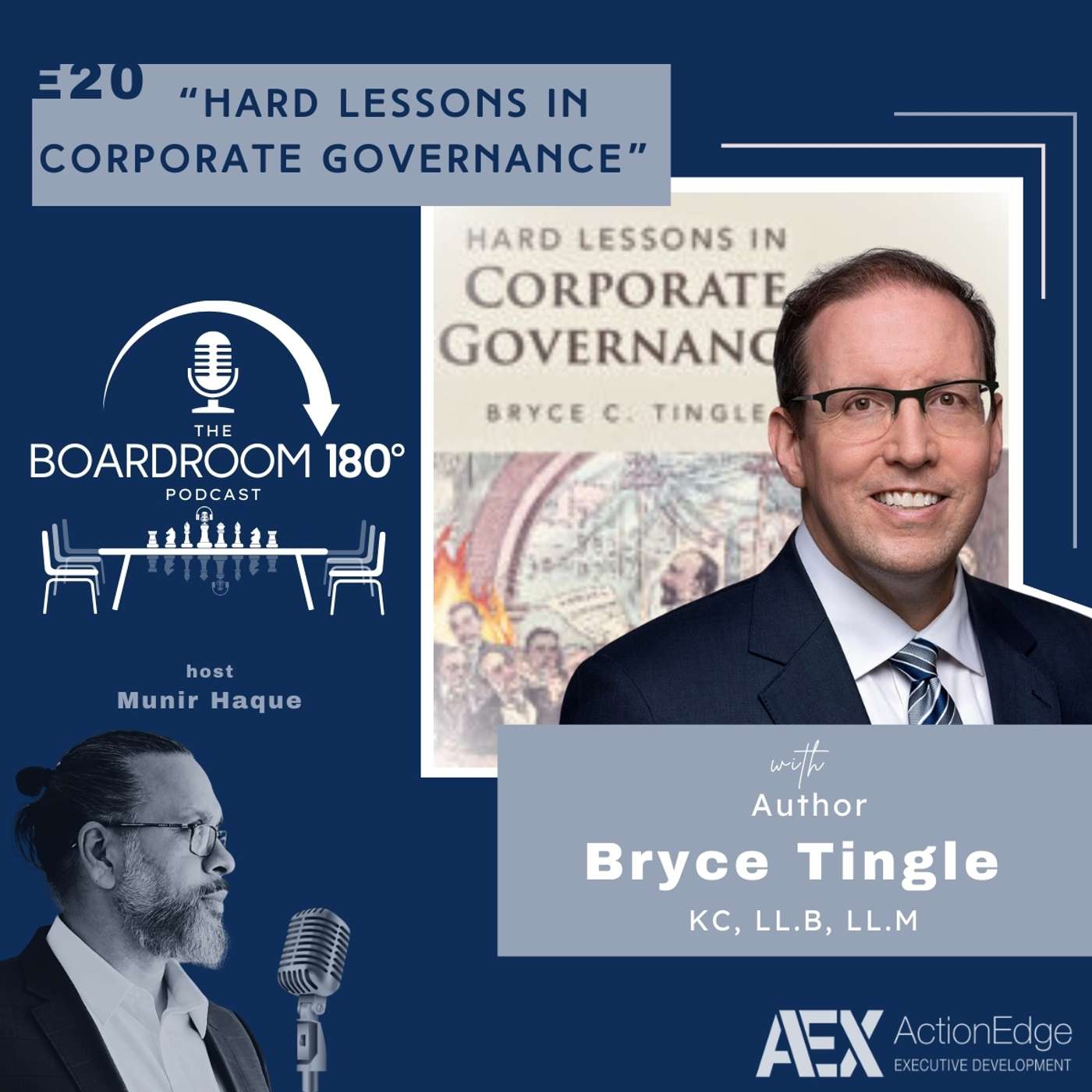
‘Hard Lessons in Corporate Governance’ with author Bryce Tingle KC
In this episode, host Munir Haque’s guest is Bryce Tingle, who holds the N. Murray Edwards Chair in Business Law at the University of Calgary. Bryce is also a member of the Alberta Securities Commission and the author of a new book called “Hard Lessons in Corporate Governance” . He joins Munir to talk about the evolution of venture capital, the role of corporate governance in shaping the success of startups, and how venture financing shapes corporate governance and long-term success in business. Bryce Tingle reviews some of the history of corporate governance dating back to the 80s and 90s and examines how the shift from insider directors to largely outsider independent directors took place. He highlights the intersection of securities law, investor protections, and corporate structures, discussing with Munir how these elements affect capital formation and business environments. Bryce advocates for governance reforms that could create a more favorable ecosystem for high-growth companies and nurture greater economic innovation in Canada. The discussion is well-informed by the experience and knowledge Bryce Tingle brings to the subject matter, as well as the focus of his book. About Bryce Tingle: Bryce C. Tingle KC, LL.B, LL.M, holds the N. Murray Edwards Chair in Business Law at the University of Calgary. He is a member of the founding teams for several companies active in the technology, energy and financial industries. He also advises several private and public companies. He is the author of many academic publications. His new book, Hard Lessons in Corporate Governance , was published in May 2024 by Cambridge University Press. He has twice been named one of the University of Calgary's Peak Scholars. He serves as a Member of the Alberta Securities Commission. — Contact Munir Haque | ActionEdge Executive Development: Website: AEEDNow.com Linkedin: Action Edge Executive Development Inc. Contact Bryce Tingle: Book: “Hard Lessons in Corporate Governance” by Bryce C. Tingle LinkedIn Podcast Production: Recording: PushySix Studios Production Assistance: Astronomic Audio — Transcript Bryce Tingle: [00:00:02] It's easy to talk about what's not working. Figuring out the best way around the corporate governance mess we've made is more complicated in books and articles I've tried to set out with some of those steps would be, but I do believe that Canadians and Canadian politicians can take a look at what's going on and fix it. It certainly lies within our power to fix. We made the mess, we can unmake the mess. Munir Haque: [00:00:37] Hello everyone, and welcome to another episode of The Boardroom 180 Podcast. I'm your host Munir Haque, an executive coach and senior board strategist. I have partnered with Action Edge Executive Development to lead their governance and political acumen division. In each episode, we meet with governance leaders and step into their boardrooms, where decisions shape the world around us. Munir Haque: [00:00:57] On today's show, we have Mr. Bryce Tingle. He holds the N. Murry Edwards Chair in Business Law at the University of Calgary. He's a member of the Alberta Securities Commission. He was recently appointed a member of the National Special Advisory Group to the RCMP Integrated Market Enforcement Team. Mr. Tingle is a director of several companies active in the technology and financial industries. He served as general counsel for several tech and natural resources companies. He has a master's of law from Duke, a masters of law in E-Business from Osgoode, and a Bachelors of Law from the University of Alberta. He has served on various public and private corporations and charitable boards, including serving as director at the Alberta Ballet. He is the author of a new book called 'Hard Lessons in Corporate Governance', which was published in 2024 by Cambridge University Press. Welcome to the Boardroom 180 Podcast, Mr. Tingle. Bryce Tingle: [00:01:57] Thank you very much. I'm very pleased to be here. Munir Haque: [00:02:10] You've got quite an impressive resume, but the one thing that stuck out to me was that recently you were appointed to the National Special Advisory Group to the RCMP Integrated Market Enforcement Team. That sounds interesting and intriguing, are you bound by any confidentiality or is that something you can talk to? Is that top secret? Bryce Tingle: [00:02:34] It is confidential, I am bound. But generally speaking, the IMET teams are part of the RCMP, which is our federal law enforcement arm. Here in Canada, they're the part of the RCMP that investigates financial crimes. Things like terrorism financing, Ponzi schemes, fraud, attempts to evade export controls. These things are dealt with by the IMET teams, and there are myself and three other individuals who advise them on those investigations. Munir Haque: [00:03:10] So you're not the person on the ground who's got the little note on their background as they're going to raid corporate offices? Bryce Tingle: [00:03:16] I can't tell you how much I would love to have a bulletproof vest with 'police' written on the back. RCMP windbreaker, it would be great. It would make my life way more interesting than it is. Munir Haque: [00:03:29] Do you at least get a baseball cap or something? Bryce Tingle: [00:03:32] So far, nothing. Free trips to Ottawa is what I get. Munir Haque: [00:03:37] Okay, it's a nice town. To start this off here, you wrote a book called 'Hard Lessons in Corporate Governance'. One of the interesting things that I find is that it's easy to learn from other people's failures. I was asked to talk about failures, and here you are. You wrote a substantial book that covers a lot of failures and the lessons that we learned from them. I won't be asking you the flip side of that, the successes, but maybe we start talking about the book a little bit. What motivated you to write 'Hard Lessons in Corporate Governance'? Bryce Tingle: [00:04:13] I came to it indirectly. By way of background, I spent a decade and a half in private practice, mostly working with startup companies mostly in the tech industry, working with venture capital funds and mezzanine debt lenders. During that time, I did a lot of advising of boards of directors. Then I went in-house as general counsel of a couple of large international groups, and in that capacity also did a lot of advising of boards of directors, even assembling boards of directors. Over the course of that, I advised clients for the companies I worked for in what the current best practices were for corporate governance, and I did so without much second thought. Everyone from the Securities Commissions, to the Wall Street Journal, to the Globe and Mail, to think tanks, to proxy advisers, everyone was more or less saying exactly the same thing. I passed on this advice, and I never really felt like I had any reason to doubt it. When I becam...
March 25, 2025Episode 1944 min
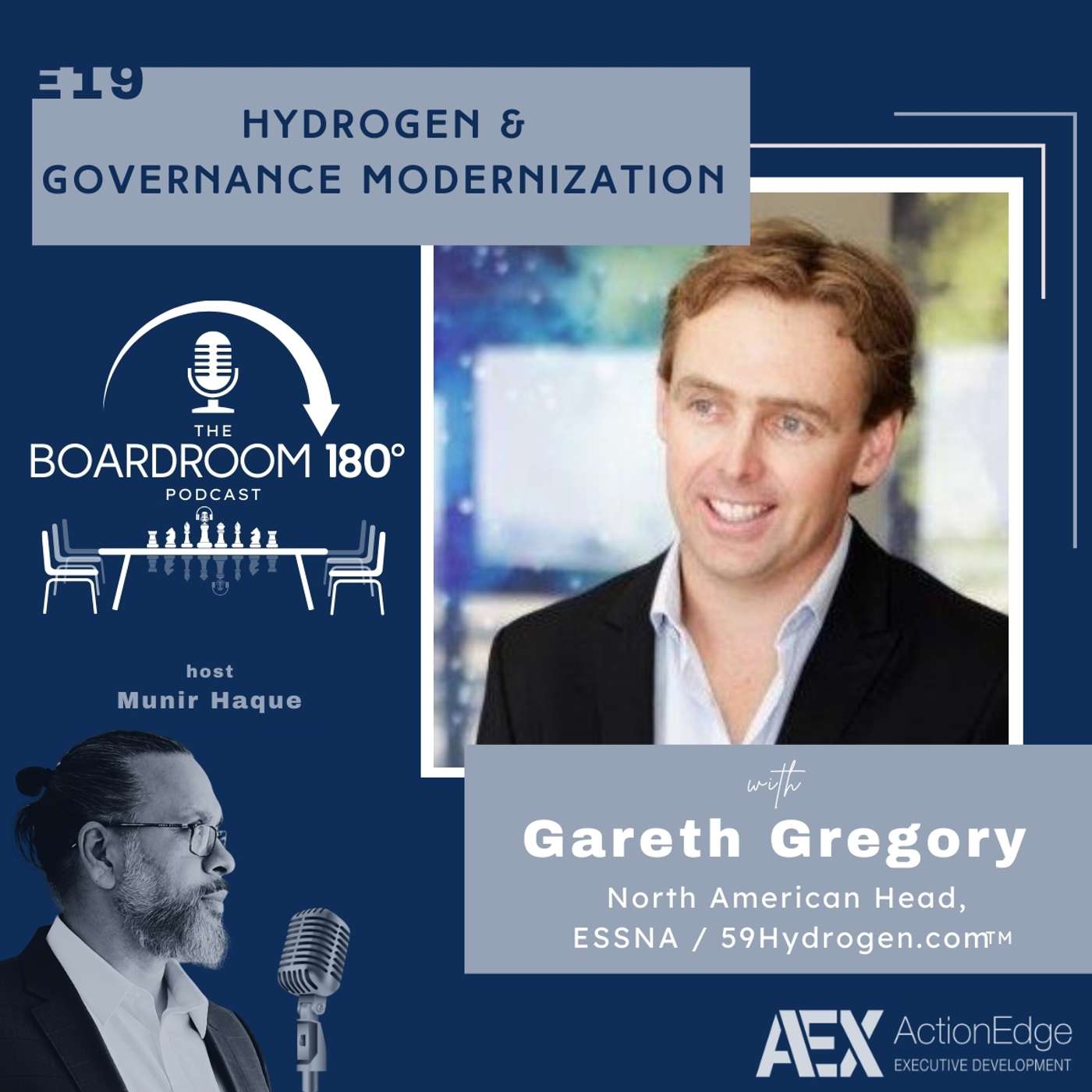
Hydrogen and Governance Modernization with Gareth Gregory of ESSNA \ 59Hydrogen.com
In this episode, host Munir Haque’s guest is Gareth Gregory, the North American Head of Strategic Energy, Client Delivery, and 59Hydrogen Decarbonization Division of the Energy Security Services North America or ESSNA. Munir and Gareth discuss the intersection of governance, innovation, and the evolving energy landscape. With decades of experience in energy modelling, decarbonization, and hydrogen technology, Gareth shares his journey from entrepreneurship to leading ESSNA and 59Hydrogen. The conversation explores the future of hydrogen as a clean energy solution, the challenges of traditional energy markets, and the importance of balancing risk management with strategic decision-making. Gareth details how ESSNA provides energy modelling and funding focusing on decarbonization and hydrogen technology, while 59Hydrogen specializes in decentralized hydrogen production and purification. He challenges outdated boardroom structures, emphasizing that governance should enable growth rather than restrict it. Governance failures, he points out, often stem from outdated leadership, and companies need to modernize decision-making processes to stay competitive. Munir and Gareth explore the importance of regulatory evolution, industry collaboration, and financial independence. Gareth hopes that ESSNA will become North America’s leading decentralized hydrogen provider, with major projects, a hydrogen symposium, and a strong focus on transparency and implementation. About Gareth Gregory: Gareth Gregory is the North American Head of Strategic Energy, Client Delivery, and 59Hydrogen Decarbonization Division of the Energy Security Services North America Inc (ESSNA). He was accountable for the launch, development and stabilization of the North American operation in Calgary Alberta. Gareth will continue to lead the engineering of 59Hydrogen solutions globally as the market develops across North America. In his previous role, Gareth served as the Africa Head of Strategic Energy and Client Delivery in the commercial division, Energy Security Services Africa (Pty) Ltd. His business activity has covered numerous sectors with a combination of finance and technical experience. — Contact Munir Haque | ActionEdge Executive Development: Website: AEEDNow.com Linkedin: Action Edge Executive Development Inc. Contact Gareth Gregory: Website: EnergySecurity-na.com LinkedIn Podcast Production: Recording: PushySix Studios Production Assistance: Astronomic Audio — Transcript Gareth Gregory: [00:00:01] Part of the reason that governance fails is that you have such a historic, out of date perspective as to what it actually means. Under 40 year olds sitting on boards making decisions, only 0.3%. You've got to get real in terms of innovation, how quickly things are adapting and moving. I meet people that sit on boards probably every week, and I can honestly say I would lose sleep if 95% of them sat on our board. It just seems like a very detached perception of reality. Munir Haque: [00:00:39] Hello everyone, and welcome to another episode of The Boardroom 180 Podcast. I'm your host Munir Haque, an executive coach and senior board strategist. I have partnered with Action Edge Executive Development to lead their governance and political acumen division. In each episode we meet with governance leaders and step into their boardrooms, where decisions shape the world around us. Munir Haque: [00:00:59] On today's show, we have Gareth Gregory. He's with the Energy Security Services North America Inc., or ESSNA, the North American head of strategic energy, client delivery and 59Hydrogen Decarbonization Division. Gareth Gregory is the leader in strategic energy solutions, specializing in decarbonization strategies for industries with carbon liabilities. As the North American head, Gareth oversees operations, growth and the implementation of DAAS carbon intensity framework. A hydrogen specialist, he manages the design, funding and operation of decentralized modular hydrogen plants. His experience spans energy economics, policy and technology, integrating these with ESG reporting to drive meaningful impact. Gareth has also delivered capital projects exceeding $1 billion globally, gaining a reputation for innovative decarbonization programs. Under his leadership, ESSNA developed refinery projects and modular hydrogen solutions across North America. He holds a BCom in Auditing and Management Accounting from the University of Pretoria and a BSc Honors in Energy Studies, cum laude from University of Johannesburg. Welcome to The Boardroom 180 Podcast, Gareth. Gareth Gregory: [00:02:15] Thank you very much for having me, it's a great pleasure being here. Munir Haque: [00:02:19] Thanks for making the time. We met last year at the Petroleum Club, I think there was an event going on there. I was sitting at a table and there was a lawyer there, and I was giving her my spiel about The Boardroom 180 podcast on governance. When she heard governance she said, you need to talk to this guy over here, pointing at you. Admittedly, I don't know much about hydrogen production or use. Before we get into the nuts and bolts of this, tell me a little more about yourself and your career arc, how you got into what you're doing now. Gareth Gregory: [00:03:00] It's been a great journey over many years, this being our sixth company now. I think, on the entrepreneurship side, we've always been looking out for great opportunities. The educational side of my background has certainly assisted and helped both in the finance and the technical side. But I think what was really important was the journey to get to this point in time now in North America and overseeing both the Canadian markets and the US market. In the early days, we had established a company that focused on energy modeling and planning, which is very much a professional services orientated environment. Over a period we had clients that were asking us to oversee construction, which we did. Then we started doing a lot of our own construction, and it got to a point that we developed ourselves into an EPCM, engineering, procurement, construction and management firm for the sub-Saharan African market. There was a great experience having both the background modeling knowledge, but also the ability to start building out on smaller projects in terms of delivery. Shortly after that, we had one of our clients that had engaged with us on a combined cycle gas and steam turbine design, their internal engineering department couldn't maintain the efficiencies of the system. Gareth Gregory: [00:04:19] They actually sold that facility back to us for 50% of what we had sold it to them at. That was our first off balance sheet transaction. The reason that that is so important is that I think that actually enabled our arrival and expansion now, both in Canada as well as the US, understanding an annuity based financial model. About 14 years ago was our introduction into hydrogen, possibly by some level of fluke. We had a client that required a 4% hydrogen mix in their annealing ovens, which was natural gas driven. That was...
Is this your show?
Claim this listing to keep it up to date, reach guests who want to pitch you, and manage bookings with Guestify.