Find partners
The AFIRE Podcast

The AFIRE Podcast

Hosted by AFIRE

Episodes

170

Latest episode

Sep 2026

Language

EN

About the show

AFIRE is the association for international real estate investors focused on commercial property in the United States. www.afire.org

Listen to episodes

60 recent
November 4, 202637 min

Emerging Trends in Real Estate: Deep dive into the PwC / ULI report

Institutional investors are in the business of predicting the future, and one of their most valuable resources is the PwC Emerging Trends in Real Estate report. Produced jointly with the Urban Land Institute (ULI) and drawing on perspectives from approximately 1,500 industry leaders and other real estate investment professionals, the 48th edition was released during ULI’s annual Fall Meeting in Miami. Alongside such similar publications as the AFIRE Mid-Year Pulse Report, the report provides a clear picture of emerging market trends, investment opportunities, and the forces shaping the real estate landscape. To take a closer look at the 2027 edition, AFIRE podcast host Gunnar Branson spoke with PwC’s Emerging Trends Chair Andrew Alperstein and Peter Pollini, Financial Services Industry Leader at PwC US. LINKS: PwC Emerging Trends in Real Estate 2027 report https://www.pwc.com/us/en/industries/... AFIRE Mid-Year Pulse Report https://www.afire.org/summit/2026midy... Watch more episodes of the AFIRE podcast at our website or on YouTube. https://www.afire.org/podcast/ Register for AFIRE Events, like our Winter Conference on Feb. 15-17, 2027 in Miami. https://www.afire.org/events/upcoming... https://www.afire.org/events/winter27/ Interested in sponsoring AFIRE content? Check out our sponsorship options. https://www.afire.org/sponsorship/ KEY MOMENTS: 00:00 Introduction 01:35 2027 title: “You Have to Work For It” 03:10 Results of new sentiment survey 04:15 New consensus around buying 06:30 New environment of US political risk 07:40 High rates and cost of operating 09:00 Survey methodology 12:05 Competition for allocation 13:20 Infrastructure performance 15:00 Data center and hyperscaler roadblocks 16:45 Capital migration away from multifamily and industrial 17:30 Effects of demographic changes 20:15 Energy investing priorities 22:50 Effects of political climate 24:20 Affordable housing legislation 26:20 Highlighted markets for 2027 29:35 Interest in data centers 32:15 Surprising trends for 2027 34:00 Position of real estate in the new economy 35:30 Continued story of growth in US 36:30 Closing thoughts DISCLAIMER The publisher of the AFIRE Podcast is not engaged in providing tax, accounting, or legal advice through this publication. No content published in the AFIRE Podcast is to be construed as a recommendation to buy or sell any asset. Some information included in the AFIRE Podcast has been obtained from third-party sources considered to be reliable, though the publisher is not responsible for guaranteeing the accuracy of third-party information. The opinions expressed in the AFIRE Podcast are those of its respective contributors and sources and do not necessarily reflect those of the publisher.
September 15, 202634 min

Asian Capital & US Commercial Real Estate: Latest Trends

Japanese investors now own about 6% of the US home-construction market, according to the Wall Street Journal,, and Japan-linked investors have purchased at least $2.1B worth of NYC real estate since 2024. What’s clear is that amidst geopolitical volatility and shifting global economic dynamics, cross-border capital flows are changing. Cross-border real estate investment into the United States from Europe and Canada is slowing, while Asian capital activity—particularly from Japan—is increasing. So what does that mean for other investors in US commercial real estate? In this episode of the AFIRE Podcast, host Gunnar Branson checks in with two experts on Asian capital from Cushman & Wakefield: Gordon Marsden, the firm’s head of global capital, APAC & EMEA, and Marc Royer, the firm’s managing director, global capital advisory. Together, they explore the key drivers behind Asian capital deployment in US property markets. They discuss some of the attributes that differentiate Japanese investment strategies relative to those of other countries. And they describe how Japanese investors navigate currency volatility and structural changes, as well as the evolving sophistication of Asia-Pacific institutional investors. LINKS Japan Is Placing a Multibillion-Dollar Bet on the U.S. Housing Market: Wall Street Journal https://www.wsj.com/real-estate/japan-is-placing-a-multibillion-dollar-bet-on-the-u-s-housing-market-2ced2a01 Why Japanese Capital Is Moving Into U.S. Real Estate Markets: America Mortgages https://www.americamortgages.com/japanese-moving-into-us-real-estate/ Japanese investors rush to buy NYC multifamily: The Real Deal https://therealdeal.com/new-york/2026/04/29/japanese-buyers-become-driving-force-of-nyc-multifamily/ To hear the globe’s top experts discuss opportunities in US property markets, register for future AFIRE conferences: https://www.afire.org/events/ KEY MOMENTS 00:00 Introduction 01:09 Japanese Capital in US Markets 03:45 Evolving Investment Models 05:35 Structural Capital Origins 07:32 Demographics and Diversification 08:35 Knowledge Acquisition Strategies 09:19 Managing Currency Volatility 13:08 Long-Term Portfolio Allocation 14:55 Relationship-Driven Investing 18:00 Regional Investor Sophistication 21:02 Asia-Pacific Regional Investment Trends 24:48 Shared Market Lessons 27:12 Common Investor Misconceptions 30:23 Regional Infrastructure Demand 33:02 Future Outlook DISCLAIMER The publisher of the AFIRE Podcast is not engaged in providing tax, accounting, or legal advice through this publication. No content published in the AFIRE Podcast is to be construed as a recommendation to buy or sell any asset. Some information included in the AFIRE Podcast has been obtained from third-party sources considered to be reliable, though the publisher is not responsible for guaranteeing the accuracy of third-party information. The opinions expressed in the AFIRE Podcast are those of its respective contributors and sources and do not necessarily reflect those of the publisher.
September 8, 202638 min

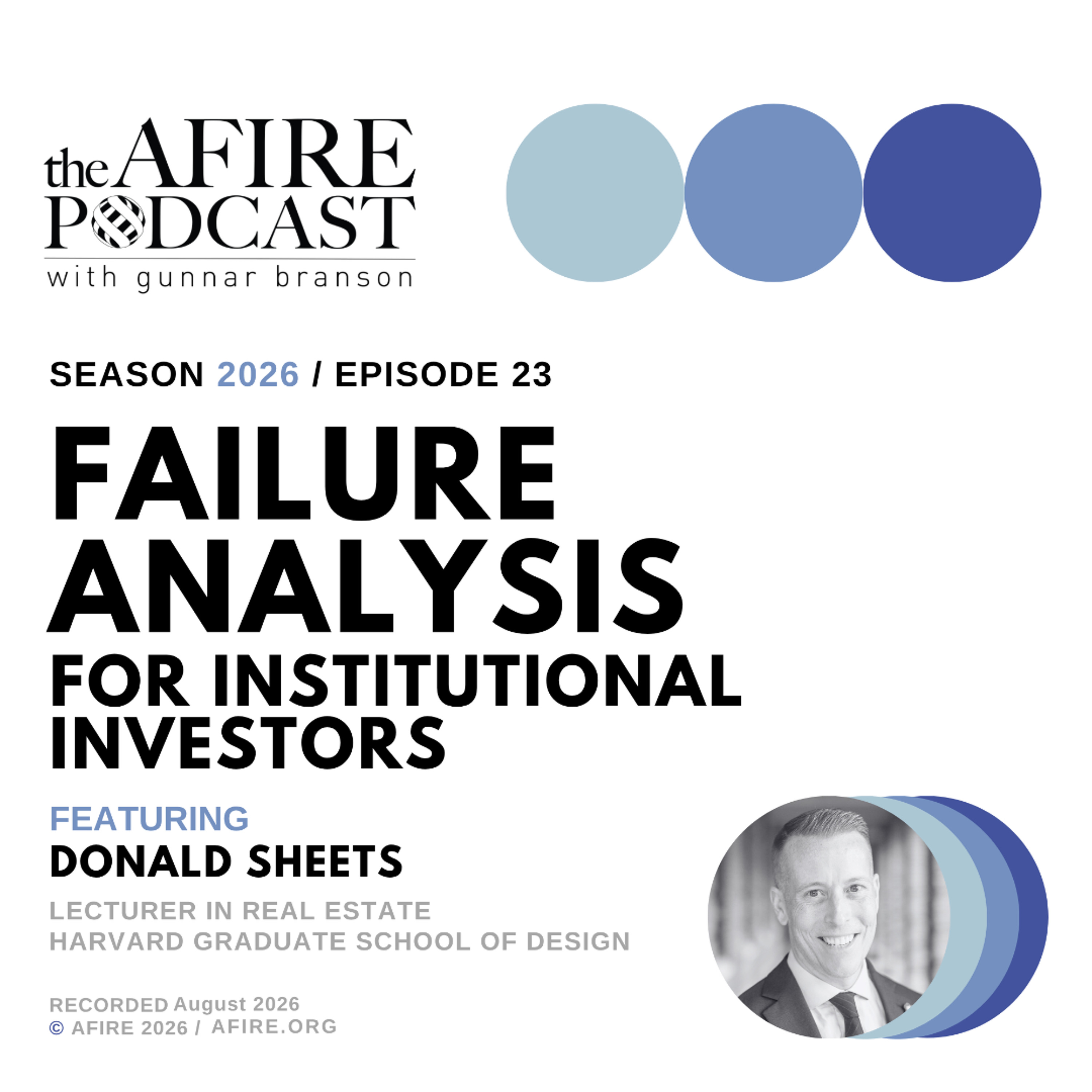
Failure Analysis for Institutional Investors | Donald Sheets, Harvard Graduate School of Design

Things don't always work out the way we expect. And in fact, many of AFIRE’s institutional investors mark their resilience as leaders in terms of how many downturns they’ve weathered. So how do the best leaders, and the best organizations, manage failure? What systems do they have in place to analyze mistakes and improve in the future? Donald Sheets, lecturer in real estate at the Harvard Graduate School of Design, studies failure as an academic discipline. In this conversation with AFIRE CEO and podcast host Gunnar Branson, Sheets describes what separates successful, resilient investment funds, and how they deal with failure, from those who keep making the same mistakes over time. Note: This podcast is being published in conjunction with Donald Sheets’ essay on failure in AFIRE’s latest Summit Journal, which will be distributed at our Annual Member Meeting on Sept. 15-17, 2026, in New York City. LINKS Donald Sheets writes about organizational judgment in the latest Summit Journal: https://www.afire.org/summit/nextdecision/ He's also speaking on distressed investing, capital markets and leadership at the upcoming Annual Member Meeting in New York City on Sept. 15-17, 2026. Register for the AMM: https://www.afire.org/events/amm2026/ Check out the agenda for the AFIRE Annual Member Meeting here: https://www.afire.org/events/amm2026/#agenda Learn more about Donald Sheets here: https://www.gsd.harvard.edu/person/donald-sheets/ Donald Sheets is on LinkedIn: https://www.linkedin.com/in/donald-d-sheets-b4ab62343/ KEY MOMENTS 00:00 Predicting the future 01:44 Introducing Donald Sheets 02:53 Industry silver linings 05:51 Defining failure neutrality 09:34 The medical precedent 10:38 The aviation example 12:08 Retrospective business analysis 13:51 Reframing for success 13:42 Analytical evaluation tools 14:12 The garbage analogy 16:48 Evaluating radical success 15:07 Managing analytical bias 24:23 Incremental organizational steps 31:13 Secondary vs primary 32:29 Deepening sensitivity analysis

August 3, 202646 min

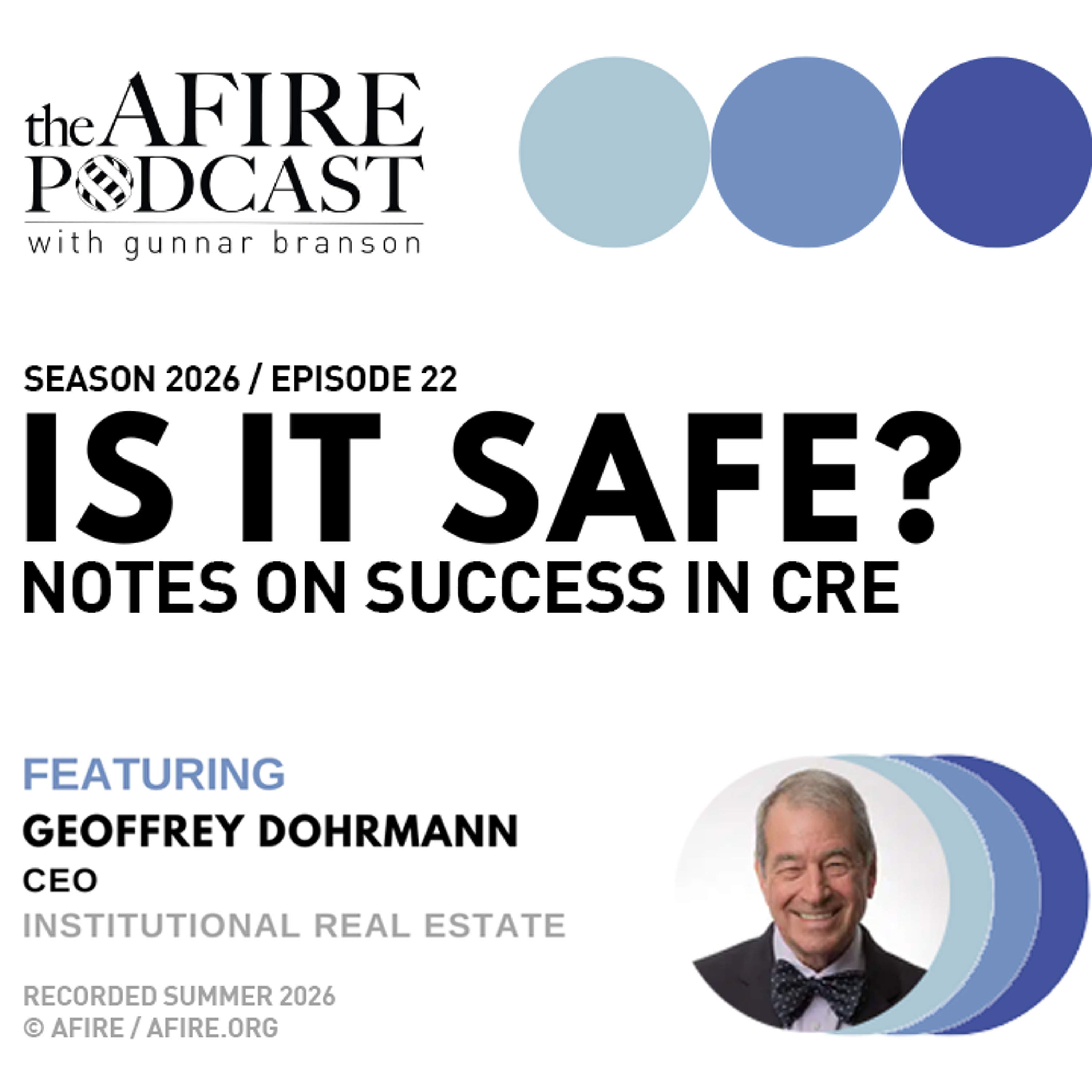
Is It Safe? Notes on Success in CRE | Geoffrey Dohrman, Institutional Real Estate

In an environment when everyone in US commercial real estate is basically making the same pitch, why are some firms more successful than others at raising capital? Why are some firms more successful than others at getting the deal? In this episode, AFIRE CEO Gunnar Branson discusses these questions with the founder, chairman and CEO of Institutional Real Estate Inc., Geoffrey Dohrmann. Branson and Dohrmann decide the key involves relationships and trust, and discuss ways to meet the challenge of building trust across international borders and between investors. Also on the agenda: Wisdom from commencement speeches! Marathon Man star Laurence Olivier’s advice to Dustin Hoffman! And what a catchphrase from one of Geoffrey Dohrmann’s old girlfriends has to do with relationship building in CRE. LINKS Geoffrey Dohrmann LinkedIn https://www.linkedin.com/in/geoffrey-dohrmann-cre-9b2b5a2/ Institutional Real Estate Inc. website https://irei.com/ Dustin Hoffman on Laurence Olivier’s advice in Marathon Man https://www.youtube.com/watch?v=fodPlCp-28c IREI podcast with Bob Sessa on how LPs evaluate leadership https://irei.com/video-and-podcast/nextgen-capital-conversations-episode-4-talent-and-retention/ Steve Jobs’ 2005 Stanford commencement speech https://www.youtube.com/watch?v=UF8uR6Z6KLc Blackstone president Jon Gray’s 2023 commencement speech https://www.youtube.com/watch?v=T7fKDtOqZOY To hear the globe’s top experts discuss opportunities in US property markets, register for future AFIRE conferences: https://www.afire.org/events/ KEY MOMENTS 00:00 Marketing vs success 01:40 Guest introduction 04:08 Winning through trust 06:10 Inclusion and actions 10:39 Best practices 14:34 Ego and leadership 17:36 Ownership and accountability 21:24 Asset liability managers 31:49 Obi-Wan Kenobi comparison 34:26 Fiduciary financial objectives 38:26 Brand building asset 39:38 Commencement speeches 43:13 Success and relationships

April 22, 202623 min

The Starter Home Crunch: Who Gets to Build? | Tony Avila, Avila Real Estate Capital

A nationwide housing crisis is pricing out millions of would-be homeowners. Conventional wisdom suggests the problem is demand, as in, too much of it. But what if the problem instead involves the supply side of the equation — namely, how and where we build? In conversation with Tony Avila of Avila Real Estate Capital, AFIRE CEO Gunnar Branson explores why attainable single-family homes are so scarce. The reasons include decade-long entitlement battles and loopy land loans that most institutions hope to avoid. Avila explains how his firm funds regional developers and partners with major homebuilders, while targeting the “sweet spot” of American incomes. Also on the agenda: Migration trends, policy missteps and why the next decade is shaping up to be the world’s biggest housing construction opportunity. LINKS Visit the Avila Real Estate Capital website https://www.avilacapllc.com/ To hear the globe’s top experts discuss opportunities in US property markets, register for future AFIRE conferences: Summer Conference 2026 in Tokyo https://www.afire.org/events/tokyo26/ KEY MOMENTS 00:00 – Why housing feels impossible for many right now 00:36 – Welcome to the AFIRE Podcast 00:49 – Meet Tony Avila 01:15 – What’s driving the home affordability crunch 02:06 – Entitlements that take decades 03:54 – Funding local land developers 04:24 – Why land loans are so hard 05:19 – Developers turned specialist lenders 06:19 – Working with institutional capital 09:26 – Builders as LPs and takeout buyers 11:10 – Biggest risks to housing projects 12:43 – Rates, war and buyer confidence 15:39 – Do millennials really hate owning? 17:35 – 8 million homes in 10 years 19:03 – Where new homes should be built

March 10, 202630 min

Putting AI to Work in Real Estate

How can investors gain a competitive edge when seeking deals in the hospitality sector? How can hotels use AI to improve the guest experience? And how can hospitality operators use AI to run hotels more efficiently? AFIRE CEO Gunnar Branson explores the topic with the co-founder and managing partner of AWH Partners, Russ Flicker, about how his $2 billion hospitality platform leverages proprietary data and AI to make smarter decisions. When used correctly, Flicker says, AI can help investors to focus on the right deals, optimize operations, and enhance the guest experience. The idea is to turn information into actionable insight and competitive advantage. LINKS Visit the AWH Partners website https://www.awhpartners.com/ To hear the globe’s top experts discuss opportunities in US property markets, register for future AFIRE conferences: Summer Conference 2026 in Tokyo https://www.afire.org/events/tokyo26/ KEY MOMENTS 00:00 Introduction 00:57 Russ Flicker on AWH Partners 01:45 AI and data-driven hospitality investing 02:56 Submarket focus vs. traditional comp sets 05:00 Evaluating hotel metrics and amenities 06:33 Balancing gut instinct and data 09:14 Building a data-first culture 12:28 Hospitality market trends 15:05 Transaction constraints and rising costs 16:59 AI for deal focus and operational efficiency 18:22 AI in revenue and guest experience 21:36 Understanding customer behavior 24:40 Privacy, data protection, and AI tools 27:45 Future outlook for hospitality 29:43 Closing remarks

February 20, 202637 min

2026 Economic Outlook

What happens when uncertainty shakes the global economy, and investors start questioning where to put their money? In this episode, AFIRE CEO Gunnar Branson talks with Moody’s Analytics Chief Economist Mark Zandi about slowing job growth, shifting trade and immigration policies, and the market volatility that has investors eyeing gold, silver, crypto, and real estate. Zandi highlights both the risks of a potential recession and the opportunities in U.S. commercial real estate, where prices have corrected significantly. The near term may present “bouts of real anxiety,” says Zandi, but in the long term, he adds, “I’m confident that we’ll be fine.” LINKS Mentioned in the episode: Trump taps ex-Fed insider Warsh to lead world's top central bank https://www.reuters.com/world/us/trump-picks-former-fed-official-warsh-run-fed-2026-01-30/ To hear the globe’s top experts discuss opportunities in US property markets, register for future AFIRE conferences: Summer Conference 2026 in Tokyo https://www.afire.org/events/tokyo26/ KEY MOMENTS 00:00 Introduction 00:36 Market uncertainty and investor confusion 00:56 Mark Zandi’s background and perspective 02:19 Humility in today’s economy 03:24 De-globalization and safe-haven assets 05:45 U.S. commercial real estate as opportunity 07:21 CRE market corrections and valuations 08:59 Relative attractiveness for international investors 10:29 Single-family rental market overview 11:54 Affordability challenges and workforce housing 14:37 Local variations and political complexity 15:16 Job growth stall and recession risk 17:33 Fed rate cuts and policy pressures 20:24 Long-term rates and equilibrium forecasts 22:22 Inflation concerns and consumer impact 25:35 AI, tech investment, and data center boom 26:42 Potential bubbles and market corrections 30:06 Long-term growth perspective for real estate 31:06 Bumps ahead: cyber events and AI oversight 32:35 Optimism: U.S. economy resilience 34:06 Historical perspective and maintaining cool heads

February 10, 202637 min

Future City: The Meaning of Buildings

What is the future of the built environment? The National Building Museum in Washington, DC, where AFIRE members tour this week during our Winter Conference, is a museum about the world we design and build. The museum’s exhibits celebrate building architecture, design, engineering, construction—and the act of urban planning. But most of all, it’s a showcase for the imagination and ambitions of those who help create what we call real estate. In this podcast, AFIRE CEO Gunnar Branson interviews James Ball, the National Building Museum’s director of future cities, about the past, present and future of the structures we exist in every day. This conversation is geared to people who invest in developing buildings around the world. LINKS To hear the globe’s top experts discuss opportunities in US property markets, register for future AFIRE conferences: Winter Conference 2026 in Washington, DC https://www.afire.org/events/wc2026/ Summer Conference 2026 in Tokyo https://www.afire.org/events/tokyo26/ Find the National Building Museum on the web here: https://nbm.org/ Ball discusses the NBM’s new exhibit, Coming Together: https://nbm.org/exhibitions/coming-together/ The NBM’s online initiative, I Hope This Becomes: https://ihopethisbecomes.nbm.org/ Discussed during the episode was Donella Meadows, the environmental scientist behind The Limits of Growth: https://en.wikipedia.org/wiki/Donella_Meadows KEY MOMENTS 00:00 Introductions 01:30 What is the National Building Museum? 03:05 Role of built environment in society 05:30 History of the building that houses the NBM 07:58 How our built world shapes us 09:41 Future of the city 11:50 Starchitect fallacy and the genius theory of urban planning 14:44 New NBM exhibit: Coming together 18:02 Destructive development narratives 21:20 How to make buildings beautiful 23:50 Museums’ role in real estate 26:01 Role of the building user 28:25 City as a multi-generational yet still incomplete project 30:25 Message to building industry 33:50 New moment in city building 35:18 AFIRE visits the NBM 36:20 Wrap up

January 28, 202633 min

Success Story: How to Convert Office to Residential

Can office buildings from the 1970s and 80s–often dismissed as "garbage”—be the key to solving the US housing crisis? While conventional wisdom says these deep-floor-plate structures are "useless" and that we need to "scrape" them all, Robert Seldin, Managing Principal of Madison Highland and developer of the Three Collective complex in Falls Church, Virginia, has proven the skeptics wrong. In this episode timed to appear before the AFIRE Winter Conference tours Three Collective, AFIRE CEO Gunnar Branson explores the right way to convert office to residential, and how one "impossible" asset became profitable. LINKS To hear the globe’s top experts discuss opportunities in US property markets, register for future AFIRE conferences: Winter Conference 2026 in Washington, DC https://www.afire.org/events/wc2026/ Summer Conference 2026 in Tokyo https://www.afire.org/events/tokyo26/ Seldin is the Managing Principal of Madison Highland and developer of Three Collective: https://www.threecollective.com/ Madison Highland is a developer of Three Collective: https://www.threecollective.com/ KEY MOMENTS 0:00 – Are 1970s office buildings too "useless" to convert? 2:30 – What makes a mid-century office building a good "substrate" for housing? 4:37 – How do you solve deep floor plate issues in office-to-residential conversions? 7:02 – Why is converted office space higher quality than new wood-frame construction? 10:02 – How can you repurpose extra office elevators during a conversion? 13:43 – Do office-to-residential conversions have enough parking? 18:40 – How is remote work changing multifamily building requirements? 22:35 – What is the cost and timeline for an office-to-apartment conversion? 26:38 – How fast do converted office apartments lease up? 28:10 – Is the office conversion trend the new "Soho Loft" revolution?

January 12, 202655 min

Commercial Real Estate and the Cycles of History with Fourth Turning author Neil Howe

How will demographics affect commercial real estate investing? How will changes in generational characteristics affect opportunities in US property markets? Neil Howe is an author of The Fourth Turning and The Fourth Turning is Here. An expert in generational demographics who is credited as one of the coiners of the term “millennial”, Howe discusses the cycles of history and their implications for cross-border investors in this wide-ranging conversation with AFIRE CEO Gunnar Branson. LINKS To hear the globe’s top experts discuss opportunities in US property markets, register for future AFIRE conferences: Winter Conference 2026 in Washington, DC https://www.afire.org/events/wc2026/ Summer Conference 2026 in Tokyo https://www.afire.org/events/tokyo26/ Watch Neil Howe’s POV https://youtu.be/qFm_tFmgBj8 Recent Neil Howe books include: The Fourth Turning https://www.amazon.com/s?k=the+fourth+turning The Fourth Turning Is Here https://www.amazon.com/Fourth-Turning-Here-Seasons-History/dp/1982173734/ The thinking behind Howe’s theories on the cycles of history: https://en.wikipedia.org/wiki/Strauss%E2%80%93Howe_generational_theory Howe is the managing director of demography at Hedgeye Risk Management: https://app.hedgeye.com/ KEY MOMENTS 00:00 – How demographics is one of the most powerful factors for investors. 00:54 – Who is Neil Howe? 01:25 – Why is Neil Howe thinking about Investing and future casting? 02:35 – Can the meaning of being 60 change over time? 02:57 – What are the origins of generational demography? 04:02 – Did we overestimate long-term care this decade? 05:05 – Will home-oriented care redefine the future of healthcare? 06:28 – Could Gen X be America’s next leadership generation? 07:55 – Do crises reform the cycles of American history? 08:20 – Are infrastructure-related investments shaped by dark periods? 09:06 – How did the Great Depression and WWII shape generations? 14:25 – Are we entering a new era of anti-globalization? 16:37 – Are we entering the Fourth Turning now? 17:12 – Are nations hoarding resources to prepare for crisis? 18:32 – What are the hallmarks of the late Fourth Turning? 21:55 – How can real estate investors respond to rising inflation? 22:47 – Can inflation be controlled in a de-globalizing world? 23:07 – Why can’t we effectively tackle inflation politically? 24:53 – Is winning the US election now more important than governance? 25:50 – Are voters settling for “not the other guy”? 26:10 – What steps lead to renewed community today? 27:07 – Can understanding history guide today's investments? 29:15 – Why does Southern migration keep accelerating? 32:09 – Are rising risks changing Sun Belt investments? 35:45 – Can old lake cities thrive again? 36:30 – Is the lack of public education a deal-breaker for families? 39:23 – Are pension costs the hidden urban challenge? 40:46 – What’s driving rural decline but urban stability? 44:54 – How does age influence where people choose to live? 50:41 – Are we building the right types of housing for today?

Is this your show?

Claim this listing to keep it up to date, reach guests who want to pitch you, and manage bookings with Guestify.

Claim this listing

More Business podcasts