Weekend Update - W2636
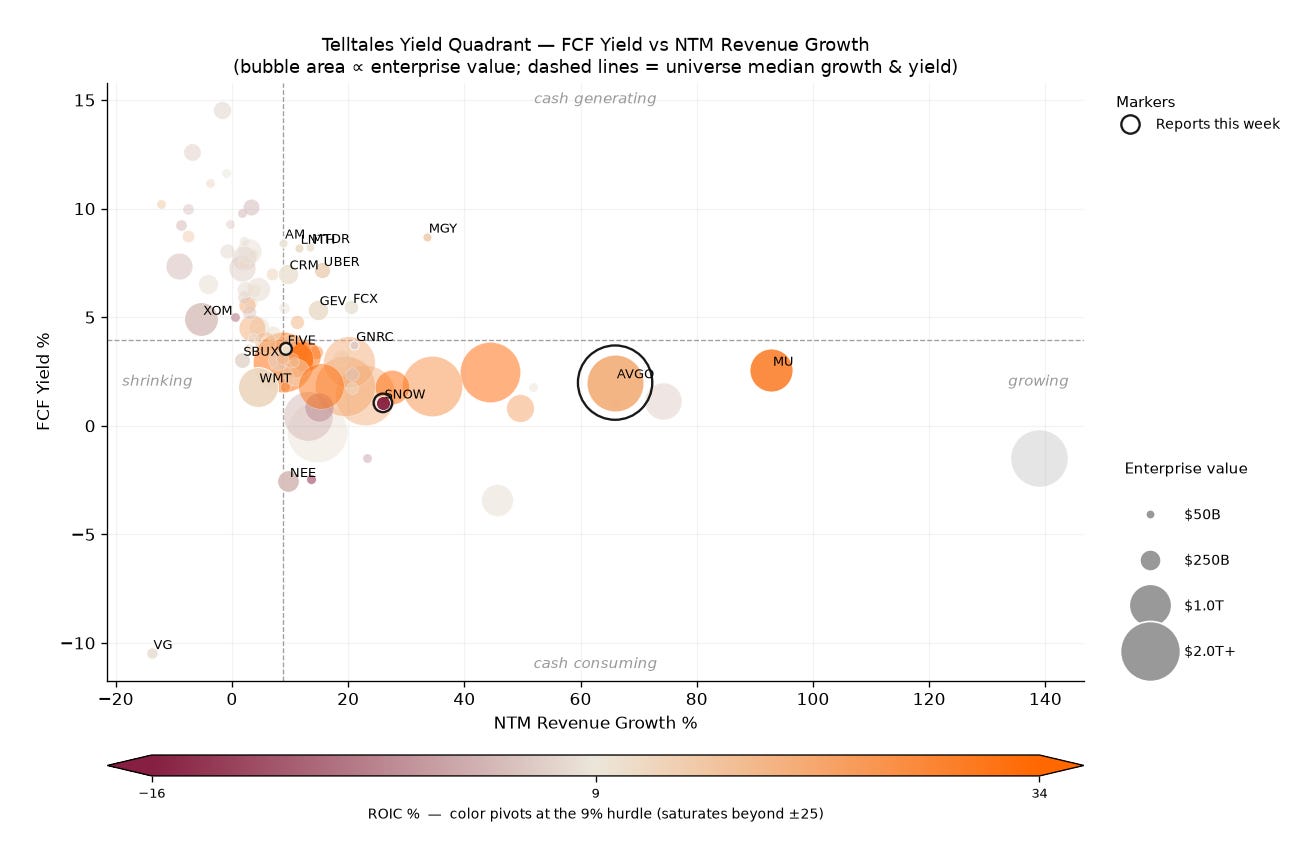
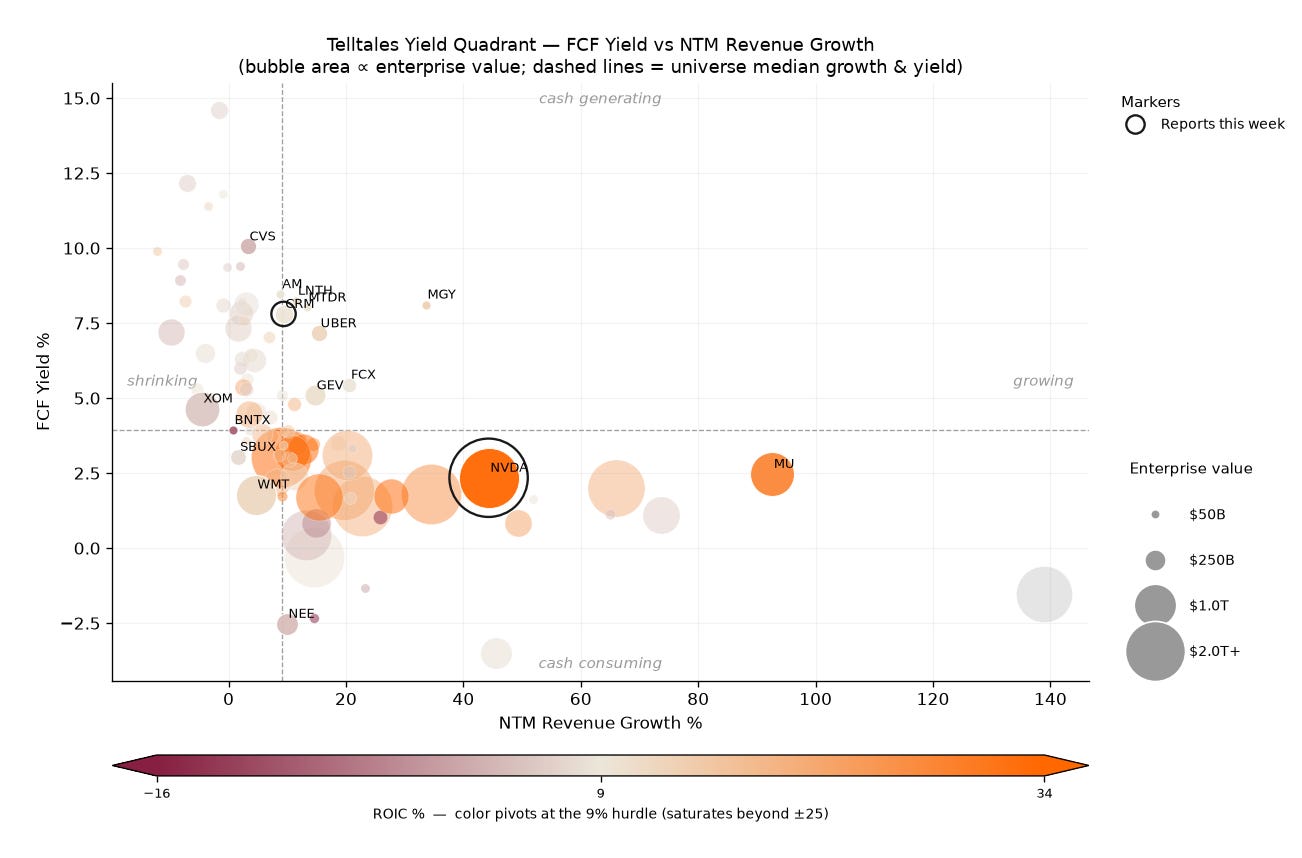
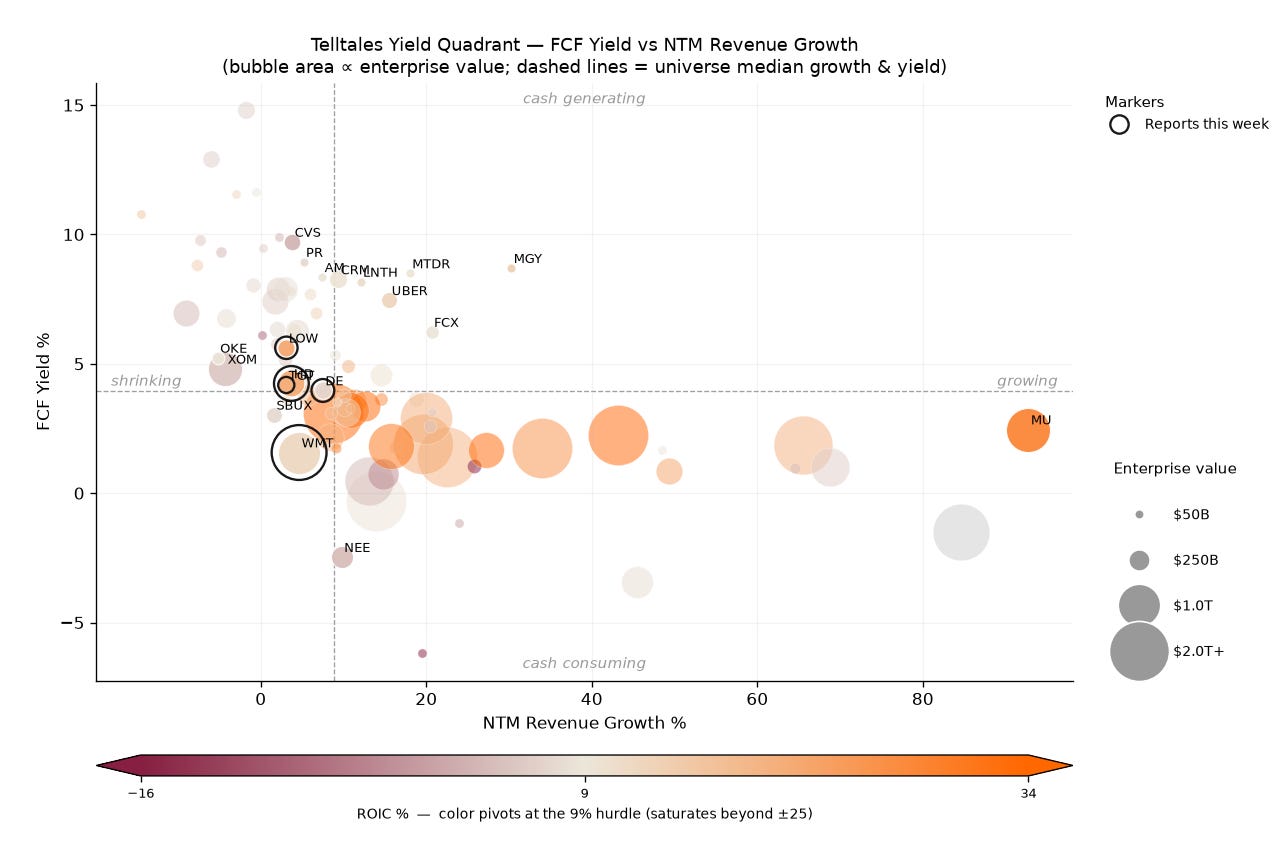
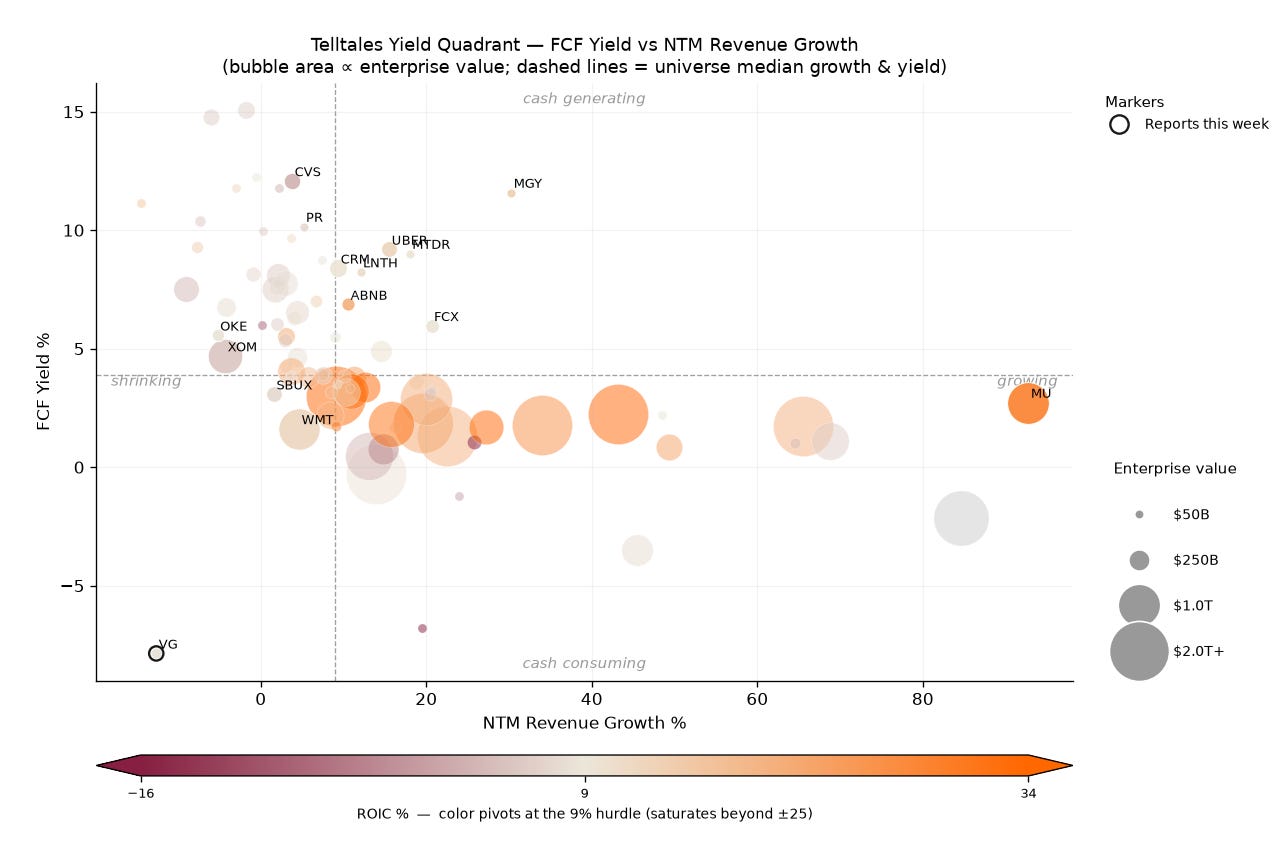
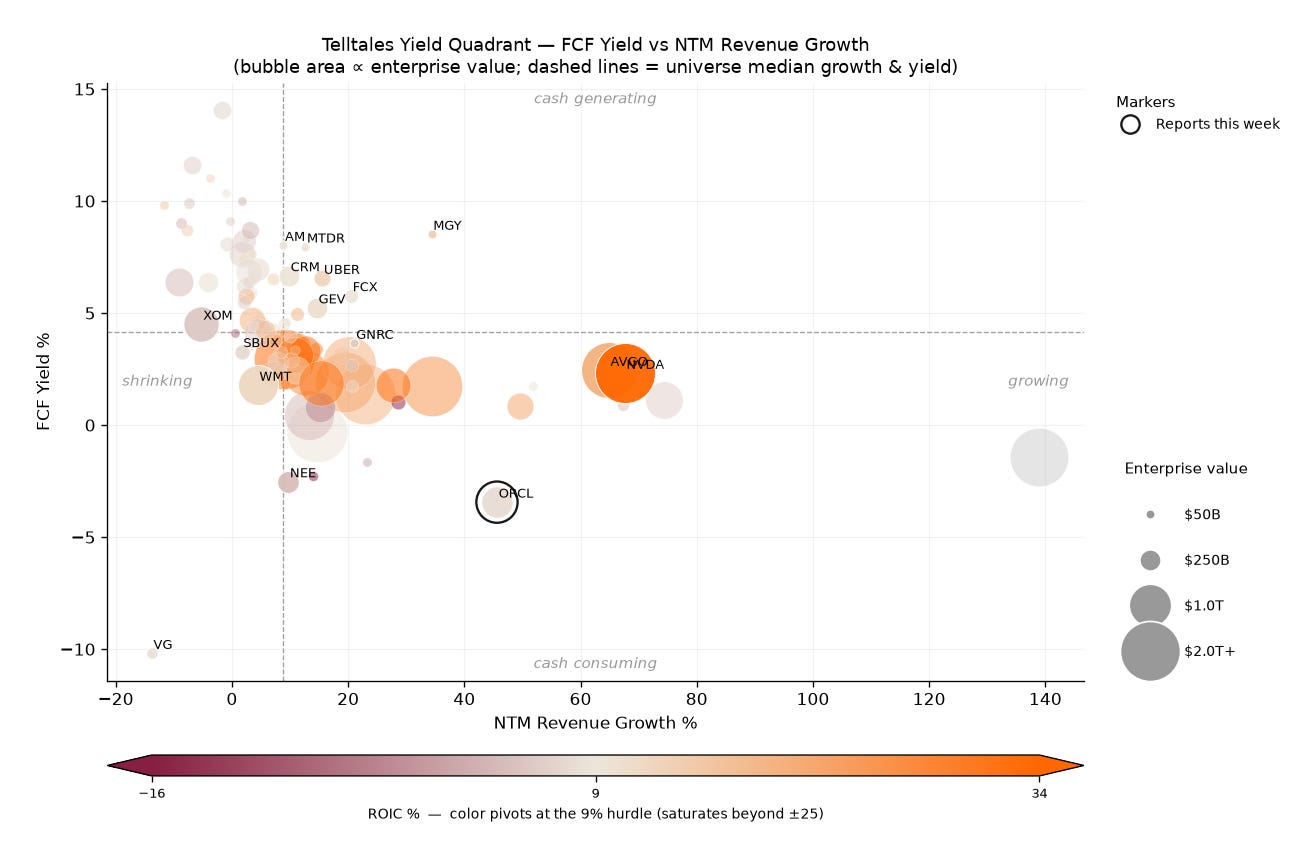
▶ Explore this week’s Tape — live, sortable, drill-down → ONEOK Bought a Ratio ONEOK announced a four-point-four-billion-dollar acquisition last weekend and raised nine billion dollars to pay for it. The gap between those two numbers is the story, and it is not what the headlines carried. Four-point-four billion buys Brazos Midstream’s Permian gathering and processing assets. Five billion retires debt ¹ . Page ten of the Cash Flow Memo carries ONEOK at about thirty-three billion dollars of net debt², so five billion is a real dent. The interesting part is which five billion, and what replaced it. Start with what Apollo actually bought, because nine-billion-dollar minority equity investment conceals more than it reports. Apollo gets a Class B interest in a newly formed holding company, ONEOK Holdings, L.L.C. It is nonvoting. No board seat, no liquidation preference, structurally subordinate to every existing ONEOK bond. It is entitled to fifteen percent of the operating company’s quarterly cash flow, and its total return is capped at a seven percent internal rate of return for the first nine years. ONEOK can buy the whole thing back beginning on the eighth anniversary of closing, at that same capped return ³ . Apollo took a bond’s return while standing in an equity’s place in the stack. Now what ONEOK bought. One sentence in the release explains the other twelve: the investment has been reviewed with ONEOK’s credit rating agencies, all of which consider the transaction as credit-enhancing, and ONEOK expects to receive full equity credit ⁴ . Every concession in the paragraph above is priced to earn that clause. This instrument was assembled by people who knew precisely which boxes a rating methodology checks. Pro forma 2027 leverage lands near three and a quarter times debt to EBITDA, and not one common share was issued ⁵ . Apollo, in the same release, called it flexible, high-grade capital solutions at scale, structured around ONEOK’s long-term strategic objectives. Translation: we found the boxes and built something that ticks all of them. Then the tender offer, filed the same day and buried under the acquisition headline. ONEOK is offering to repurchase up to two billion dollars of its own notes across twenty series, and the acceptance priority order tells you what it wants back. Level one is the three-point-nine-five percent notes due 2050. Level two, four-point-two percent due 2047. The list runs long-dated and low-coupon at the top, and the company adds, in a parenthetical, that most of the targeted notes currently trade below par ⁶ — below face value, because those coupons sit under what the market charges today. So ONEOK is retiring some of the lowest cash coupons on its balance sheet and funding the gap with money that costs seven percent. The cash cost of the capital went up. The ratio the agencies quote went down. Both by design. None of that makes it a bad trade. Seven percent capped is genuinely cheaper than ONEOK’s cost of common equity, every dollar of value above the cap accrues to the shareholders already there, the capital account amortizes as distributions run past the cap, and the call option hands the whole claim back inside a decade. Against issuing stock or thirty-year paper at today’s yields, it is the cheapest of the three doors. It is a well-built instrument. What it is not is a reduction in the claims on ONEOK’s cash. The leverage did not leave the company. It moved to a line the leverage ratio does not read. Midstream has built this shape before, and ONEOK has built it twice. On June 30, 2017, the company acquired every ONEOK Partners unit it did not already own ⁷ , collapsing a structurally separate claim on the same operating cash flow back into the common, because by then that claim had become the expensive way to fund a build. Nine years later there is a new structurally separate claim on the same operating cash flow, with the buy-back written into the document on day one. Call that a cycle rather than a criticism. Funding structures get cleverest at exactly the point where assets are dearest and internal cash flow is furthest from covering the plan. Oracle reports Thursday running the same trade with none of the engineering. The cashflow read is in Marcus’s column below; short version, the cash line on that page is the least useful number on it. What changes the read. The near test has a clock on it. The early tender deadline is 5 p.m. New York time on September 14, with the offers expiring September 29 ⁸ . Watch how much of the two-billion-dollar cap fills and where those 2050s clear. Fill it at a discount and the five-billion extinguishment is cheap and quick. Fall short and ONEOK finishes the job through make-whole calls, which is the expensive door. After that: Hart-Scott-Rodino clearance and a fourth-quarter close on Brazos, then the first print carrying a noncontrolling-interest line where none existed. The read breaks if the agencies deliver anything less than the full equity credit the company says it expects. Every number in this structure is priced off that one word. Wall Street’s consensus on ONEOK: a balance-sheet repair with a growth acquisition attached, and Wells Fargo took its target to a hundred and six dollars on the EBITDA outlook ⁹ . The Brazos EBITDA is real, bought at roughly seven and a half times the assets’ estimated 2027 number, with fourteen rigs running on the acreage ¹⁰ . The deleveraging is a ratio. The Tape — W2636 Universe of 94 cashflow-memo names, snap dates 2026-09-02 → 2026-09-04. Composite is rank-sum percentile of FCF Yield + NTM Revenue Growth (higher = better balance). Banks and finance-book names shown separately. Telltales Yield — Top 10 From the Cashflow Desk — Marcus Graham Oracle is the only name in this universe reporting before the next issue, and the leaderboard cannot price it, because the cash leg is negative by construction. Capex ran $55.7B TTM against $67.4B of revenue. Eighty-three cents of every revenue dollar, into the build. That is the cost of the build, not the flag the screens read it as, and no multiple belongs on a denominator management is deliberately spending through. What prices Oracle right now is conversion, and 45.6% NTM revenue growth is the market underwriting a backlog it has not yet seen turn into cash. Reading the negative cash line as deterioration is the screen standing in for the work. The test on the September 10 print is whether the capex guide steps up again alongside the revenue guide, or capex flattens while revenue accelerates. Only the second one shortens the payback. Telltales Yield — Bottom 10 This Week’s Reporters Sector Medians Debt / FCF Watch (highest leverage on TTM FCF) Weekly Price Movement Top 5 (week-over-week price) Bottom 5 (week-over-week price) Banks (shown separately — FCF metric not meaningful) Finance-book — FCF not comparable Customer-float / captive-finance / reserve businesses (IBKR broker float, KMX CarMax Auto Finance, PYPL customer funds, CRCL stablecoin reserves). The memo’s operating-FCF method overstates their FCF, so they are held off the ranked leaderboard pending the P&L-waterfall rebuild. Data Gaps 91 of 92 ranked-eligible names ranked. 1 dropped for missing FCF yield or NTM revenue growth; 7 shown separately (banks + finance-book, FCF not comparable). Source: cashflow-memo master_2026-09-04.csv . NTM growth from analyst-estimates consensus. Composite is a percentile rank, not a recommendation. The Issue — This Week's Brief The Cashflow Memo A Quiet Earnings Week Is When You Find Out What Management Believes Three new CEOs, four energy checks, and two guides the market read in opposite directions The Telltales Weekend Update. Ava Cabot and analyst Marcus Graham walk through what happened this week — and what’s coming next — across the 86 companies in the Cash Flow Memo. About 13 minutes. No filler. Download the memo at telltales.us . Mike, Jason, and Hunt are back Wednesday on episode E2637. Chapter markers * Time | Segment * 0:00 | Cold open * 0:45 | Theme — Energy writes the checks * 4:45 | Deep dive — Broadcom vs. Snowflake * 8:45 | Rapid-fire * 11:45 | Close * 12:40 | Disclaimer Full transcript Cold open Ava: A quiet earnings week is when you find out what management actually believes. Only three companies in the Cash Flow Memo report over the next two weeks[^earn-orcl][^earn-len][^earn-fdx]. So this week didn’t hand us prints. It handed us decisions. Apple replaced Tim Cook[^news-aapl-ceo-20260901]. Albemarle went outside the company for its next chief executive[^news-alb-ceo-20260903]. Four energy companies committed serious capital, including a merger that would create the largest regulated electric utility in the country[^news-nee-merger-20260904]. And two enterprise software names reported on the very same Wednesday and got read in completely opposite directions. Nobody had to guess what these managements think this week. They showed you. Ava: Telltales Weekend Update. I’m Ava Cabot, with Marcus Graham at the cashflow desk. Theme — Energy writes the checks Ava: Start with the loudest thing that happened in a quiet week. Four energy companies, across four completely different parts of the business, all committed capital inside seven days. Power, upstream, midstream, and LNG. Nobody was reporting. Everybody was spending. Ava: NextEra first. Shareholders on both sides approved the $66.8 billion all-stock merger with Dominion Energy — a deal that would create the largest regulated electric utility in the United States[^news-nee-merger-20260904]. And in the same week, NextEra Energy Resources committed to a $13 billion natural gas complex in Fayette County, Pennsylvania[^news-nee-gasplant-20260901]. Marcus, the cashflow take. Marcus: Notice what NextEra is paying with. It’s an all-stock merger[^news-nee-merger-20260904] — they’re issuing paper, not writing a check, and then separately committing $13 billion of cash to a gas plant[^news-nee-gasplant-20260901]. That combination tells you something the press release doesn’t. The memo already carries $82 billion of net debt on this name[^memo-nee-netdebt-20260904]. NextEra is mid-build, free cash flow is running negative, and the multiple isn’t the right frame here — what prices this company is whether the regulated rate base absorbs the spend. Stock is the currency you use when your own cash flow can’t fund the plan and you’d rather not add to the debt load. I’d read the all-stock structure as the honest signal in that announcement. Ava: On page 9 of the memo, the story is the opposite. Chevron is committing more than $7 billion over five years to more than double its Venezuelan production[^news-cvx-venezuela7b-20260902], after getting assigned additional Orinoco Belt acreage[^news-cvx-venezuela-20260903]. Mike Wirth’s framing, and I want you to sit with the phrasing: patience pays off, after two decades of staying while competitors exited following the nationalizations[^news-cvx-wirth-20260902]. Twenty years of waiting out an expropriation, filed under patience. Piper Sandler took its target to a street-high $243 on the back of oil prices[^news-cvx-piper-20260903]. Marcus: Chevron is buying volume because price isn’t going to do the work. The memo has Chevron at 16x free cash flow on $26 billion of trailing free cash flow[^memo-cvx-evfcf-20260904][^memo-cvx-fcf-20260904] — which is not a demanding number for an integrated. But the forward revenue line in the same dataset has Chevron shrinking roughly 9% over the next twelve months[^data-cvx-ntmgrowth-20260904]. That’s the context for Venezuela. When the top line is going backwards on price and mix, you either accept the decline or you go buy barrels. Wirth went and bought barrels, in the one basin he never left. What I’d watch is whether that capital shows up as production or as a write-down, because the history of that basin is not kind. Ava: Midstream, same week. ONEOK is buying Brazos Midstream’s Permian gathering and processing assets for $4.4 billion in cash[^news-oke-brazos-20260901]. And here’s the part worth slowing down for — Apollo is putting up $9 billion, as a minority equity investment in ONEOK, to fund it[^news-oke-apollo-20260830]. That is not a loan. Somebody else is buying a piece of the company so the company can buy the assets. Marcus: That structure is doing real work, and it’s the most interesting capital decision of the week. The memo carries ONEOK at $33.6 billion of net debt against $3.4 billion of free cash flow[^memo-oke-netdebt-20260904][^memo-oke-fcf-20260904]. Call it 10x net debt to free cash flow. At that level of leverage, the bond market is not where you go to fund a Permian acquisition, so ONEOK sold a piece of itself to a private-markets buyer instead. It’s a rational trade and it dilutes the people who already own it. Both of those are true at the same time, and the release only tells you the first one. Ava: And then there’s Cheniere, which is the cleanest of the four and got the least attention. Corpus Christi Stage Three reached substantial completion, the 5,000th cargo went out of the Gulf Coast, and management took the 2026 EBITDA guide up to a range of $7.9-8.4 billion, from $7.25-7.75 billion[^news-lng-ccl3-20260831][^news-lng-ebitda-20260831]. Equinor took its first cargo under the long-term agreements the same week[^news-lng-equinor-20260903]. Cheniere is on page 9 as well, at 17x free cash flow[^memo-lng-evfcf-20260904]. No merger, no arbitration claim, no private-equity partner. They finished the thing they said they’d finish and raised the number. Ava: Four companies, four balance sheets, four completely different answers to the same question. One issued stock, one bought barrels, one sold a piece of itself, and one just built the plant. And not a single one of them reported earnings this week. Deep dive — Broadcom vs. Snowflake Ava: Now the part that should bother you. Wednesday, September 2. Two companies on page 2 of the Cash Flow Memo both reported, both beat, and the market treated them like they were in different industries on different continents. Ava: Broadcom: third-quarter adjusted earnings of $3.32 a share, ahead of expectations[^news-avgo-q3eps-20260902]. Then the fourth-quarter revenue guide came in at $34.8 billion against a consensus of $35.03 billion[^news-avgo-q4guide-20260902]. Snowflake, same day: quarterly revenue of $1.5 billion, and management raised the full-year product revenue guide to $6.07 billion[^news-snow-q2-20260902]. Shares jumped on adoption of the AI coding tools, with more than 60% of accounts now using the AI offerings[^news-snow-aiadoption-20260902]. One of those stocks got sold. The other one ripped. Marcus, the cashflow take. Marcus: Broadcom is the surprising one, because it beat and got sold anyway. Going into that print, the memo had Broadcom at 53x free cash flow, on $34 billion of it[^memo-avgo-evfcf-20260904][^memo-avgo-fcf-20260904]. The page was drafted two days before he reported, so that is a clean pre-print anchor, and it says the market was already paying a full price. Then the guide came in roughly $200 million light[^news-avgo-q4guide-20260902]. On a quarter that size, that is inside the rounding error of anybody’s model. It got treated as information anyway. That’s what a multiple that full does to you. It removes your tolerance for a guide that isn’t perfect. We re-anchor when the fiscal third-quarter filing lands. Ava: $200 million. On $35 billion. Marcus: Now put Snowflake next to it, because the pair is the whole point. The memo had Snowflake at 100x free cash flow going into the same Wednesday[^memo-snow-evfcf-20260904]. And the forward revenue line has Snowflake growing about 29% over the next twelve months, against Broadcom’s 65%[^data-snow-ntmgrowth-20260904][^data-avgo-ntmgrowth-20260904]. Twice the multiple, less than half the growth. I’d hold that read carefully rather than hard, because a raised guide is a real fact, and the sell-side point about accelerating against hard comparisons is a fair one[^news-snow-analyst-20260903]. But whatever is setting the gap between these two names, it isn’t the growth rates. We re-anchor on both when the filings land. Ava: So what is setting it? Marcus: Direction of surprise, not level of value. Both managements said the same thing this week — demand is fine, timing and supply are the constraint. The market paid 100x for the version of that sentence that came with an upward revision[^memo-snow-evfcf-20260904], and marked down the version that came with a rounding error. That’s a statement about how the market is pricing revisions right now, and I’d weight it as the more durable read of the two prints. Ava: Which is a polite way of saying the tape is trading the delta and ignoring the denominator. Same Wednesday. Same page of the memo. Same story about AI demand. And the company generating $34 billion of free cash flow[^memo-avgo-fcf-20260904] is the one that got punished. If you want the one sentence to carry out of this segment, it’s that anybody telling you the market repriced AI this week is describing a mood, not a mechanism. It repriced two guidance revisions. That’s a much smaller thing, and it’s much easier to be wrong about. Rapid-fire Ava: Lightning round, and it’s a leadership round. Ava: Apple. John Ternus officially took over as chief executive from Tim Cook, ending a 15-year tenure[^news-aapl-ceo-20260901]. Ternus’s first internal memo talked up the product pipeline and a, quote, phenomenal iPhone launch on September 9[^news-aapl-iphone-20260901]. Phenomenal. Eight days into the job, describing a product he inherited. The memo has Apple at 34x free cash flow on $136 billion of it, with $76 billion of net cash on the balance sheet[^memo-aapl-evfcf-20260904][^memo-aapl-fcf-20260904][^memo-aapl-netcash-20260904]. Whatever Ternus wants to do, he has the means. Less fun: a UK class action is seeking £2 billion, about $2.7 billion, over App Tracking Transparency[^news-aapl-uklawsuit-20260903]. Ava: Albemarle went outside. Ragnar Udd, from BHP, becomes president and chief executive effective February 1, 2027, with Kent Masters moving to executive chairman[^news-alb-ceo-20260903]. Same week, Albemarle is preparing to reopen the Kings Mountain lithium mine in Cleveland County after finishing dewatering[^news-alb-kingsmountain-20260903]. A mining executive to run a lithium company that’s reopening a mine. The board was not subtle. The stock fell about 2% on the news[^news-alb-stock-20260903]. And ConocoPhillips seated both a new chief executive and a new chief financial officer on September 1[^news-cop-leadership-20260902]. Ava: PayPal. Stripe and Advent walked away from a $53 billion bid to take the company private[^news-pypl-stripeadvent-20260828]. Days later, another 251 jobs cut at the San Jose headquarters, part of a multiyear restructuring under new chief executive Enrique Lores[^news-pypl-layoffs-20260904]. The memo has PayPal at about 10x free cash flow[^memo-pypl-evfcf-20260904] — the cheapest name anywhere near this show tonight. Somebody was willing to pay $53 billion. Nobody is willing to pay it now. Same company, same cash flow, three weeks apart. Ava: Also in the cutting business: Uber is eliminating 3,300 roles, 10% of its workforce, to strip out management layers[^news-uber-layoffs-20260902]. The specifics are unusually precise for a layoff announcement — a 20% reduction in the number of employees sitting seven or more levels below the chief executive, and half as many teams with only one or two direct reports[^news-uber-layoffs-structure-20260902]. That is not a cost cut dressed up as a reorganization. That is a reorganization that happens to cost less. Ava: Forward week. Oracle reports Thursday[^earn-orcl]. Lennar the following Wednesday[^earn-len]. FedEx Thursday after that, and FedEx just agreed to sell its Supply Chain logistics arm to CMA CGM for $1.4 billion, so the print will have a story attached[^earn-fdx][^news-fdx-cmacgm-20260903]. Three reports in two weeks. That’s the whole calendar. Close Ava: That’s the show. A quiet earnings week is when you find out what management actually believes — and this week the boards, the balance sheets, and the buyers all said it out loud. Wall Street’s consensus this week: Broadcom’s guide was a disappointment and Snowflake’s was a triumph. One of those companies generates $34 billion of free cash flow[^memo-avgo-fcf-20260904]. It is not the one that went up. Ava: Next week the calendar finally reopens with Oracle on Thursday[^earn-orcl]. On Wednesday’s show, Hunt walked the memo to page 3 and pointed out that Nvidia’s run-rate free cash flow now sits about $50 billion ahead of Apple’s — $186 billion against $136 billion[^ep-e2636]. Hold that number next to what you just heard about who the market rewarded this week. Hunt, Jason, and Mike are back Wednesday on episode 2637. Ava: Download the memo at telltales.us, and send us a note through the Substack — we read them. Ava: The show is produced entirely with AI tools, and both voices you’re hearing are AI-generated. Disclaimer Ava: This podcast is intended for informational purposes only. You should always do your own work to determine if an investment is suitable for you. The views expressed on this podcast are the host alone and do not constitute an offer to sell or a recommendation to purchase, or a solicitation of an offer to buy any security, nor a recommendation for any investment product or service. While certain information contained herein has been obtained from sources believed to be reliable, neither the host nor any of their employers or their affiliates have independently verified this information, and its accuracy and completeness cannot be guaranteed. Accordingly, no representation or warranty, express or implied, is made as to, and no reliance should be placed on, the fairness, accuracy, timeliness, or completeness of this information. The host and all employers and their affiliated persons assume no liability for this information and no obligation to update the information or analysis contained herein in the future, and may or may not hold positions in the securities mentioned. Sources * Albemarle Corp. names outsider as new Charlotte CEO in 2027 . (2026, September 3). Charlotte Observer. https://www.charlotteobserver.com/news/business/article317113061.html * Albemarle names BHP executive Ragnar Udd as next CEO . (2026, September 3). Investing.com. https://www.investing.com/news/company-news/albemarle-names-bhp-executive-ragnar-udd-as-next-ceo-93CH-4887717 * Apple Ternus touts product pipeline, phenomenal Sept. 9 iPhone launch in memo . (2026, September 1). Bloomberg. https://www.bloomberg.com/news/articles/2026-09-01/apple-ternus-touts-product-pipeline-phenomenal-sept-9-iphone-launch-in-memo * Broadcom (AVGO) Q3 earnings report 2026 . (2026, September 2). CNBC. https://www.cnbc.com/2026/09/02/broadcom-avgo-q3-earnings-report-2026.html * Broadcom guides to big numbers but investors wanted more. Why we’re OK to hold for now . (2026, September 2). CNBC. https://www.cnbc.com/2026/09/02/broadcom-guides-to-big-numbers-but-investors-wanted-more-why-were-ok-to-hold-for-now.html * Cheniere announces substantial completion of CCL Stage 3 project, production and export of 5,000th LNG cargo . (2026, August 31). Shipping Herald. https://www.shippingherald.com/cheniere-announces-substantial-completion-of-ccl-stage-3-project-production-and-export-of-5000th-lng-cargo/ * Cheniere Energy: Corpus Christi expansion strengthens its LNG growth outlook . (2026, August 31). Yahoo Finance. https://finance.yahoo.com/energy/articles/cheniere-energy-corpus-christi-expansion-234831212.html * Chevron CEO says patience pays off in giant Venezuela oil deal . (2026, September 2). Bloomberg. https://www.bloomberg.com/news/articles/2026-09-02/chevron-ceo-says-patience-pays-off-in-giant-venezuela-oil-deal * Chevron gets street-high PT at Piper Sandler on booming oil prices . (2026, September 3). Investing.com. https://www.investing.com/news/stock-market-news/chevron-gets-streethigh-pt-at-piper-sandler-on-booming-oil-prices-4887973 * Chevron to expand in Venezuela operations, doubling production through $7 billion investment . (2026, September 2). CNBC. https://www.cnbc.com/2026/09/02/chevron-venezuela-operations.html * CMA CGM to acquire FedEx third-party logistics arm for $1.4 billion . (2026, September 3). EuropeSays. https://www.europesays.com/france/73958/ * ConocoPhillips names new CEO and CFO in leadership transition . (2026, September 2). BIC Magazine. https://www.bicmagazine.com/resources/people-going-places/conocophillips-names-new-ceo-and-cfo-in-leadership-transition/ * Equinor takes first LNG cargo from Cheniere . (2026, September 3). LNG Prime. https://lngprime.com/americas/equinor-takes-first-lng-cargo-from-cheniere/196203/ * John Ternus replaces Tim Cook as Apple CEO . (2026, September 1). The New York Times. https://www.nytimes.com/2026/09/01/technology/apple-tim-cook-john-ternus.html * NextEra-Dominion $66.8bn merger clears shareholder votes . (2026, September 4). Power Technology. https://www.power-technology.com/news/nextera-dominion-merger-shareholder-approval/ * NextEra Energy Resources to build $13B natural gas plant . (2026, September 1). Pittsburgh Business Times. https://www.bizjournals.com/pittsburgh/news/2026/09/01/nextera-energy-resources-gas-plant-13-bil.html * Oneok to buy natural gas assets with $9 billion Apollo stake . (2026, August 30). Bloomberg. https://www.bloomberg.com/news/articles/2026-08-30/oneok-to-buy-natural-gas-assets-with-9-billion-apollo-stake * ONEOK to grow Midland midstream footprint with Brazos acquisition . (2026, September 1). Yahoo Finance. https://finance.yahoo.com/energy/articles/oneok-grow-midland-midstream-footprint-181837691.html * PayPal adds another round of layoffs . (2026, September 4). Los Angeles Times. https://www.latimes.com/business/story/2026-09-04/paypal-adds-another-round-of-layoffs * Snowflake (SNOW) Q2 earnings report 2027 . (2026, September 2). CNBC. https://www.cnbc.com/2026/09/02/snowflake-snow-q2-earnings-report-2027.html * Snowflake is ripping after its earnings report. Two analysts say there’s more upside to come . (2026, September 3). CNBC. https://www.cnbc.com/2026/09/03/snowflake-is-ripping-two-analysts-say-theres-more-upside-to-come.html * Snowflake raises sales outlook, shares jump on AI coding tool adoption . (2026, September 2). Bloomberg. https://www.bloomberg.com/news/articles/2026-09-02/snowflake-jumps-on-revenue-outlook-uptake-of-ai-assistant * Stripe and Advent end PayPal pursuit . (2026, August 28). Axios. https://www.axios.com/2026/08/28/stripe-advent-end-paypal-pursuit * Uber to cut 3,300 corporate jobs in management overhaul . (2026, September 2). The Guardian. https://www.theguardian.com/technology/2026/sep/02/uber-to-cut-3-300-corporate-jobs-in-management-overhaul * Uber to cut 3,300 jobs in company overhaul to reduce management layers . (2026, September 2). Bloomberg. https://www.bloomberg.com/news/articles/2026-09-02/uber-to-cut-3-300-jobs-in-company-overhaul-to-reduce-management-layers * UK group tries to get $2.7 billion out of Apple over App Tracking Transparency . (2026, September 3). AppleInsider. https://appleinsider.com/articles/26/09/03/apple-sued-over-app-tracking-transparency-in-27-billion-class-action * US oil giant Chevron confirms it will expand operations in Venezuela . (2026, September 3). AP News. https://apnews.com/article/venezuela-chevron-trump-oil-4d77fa9a9d53fc8693a242fbbb07fcef * Why is Albemarle stock sliding today? (2026, September 3). Investing.com. https://www.investing.com/news/stock-market-news/why-is-albemarle-stock-sliding-today-93CH-4888185 Internal data Internal data is provided on a best efforts basis. This is a public episode. If you would like to discuss this with other subscribers or get access to bonus episodes, visit telltales.substack.com