The podcast that goes behind and beyond the technology news headlines to explore the unheard and unseen. The topics include 5G, AI, IoT, Smartphones, Networking, Intellectual Property and others.
Listen to episodes
60 recent
October 13, 202635 min
Ep. 76: GlobalFoundries VP on Optical for Data Center Scale-Up
AI has fundamentally changed the data center interconnect market. This is especially true for interconnect for Scale-Up (connectivity within the rack). In this Episode, I talk to Thomas Barber of GlobalFoundries about the evolution of the data center interconnect landscape, how quickly the speed and latency requirements within racks are increasing, from 200 Gbps to 1.6 Tbps and beyond, how optical connectivity is fast becoming a basic need: the “Copper where you can and optical where you must” approach, evolution from today’s optical pluggable to Co-Packaged Optics (CPO) and more. We also explore the role of a foundry like GlobalFoundries in CPO, its SCALE OCI CPO Module, the proprietary vs. standard-based solutions dilemma in the optical scale-up space, and what's next.
September 20, 202643 min
Ep. 75: Lenovo Innovation World & IFA 2026 - Recap & Analysis
Tantra Analyst attended Lenovo’s Innovation World 2026 and IFA 2026 events in Berlin in early September. Personal AI was a major theme at both events. IFA also had a strong Physical AI component, with humanoid robots stealing the show. In this episode, Leonard Lee of Next Curve and I recap and analyze the keynotes, announcements, demos, discussions, and interactions from both events. We discuss how Lenovo gave a glimpse of its view of Personal AI, with the announcement of new Nvidia RTX Spark laptops, powerful workstations, beautiful smartphones, and watches, as well as Qira platform that leverages its “pocket to cloud” reach; and how AMD, through its Threadripper Halo super workstation, is bringing Edge AI to on-prem for enterprises and more. We also explore what the spread of AI and robots means for society, and how IFA has almost become a consumer white goods show. Also, check out previous episode #69, discussing Qira in detail.
August 24, 202632 min
Ep. 74: Samsung Galaxy Z Fold8 Ultra Review, with SmartTech Research
Samsung announced its latest Galaxy Z Fold8 series phones during its Unpacked event on July 22, 2026. This announcement was even more crucial as Samsung seeks to maintain its lead in the form factor it pioneered, with Apple expected to introduce its own foldable device soon. In this episode, fellow analyst Mark Vena of SmartTech Research and I review the Galaxy Z Fold8 Ultra, exchange experiences and views about the device, how it further enhances the foldable experience compared to Z Fold7, in terms of battery life, brightness, less noticeable crease, and other features, market potential for the new, wider form factor Z Fold8, overall opportunity for the foldable market. We also delve into how the Apple foldable iPhone will affect the market.
August 18, 202641 min
Ep. 73: Arm EVP on AGI CPU - Conception, Opportunity & Ecosystem Impact
In the high-stakes AI infra market, GPUs were all the rage till Arm announced its AGI CPU and showed the world the importance of CPUs in the agentic AI world. Arm scored a masterstroke by targeting a high-value, unaddressed niche in the market without stepping on the toes of its large, long-time, loyal IP licensee ecosystem with its first chip. In this episode, I talk to Mohamed Awad, EVP of Arm AI infrastructure BU, and the man behind AGI CPU, about the drivers, large and quickly growing opportunity, how the chip is designed for Agentic AI, the competitive landscape against X86 players, differentiation against hyperscalers with their own Arm CPUs, and most importantly, how it is allying the fear of its expansive licensee ecosystem worried about their licensor becoming a possible competitor. We also delve into the evolution of the AGI CPU, the interplay between Arm’s IP (cores), subsystems, and the AGI CPU roadmap, and whether this “product” strategy is limited to the AI CPU market or can extend to other markets as well. Check out my EE Times article analyzing Arm AGI CPU announcement: AGI CPU: Arm’s $100B AI Silicon Tightrope Walk Without Undermining Its Licensees
August 10, 202628 min
Ep. 72: Is OpenAI Trying to Fight Apple in Public Square?
In Apple's high-profile case against OpenAI, the latter went on a public offensive. It aggressively projected its version of the story, countering Apple’s allegations through many public channels, including news media and its own blog, even before filing its official legal reply to the court. In this episode, I continue the discussion with Christie Thoene, former VP of Legal and Policy Comms at Qualcomm, on OpenAI’s strategy, how it exploited Apple’s initial misstep to set its own narrative in the public, the delicate balance Apple has to maintain between pushing its case without creating the perception that it is impeding innovation, how important the PR offensive is in high-visibility cases like this, what are the next step and more. We also delve into what Apple’s motion for injunction and OpenAI’s motion to dismiss the case mean. Index: 00:00 - Intro 02:40 - Guest intro (Christie Thoene) 03:15 - OpenAI's strategy to publicly respond to Apple's allegations before court filing, and Apple's initial misstep (company's #blog and MSNBC ) 07:11 - Apple's request for "preliminary #injunction " against OpenAI to stop working on the disputed products/services and OpenAI's request for "motion to dismiss" the case because of lack of merit 09:20 - What OpenAI's comms team might be thinking now, and what would be their short-term goals; Quickly set the narrative in their favor, and make the case a public spectacle 11:31 - What Apple's comms team might be thinking now, and what would be their short-term goals; Not fight it in the public square, don't be perceived as a "large company" trying to quell innovation; making sure the #brand is not affected 16:33 - Does the public posturing affect the case? Time is on Apple's side, whereas OpenAI would like to quickly close this case so that it doesn't affect their product & IPO plans 19:47 - How the public discourse affects the judge, potential jury, and Apple's current and potential new partners 22:00 - Will public opinion affect the legal positioning of both companies? 25:26 - Next steps: 1) OpenAI's legal reply to court (Aug 2026); 2) Judge's decision on the injunction and #motiontodismiss requests (Oct 2026) 27:22 - Closing
July 13, 202629 min
Ep. 71: Apple vs. Open AI – Case Analysis
On Jul 10th 2026, Apple sued OpenAI alleging theft of confidential information. The court filing claims that two OpenAI employees were stealing and encouraging Apple employees who are pursuing employment at OpenAI to steal Apple trade secrets. These individuals, both non-profit and for-profit entities of OpenAI, as well as IO Products, the company founded by legendary designer Jony Ive, acquired by OpenAI, are named as defendants in the case. In this episode, Christie Theone, Principal at CTG Advisory, and Ex. VP of Qualcomm Policy and Legal comms and I discuss the specifics of Apple’s allegations, OpenAI’s statement, and likely response, as well as possible next steps. We also delve into how this will affect OpenAI’s plan to introduce highly anticipated personal AI devices, who has better leverage, the remedies Apple is requesting, and what some considerations might be for settlement. Index: 00:00 - Intro 01:43 - Guest intro ( Christie Thoene Theone, Principal, CTG Advisory ) 02:28 - Apple's complaint: Two employees of OpenAI + OpenAI (pro & non-profit) + IO Products (Founded by #JonyIve ) 04:05 - Apple's attempt to set a narrative - All OpenAI innovations are tainted by the theft of Apple's trade secrets, even what IO Products might be working on 05:05 - Although complaints are centered around two employees (only one is a top-level executive), liability will be borne by the company 07:56 - Apple's complaints are well structured, presented "as a matter of fact," without inflammatory language, making the case very obvious and appearing to be "open and shut." 10:33 - Jony Ive's name never appears in the complaint. Probably out of respect, and not to tarnish his name 12:06 - OpenAI's statement is pretty standard PR response 14:42 - Next steps - Likely request for an extension to file the reply. The question is whether they just reply to Apple's allegation, or countersue to get some leverage 17:02 - Discovery is going to be interesting, with many trade secrets at play. Details will come out if there are conflicts between the companies. Can it be motivation for settlement? 21:05 - As things stand today, OpenAI is at a weaker place, as this case affects its product plans and IPO plans, and time is on Apple's side 22:45 - Apple's remedy requests are not very clear, not sure what "enjoining" in this case means. Injunctions are very hard to come by 25:15 - OpenAI can keep working on whatever they are doing till there is an order from the judge (e.g. 25:33 - The first target for Apple is to seek an early decision to stop OpenAI from whatever they are working on, and the target for OpenAI is to seek early dismissal of the case. Both are hard to come by 29:12 - Closing
July 7, 202647 min
Ep. 70: State of Enterprise AI - Discussion with Lenovo & TCS
This is a special episode produced by the collaboration between TiE San Diego and Tantra's Mantra. In this episode, I speak to Mark Budgen of Lenovo and Rajnikant Gupta of TCS on the current status of AI adoption in enterprises. We start by discussing which segments and which functions within organizations have seen deeper adoption of AI, whether AI projects have moved from PoC and trials to production, what the major challenges are in that transition, how the thinking and approach of enterprises toward AI have changed over the short period, the need for “Human in the loop,” and the necessity of Hybrid AI. We discuss key takeaways from Lenovo’s “ CIO Playbook 2026 ” report and how enterprises are now more focused on improving and accelerating business outcomes rather than simply improving productivity. Finally, we delve into what to expect in the near and far future, moving from Generative and Agentic AI to Physical and Embodied AI. Index: 00:00 - Intro 01:05 - Guest intro (Mark Budgen, CTO, Global Technology Partners at Lenovo, & Rajnikant Gupta, Global Head - Partner Ecosystems and Alliances, TCS) 02:28 - Current status of AI adoption in Enterprises, how AI can improve business, not just efficiency, risk considerations 06:30 - Difference in level of AI adoption between various functional groups within Enterprises - IT, Coding, Security, Supply Chain, Sales & Marketing 13:30 - Evolution of Human involvement in AI processes. Humans in the Agentic AI loop will be required for a long time, because of the risk of failure and its costs 16:56 - Key takeaways from Lenovo's "CIO Playbook 2026" report: AI is not the entire toolbox, but one of the tools; focus is on how to use AI to improve and accelerate business and finally the outcomes; mapping IT KPIs to Business KPIs 22:16 - Current status of AI projects, in "Production" vs. "PoC" or "Trials" stage. The majority still in the process of moving to Production. Execs now better understand their business value; Focus on platforms to scale rather than simple point solutions 28:13 - Challenges in implementing AI: Employee fear of replacement, lack of domain experts with AI knowledge, 31:56 - Hybrid AI: How to decide where to run AI: Cloud or Edge? Dependencies: Sovereignty, access to data, power, and cooling; Token use optimization 38:27 - What to expect to see in the near and far future: Physical AI, Embodied AI, AI becoming ubiquitous and 41:20 - Closing
June 19, 202641 min
Ep. 69: Lenovo VP on QIRA – Cross Device/Platform/OS Personal AI Agent
At CES 2026, Lenovo showcased an exciting new AI innovation called QIRA, redefining what personalized technology can offer. This powerful, system-level feature works seamlessly across devices and platforms, enhancing user experience like never before, and it’s now being rolled out on select Lenovo devices. In this episode, I had the privilege of speaking with Jeff Snow, the Head of Product and AI Ecosystem at Lenovo. We explored the inspiring vision behind QIRA, its capabilities, and how Lenovo is uniquely positioned to offer such an experience. Join us as we dive into how QIRA gathers insights, develops its extensive knowledge base, maintains synchronization across devices, and implements robust measures to protect user privacy and security. Index: 00:00 - Intro 02:00 - Guest intro (Jeff Snow, VP & Head of Product & AI Ecosystem) 02:50 - What is QIRA - Cross-device, local-first personal intelligence 03:42 - The vision of QIRA - Uniform "Lenovo AI Experience" across devices 05:13 - Organizationally, one team is working on QIRA, implemented on all Lenovo devices 06:12 - Examples of what it can do today: Catch me up - Summarize what happened across devices, Pay attention - Summarize meetings, and make it part of the knowledge base across devices, more 08:17 - QIRA learns from experiences - Implicitly and explicitly (with user permission), gathers and personal knowledge & insights 09:59 - It is more than an OTT app - App interface, but tightly integrated into the machine, even connecting with the OS, utilizes local AI models, and can be surfaced in any other apps 12:29 - The inputs to QIRA - Multimodal, text, images, voice, additional context (emails, chats, etc.), system health and telemetry, cross-device artifacts (e.g. notifications) 14:00 - Explicit user permission is required before saving any inputs, and it can be revoked at any time. "Humans are always in the loop" 15:06 - ALL the data generated by the device is stored locally on that specific device, the vectorized and encrypted data is shared across devices to keep all the devices in sync 18:16 - The "learning" happens and is stored in the individual device, and synced across devices 20:10 - Hybrid and agile model selection: mix of local, cloud, own, and third-party, with always a local-first approach 21:56 - User option "Local-only" or "Hybrid." Even in local-only mode, sync across devices can be enabled 23:56 - Most QIRA actions are user-initiated or part of an experience or workflow. 23:27 - It can surface suggestions, but not directly take action without direct user intervention 28:49 - QIRA can be the primary AI assistant interface on your Lenovo device 32:20 - Lenovo is exploiting its unique position, with pocket-to-cloud offerings, to provide a more personalized and well-rounded AI experience to its users 32:49 - Key challenges Lenovo faced in bringing QIRA to market: changing the mindset of the team to be software-focused, and moving quickly 34:99 - Defenses against accessing QIRA-related data when the device is stolen 36:17 - Ability to migrate personal knowledge base from old to new device 37:20 - No QIRA knowledge base vector data cloud back-up 38:30 - Different peer product in China, QIRA is for the rest of the world 39:33 - Evolution of QIRA: More devices, third-party devices, even richer knowledge base & orchestration, enterprise solution 39:48 - Portability of QIRA vector database 41:20 - Closing
May 2, 2022Episode 1927 min
Ep. 19: Discussing the next phase of 5G & 6G with the President of 5G Americas
In this episode, I interview Chris Pearson, President of 5G Americas, the US cellular operator and vendor organization. The discussion includes the opportunites and challenges of 5G Americas. as well as how the next phase of 5G and 6G will take shape in the USA.
September 15, 202532 min
Ep. 59: Discussion with the CEO of Edge AI Foundation
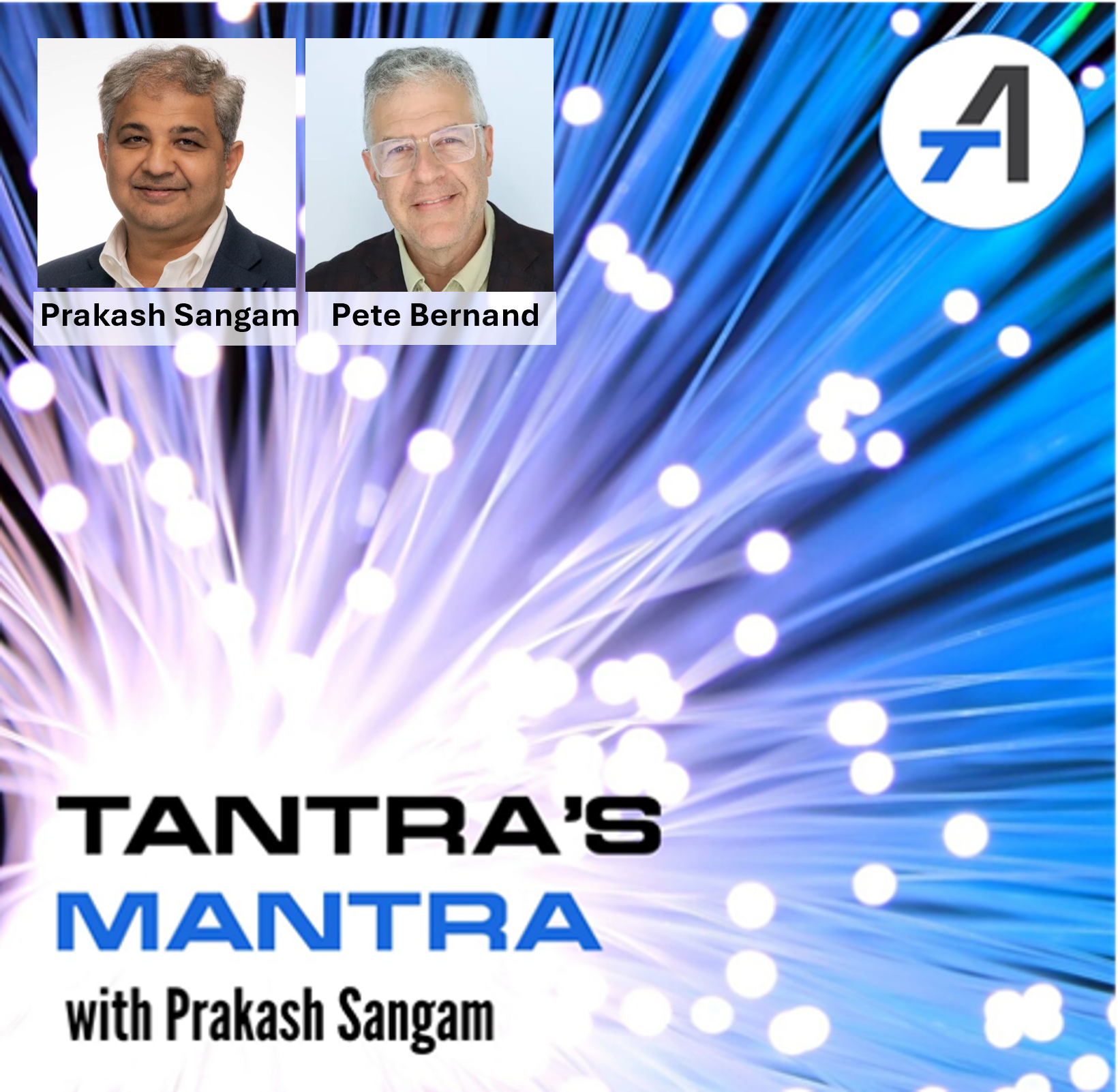
Edge AI has been hailed as the future of AI. However, it is yet to take off, and most of today's investment is directed towards cloud AI. Notwithstanding that, some green shoots are emerging. In the episode, I talk to Pete Bernard, CEO of the industry association, Edge AI Foundation, on the reasons behind the slow growth of Edge AI, the challenges the industry is facing, and what use cases and early segments are seeing traction. We also delve into the vision and mission of the foundation, exploring how it is helping the industry address challenges while harnessing opportunities, and what the future holds.
Is this your show?
Claim this listing to keep it up to date, reach guests who want to pitch you, and manage bookings with Guestify.