Find partners
Secrets of a CRA Recruiter

Secrets of a CRA Recruiter

Hosted by craresources

Episodes

148

Latest episode

Jun 2026

Language

EN-US

About the show

Welcome to the CRA Resource Show! craresources is a unique Recruitment Agency with a single focus of providing CRA Staffing for Clinical Studies across North America.

Listen to episodes

60 recent
June 14, 2026Episode 1723 min

How to Stop Being The Invisible Expert

Why the Most Qualified Person in the Room Isn't Getting CalledYou have 10, 15, or 20+ years of experience, a track record that speaks for itself, and a depth of knowledge that most hiring managers would fight to bring onto their team. So why do you feel like an invisible expert?No callbacks. No interviews. Just applications disappearing into a portal that never responds.After a while, the silence can feel personal. But listen up because the silence isn't a reflection of your value. It is a reflection of your visibility, and those are two very different things.Right now, the clinical research job market is producing something we are seeing with real consistency: the invisible expert. This is the seasoned professional who has spent a career building genuine expertise, only to find that expertise completely undetectable in today's job market. Maybe you were laid off and found yourself back in a search you weren't prepared for. Maybe you have been out for a stretch of time, and the applications aren't landing. Either way, you are qualified. You just aren't findable.So the question we are covering in today's roundtable:If a recruiter searched for someone with your exact background today, would they find you? Would your LinkedIn profile tell the story of who you are professionally, or would it raise questions you don't want raised?Your digital brand is no longer a nice-to-have. It is the front door to every opportunity in this market. And for mid-career professionals who built their reputations before personal branding became a career requirement, that front door is often invisible, outdated, or simply closed.We cover what is making experienced professionals disappear in today's search, what recruiters are actually looking for when they find your profile, and the specific, practical moves that shift you from invisible to impossible to overlook.You have earned the right to be found. Let us show you how.craresources

June 2, 2026Episode 1623 min

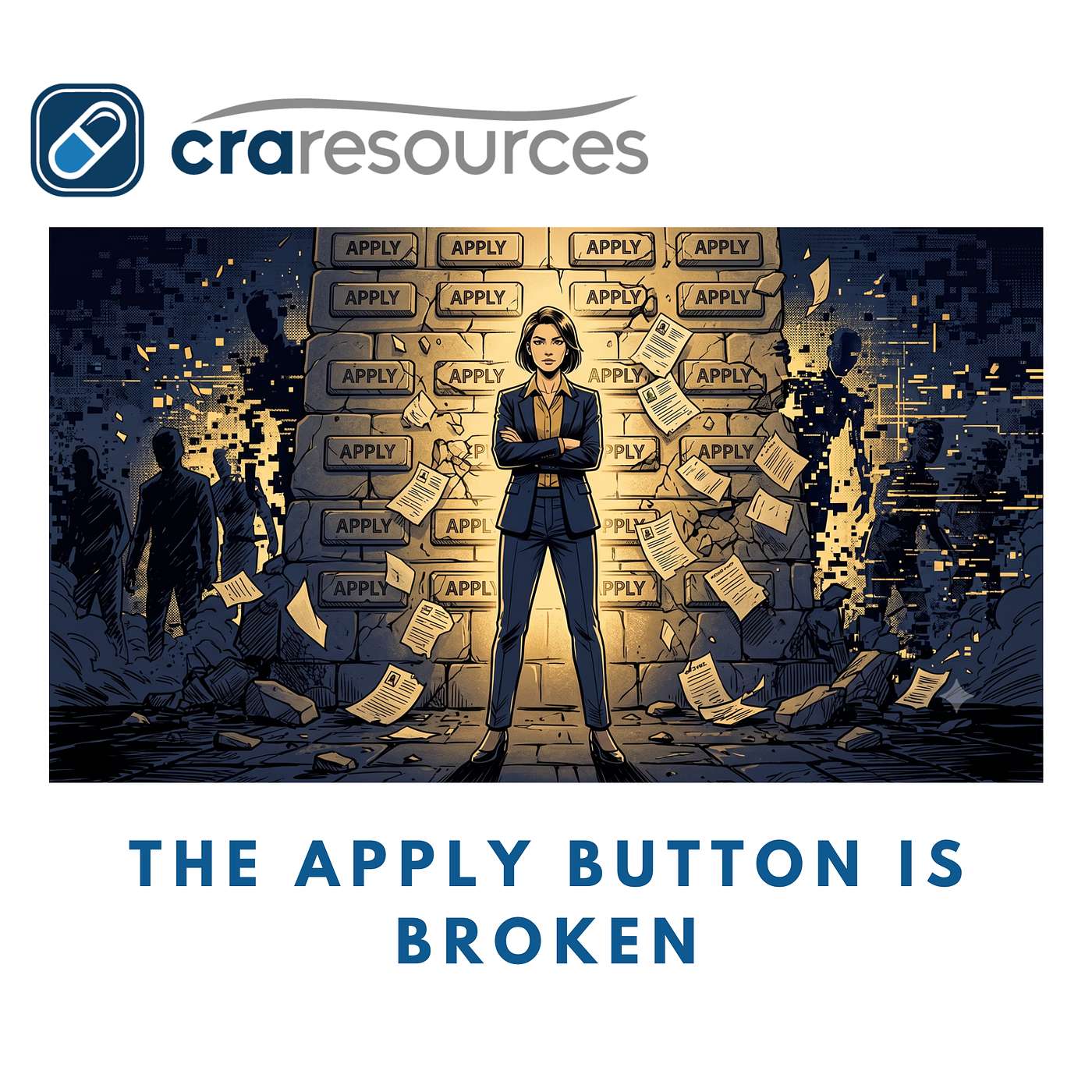
The Apply Button is Broken

Here is why I am officially declaring the death of the job portal…You sent the application, you checked the portal, and you waited…and then waited some more.Nothing.You aren’t imagining it, and you aren’t the problem. The apply button is broken. Our team said it out loud in our latest roundtable, and we meant it.Here is what is actually happening inside job portals right now. Our own data shows that roughly 60% of applicants coming through job portals have falsified all or part of their credentials. Not embellished. Falsified. They use fake companies as “employers”, fabricate their experience, or state they have degrees they never earned. On top of that, at least 20% of applicants aren’t real people at all. They are AI-generated ghost candidates created to harvest company data.That math is brutal. If you are a legitimate, experienced CRA submitting through a portal in 2026, you are competing inside a pool where only 20% of applicants are real. The noise is deafening, and the fatigue on both sides of the hiring table is real.So what does that mean for you?It means:The portal alone will not find you a job.Unfortunately, the resume that worked five years ago isn’t enough today.Being human, visible, and reachable isn’t optional anymore.LinkedIn outreach gets read when your email goes to spam.And, your application has to clear an ATS before a human ever sees it.None of that is your fault. All of it is fixable.My team and I sat down to walk through exactly what is happening when candidates hit the apply button, and, more importantly, what to do about it. We talked about the layers your application has to clear, where most candidates are losing ground, and how to show up in a way that actually gets you found.Give it a listen. You deserve to understand the market you are navigating.craresources

May 12, 2026Episode 1528 min

Career Progression Beyond 90 Days

You survived your first 90 days. The onboarding fog has lifted, your name is in the team chat, and you finally know where the coffee lives. So… is it too early to focus on career progression?Have you ever wondered why some people quietly climb while others stay stuck in “doing fine”? What if doing your job well isn’t actually the thing that gets you promoted? And here is a harder question: when was the last time you asked your manager what “excellent” looks like in your current role?In this week’s craresources Team Roundtable, we dig into career progression for professionals who are past the proving phase and ready for what comes next. But we aren’t handing out the recycled advice you have heard a hundred times before.Instead, we dig into some topics that will help you keep moving forward.Are progression and promotion the same thing? (Spoiler: they aren’t.)What does it mean to operate at the next level before you have the title?Why are vague answers from your manager actually your responsibility to fix?What is your internal brand saying about you when you aren’t in the room?How do you build visibility without becoming the office self-promoter no one trusts?We also tackle the question most professionals cannot answer when their manager asks it directly: What do you actually want to be promoted into?If you have been quietly waiting to be “noticed,” this episode will challenge you. And if you love your current role and don’t want a title change, stay with us anyway, because career progression isn’t only about climbing.Sometimes it is about deepening.Listen to the full Team Roundtable episode…if you are already considering progression, we can help.craresources

April 22, 2026Episode 1413 min

New Job? What Happens After You Prove You Belong

The first 90 days in a new job are important, and today we are going to discuss the ‘ownership’ phase…which usually happens between days 60 and 90.This phase happens once you have learned the basics. You have found your footing. And hopefully, you have stopped feeling like the brand-new person in the room.The next question should be: what now?How do you move from simply doing the job to shaping your role in a way that supports your future?When do you speak up? And how do you do it without sounding like you are trying too hard?How do you show initiative in the new job without stepping on anyone’s toes?And how do you make sure the work you are doing now is building toward the career you actually want?In this second part of our roundtable on the first 90 days of a new job (listen to part 1 here), our team digs deeply into that next phase. We talk about ownership, visibility, and the quiet confidence that comes from understanding your value and knowing how to communicate it. We also talk about the trickiest parts of starting strong: learning to advocate for yourself while remaining thoughtful, curious, and collaborative.This conversation isn’t about having all the answers on day one. It is about learning how to ask better questions. It is also about noticing what isn’t working. And lastly, it is about how to position yourself as someone who isn’t just getting through the job…but growing through it.craresources

April 7, 2026Episode 1316 min

First 90 Days in a New Role...

Are You Settling In or Setting Yourself Up?Starting a new job can feel exciting, a little intimidating, and if we are being honest, a bit like you are trying not to trip in front of everybody. You have the laptop, the logins, the introductions, and the strong desire to do a good job. But somewhere between being “the new person” and trying to prove yourself, a lot of professionals slip into a dangerous little habit called settling in during their first 90 days in a new role.That is exactly what we unpack in the first part of our roundtable conversation, outlining an effective 30-60-90 day onboarding plan.In this discussion, our recruitment team talks candidly about why the first 90 days in a new role matter so much, and why being too quiet or too busy can work against you faster than you might think. We explore what hiring managers are really watching for, why silence can raise questions, and how the early days of a new job are not just about proving that you got the offer, but showing you are ready to grow into the role.The conversation also gets into the importance of asking questions, learning the culture, and understanding how a company really works before assuming you already know the playbook. Because let's be real, every workplace has its own language, pace, and unspoken rules.If you have ever wondered how to start strong without overdoing it, this episode is for you. Listen in and hear what our team has to say about making your first 90 days count.craresources

March 26, 2026Episode 1213 min

LinkedIn Skills and Publication Sections

Part 2 of our LinkedIn “other section” roundtable dives deeper into the profile sections most job seekers skip entirely. What if your LinkedIn Skills list is quietly confusing recruiters and LinkedIn’s algorithm? Or what if I told you that properly leveraging your Publications section could pull hiring managers straight to your inbox?Our team gets real about why a laundry list of 50+ random LinkedIn skills screams “jack of all trades, master of none.” We take you through why it is important to pin the top 3 that match your target roles and keep the rest tight, describing two to three clear expertise lanes only.Oh, and have you ever wondered why endorsements from people who have never seen your work don’t positively impact your impressions or LinkedIn traffic? We break down what actually builds credibility with your skills section.Then we dive into Publications. This LinkedIn section is an underused gem that screams authority. Why do hiring managers love seeing conference talks, articles, or ResearchGate papers right on your profile? Alternatively, what happens when you make recruiters dig for your proof instead of serving it up? In clinical research, especially, this section turns “I have done trials” into “Here is exactly what I have accomplished.”We wrap with the “add section” button recruiters wish you would use more: Projects, Volunteer, Honors & Awards, and Languages. But there is a catch to overusing (or misusing) LinkedIn’s features…and we discuss it during this roundtable.Listen to Part 2 now and spot what’s holding your LinkedIn back.craresources

March 19, 2026Episode 1117 min

How “Hidden” LinkedIn Sections Can Win the Interview

Most job seekers obsess over their LinkedIn headline and About section, but then quietly ignore everything else. Yet these “other” LinkedIn sections are often where recruiters find the proof they need to move you from “maybe” to “must-interview”.In this new roundtable episode, our recruiting team wraps up our LinkedIn optimization series by zooming in on the parts of your profile that rarely get talked about: Featured, Recommendations, Licenses & Certifications, and Education. These aren’t just nice-to-have add-ons. Used well, they can better tell your story, attract both bots and humans, and make you stand out in a crowded, employer-driven market.We start with the Featured section: your “proof of impact gallery” and trailer to your About. Most people use this section as a random dump of old posts. But it is perfect for case studies, portfolios, and 3–6 high-impact wins.From there, we shift to Recommendations: how to ask for them without awkwardness, who to target (managers, peers, clients), and why “great team player” comments land like describing a golden retriever.Next up are Licenses & Certifications vs. Education, where we share real recruiting-trench stories. Unclear degrees or fuzzy certification dates don’t just raise eyebrows; they delay submissions and cost interviews. The fix? Keep them accurate, separated, and up-to-date, especially when clients demand specific credentials.Our goal is simple: show why these “hidden” sections matter. This episode will change how you think about completing your profile.Listen to Part 1 now and audit these sections on your own LinkedIn with fresh eyes.craresources

March 5, 2026Episode 1022 min

How to Optimize Your LinkedIn Experience Section

Most job seekers treat the LinkedIn Experience section like a form to fill out: titles, dates, and a few “responsible for…” bullets. But what if that section is actually one of the most powerful levers you have for both the machine and the humans deciding your next opportunity?In our latest roundtable, our recruiting team breaks down how to turn your Experience section into proof of value that works double-duty. It feeds LinkedIn’s 360Brew algorithm with clear, consistent signals, and it gives hiring managers the mini-stories they need to quickly trust you as a candidate.How closely does your Experience need to align with your resume? What happens when dates, titles, or responsibilities don’t match... and how could that quietly be costing you interviews?We dig into why alignment across your Headline, About, Skills, and Experience is now mission‑critical. And, we outline how 360Brew uses that consistency to assign you a professional “persona” that determines which searches and feeds you show up in. Are you unintentionally confusing the system by telling different stories in different sections?You will also hear concrete examples of transforming dry bullets into concise stories using context, action, result, and reflection. We outline how to craft stories that cut through buzzwords like “strategic leader” and actually prove your impact.What are the three non‑negotiables recruiters scan for in Experience? Which red flags make us hesitate, and which signals encourage us to move your candidacy forward faster?Don't you want your profile to be both findable and irresistible so recruiters discover you and hiring managers remember you? I thought so! This episode will give you a practical, no‑fluff roadmap on how to optimize your LinkedIn Experience section.craresources

February 26, 2026Episode 924 min

LinkedIn About Section Examples

Most professionals know their LinkedIn “About” section matters. But few realize just how much recruiters, hiring managers, and even LinkedIn’s own 360Brew algorithm are relying on it to make fast decisions about them.In this roundtable episode, our recruiting team pulls back the curtain on what really happens when we open your profile. Why do 92% of us decide to engage or scroll largely based on your About section? What makes one clinical research profile feel like “generic experience” while another jumps off the page with “who you serve, what you deliver, and proof”? And how do you create an emotional connection and satisfy the bots at the same time?You will hear our recruiters walk through real “before and after” LinkedIn About sections. We show you how a few specific metrics can change your credibility in seconds. And importantly, we explain why listing companies and job titles in your About is a missed opportunity. Our discussion shares practical tips on keywords: which ones actually help you show up in search results? How can you mine job descriptions for the right language? And how do you avoid sounding like a robot when you are writing for an algorithm?Finally, we introduce the five-part framework we use when coaching candidates, covering your opening line, story, bullet “skills stack,” audience focus, and call to action. If you have struggled to create your About section, learning how to use this framework is gold. The goal? Ensuring your About section becomes a powerful handshake that works on autopilot for your job search and your long-term career brand.If you have ever wondered, “Is my About section helping me get found, or quietly holding me back?”, this episode is for you.craresources

February 18, 2026Episode 818 min

LinkedIn Posts for Job Seekers

Your “perfect” LinkedIn profile still isn’t attracting opportunities. Why not? Brace yourself because I am going to tell you that you should be putting out LinkedIn Posts. Today’s podcast pulls back the curtain on what really gets job seekers noticed in a LinkedIn 360Brew world. And it is beyond just polishing your headline and calling it a day.I get it…you don’t feel qualified to write LinkedIn posts. But before you tune out because you will…absolutely…not…create…LinkedIn Posts, give me just a minute. Why? Because simply having a profile is no longer enough, and strategic posting can drive two to three times more of the right traffic to your page.We describe how easy it is to create posts that position you as an expert. And, we outline why you should avoid the generic, copy‑paste “inspiration” posts that scream “bot” instead of “credible professional”.We dig into how LinkedIn’s new 360Brew algorithm actually “reads” your content. And, we also explain how LinkedIn compares your posts to your headline, About, skills, and experience to assign you a professional persona. And this is all important when it comes to attracting the right traffic.Are your posts reinforcing the niche you want to be known for? Or are you confusing the system with cat memes and vague career platitudes?You will also pick up practical tactics you can apply immediately:How to write hooks that trigger that crucial “see more” click.Why dwell time matters more than likes.How to pull real achievements from your resume and turn them into engaging, human posts (with help from AI tools that don’t make you sound like a robot).Learn to start posting with purpose, and turn your feed into a magnet for recruiters in your niche. Press play and let’s get you found.craresources

Is this your show?

Claim this listing to keep it up to date, reach guests who want to pitch you, and manage bookings with Guestify.

Claim this listing

More Business podcasts