
Find partners
Productside Stories

Productside Stories

Hosted by Productside

BusinessManagementInterviews guests

Episodes

66

Latest episode

Nov 2026

Language

EN-US

About the show

Welcome to Productside Stories, a product management podcast featuring honest conversations with experienced product leaders. We cover what it really takes to build successful, outcome-driven products: from strategy and discovery to delivery, leadership, and AI. Hosted by Productside, a product management training and consulting company, this podcast is designed for PMs and product leaders who want practical insight (not theory) for modern product work.

Listen to episodes

60 recent
November 10, 2026Episode 1035 min

The Great Compression: Will AI Replace Product Managers?

Vibe Coding for Product Managers: How Far Can Non-Technical PMs Really Go? AI can take a non-technical PM from a problem to a working prototype in an afternoon. Karl Abbott, Senior Ecosystem Product Manager at Microsoft working on Linux on Azure, thinks that's great right up until someone else starts depending on it. Rina Alexin and Karl get into vibe coding for product managers, the exact moment an engineer needs to step in, and the question keeping PMs up at night: will AI replace product managers by 2030? Karl answers with 16 years at Red Hat behind him. Key Topics Discussed in This Episode How Far Can a Non-Technical Product Manager Go With AI? Further than you'll understand, says Karl. He lays out how to start vibe coding with a small problem you know well, make the AI explain its choices, and edit the code yourself before you trust it. The Line: When Someone Else Depends on It, Get an Engineer Karl runs a handful of vibe-coded tools for his own work. The moment someone else relies on one, he hands it to engineering. He also explains how an installer he hacked together shipped in the product within a week. Will Product Managers Exist in 2030? The Product Builder Debate The 2026 CPO Insights Report predicts a "Product Builder" replaces the PM by 2030. Karl calls it role compression, not extinction, and warns that cutting junior hires today leaves teams short on judgment tomorrow. Why Listen to This Episode? In this thought-provoking episode, you’ll gain: A practical starting point for vibe coding when you don't have a coding background A clear rule for deciding when a prototype needs engineering review A simple test for when to trust AI output and when to go find an expert A better answer to "Where do you see yourself in 10 years?" in a market that refuses to sit still If you've ever shipped something you couldn't fully explain, this episode is for you. Related Resources Check out these additional tools and resources to add to your PM belt: Productside Resource Library More Productside Stories Podcast Episodes Explore Productside Courses


November 2, 2026Episode 925 min

Women in AI Product Management: Why Representation Shapes Better Products | Productside Stories

Women in AI Product Management: Why Representation Decides What Gets Built Your AI can pass every test and still fail the people nobody thought to test for. In this Women in Product Management episode of Productside Stories, Nicole Tieche talks with Purnima Bihari, VP of Product at Andgo Systems, about why women in AI product management change what gets built in the first place. Purnima traces how bias slips in long before launch and shares the career advice that took her from engineering into product leadership. Key Topics Discussed in This Episode Where bias enters AI products Purnima maps the four places bias gets into AI products: problem selection, data collection, product design and evaluation. Miss women at any of them and you’ll find the gap in production. Golden data sets and autonomous agents A golden data set defines what “good” looks like for an AI system. Purnima explains why its blind spots stay hidden until an autonomous agent acts on them, and why every later step then inherits the mistake. Treat yourself as the product Purnima’s advice for women in product management: know your value prop well enough that a sponsor can repeat it in rooms you’re not in. Then ship yourself as a minimum viable product and iterate. Why Listen to This Episode? In this thought-provoking episode, you’ll gain: A clear map of the four places bias gets into AI products, so you catch it before your users do A plain-English take on golden data sets, and why their gaps get riskier once AI agents act on their own Questions to ask when your hiring shortlist keeps looking the same A career playbook for women in product management, from defining your value prop to finding a sponsor Purnima wants diversity in AI product decisions tracked as closely as hiring numbers. Give her 30 minutes and you’ll look at your next data set differently. Related Resources Check out these additional tools and resources to add to your PM belt: Productside Resource Library More Productside Stories Podcast Episodes Explore Productside Courses

October 27, 2026Episode 832 min

AI Product Marketing: Selling AI Customers Don’t Trust

AI Product Marketing: How KeyShot Sells AI to Customers Who Don’t Trust It Most AI product marketing assumes the customer wants AI. KeyShot can’t make that bet. Its customers render physical products before a sample exists, and plenty of them won’t send a CAD file to the cloud for anyone. Zak Cherif, Senior Director of Product Marketing at KeyShot, joins Rina Alexin to explain how to market AI products to people who don’t trust them. He walks through the local model that got KeyShot its first real AI feedback, plus the prompt he uses to make AI argue with him. Key Topics Discussed in This Episode Marketing AI to customers who don’t want it KeyShot’s first AI features run on a local model that users download once, with no live internet connection. Privacy and no extra cost became the value props that got hesitant designers to try it. AI as a devil’s advocate, not a yes-man As KeyShot’s only product marketer, Zak uses AI for competitive intelligence and messaging variants. His favorite request: poke holes in this. He also explains why he switches between ChatGPT and Claude. Product manager vs. product marketing manager Zak has worked where product owned the roadmap and where business leaders owned it. His advice for product manager vs. product marketing manager friction: learn who owns what, then work the overlap. Why Listen to This Episode? Get an AI go-to-market strategy built for skeptical, IP-sensitive buyers instead of another list of AI tools. Hear why KeyShot gave its first AI feature away inside the subscription, and what it got back in feedback. Pick up Zak’s habit of asking AI to tear your messaging apart instead of applauding it. Learn how PMs with no product marketer can take on the job of representing the customer. Shipping AI features your customers aren’t sure about? Our AI Product Management course teaches PMs to build and launch AI features people use. Related Resources Check out these additional tools and resources to add to your PM belt: Productside Resource Library More Productside Stories Podcast Episodes Explore Productside Courses
October 20, 2026Episode 741 min

AI Evaluation for Product Managers: Why Benchmarks Lie | Productside

AI Evaluation for Product Managers: Why Most AI Benchmarks Measure the Wrong Thing Frontier AI models post near-perfect benchmark scores. Give those same models real freelance work, and in research Yoav cites, the best one finishes about 20% of it. Yoav Goldhorn, Chief Product Officer at PALSAR and AI Evaluation Manager at Red Hat , builds the methods that close that gap. He joins Rina Alexin to explain AI evaluation for product managers: why a benchmark score says little about the agentic AI you ship, and what your team needs to measure before your users find the failures for you. Key Topics Discussed in This Episode The benchmark gap : Benchmarks score a bare model. Your product runs agents, tools, RAG engines and context on top of it. Yoav explains why AI benchmarks are misleading when the thing you test isn’t the thing you deploy. LLM as a judge and the metrics that matter : Asking one LLM to grade another on a 0-to-1 “correctness” scale produces noise. Yoav makes the case for defining “correct” before you measure it, and for tracking pass@k and pass^k across repeated runs. AI quality assurance as a product discipline : Yoav’s two-stage approach starts with AI output quality thresholds you clear with statistical significance before launch. Once real users arrive, gates and alerts flag systematic failures so your team can find the root cause fast. Why Listen to This Episode? In this thought-provoking episode, you’ll gain: Your dashboard gives leadership one tidy accuracy number, and you have a nagging feeling it doesn’t mean much. Find out why handing an AI agent a toolbox of just ten tools can drag its performance down hard. Get a practical way to sort the AI failures that cost you customers from the ones you can shrug off (wrong instructions vs. a chatbot that calls itself Mike instead of Steve). Hear why Yoav believes PMs who own the breakdown of their own workflows will come out ahead in the agentic shift. If your AI roadmap rests on a benchmark score, listen to this one before your next launch review. Related Resources Yoav mentions the following in this episode: Remote Labor Index ( Epoch AI ): https://epoch.ai/benchmarks/rli?view=graph&tab=release-date#explore-the-data When AI Benchmarks Plateau: A Systematic Study of Benchmark Saturation ( arXiv ): https://arxiv.org/pdf/2602.16763 The 2026 AI Index Report: Technical Performance ( Stanford HAI ): https://hai.stanford.edu/ai-index/2026-ai-index-report/technical-performance Check out these additional tools and resources to add to your PM belt: Productside Resource Library More Productside Stories Podcast Episodes Explore Productside Courses
October 13, 2026Episode 639 min

The Truth About Vibe Coding for Product Managers

Vibe Coding for Product Managers: How AI Is Redefining Prototypes, MVPs, and Who Gets to Build AI made building cheap. Nobody sent the memo about maintenance. In this episode of Productside Stories, Rina Alexin sits down with Elena Avramenko, founder and CEO of Modaal.dev, to talk about vibe coding for product managers without the hype. Elena shipped dozens of iPad apps long before AI could write a line of code. Now she helps non-engineers build native mobile apps with AI. Her take: the prompt is the easy part, and product judgment still decides what deserves to exist. Key Topics Discussed in This Episode The Hidden Maintenance Cost of AI-Generated Code AI writes code fast, but it never tells you what that code will cost to maintain. Elena explains why she treats every agent like a junior developer and questions each decision before it ships. Validate Before You Vibe Code Your spare hours are an investment. Elena explains why most builders in her community kill five to seven ideas before they commit, and why customer conversations should come before the first prompt. Vision, Taste, Debug, Delight Elena walks through how her three-person team builds with AI. She builds an ugly working prototype, her designer swaps the AI-generated UI for real craft, and the engineer spends only about 5% of his time on it. Why Listen to This Episode? In this thought-provoking episode, you’ll: Learn how to approach AI prototyping for non-engineers without skipping product discovery Hear why human craft will become the moat once AI-built apps flood the App Store Find out what "bring your own agent" means for vibe coding tools and your credit card bill Get Elena's rule for leading AI adoption on your team: build something yourself first, then invite your team to follow If you've ever wondered whether product managers should vibe code, this episode gives you the honest answer, maintenance bill included. Related Resources Check out these additional tools and resources to add to your PM belt: Productside Resource Library More Productside Stories Podcast Episodes Explore Productside Courses
October 6, 2026Episode 535 min

AI Product Discovery and PM-Designer Collaboration with Snehal Ghag

How Product Managers and Designers Use AI to Transform Product Discovery AI product discovery won't save you if your designer first hears about a feature when it needs to "look nice." By then you've already paid for the mistake, and the invoice just hasn't landed. In this episode of Productside Stories, Rina Alexin talks shop with Snehal Ghag, Design Manager for AI Products at ServiceNow, about product manager and designer collaboration that starts in the problem space. Snehal worked at Amazon India and Salesforce before ServiceNow. She explains how her team pairs synthetic personas with vibe prototyping, and why real users still get the last word. Key Topics Discussed in This Episode PM-Designer Collaboration Is Basically Co-Parenting Snehal compares product manager and designer collaboration to new parents raising their first kid: you figure out the problem together before anyone picks a path. Leave design out until the end and rework sends you the bill. Synthetic Personas: Great Sparring Partners, Terrible Stand-Ins Her team builds AI personas from real user research, then sets the grumpiest ones loose on every design. Synthetic users never replace real ones, though. Usability testing still happens before anyone writes code. Vibe Prototyping Without Skipping the Homework Vibe prototyping gets several design options in front of users in a single day. The catch: Snehal spends 80% of the effort in the problem space, so those speedy prototypes answer the right question. Why Listen to This Episode? This one's for you if: Your designer only hears about features at the "make it pretty" stage, and rework keeps eating your roadmap. You want AI in UX research but don't fully trust synthetic users. (Good instinct.) You'd like to see how ServiceNow uses AI as a thinking partner to roast PRDs before stakeholders get the chance. Your product discovery process sprints straight to solutions. (Spoiler: most do.) Hit play, then pull up an extra chair at your next planning meeting. Your AI partner's been waiting. Related Resources Check out these additional tools and resources to add to your PM belt: Productside Resource Library More Productside Stories Podcast Episodes Explore Productside Courses
September 28, 2026Episode 422 min

AI in Product Management: Lessons from Pawana Burlakoti

Pawana Burlakoti on AI, Empowered Teams, and Product Sense Everyone says their team is "using AI." Pawana Burlakoti, Product Management Executive, can show you what hers has built. In this episode of Productside Stories, she tells host Nicole Tieche how her teams make AI in product management part of the job, not a side hobby. She also covers the hiring bar she won't lower and why her UX team reports into product. Her verdict on this year? It's "the applying stage." And no, product sense isn't going anywhere. Key Topics Discussed in This Episode Learn and play: how Pawana's teams use AI Every team in Pawana's org has a goal to learn something with AI and share it. One teammate built a best-practice repository in a single evening. That used to take months. Hiring product managers in the AI era Looking for an AI-mature product manager? Pawana says they don't exist yet. She hires for strong product sense, then looks for candidates who've built something with AI because they couldn't help themselves. How to build an empowered product team Pawana's UX and research teams report into product, so clients hear one voice instead of three competing agendas. She also explains how she grows empowered product teams, where even early-career PMs lead. Why Listen to This Episode? In this thought-provoking episode, you’ll gain: A model for AI adoption your team can copy by Monday A straight answer to "Will AI replace product managers?" (Short version: not the ones with product sense.) What an SVP of Product looks for when she hires PMs today The case for putting product and UX under one roof and building shared capabilities once across your portfolio Hit play before your next "So, what are we doing with AI?" meeting. Related Resources Check out these additional tools and resources to add to your PM belt: Productside Resource Library More Productside Stories Podcast Episodes Explore Productside Courses

September 21, 2026Episode 333 min

AI ROI in Product Management. Velocity Isn't Value.

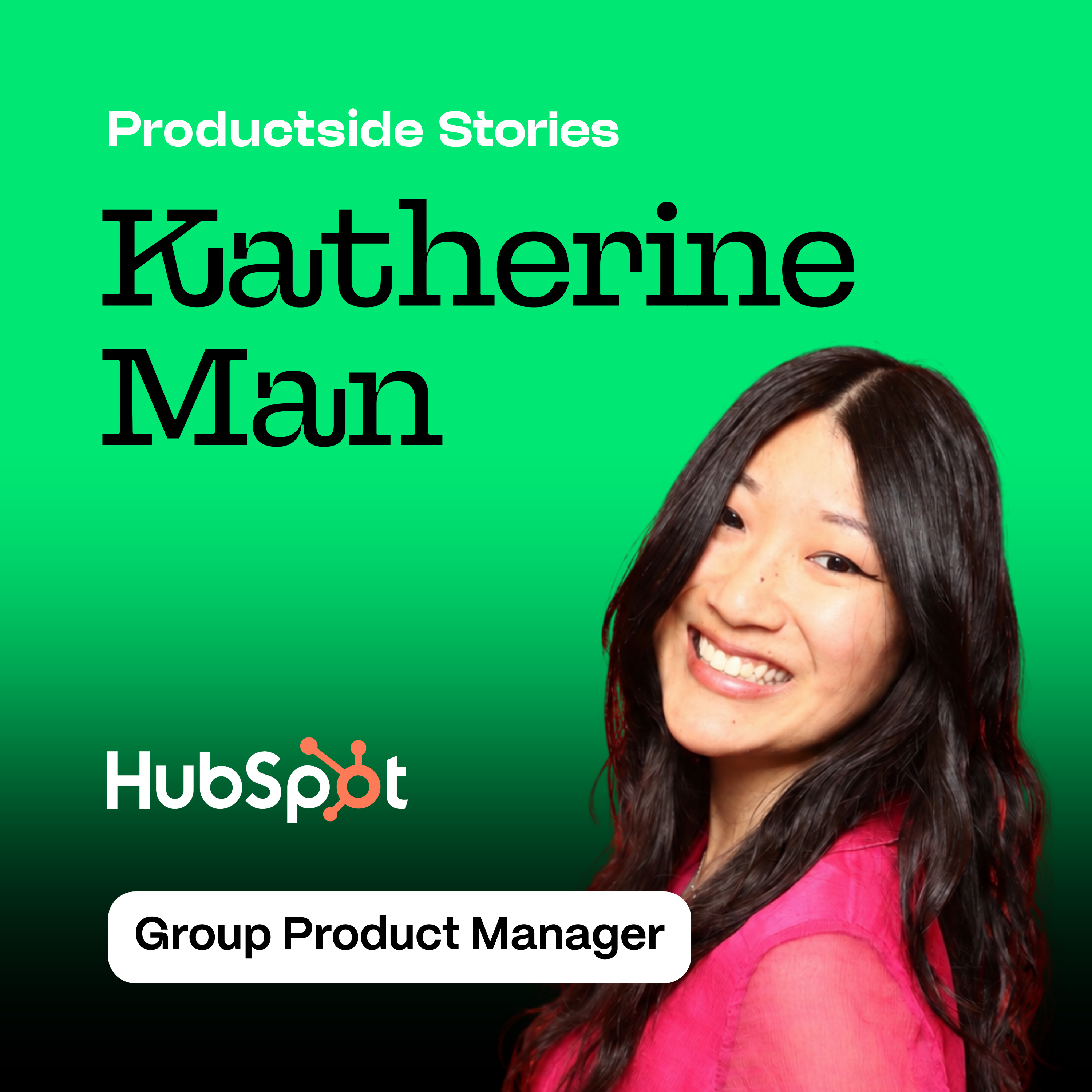
Your Velocity Doubled. Did Anything Get Better? Shipping faster is easy to prove. Shipping better is the part nobody has instrumented yet. Katherine Man has spent six years at HubSpot and over a decade building the platforms that go-to-market teams run on. She sits down with Rina Alexin for a deliberately moderate take on AI: what it has genuinely changed about product work, what it has only made noisier, and why the role everybody predicted would disappear is still very much here. Key Topics Discussed in This Episode AI took the bottom 10% of your job The simplest part of the role got democratized. Which leaves the other 90%, the part that makes someone actually good, more exposed than it has ever been. Katherine's view: the roles did not merge, the conversations got better. Excuse culture is dead No PM on the team? AI is your PM. No designer? You have prototyping tools. Katherine has watched a tech lead write product requirement docs for six months and designers run their own research and scoping. Fully resourced teams are now the exception, and she treats that as a planning assumption instead of a complaint. Output metrics are the easy answer Velocity is up. Quality systems have not caught up. Katherine points to customer-facing numbers instead: meetings booked through the prospecting agent, resolution rate through the customer agent. That's the scoreboard that counts. The grunt work was the training Writing bad PRDs by hand is how a generation of PMs learned to write good ones. Hiring for recent graduates is thinning while current employees stay put. Katherine is blunt that the industry has a five-year problem it hasn't priced in. Why Listen to This Episode? In this episode, you’ll get: A working test for AI ROI , built on customer outcomes rather than adoption dashboards and token leaderboards A realistic model for covering unfilled roles , including where AI stretches and where it stops (prioritization, trade-offs, decisions) The overconfidence trap , told through Katherine's own story of walking into a design review certain, and wrong A plan for building judgment in junior PMs when the tasks that used to build it are gone Plus the billboard on the way in from SFO that explains everything wrong with AI marketing right now. Related Resources Check out these additional tools and resources to add to your PM belt: Productside Resource Library More Productside Stories Podcast Episodes Explore Productside Courses

September 15, 2026Episode 230 min

How AI Is Changing Product Management

AI Wrote the PRD. You're Still Accountable for It. Seven pages out of the model in minutes. Formatted, confident, and not necessarily right. Advaita Nigudkar has spent eight years at BILL and helped launch the company's first agentic AI platform, in a category where a wrong number means somebody's money moved. She sits down with Rina Alexin to talk about the context work that makes AI output usable, using an LLM as a judge to hold a quality bar across growing teams, and the one PM quality she thinks AI can quietly take from you. Key Topics Discussed in This Episode Garbage in, garbage out is now a job description One-line prompts produce PRDs that solve the admin use case and ignore everyone else. Advaita's team built templates and skills that interrogate the PM first: which customer, which SKU, which partner type. An LLM as your PRD judge Feed the model your best past PRDs as the gold standard and let it flag what's missing. The PM supplies the substance. The model finesses it. Consistency survives headcount growth and churn. The trust feature you hope nobody opens BILL's agents move money, so the team shipped an activity log and on/off controls. Engagement dropped once customers trusted it. That was the point. Why Listen to This Episode? In this episode, you'll get: A repeatable way to raise the bar on AI-written PRDs , using past work as the standard instead of vibes The context you have to supply before AI is useful : personas, permissions, business types, historical decisions A trust playbook for AI features in regulated environments , from encrypted data handling to auditability and kill switches A framework for what stays human : negotiation, cross-functional trade-offs, and the judgment behind which problems deserve solving Plus the warning Advaita gives every PM who gets comfortable with easy answers. Related Resources Check out these additional tools and resources to add to your PM belt: Productside Resource Library More Productside Stories Podcast Episodes Explore Productside Courses

September 9, 2026Episode 132 min

Product and Design Collaboration: AI Can't Judge

AI Can Build Ten Prototypes. It Still Can't Tell You Which One Is Right. AI will hand you ten prototypes before standup ends. It cannot tell you which one deserves to exist. That gap is where this conversation lives. Jared Hall-Dugas has spent 20 years designing for Warner Bros., the US Air Force, and now National Grid. He sits down with Rina Alexin to talk about product and design collaboration when the tools got fast, why a polished prototype is often a shop with no electricity, and the exact point in your process where cutting design out starts costing you rewrites. Key Topics: Product and Design Collaboration Under AI Pressure Judgment is the job now Jared can look at ten AI-generated prototypes and tell you which one will land and why. That call is not automatable yet. He argues judgment is the thing product and design both get paid for. The output looks done. It isn't. Buttons that go nowhere. Data that doesn't reconcile. Jared calls it a Pinocchio problem: the shop window looks ready to open, and there's no electricity inside. Somebody in the room has to say so. Where cutting design out gets expensive Design belongs in the room from day one. If that's impossible, Jared names the non-negotiable: the moment discovery converges into a defined solution. Skip it there and you're rewriting later. Why Listen to This Episode? In this thought-provoking episode, you’ll gain: A sharper answer to "what part of my role is safe" that isn't wishful thinking A test for spotting AI output that looks finished and isn't, before it reaches a VP The one point in your process where a designer is non-negotiable, and the language to argue for it A repeatable way to move AI culture inside a slow, regulated, 50,000-person organization Jared's closing line is the one worth sitting with: your designer is just as unsure about all of this as you are. Related Resources Check out these additional tools and resources to add to your PM belt: Productside Resource Library More Productside Stories Podcast Episodes Explore Productside Courses

Is this your show?

Claim this listing to keep it up to date, reach guests who want to pitch you, and manage bookings with Guestify.

Claim this listing

More Business podcasts