
Find partners
On Time in Full

On Time in Full

Hosted by Designed Conveyor Systems

Episodes

78

Latest episode

Jan 2026

Language

EN-US

About the show

From supply chain to production capabilities, On Time in Full will explore how the material handling industry has many career growth opportunities.

Listen to episodes

31 recent
September 22, 2022Episode 1023 min

How Modular Conveyor Systems Help Alleviate Supply Chain Challenges

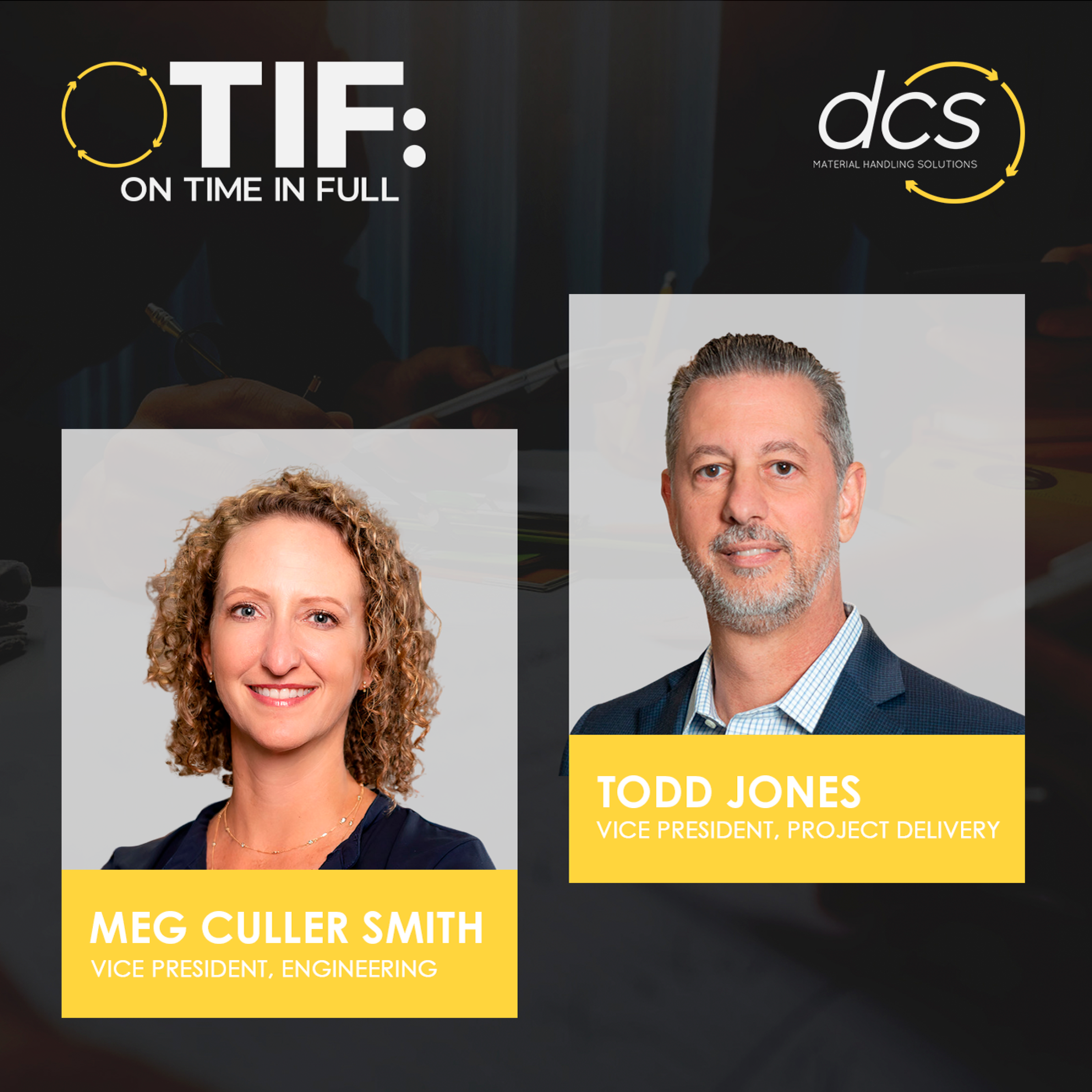
Modular is having a moment and the motivations are clear. Modular is easy to assemble, adaptable and avoids supply chain disruptions. Now, Designed Conveyer Systems offers a modular conveyor system option. Host Tyler Kern spoke with Designed Conveyor System’s Todd Jones, VP of Project Delivery, and Meg Culler Smith, CP of Engineering on the topic of modular conveyor system pieces. “A modular conveyor system is a complete conveyor system designed to transport a variety of products. But the trick is that it’s put together from a very few basic building blocks of conveyers,” said Meg Culler Smith, Vice President of Engineering. The modular building blocks include straight sections, curves, merges, diverts, lift gates, herringbone sections, and more. The units arrive assembled and pre-wired. Once the sections are put together and plugged in, the system is ready to be used. “These are fairly simple systems. There’s not a lot of sophisticated electronics, which is the primary driver of supply chain issues today,” said Todd Jones, Vice President of Project Delivery. The modular conveyor system comes in standard sizes. They are not made to order but readily available. One particular DCS client opted for the modular conveyor system while waiting for its permanent solution. The modular system will be built outside of the permanent system's footprint, so the site can be up and running before the permanent elements are ready. Once the permanent system is tested and running, the company can take down the modular design, store it as a backup, move it to a new site, or resell it.  “These systems let you do more, with less,” said Jones. With fewer technical elements, the modular conveyor system doesn’t need highly skilled laborers to put the systems together. They’re easy to assemble and disassemble. The systems are cost-effective, flexible, and quick to implement. “Some people like to call them legos, any of those kinds of modular toys that you had as a child. Because these pieces are all designed to connect to each other in various  configurations, so, you know, if you can dream it, you can build it,” said Smith.  

August 11, 2022Episode 815 min

Veterans Transitioning to Project Management and MHI Roles

Veterans retire with a variety of skills under their belt. These skills form a natural path from the military into the civilian workforce, particularly translating to project management. To talk about this overlap, DJ Hughes, a current armed forces reserve officer with twenty years of active-duty service under his belt, talks to host Tyler Kern about his transition into project management fifteen years ago.“In my civilian career, I have done work in operations management and project management roles in a variety of companies. I have served in the Military Reserve,” said Hughes. He joined the Design Conveyor Systems team about a year ago. The overlap lays the foundation, but Hughes has had some adjustments to make around pace. “It’s drilled into you to move with a sense of urgency in military training,” said Hughes. There’s good reason for it in the military, “but shifting can be difficult.” Project management requires a steady pace that consistently considers the overarching project goals and completes steps sequentially. In project management and frontline work, “Leadership is critical, but we must accomplish our mission, the tasks in front of us,” said Hughes, “This mission mentality translates well into a project-based mindset because you have requirements, training that needs to happen, budgets that you must adhere to.” Veterans are used to training and shifting from tactical to strategic levels. In project management, it’s all about planning. You have the proper plans in place. You understand what needs to be accomplished.Communication is critical in the Army, Navy, and Air Force. “Always giving your intent, your mission. It’s clear from the person at the top to the soldier that they understand the ‘why,’’” said Hughes. Critical parts of project management outline communication expectations in the early planning stages. Through a project, communication must be clear. “We all have to understand the goal and how we’re going to execute to get there,” said Hughes.

May 27, 2022Episode 711 min

Resolving Conflict On Site

Conflict will inevitably happen at a jobsite. However, it is not about avoiding conflict but figuring out how to handle the conflict. Brian Niccum is the director of site management at Designed Conveyor Systems (DCS). Niccum provides insight for conflicts that can arise on sites and how to deal with them properly and professionally to ensure a project gets completed safely.“Having the smaller issues resolved in the beginning works to deescalate the larger conflict” said Niccum. Larger issues that arise in conflict require parties to remain deescalates and logical when working towards conflict resolution. The neutral space allows for mediators to not take sides and emphasize common ground. As people work together on projects the more growth will happen which then produces resiliency towards the obstacle’s teams face. Each party/trade requires an empathic approach when issues arise between multiple departments. Misinterpretations may be common among different perspectives. Therefore, all parties much be present to ensure equality and clarity among the parties.Site Mangers and every employee partake in a disk assessment at Designed Conveyor Systems which determines a fit between your personality and work style in order to create teams that are more compatible when working closely on projects together. “Onsite confclit doesn’t necessarily make it all the way up to leadership and senior leadership” Said Niccum. Designed Conveyor Systems gave teams a two day training on conflict resolution that now has equipped members thus far with skills to address conflict and resolved issues safely and effectively.

April 13, 2022Episode 614 min

The Convergence of Value and Technology in Supply Chain Logistics

Technology is integral to staying relevant in modern supply chain logistics, especially in markets that are always on the move and projected to evolve. A Licensed engineer and Designed Conveyor Systems’ President, Matt Ferguson, has witnessed this critical phenomenon firsthand.  Throughout his career, he’s observed how – when properly implemented and progress is identified – tech can be the key to achieving a customer’s goals. But he also understands there are some difficulties and hurdles to overcome in the process. “One of the biggest challenges with applying new technology is defining what good performance looks like,” Ferguson explained.Join him and On Time in Full host Tyler Kern as they examine the convergence of value and technology when developing industry-specific logistics automation. They also explore how DCS creates and integrates new technology to impact their customers’ productivity as well as some of the trials involved.With a background in systems integration, Ferguson is helping design equipment that uniquely fulfills customer needs, allowing them to actualize success and reach new levels of accomplishment.“Let’s discuss how we can win in small ways, demonstrate that technology is going to actually solve the problem, or discover ways that it compliments how you do things now,” Ferguson said, “and then let’s begin to iterate – let’s continue to give technology a chance to improve and evolve because it has done so very rapidly over the past couple years.”Find out how DCS is boldly pushing partners into the future so they can realize new levels of expansion.

March 18, 2022Episode 518 min

Maximizing the Tradeshow Experience for Both Exhibitors & Attendees

Trade shows are back, and after virtual environments and solutions showed people the various ways they can engage with their industries, colleagues and communities, it’s as important as ever to ensure a premium experience for attendees. But what about the vendors exhibiting the show? Experience isn’t a one-way street for just "end users;" the show exhibitors need to see the benefits, too. Gary Church, Strategic Accounts Executive at Designed Conveyor Systems, joined Tyler Kern on this episode of On Time In Full to lend his expertise on timely tips for creating an unforgettable trade show experience for exhibitors and attendees.Church remarked that attendance for trade shows is ramping up again after two years of the pandemic, and attendees are excited to come out and see what exhibitors have to offer. He cautioned, though, that companies shouldn't magically expect to generate sales just by being a vendor that sets up an exhibit.“If you’re going to exhibit at a show, you’ve got to work on strategy, structure, and then implementation. And you’ve got to build it internally," Church said.No matter the size of the event or the strategy an exhibitor maps out, trades hows are a prime selling opportunity, and vendors need to take every advantage a show affords and make the most of them. Church said that the pre- and post-show events could be just as, or even more important than, the main show.Some of the same strategies and thought processes that go into a vendor’s role in a trade show apply to attendees.“If you’re an attendee, what you want to ask yourself and for your company is number one, ‘why are we going to this show,’ Church said. “What are our goals, and what exhibitors, vendors, and suppliers do we really want to get to and talk to?”When attendees complete a show, they should walk away with new information and contacts that can benefit their company and their customers.

March 4, 2022Episode 413 min

Finding Solutions Around the Equipment Supply Chain Issues

On this episode of On Time In Full, Tyler Kern was joined by John Knudsen, Project Director, Designed Conveyor Systems, to discuss equipment lead times. Global supply chains have struggled with many challenges throughout the pandemic including fluctuating lead times throughout the industry. Knudsen shared various challenges that the industry faces highlighting sourcing material, extended lead times, labor, resources, and transportation to sites as severe issues within the material handling world. Knudsen speaks to the “perfect storm” Covid created throughout the industry that includes an unmotivated workforce.Knudsen discussed  how planning projects ahead of time and defining clear goals for operations are two of the best practices a company can employ during these pressing times. Planning ahead of time allows companies to be prepared to address unexpected challenges  While there is a long wait on lead times, planning in advance can aid in dealing with the changes found in today’s supply chain. Additionally, planning for capacity can save many headaches in how to deal with them. Lastly, companies want to assess and define their goals to ensure they are aligned to support a company’s desired future state.  Goals allow for structure with flexibility when needed to support positive outcomes.Knudsen shared more insight into making the planning process more effective for companies. He shared that augmenting the current process by adding off-the-shelf equipment with a short lead time and using equipment until you get the point for installation were methods to address the planning process.Listen in to learn more about solving supply chain issues with industry expert John Knudsen.More Episodes In This SeriesThe Keys for Maintaining System Uptime in Material HandlingOpportunities in the Material Handling Industry

February 8, 2022Episode 318 min

The Keys For Maintaining System Uptime in Material Handling

In this episode of On Time In Full, Tyler Kern spoke with Matt Greene, Vice President of Life Cycle at Designed Conveyor Systems. Greene oversees the company’s 24/7 client support program; operations and maintenance training; spares and warranty customer service, and various lifecycle projects including expansions and retrofits.Greene discussed various best practices in maintaining system uptime for material handling including an insightful opening into whether to host applications on sight or in the cloud. In discussing the decision-making process to host applications locally or in the cloud Greene noted that although cloud hosting is not new, it has been growing quickly with ever-increasing capabilities.He continued to discuss the decision-making process which came down to latency problems with cloud hosting. “Typically, what we see is a hundred millisecond threshold. So, how fast do you (clients) need your decisions? And, if it’s faster than a hundred-milliseconds then we say you know you should probably be hosting locally. You probably don’t want to go with a cloud solution.”What does this mean for somebody who is trying to put in a new material handling system?In reality, the most frequent need for decisions under a hundred milliseconds comes in playing during scan and sort operations, high-speed sortation of products. Then, it makes sense to host locally. “In most other instances, there is a cloud-based solution that will work with manufacturer’s needs,” stated Greene.Greene and his colleagues at Designed Conveyor Systems take a consultative approach to meeting client needs when it comes to deciding the best practices in material handling. System downtime is costly so ensuring clients have the right systems in place to meet their specific needs is critical. Listen in to learn more about what factors need to be considered in maintaining your material handling system uptime.

June 11, 2024Episode 117 min

The Future of Supply Chain Consulting_ The Vision Behind the Waller Associates Acquisition

As the supply chain and material handling sectors continue to innovate and evolve, the recent acquisition of Waller & Associates by Designed Conveyor Systems (DCS) marks a pivotal moment of transformation. The merger symbolizes a strategic alignment poised to redefine industry standards and service offerings. According to industry forecasts, companies are increasingly investing in comprehensive supply chain solutions, with significant growth anticipated in the integration of consulting expertise and material handling capabilities.How does this acquisition shape the future of supply chain consulting and material handling? This critical question is addressed in the latest episode of "On Time In Full," where host Gabrielle Bejarano sits down with Jeff Waller, President and CEO of Waller & Associates, and Curt Kincaid, EVP of Solutions and Growth at DCS. Together, they explore the synergies and strategic benefits brought about by this landmark acquisition.Key Takeaways from the Conversation:Founding and Evolution: Jeff Waller discusses the challenges and growth of Waller & Associates since its inception in 2009, highlighting their initial focus on government subcontracting and eventual expansion into the commercial sector.Firm’s Philosophy: Emphasizing independence and operational expertise, Waller underscores how their approach differs from other consulting firms, ensuring clients receive seasoned professionals for every project.Strategic Acquisition: Curt Kincaid explains the motivation behind DCS's acquisition of Waller & Associates, noting the complementary nature of their services and the cultural fit that facilitated a seamless partnership.Synergies and Client Benefits: The merger combines Waller's strategic consulting with DCS's robust material handling solutions, offering clients a comprehensive, one-stop shop for supply chain needs while maintaining Waller's operational independence.Addressing Challenges: The conversation highlights current supply chain challenges, such as workforce issues and the need for enhanced supply chain visibility, with Waller providing strategic consulting to help clients navigate these complexities.Future Trends: Looking ahead, the discussion covers the rapid technological advancements in robotics and AI, positioning supply chain consulting at the forefront of industry transformation, with a focus on delivering strong ROI for clients.Jeff Waller brings a wealth of experience from his leadership at Waller & Associates, while Curt Kincaid contributes his strategic vision for growth and integration at DCS. Their combined insights provide a comprehensive overview of how the acquisition is set to drive innovation and efficiency in the supply chain and material handling sectors.

October 1, 2024Episode 113 min

The Key Ingredients for Successful In-Person Events

In the latest episode of On Time In Full, a podcast from Designed Conveyor Systems (DCS), host Gabrielle sits down with Alexa Brock, Strategic Development at DCS, to discuss the evolving role of in-person events and trade shows in the logistics and material handling industry. With a deep dive into the value of face-to-face interactions, Alexa shares key insights on how DCS leverages these events to build meaningful relationships, engage with industry advancements, and stand out in a crowded market.Alexa highlights that in-person events allow companies like DCS to showcase their offerings in an interactive and creative way. For example, at MODX, DCS featured their WES software with a large Datum display, giving attendees a hands-on experience with DCS-branded swag like Starbucks gift cards and golf balls. This engaging approach helps prospects visualize how DCS's solutions could work in their own operations.Beyond the flashy booths and innovative displays, Alexa explains that DCS places a strong emphasis on relationship building. "We’re not transactional," she says. "We take the time to get to know people, understand their challenges, and see if there’s a cultural fit before moving forward."The podcast also explores how DCS prepares for trade shows, including the pre-show outreach and off-site events that help strengthen connections. Alexa emphasizes the importance of follow-up after events, noting that DCS’s approach is focused on relationship building rather than hard selling.In-person events are not just about lead generation—they’re also an opportunity for team building and collaboration. Alexa encourages companies to use these moments to deepen internal relationships, making trade shows both a business and team-building opportunity.

July 17, 2024Episode 116 min

Enhancing Client Relationships through Solution Partnerships

In the latest episode of "On Time In Full," host Gabrielle Bejarano and Robert Hosier, Principal of Solution Design at Designed Conveyor Systems, discuss the critical differences between solution providers and integrators, and how understanding these roles can significantly enhance business improvement strategies in the evolving landscape of automation. Tune in for insights on fostering impactful partnerships and navigating the complexities of modern supply chain management.

Is this your show?

Claim this listing to keep it up to date, reach guests who want to pitch you, and manage bookings with Guestify.

Claim this listing

More Business podcasts