Honest conversations with disruptors in healthcare. Presented by the Moving to Value Alliance, a 501(c)(3) nonprofit dedicated to cultivating a healthcare ecosystem that prioritizes high-quality outcomes at affordable costs for employers and consumers. Learn more at movingtovalue.org.
Listen to episodes
60 recent
October 13, 202645 min
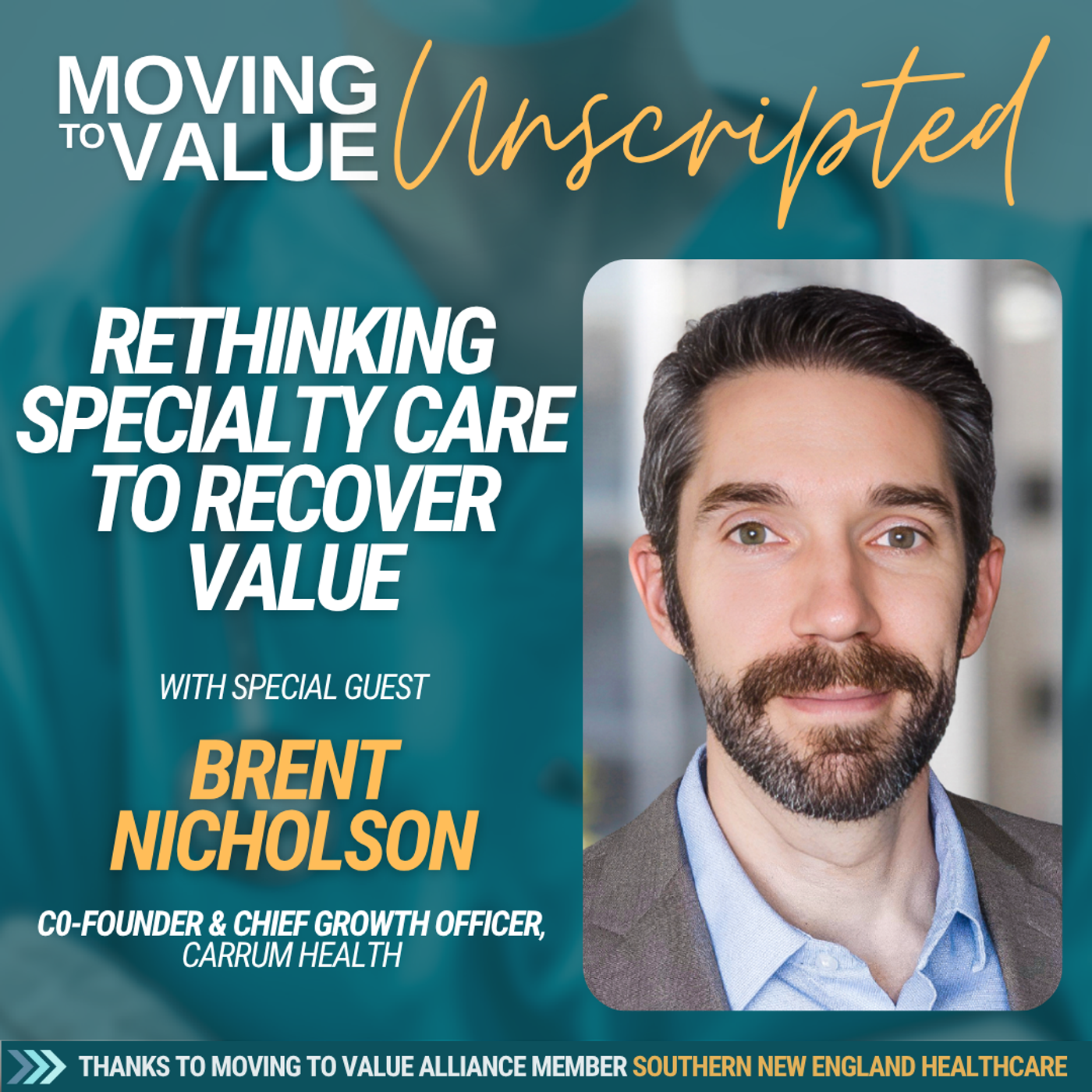
Rethinking Specialty Care to Recover Value (feat. Brent Nicholson)
Specialty care—surgeries, cancer care, and complex procedures—drives nearly half of all employer health spend and is rising faster than any other category. Brent Nicholson, Co-Founder and Chief Growth Officer of Carrum Health, joins us to explore how high-value specialty networks are disrupting traditional fee-for-service waste. Brent breaks down how Carrum Health expands beyond elective orthopedics into complex oncology and substance use care, leveraging prospective bundled payments with built-in complication warranties. From code-level physician quality curation to independent RAND Corporation data proving 30% surgical avoidance, an 80% drop in readmissions, and $16,000 average savings per procedure, learn why employers are moving toward bold steerage to capture hard-dollar healthcare savings. Find the transcript of this episode at movingtovalue.org/transcript/nicholson ________ Sign up for our email list. Thank you to our members who make our work possible! As a 501(c)(3) nonprofit, the Moving to Value Alliance relies on generous supporters to advance our mission of creating a value-based healthcare ecosystem with high-quality health outcomes at a reasonable cost for plan sponsors and their members. Get involved at movingtovalue.org/members .
September 22, 202646 min
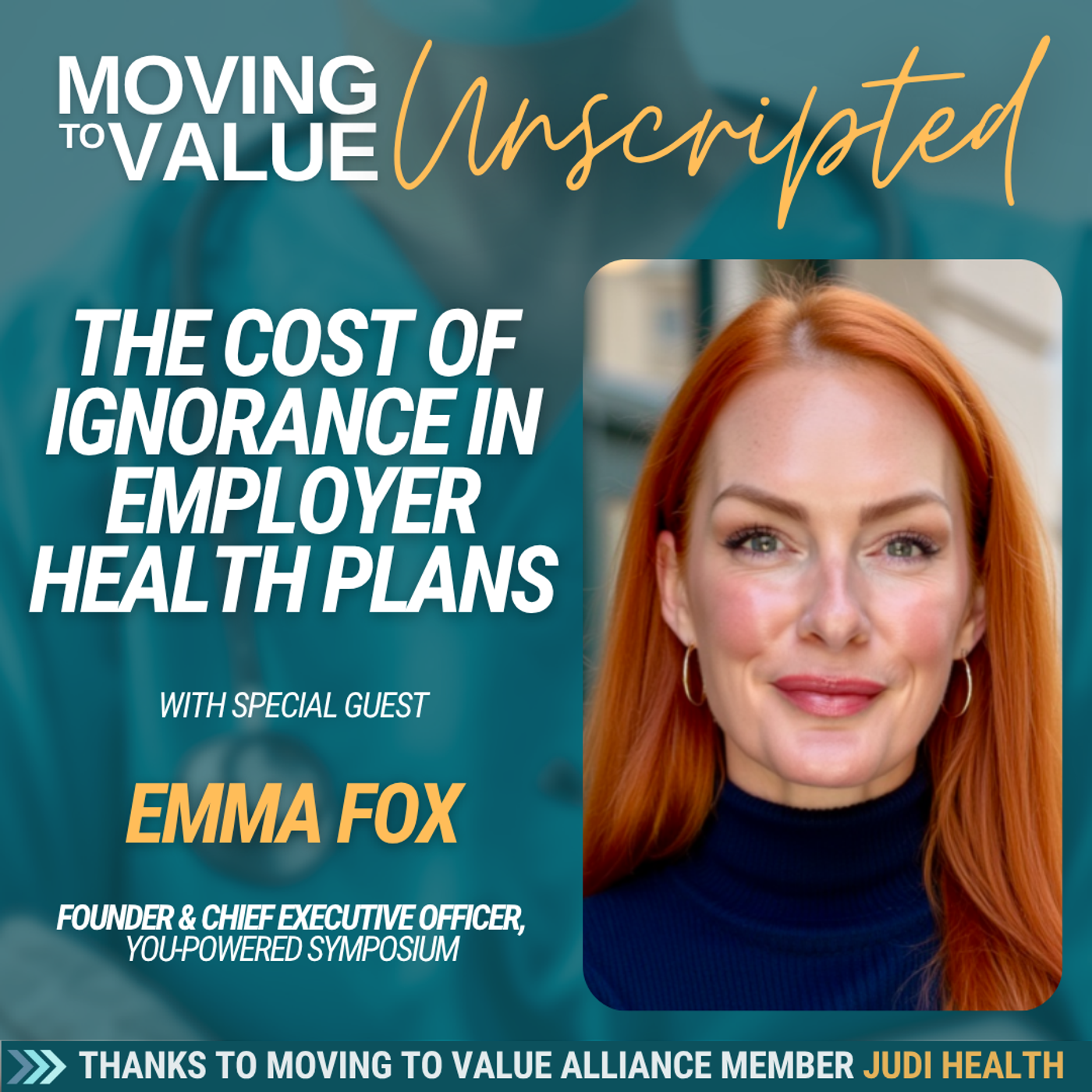
The Cost of Ignorance in Employer Health Plans (feat. Emma Fox)
Why should we accept impossible healthcare cost increases without questioning the numbers? We sit down with Emma Fox, CEO of Foxwatch Consulting and EVP at Liberty Company Insurance Brokers, to name and shame the hidden fees, opaque broker traps and massive ERISA fiduciary liabilities draining employer budgets. From her transition out of legacy insurance carriers to navigating her own medical bankruptcy, Emma pulls back the curtain on an industry structured around misaligned incentives. She breaks down real-world examples of extreme claims mismanagement, explaining why passive plan sponsors face growing legal exposure and how standard broker "benchmarking" spreadsheets offer nothing more than a false sense of security. The solution doesn't require stripping benefits or causing chaos for employees. Emma reveals how strategic adjustments like integrating Direct Primary Care, enforcing pass-through pharmacy contracts and auditing claims data can eliminate waste and slash health plan spend. ________ Sign up for our email list. Thank you to our members who make our work possible! As a 501(c)(3) nonprofit, the Moving to Value Alliance relies on generous supporters to advance our mission of creating a value-based healthcare ecosystem with high-quality health outcomes at a reasonable cost for plan sponsors and their members. Get involved at movingtovalue.org/members .
September 8, 202648 min
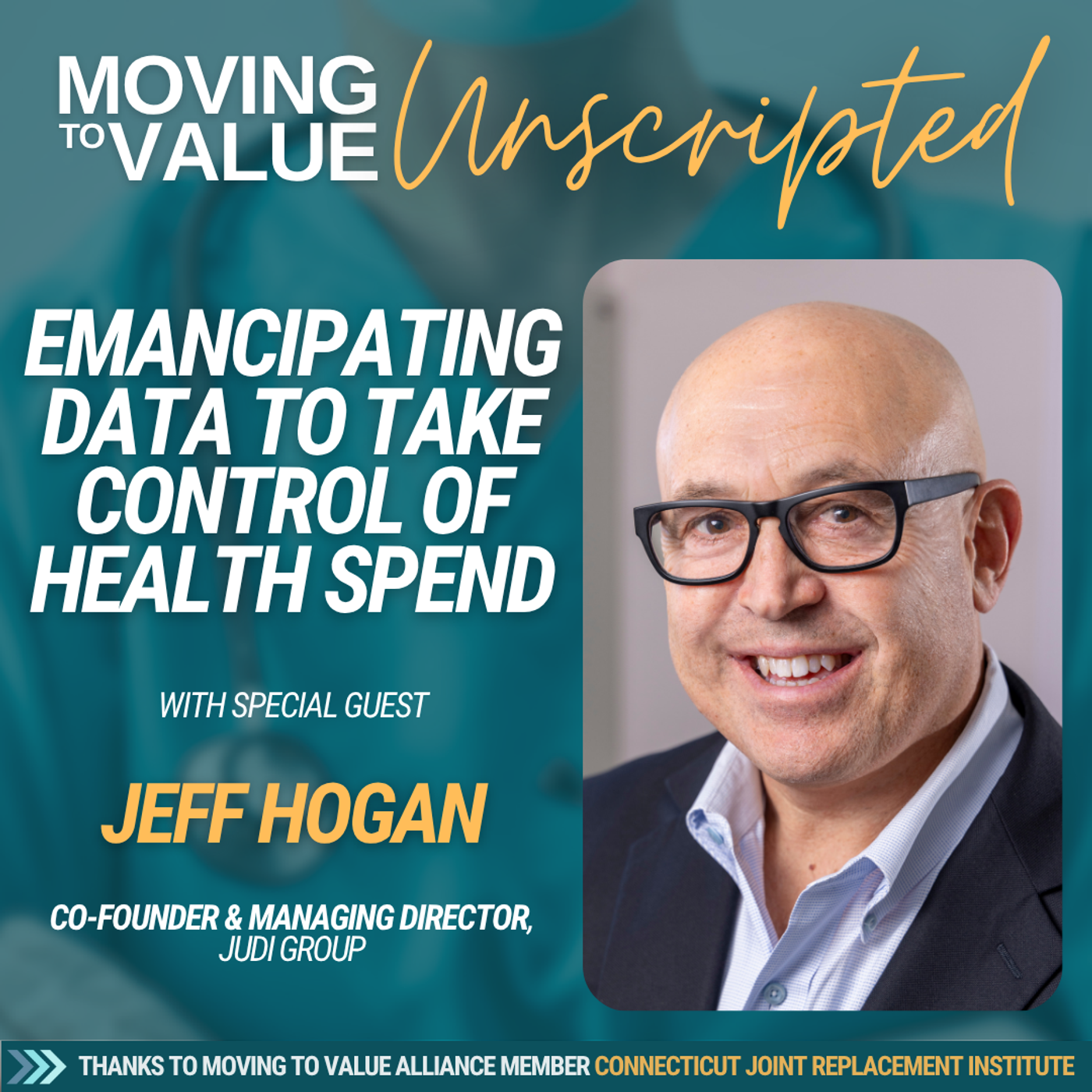
Emancipating Data to Take Control of Health Spend (feat. Jeff Hogan)
With US healthcare spending reaching an unsustainable $5.7 trillion, employers face a turning point as double-digit renewal hikes threaten their bottom line. Jeff Hogan, Co-Founder and Managing Director of The Judi Group and former host of Moving to Value Unscripted , returns to break down how plan sponsors can transition from passive buyers into active fiduciaries. Jeff uncovers the hidden contract mechanisms, PBM spread pricing, and TPA fees that siphon off 25% to 33% of employer healthcare spend. He outlines what business leaders must do to comply with expanded Consolidated Appropriations Act (CAA) rules, enforce claims-data rights and protect themselves from personal fiduciary liability. Tune in to discover actionable strategies for taking back control of your health plan over the next 12 to 24 months. ________ Sign up for our email list. Thank you to our members who make our work possible! As a 501(c)(3) nonprofit, the Moving to Value Alliance relies on generous supporters to advance our mission of creating a value-based healthcare ecosystem with high-quality health outcomes at a reasonable cost for plan sponsors and their members. Get involved at movingtovalue.org/members .
November 12, 202444 min
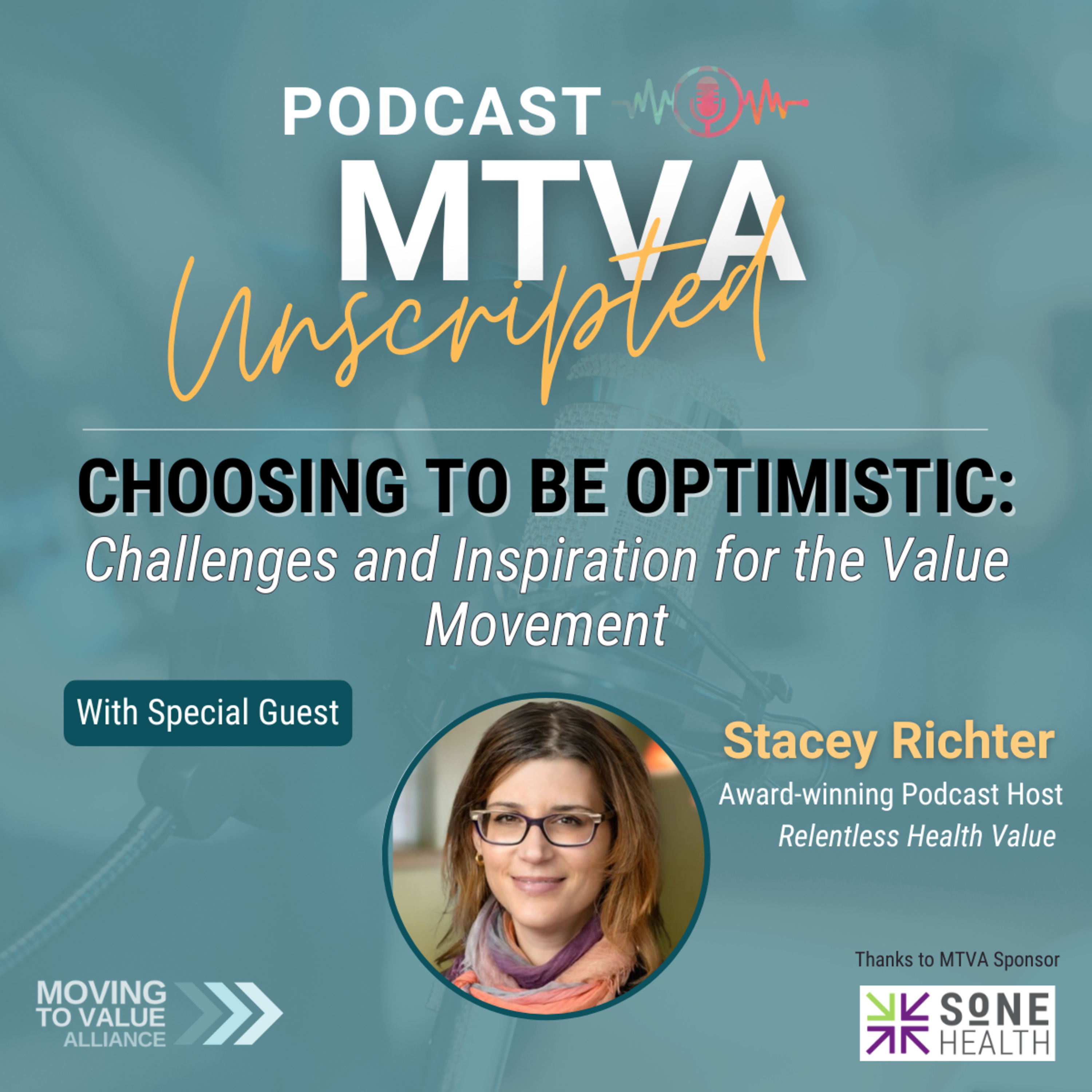
Choosing to be Optimistic: Challenges and Inspiration for the Value Movement w/ Stacey Richter
The Moving to Value Alliance (MTVA) has been promoting value in health care for over 7 years. Though we’ve seen some progress, spending is steadily rising, many health outcomes remain unchanged, and burnout is a real problem for healthcare professionals. It can be easy to feel discouraged, but that’s not what MTVA – nor our special guest this week – stand for. “I feel like it’s a choice in a way to be pessimistic or optimistic. You know that change is slow until it’s really fast, that’s how it always works.” Who better to discuss the state of the movement to value in healthcare than Stacey Richter?! As host of the top healthcare podcast Relentless Health Value , Stacey is usually the one asking questions – she’s interviewed hundreds of experts from all corners of the industry. We’re honored she let us turn the tables for this conversation with MTVA Board Members. Stacey is tuned into the healthcare landscape. In this episode, we learn about her “why” and discuss the role of technology and operational excellence, the importance of primary care, and how the term “value” has been coopted. Stacey is hopeful for the future, and she points to the local level for sources of inspiration. “I firmly believe that when enough people begin to push in the same direction, when the reputational damage starts to happen from people who are overly putting profits over patients in really obvious and unpalatable ways, that's when things start to change.” In addition to hosting Relentless Health Value , Stacey is co-president of QC Health – a public benefit corporation finding cost-effective ways to improve the health of Americans. MTVA Board Member John Rodis, MD works with Stacey as the Benefit Director of QC Health. Stacey is also co-president of Aventria Health Group , a consultancy working with clients who endeavor to form collaborations with payers, providers, pharma, employer organizations or patient advocacy groups. Episodes mentioned, from MTVA Unscripted and Relentless Health Value: MTVA Unscripted episode with Ge Bai MTVA Unscripted episode with Brian Klepper Relentless Health Value episode with Dr. Marty Makary Relentless Health Value episode with Dr. Will Shrank ———————————— We’re excited to welcome like-minded organizations and individuals to join the MTVA Membership program! As a 501(c)(3) nonprofit, we rely on support from our grassroots network to advance our mission of creating a value-based health system with high-quality patient outcomes at a reasonable cost. We’re proud to offer two membership models, Ally Member and Trade Member. Tax-deductible membership contributions help us enrich the healthcare environment with quality content – including this podcast – and robust platforms to fuel discussion, collaboration, and advocacy that lead to ground-breaking solutions. For more information and to join us, visit our website https://www.movingtovalue.org/membership . All episodes of MTVA Unscripted can be found here .
July 9, 202446 min
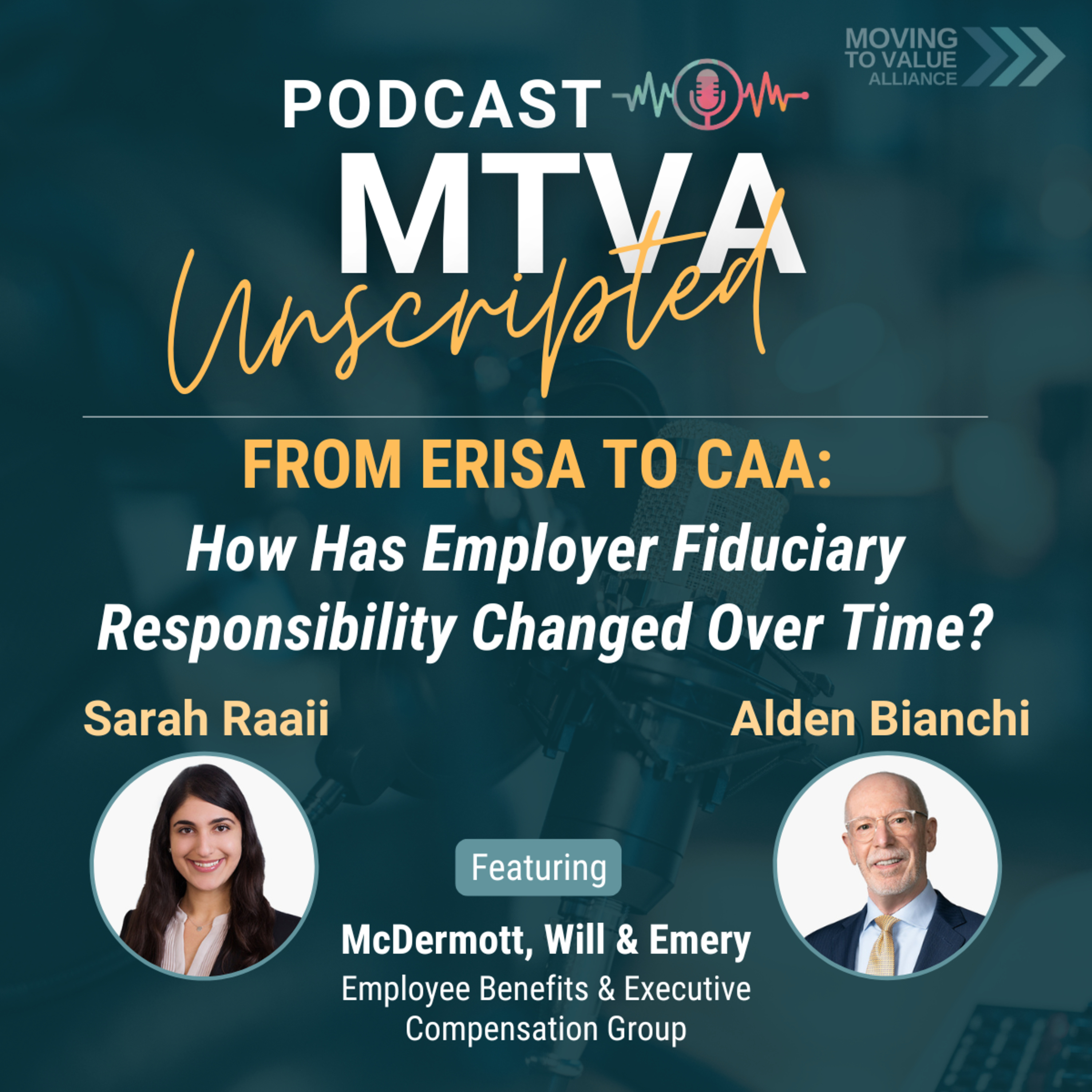
From ERISA to CAA: How Has Employer’s Fiduciary Responsibility Changed Over Time?
Though ERISA is often thought of as an issue for retirement plans, the law has always applied to employer-sponsored health benefit plans. The Consolidated Appropriations Act of 2021 (CAA) sought to put a spotlight on the issue by clarifying responsibilities of health benefit plan fiduciaries and the third-party service providers they contract with. Yet, 3 years after its passage, many plan sponsors still can’t get their vendors or advisors to provide the required fee disclosures. “I’m baffled. I’ve never seen such wholesale noncompliance that seems to be just tolerated indefinitely. Something’s got to move there.” — Alden Bianchi In this conversation with MTVA, attorneys Sarah Raaii and Alden Bianchi of McDermott, Will & Emery’s Employee Benefits & Executive Compensation Group share how to comply with the CAA’s new requirements, and what health plan fiduciaries can do to ensure they fulfill their responsibilities to beneficiaries. As attorneys who focus on health and welfare plan issues, Sarah and Alden discuss the history of ERISA, steps that employers and health plan fiduciaries should take, and what it might take to boost compliance. ————————————————————————— Check out our other episodes on health plan fiduciary responsibility: MTVA Unscripted episode on the Johnson&Johnson lawsuit MTVA Unscripted episode on what employers need to do to comply with CAA All episodes of MTVA Unscripted can be found here .
February 3, 202636 min
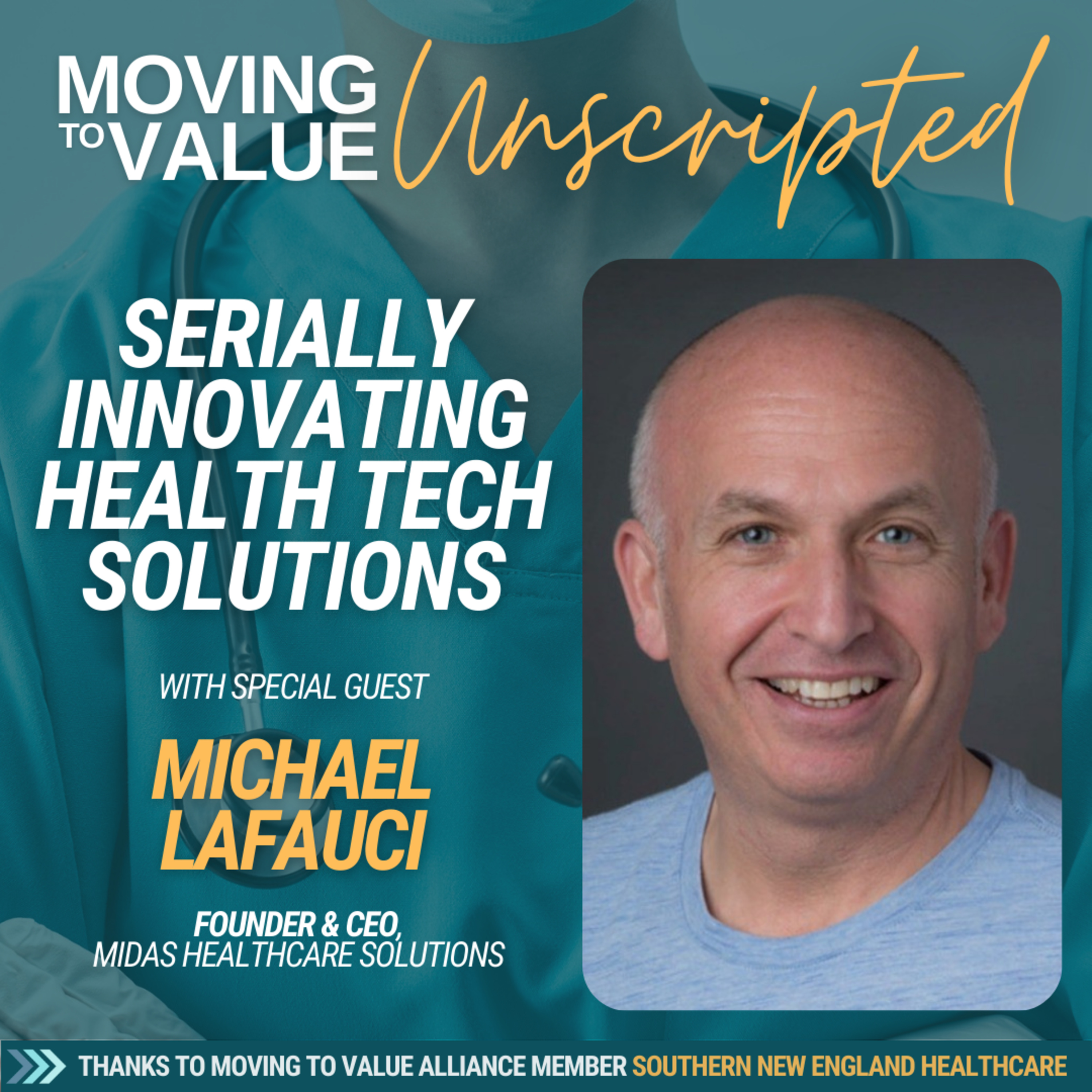
Serially Innovating Health Tech Solutions (feat. Michael LaFauci)
From the ball park to the operating room, Michael LaFauci spots solutions with an innovator's eye. The idea for his current venture, Midas Healthcare Solutions, began with a lint roller. LaFauci discusses the "innovator’s DNA" that led him from pharmacy assistant to serial entrepreneur. He developed technology that allowed sports fans to order refreshments from their seats. He created a device to prevent fetal lacerations during C-sections. Now, his team's MidasVIEW system is increasing transparency and safety in drug diversion within health systems, integrating digital connectivity, 360-degree cameras and artificial intelligence to create a verifiable chain of custody and make medication disposal feel cool. Beyond the technology, LaFauci touches on the grit required for innovation — the blood, sweat and tears of a years-long journey from a lint roller prototype to a commercialized pilot, as well as the courage to "fall forward" and trust his vision. ________ Sign up for our email list. Thank you to our members who make our work possible! As a 501(c)(3) nonprofit, the Moving to Value Alliance relies on generous supporters to advance our mission of creating a value-based healthcare ecosystem with high-quality health outcomes at a reasonable cost for plan sponsors and their members. Get involved at movingtovalue.org/membership .
July 16, 202543 min
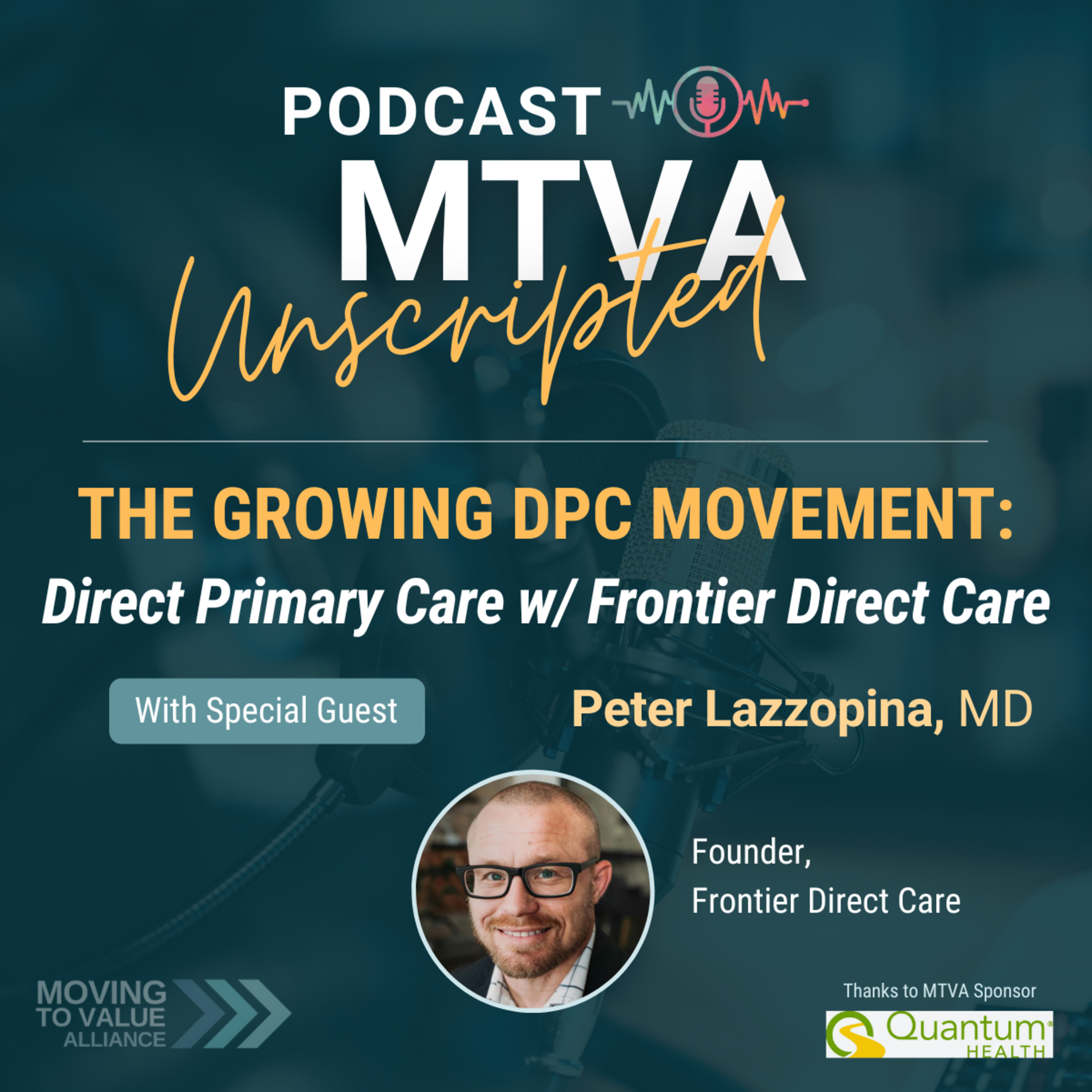
The Growing Direct Primary Care Movement w/ Frontier Direct Care Founder Dr. Peter Lazzopina
“The only thing that actually reduces mortality and morbidity in primary care is a long-term relationship with a PCP.” In this conversation, MTVA explores the fast-growing movement of direct primary care (DPC) with special guest Peter Lazzopina, MD - Founder of Frontier Direct Care in Texas. Based in the Rio Grande Valley, Frontier has grown organically from a single-man operation to a thriving network that’s redefining access, cost, and outcomes. Dr. Lazzopina describes how relationship-based medicine works better for patients, employers and providers. The model keeps physician panel sizes small, visits long, and incentives fully aligned—resulting in high provider morale, better health outcomes, and big savings for employers. By partnering with Frontier, the city of McAllen, TX reduced ER visits by 74% in just one year. In two years, Frontier saved the city $8 million ! Dr. Lazzopina and Frontier are proving that DPC can help solve our primary care crisis! This is a grassroots movement with real momentum—and one that can’t be ignored! NOTE: Frontier Direct Care has a business relationship with MTVA Board Member Dr. Steve Schutzer’s company Upswing Health. This episode is NOT sponsored by Upswing nor Frontier. ———————————— All episodes of MTVA Unscripted can be found here . | Sign up for our email list here . Thank you to our MTVA Trade Members and Ally Members whose support helps make this podcast possible! As a 501(c)(3) nonprofit, we rely on support from our grassroots network to advance our mission of creating a value-based health system with high-quality patient outcomes at a reasonable cost. For more information and to join us, visit our website: https://www.movingtovalue.org/membership .
April 3, 202549 min
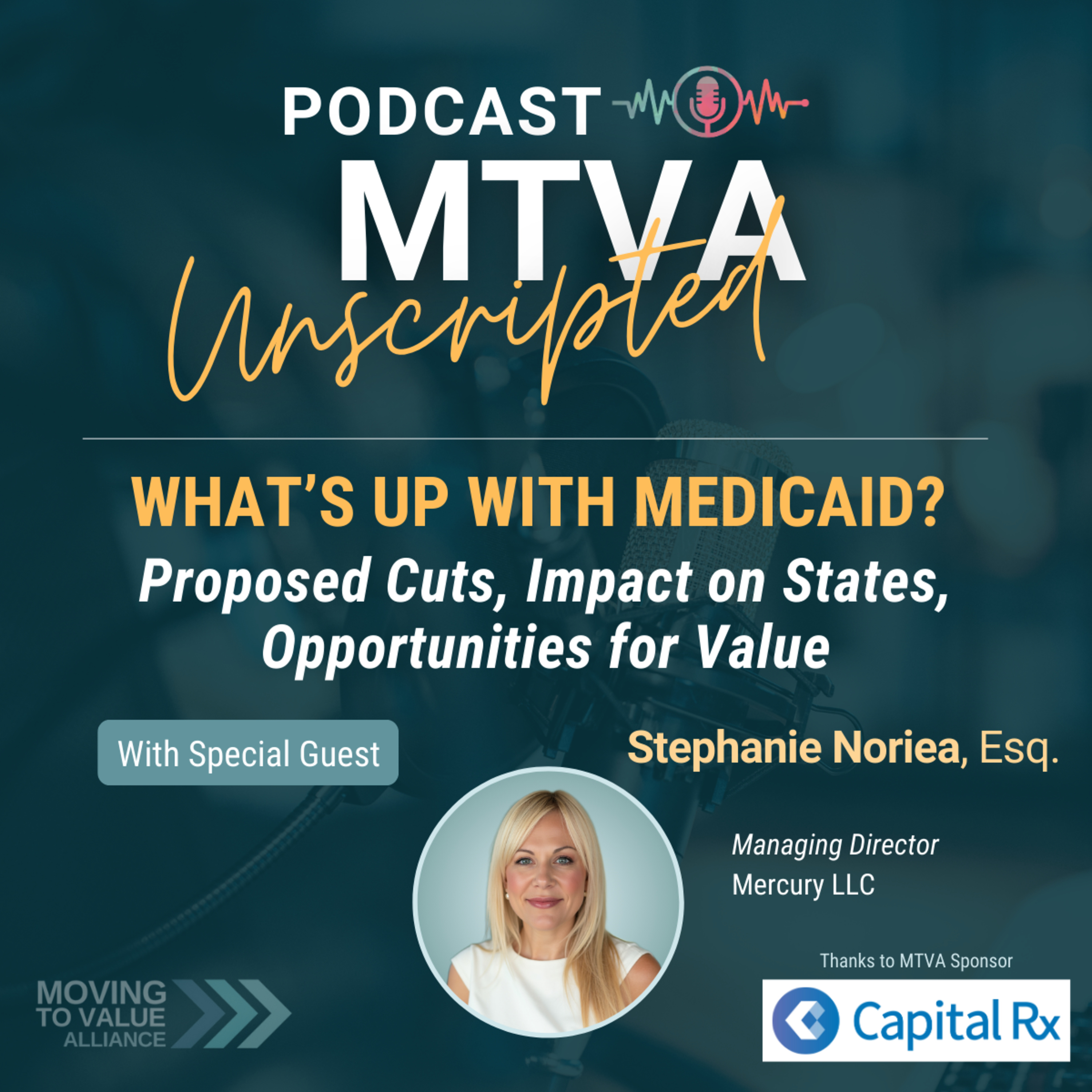
What’s up with Medicaid? Proposed Cuts, Impact on States, and Opportunities for Value w/ Stephanie Noriea
We’re just a couple months into the second Trump administration, and already we’re seeing a massive push to reduce federal spending. One program that seems to be on the chopping block: Medicaid. In late February, House Republicans passed a budget resolution that would drastically reduce federal funding for Medicaid . What’s really going on in Washington? How would proposed cuts impact states – and the millions of Americans who are covered by Medicaid? How can we harness this attention on Medicaid to advance solutions that cut costs AND improve outcomes? In this episode, Stephanie Noriea joins MTVA to help us make sense of the current situation with Medicaid. Stephanie is an attorney and Managing Director at Mercury LLC who has spent the past 9 years working at the intersection of Medicaid and value-based care. She shares her experience working with startups to bring innovative solutions to Medicaid, breaking down how to navigate the complex landscape and enact meaningful change. “I have never met a single legislator or governor who says ‘I hate medicaid.’ That’s not what I hear. What I hear is how do we effectuate change? How do we do this better? How do we engage better? And they don't know. And it’s up to us, the practitioners on the ground, the thought leaders, etc to bring these solutions.” MTVA and Stephanie agree: NOW is the time to bring value-based solutions to Medicaid! It is possible to generate cost savings while simultaneously improving access and quality of care. Tune in to learn what’s on the horizon for Medicaid, and how we can leverage ideas from the value movement to help transform the program! ———————————— Sign up for our email list here . As a 501(c)(3) nonprofit, we rely on support from our grassroots network to advance our mission of creating a value-based health system with high-quality patient outcomes at a reasonable cost. Tax-deductible membership contributions help us enrich the healthcare environment with quality content – including this podcast – and robust platforms to fuel discussion, collaboration, and advocacy that lead to ground-breaking solutions. For more information and to join us, visit our website https://www.movingtovalue.org/membership . All episodes of MTVA Unscripted can be found here .
March 4, 202548 min
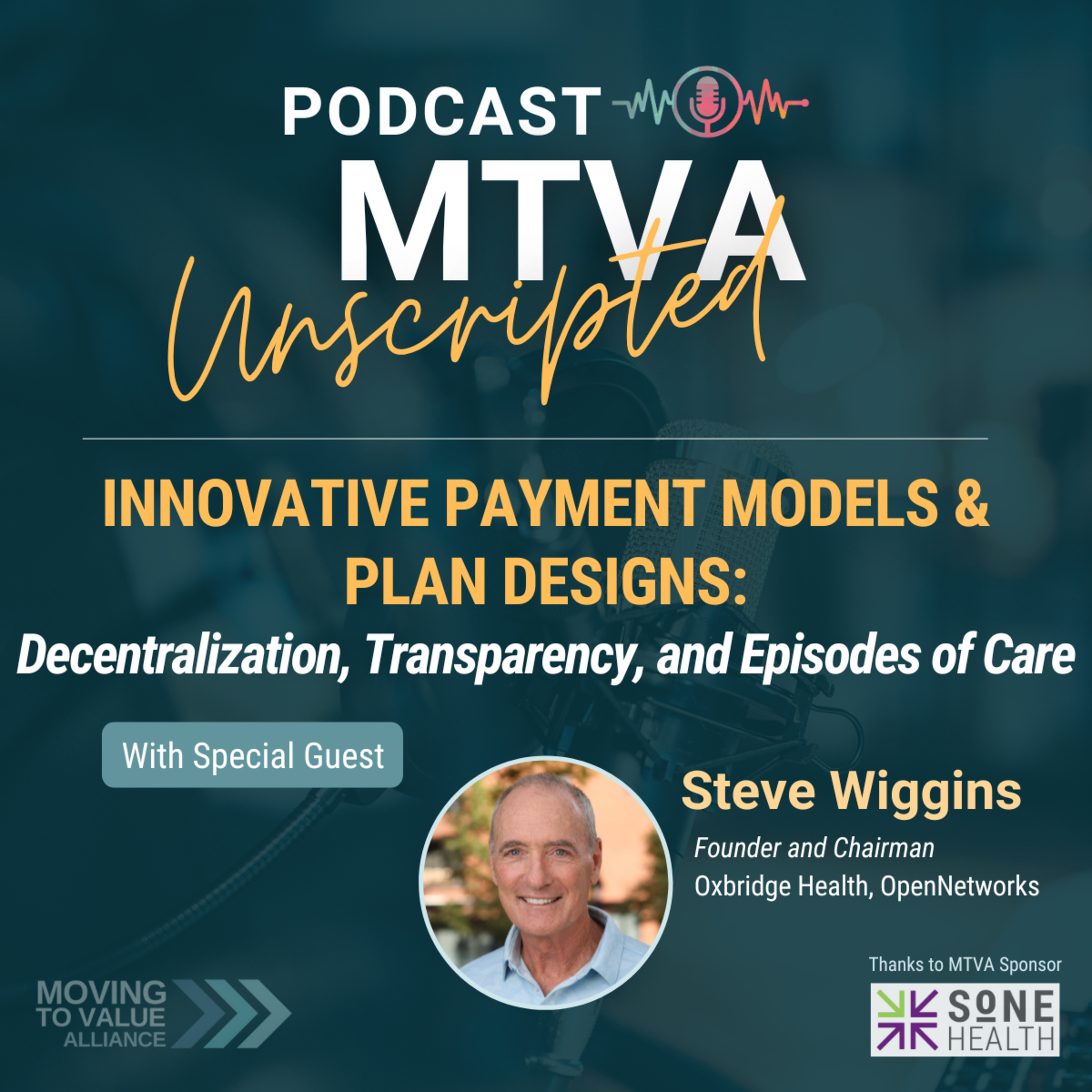
Innovative Payment Models & Plan Designs: Decentralization, Transparent Pricing, and Episodes of Care w/ Steve Wiggins
“I’d like to leave an infrastructure behind that is better than the one I encountered when I came in, because we're stifling innovation, we're stifling creativity, we’re stifling advance.” How can decentralization and transparent pricing reshape American healthcare? In this episode of Moving to Value , the MTVA Board sits down with Steve Wiggins , a healthcare entrepreneur with 40 years of experience at the intersection of healthcare and technology. Steve has founded and led multiple companies driving innovations in payment models and care management—and today, he’s on a mission to transform the system with his latest ventures: Oxbridge Health and OpenNetworks . Steve’s involvement in healthcare began in college, when his best friend suffered a life-changing injury that left him paralyzed. Since then, he has dedicated his career to creating solutions that improve access, affordability, and outcomes. Steve shares how innovative plan designs and payment models based on episodes of care can break the cycle of rising costs and realign payment with how patients experience healthcare. He also explores how policies like the Transparency in Coverage Rule and the No Surprises Act are pushing the industry toward greater transparency. “To me, if you’ve been in my seat, you look at this and you say, ‘This is the beginning of a profound change. It’s all going to be different.’” With Oxbridge Health, he introduces “Episode Benefit Plans,” which use bundled payments to lower costs while preserving broad provider choice. Open Networks is pioneering America’s first health network cooperative—leveraging pricing transparency and data to offer patients predictability on their out-of-pocket costs. ———————————— As a 501(c)(3) nonprofit, we rely on support from our grassroots network to advance our mission of creating a value-based health system with high-quality patient outcomes at a reasonable cost. Tax-deductible membership contributions help us enrich the healthcare environment with quality content – including this podcast – and robust platforms to fuel discussion, collaboration, and advocacy that lead to ground-breaking solutions. For more information and to join us, visit our website https://www.movingtovalue.org/membership . All episodes of MTVA Unscripted can be found here .
January 10, 202548 min
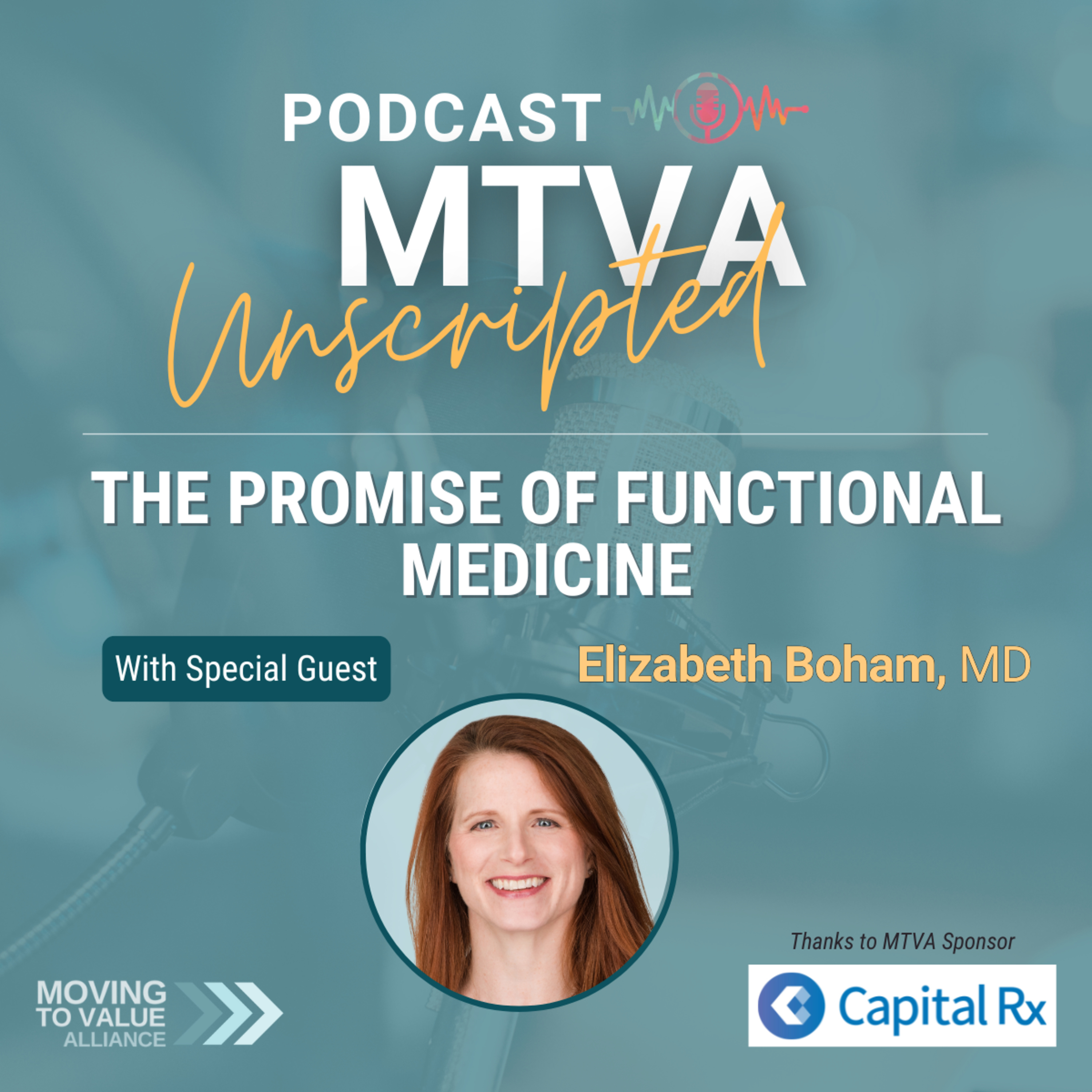
The Promise of Functional Medicine w/ Dr. Elizabeth Boham
“We are incentivized to practice medicine based on reimbursement, so that has resulted in more procedures, more pharmaceuticals, and less time with our patients. That has to change.” MTVA is joined by Elizabeth Boham, MD to discuss functional medicine. Dr. Boham uses her background in nutrition to help patients improve their health, and manage diseases including insulin resistance, Metabolic Syndrome, Diabetes, autoimmune conditions, and obesity. We discuss steps providers can take to integrate functional medicine principles into their practice, how lifestyle can impact gene expression, and the the critical role diet plays in health. Dr. Boham is Medical Director of the UltraWellness Center in Lenox, Massachusetts, Board Certified in Family Medicine, and also a registered dietitian. She is on the faculty of The Institute for Functional Medicine, and developed a Functional Nutrition course being used to educate physicians and other health professionals worldwide. You can read two studies on the benefits of functional medicine Dr. Boham referenced here: https://pmc.ncbi.nlm.nih.gov/articles/PMC9173848/ https://www.ifm.org/news/cleveland-clinic-functional-medicine-improves-outcomes For more on nutrition, check out our episode with Al Lewis . ———————————— We’re excited to welcome like-minded organizations and individuals to join the MTVA Membership program! As a 501(c)(3) nonprofit, we rely on support from our grassroots network to advance our mission of creating a value-based health system with high-quality patient outcomes at a reasonable cost. We’re proud to offer two membership models, Ally Member and Trade Member. Tax-deductible membership contributions help us enrich the healthcare environment with quality content – including this podcast – and robust platforms to fuel discussion, collaboration, and advocacy that lead to ground-breaking solutions. For more information and to join us, visit our website https://www.movingtovalue.org/membership . All episodes of MTVA Unscripted can be found here .
Is this your show?
Claim this listing to keep it up to date, reach guests who want to pitch you, and manage bookings with Guestify.