Edmund Greaves and Chris Tuite host Mouthy Money - a UK finance podcast on building wealth with long term investing and saving strategies. From the stock market for beginners, to mortgage rates, fears of economic recession, whether to invest in gold and silver or what the consumer price index is, we look at complicated financial topics through a personal lens. With regular financial expert guests to unpick knotty issues, we've got you covered with weekly episodes.
Listen to episodes
60 recent
September 2, 202622 min
Why do some people not trust pensions?
Sean Standerwick is a chartered financial planner, and a fair part of his job is talking people out of distrusting their own pension. This episode is what he tells them. You come away with a number to measure your own pot against. The Retirement Living Standards put a single person's minimum retirement at £13,900 a year, a moderate one at £32,700 and a comfortable one at £45,400, against a full state pension of £12,547.60. You also get the tax case in three parts — relief going in, no tax while the money is invested, and 25% available tax free on the way out — along with the three routes to paying in: salary sacrifice through work, your own limited company, or personally. The second half is the more useful part if you are the sceptic yourself. Sean argues that people seldom object to the pension itself and mostly resist being sold to, and he works through two clients who talked themselves round once the conversation changed shape. Figures are current for the 2026/27 tax year. This episode is information rather than financial advice.
August 25, 202625 min
You Opened a Stocks & Shares ISA — Now What?
From April 2027 the cash ISA allowance for under-65s drops from £20,000 to £12,000. The overall allowance doesn't move, so £8,000 a year has to go somewhere that isn't cash. For a lot of people that turns investing from a someday decision into a this-year one. Edmund Greaves is joined by Andy Prosser, Head of Investments at the ETF platform InvestEngine, on how to pick what you invest in — time horizon, risk tolerance, the difference between an ETF and a traditional fund — and on what InvestEngine's own investors have been buying this year. Ed also explains what he got wrong when he started. InvestEngine investing data: https://blog.investengine.com/most-bought-etfs-july-2026/ https://blog.investengine.com/most-popular-etfs-uk-2026/ Nothing here is financial advice. Investing involves risk and you can lose money. ISA and tax rules can change.
August 13, 202628 min
Investing Stakes: The AI sell off has wiped out Ed's gains
AI stocks retreated through July, and Ed’s portfolio went with them. Chris Tuite's didn't. So does Ed scrap his strategy and copy Chris T’s? That question sits at the centre of this month's Investing Stakes, in partnership with Stratiphy. If you want to explore Stratiphy or build your own rules-based portfolio, you can use our referral link:🔗 https://www.stratiphy.io/referrals?code=INVESTINGSTAKESDisclosure: This is a referral link. We may receive a benefit if you sign up using it. Ed’s tech-heavy Black Elephant strategy peaked in June and has handed back a chunk of it since, with Corning alone falling close to half its value and accounting for roughly half the decline. Chris kept out of the direct AI names and has carried on climbing. He is now behind every strategy and benchmark we track. Chris Ling, Chief Investment Officer at Stratiphy, walks through why AI stocks pulled back, why the drawdown stayed concentrated in that corner of the market, and what happens to your returns when you abandon a strategy mid-run to chase whoever led last month. We put six months of our own numbers into a matrix and follow what would have happened to an investor who switched into the winner every time. The answer is not flattering. We also cover the difference between our two quantitative models, why a faster-trading strategy is not the same thing as a more volatile one, and the case for doing nothing when the market goes against you. Chapters and full data tables are on the Substack, where we publish the monthly performance figures in more detail.👉 Stratiphy: https://www.stratiphy.io/referrals?code=INVESTINGSTAKES 👉 Substack: https://mouthymoney.substack.com👉 Subscribe for a new episode every monthYour capital is at risk. Past performance does not guarantee future returns. Nothing here is personal financial advice.
August 11, 202623 min
Why a pensions might be better than a Junior ISA for your kids
Ed pays £50 a month into a junior ISA for each of his sons. At 18 it's legally theirs, and he can't do a thing about it. So what happens if he uses a pension instead? Full description Every month he puts £50 into a junior ISA for each of his two sons. On their eighteenth birthdays that money becomes theirs outright — no conditions, no drip-feed, no veto. So Ed modelled the alternative: the same £50 a month into a junior SIPP, a self-invested personal pension. Children get 20% tax relief despite paying no tax, which means £50 goes in as £62.50. Over a lifetime, that relief alone is worth £82,000. The catch is that they can't touch it until 57 at the earliest, and probably 60 by the time his sons get there. Chris and Ed work through the whole model — the tax relief, the charges, the inflation problem — and argue about whether an 18-year-old can be trusted with the money at all. We both end up somewhere we didn't expect. The numbers, at 8% growth and 0.5% annual charges: £10,200 paid in over 17 years becomes £19,930 in a junior ISA at 18, or £24,912 in a junior SIPP. Left alone to 60, that SIPP reaches £511,675. Restart contributions at 22 and it reaches £661,264, against £529,012 for the ISA. Raise charges to 1.2% and £181,915 disappears. Double the contribution to £100 a month and the pot hits £1,322,529 — which 3% inflation reduces to £231,211 in today's money. (00:00) I think I've been doing this wrong(01:12) The junior ISA as it stands(02:32) Chris makes the case for the ISA(05:02) Would an 18-year-old actually blow it?(06:31) The tax relief is worth £82,000(07:20) Junior ISA against junior SIPP at 18(09:01) What happens if they restart at 22(09:40) When can they actually access a pension?(10:30) What charges do to all of this(13:00) Only 23% of UK workers are on track for a moderate retirement(15:43) What £100 a month becomes(17:36) The inflation problem nobody talks about(20:00) Tax on the way out(20:49) What Chris is doing(21:23) What I've decided to do Full tables and charts, at both contribution levels and both charge scenarios, in cash and in today's money: [Substack link] Retirement Living Standards figures from Pensions UK, 2026 update, calculated by the Centre for Research in Social Policy at Loughborough University. Neither of us is a financial adviser and none of this is financial advice. All projections are illustrations based on stated assumptions, not forecasts. Investment returns are not guaranteed and tax rules change.
August 4, 202623 min
£50,000 or a £1 Million Coin Flip?
£50,000 guaranteed, or a 50/50 coin flip for £1 million? YouGov asked 4,600 British adults, and 73% took the safe money. That result set off a fair bit of argument — including between the two of us. Ed and Chris go through what the poll actually found, why the gender and age splits are the most revealing part of it, and how each of us thinks about risk with our own money. Then we both commit to an answer, and we don't land in the same place. Along the way: why the coin flip is worth ten times the guaranteed option on paper, whether Americans really are less risk-averse than Brits, what £50,000 would actually buy you, and the question neither of us had thought to ask until the end. Chapters 00:00 The question 00:58 What the poll found 03:15 Are Americans really bigger risk-takers? 04:30 The gender split 06:42 Why young people flip the coin 09:02 The financial equivalent of watching paint dry 11:04 The risk of not taking enough risk 17:35 What we'd actually do 18:45 Where the money would go 22:06 Wait — who's tossing the coin? So what's your answer? Guaranteed cash or a shot at life-changing money — and what's the number that would make you flip? Tell us in the comments; we read and reply to all of them. New episodes weekly. Subscribe so you don't miss one. Everything here is general information about money, not personal financial advice. If you're making a decision about your own finances, speak to a regulated adviser.
July 21, 202622 min
Overpay the Mortgage or Max the Pension? The £600k Decision
£500 a month has just freed up. Do you kill the mortgage — or supercharge the pension? When childcare costs drop, most households would love the problem Chris is facing: a few hundred pounds a month to redirect, and one big decision to make. Overpay the mortgage and be debt-free years early, or pour it into the pension and let compounding do the work? So Ed and Chris ran the real numbers on Chris's own finances — a £453k mortgage on a 29-year term, 27 years to retirement — and modelled both paths. The gap is bigger than you'd think: roughly £750k in the pension one way, around £1.3m the other. But as they get into tax relief, the spread between market returns and mortgage rates, what each route means for retirement income, and a smart way to clear the mortgage with tax-free cash, it becomes clear the spreadsheet answer isn't always the one you'd choose. In this episode: - How £500 a month becomes a six-figure difference over 27 years - Why a guaranteed 4.5% saved isn't the same as a hoped-for 7% earned - Where both options land against the "comfortable retirement" benchmark - Using your 25% tax-free lump sum to clear the mortgage — and the trap of doing it the wrong way - Why pensions and property are now taxed very differently when you pass them on Team mortgage or team pension? We'd love to hear how you'd play it. We don't give financial advice — we're talking through our own situations. Everything here rests on assumptions that will change, so if you're weighing this up yourself, speak to an FCA-regulated financial adviser. (0:00) The £500 question (1:39) Chris's 29-year mortgage problem (2:27) The reveal: £750k vs £1.3m (4:42) Why the real number could be higher (6:54) Shorting inflation & the 2.5% spread (8:48) Clearing the mortgage a decade early (9:30) What it means in retirement (11:09) Finishing the mortgage with tax-free cash (12:18) The inheritance tax trap: home vs pension (15:27) A two-pronged plan (17:39) The discipline problem (18:51) Inflation, rates & staying ahead (20:51) So, what did Chris decide? The Mouthy Money podcast — how we actually think about pensions, ISAs, mortgages, tax and the economy. New episodes every week.🔔 Subscribe: https://www.youtube.com/@mouthymoneypodcast📰 Mouthy Money News (short explainers, twice a week): https://www.youtube.com/@MouthyMoneyNews📲 TikTok: https://www.tiktok.com/@mouthy.money📸 Instagram: https://www.instagram.com/mouthymoney/✍️ Substack: https://mouthymoney.substack.com/📩 Get in touch: editors@mouthymoney.co.ukListen anywhere:Spotify: https://open.spotify.com/show/72bQEJnPAWJprmy0B9Yy4uApple: https://podcasts.apple.com/gb/podcast/mouthy-money/id1712308475 Full disclaimer: Produced for general information only. Not investment, legal, tax, mortgage or other financial advice. If in doubt, consult a regulated professional about your own situation. Past performance is no guarantee of future results. Investments can fall as well as rise and you may get back less than you put in. Never invest more than you can afford to lose. More at https://www.fca.org.uk/investsmart. Captions are auto-generated and may not be fully accurate.
July 10, 202625 min
Investing Stakes: The AI Stock Nobody Talks About (But Everyone Depends On)
Every month, Ed and Chris put real money into their own strategies, run them live on Stratiphy and compare results with an expert on hand to explain the damage. If you want to explore Stratiphy or build your own rules-based portfolio, you can use our referral link: 🔗 https://www.stratiphy.io/referrals?code=INVESTINGSTAKES Disclosure : This is a referral link. We may receive a benefit if you sign up using it. This episode: Alphabet is in everyone's portfolio, but is there a smarter way to back the same story? Enter Corning — the 1851 glassmaker quietly building the fibre optics that AI data centres can't run without. Plus, Ed's portfolio flashes its first sell signal, and the gap between the two strategies starts to open up. Picks and shovels, bubble talk, and a lesson in why one day's performance tells you nothing. ⏱️ Chapters 00:00 Intro 00:48 Stratify update: concentration limits and rebalancing 02:42 Why Alphabet is in every portfolio — except Chris T's 03:57 The tech-sceptic case: waiting for the correction 06:01 Is Alphabet diversified enough to survive? 08:15 The fundamental view: valuations, CapEx and the cloud backlog 11:53 Corning: the picks-and-shovels alternative 14:12 Why a monopoly on the infrastructure beats picking winners 16:37 The strategies: scores on the doors 18:01 What's driving the gap — and the risk-adjusted picture 20:16 Ed's first sell signal 22:04 The one-day drop that means nothing 23:26 Final thoughts Capital at risk. This episode was made in partnership with Stratiphy. The Mouthy Money podcast — how we actually think about pensions, ISAs, mortgages, tax and the economy. New episodes every week. 🔔 Subscribe: https://www.youtube.com/@mouthymoneypodcast 📰 Mouthy Money News (short explainers, twice a week): https://www.youtube.com/@MouthyMoneyNews 📲 TikTok: https://www.tiktok.com/@mouthy.money 📸 Instagram: https://www.instagram.com/mouthymoney/ ✍️ Substack: https://mouthymoney.substack.com/ 📩 Get in touch: editors@mouthymoney.co.uk Listen anywhere: Spotify: https://open.spotify.com/show/72bQEJnPAWJprmy0B9Yy4u Apple: https://podcasts.apple.com/gb/podcast/mouthy-money/id1712308475 Important : This content is for information and discussion only and is not financial advice. Capital is at risk and past performance is not a reliable indicator of future results. Full disclaimer : Produced for general information only. Not investment, legal, tax, mortgage or other financial advice. If in doubt, consult a regulated professional about your own situation. Past performance is no guarantee of future results. Investments can fall as well as rise and you may get back less than you put in. Never invest more than you can afford to lose. More at https://www.fca.org.uk/investsmart. Captions are auto-generated and may not be fully accurate.
July 7, 202617 min
How Much Cash Should You Actually Keep?
Somewhere in Britain, someone has £40,000 in a savings account and can't tell you why. It crept up a pound at a time, each one buying a little more peace of mind. And most of it is now going backwards. We're taught that saving is the safe choice. But past a point, cash stops protecting you and starts costing you — and almost nobody can tell you where that point sits. This week, Ed and Chris Tuite work out how much cash you should actually keep. Three things that move your number: how safe your job is, what fallback options you have, and how well you sleep at night. Then the part most people skip — what to do once you hit your number, why you flip your saving ratio, and the £19,000 difference it makes over 20 years. Got a rainy day fund? Tell us your number in the comments. The Mouthy Money podcast — how we actually think about pensions, ISAs, mortgages, tax and the economy. New episodes every week. 🔔 Subscribe: https://www.youtube.com/@mouthymoneypodcast 📰 Mouthy Money News (short explainers, weekly): https://www.youtube.com/@MouthyMoneyNews 📲 TikTok: https://www.tiktok.com/@mouthy.money.news 📸 Instagram: https://www.instagram.com/mouthymoney/ ✍️ Substack: https://mouthymoney.substack.com/ 📩 Get in touch: editors@mouthymoney.co.uk Important: This content is for information and discussion only and is not financial advice. Capital is at risk and past performance is not a reliable indicator of future results. Produced for general information only. Not investment, legal, tax, mortgage or other financial advice. If in doubt, consult a regulated professional about your own situation. Past performance is no guarantee of future results. Investments can fall as well as rise and you may get back less than you put in. Never invest more than you can afford to lose. More at https://www.fca.org.uk/investsmart. Captions are auto-generated and may not be fully accurate.
June 29, 202625 min
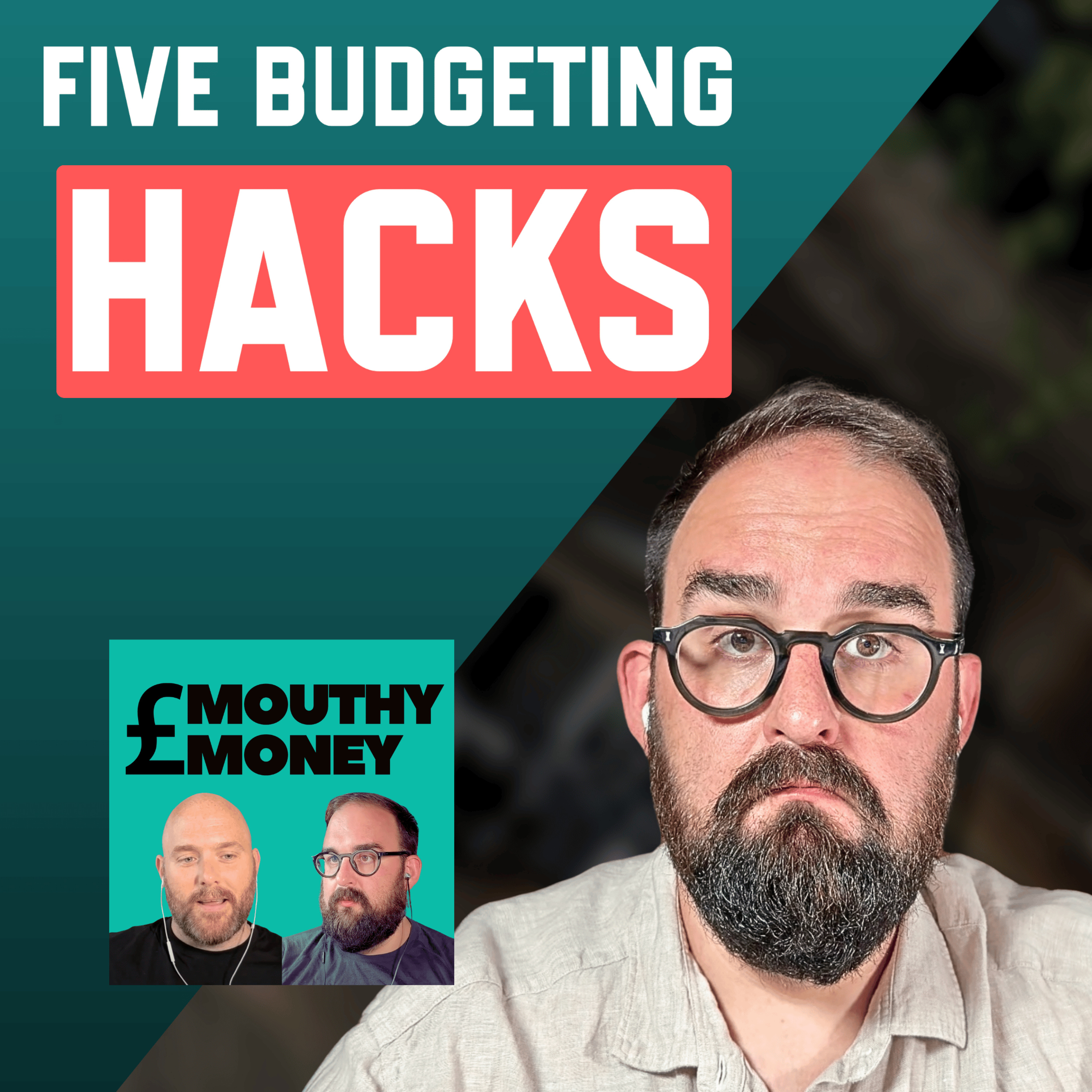
Five Money Budgeting Hacks to Make Every Pound Work Harder
Most of us treat our monthly budget like a fixed thing: money comes in, bills go out, and whatever's left is what's left. But that's rarely the whole story. In this episode, Edmund and Chris dig into how to sweat every pound in your budget — the five rules they actually use themselves, where they're getting it right, and where they're (cheerfully) getting it wrong. No "skip your morning coffee" clichés. Just honest, practical budgeting from two people who track this stuff to the penny — including the real numbers from Chris's own household and the framework Ed has used for a decade. What we cover: -Why you should always pay yourself first -The 50/20/30 rule — and when to ignore it -How to split bills fairly when you and your partner earn different amounts -Working out your "why" before you worry about the how -Good debt vs bad debt, and how to dig your way out The Mouthy Money podcast — how we actually think about pensions, ISAs, mortgages, tax and the economy. New episodes every week. 🔔 Subscribe on YouTube: https://www.youtube.com/@mouthymoneypodcast 📰 Mouthy Money News (short explainers, twice a week): https://www.youtube.com/@MouthyMoneyNews 📲 TikTok: https://www.tiktok.com/@mouthy.money 📸 Instagram: https://www.instagram.com/mouthymoney/ ✍️ Substack: https://mouthymoney.substack.com/ 📩 Get in touch: editors@mouthymoney.co.uk Important: This content is for information and discussion only and is not financial advice. Capital is at risk and past performance is not a reliable indicator of future results. Full disclaimer: Produced for general information only. Not investment, legal, tax, mortgage or other financial advice. If in doubt, consult a regulated professional about your own situation. Past performance is no guarantee of future results. Investments can fall as well as rise and you may get back less than you put in. Never invest more than you can afford to lose. More at https://www.fca.org.uk/investsmart. Captions are auto-generated and may not be fully accurate.
June 22, 202620 min
How Chris secured a lower rate on his mortgage - and what his plan to do next is
Mortgage rates were supposed to be climbing — Middle East tensions, inflation creeping back, every reason for lenders to get nervous. So how has Chris just secured a deal cheaper than the one he's on? In this episode he walks through exactly how he did it: the rate he's reserved, why he hasn't signed yet, the fix-vs-tracker decision we couldn't quite agree on, and how long he's got before the September deadline. If you've got a remortgage coming up, this is the one that could save you money.⚠️ We're not financial advisers and this isn't financial advice. Everything here is illustrative — we're sharing how we think about our own situations. Figures and projections are assumptions, and past performance is no guide to the future. Do your own research or consider speaking to a regulated adviser before making decisions.👍 Like and subscribe for new episodes every week.🎙️ Weekly podcast on Spotify, Apple & Amazon ✍️ In-depth writing at https://mouthymoney.substack.co.uk *MOUTHY MONEY**Our substack* https://mouthymoney.substack.co.uk *Get in touch* editors@mouthymoney.co.uk *DISCLAIMER*_This video is produced for general informational purposes only. It should not be construed as investment, legal, tax, mortgage or other forms of financial advice. If in any doubt about the themes expressed, consider consulting with a regulated financial professional for your own personal situation. Past performance is no guarantee of future results. Investments can go down as well as up and you may get back less than you started with. Investments are speculative and can be affected by volatility. Never invest more than you can afford to lose. For more information visit www.fca.org.uk/investsmart. Please note, video captions are auto-generated and may not be 100% accurate._
Is this your show?
Claim this listing to keep it up to date, reach guests who want to pitch you, and manage bookings with Guestify.