

Find partners
Moneylife News Bites

Moneylife News Bites

Hosted by Debashis Basu & Sucheta Dalal

Episodes

296

Latest episode

Aug 2026

Language

EN

About the show

Moneylife News Bites is a weekly podcast hosted by veteran journalists and founders of Moneylife, Sucheta Dalal and Debashis Basu. Each week a new episode analyses an important news topic, based completely on unbiased and ethically researched information that is not available anywhere else. A video version of this podcast is available on our YouTube channel - @MoneylifeNewsBites Interested listeners and readers can follow Moneylife News on our website - https://www.moneylife.in/ Hosted on Acast. See acast.com/privacy for more information.

Listen to episodes

60 recent
August 13, 202613 min

Economic Prosperity: The Visible Hand

What really drives a country from poverty to prosperity?Economic theories often point to capital, technology, markets, institutions and sound policies. But Debashis Basu argues that there is a crucial missing ingredient: leadership.In this audio, we explore why good policies alone cannot create prosperity. Drawing on the experiences of Singapore, South Korea, Taiwan and China—and research on the economic impact of changes in national leadership—Basu examines how serious, visionary and accountable leaders can shape a country's economic trajectory.The key question is not simply whether a country has the right policies, resources or institutions, but whether its leadership has the ability and integrity to implement, learn, experiment and course-correct.The invisible hand of the market may be indispensable. But history suggests that successful economic transformation also requires another hand—visible, fallible and distinctly human. Hosted on Acast. See acast.com/privacy for more information.

August 12, 202619 min

Food Packet Ke Andar Kya Hai? Our Right to Know

What’s really inside the food packet you buy—and how much of that information is actually visible to you?In this video, Sucheta Dalal examines the ongoing battle over front-of-pack warning labels for foods high in sugar, salt and saturated fats, and asks a fundamental question: Do consumers have a right to know what they are buying before they buy it?The issue is now before the Supreme Court, after concerns were raised over the slow progress of the Food Safety and Standards Authority of India (FSSAI) in introducing effective front-of-pack labelling.The debate goes beyond nutrition labels. It is about whether consumers should have to decipher tiny-print ingredient lists, calculate serving sizes and percentages, or rely on health claims and marketing messages to understand what is really in a product.From malt drinks and fruit juices to flavoured yoghurt, namkeen, muesli and granola, this video looks at how seemingly healthy products can contain significant amounts of added sugar or sodium.The audio also explores evidence from a Mumbai study involving adolescents, which found that explicit red warning labels were more effective at helping participants identify healthier food choices than Health Star Ratings or NutriScore.With rising concerns around obesity, diabetes, cardiovascular disease and ultra-processed foods, the question is becoming increasingly urgent:When a packet is designed to sell, who ensures that the truth is equally visible?Watch, share and join the conversation on consumer rights, food safety and public health. Hosted on Acast. See acast.com/privacy for more information.

August 5, 202616 min

The Tukaram Mundhe Effect: When Enforcement Becomes Credible

Can one honest officer change an entire system?In this episode, veteran journalist Sucheta Dalal examines the remarkable impact of Maharashtra FDA Commissioner Tukaram Mundhe's crackdown on food safety violations.From elite clubs and iconic restaurants to adulterated milk suppliers and government canteens, the message has been unmistakable: the law applies to everyone.Why has this enforcement drive triggered such widespread compliance? Why are businesses rushing to clean up before inspections? And what does this reveal about India's larger crisis of weak regulation, poor enforcement and powerful lobbying?Sucheta Dalal also places Mundhe's actions in the context of India's history, comparing his approach with administrators like GV Ramakrishna, SR Rao, GR Khairnar and RC Sinha, whose willingness to enforce existing laws transformed public institutions.Key topics covered:- The "Tukaram Mundhe Effect"- Maharashtra FDA raids on restaurants and clubs- Food safety and public health- Adulterated milk and fake food products- Regulatory enforcement vs. industry lobbying- Why India struggles with food safety compliance- Lessons from honest public administratorsWatch the full analysis to understand why credible enforcement—not new laws—is often the missing ingredient in protecting consumers. Hosted on Acast. See acast.com/privacy for more information.

July 22, 202617 min

India's Ghost Projects: Empty Stations, Airports & Schools

A ₹6 crore railway station that hasn't seen a single train in nearly three years. Empty airports. Phantom schools. Idle hospitals. Ghost employees.Is India building infrastructure for citizens—or for headlines?In this audio, senior journalist Sucheta Dalal examines the growing phenomenon of "ghost infrastructure"—public assets that are inaugurated with great fanfare but remain unused, abandoned or grossly underutilised.From the mysterious Nishatpura railway station in Bhopal to loss-making transport projects, abandoned schools, idle airports under the UDAN scheme, unused hospitals and digital ghost beneficiaries, this investigation asks a simple question:Why are taxpayers paying for projects that fail to serve the public?Drawing on CAG audit reports, official data and documented examples from across India, this video explores:- The ₹6 crore ghost railway station- The Mumbai Monorail's continuing losses- Ghost schools and empty classrooms- Idle hospitals despite overcrowded patients- Ghost airports under the UDAN scheme- Phantom government employees and welfare leakages- Why announcements often matter more than outcomes- What accountability is needed before India can achieve Viksit Bharat 2047This is not merely a story about wasted money—it is about governance, accountability and the public trust. Hosted on Acast. See acast.com/privacy for more information.

July 16, 202610 min

Viksit Bharat Dream Vs Human Capital Deficit

India's highways, airports and digital infrastructure showcase rapid progress. But is physical infrastructure alone enough to achieve the dream of Viksit Bharat?In this thought-provoking talk, Debashis Basu argues that India's biggest challenge is not the lack of capital or technology, but a persistent human capital deficit. Drawing on economic research by Gregory Mankiw, David Romer, David Weil, Robert Lucas and Paul Romer, he explains why education, healthcare and skills—not just GDP growth—determine whether a nation becomes truly prosperous.The video also examines how South Korea, Singapore and China transformed themselves through sustained investments in human capital, and why India risks remaining trapped as a lower-middle-income country unless it reforms education, vocational training and public health.Topics covered:• Why human capital matters more than physical capital• The limits of infrastructure-led growth• India's skilling and employability crisis• Lessons from South Korea, Singapore and China• NEP, vocational education and workforce readiness• What India must do to realise the Viksit Bharat vision Hosted on Acast. See acast.com/privacy for more information.

July 15, 202615 min

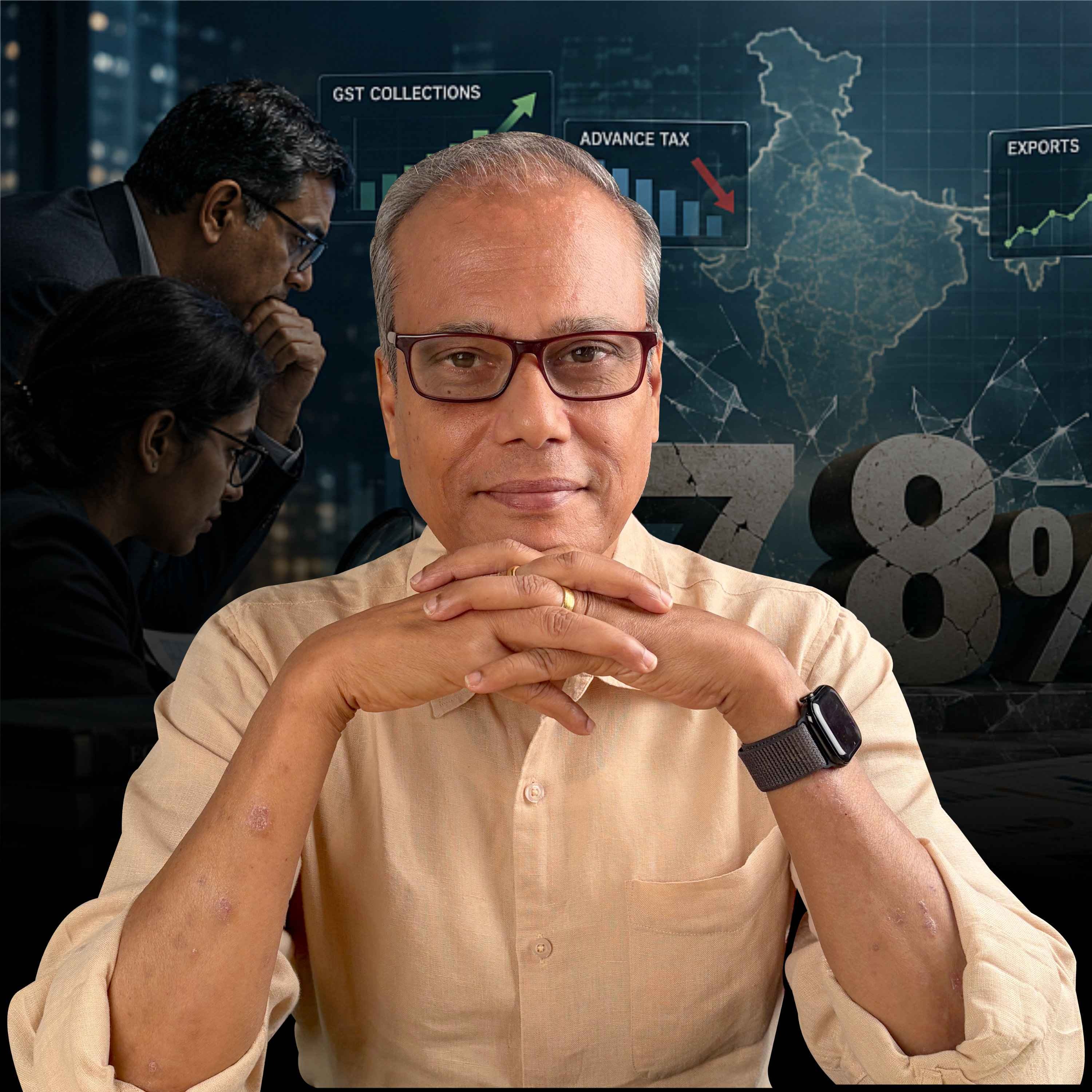
India's Infrastructure Boom: Built to Show, Not Built to Last?

India has witnessed an unprecedented infrastructure boom over the past decade, with new expressways, bridges, tunnels, airports and mega projects transforming the country's landscape.But alongside the impressive inaugurations and glossy visuals is a troubling pattern: collapsing bridges, cracked highways, design blunders, rushed construction and a striking lack of accountability.In this audio, veteran journalist Sucheta Dalal examines why India's infrastructure is increasingly making headlines for the wrong reasons. From Bihar's recurring bridge collapses and the Morbi tragedy to Mumbai's engineering missteps and concerns over expressways, she asks whether speed and spectacle have overtaken quality, safety and governance.The discussion explores:- Why infrastructure failures are becoming so common- The role of political timelines and rushed inaugurations- Weak oversight, contractor accountability and audit failures- Why major public assets fail without lasting consequences- What India must change to build infrastructure that truly lastsIs India building for generations—or simply building for the next inauguration?Watch the full analysis and share your thoughts in the comments.Read the full article: https://www.moneylife.in/article/indias-frequent-infrastructure-failures-built-to-show-not-to-last/81051.html Hosted on Acast. See acast.com/privacy for more information.
July 8, 202615 min

Why NSE Cannot Escape RTI Anymore

For 16 years, the National Stock Exchange (NSE) fought to avoid being brought under the Right to Information (RTI) Act. The Delhi High Court has now reaffirmed that the NSE is a public authority under the RTI Act—a landmark judgment with far-reaching implications for transparency, regulatory accountability, and investor protection.In this audio, veteran financial journalist Sucheta Dalal explains:• Why the Delhi High Court's verdict is a major victory for transparency• How the NSE resisted RTI for over a decade and a half• The role of SEBI and why regulatory accountability is under scrutiny• What the infamous co-location (Colo) scandal revealed about governance failures• Why NSE's proposed IPO makes transparency even more important• What this ruling means for investors, market institutions, and India's financial systemThe debate is about much more than one stock exchange. It raises fundamental questions about whether India's most powerful market institution should be held to the same transparency standards expected of other public authorities. Hosted on Acast. See acast.com/privacy for more information.

July 1, 202611 min

DMFs vs FPIs: Beyond the Rhetoric

Has India's stock market really become independent of Foreign Portfolio Investors (FPIs)? Or is the popular narrative missing a crucial piece of the puzzle?In this insightful analysis, Debashis Basu examines whether Domestic Mutual Funds (DMFs), powered by massive SIP inflows, have truly replaced foreign investors—or whether they are simply investing in different parts of the market.This audio explores:- Why FPI selling hasn't caused the market to crash- The rise of SIP-driven investing in India- Why mutual funds are favouring mid-cap and small-cap stocks- The difference between stock market support and foreign exchange inflows- How FPI outflows affect the rupee, even when domestic investors keep buying- What investors should understand about India's evolving capital marketsIf you invest through mutual funds, SIPs or directly in stocks, this analysis will help you look beyond the headlines and understand what's really driving the Indian market.Read More: https://www.moneylife.in/article/dmfs-vs-fpis-beyond-the-rhetoric/80915.html Hosted on Acast. See acast.com/privacy for more information.

June 30, 202614 min

An Attack on Justice? Why the Gautam Patel Case Matters to Every Indian

Retired Bombay High Court judge Justice Gautam Patel has revealed a disturbing campaign of threats, intimidation and violence allegedly aimed at forcing him to recant his landmark judgment in the Dawoodi Bohra succession dispute.What began as legal litigation has now raised far bigger questions: Can judges decide sensitive cases without fear? What happens when a judge's family becomes the target? And what does this mean for the independence of India's judiciary and the rule of law?In this audio, journalist Sucheta Dalal examines the shocking disclosures, the broader judicial crisis, the implications for pending appeals, and why the State's response could determine public confidence in India's justice system for years to come.Watch the full analysis and join the discussion.Read more: https://moneylife.in/article/target-gautam-patel-will-judges-judge-without-fear/80910.html Hosted on Acast. See acast.com/privacy for more information.

June 26, 202615 min

Will the Supreme Court Finally Rein in Rogue ARC Practices?

Can Asset Reconstruction Companies (ARCs) help clean up India's banking system—or have some become part of the problem?In this audio, veteran financial journalist Sucheta Dalal examines the Supreme Court's sharp observations in a PIL alleging that a ₹1,537 crore bank debt was settled for just ₹73.5 crore through ARC transactions.The Court has questioned whether there is a deeper nexus involving borrowers, banks and ARCs, while issuing notices to the RBI, SBI, other public sector banks, SEBI, SFIO, Ernst & Young and others.The discussion also explores:- How ARCs are meant to function- RBI's concerns about evergreening and opaque transactions- Why small borrowers often face tougher treatment than large corporate defaulters- The JKM Infra case and the alleged diversion of funds- RBI's 2025 ARC Directions and whether they go far enoughCould this Supreme Court case finally bring greater transparency and accountability to India's stressed asset resolution process?Watch the full analysis by Sucheta Dalal.Read the full article: https://moneylife.in/article/will-the-supreme-court-finally-rein-in-rogue-arc-practices/80867.html Hosted on Acast. See acast.com/privacy for more information.

Is this your show?

Claim this listing to keep it up to date, reach guests who want to pitch you, and manage bookings with Guestify.

Claim this listing

More Business podcasts