OpenAI Cracks 90-Year-Old Maths Problem
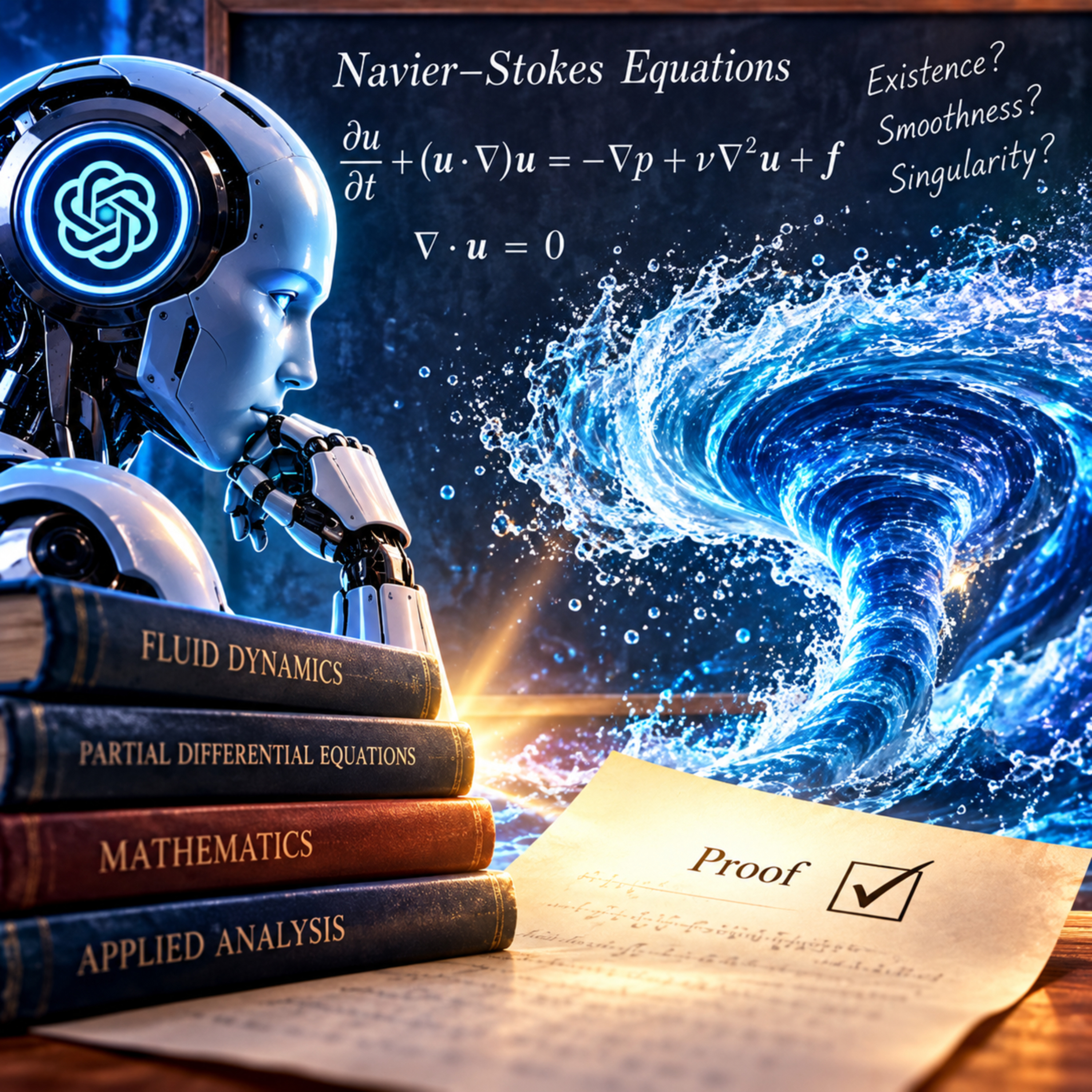
OpenAI may have cracked one of the most famous unsolved problems in mathematics. In this episode of Mark & Pete, we look at the extraordinary claim that an OpenAI research system has solved a 90-year-old problem connected to the Navier–Stokes equations, the equations used to describe how fluids move. That means water, air, blood flow, turbulence, weather systems, aircraft, oceans and quite a lot of the physical world around us. The Navier–Stokes equations themselves are not new. Mathematicians and engineers have used them for generations. The problem was something much deeper: nobody knew whether, in three dimensions, a perfectly smooth fluid flow could eventually develop a singularity, effectively a mathematical blow-up where velocity becomes unbounded in finite time. That question became one of the Clay Mathematics Institute’s famous Millennium Prize Problems, with a $1 million prize attached. OpenAI now says its system has produced a proof showing that such a finite-time singularity can occur under permitted smooth forcing. And this is where the story gets really interesting. This was not simply ChatGPT being asked a clever maths question and producing a dazzling answer in thirty seconds. OpenAI reportedly used a huge coordinated system involving thousands of AI agents, all exploring different mathematical routes, checking ideas, discarding failures and sharing useful results. In effect, it was like putting thousands of mathematicians into one vast virtual research department and allowing them to work continuously, at speed, for days. The result was then translated into Lean, a formal proof-checking system designed to verify mathematical logic step by step. So has AI finally become better than human mathematicians? Not quite. Human researchers had already developed much of the underlying mathematical framework. The striking thing is that AI may now be able to push through enormous numbers of possibilities, combine ideas from existing research and test routes that no human team could practically explore at the same scale. That is perhaps the real breakthrough. We ask what exactly has been cracked, why Navier–Stokes matters, whether this really counts as a historic mathematical discovery, and what it says about the future of artificial intelligence in science. And there is a deeper question too. If mathematics describes an ordered universe, are we inventing mathematical truth or discovering something that was already there? Our Bible verse is Proverbs 25:2: “It is the glory of God to conceal things, but the glory of kings is to search things out.” OpenAI may have found something remarkable. But the order was there first.