
Find partners
Invested In Climate

Invested In Climate

Hosted by Jason Rissman

BusinessInvestingInterviews guests

Episodes

138

Latest episode

Jul 2026

Language

EN

About the show

Invested in Climate hosts conversations with leading thinkers to help our listeners do more to address the climate crisis through their Work, Investments, Learning, Lifestyle and Activism. People everywhere, communities, governments and all sectors of the economy are mobilizing to address climate change. The scale of this global action is unprecedented. Never before have so many people dedicated so much energy, creativity and capital to addressing a shared, global threat. Will it be enough? What else is needed? And, most importantly, what can you do? We all have a part to play, so let’s go.

Listen to episodes

60 recent
July 14, 202642 min

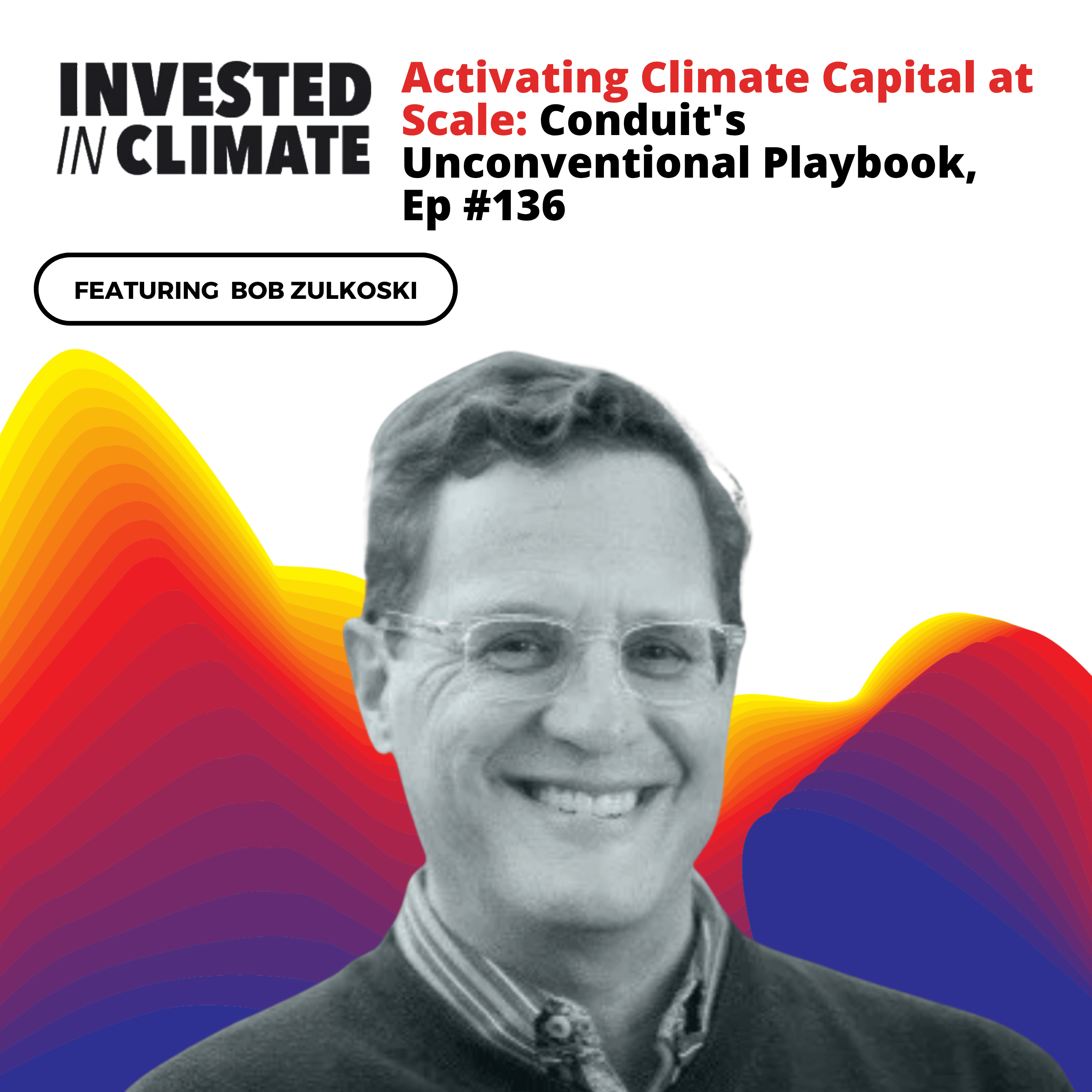
Activating Climate Capital at Scale: Conduit's Unconventional Playbook, Ep #136

The climate transition will require trillions of dollars of investment, but many of the biggest opportunities still face structural financing barriers because our financial system was not designed for a challenge of this scale and complexity. As investors, entrepreneurs, and institutions work to accelerate the transition, there is a growing need for new financial models that can bridge those gaps and unlock capital more effectively. Today, we’re joined by Bob Zulkoski of Conduit Capital , a firm taking a very different approach to climate finance. Rather than building one big fund, Conduit is creating platforms designed to unlock private capital at scale — from financing energy-efficiency upgrades in commercial real estate, to launching climate-transition SPACs, to developing a new blended-finance vehicle aimed at helping impact investment managers bridge what Bob calls the “Pioneer Gap.” Bob calls the model radical collaboration, and the goal is not just to invest well, but to prove new models that others can replicate. On today’s episode, we cover: 1:19 – Framing the Climate Finance Challenge and Introducing Bob Zulkoski 2:34 – What Is Conduit Capital? Vision and Radical Collaboration 3:48 – Replication as Theory of Change: Paving the Way for Competition 5:23 – Business Model: Non‑Concessionary, Patient, Impact at Scale 6:41 – Introducing Sustainable Credit Partners (SCP) and Mid‑Market CRE 8:09 – The Retrofit Problem: Aging Buildings, Spiking Energy Costs, Brown Discount 10:04 – SCP’s Lending Model: Easier, Cheaper, Faster for Borrowers 11:34 – Underwriting + GreenGen Partnership and Education Role 13:55 – SCP Traction: Origination Targets, Pipeline, Institutional Capital 16:02 – Loan Sizes, Typical Collateral, and Brown Discount Mitigation 16:48 – Three “Superpowers”: Market Familiarity, GreenGen + Climate First Bank, Moody’s 19:53 – Who Else Should Do This? Scaling via Competition and Green CLOs 22:48 – Introducing Climate Transition SPACs and Market Backdrop 23:01 – Rethinking SPACs: Tool for Climate Transition and Valuation Gaps 27:37 – First SPAC: Energy Transition Special Opportunities and Target Sectors 29:48 – Why Regenerative Agriculture Belongs in Climate SPACs 32:19 – Defining the Pioneer Gap vs. Missing Middle/Valley of Death 35:30 – The Pioneer Gap Impact Platform Fund and Alliance Structure 37:50 – Blended Finance Stack: Catalytic, Mezzanine, and Market Capital 39:08 – Why This Is the “Best of Times” for Climate Investing 41:40 – Closing Reflections Resources Mentioned Sustainable Credit Partners (SCP) GreenGen Moody’s Investors Service Climate First Bank C‑PACE (Commercial Property Assessed Clean Energy) Climate Transition Special Opportunities SPAC Spring Lane Capital Pioneer Gap Alliance & Pioneer Gap Impact Platform Fund Connect with us Bob Zulkoski Jason Rissman Keep up with Invested In Climate Sign up for our Newsletter Subscribe for our Other Future Newsletter LinkedIn Instagram If you like what you hear, subscribe and rate to support the show! Have feedback or ideas for future episodes, events, or partnerships? Get in touch !

June 23, 202648 min

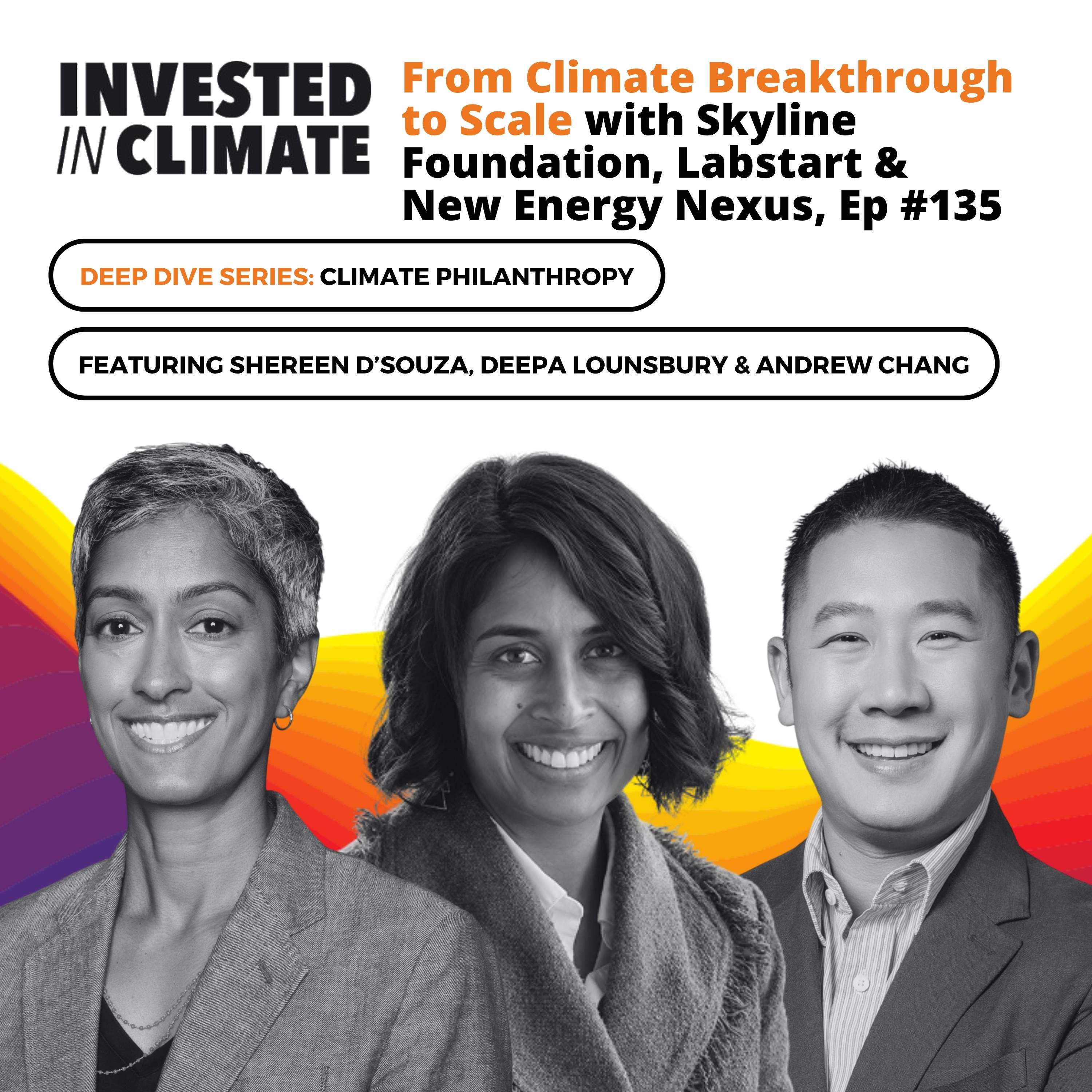
From Climate Breakthrough to Scale with Skyline Foundation, LabStart & New Energy Nexus, Ep #135

Climate philanthropy does far more than fund advocacy and conservation—it bridges critical funding gaps for breakthrough technologies that traditional, financially driven investors often overlook. In this special episode, we continue our ongoing Climate Philanthropy series in partnership with the Skyline Foundation to explore how non-profit support accelerates the climate tech pipeline. Shereen D’Souza (Climate Solutions Portfolio Lead at Skyline Foundation ) sits down with two powerhouse CEOs from her grantee portfolio, Deepa Lounsbury of LabStart and Andrew Chang of New Energy Nexus , to discuss what it really takes to move climate innovation from a university lab to global deployment. Why This Episode Matters Bringing a "hard tech" climate startup from initial lab concept to commercial scale takes an average of 10 years , and every single step of that journey faces a unique "valley of death." Because scaled deployment looks drastically different depending on the geography, supporting entrepreneurs requires a highly specialized ecosystem. This conversation highlights how philanthropy strategically funds distinct, critical phases of the lab-to-market pipeline to scale viable climate solutions faster. On today’s episode, we cover: 0:58 – Why climate philanthropy & Skyline partnership 3:35 – LabStart vs. New Energy Nexus focus 4:09 – Guest intros: Deepa (LabStart) & Andrew (New Energy Nexus) 4:46 – Deepa’s background in climate, VC, and CalSEED 6:20 – What LabStart does & “deep climate tech” focus 8:02 – Andrew’s overview of New Energy Nexus global model 9:43 – Programs: bootcamps, grants, CalSEED, and global south focus 11:16 – What it looks like to be a New Energy Nexus entrepreneur 11:54 – Philippines rooftop solar opportunity: Solar Innovation Program 12:48 – Pakistan rooftop solar boom and Climate Innovation Pakistan 13:40 – CalSEED structure and impact in California 13:58 – What it looks like to be a LabStart entrepreneur 14:55 – LabStart Discover and Launch phases 15:54 – Why philanthropy is needed in climate tech innovation 18:36 – Philanthropy in the global south and hyperlocal impact 22:10 – LabStart success story: architect-turned-3D housing founder 24:32 – Additional LabStart founders and outcomes 25:25 – How much philanthropic capital is needed 27:17 – IEA investment gap and catalytic examples from Indonesia 29:43 – Why fund new technologies vs. only deployment 32:06 – How country pathways shape New Energy Nexus engagement 33:02 – California deployment example: ThermoShade 33:58 – Indonesia fishermen & electric motorboats case: Volto Sea 34:51 – Pakistan PakPlug EV charging app 35:22 – What else the ecosystem needs: Andrew on subnational governments 37:34 – What else the ecosystem needs: Deepa on IP & ecosystem gaps 41:02 – Five-year vision & asks: Deepa and LabStart 43:49 – Five-year vision & asks: Andrew and New Energy Nexus 47:26 – Closing thanks from Shereen Resources Mentioned Invested in Climate: Climate Philanthropy series Skyline Foundation LabStart New Energy Nexus Project Drawdown Jamil Wyne CalSEED Solar Innovation Program Climate Innovation Pakistan CalTestBed AusTestbed ThermoShade Swap Energy Xuraya Volto Sea PakPlug Schmidt Family Foundation Boundless Earth Atlassian Foundation California Energy Commission (CEC) New York State Energy Research and Development Authority (NYSERDA) Mubadala Investment Company (Abu Dhabi) Australian Renewable Energy Agency (ARENA) International Energy Agency (IEA) Elemental Impact Activate Renewables First Connect with us Shereen D’Souza Deepa Lounsbury Andrew Chang Jason Rissman Keep up with Invested In Climate Sign up for our Newsletter Subscribe for our Other Future Newsletter LinkedIn Instagram If you like what you hear, subscribe and rate to support the show! Have feedback or ideas for future episodes, events, or partnerships? Get in touch !
June 9, 202638 min

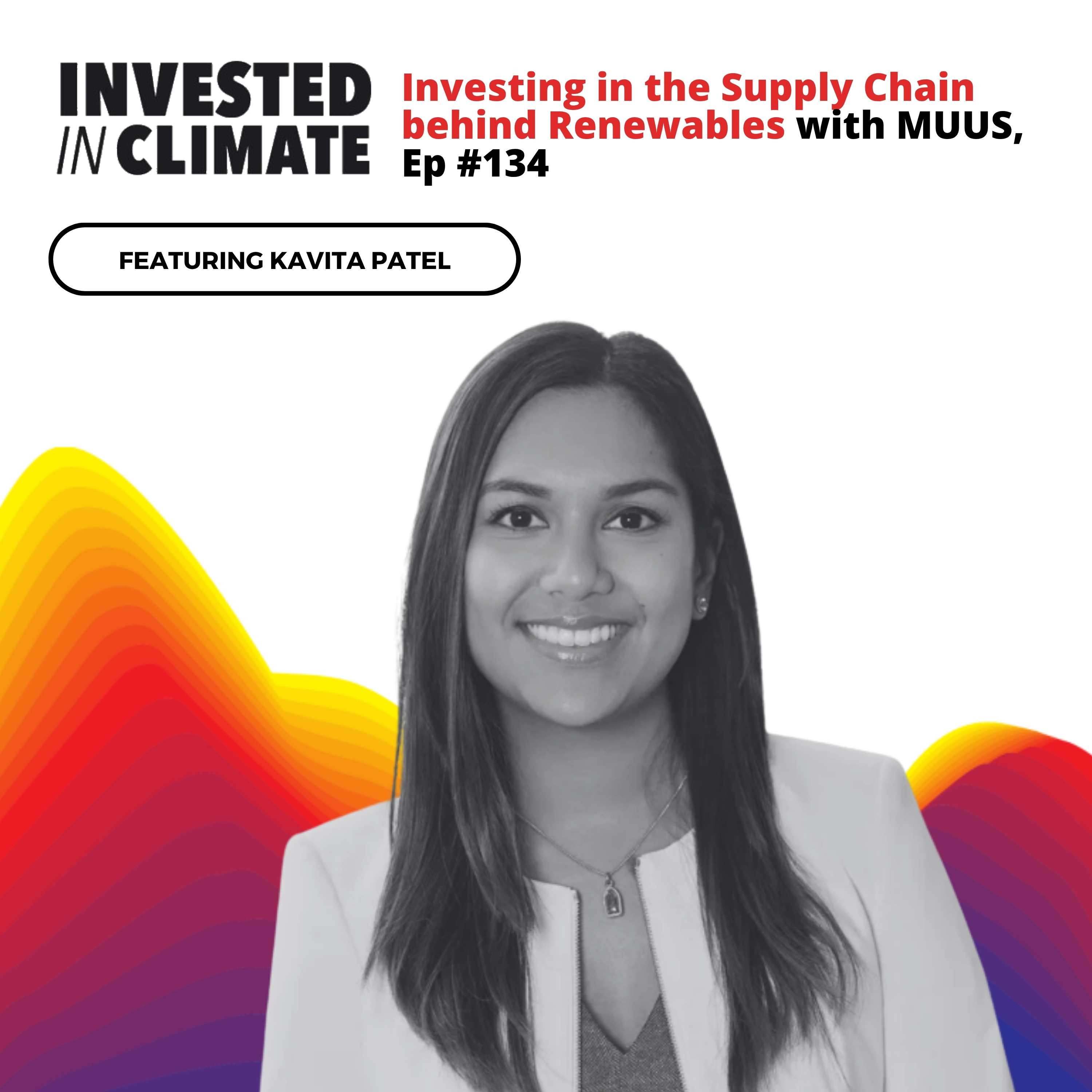
Investing in the Supply Chain behind Renewables with MUUS, Ep #134

Today, we’re diving into a part of the climate transition that doesn’t get nearly as much attention as solar panels, electric vehicles, or AI: the materials, minerals, and manufacturing systems that make modern civilization possible. Steel alone accounts for roughly 7–8% of global greenhouse gas emissions, and the energy transition is driving unprecedented demand for critical minerals, advanced materials, and domestic manufacturing capacity. These sectors offer incredible investment opportunities, and that’s the focus of my guest, Kavita Patel. Kavita is a portfolio manager for venture investment for MUUS & Company (MUUS), the family office of TIGER 21 Founder and Chairman, Michael Sonnenfeldt, and his family. We discuss opportunities ranging from critical mineral recycling to next-generation building materials, what she’s learned investing through the ups and downs of climate tech, and why she believes some of the most compelling opportunities today may be hiding in sectors many investors overlook. We also explore where climate capital is flowing, where it may be underinvesting, and how investors can think rigorously about both financial returns and real-world climate impact. I learned a lot from this conversation, and I think you will too. Here we go. On today’s episode, we cover: 01:12 – Introducing guest: Kavita Patel of MUUS & Company 02:35 – Kavita’s background and path into climate investing 05:24 – From BlackRock and ESG to climate venture 07:19 – What is MUUS & Company? Climate thesis and focus areas 09:35 – Why critical minerals, materials, and domestic manufacturing 11:30 – Is materials & mining underhyped for investors? Market overview 13:17 – Venture timelines in hardware and industrial innovation 15:13 – Portfolio example #1: Nth Cycle’s critical minerals recycling 18:28 – Mining’s environmental impact and why focus on recycling 20:08 – Portfolio example #2: InventWood as a low‑carbon steel replacement 22:53 – No green premium: solving top pain points in B2B climate tech 23:03 – Where climate capital is flowing vs. where it should go 25:22 – What Kavita has learned from founders through market cycles 29:01 – Common fundraising pitfalls for climate founders 32:20 – Building the capital stack: partners, family offices, and non‑dilutive capital 35:15 – Measuring impact: MUUS’ use of the Crane tool 38:16 – Closing thoughts Resources Mentioned MUUS & Company (MUUS) TIGER 21 Nth Cycle (critical minerals refining & recycling) Trafigura (metals & commodities trading group) InventWood (wood-based high‑performance material) CRANE – Carbon Reduction Assessment for New Enterprises International Energy Agency (IEA) Connect with us Kavita Patel Jason Rissman Keep up with Invested In Climate Sign up for our Newsletter Subscribe for our Other Future Newsletter LinkedIn Instagram If you like what you hear, subscribe and rate to support the show! Have feedback or ideas for future episodes, events, or partnerships? Get in touch !
May 5, 202635 min

The Abundance Playbook for Renewable Energy with GoodPower, Ep #133

Most people assume the main barrier to clean energy in America is technology or cost. Neither is true anymore. The sun is cheap. The wind is free. The turbines work. What doesn't work is the system we've built around them. Between 70 and 90 percent of renewable energy projects started in the US never reach construction. The ones that survive face a gauntlet of federal reviews, local ordinances, interconnection queues stretching years, and organized opposition campaigns funded by interests that don't want to see the grid change. We're talking about over 2,000 gigawatts of clean energy projects sitting in line waiting to plug into the grid — enough to power the country many times over. Today's guest is doing something about this problem. GoodPower is a nonprofit organization using research, strategic communications, campaigns, and even technology to accelerate the transition to renewable energy around the world. In this conversation, I’m joined by Leah Qusba, GoodPower’s CEO, who has been with the organization for almost 17 years. We spoke about GoodPower's history and evolution, its work in changing culture, building political power, accelerating an economy that works for all, and much more. Leah reflects a fast-growing school of thought — calling it the abundance mindset, after Derek Thompson and Ezra Klein's influential book — that sees future-forward infrastructure as the key to unlocking tremendous economic opportunity. It's a compelling, inspiring perspective that has spread quickly and is already driving real policy and investment. So buckle up and enjoy. On today’s episode, we cover: 01:31 – Clean energy bottlenecks & introduction of GoodPower 03:15 – Welcoming Leah Qusba 04:03 – Founding story of Good Power (formerly ACE) 04:44 – From youth education to campaigns and power-building 05:31 – Why rebrand from Action for Climate Emergency to GoodPower 05:49 – Moving from alarm to hope and economic opportunity 07:11 – Core problem: speeding up an inevitable energy transition 08:19 – Shift from “protecting environment” to building clean energy 09:22 – Strategic plan overview & Pillar 1: shifting culture at scale 09:44 – Operating in culture & early bet on the creator economy 11:05 – Lessons from supporting climate-focused creators 13:06 – Surprising creators: rural and agricultural influencers 15:10 – Laying cultural groundwork and de‑politicizing renewables 17:35 – Pillar 2: building political power in the U.S. 19:13 – Climate as a voting issue vs. economic priorities 21:52 – Mobilizing climate‑first nonvoters & social norms of voting 24:46 – Pillar 3: building a “good economy for all” 27:58 – Under the hood: siting and permitting campaigns 31:05 – Beyond core pillars: funding models and nonprofit evolution 33:15 – How listeners can help locally & post‑election accountability Resources Mentioned GoodPower GoodPower Strategic Plan Environmental Voter Project (We featured CEO Nathaniel Stinnett on Ep #94 !) Connect with us Leah Qusba Jason Rissman Keep up with Invested In Climate Sign up for our Invested in Climate Newsletter Subscribe for our Other Future Newsletter LinkedIn Instagram If you like what you hear, subscribe and rate to support the show! Have feedback or ideas for future episodes, events, or partnerships? Get in touch !
April 22, 202652 min

New Thinking for a New Era with Climate Capital Reset Project, Ep #132

Whether or not we want to acknowledge it, we’re in a new era of climate investing. Unprecedented uncertainty, federal policy upheaval in the United States, repeated energy shocks from wars, inflation, high interest rates, a persisting liquidity crunch, the AI data center boom – much has happened, the game has changed and investors are thinking very differently about climate than they did just a few years ago. Three expert climate finance advisors who have worked in climate finance for decades set out to understand what has changed in climate investing. Dan Firger, Will Coleman, and Bill Tarr are highly respected thought leaders and strategic advisors working with large family offices, foundations and prominent climate investors. They teamed up and interviewed over 150 investors and experts to develop Climate Capital Reset Project , a detailed account of the new thinking defining this new era of climate investing. We spoke about the trends reshaping climate finance today, emerging dynamics, recommendations for capital allocators, considerations for philanthropists, and much more. Dan, Will, and Bill’s report will likely be one of the most influential pieces written on climate finance this year. It’s already the basis for closed-door consultations and convenings with prominent investors, and our conversation shed incredible light on the new paradigms already driving climate finance today. On today’s episode, we cover: 03:01 – Guest Introductions & Backgrounds 06:04 – Why the Climate Capital Reset Project Now? 08:55 – Trend #1: Unprecedented Market Uncertainty 11:13 – Trend #2: AI, Data Centers & the Grid 13:23 – Trend #3: Liquidity Crunch & the Missing Middle 15:42 – Trend #4: Narratives, Labels & Climate Messaging 17:24 – How We Talk About Climate & Climate Investing 19:37 – Theme: ‘Ruthless Pragmatism’ in Climate Capital 24:00 – Shaping Winners Through Consolidation 26:57 – Domestic vs. International: Who Captures the Upside? 27:31 – Blended Finance: Misuse, Scarcity & Focus 30:48 – Examples of Effective Blended Finance 31:56 – Geographic Arbitrage & Emerging Markets 34:37 – Corporates’ Role in Climate Tech & Scale 38:05 – War in the Middle East, Energy Shocks & Resilience 43:24 – New Investment Models & Insurance Innovation 46:24 – Long-Duration, Asset-Heavy Climate Businesses 48:43 – A Narrow Window for a Climate Capital Reset 50:41 – What’s Next for the Climate Capital Reset Project 51:41 – Closing & Call to Action Resources Mentioned Climate Capital Reset Project Builder’s Vision Intersect Power Lineage Logistics Devoted Health Fervo Energy Frontier Microsoft Carbon Removal PJM Interconnection ERCOT (Electric Reliability Council of Texas) USAID (U.S. Agency for International Development) Bloomberg Philanthropies ReGen Ventures More Davidow Ventures (MDV) Connect with us Dan Firger Will Coleman Bill Tarr Jason Rissman Keep up with Invested In Climate Sign up for our Newsletter (Other Future) LinkedIn Instagram If you like what you hear, subscribe and rate to support the show! Have feedback or ideas for future episodes, events, or partnerships? Get in touch ! Share ideas for our newsletter here !
March 24, 202646 min

Reimagining Higher Ed for the Climate Era with Unity Environmental University, Ep #131

Education and our ability to respond to climate change are inexorably linked. Major international studies have shown that education is the single strongest predictor of whether or not someone is aware of climate change. In the US, while 74% of Americans support climate action, support is typically 10–20 points higher among those with a college education. It's not about perceptions on climate change; a more educated workforce is better able to innovate, accelerate the climate transition, and adapt in a less stable world – especially if that education builds climate resilient skills. One could almost imagine a university designed around this need – and that is exactly what the team at Unity Environmental University are building. Today, we're joined by Unity President Dr. Melik Khoury who is creating not just a new curriculum, but a new, more inclusive approach to higher ed. Dr. Khoury argues powerfully against the elitism that has underpinned our educational system and climate narratives. We spoke about his background, the role of education in addressing climate change, how Unity is different, and the influence it could have. Dr Khoury’s energy is contagious and we're sure he’ll get you thinking. Enjoy. On today’s episode, we cover: 03:06 – Dr. Khoury’s upbringing in West Africa and awakening to environmental issues 04:24 – Discovering the real impacts of resource exploitation 06:01 – Choosing higher education transformation as the main lever 08:32 – The core climate problem: beyond politics and single-issue framing 09:04 – Climate as transdisciplinary: food, energy, people, commerce 11:05 – History of Unity Environmental University 13:07 – Transforming Unity’s model and unbundling education 15:14 – New operational model and rethinking the faculty role 15:23 – Scaling Unity and redefining what a university is 19:42 – Preparing students to operate in complex, uncertain systems 20:15 – Embedding climate and sustainability across the curriculum 23:14 – AI’s challenge to traditional notions of knowledge and learning 23:48 – What Unity is learning from its students and their needs 28:14 – What success looks like for a climate-focused university 28:30 – Influencing the broader higher-ed ecosystem 31:47 – How AI is changing higher education and climate learning 32:11 – Why Unity embraces rather than bans AI 35:58 – Concrete AI experiments at Unity (UNA, tutors, automation) 39:31 – Is climate momentum fading? Perception vs. reality 39:57 – Climate’s “brand problem” and the real enemy: ignorance 42:58 – Depoliticizing climate and making the economic case 43:16 – How we broadly attack ignorance through education reform 45:52 – Call for partners and funders to back scalable climate education 45:52 – Closing thanks and episode wrap-up Resources Mentioned Unity Environmental University Connect with us Dr. Melik Khoury Jason Rissman Keep up with Invested In Climate Sign up for our Newsletter LinkedIn Instagram If you like what you hear, subscribe and rate to support the show! Have feedback or ideas for future episodes, events, or partnerships? Get in touch !
March 10, 202658 min

Creating Leaders for a Regenerative Economy with Work on Climate, Ep #130

Imagine for a moment if economic activity made nature and society healthier. It’s a notion that at first might seem absurdly idealistic, and then when you think about it, maybe essential for our survival and thus perhaps what the goal of an economy should actually be. Welcome to the concept of regenerative economics. There’s a growing number of leading thinkers, organizations, policymakers, and even businesses fueling the regenerative movement. With AI and a new geopolitical order creating massive disruption, it’s an important time to consider bold visions for the future. Today, we’re joined by someone who’s both a bold visionary and practical implementer. Eugene Kirpichov left his dream job at Google in 2020 to found Work on Climate , a community that has now helped tens of thousands of people looking for ways to address climate change. Eugene sees communities as mindbogglingly effective for scaling impact. By helping people realize their potential as climate leaders, Work on Climate is harnessing the power of community to work towards a regenerative economy. Eugene is a guy of big ideas, who thinks about systems strategically and makes things happen. It was a blast talking to Eugene and we suspect you’ll enjoy the conversation as well. Here we go. On today’s episode, we cover: 00:57 – Regenerative Economics & Introducing Eugene 02:41 – Recent Encounters & Shared Community 03:00 – Eugene’s Early Life in Russia & Tech Beginnings 06:25 – Joining Google & Finding Eugene’s Niche 08:47 – Eugene’s Climate Wake‑Up & Decision to Leave Google 10:30 – Discovering the Climate Solutions Ecosystem 12:56 – Founding Work on Climate 14:18 – Community Power & Founder Success Stories from Work on Climate 15:34 – How Work on Climate Operates & Is Funded 17:36 – Eugene’s Shift: From Climate Jobs to Climate Leaders 21:30 – Examples of Everyday Climate Leadership 24:25 – Three Qualities of a Climate Leader 26:33 – Rethinking the “Most Impactful Thing I Can Do” 29:56 – Eugene’s Long‑Term Vision for Work on Climate 33:02 – What a Regenerative Economy Is 38:18 – How to Build a Regenerative Economy in Practice 44:18 – AI as System Accelerator & Regenerative Tool 48:15 – EPA Ruling, Shared Reality & Coordination 51:32 – What Eugene Is Reading & Learning From 55:07 – Call to Action for Funders & Individuals Resources Mentioned Work on Climate An Inconvenient Truth An Inconvenient Sequel: Truth to Power Work for Climate Eigen Robotics Climate Capital: Tom Chi Relationality: David Jay Pedagogy of the Oppressed: Paulo Freire Impact Networks: David Ehrlichman Eugene’s article on the EPA ruling Connect with us Eugene Kirpichov Jason Rissman Keep up with Invested In Climate Sign up for our Newsletter LinkedIn Instagram If you like what you hear, subscribe and rate to support the show! Have feedback or ideas for future episodes, events, or partnerships? Get in touch !
February 24, 202639 min

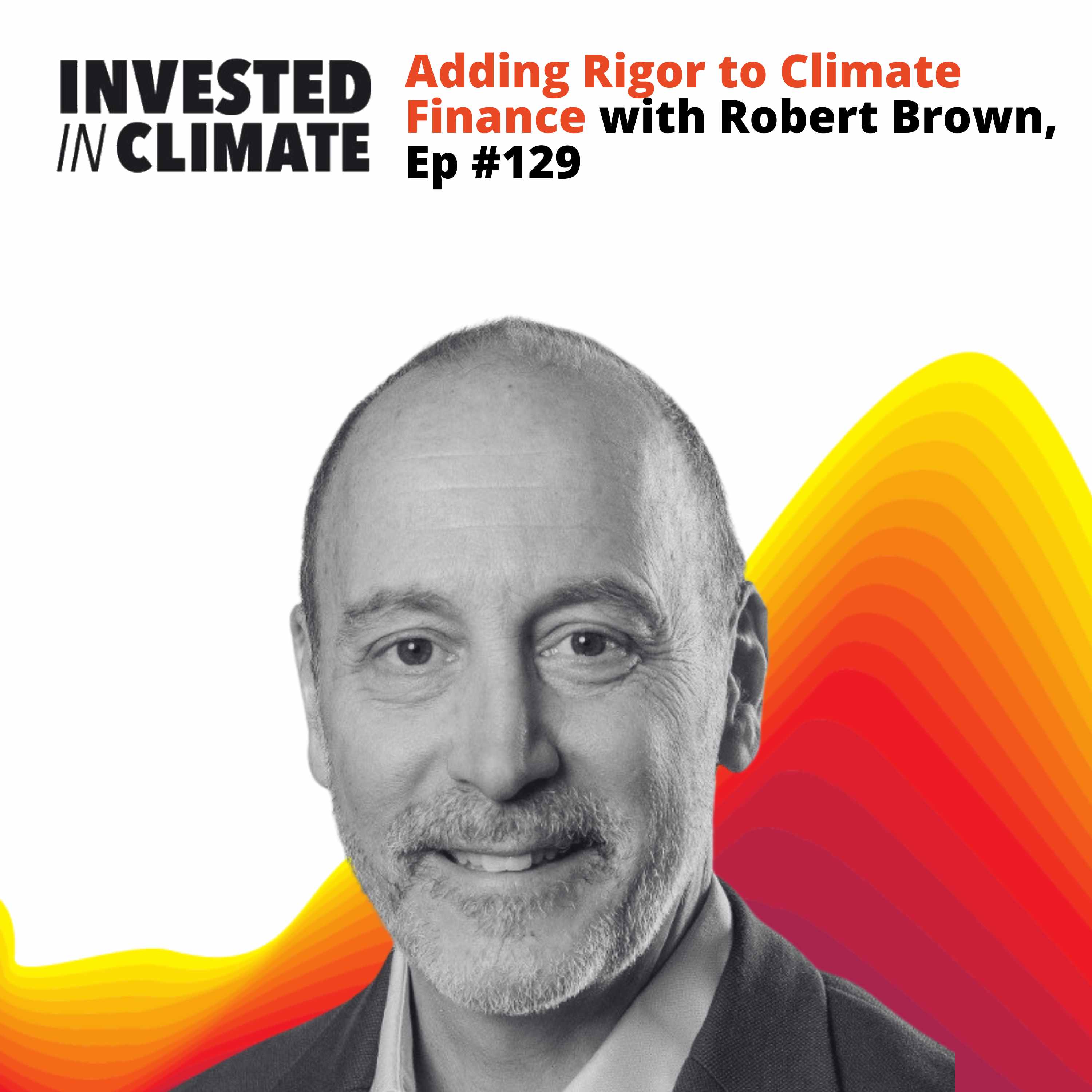
Adding Rigor to Climate Finance with Robert Brown, Ep #129

Frequent listeners know we're always eager to learn about how climate investing needs to change to be more effective. With the attacks on ESG and a new political era, we’re clearly in a new chapter for climate investing and being intentional about the ingredients, language and goals of this new chapter is critical for delivering both solid returns and real impact. Rob Brown argues that its time to step back from overreach and inauthentic impact goals, and fuel this new chapter with rigor. Rob wears a couple of hats as Director of Climate Research at Resolution Investors and Chief Research Officer at Impact Evaluation Lab . In these roles, Rob bring his decades of investment experience using research and analysis to improve long term thinking, risk management and what he calls mission authenticity, or the ability to really deliver on the kind of impact one promises. Tune in for a deeply fascinating conversation about how climate investing is maturing and the work that still needs to be done for this new chapter. Enjoy. On today’s episode, we cover: 02:41 – Rob’s career journey & love of solving problems 05:17 – From Just Capital to Impact Evaluation Lab & Resolution Investors 09:52 – How to tell serious impact investors from pretenders 14:34 – Is rigor a cost center? Making the ROI case 19:29 – A lightning history of sustainable investing 23:14 – Why sustainable finance is “deeply stressed” 27:08 – Climate investing as long‑term risk‑adjusted returns 29:27 – Two key shifts: longer horizons & real tech expertise 33:02 – Rigor, incentives, and how the field grows up 36:45 – Why sustainable investing is the future of capital markets 39:11 – Closing remarks Resources Mentioned Resolution Investors Impact Evaluation Lab . Just Capital Atlas Impact Partners Generation Investment Management Connect with us Rob Brown Jason Rissman Keep up with Invested In Climate Sign up for our Newsletter LinkedIn Instagram If you like what you hear, subscribe and rate to support the show! Have feedback or ideas for future episodes, events, or partnerships? Get in touch !
January 27, 202648 min

Earthshot & Elemental’s 1–2 Punch for Climate: VC + Philanthropy, Ep #128

We all know that no single investment strategy—and no single asset class—is going to fund the climate innovation we need on its own. Moving real solutions forward takes multiple tools working together. That’s why I’ve long been drawn to catalytic capital and blended finance—using philanthropy to unlock risk-taking and bring more and different kinds of investors along. That’s what drew me to the work of Elemental Impact and Earthshot Ventures , two organizations founded by Dawn Lippert that are designed to move critical climate technologies from early validation to scale. Elemental uses philanthropic capital to de-risk and accelerate early solutions—but for those solutions to reach real commercialization, venture and private markets have to follow. That’s where Earthshot Ventures comes in, investing early in companies with a strong “why now.” Together, they direct capital into consequential companies to create impact at scale. In this episode, we’re joined by Dawn, along with Matt Logan, General Partner at Earthshot Ventures. We talk about how Elemental and Earthshot work together in practice, real examples of the companies and projects they’re backing, a new and innovative investment structure they’ve pioneered, and where they see climate investing headed in 2026—and beyond. This conversation kicks off a new deep dive series with Elemental Impact. Stay tuned for more, and if you’d like to find or propose future series ideas, reach out to us through our website . What You’ll Learn The Power of Catalytic Philanthropy: How a "slice" of philanthropic capital can act as the nucleus for a project, bringing in banks, corporates, and infrastructure funders. The dSAFE Innovation: How Elemental adapted the Y-Combinator SAFE note into a "Development SAFE" to reduce transaction costs and provide non-dilutive capital for early projects. Community-Led Scaling: Why the "human" half of the solution—customers, cities, and communities—is just as essential as the technology itself for climate tech to succeed in the real world. A VC Lens on Climate: How Earthshot operates as a returns-focused venture fund that only backs climate-positive companies, uses a proprietary outbound-sourcing engine to find founders before they’re fundraising, and targets “cheaper, better, faster—with greener as a co-benefit” business models. The 2026 Investment Frontier: Why Earthshot is doubling down on Space Tech for remote agriculture and wildfire monitoring, and why Robotics is a top category to watch for automating "dull, dirty, and dangerous" climate jobs. A Unique Partnership Model: How a service agreement and shared revenue between a non-profit and a VC fund creates a sustainable ecosystem for innovation. In today’s episode, we cover: 02:48 2025 temperature check 05:39 Why Dawn started Elemental and then Earthshot 07:39 Matt’s background and path into climate VC 09:49 Earthshot’s thesis and sourcing–picking–winning–helping 11:15 How Elemental and Earthshot are structurally linked 13:34 Philanthropy, donor-advised funds, and recycling returns 16:09 Nitricity case study – low‑carbon fertilizer 18:21 The Development SAFE (dSAFE) 21:31 Earthshot portfolio highlights – KoBold Metals, Etched & SuperCircle 27:01 Workforce, community, and local impact 30:31 Fervo Energy case study – rural apprenticeships 33:46 Policy as alpha in AI, mining, and space 35:48 2025 turbulence, donors, and investor caution 38:00 Moving beyond solar/wind/EVs in philanthropy 38:57 Mining, metals, and transition tradeoffs 41:03 2026 outlook – AI, infrastructure, space, and robotics 47:49 Optimism and “Audacity” for 2026 Resources Mentioned Elemental Impact Earthshot Ventures Nitricity – Low‑carbon, renewable-powered nitrogen fertilizer KoBold Metals – AI-powered mineral exploration for the energy transition Etched – AI accelerator chips built specifically for transformer models SuperCircle – Circular logistics and recycling infrastructure for apparel Fervo Energy – Next‑generation geothermal power developer Hubble Network – Satellite network enabling direct-to-space Bluetooth connectivity ARPA‑E (Advanced Research Projects Agency–Energy) International Energy Agency (IEA) Advanced Microgrid Solutions – Distributed energy storage Connect with Us Dawn Lippert Matt Logan Jason Rissman Elemental Impact Website: https://elementalimpact.com/ Linkedin: https://www.linkedin.com/company/elementalimpact/ ‍ Earthshot Ventures Website: https://www.earthshot.vc/ Linkedin: <a...

January 13, 202653 min

What's Changed and What's Coming in Climate Investing with Rob Day and Raj Atluru, Ep #127

We’re back with the sixth installment of our Missing Middle in Climate Tech series, produced in partnership with Spring Lane Capital . As we kick off 2026, this episode offers a timely, grounded conversation with two seasoned investors who bring decades of perspective to where climate investing has been and where it’s headed next. Rather than focusing on predictions alone, the discussion goes deeper into the nuance of how capital is actually being deployed in today’s market. Rob Day, Co-Founder of Spring Lane Capital, and Raj Atluru, Managing Partner at Activate Capital , trade ideas and reflect on how the climate tech landscape has evolved. Together, they unpack how investor priorities have shifted over time, the metrics they look for in growth-stage companies, and the opportunities emerging from today’s macro forces, including interest rates, deglobalization, and AI’s rapidly escalating energy demand. For listeners looking to understand how experienced investors are navigating complexity, risk, and scale in climate tech right now, this is a conversation worth spending time with. Explore the full Missing Middle in Climate Tech series or reach out with ideas for future collaborations at investedinclimate.com . On today’s episode, we cover: 02:20 – Guest Intros & The “Missing Middle” Problem 04:39 – A Second Lens on the Missing Middle 07:00 – Origin Story of Activate Capital 10:40 – Energy, Load Growth & Macro Shifts 12:09 – “Why Now?” and Today’s Load Shock 17:27 – Structural Causes of the Missing Middle 19:26 – Heavy Lifting at Growth Stage 25:43 – Hardware Is Back: Fund III Themes 30:16 – Scaling, Learning Curves & Project Execution 33:00 – From Founder-Led to Scalable Sales 40:13 – Being Contrarian (EVs, AI & Hype Cycles) 43:57 – EV Fundamentals & Infrastructure Gaps 45:15 – Policy vs. Interest Rates 47:55 – Home Electrification & Rooftop Solar 48:06 – Speed-Round Predictions for 2026 49:26 – Dry Powder & Exit Fuel 51:50 – Climate Tech Becomes “Just Tech” 53:06 – Closing & Call to Action Resources Mentioned Spring Lane Capital Activate Capital DFJ (Draper Fisher Jurvetson) SolarCity (historical, now part of Tesla Energy) Enpal Voltus Crusoe Energy XNRGY Aerones Infravision Jetson Muon Space Soluna Lunar Energy Connect with us Rob Day Raj Atluru Jason Rissman Keep up with Invested In Climate Sign up for our Newsletter LinkedIn Instagram If you like what you hear, subscribe and rate to support the show! Have feedback or ideas for future episodes, events, or partnerships? Get in touch !

Is this your show?

Claim this listing to keep it up to date, reach guests who want to pitch you, and manage bookings with Guestify.

Claim this listing

More Business podcasts