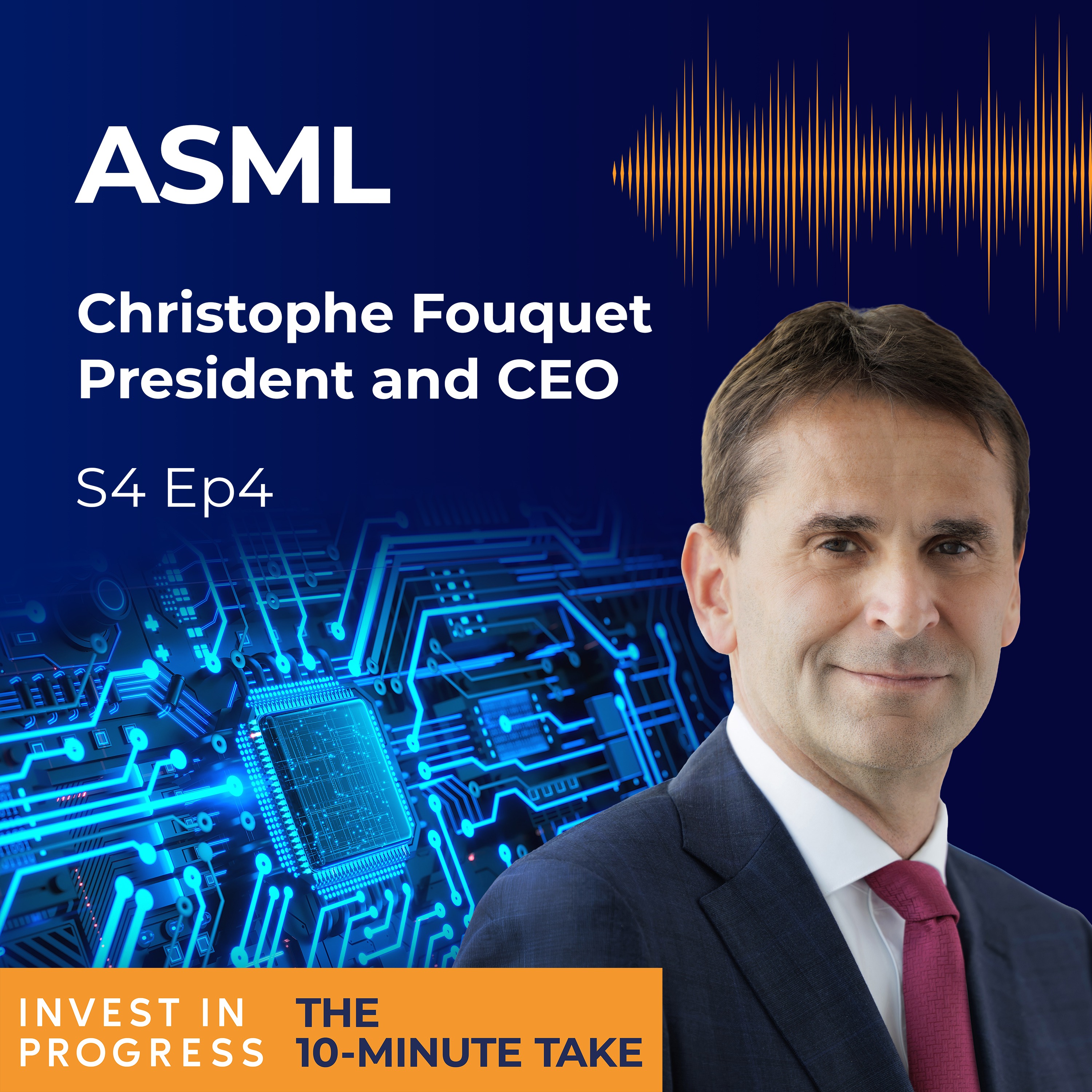
10-MINUTE TAKE: ASML
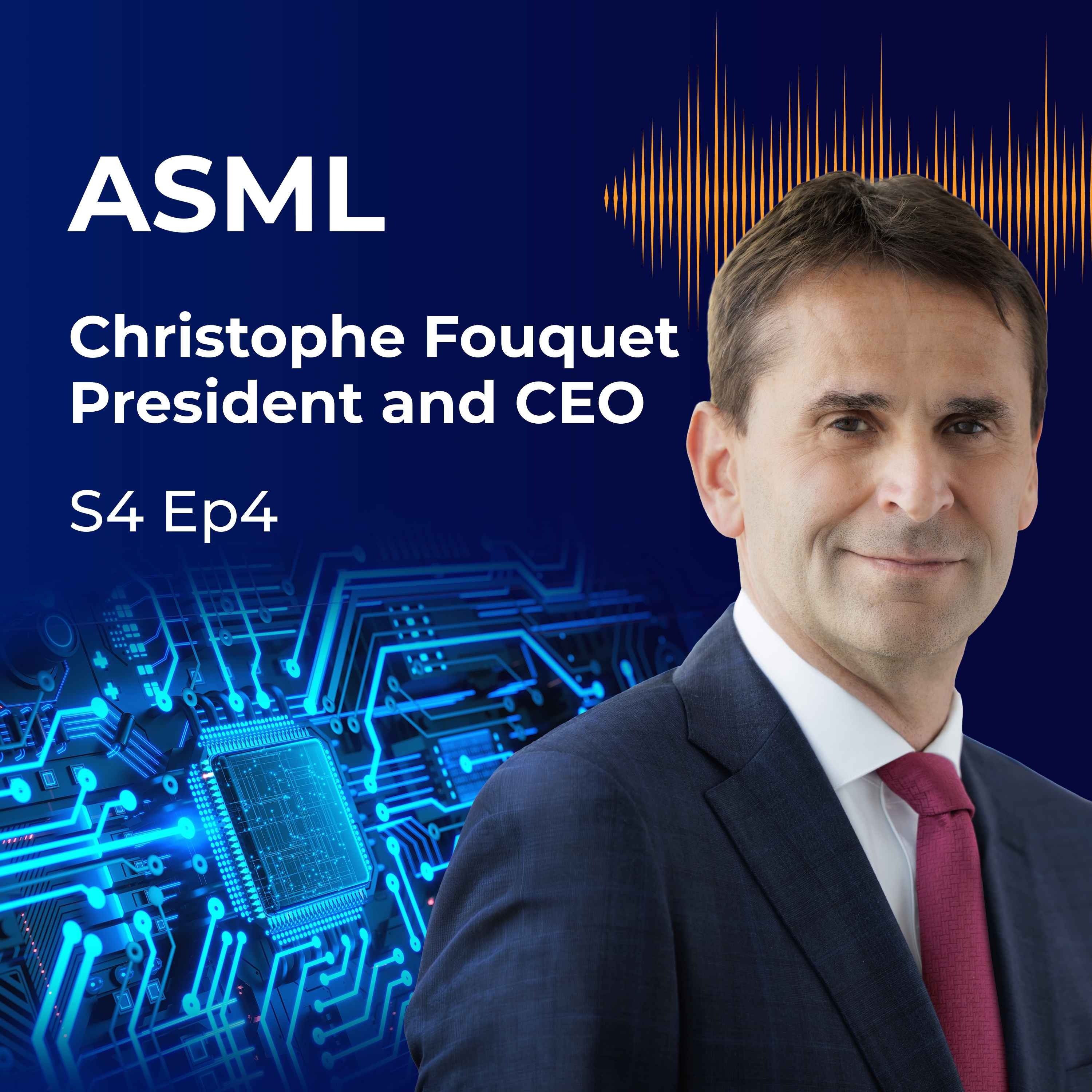
A compressed version of Scottish Mortgage’s interview with chip-making equipment company ASML’s chief executive, Christophe Fouquet. Listen to the full episode here. ASML prints the vanishingly small patterns that make leading-edge computer chips possible. NVIDIA, Amazon and Anthropic all rely on it to create their products and services. “Without EUV [extreme ultraviolet light technology]… you don’t have AI,” Fouquet tells Scottish Mortgage deputy manager Lawrence Burns in this podcast. Background: When Scottish Mortgage invested in ASML, it couldn’t be certain that the Dutch firm’s efforts to harness EUV light would succeed. The holding was effectively an informed bet that the company could pull off one of the “greatest technical endeavours” of the time, as Burns puts it. To achieve this, the firm had to solve engineering challenges, such as generating plasma many times hotter than the sun’s surface tens of thousands of times a second, to create the special light. Then, it had to work out how to capture and control it with specialised multilayer mirrors. All this was done to print billions of transistors in spaces often as small as a fingernail. Its achievement has pushed computing to new limits, not least enabling the training of AI models including Claude, ChatGPT, Gemini, Mistral and MiniMax. “Whatever happens… ASML wins,” says Burns. “It’s an agnostic royalty on AI demand, and more broadly, compute demand.” Timecodes: 00:00 Introduction 01:11 Christophe Fouquet interview begins 01:20 Printing transistors 02:58 Nanometre scale, g-force acceleration 05:09 Moore’s Law “on steroids” 08:25 A cyclical industry 10:48 An unknowable future Glossary (in order of mention): EUV (extreme ultraviolet): A type of lithography that uses extremely short-wavelength light to print the finest, most advanced chip features. Lithography: The process of printing the pattern of a chip’s circuitry onto a silicon wafer using light. Semiconductor: The material (usually silicon) at the heart of a computer chip. Also used as shorthand for the chip industry. Transistor: A microscopic on/off switch. Packing more of them onto a chip is what increases computing power. Compute: Computing capacity – the processing power needed to train and run AI models. Logic chips and memory chips: The two main chip types – logic chips process information, memory chips store it. Moore’s law: There are various definitions, but a common one is that the number of transistors on a chip roughly doubles every two years. Transistor density: The number of transistors packed into a given area of a chip – the measure that Moore’s law tracks. Wafer: The thin disc of silicon on which chips are patterned, layer by layer, before being cut into individual chips. High NA: ASML’s next-generation EUV technology. NA stands for numerical aperture – a measure of how much light an optical system can gather and focus. High NA EUV gathers more than the original EUV system, allowing finer printing. Reticle: The mask carrying the chip-pattern information that the lithography machine projects onto the wafer. Inference: The stage where a trained AI model is actually used to answer queries or make predictions, as opposed to training it. Cyclical (industry): An industry whose sales rise and fall in boom-and-bust cycles, rather than growing steadily. Node: A generation of chip-manufacturing technology, loosely named for the size of its smallest features – smaller numbers mean denser, more advanced chips. Check the podcast description to ensure this content is suitable for you. Your capital is at risk. Presenter: Claire Shaw Executive Producer: Leo Kelion Line producer: Jessica Rooney Broadcast Technician: Samual O’Hare Editor: Jody Black Hosted on Acast. See acast.com/privacy for more information.