
Find partners
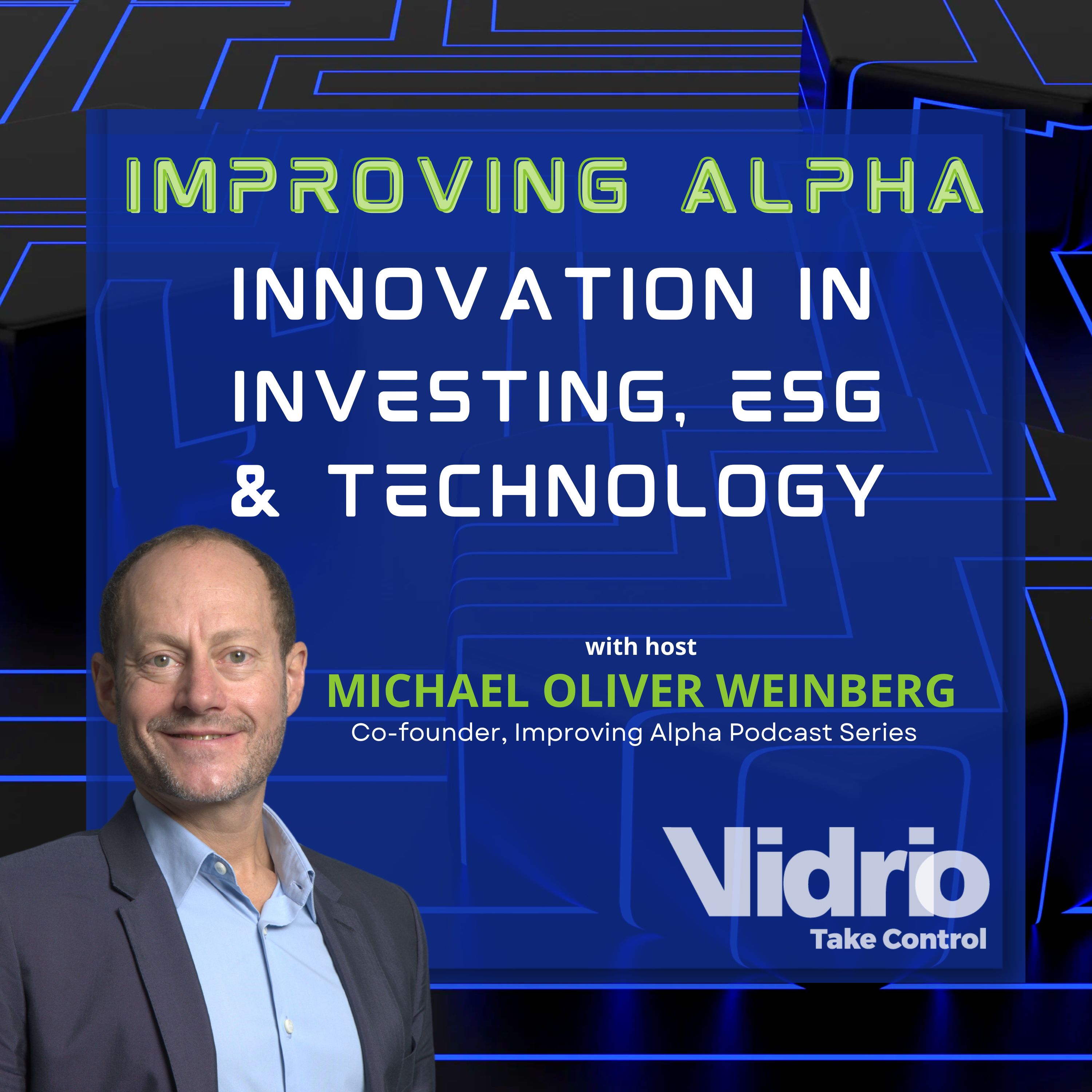
Improving Alpha: Innovation in Investing, ESG and Technology

Improving Alpha: Innovation in Investing, ESG and Technology

Hosted by Michael Oliver Weinberg

BusinessInvestingInterviews guests

Episodes

44

Latest episode

Aug 2026

Language

EN-US

About the show

The Improving Alpha: Innovation in Investing, ESG and Technology podcast with host Michael Oliver Weinberg, is built to engage with innovative allocators on forward thinking investment management business strategies and the challenges across alternative investment sectors. Through each of these discussions we will explore achievements, lessons learned and future advice for dealing with today’s financial markets. This podcast series is being powered by Vidrio. Learn more at Vidrio.com.

Listen to episodes

45 recent
August 17, 202628 min

Improving Alpha: How Frank Mihail Runs One of America’s Top Sovereign Wealth Endowments

When looking at the latest oil and gas headlines across the United States, many immediately think of Texas. North Dakota ranks #3 among the largest oil-producing states in the nation and is home to the $9BN North Dakota Trust Lands sovereign wealth endowment. This streamlined team generates revenue from oil royalties and taxes and is one of the healthiest institutions in the nation. So what’s their secret against a world with higher inflation, volatility, and more? In this episode of the Improving Alpha podcast, we welcome Frank Mihail, CFA, Chief Investment Officer, North Dakota Trust and Lands . In this discussion, Frank discusses his early beginnings as an oil and gas engineer, which quickly evolved into selling Beverly Hills real estate, and eventually into building out a hedge fund book and a portable alpha program, which presented him with the opportunity to join North Dakota Trust Lands. Additional takeaways from this episode: What is different in running a sovereign wealth endowment versus some of the other guests that we’ve had recently ( Kevin SigRist, North Carolina Investment Authority , or Andrew Junkin, Virginia Retirement System )? How are Frank and his team advocating for better benchmarks in private infrastructure, and what is their diversification approach with the portfolio to improve alpha? Where does he see asset class opportunities for adding capital and generating liquidity for the portfolio? How does Frank and his team navigate board discussions and manager red flags against current allocation decision-making? What does Frank think about the debate surrounding the usage of a Total Portfolio Approach in institutional investing? And more. Resources: Book: Unreasonable Hospitality by Will Guidara Connect with Frank Mihail: LinkedIn: Frank Mihail Website: State of North Dakota Connect with Michael Oliver Weinberg: Michael Oliver Weinberg Vidrio About Our Guest: Frank Mihail, CFA, is the Chief Investment Officer of North Dakota Trust Lands, where he oversees the investment strategy for one of the state’s sovereign wealth funds. He leads the management of a multi-billion-dollar endowment that supports public education through long-term investing across public and private markets. Before joining North Dakota Trust Lands, Frank held investment leadership roles at New Mexico PERA and previously worked in private wealth management after beginning his career as a mechanical engineer and real estate professional. He is a CFA charterholder and earned his MBA from UCLA, bringing a disciplined, long-term approach to institutional portfolio management, strategic asset allocation, and investment governance. T he information covered and posted represents the views and opinions of the guest and does not necessarily represent the views or opinions of Vidrio Financial, and/or our host, Michael Oliver Weinberg. The Content has been made available for informational and educational purposes only. The Content is not intended to be a substitute for professional investing advice. Always seek the advice of your financial advisor or other qualified financial service provider with any questions you may have regarding your investment planning. The release date may not correspond to the recording date. Source

August 3, 202630 min

Improving Alpha: Cheryl Einhorn on AI & the Erosion of Critical Thinking

Are investors handing over too much power to artificial intelligence and thereby sacrificing critical decision-making skills in an effort to get easy answers? What happens to cognitive biases or thinking mistakes when we treat AI queries like a transaction rather than a conversation? The Improving Alpha podcast welcomes Cheryl Einhorn, Founder and CEO of Decisive, Author, and Columbia University Professor, to discuss her perspectives around AI and how quickly critical thinking frameworks can erode in young leaders who get addicted to AI. Cheryl goes on to detail what you should be doing today to protect your decision-making skills for the future. Key takeaways: What exactly are cognitive biases and why do they significantly impact your clarity in making decisions and properly seeing the world? What does Cheryl mean by using the term “AI sycophancy,” and how can institutional investors defend against it? In a heightened time of AI where decision-making needs to be faster and data is coming from multiple angles, why does the discipline pause hold so much value? As AI continues to become better at market predictions, how does the portfolio manager or investment team take away critical meanings from the AI output to guarantee they’re solving for the right challenge? Humans can find it difficult to receive feedback. Given this perspective, could AI be leveraged to strength-test an idea without risking harm to human relationships and connections? How can you protect your cognitive load while developing skills that leverage AI as a teacher? and more. Resources: Book: The Human Edge by Cheryl Einhorn Book: Problem Solver by Cheryl Einhorn Connect with Cheryl Einhorn: LinkedIn: Cheryl Einhorn Website: Decisive AREA Method Website: Columbia University Website: Cornell University Connect with Michael Oliver Weinberg: Michael Oliver Weinberg Vidrio About Our Guest: Cheryl Einhorn is the founder and CEO of Decisive, a decision sciences company that trains people and teams in complex problem-solving and decision-making skills using the AREA Method. AREA is an acronym for an evidence-based decision-making system that uniquely controls for and counters cognitive bias to expand knowledge while improving judgment. Cheryl developed AREA during her two decades as an award-winning investigative journalist writing for publications ranging from The New York Times to Foreign Policy Magazine, Barron’s, and Harvard Business Review. Cheryl is a longtime educator, teaching at Columbia University and at Cornell University’s SC Johnson School of Business and Cornell Tech. She is the author of three books: Problem Solved, A Powerful System for Making Complex Decisions with Confidence and Conviction, about personal and professional decision-making, and Investing In Financial Research, A Decision-Making System for Better Results about financial and investment decisions. Her new book about Problem Solver Profiles and the psychology of decision-making, Problem Solver, Maximizing Your Strengths To Make Better Decisions, recently won book awards for best psychology book and creative nonfiction book of 2024. Cheryl is also a contributing editor to several books by Harvard Business Review. T he information covered and posted represents the views and opinions of the guest and does not necessarily represent the views or opinions of Vidrio Financial, and/or our host, Michael Oliver Weinberg. The Content has been made available for informational and educational purposes only. The Content is not intended to be a substitute for professional investing advice. Always seek the advice of your financial advisor or other qualified financial service provider with any questions you may have regarding your investment planning. The release date may not correspond to the recording date. Source

July 28, 202641 min

Improving Alpha: The Public-Private Debate & Its Impact on Allocators

Why are companies like SpaceX, Anthropic, and OpenAI delaying going public, and can this phenomenon be traced back to regulatory changes of the nineties? Can private market funding essentially dry up, leaving no alternative? How do these firms approach regulatory thresholds and what is the impact to stratgeic allocations by today’s leading LPs? Michael Ewens, David L. and Elsie M. Dodd Professor of Finance, Finance Division and Co-director Private Equity Program, Columbia Business School, joins our latest episode of the Improving Alpha podcast and breaks down his own observations from his research on the public-private market debate, early stage pitching biases, private capital and US economic inequality, and the impact of PE ownership. Highlights from Michael Ewens and host Michael Oliver Weinberg follow below. How can the lessons of the dot-com boom parallel the private capital market boom and influence what we see today in a huge pool of private capital across equity and debt markets? Are dual share class structures surging as it relates to the announcements of SpaceX, Anthropic, and others going public? What does that mean for allocators? From an alpha perspective, what is the impact of going public, and how do business owners navigate the crossing of regulatory public float thresholds? Are early-stage investors biased against female founders even, and what were some of the ‘rational’ reasons for these biases? What does Michael’s research reveal about private capital market expansion and the rise in US economic inequality? What are his thoughts on the democratization of alternatives? How can investors quantify intangible capital in a world of increasing technology across things like automation, robotics, and a startup’s IP? And more. Resources: A Brief History of Intelligence by Max S. Bennett Paper: Private or Public Equity? The Evolving Entrepreneurial Finance Landscape by Michael Ewens & Joan Farre-Mensa Connect with Michael Ewens: LinkedIn: Michael Ewens Website: Columbia Business School Connect with Michael Oliver Weinberg: Michael Oliver Weinberg Vidrio About Our Guest: Michael Ewens is the David L. and Elsie M. Dodd Professor of Finance at Columbia Business School and co-director of the Private Equity Program. He is also a Research Associate at the National Bureau of Economic Research (NBER), Associate Editor of the Journal of Financial Economics, Associate Editor at the Review of Financial Studies, Associate Editor at Management Science, Associate Editor at the Journal of Corporate Finance, and co-editor of the Journal of Economics & Management Strategy. He received a Ph.D. in economics from the University of California, San Diego. Since 2006 he has been a quantitative advisor for Correlation Ventures, a quantitative-focused venture capital firm. His research has appeared in the Economist, Bloomberg, and the New York Times. Prof. Ewens has taught private equity and venture capital finance at Columbia Business School, California Institute of Technology, Wharton School of Business, Carnegie Mellon University, and the University of California San Diego. From 2010 to 2014, he was on the faculty at the Tepper School of Business at Carnegie Mellon University, and from 2014 to 2022, he was on the faculty at the California Institute of Technology. He co-organizes the Columbia Private Equity Conference and the virtual Workshop on Entrepreneurial Finance and Innovation. T he information covered and posted represents the views and opinions of the guest and does not necessarily represent the views or opinions of Vidrio Financial, and/or our host, Michael Oliver Weinberg. The Content has been made available for informational and educational purposes only. The Content is not intended to be a substitute for professional investing advice. Always seek the advice of your financial advisor or other qualified financial service provider with any questions you may have regarding your investment planning. The release date may not correspond to the recording date. Source

July 22, 202642 min

Improving Alpha: Institutional Investors and the Critical Minerals Battle

Institutional investors seeking strategic opportunities around the world today need to be aware of how extreme political shifts, government corruption, asset volatility, and other factors can affect their portfolios. Taking the center stage of this discussion is the play on critical minerals and mining, and what sort of innovations or alternative ecosystems can be developed to help improve investment strategies. In this episode of the Improving Alpha podcast, host Michael Oliver Weinberg welcomes Nicolas Stavros Niarchos, Journalist and Author of The Elements of Power . In this discussion, Nicolas covers his observations on conventional sovereign risk models and what happens when you get on the wrong side of the wrong person in these macro-political crisis environments. Additional points of investor interest in this discussion include: What level of caution should institutional investors take when any rule of law is minimized in assessing investment targets? How can investors balance gatekeeper risk in critical-mineral mining, and is it better to avoid gatekeepers entirely? What does Nicolas see across the Congo and the treatment of their critical mineral operations? How can investors efficiently deploy capital into these supply chains, and what are some of the investment innovations that exist today? For critical mining operations in general, is it better to keep costs low and give up control to Chinese miners, or take on a higher cost and have a higher control level for the future? If institutional capital does continue to flee from these mining jurisdictions due to perceived risk, governance risk, ESG risks, and FCPA liability, will it then equate to lighter sets of legal constraints and more unscrupulous actors gaining ground in these areas? What exactly is the “green paradox”? Based on Nicolas’s research, will technology substitution and innovation change the way we look at battery chemistry, resulting in the destruction of demand for cobalt and nickel? And more. Connect with Nicolas Niarchos: LinkedIn: Nicolas Niarchos Instagram: @apostcardfromthevolcano Connect with Michael Oliver Weinberg: Michael Oliver Weinberg Vidrio About Our Guest: Nicolas Stavros Niarchos is a journalist and author whose work focuses on global supply chains, critical minerals, conflict, energy, and international affairs. He has reported from regions across Africa, Europe, and the Middle East, bringing attention to the economic, political, and human impacts of resource extraction and global trade. A former fact-checker at The New Yorker, Nicolas has built a reputation for deeply researched reporting and on-the-ground investigations. He is the author of The Elements of Power, a book that examines the critical minerals driving modern technology, clean energy, and geopolitical competition, with a particular focus on cobalt production in the Democratic Republic of Congo. T he information covered and posted represents the views and opinions of the guest and does not necessarily represent the views or opinions of Vidrio Financial, and/or our host, Michael Oliver Weinberg. The Content has been made available for informational and educational purposes only. The Content is not intended to be a substitute for professional investing advice. Always seek the advice of your financial advisor or other qualified financial service provider with any questions you may have regarding your investment planning. The release date may not correspond to the recording date. Source

June 30, 202652 min

Improving Alpha: Decoding the Research in Secondaries, Co-investing, and Impact Funds

What have been the main motivators in LP investors looking at secondary markets and co-investments? Can larger asset owners like sovereign wealth funds and major endowments play in this space, or is it better left to more nimble allocators? Back in April, Improving Alpha welcomed Simon Mayer from Carnegie Mellon University to discuss his thoughts on academia’s influence on institutional investing ( definitely worth a listen here ). In this brand new episode, we build on that discussion, welcoming J osh Lerner, Jacob H. Schiff Professor of Investment Banking, Harvard Business School, to discuss his research and perspectives on secondaries, co-investments, impact funds, and his future research on how geopolitics could impact and transform venture capital. Additional highlights that Josh and Michael covered are below: How is the growth of private equity and venture capital pacing in relation to secondaries? Can endowments leverage secondaries effectively? Does their organizational size impact their approach to these financial vehicles? What are the benefits of LPs investing in co-investments vs. traditional private equity structures? Based on the research, do these structures end up at the same place in terms of performance? Does Josh believe that we’re in an overvaluation period as it relates to AI investments? When could we see a correction, and what organizations will most likely capture the value from AI innovations? Are impact funds making a real contribution to society and pioneering technologies that more traditional funds avoid? What does their performance look like for allocators looking to get involved? In the last 30 years, up until 2022, we have seen venture capital moving away from “tough technologies”. How is the game evolving today? What is Josh’s perspective on why large corporations fail at internalizing disruptive tech in favor of buying venture-backed start-ups instead? and more. Resources: The Infinite Alphabet: And the Laws of Knowledge by Cesar Hidalgo Connect with Josh Lerner: LinkedIn: Josh Lerner Website: Harvard Business School Connect with Michael Oliver Weinberg: Michael Oliver Weinberg Vidrio About Our Guest: Josh Lerner is the Jacob H. Schiff Professor at Harvard Business School and Co-Director of the HBS Private Capital Project. Much of his research focuses on venture capital and private equity organizations and innovation policy. He has been recently recognized as among the forty most influential economists worldwide by ScholarGPS and research.com. He has co-directed the National Bureau of Economic Research’s Productivity, Innovation, and Entrepreneurship Program since 2010 and serves as co-editor of their publication, Entrepreneurship and Innovation Policy and the Economy. He founded and runs the Private Capital Research Institute, a nonprofit devoted to encouraging access to data and research and has been a frequent leader of and participant in the World Economic Forum projects and events. In the 1993-1994 academic year, he introduced an elective course for second-year MBAs. Over the past three decades, “Venture Capital and Private Equity” has consistently been one of the largest elective courses at Harvard Business School and whose teaching materials are used in business schools around the world. He has taught numerous executive and doctoral courses on venture capital, private equity, and entrepreneurship and has introduced a series of entrepreneurship classes at Harvard College. He graduated from Yale College with a special divisional major. He worked for several years on issues concerning technological innovation and public policy. He then earned a Ph.D. from Harvard’s Economics Department. T he information covered and posted represents the views and opinions of the guest and does not necessarily represent the views or opinions of Vidrio Financial, and/or our host, Michael Oliver Weinberg. The Content has been made available for informational and educational purposes only. The Content is not intended to be a substitute for professional investing advice. Always seek the advice of your financial advisor or other qualified financial service provider with any questions you may have regarding your investment planning. The release date may not correspond to the recording date. Source

May 26, 202648 min

Improving Alpha: How Institutional Investors Make Sense of Platformocracy in Investing

As more institutional investors increasingly rely on massive amounts of data and consolidated software ecosystems, the term Platformocracy is finding its way into everyday usage. The term is defined as how major technology companies function as unelected governments, leveraging their networks to unilaterally dictate free speech, rules around online privacy, and more, all without impartial oversight. Given this landscape, how can institutional investors navigate allocation strategies to avoid risks in their investments and keep their investment strategies private? In our latest episode of the Improving Alpha podcast series, host Michael Oliver Weinberg speaks with Jonathan Bellack, ex-Googler and Author of the Platformocracy newsletter, to discuss his insights on corporate controls tied to digital communities, privacy concerns on data usage, AI-driven market manipulation, and more. Key takeaways include: How did Jonathan’s career evolve from building and growing sustainable businesses to working in digital counter-abuse and safety technology? Can technology companies really build a transparent democratic process for their online communities, or does the concept of implicit feudalism win the day? The concept of exit signals, and how organizations pay closer attention to them before it’s too late. What is the idea of surveillance capitalism, and the impact on digital privacy? How should asset owners look at information integrity, and can it be considered a systemic risk in today’s digital environment? What are Jonathan’s thoughts on ethical investing and how it relates to fiduciary duties? Will AI-driven governance make platforms more stable for investors? And more. Connect with Jonathan Bellack: LinkedIn: Jonathan Bellack Website: Jonathan Bellack Website: Platformocracy Connect with Michael Oliver Weinberg: Michael Oliver Weinberg Vidrio About Our Guest: Jonathan Bellack has spent more than 30 years working across the evolution of the internet economy, beginning with dot-com startups before earning his MBA and helping lead a SaaS turnaround that was later acquired by Google for $3.1 billion. During his 15 years at Google, he served as a senior product management leader, helping build billion-dollar advertising businesses while also leading efforts focused on online safety and counter-abuse technologies that impacted billions of users worldwide. After leaving Google in 2023, Jonathan spent a year building the Applied Social Media Lab at Harvard’s Berkman Klein Center for Internet and Society. Today, Jonathan focuses on helping product-driven organizations and leaders solve problems and deliver meaningful outcomes. He also publishes Platformocracy, a weekly newsletter exploring participatory governance and accountability in online communities. Outside of work, Jonathan is a husband and father of two sons with a passion for grilling, whiskey, and all things nerd culture. He serves on the boards of Montclair Local Nonprofit News and New Jersey 11th for Change, as well as the Trust & Safety Advisory Group at the Institute for Security and Technology. He also guest lectures on product leadership at Columbia and UCLA business schools, and recently added “dog owner” to the list. T he information covered and posted represents the views and opinions of the guest and does not necessarily represent the views or opinions of Vidrio Financial, and/or our host, Michael Oliver Weinberg. The Content has been made available for informational and educational purposes only. The Content is not intended to be a substitute for professional investing advice. Always seek the advice of your financial advisor or other qualified financial service provider with any questions you may have regarding your investment planning. The release date may not correspond to the recording date. Source

April 20, 202636 min

Improving Alpha: Creating Synergies between Academia and Alternative Institutional Investors

As the complexity in alternative financial markets grows, is the bridge between academia and institutional investing being stretched to a point of collapse? Both researchers and investors deal with similar problems in institutional investing. Solution approaches may differ, but could a value be found in combining points of view, so that investors benefit from greater combined intelligence and portfolio performance gains? In our latest episode of the Improving Alpha podcast, we welcome Assistant Professor of Finance, Simon Mayer, from Carnegie Mellon University. Alternative investors who are wondering where academic theory and practitioner insights intersect will gain a tremendous view of the synergies that can be achieved today. Catch the latest as host, Michael Oliver Weinberg, and Simon Mayer cover these synergies and trends across digital assets, ESG investing, continuation vehicles, and SPACs. Highlights include: What new developments are emerging when it comes to private capital markets? What is the attraction to stablecoins, and how will it impact the larger financial ecosystem, especially in light of the Genius and Clarity Acts? Why do private equity continuation vehicles exist, and just how great is the risk of zombie CVs and/or GPs sitting on both sides of the deal table? What is the current state of ESG today, failures, passive investment when allocators wish to go greener, and shareholder activism? What can be learned from the previous SPAC boom? Are they still useful, and how should you ride this roller-coaster for future strategic investments? What does Simon believe will occur with the tokenization of other alternative assets as the market evolves? And more. Connect with Simon Mayer: Website: Carnegie Mellon University Website: Tepper School of Business at Carnegie Mellon University Connect with Michael Oliver Weinberg: Michael Oliver Weinberg Vidrio About Our Guest: Simon Mayer joined Carnegie Mellon University as an Assistant Professor in Finance in summer 2023. Prior to joining CMU, Simon has been faculty at HEC Paris and a research fellow at Chicago Booth. He received his PhD in Financial Economics in 2021 at Erasmus University Rotterdam. His research interests include Corporate Finance, Financial Intermediation, Private Capital Markets, and Financial Technology. Simon has published in leading academic journals, including the Journal of Finance, Review of Financial Studies, and the Journal of Financial Economics. At Tepper, he is teaching courses on Corporate Finance and Financial Markets. T he information covered and posted represents the views and opinions of the guest and does not necessarily represent the views or opinions of Vidrio Financial, and/or our host, Michael Oliver Weinberg. The Content has been made available for informational and educational purposes only. The Content is not intended to be a substitute for professional investing advice. Always seek the advice of your financial advisor or other qualified financial service provider with any questions you may have regarding your investment planning. The release date may not correspond to the recording date. Source

March 10, 202636 min

Improving Alpha: Kevin SigRist on Modernizing Governance and Improving Investment Operations for a $200B Portfolio

When examining sole fiduciary states, such as North Carolina, the direction of pension plans and other asset pools typically consolidates under a single elected official, typically the State Treasurer. Combine that setup with disappointing investment performance, and the stage begins to get set to reform both governance and investment operations. This is what happened in 2025 when Brad Briner, the Treasurer of North Carolina, began to implement reforms to adopt best practices in institutional investments and lay out the new organization known as the North Carolina Investment Authority. For this episode of the Improving Alpha podcast, host Michael Oliver Weinberg welcomes Kevin SigRist, Chief Investment Officer, North Carolina Investment Authority, to discuss the $200B pension portfolio. Kevin covers not only the performance future of the plan, but the risk profile, governance, views on inflation, and other current allocator trends. Additional key highlights include: How will the significant governance reforms of 2025 impact the pension for this year and beyond, and what does Kevin expect from the asset liability study being concluded in February? What is the biggest dial today that will change the pension’s risk profile and reduce the conservative approach that the plan has taken in the past with regard to high-grade fixed income and cash? As the plan shifts from risk in manager selection to more of a market risk focus, how will diversification be impacted across the portfolio? Why are private market allocations so appealing, and why are co-investment levels getting the plan a lot of attention? How is AI being deployed for investment operations and improving collaboration across the team at the North Carolina Investment Authority? Why is manager alignment so important for future allocations? How are advanced modeling and portfolio scenario analysis looking at inflation for their pool of retirees? and more. Resources: Book: Running and Being by George Sheehan Connect with Kevin SigRist: LinkedIn: Kevin SigRist State Treasurer of North Carolina Connect with Michael Oliver Weinberg: Michael Oliver Weinberg Vidrio About Our Guest: Kevin SigRist is Chief Investment Officer at the North Carolina Investment Authority, where he oversees the investment strategy for approximately $200 billion across pension, defined contribution, and state asset pools. He has spent decades in institutional investing, with prior roles including CIO positions at the North Carolina Department of State Treasurer, senior leadership at the Florida State Board of Administration, and work in global investing with SAMA’s investment subsidiary. Kevin’s background spans public markets, private markets, asset liability management, and governance reform, with a career focused on aligning long-term investment decisions with real funding and fiduciary objectives. T he information covered and posted represents the views and opinions of the guest and does not necessarily represent the views or opinions of Vidrio Financial, and/or our host, Michael Oliver Weinberg. The Content has been made available for informational and educational purposes only. The Content is not intended to be a substitute for professional investing advice. Always seek the advice of your financial advisor or other qualified financial service provider with any questions you may have regarding your investment planning. The release date may not correspond to the recording date. Source

February 17, 202651 min

Improving Alpha: Gerd Gigerenzer’s Case for Heuristics in Investing

Albert Einstein is often quoted as stating, “The intuitive mind is a sacred gift and the rational mind is a faithful servant.” As a society today, in this unstable world, you need both to accelerate success while avoiding defensive decision-making. Instead of taking up that defensive position, have the courage to go with more robust yet easier strategies blending data and intuition together. There’s no better guest to help us navigate the field of heuristics and how institutional investors can apply psychology today than Gerd Gigerenzer , Director Emeritus, Max Planck Institute for Human Development . In this latest Improving Alpha discussion, Gerd tells us why he gave up his life as a musician and chased his dreams in the field of academia, eventually writing several books, such as: Gut Feelings: The Intelligence of the Unconscious Risk Savvy: How to Make Good Decisions Simple Heuristics That Make Us Smart How to Stay Smart in a Smart World Calculated Risks: How to Know When Numbers Deceive You Additional discussion points in this podcast include: What is the purpose of the Max Planck Institutes around the world, and how can they impact the lives of those in the financial space? What is a heuristic? Quarterly Reporting: Aswath Damodaran recently expressed his opinions on quarterly reporting . What does Gerd believe when it comes to the value of quarterly reporting for companies today? The concept of volatility and what it means today for those working in finance. Why did Harry Markowitz avoid using his own Nobel-winning prize method in choosing his own investments in retirement, favoring a simple heuristic that is equal to 1/N? What is the Turkey Illusion, and why can this be applied to shocks like the financial crisis of 2008 and the Great Depression? How can AI be leveraged in both an uncertain world and a more narrow/stable situation? Are there different applications? And more. Resources: Simple Heuristics That Make Us Smart by Gerd Gigerenzer Calculated Risks by Gerd Gigerenzer Risk Savvy by Gerd Gigerenzer How to Stay Smart in a Smart World by Gerd Gigerenzer Radical Uncertainty by John Kay and Mervyn King Connect with Gerd Gigerenzer: Max Planck Institute for Human Development LinkedIn: Gerd Gigerenzer Connect with Michael Oliver Weinberg: LinkedIn: Michael Oliver Weinberg Vidrio About Our Guest: Gerd Gigerenzer is Director Emeritus at the Max Planck Institute for Human Development and founder of the Harding Center for Risk Literacy. A former professor at the University of Chicago, he is internationally known for his research on decision-making under uncertainty, heuristics, and statistical literacy. His work challenges conventional ideas of optimization and highlights how simple, well-designed rules can lead to better outcomes in complex, uncertain environments. T he information covered and posted represents the views and opinions of the guest and does not necessarily represent the views or opinions of Vidrio Financial, and/or our host, Michael Oliver Weinberg. The Content has been made available for informational and educational purposes only. The Content is not intended to be a substitute for professional investing advice. Always seek the advice of your financial advisor or other qualified financial service provider with any questions you may have regarding your investment planning. The release date may not correspond to the recording date. Source

January 26, 202631 min

Improving Alpha: Andrew Junkin on Strengthening Defensive Layers in Pension Retirement Plans

There’s a famous sports adage on how great defenses win championships, but can defensive layers be efficiently applied to pension plans that have close to $128 billion in AUM and provide secure retirement benefits to 850,000 participants? In addition to positioning your defense, how can CIOs reduce drawdown risk while navigating investment board politics, innovation goals, and uncovering longer-term sources of strategic alpha? ​In our first episode of 2026 for the Improving Alpha podcast, we uncovered allocation strategies for the Employees’ Retirement System of Hawaii . This time, we traveled ~5,000 miles to welcome Andrew Junkin, Chief Investment Officer of the Virginia Retirement System (VRS) . Host, Michael Oliver Weinberg, speaks with Andrew about his journey from investment consulting to moving east of the Mississippi, where he took on the CIO role at the State of Rhode Island during COVID, before landing at VRS. Key takeaways from Andrew’s discussion include: Why, after 150 nights on the consulting road, did Andrew look for a career change? How does Andrew balance the Code of Virginia rules in avoiding large drawdowns by adding layers of defense to the portfolio? Can good investment decisions be freed up from political perspectives, and how does that shape governance of the $128BN fund? Does cash on hand actually create drag in asset owner portfolios, or does it help liquidity, avoiding the ‘shaking of couch cushions to fund capital calls and more? With equity prices and valuations at all-time highs, and spreads tightening, are there still investment opportunities out there to take advantage of for your beneficiaries? Red flags on asset gathering mode by fund managers, and flipping the right switches on investment partnerships. Why the Chief Investment title shouldn’t be about picking investments, but rather focus on machine building for the future. And more! Connect with Andrew Junkin: LinkedIn: Andrew Junkin Website: Virginia Retirement System Connect with Michael Oliver Weinberg: Michael Oliver Weinberg Vidrio About Our Guest: Andrew Junkin serves as the Chief Investment Officer of the Virginia Retirement System where he manages and oversees the investment program for the fund, valued at more than $100 billion. The fund serves approximately 773,000 active members, retirees and beneficiaries. VRS covers teachers, state employees and most employees of the Commonwealth’s counties, cities, towns and political subdivisions. Previously, Junkin served as the Chief Investment Officer for the State of Rhode Island’s pension plan, defined contribution and 529 plans, as well as cash and operating funds and debt management program. Prior to his public fund experience with Rhode Island, he worked at Wilshire Associates in California and Colorado, where he served in various capacities, including Managing Director and President from 2015 to 2020. During his tenure, Junkin also served as the Lead Consultant for a $400 billion pension plan and was responsible for driving overall strategy, asset allocation, risk management, implementation and sourcing new strategies. From 1995 to 2005, Junkin was the President of Asset Services Company in Oklahoma City, Oklahoma where he served as Lead Consultant for family office and foundation clients. Junkin holds a Master of Business Administration from the Wharton School and a bachelor’s degree in Business from Oklahoma City University. T he information covered and posted represents the views and opinions of the guest and does not necessarily represent the views or opinions of Vidrio Financial, and/or our host, Michael Oliver Weinberg. The Content has been made available for informational and educational purposes only. The Content is not intended to be a substitute for professional investing advice. Always seek the advice of your financial advisor or other qualified financial service provider with any questions you may have regarding your investment planning. The release date may not correspond to the recording date. Source

Is this your show?

Claim this listing to keep it up to date, reach guests who want to pitch you, and manage bookings with Guestify.

Claim this listing

More Business podcasts