How the Deal was Done: Fast-paced interviews with top sellers & leaders. Each week we sit down with the best enterprise sales executives and Founders to unpack transformational deals & discuss the mindsets, strategies, and actions of world class performers.
Listen to episodes
60 recent
June 3, 20261 hr 5 min
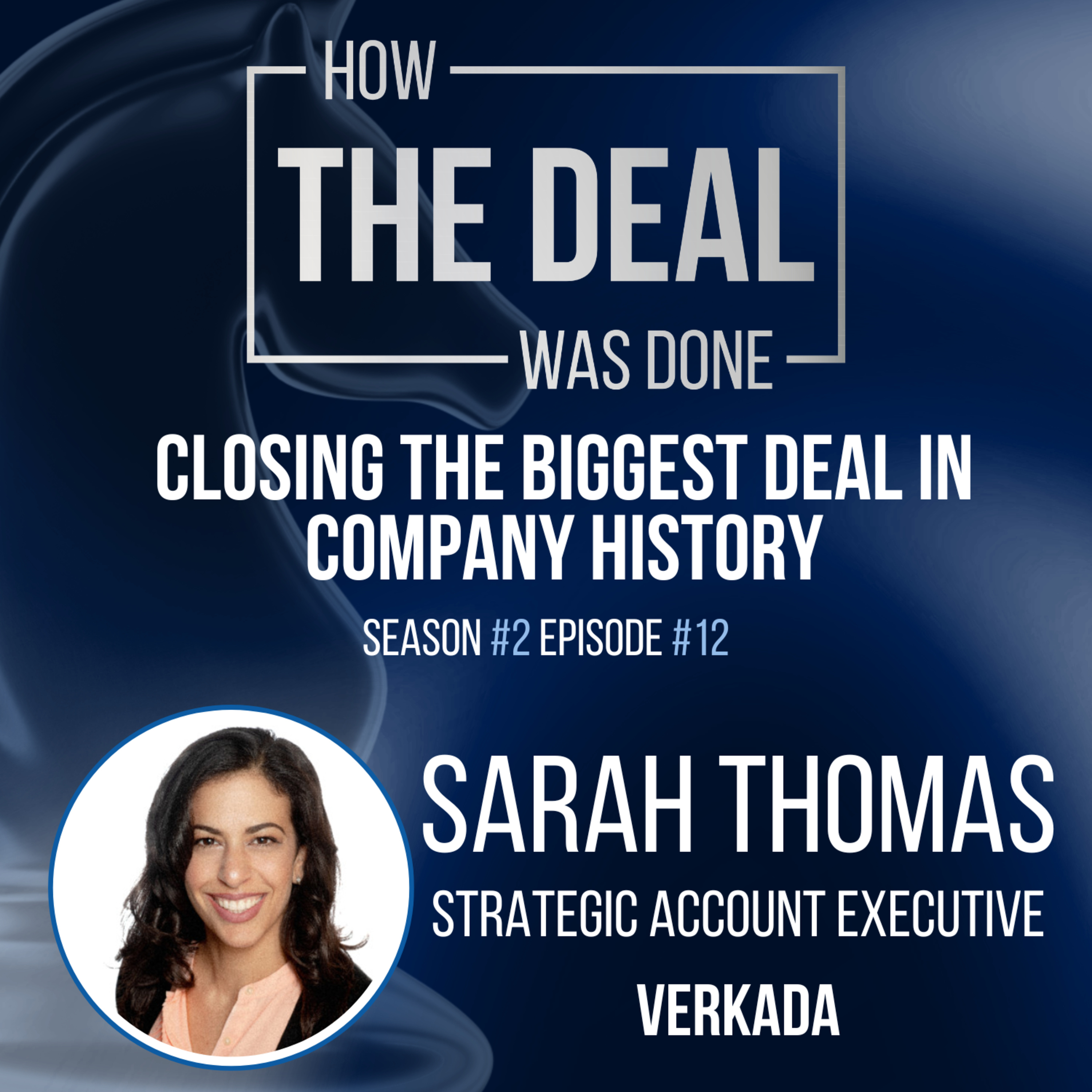
S2E12: Sarah Thomas, Closing The Biggest Deal in Company History
How the Deal Was Done | Sarah Thomas, Strategic AE at Verkada Sarah Thomas closed the biggest deal in Verkada history. 1,000 retail franchise locations, a skeptical new champion, a botched proof of concept, and a three-party sell across customer, integrator, and Verkada internally. The deal nearly died over a scope miscommunication that put her integrity on the line. She revived it by owning the mistake, renegotiating the structure, and rebuilding trust at every layer. In this episode: How to run parallel prospecting threads across a channel deal What to do when your pilot surfaces a broken promise How to beat a cheaper competitor on total cost of ownership Why selling year four matters more than winning year one How to structure staggered licensing around implementation reality Key Quotes "The customer said we had communicated one thing in the sales process — and during the POC it looked different. My integrity was challenged. But we owned our part of it." "How do they trust us year two, year three, year four? Not just buying equipment — truly partnering." "Can you even spend this money? It's uncomfortable asking, but maybe not as soon as I should." Resources Mentioned Fanatical Prospecting — Jeb BlountGong — deal intelligence and call reviewGemini — prospecting and account research Connect with Sarah LinkedIn : Sarah Thomas, Strategic Account Executive, Verkada How the Deal Was Done | Host: Matthew KlingnerFor senior AEs, founders, and GTM leaders who want to close bigger, more complex deals.
May 19, 2026Episode 111 hr 31 min
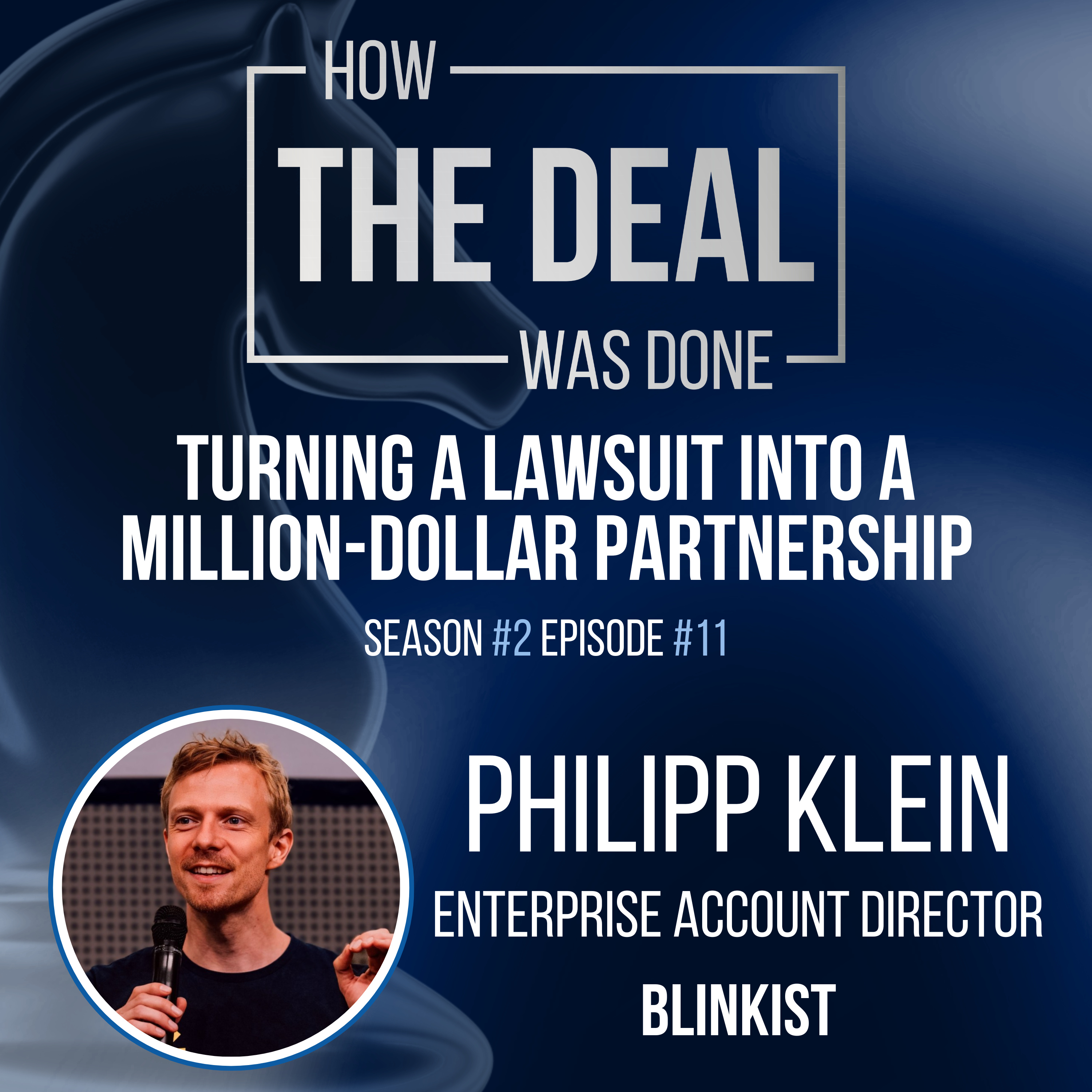
S2E11: Philipp Klein: From Legal Threats to a $1M Win
How the Deal Was Done Episode: Philipp Klein, From Legal Threats to a $1M Win Guest: Philipp Klein, Enterprise Account Director Companies: Blinkist | CoachHub Industry: Learning & Development / HR Tech Episode Summary Philip Klein joined CoachHub as one of its first five employees in 2019. In this episode, he walks through one of the most dramatic enterprise deals in the company's history — a nearly seven-figure coaching platform sale to Booking.com that spanned two years, survived a legal threat, and navigated a global pandemic. Key Moments in the Deal 1. The Lead Came from an SDR Philipp credits the shared-room culture of celebrating every small win as the foundation that made the deal possible. That buzz and collective energy often makes up for what early-stage teams lack in formal training. 2. Qualifying for Transformation, Not Just Interest CoachHub's calendar was full of the wrong meetings — coaching enthusiasts who wanted to coach 10–15 people. Booking.com 's team was different: they asked how CoachHub could scale and weren't scared of big numbers. 3. Reframing the Demo Request Rather than handing over access to an immature product, Philipp asked prospects to articulate what they actually needed to evaluate. That unlocked 4–5 additional stakeholder meetings that competitors — who just sent the login — likely never got. 4. The Legal Crisis Days after signing the pilot, Booking.com went dark, then sent a formal email threatening legal action over a data privacy dispute. Philip's response: mapped stakeholders on LinkedIn, escalated to senior management, and brought in the CEO and Chief Legal Officer to a recovery meeting. The CLO's command of data privacy law reestablished credibility and broke the impasse. 5. COVID as an Unexpected Catalyst When the pandemic froze Booking.com 's business, CoachHub kept dialing. They proposed a small global pilot — 15 senior decision-makers at HQ — to stay relevant and transition from vendor to strategic partner. When budgets unfroze, they were first in line. 6. Closing the Big Deal By late 2020, the close was — in Philip's words — the easier part. Financial incentives pulled the deal from December to November, and implementation meetings were already in stakeholders' calendars before the signature. The deal closed itself through the gate they'd built. Quotable Moments "The signature is basically just a gate the customer has to go through. Otherwise they cannot get to the next room." "You don't build confidence from successes. You build it from a mixture of successes and failures." "The difficult groundwork is what we did before. The big close was actually the easier part." Resources & Links Connect with Philipp LinkedIn: https://www.linkedin.com/in/philippklein/ Case study video: Search "CoachHub Booking.com " to see the video he negotiated into the contract How the Deal Was Done drops weekly. Subscribe wherever you listen to podcasts
May 11, 20261 hr 17 min
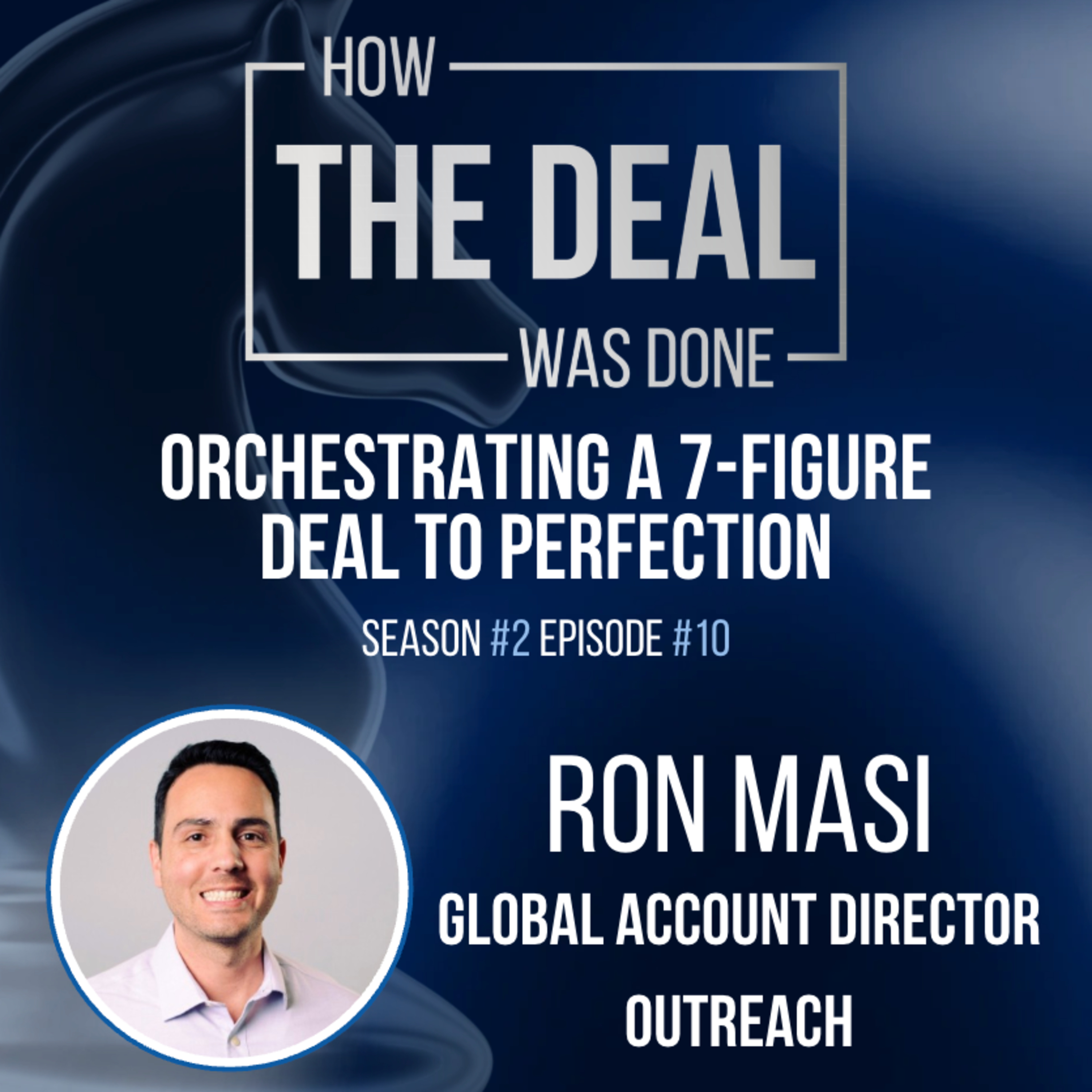
S2E10: Ron Masi, Orchestrating a 7-Figure Deal to Perfection
Ron Masi - Linkedin Ron spent 10 years selling ink on paper before moving into SaaS in 2015. He built his enterprise game the hard way — through coaches, mentors, and a lot of swing-and-miss — until he had a system for running deals at a level most AEs never reach. This episode is about a deal he's never forgotten. Not because of the size, but because of the execution. Every piece moved on purpose. The research, the internal alignment, the mind maps, the 90-minute demo that didn't show a single feature — it all came together and they walked out knowing they'd won. What you'll take away: How to build a deal dossier that actually changes how you sell, how to run an internal team across a complex opportunity without being in every room, and what it looks like when a demo stops being a demo and becomes a story. On research: "We highlighted every page of the CEO's book. We knew everything about them first." On internal selling: "Some people want to run really fast with you. Some people want to go slow. You have to think about how you're going to set this up." On not connecting the dots for the customer: "Never let the customer have to connect the dots. You need to connect them as much as possible." On the demo: "We didn't show the platform. We told them a story. We maybe clicked on four things. Maybe." On the win: "There was no possible way the people coming next were going to do that." On the feeling: "It's like an energy you don't even understand. Like if you played sports and you're in the zone — the basket was as big as the ocean." People Mentioned: Jamal Reimer — Mega deal coach, mentor to Ron Brian Burns — Sales coach, introduced Ron to mind mapping & "map to money" Dennis Sorensen — Mentor, taught Ron how to unpack annual reports & 10-Ks Mind mapping — Core tool Ron used to organize deal strategy and move pieces as the deal evolved
May 5, 2026Episode 91 hr 22 min
S2 Ep 9: Scott Knights, Global Top Performer at Proofpoint
Scott Knights — Major Account Manager at Proofpoint The Episode Scott Knights is a Major Account Manager at Proofpoint in Melbourne, managing some of the company's largest enterprise accounts across ANZ. This episode centers on how Scott inherited an account where the platform was "just working" — a comfortable situation that most AEs leave alone — and turned it into a full-scale platform transformation by convincing 30+ stakeholders across a parent organization to adopt a new vision for human-centric security. The account had been running the same Proofpoint deployment since the mid-2010s, nearly a decade without strategic evolution. You'll walk away with a clear picture of how to re-enter a dormant account, build a vision-led business case, and orchestrate internal and external stakeholders without losing anyone along the way. Key Quotes: On the most dangerous thing a customer can tell you: "The first bit of feedback was, hey, everything's great, but there's not really any further opportunity here. And that's kind of really interesting because I think that's the place that AI cannot disrupt." On qualifying out before the customer falls in love with the solution: "I said, look, we can definitely solve this. But it's going to cost approximately X. Are you comfortable and confident that your executive or senior leadership are going to sign off on this? And in the end, you could sort of see that that particular individual hadn't kind of really thought through the commercial value of what they were trying to achieve." On what the job actually is: "It's as much of a orchestrator as it is as a technology evangelist. If I look at one of my customers, there's 30 odd stakeholders within the parent org — from security and strategy and architectural teams, through to operational teams, through to legal and vendor managers and procurement." On the culture that quietly kills deals: "If the culture between teams kind of goes a bit off and starts to become even a little bit dysfunctional — people getting agitated with one another, blame or frustration being vented on calls — the wheels can very quickly fall off after that." On what to do when a stakeholder pushes back: "Seek first to understand and then be understood. What's going on for that person? What's the concern? What's the gap they're trying to solve for? And then once I understand that, I can go, okay, well, how do we solve this together?" On the mindset behind everything: "I'm just a very average guy. There is nothing exceptional about who I am or what I bring. But it's determination or diligence or just putting in that little bit of effort every day — it adds up. The success is just a natural outcome of that value creation." Referenced in the episode: Strategic Coach — Dan Sullivan's entrepreneurial mindset framework; Scott studies his work extensively — strategiccoach.com Eat That Frog! — Brian Tracy — tackling your single most important task first; Scott keeps this on his desk The Dip — Seth Godin — when to push through hard seasons and when to move on Books by Kazuo Inamori — Founder of Kyocera; philosophy of asking "what is the right thing to do as a human being?" in every business decision; most titles in Japanese, English translations available Servant Leadership — Robert K. Greenleaf — Scott's explicit North Star for how he approaches customer relationships Enterprise Sales Community — Founded by Jamal Reimer; global network of senior enterprise sellers — referenced as transformative to his own career Connect with Scott: LinkedIn — Scott Knights, Major Account Manager, Proofpoint, Melbourne
April 20, 20261 hr 3 min
S2 Ep 8: Merel Roest, Mastering Internal and External Storytelling in Strategic Sales
Episode Speaker Notes: Merel Roest — Head of Sales at Guardey, Founder @ Blackbird GTM The Episode: Merel Roest spent her first five years in marketing before moving into enterprise sales — and that background became her edge. At Freshworks, she closed a three-year, group-wide customer service transformation deal with a 5,000+ employee American organization, selling a product that wasn't fully built yet. Getting to yes meant running two parallel sales motions at the same time: one across multiple client stakeholders all the way up to their CEO, and one internally — working level by level through a hierarchical American HQ she could barely get face time with from her satellite office in the Netherlands. She won both. Now Head of Sales at Guardey, Merel is building the sales org from the ground up — rewriting the pitch, cleaning the CRM data, and using custom-built GPTs to accelerate her team's learning curve. What you'll take away: How to build a deal story that actually lands, how to run an internal sale when the product isn't ready, and what it really takes to go from President's Club rep to first-time leader. Key Quotes On ditching the standard deck: "It was me talking at you, not me talking with you. I shaped it completely around them — about solving their problem, not about us." On demos that keep people awake: "A lot of account executives click through buttons. That's where people fall asleep. We created personas — this is your customer, this is their problem, this is how they'd use the tool." On the most powerful moment in any demo: "Based on what you've now seen, how would this help you? Let them say it." On social proof that actually works: "Everyone has a logo slide called 'Our Customers.' I hate it — it says nothing. What problem did you solve for them? That's the story you should focus on." On conviction in the deal: "I already knew from my gut from the beginning — I don't know why, but I just felt it. This one's ours." On product belief as a prerequisite: "I would never be able to sell something I don't feel is actually going to help. Your product needs to be good." On the internal sale: "I didn't just have a pitch deck for the customer. I had a pitch deck for our internal stakeholders — one for my line of reporting, one for the solution engineers. Everyone needs to know the ins and outs of why we think this could work." On sales culture: "If your employees are happy, your customers are going to be happy. Culture is very underestimated in high-pressure SaaS sales environments." On moving from rep to manager: "I wanted to earn this person's respect before going into coaching mode. And I told him: I'm going to make mistakes. If I do something that doesn't sit well with you, I hope you'll tell me." On perfectionism at a startup: "Done is better than perfect. I have to tell myself that every single day." Resources & Links Referenced in the episode: Winning by Design — Jaco van der Kooij's demo methodology; Merel cites his video on keeping buyers engaged throughout a demo The Maverick Selling Method — Brian Burns — top performers throw out the standard script SPIN Selling, MEDDIC, SPICED — frameworks Merel used to build custom GPTs for her team's discovery and coaching TrustPilot & Google Reviews — used by Merel to benchmark client performance and build compelling before/after storytelling Glassdoor — recommended for vetting a company's culture before accepting a role Connect with Merel: LinkedIn — Merel Roest
April 13, 20261 hr 8 min
S2 Ep 7: Mike Sullivan, From $80K Debt to $70M Closed
Mike Sullivan is Executive Director of Sales at TriNetX, where he sells into top-20 pharmaceutical companies. This episode centers on his career-defining deal - a $3.55M ARR, two-year enterprise contract with a Fortune 500 pharma company that took nearly two years to close, ran 20+ use cases across 5 business units, and required Mike to get high in the account at month 20 of 24. This came at a time of great personal challenge and difficulty - balancing debt and obligations, while threading the needle of an incredibly difficult strategic sale. This deal flies in the face of almost everything we're taught in enterprise sales — and it worked because Mike refused to take shortcuts. He was 39 years old with $80K in debt when he joined TriNetX. This deal changed everything. Connect with Mike: LinkedIn: Mike Sullivan Website: mikesullivan.co Mike offers free 30-minute coffee chats for anyone navigating sales challenges or working to turn things around — reach out directly on LinkedIn or via his site. On getting high in the account: "I wasn't high in this deal until month 20 of 24. That goes against everything we're taught in enterprise sales — but I couldn't get there no matter what I tried." On running the pilot: "Rather than you as the customer pointing and clicking, we ran the use cases in our software for you and presented back the output. We did the upfront heavy lifting ourselves." On co-creating the business case: "We were building the business case with the customer throughout the entire deal cycle. So when we had the readout meeting, it was crystal clear — here's where you are today, here's what tomorrow looks like." On commission breath: "If you're making it about you and your commission check, you're putting your deal at risk. You'll subconsciously say the wrong thing at the wrong time." On patience: "Aggressive patience. You've got to be aggressive in the right way — persistent, following up — but patient as hell. If you squeeze an egg too hard, it breaks." On the internal sale: "A lot of times the internal sale is harder than the external sale. We know in our gut which deals have huge potential even when the pipeline doesn't reflect it." On transformation: "I didn't feel like I was selling at all during that deal cycle. It was more just project management — co-creating the process, co-creating the business case, really partnering with them." On mindset: "It's you against you. Are you doing the best you can do every single day? You can only control your attitude, your actions, and your effort. Literally nothing else." Books mentioned: The Gap and the Gain — Dan Sullivan & Dr. Benjamin Hardy The Four Agreements — Don Miguel Ruiz Ego Is the Enemy — Ryan Holiday Take the Stairs — Rory Vaden Connect with Mike: LinkedIn: Mike Sullivan Website: mikesullivan.co Mike offers free 30-minute coffee chats for anyone navigating sales challenges or working to turn things around — reach out directly on LinkedIn or via his site.
April 6, 20261 hr 2 min
S2 Ep 6: Kishan Patel, Closing a 8-Figure Deal in 27 Days
Kish Patel: Closing an Eight-Figure Deal in 27 Days Kish Patel is a Strategic Director of Accounts with 15 years in enterprise selling, the last five in cybersecurity and confidential computing. In this episode, he unpacks how he displaced a seven-year incumbent — who was also that competitor's number one customer — and closed a multi-year, eight-figure contract in 27 days. The key wasn't the product. It was financial intelligence, executive alignment, and a two-line proposal engineered directly to the CFO's bonus metrics. Sell the financial gap, not the feature. Kish spent 30 days researching the account before a single pitch — mapping EBITDA pressures, analyst questions, and hiring signals to understand what the business actually needed to achieve. Use the DEF 14A. Pull executive comp structures from public SEC filings and build your proposal around the two metrics that drive their bonuses. The CFO opened the DocuSign and signed in 30 seconds. Orchestrate from the outside in. Kish connected his Morgan Stanley team to the prospect's banking team to create legitimate pressure before ever getting in front of executives. The intro came with weight. AI is the trailer, not the movie. Use AI tools to accelerate research, but listen to the earnings calls yourself. You'll hear what the execs are proud of, what they're dodging, and what the analysts keep hammering — none of which shows up in a summary. Solve bigger problems, close bigger deals. If you're closing six-figure deals, you're solving seven-figure problems. Find the eight-figure problem and your deal sizes follow. Books The JOLT Effect — Matt Dixon & Ted McKinnon Brutal Truth About Sales — Brian Burns Tools Whyzer - Incredible deep research platform, geared toward financial fluency NotebookLM — Google's AI research tool; used to synthesize job postings into tech stack diagrams and generate audio summaries of analyst reports Gemini Deep Research — Used for comprehensive account research before uploading to NotebookLM SEC EDGAR — Search DEF 14A proxy statements and 10-K filings for any public company People & Podcasts Referenced: Brian Burns — Brutal Truth About Sales Podcast (treasure map vs. treasure hunt framework) Nate Nasralla — Peer advisor referenced during a pivotal deal moment Fluint.io LinkedIn — Kish Patel ______________________________________________________ How the Deal Was Done hosted by Matthew Klingner. New episodes every week.
March 30, 20261 hr 8 min
S2 Ep 5: Bas Pleune: From Broken to 7 Figures: Turning a Failing Account Into a Record-Breaking Win
Bas Pleune is the newly appointed CRO of Garde, and former enterprise seller at ContentSquare where he spent four years transforming a broken, problem-riddled account into one of the company's most strategic partnerships. He didn't win this account — he inherited it. The technology hadn't delivered, the champion was frustrated, and the contract was at risk. What followed was a masterclass in patience, relationship architecture, and systematic enterprise selling. Key Takeaways The org chart as a trust weapon. Bas mapped every stakeholder, reporting line, and informal power dynamic across four years. He used it to brief new champions, earn internal credibility, and open doors into parts of the organization he hadn't reached yet. Align your internal team to their own KPIs. SDRs are measured on number of opportunities — so give them ten smaller ones inside one account. CSMs want multiple active users — so expand the footprint. Pre-sales wants to close — so bring them in strategically. Make it easy for everyone to win by helping you. Use the buying process as a competitive weapon. When champions mentioned evaluating competitors, Bas asked one question: are they registered vendors? He knew they weren't. Then he painted the picture of exactly what that procurement process would cost them personally — and offered to save them the trouble. The tag-along close. Found a champion with enough priority and political capital to drive a deal through procurement? Use their momentum to pull through the lower-priority opportunities that couldn't close alone. Bundle them in and move together. Cloud marketplace as a deal accelerator. Routing deals through AWS, Microsoft, or Google marketplaces lets customers draw down on pre-committed cloud spend — unlocking higher discount brackets and aligning IT, procurement, and the hyperscaler rep all at once. Science over art. The best sales leaders — including some who are engineers by training — treat selling as a machine. Curiosity, business acumen, and financial literacy are the inputs. Everything else follows. Resources & People Mentioned ContentSquare — Digital experience analytics platform: contentsquare.com Guardey — Bas's current company as CRO: garde.com Nate Nasralla — Fluint CEO, referenced on emotional storytelling in deals: fluint.io John McMahon — Referenced on the science of enterprise sales, author of The Qualified Sales Leader Brandt Williams — Guest recommendation, former colleague, seller turned entrepreneur Jamie Ritchie — Guest recommendation, top enterprise seller at ContentSquare UK Jamal Reimer — Enterprise sellers community, where Bas and Matthew connected Connect Bas Pleune: LinkedIn
March 23, 202652 min
S2 Ep 4: Rachit Kataria, What AI Can't Replace in Enterprise Sales
Rachit Kataria | The Only Deals Left Are the Human Ones Rachit Kataria is co-founder and CEO of Centralize, backed by Y Combinator and Salesforce Ventures. He's a product engineer by trade who built a GTM motion from zero that's now landing enterprise customers like Intercom, Brex, Highspot, LangChain, and Cresta. This episode covers the future of strategic selling in an AI world, how Rachit built Centralize's go-to-market from the ground up, and why the sellers who thrive in five years will look nothing like the ones being replaced today. Key Quotes "Transactional sales might just die in five years. The only moat you have is your relationships." "Enterprise sales is not a meritocracy. Your job is not to get them to say yes to your product. It is to make it the most politically easy thing to say yes to." "I'm just here to get your shit done internally. You want to get something done? I'm just here to make it happen." "We call it relationship amnesia. You don't even realize you have it. And the worst thing is when someone leaves the company and walks out the door with them." "The most important deals worth getting done right now do not happen without crossing a certain trust threshold." "AI gets you to the last mile. You already have the puzzle pieces, you know what to say. With us, you know whom." Main Takeaways & Discussion Points Transactional sales is being automated out of existence. Rachit's thesis: in five years, AI will handle everything that's copy-paste, template-based, or sequence-driven. What's left is enterprise — complex, human, trust-dependent deals. The sellers who are building those skills now are future-proofing. Everyone else is on borrowed time. Relationship amnesia is costing companies more than they realize. Every rep who leaves takes their relationships with them. Every warm connection sits dormant in someone's inbox. Companies treat their relationship network as a people problem when it's actually an infrastructure problem — and most haven't built the infrastructure. The below-the-line stakeholders will sink you just as fast as missing the above-the-line ones. Going high in the org isn't enough. If the people vetting, implementing, and living with the software aren't on board, the deal dies anyway — just slower and more painfully. The SLG to PLG journey. Centralize started top-down: get the CRO and VP of Sales excited, roll it out. What they discovered is that the best individual reps — the forward-thinking ones closing the most complex deals — were pulling it up organically in QBRs and one-on-ones. One rep at Cresta used it in his session at their sales kickoff. His manager said it was teaching him how to think like an AE before he'd ever run a full sales cycle. The "slopification" of outreach. AI has made every message beautiful and every inbox unreadable. The only way through the noise now is trust, creativity, and relationships — the things that can't be templated. The sellers who understand this are pulling further ahead. The ones still optimizing sequences are running faster on a treadmill. Time to value is the new moat. Cursor, Lovable, Centralize — the companies winning in AI aren't the ones with the most features. They're the ones where a user gets an undeniable "aha" in the first 10 minutes. In B2B, that moment has to exist at the individual rep level before it ever becomes an enterprise conversation. Resources Mentioned Centralize — Relationship intelligence and multithreading platform: usecentralize.com (single player mode available — early access via the site) Y Combinator — Centralize went through YC two years ago: ycombinator.com Salesforce Ventures — Lead investor post-YC Cursor — Referenced as the benchmark for "time to value" in AI tools: cursor.sh Lovable — Referenced alongside Cursor as a model for viral B2B product adoption: lovable.dev Connect Rachit Kataria: LinkedIn Centralize: usecentralize.com
March 16, 202642 min
S2 Ep 3: Jamal Reimer, From Three $50M+ Deals at Oracle to Global CEO
Jamal Reimer is one of the most recognized voices in enterprise selling. While at Oracle, he closed three separate $50M+ transactions with major international firms - and has since built a global community, coaching practice, and an AI platform around helping senior sellers engineer deals at that scale. He popularized the term "mega deal" long before it became a LinkedIn buzzword, and his book Mega Deal Secrets tells the unfiltered story of how he closed his first one, coming out of years of mediocrity and missed quotas. This episode covers the mental and tactical shift from run-rate selling to strategic selling, what actually happened inside Jamal's first $50M deal, how the best sellers in 2026 are using AI differently than everyone else, and why financial fluency is now the most underleveraged skill in enterprise sales. Resources : Mega Deal Secrets (Book) Jamal's novel-format account of his first $50M deal at Oracle. Covers the full arc from near-churn to landmark win, including the mindset shifts, internal politics, executive dynamics, and commercial engineering that made it possible. https://www.amazon.com/Mega-Deal-Secrets-Biggest-Career/dp/1737765527 Enterprise Sellers Community: A global network of senior strategic sellers focused on closing seven and eight-figure deals. Weekly wins, peer accountability, and shared playbooks. This is the community referenced throughout the episode where members regularly share business cases with eight digits on them and pricing slides that go into the millions. Jamal and Matthew both credit this community as a key accelerant for thinking bigger and borrowing conviction from others who've done it. https://www.enterprisesellers.com WHYZER.ai Jamal's AI-powered platform for account research and financial intelligence. Built for enterprise sellers who need to understand how executives are compensated, how companies are structured to transform, and where budgets are actually allocated. The platform operationalizes the financial fluency concepts discussed in this episode, helping sellers see at a glance the metrics that matter to their buyers. https://www.whyzer.ai Financial Fluency Sessions: Jamal runs free sessions on financial fluency for enterprise sellers. This is the skill he identifies as most underleveraged in modern sales: the ability to speak the language of finance, structure proposals around executive compensation metrics, and translate product capabilities into EBITDA impact, margin expansion, or net revenue figures. https://www.jamalreimer.com Connect: Jamal Reimer on LinkedIn https://www.linkedin.com/in/jamal-reimer Guest Background: 10+ Years at Oracle: as a Senior Strategic Sales Executive Landmark deals: Three separate $50M+ transactions with major international companies Author: Mega Deal Secrets - a novel-format account of his first mega deal Community: Founder of a global community of senior strategic sellers - Enterprise Sellers Current company: CEO & Founder of WHYZER - an AI-powered platform for account research and financial intelligence for enterprise sellers
Is this your show?
Claim this listing to keep it up to date, reach guests who want to pitch you, and manage bookings with Guestify.