A series of thought leading podcasts ranging on topics and sectors by one of the world’s leading global law firms, Herbert Smith Freehills Kramer. For more information please visit www.hsfkramer.com
Listen to episodes
60 recent
October 22, 20267 min
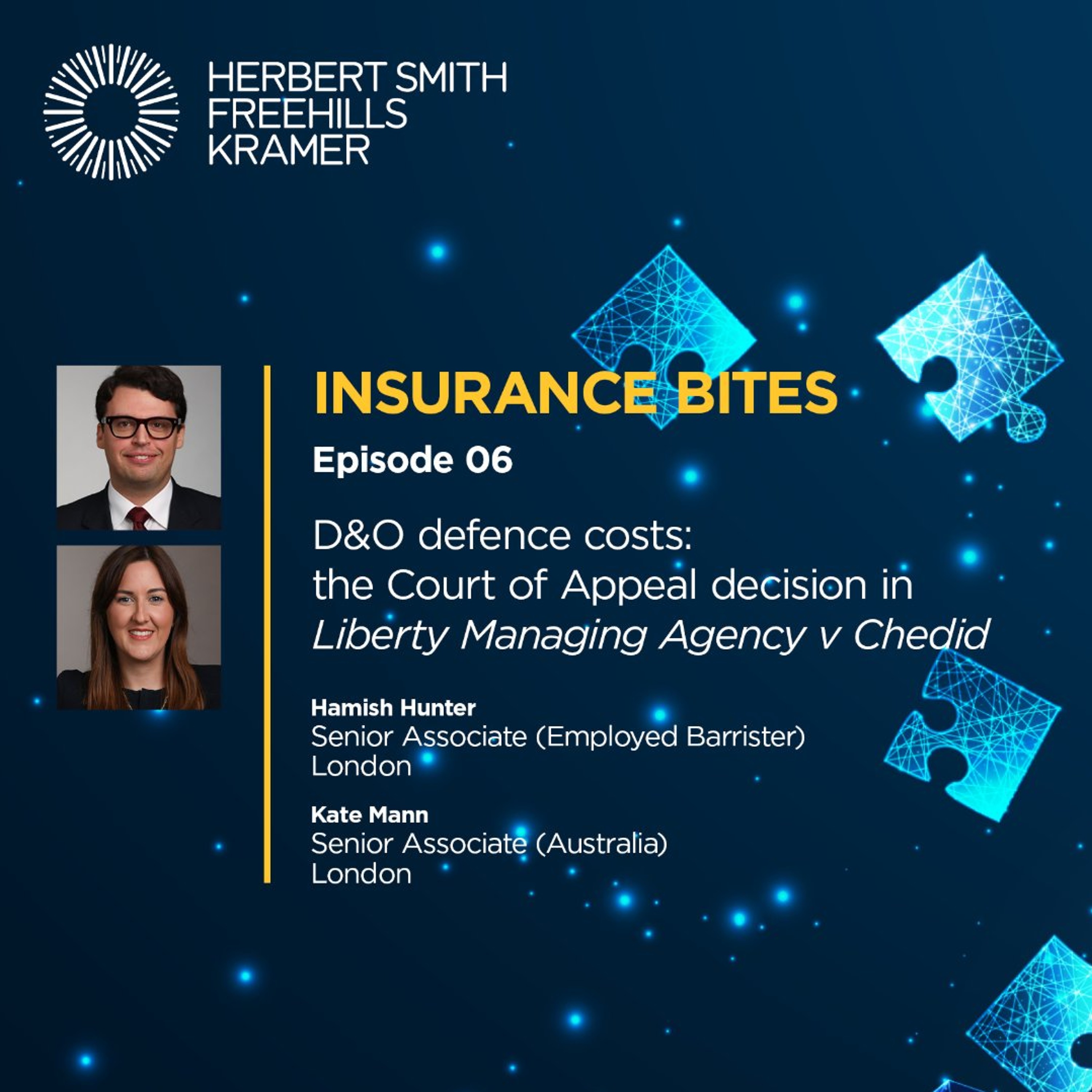
Insurance Bites EP6: D&O defence costs: the Court of Appeal decision in Liberty Managing Agency v Chedid
In this episode of Insurance Bites, Hamish Hunter and Kate Mann, Senior Associates in the Insurance & Professional Risks team, report on the appeal in Liberty Managing Agency Limited v Chedid which considered whether allegations of fraud against directors or officers permit a D&O insurer to withdraw cover, or whether the insurer must wait for independent determination. This is a critical question for an insured policyholder as it may determine whether they have the resources to mount a proper defence to the allegations. Our article on the first instance decision can be seen here on our Insurance Notes blog: https://www.hsfkramer.com/notes/insurance/2026-posts/established-not-alleged-commercial-court-confirms-d-o-policyholders-right-to-defence-costs
October 22, 20266 min
The Construction Law Shortcast: EP1 The prevention principle and time at large
What happens when an employer's own conduct prevents the contractor from meeting the contractual completion date? And what are the consequences when a contract has no effective mechanism to deal with acts of prevention? In the first episode of the Construction Law Shortcast, Xavier Milne and Noe Minamikata tackle two foundational principles of English construction law that anyone involved in construction projects needs to understand: the prevention principle and time at large. These concepts have significant practical implications for the completion date, liquidated damages regime, and other contractual relief potentially available to the parties. A concise breakdown of two principles that neither employers nor contractors should overlook.
October 21, 202633 min
Inside Arbitration Issue 22: Building the Bench - A conversation with Lise Bosman
AFSA’s appointment of Professor Lise Bosman as the inaugural president of its International Court was a clear statement of intent. Her career has moved between practice, academia and arbitral institutions: from apartheid-era campus politics at the University of Cape Town, the Iran–US Claims Tribunal in The Hague, practising commercial arbitration at Freshfields, leadership of the International Council for Commercial Arbitration (ICCA) and two decades teaching arbitration law at the University of Cape Town (UCT). She also serves as senior counsel to the Permanent Court of Arbitration. When she sat down with Jonathan Ripley-Evans, partner in the Johannesburg office at HSF Kramer, the conversation ranged across the current state of South African arbitration, how the AFSA International Court works, and how younger practitioners can build credible careers in the field. Speakers: Lise Bosman (President, AFSA International Court) and Jonathan Ripley Evans (Partner, Herbert Smith Freehills Kramer)
October 15, 202638 min
On Just Terms S2 E13: Across the Tasman: New Zealand's class actions landscape with Bell Gully
In this episode, partners Jason Betts and Aoife Xuereb speak with Sophie East and Jesse Wilson, partners at Bell Gully, about the evolving class actions landscape in New Zealand and how it compares with developments across the Tasman. They explore the foundations of New Zealand's representative proceedings regime, the significance of the Supreme Court's landmark decision in Ross v Southern Response, and the increasingly important role of litigation funders. The conversation also examines the claims driving activity in the market, the growing influence of Australian class action trends on claim theories and parallel proceedings, and what may lie ahead for the New Zealand class actions landscape.
October 14, 202617 min
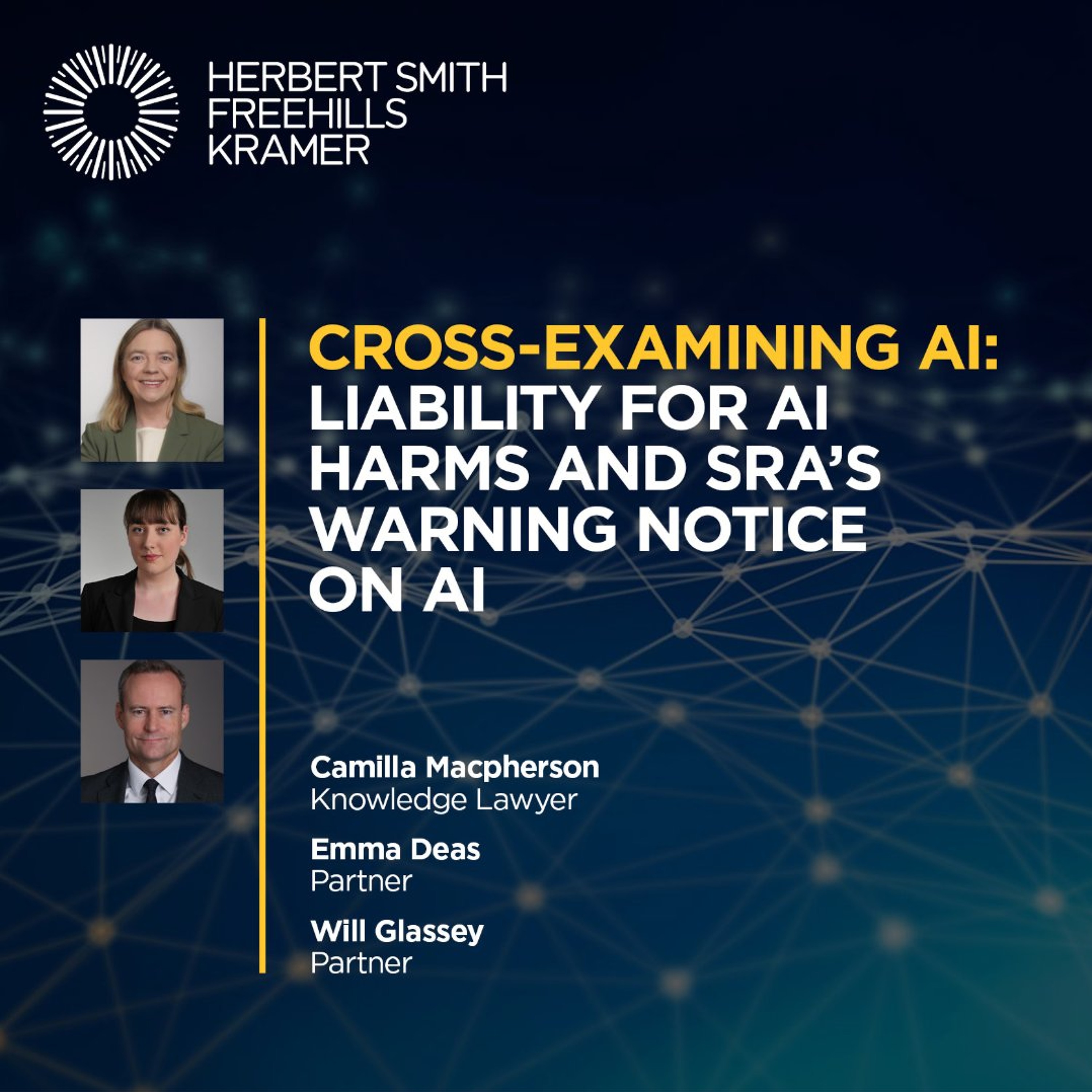
Cross-examining AI: Liability for AI harms and SRA’s warning notice on AI
This is the fourth episode of "Cross-examining AI", HSF Kramer's podcast series on disputes and AI where we unpack the key developments that are shaping litigation. In this episode we look at the UKJT’s statement on liability for AI harms, the SRA’s recent warning notice on AI and the first case from the Solicitors Disciplinary Tribunal where a lawyer has been struck off for misuse of AI. This episode is hosted by Camilla Macpherson, a knowledge lawyer in our disputes team, who is joined by Emma Deas, a partner in our banking litigation team and Will Glassey, a partner in our disputes practice with a focus on professional negligence and professional disciplinary claims. Below you can find links to our blog posts on the developments and cases covered in this podcast. • UK Jurisdiction Taskforce publishes final legal statement on liability for AI harms https://www.hsfkramer.com/notes/litigation/2026-07/uk-jurisdiction-taskforce-publishes-final-legal-statement-on-liability-for-ai-harms • Solicitors Regulation Authority issues a Warning Notice on the misuse of AI https://www.hsfkramer.com/notes/insurance/2026-posts/solicitors-regulation-authority-issues-a-warning-notice-on-the-misuse-of-ai • Lawyer struck off in first disciplinary case on AI misuse https://www.hsfkramer.com/notes/insurance/2026-posts/lawyer-struck-off-in-first-disciplinary-case-on-ai-misuse
October 13, 202640 min
Cross Examining Cyber EP28: Cross Examining Charles Carmakal
Welcome to Cross Examining Cyber, a podcast brought to you by Herbert Smith Freehills Kramer. In this series, we speak with leading cyber practitioners, business leaders and policymakers about the issues shaping today's cyber landscape, from emerging threats and regulatory developments to governance, resilience, and security strategy. In this episode, we cross-examine Charles Carmakal, Chief Technology Officer of Google Cloud Mandiant Consulting and one of the world's most respected cyber security and threat intelligence experts. Over the course of his career, Charles has been at the forefront of investigating some of the most significant cyber incidents and nation-state campaigns impacting governments and organisations around the globe. His insights are widely sought after by boards, executives and security leaders navigating an increasingly volatile threat environment. In this conversation, Charles shares his views on the growing intersection between geopolitics and cyber risk, and how global instability is reshaping the threat landscape for organisations of every size. Drawing on his extensive incident response and threat intelligence experience, he discusses the motivations and tactics of today's threat actors, the challenges of operating in an era of heightened geopolitical tension, and the practical steps organisations can take to improve their resilience. Charles also reflects on the reality that many successful cyber intrusions still begin with surprisingly simple techniques. From social engineering to physical security failures such as tailgating, he explains why organisations must remain focused on cyber fundamentals even as the threat landscape becomes more sophisticated and complex. This episode provides a fascinating perspective from one of the industry's leading voices on the threats shaping the future of cyber security and what leaders should be thinking about today to prepare for tomorrow. Thanks again for listening. This is Cross Examining Charles Carmakal. Here we go...
October 6, 202617 min
Legal Tech Deciphered Trust, Truth and Hallucinations: When Clients Communicate Everywhere, How Do You Collect Anything
In this episode we explore a challenge that receives far less attention than AI: how organisations identify and collect data in an increasingly fragmented communications landscape. From disappearing messages and encrypted devices to AI-generated transcripts and summaries, our speakers, Stephanie Barrett, David Beck, and Danbee Kim explore what happens when the volume of data, communication channels and information sources expand faster than an organisations' ability to keep track of them. The episode highlights a simple but important message: before organisations can unlock value from AI, they must first understand where their data lives, how to collect it, and whether it is fit for analysis. Good governance, clear policies, and a robust collection strategy remain the foundation of any successful data and AI programme.
October 1, 202630 min
OJT S2 E12 - Complexity, class actions and the future of litigation with the Honourable Justice Michael Wigney, Federal Court of Australia
In this episode, partners Jason Betts and Anna Sutherland speak with the Honourable Justice Wigney of the Federal Court of Australia, one of Australia's most experienced judges in complex commercial litigation and representative proceedings, about the growing complexity of modern litigation and its implications for courts, practitioners and clients. They discuss the rise of sprawling commercial cases, the challenges of electronic trials and vast volumes of evidence, and what judges find most effective in written and oral advocacy. The conversation also explores the use of expert evidence, the scrutiny of class action settlements, litigation funding and legal costs, before concluding with Justice Wigney's perspectives on the opportunities and limitations of AI in legal practice.
September 30, 202624 min
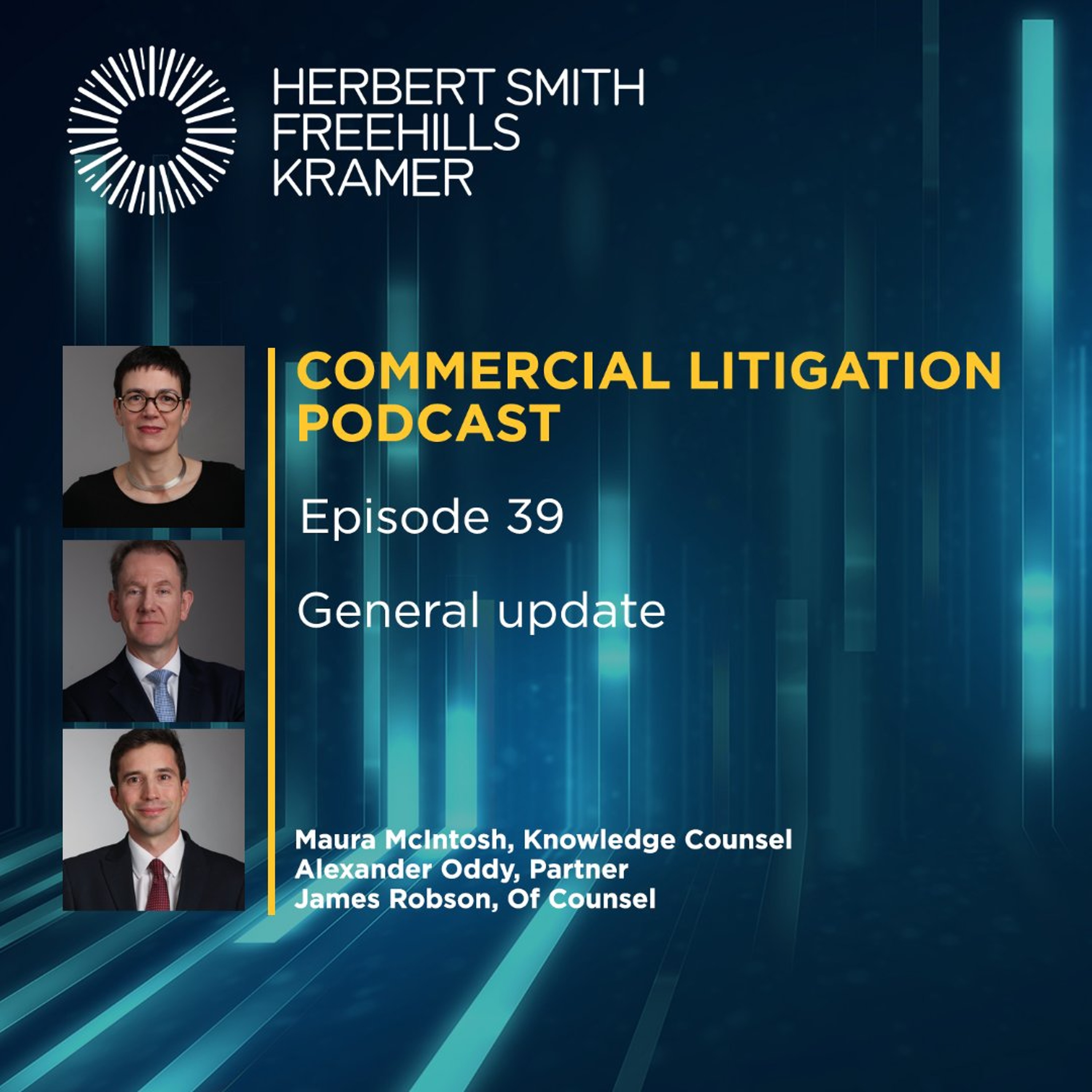
Commercial litigation EP39: General update
This is the 39th episode of our series of commercial litigation update podcasts. In this episode we discuss an interesting decision on privilege and company directors, some important client resources on ADR and a couple of significant contract law decisions, on termination and the recovery of loss-of-bargain damages and force majeure. This episode is hosted by Maura McIntosh, a knowledge counsel in our commercial litigation team, who is joined by Alexander Oddy, a disputes partner, and James Robson, an of counsel in our disputes team. Below you can find links to our blog posts on some of the developments and cases covered in this podcast. • New third edition of our leading textbook Class Actions in England and Wales https://www.hsfkramer.com/notes/litigation/2026-09/new-third-edition-of-our-leading-textbook-class-actions-in-england-and-wales • Creation of new Business and Property Division of the High Court announced https://www.hsfkramer.com/notes/litigation/2026-06/creation-of-new-business-and-property-division-of-the-high-court-announced • High Court decision underlines need for investor-appointed directors to think carefully before disclosing the company's privileged material https://www.hsfkramer.com/notes/litigation/2026-08/high-court-decision-underlines-need-for-investor-appointed-directors-to-think-carefully-before-disclosing-the-companys-privileged-material • Herbert Smith Freehills Kramer relaunches ADR Practical Guides and Conflict Management Toolkit https://www.hsfkramer.com/notes/adr/2026-posts/herbert-smith-freehills-kramer-relaunches-adr-practical-guides-and-conflict-management-toolkit • Supreme Court confirms award of loss of bargain damages following termination for non-repudiatory breach under express contractual provision https://www.hsfkramer.com/notes/litigation/2026-08/supreme-court-confirms-award-of-loss-of-bargain-damages-following-termination-for-non-repudiatory-breach-under-express-contractual-provision • High Court clarifies meaning of “unforeseeable” in force majeure clause https://www.hsfkramer.com/notes/litigation/2026-08/high-court-clarifies-meaning-of-unforeseeable-in-force-majeure-clause Link to episode transcript: https://marketing.hsfkramer.com/20/36058/landing-pages/commercial-litigation-podcast-ep39-transcript.pdf
September 23, 202626 min
Inside Employment (Australia) EP8: The future of non-competes: unpacking the proposed reforms
In this episode of Inside Employment, Tony Wood, Natalie Gaspar and Lucy Boyd unpack the Federal Government’s proposed reforms to non-compete and restraint of trade laws, recently released in exposure draft form. The proposed changes would significantly reshape the use and enforceability of non-compete and non-solicitation clauses across Australia. Tony, Natalie and Lucy discuss the key elements of the proposed reforms, including the ban on non-competes for employees below the high-income threshold, the prohibition on employee non-solicitation clauses, the new enforcement framework for higher income earners, and what the changes could mean for employers and workforce mobility. With consultation now underway, this episode provides a timely overview of one of the most significant proposed changes to Australian employment law in recent years.
Is this your show?
Claim this listing to keep it up to date, reach guests who want to pitch you, and manage bookings with Guestify.