Find partners
Fund the People: A Podcast with Rusty Stahl

Fund the People: A Podcast with Rusty Stahl

Hosted by Fund the People

BusinessInterviews guests

Episodes

143

Latest episode

May 2026

Language

EN

About the show

The only show that helps YOU invest in the nonprofit workforce! Here you’ll get the ideas, tools, data, and stories you need in order raise or give money to support and develop nonprofit workers and leaders in your organization or your community. This unique podcast invites you into casual, provocative conversations with diverse leaders from foundations, nonprofits, academia, and capacity-building groups. We give you the big picture view, and we dig into specific issues, such as executive transitions, burnout, HR, fundraising for staff, how public policy impacts nonprofit workers, and more. Fund the People is the national organization that works to maximize investments in America's nonprofit workforce. It was founded in 2014 by Rusty Stahl with support from The Kresge Foundation, NYU Wagner, and Tides. We’ve launched the podcast in 2020, and have published over 100 episodes across 8 seasons. We launched a private version of the show on Patreon in 2025. It features community conversations, extended episodes, and a Patreon-only show where Rusty gives you the inside view while getting outside for a walk in New York’s Hudson Valley. Visit patreon.com/fundthepeople.

Listen to episodes

60 recent
May 20, 2026Episode 1837 min

Anger, Hope, Funding, and the Future of Nonprofits with Vu Le, Nonprofit AF

Vu Le is our guest for the Season Nine Finalé, which also serves as an installment of our ongoing Defend Nonprofits, Defend Democracy Series. Recorded with a live zoom audience during our spring webinar series, Vu discusses his burnout, funding instability, philanthropy’s power dynamics, and what it will take to strengthen nonprofits in an era of rising authoritarianism. Vu argues that nonprofits and funders must stop normalizing scarcity, invest deeply in leaders and infrastructure, and organize collectively for long-term change.Drawing from his new book Reimagining Nonprofits and Philanthropy, Vu challenges conventional assumptions about fundraising, nonprofit leadership, and philanthropy itself. The conversation explores why progressive movements struggle to sustain leaders, how conservative leadership infrastructure has been built strategically over decades, and what nonprofit professionals can do right now to protect democracy and each other.Download a transcript of the episodeAbout Our GuestVu Le is a prominent writer, speaker, and former executive director of Seattle-based Rainier Valley Corps. Widely recognized for his irreverent, no-nonsense approach to social justice and philanthropy, he authors the viral blog Nonprofit AF, and is a co-founder of the Community-Centric Fundraising movement. Most recently he is author of the book, Reimagining Nonprofits and Philanthropy. In 2020, Vu was our first guest on the Fund the People: A Podcast with Rusty Stahl.Suggested Links:Vu Le’s Blog, Nonprofit AFReimagining Nonprofits and Philanthropy (Book)The Sally Covington Report (Moving a Public Policy Agenda: The Strategic Philanthropy of Conservative Foundations)Community-Centric FundraisingNonprofits Are Message with Joan Garry - Episode 251 with VuTrust-Based Philanthropy ProjectNational Council of NonprofitsIndependent SectorBolder AdvocacyRules of the Game Podcast (Note: Rusty misstated the name of the podcast in the recording. The correct name provided here)Solidaire NetworkFund the PeopleFund the People Webinar SeriesRelated Fund the People Podcast Episodes:S1:E1 — Vu Le: Treating Nonprofit People Like Batteries - The very first FTP podcast episode, revisited in this conversation, on burnout, scarcity, and nonprofit workforce culture.

May 13, 2026Episode 1733 min

Protect Direct Democracy: Ballot Measures, Funders, and Nonprofits - with Liz DiLauro, Robert Wood Johnson Foundation

In this installment of our Defend Nonprofits Defend Democracy Series, you’ll get a deep dive into one of the least-discussed but most important democracy issues facing nonprofits and philanthropy today: attacks on ballot initiatives and direct democracy. Elizabeth DiLauro of the Robert Wood Johnson Foundation joins Rusty Stahl to discuss how ballot measures have become critical tools for advancing health equity and why efforts to restrict citizen-led initiatives threaten both democracy and the nonprofit sector.Liz shares how RWJF is funding organizations defending ballot access in multiple states, helping other funders understand the legal pathways for engagement, and why funders using their public voice matters as much as their grantmaking right now. The conversation also explores democratic backsliding, gerrymandering, philanthropy’s role in this moment, and why protecting democratic participation is foundational to every social justice mission.Download the edited transcript as a .pdfGuest Bio:Elizabeth DiLauro serves as a Senior Policy Officer with the Robert Wood Johnson Foundation, where she shapes strategy and grantmaking at the state level to advance long-term change in the social policies that impact our nation’s health and well-being. Previously, Liz served as the senior director of advocacy at ZERO TO THREE, where she led the organization’s advocacy strategy to advance a policy agenda for young children and families. Earlier in her career, Liz worked with the Pew Charitable Trusts where she crafted state campaigns to increase access to children’s dental care, and the American Academy of Child and Adolescent Psychiatry where she advanced strategies to support children’s mental health policy. She has also worked in federal and state advocacy with Home Instruction for Parents of Preschool Youngsters (HIPPY) USA.Liz holds a Master of Public Administration from the Robert F. Wagner Graduate School of Public Service at New York University, with a specialization in public and non-profit policy and management.Links to Resources Mentioned in the EpisodeOrganizations:Robert Wood Johnson Foundation (RWJF)Ballot Initiative Strategy Center FoundationFairness Project Education FundBolder Advocacy (program of Alliance for Justice)Fund the PeopleReports, Publications, Events, and Tools:Rules of the Game Podcast⁠ (Bolder Advocacy, a program of Alliance for Justice)Foundations on the Hill (policy conference and Capitol Hill visits for the foundations and philanthropy infrastructure organizations)Answering the Call for a Healthy, Inclusive Democracy - Annual Letter (April 2026) by Dr. Rich Besser, President, Robert Wood Johnson FoundationAll By April (a 501c3 campaign hosted by Democracy Fund)

May 7, 2026Episode 1644 min

From 7% to 107%: Investing in Organizers Supercharges Impact - with Geraldine Alcid (Filipino Advocates for Justice) and Rebecca Gorena (All Due Respect)

In this episode (S9:E16), you’ll hear compelling evidence that investing in nonprofit workers isn’t a distraction from program results—it actually supercharges impact!Burnout is widespread in the nonprofit sector, particularly in social justice groups. But it doesn’t have to be. Our guests share their research, experience, and thinking, based on a cohort of Northern California nonprofits working with All Due Respect to improve working conditions for organizers in their ranks. Geraldine and Rebecca vividly describe how better pay, stronger systems, and a culture of wellness can significantly improve job quality, employee retention -- and program results. Download an edited transcript in .pdf formatOur Guests:Geraldine Alcid is Executive Director of Filipino Advocates for Justice (FAJ). Established in 1973 in response to the discrimination and alienation faced by Filipino immigrant newcomers, FAJ builds a strong Filipino community by organizing constituents, developing leaders, providing services, and advocating for just policies. Geraldine is also a founder and leads FAJ’s sibling 501C4 organization, FAJ Action Fund, established in 2022. She was born in Makati, Philippines, grew up in Chicago, IL. and currently lives in Oakland, CA. Rebecca Gorena (she/ella) is Senior Program Director at All Due Respect. She is a community advocate and campaign manager with over 14 years of experience across states and social justice sectors. Rebecca has led organizing and policy campaigns across many issues with an emphasis on developing the skills and autonomy of the organizers she works alongside.  This has resulted in her passion for building stronger movement spaces and leaders.Links to ResourcesKey Reports & Tools:⁠Shared Guidelines: A Commitment to Bay Area Organizers⁠ (Report from All Due Respect)⁠People Power Movements: Lessons from FAJ’s Deep Wellness Project⁠ (Report from All Due Respect)⁠Youth Organizing in the Bay Area: An Exploration of Organizational Labor Standards⁠ (Report from All Due Respect)⁠Sustainable Jobs Toolkit⁠ (Online toolkit from All Due Respect + Staffing the Mission)⁠Upgrading Nonprofit Workplaces 2026 Case Study Series⁠ (Research from Fund the People)Guest's and Host's Organizations:All Due Respect (ADR) websiteFilipino Advocates for Justice (FAJ) website FAJ on FacebookFAJ on InstagramFund the People (FTP) websiteFTP on LinkedInFTP Mailing ListRelated Networks & Partners Mentioned:RYSE CenterAAPIs for Civic Empowerment (FORCE)California Domestic Worker CoalitionEast Bay Community FoundationNational Domestic Workers AlliancePower CaliforniaAdditional FTP Episodes with All Due Respect:Thriving Wages for Community Organizers (S7:E6) – with Kara Park (All Due Respect) and Gabby Hernandez (Orale)Fair Labor Standards for Community Organizers (S3:E8) – with Kevin Simowitz and Kinzie Mabon (All Due Respect)More Relevant FTP Episodes:The Guru of Burnout (S1:E10) – with Dr. Christina Maslach, Professor Emerita, University of California Berkeley⁠⁠Using Capacity-Building Grants for People-Systems (S2 Bonus Episode) - with Andrea Frye, People’s Action (Bonus Episode)⁠How Funders Can Support Nonprofit Workers in the Age of Burnout, Part 1 (S6:E1) - with Jamie Allison, Walter and Elise Haas FundNew Study: Cost of Low Wages in Youth-Serving Nonprofits (S7:E22) – with Madison Holland, The Prosperity Initiative

April 29, 2026Episode 1538 min

Build Trust, Practice Equity: Funders and The Black Nonprofit Workforce - with Kaci Patterson, Social Good Solutions and Black Equity Collective

What does it take to move from talking about racial equity to practicing it—inside philanthropy and across the nonprofit sector? In this episode, you’ll get visionary and pragmatic guidance on how funders and nonprofits can close the gap between intention and action. Rusty speaks with Kaci Patterson, Founder of Social Good Solutions and the Black Equity Collective. Kaci shares how her work brings funders and Black-led organizations together to build relationships, trust, and unding strategies that are rooted in community.The conversation also digs into the economic and social impact of Black community organizations, the persistent under-funded/under-capacity paradox faced by these organizations, and the urgent opportunity facing philanthropy. As the DEI backlash and public sector staffing cuts disproportionately impact Black women, Kaci argues that philanthropy has a choice: retreat to old habits or invest boldly in a stronger, more equitable nonprofit workforce. This episode offers both a clear-eyed critique and a hopeful path forward—grounded in relationships, mutuality, shared leadership, and long-term sustainability.Download an edited transcript .pdf⁠ of episodeAbout Our Guest:Kaci is Founder and Chief Architect of Social Good Solutions (SGS), a Black woman-owned and operated boutique social impact consulting firm. Kaci also serves as Founder and Chief Architect of the Black Equity Collective, housed within Social Good Solutions.Kaci launched SGS in 2014 after nearly 18 years of working in the nonprofit and philanthropic sectors. Always with an eye toward human and community development, SGS works with philanthropic institutions, nonprofit organizations, and public agencies to design, operationalize and manage racial justice initiatives from concept to implementation. The firm’s expertise is operationalizing equity, demonstrating what’s possible in philanthropy and creating new standards for equity-centered practices in the field. Since 2014, SGS has raised and leveraged over $86 million (and counting!) for Black-led organizations in California!Links & Resources:Kaci Patterson & Her Work:Social Good SolutionsBlack Equity CollectiveA Guide for Pursuing Black Equity & Racial Justice in Philanthropic Initiatives and Government SystemsResearch & Data Mentioned:The Economic Contributions of California Black-Led Organizations, May 20, 2025, published by the Black Equity Collective and Nonprofit Finance FundBlack-led Nonprofits Didn’t See the Lasting Funding Boosts Promised After 2020’s Racial Reckoning, by James Pollard, April 7, 2026, Associated Press⁠Candid + ABFE report on funding for Black-led nonprofits⁠Black Women Suffered Large Employment Losses in 2025—Particularly Among College Graduates and Public-Sector Workers, by Valerie Wilson, February 10, 2026, Economic Policy InstituteRelated Organizations & Context:BLACC (Building Leaders and Cultivating Change) Fund (at Liberty Hill Foundation)ABFE - A Philanthropic Partnership for Black Communities (formerly the Association of Black Foundation Executives)Grantmakers for Effective Organizations (GEO)California Community FoundationLiberty Hill FoundationAspen Institute Civil Society FellowshipFund the People Resources:Fund the PeopleFund the People’s Talent Justice Research and Tools⁠⁠Fund the People Premium Podcast on Patreon⁠Fund the People's podcast is available on all platforms. Here are links where most people listen or watch: Apple PodcastsSpotifyYouTube video feed or audio-only feedPodPageSimilar Episodes:Funding Advocacy for Racial Equity in a Hostile Climate – with Dr. Giridhar Mallya, Robert Wood Johnson FoundationCoaching Black Women Leaders in White Nonprofit Spaces - with Kelli King-Jackson Coach and ConsultantRacial & Generational Barriers in Nonprofit Careers - with Frances Kunreuther and Sean Thomas-Breitfeld, Building Movement ProjectFunding Black Leaders to Prevent Burnout - with Dany Sigwalt, Power Shift Network

April 22, 2026Episode 1421 min

DEMOCRACY: The Unique Value of the US Nonprofit Workforce (3 of 3)

In this episode, you'll get a clear, concise, and cogent argument for the unique value of the U.S. nonprofit workforce, with a specific focus on how nonprofit workers contribute to democratic participation and self-governance. Host Rusty Stahl discusses five ways this value manifests:​Bringing the First Amendment to life​Delivering services to citizens on behalf of government​Advocating to government for the public interest​Last bulwarks of democracy​Engines of civic participationThis is the third installment in our three-episode miniseries on the Unique Value of the U.S. nonprofit workforce. The first installment focused on our contributions to American community. The second focused on our contributions to the American economy. (You can find links to the prior installments below.) Taken together, we have a powerful picture of how the nonprofit contributes to American society It's worth noting that, in this framing the 'third sector' contributes mightily to the first sector (the public sector, or government) and the second sector (the private sector, or business).Download a transcript in .pdf format.Relevant Episodes:​The Unique Value of the U.S. Nonprofit Workforce - Part 1 of 3​The Unique Value of the U.S. Nonprofit Workforce - Part 2 of 3​S1:E4 - Lester Salamon (including this episode because at about minute 9 and 54 seconds, Dr. Salamon discussed how the federal government massively 'outsources' the delivery of its programs and services to 'third parties', many of which are nonprofits)

April 15, 2026Episode 1314 min

ECONOMY: The Unique Value of the U.S. Nonprofit Workforce (2 of 3)

In this episode, host Rusty Stahl makes the economic case for valuing the nonprofit workforce—nearly 13 million workers powering 10% of the U.S. private workforce. Drawing on fresh data, he reveals how nonprofits create jobs, stabilize communities during crises, and fuel broader economic growth. If policymakers and funders overlook this workforce, they’re missing one of the most significant economic forces in the country.This is Part 2 of our 3-part miniseries on the value of the nonprofit workforce! In the first episode of the miniseries, Rusty makes a passionate plea for everyone to discuss the value of the nonprofit workforce, and then addresses how nonprofit workers bring value of their communities. Part 3 of the miniseries will discuss the value of the nonprofit workforce for our democracy.Links to Resources:​5 Surprising Facts about the U.S Nonprofit Workforce⁠​CalNonprofits 2019 Causes Count Report Subscribe to Fund the People's YouTube Channel.FTP Podcast Audio on YouTubeFTP Podcast Video on Youtube​FTP Podcast Video ClipsGeorge Mason University:​Nonprofit Employment Data (NED) Project​2024 Nonprofit Employment Data Report⁠​⁠ (national data on nonprofit wages)Spotlight on Nonprofit Wages (nonprofit wages by sub-sector)Nonprofit Employment in the States, 2017-2022 (nonprofit wages by region)​Nonprofit Works Interactive Online Database (explore nonprofit wages by geographic area, sub-sector, and in comparison to for-profit and government)Relevant Episodes:​The Unique Value of the U.S. Nonprofit Workforce - Part 1 (S9:E12, April 8, 2026, 22 minutes)​Making the Nonprofit Workforce Visible - with Dr. Alan Abramson and Chelsea Newhouse, George Mason University (S7:E24, May 21, 2025, 42 minutes)​The Power of the Nonprofit Workforce - with Dr. Lester Salamon, Johns Hopkins University (S1:E4, October 16, 2020, 52 minutes)

April 8, 2026Episode 1221 min

COMMUNITY: The Unique Value of the U.S. Nonprofit Workforce (1 of 3)

“Nonprofit workers are an unspoken part of our social contract.”Why do we need to explicitly talk about the value of the nonprofit workforce—especially to people already working within it?In this opening episode of a three-part series, Rusty Stahl argues that the nonprofit workforce has long been overlooked in public policy, media narratives, and even within the sector itself. Drawing on insights following Foundations on the Hill 2026, he highlights how nonprofit workers are frequently excluded from major policy debates—even when those policies directly impact their jobs and communities.Rusty challenges the dominant “deficit-based” framing of the nonprofit workforce, which focuses on what workers lack, and instead calls for a shift toward an “asset-based” narrative that recognizes the sector’s immense contributions.The episode then explores the first dimension of value: community. From meeting basic needs to enabling generosity and envisioning better futures, nonprofit workers are essential to the functioning, resilience, and cohesion of communities across the country.In the next episodes of this miniseries:Part 2: The value of the nonprofit workforce to the U.S. economyPart 3: The value of the nonprofit workforce to democracy and libertyIf this episode resonated with you:Share it with a colleague, funder, or policymakerLeave a review of our show on Apple Podcasts or a comment on SpotifyStart conversations in your network about the value of the nonprofit workforceResources & LinksDownload an edited .pdf transcript of this episode Fund the People: https://fundthepeople.orgEmail Rusty: rusty@fundthepeople.org Related EpisodesS9:E11 - The Federal Policy & Propaganda Landscape Facing the Nonprofit Workforce in 2026⁠S8:E1 - The Trump War on Charity⁠S7:E4 - Making the Nonprofit Workforce Visible - with Dr. Alan Abrahmson and Chelsea Newhouse, George Mason University⁠

April 1, 2026Episode 1137 min

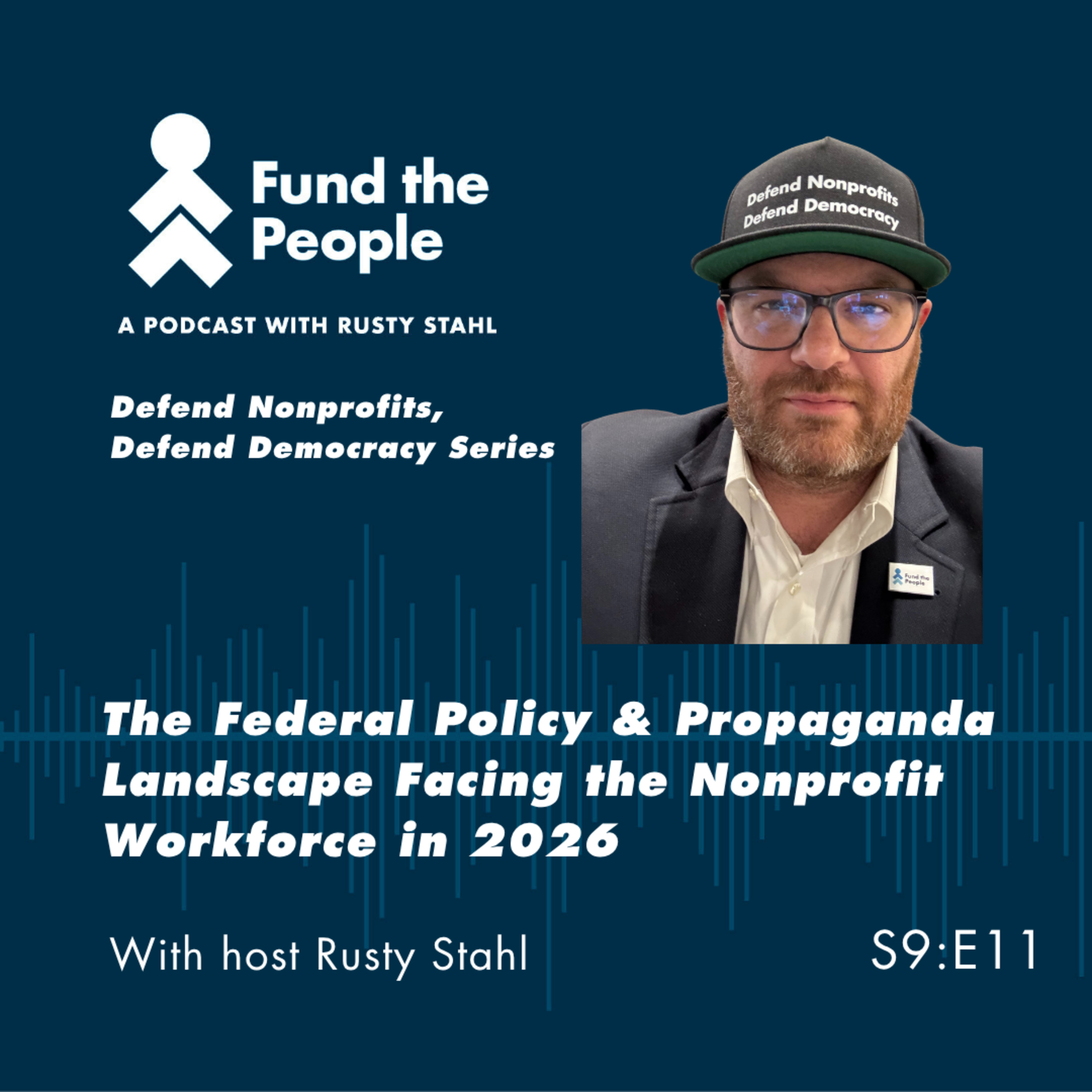
The Federal Policy & Propaganda Landscape Facing the Nonprofit Workforce in 2026 - with host Rusty Stahl, Fund the People

In this episode, you get a firsthand report from "Foundations on the Hill." Rusty discusses emerging federal threats and opportunities for our sector. From new legislation to executive action, he shares what’s at stake for the nonprofit workforce—and why we must engage now to shape the narrative. Download episode⁠ transcriptWatch episode Promo VideoLinks to Information Discussed:Challenges on the HorizonReintroduction of H.R. 9495 (H.R. 6800 and S. 3554):Press Release: ⁠Cornyn, Sheehy Introduce Bill to Revoke Tax-Exempt Status of CAIR, Groups Bankrolling Terrorists⁠ (Senator John Cornyn)⁠Official Text of H.R. 6800⁠⁠Official Text of S. 3554⁠Press Release: ⁠Nonprofit Killer Bill Re-Introduced in the House and Senate⁠ (Charity and Security Network)SPONSOR Act (S. 3942):Press Release: Moran, Cruz Introduce Legislation to Deter Non-Profit Sponsorships of Left-Wing Radicals (Congressman Nathaniel Moran)Official Text of the Bill from congress.govExecutive Actions to Frame & Investigate Nonprofits as Terrorist Supporters:Investigating Nonprofits as Terrorist Supporting Organizations:National Security Presidential Memorandum (NSPM-7) (The White House)Attorney General Memo - “Implementing NSPM-7: Countering Domestic Terrorism and Organized Political Violence - (Office of the Attorney General)FBI and IRS to investigate nonprofit groups for domestic terrorism links, sources say (CBS News)FBI and IRS join forces under Bondi directive (MS Now)How NSPM-7 Seeks to Use "Domestic Terrorism" to Target Nonprofits and Activists (ACLU)Administration imposes ideological bounds on student debt forgiveness for public servants:Overview of Proposed Changes and Updates on PSLF program (National Council of Nonprofits)Finalized Changes and Litigation (National Council of Nonprofits)Education Department Imposes Controversial New Restrictions on Public Service Loan Forgiveness Program (American Association of Universities)Administration pursues ideological litmus test for federal grants:DOGE Takes Over Federal Grant Website (NonProfit Times)Proposed Changes to Federal Grant Portal Could Disrupt Nonprofits and Harm Communities Nationwide (National Council of Nonprofits)Guide to Submitting Public Comments on Changes to Federal Grants Certification (National Council of Nonprofits) Note: public comment period ended 3/30/26. 1,300 nonprofit groups joined the sign-on letter, and 22,000 submitted public comments! Apparently there will be further opportunities to offer public comment, so this info is worth reviewing!Positive DevelopmentsPhilanthropy Caucus Launched in House of Representatives:Press Release from Congressman Blake Moore (DATE)Small Nonprofit Retirement Security Act (H.R. 4548 / S. 2365):Press Release: Buchanan Leads Bipartisan Effort to Help Small Nonprofits Offer Retirement Plans (07/21/25)Official Text of H.R. 4548Official Text of S. 2365Educating Policymakers About the Nonprofit Workforce:Five Surprising Facts About the Nonprofit Workforce (FTP hand-out for Congress)NEW: Johnson Amendment Upheld:Since recording this episode, news arrived that a court has upheld the Johnson Amendment, maintaining nonprofit separation from political campaigns and donationsOrganizations Mentioned in the Episode:Council on FoundationsFoundations on the Hill 2026Fund the PeopleIndependent SectorNational Council of NonprofitsPhilanthropy RoundtableUnited Philanthropy ForumAdditional Links:Council on FoundationsFoundations on the Hill 2026Fund the PeopleIndependent SectorNational Council of NonprofitsPhilanthropy RoundtableUnited Philanthropy ForumRelated Episodes:Peaceful Terrorists and Violent Activists (S9:E1, January 2026)The Trump War on Charity (S8:E1, September 2025)Mr. Stahl Goes to Washington (S7:E13, March 2025)Nonprofits Made America (S7:E11, February 2025)Related Playlists:Defend Nonprofits, Defend Democracy Series PlaylistHost-Only Episodes PlaylistRusty’s Rants and Reflections Playlist

March 25, 2026Episode 101 hr 3 min

S.O.S. Funding: All Hands on Deck for a Nonprofit Workforce in Crisis - Kim Almeida, Maria Cabildo, Annie Chang, Janelle Miller, & Rusty Stahl

In this episode, you’ll get a bold, provocative new idea for investing in the nonprofit workforce—and why it may be essential to the sector’s survival. We all know that restricted project support doesn't empower nonprofits to invest in their staff. But, we argue, general operating support isn't up to this task either. Staff Operating Support (SOS) offers a new way that funders and fundraisers can strategically, responsively move money to support the workforce of grantee organizations.We introduced the idea of Staff Operating Support during Season 8 (see link to the episode below) . Today's conversation, drawn from a webinar on March 12, 2026, builds on the previous one as Rusty Stahl presents updated thinking, including the 7 key traits of S.O.S. funding. This episode also features a silo-busting panel and audience of funders, nonprofit leaders, and intermediaries, sharing enthusiasm, critiques, questions, and additional ideas about S.O.S. funding.Host Rusty Stahl is joined by Co-Host Annie Chang (Nonprofit Finance Fund). Rusty defines Staff Operating Support, and shares seven key traits of the concept. Annie and a panel of nonprofit of respondents unpack the ‘compounding crises’ in the nonprofit sector’s workforce —and explore what it will take to proactively address it. Alongside Annie, the panelists are Janelle Moravek Miller (Youth and Family Counseling), Maria Cabildo, The Durfee Foundation, and Kim Almeida (Levi Strauss Foundation). From new research data to real-world results, this episode makes the case that funding staff isn’t overhead—it’s mission-critical.S.O.S. Funding Concept Info Hub - Fund the PeopleHow to Support Nonprofit Worker Well-Being - Nonprofit Finance Fund Financial Insecurity in the Nonprofit Workforce - Independent Sector and United Way (wiht link to "ALICE" in the Nonprofit Workforce report)Durfee Foundation's Sabbatical Program - The Durfee FoundationWell-Being and Equity as a Business Imperative research report - Levi Strauss Foundation and Harvard T.H. Chan School of Public Health Introducing Staff Operating Support (S.O.S.) Grants Concept⁠ with host Rusty Stahl, Fund the PeopleChasm Grows between Funder and Nonprofit Perceptions of Crisis - with Elisha Smith Arrillaga, Center for Effective PhilanthropyDonors Invest in Health Nonprofit’s Staff -- with Dramatic Program Results - with Janelle Miller Moravek, Youth and Family CounselingFunding Nonprofit People & Possibility: Inside the Durfee Foundation - with Maria Cabildo, The Durfee Foundation

March 18, 2026Episode 935 min

Out of Control: Fixing Funding that Starves Social Sector Staff - with Glen Galaich, Stupski Foundation and Break Fake Rules Podcast

Why do private foundations give away so little of their wealth each year—and how does that affect nonprofits and the people who work in them? Especially as the Trump Administration's War on Charity continues to rage?Rusty Stahl talks with Glen Galaich, author of the new book ⁠Control: Why Big Giving Falls Short⁠, about philanthropy’s culture of control, the limits of the 5% payout model, and what foundations could do differently to support nonprofit organizations and their workforce.Download the transcript of this episode in .PDF format Guest Bio: Glen Galaich is author of the new book, Control: Why Big Giving Falls Short. He is CEO of the Stupki Foundation, a private spend-down foundation based in the Bay Area. Glen hosts (or co-hosts, depending on the day) the Break Fake Rules Podcast. Click here to learn more about Glen.Links to Resources:Stupski FoundationControl: Why Big Giving Falls ShortBreak Fake Rules PodcastRusty’s appearance on Break Fake Rules Podcast (March 4, 2026)Dimple Abichandani’s appearance on the FTP PodcastDimple Abichandani’s book, A New Era of PhilanthropyVu Le’s book, Reimagining Nonprofits and PhilanthropyVu Le’s appear on the FTP PodcastMarguerite Casey FoundationCarmen Rojas appearance on Break Fake Rules PodcastFund the PeopleRelated Episodes:FTP Podcast Spotify Playlist on the Overhead Myth (Note: a free Spotify account is required to listen)How Funders Can Support Nonprofit Workers in the Age of Burnout - with Jamie Allison, Walter and Elise Haas FundEmbracing Nonprofit Abundance - with Nell Edgington, Author and Consultant

Is this your show?

Claim this listing to keep it up to date, reach guests who want to pitch you, and manage bookings with Guestify.

Claim this listing

More Business podcasts