Find partners
Fire Protection Podcast

Fire Protection Podcast

Hosted by Inspect Point, Drew Slocum

BusinessInterviews guestsExplicit

Episodes

95

Latest episode

Jun 2026

Language

EN

About the show

The Fire Protection Podcast dives deep into topics of the fire protection industry. Fire alarm, sprinkler, suppression, extinguishers and other life safety systems are discussed. Leaders from all over the world talk about new technologies and processes that are helping improve the fire safety community.

Listen to episodes

60 recent
August 26, 202612 min

The Fall River Fire and the O-Ring Sprinkler Problem — with Grant Lobdell of Dyne Fire Protection Labs

Grant Lobdell is back on the show at a moment when the whole industry is paying attention. The fire at Gabriel House in Fall River, Massachusetts put a hard question in front of every contractor: how do recalled sprinkler heads stay in buildings for decades, and whose job is it to catch them? Grant runs the lab side of Dyne Fire Protection Labs, now an NFPA Global Solutions company, and his answer starts with an honest observation: contractors handle the routine work well. It's the tests that come due 20 or 50 years after install that fall to the wayside. Dyne's whole stance is that the easier the test is to do, the more likely it gets done. From there the conversation goes inside NFPA 25. Grant walks through how testing intervals actually get set and why they keep changing edition to edition: dry sprinklers moving from 10 to 15 to 20 years as failure-rate data came in, quick response intervals stretching as the technology proved itself. The committee isn't trying to make life difficult. The intervals are a data-driven decision, and the data keeps moving. Then the hard part. Recalled O-ring sprinklers are not specifically called out in the standard today. As Grant puts it, if you hand him an O-ring sprinkler and it passes the test, it technically meets the standard, even though the failure rate says otherwise. He expects that to be a hot button in the next revision cycle. The codes, as the saying goes, are written in blood. The back half is a live walkthrough: how Inspect Point structures sprinkler head data down to the individual head, tracks the right test frequency for whatever NFPA 25 edition each building is on, projects what's coming due across every building in a portfolio, and submits heads to Dyne for testing in a couple of clicks. Grant's team sends a kit, you fill the box, and the lab report lands in your inbox.
June 30, 202637 min

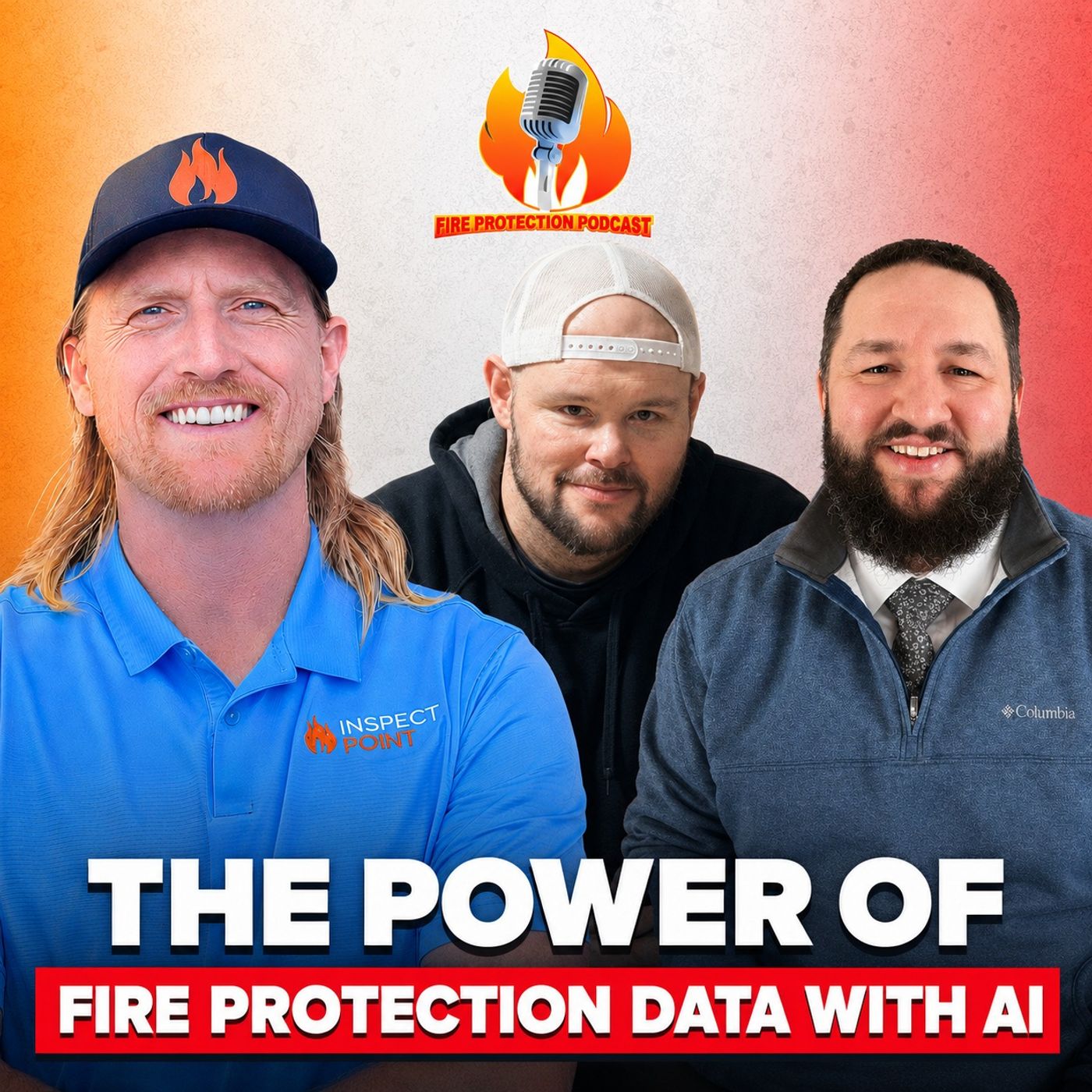
Episode #97: Inspection Data Is Your Biggest AI Advantage (with Jimmy & John)

Drew brings two of Inspect Point's own onto the show this time: John Ryan, a senior solution engineer who came up through the product and engineering side, and Jimmy Snowden, who leads the support team and spent years as a technician and inspection manager before joining the company. If you've caught their monthly customer session, "Coffee with Jimmy and John," this is the same back and forth, now for the industry at large. The heart of the conversation is data. Everybody is talking about AI, but Jimmy and John make the case that the payoff depends on what you capture and how. Plenty of companies record building data. The advantage shows up when you capture clean, standardized data at the system and asset level: manufacturers, model numbers, recalls, test dates, how an asset has performed over time. Lock that in and you can ask real questions, like how many buildings had an extinguisher that wasn't inspected last year, and start making projections instead of digging through PDFs and spreadsheets that were never built to be searched. From there they get into the new features built on that system and asset model: fully custom question sets, components and attributes you can take as granular as you want, barcoding down to an individual cylinder or valve, fire pump curves, and the AI agents on the way. The back half turns to codes and compliance. John talks through healthcare and the Joint Commission's January 2026 change that simplified fire-safety documentation, and why a transition everyone braced for went off quietly. Jimmy walks through the 2026 edition of NFPA 25, including a residential sprinkler head testing gap he spotted and ran past CASI, NFPA LiNK's AI assistant. And he closes with a sharp theory on why NFPA 25 is the most complex standard in the trade: a sprinkler system is full of water, and water can destroy property the same way fire can, so you're protecting against both. Join Drew, John, and Jimmy for a real look at where fire protection data, AI, and the codes are all heading. Topics covered: "Coffee with Jimmy and John" and how it started Why no two fire protection companies do the job the same way How fire protection differs from other trades: each system, its own code Why system and asset data, not just building data, is what makes AI useful Custom question sets, components, attributes, and barcoding everything Putting AI to work: prompts, projections, and agents on the way Healthcare and the Joint Commission's January 2026 change Inside the 2026 edition of NFPA 25 and a residential head testing gap Why NFPA 25 is so complex: protecting against fire and water 0:00 What's in this episode 1:44 Getting John and Jimmy on the mic 2:16 Meet John Ryan 3:33 Meet Jimmy Snowden 4:27 Favorite systems: dry systems and valves 5:32 "Coffee with Jimmy and John," their monthly customer session 10:13 No two fire protection companies are alike 11:07 Why fire protection is different: each system, its own code 14:13 The real AI unlock is system and asset data 15:28 New features: custom question sets, components, and barcoding 17:48 Putting AI to work: prompts, projections, and agents 23:50 Healthcare and the Joint Commission 24:24 The January 2026 change that simplified documentation 31:16 Inside the 2026 edition of NFPA 25 32:12 The residential head testing gap (and asking CASI) 34:22 Why NFPA 25 is so complex: fire and water 36:15 Wrap-up

June 17, 202631 min

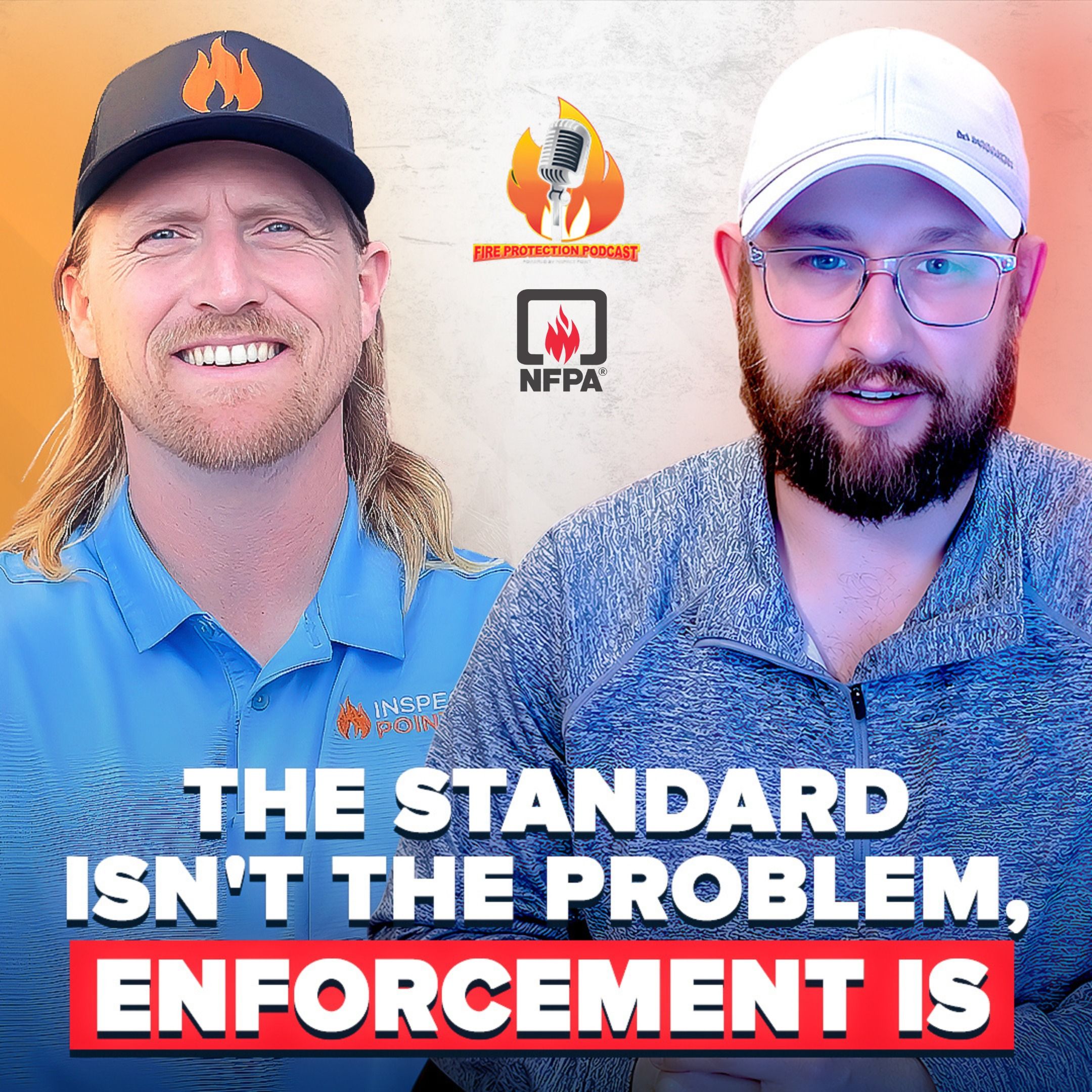
Shawn Mahoney on NFPA 241, Wood-Frame Fires, and the Enforcement Gap

Shawn Mahoney of NFPA's Technical Services team joins Drew for his fourth time on The Fire Protection Podcast, and this one covers a lot of ground before landing on a problem the industry keeps stepping over: construction-site fires. You've seen the headlines. A light wood-frame building goes up mid-construction, and the whole thing is gone, like the Denver complex that took a 238-unit building with it, or the South Park fire in North Carolina that killed two workers. Shawn's point is blunt: we already have the standard to prevent this. It's NFPA 241, the Standard for Safeguarding Construction, Alteration, and Demolition Operations, and it's been around since 1930. It's referenced by NFPA 1, NFPA 101, the IBC, and the IFC. "The biggest issue is people just aren't using it," Shawn says. The code isn't broken. Enforcement is. Drew and Shawn dig into why adoption is so piecemeal, what real enforcement looks like (Boston shuts a site down if the fire prevention program manager isn't there), the legislative push after the North Carolina fire, and what the Fire Prevention Program Manager actually has to do day to day. Before that, they preview the NFPA Conference & Expo in Las Vegas, including Drew's Tuesday session on AI and fire protection, how AI has reshaped the codes world through NFPA LiNK, CASI, and the new Notebooks feature, and why data centers and small nuclear reactors are creating fire-protection problems in towns that have never seen anything like them. Join Drew for Episode 96 for a real conversation about why the standards we already have only matter if someone enforces them. Topics covered: Inside the NFPA Conference & Expo in Las Vegas AI in fire protection: NFPA LiNK, CASI, and NFPA Insights LiNK Notebooks for codes, checklists, and impairment permits Data centers and small nuclear reactors as emerging fire risks Light wood-frame construction fires and why they're catastrophic NFPA 241 and the enforcement gap The Fire Prevention Program Manager role Timestamps 00:00 – Introduction 02:27 – Inside the NFPA Conference & Expo 05:35 – AI in Fire Protection 07:46 – Data Centers & Small Nuclear Reactors 09:13 – NFPA LiNK, CASI & NFPA Insights 12:00 – LiNK Notebooks 15:21 – NFPA 241: A Standard Since 1930 16:50 – Why Wood-Frame Construction Fires Are Catastrophic 19:07 – Referenced Everywhere, Enforced Almost Nowhere 20:36 – How Boston Enforces 241 25:54 – The Fire Prevention Program Manager Role 28:33 – Educational Videos & NFPA's YouTube Channels 30:23 – Conclusion

June 3, 202637 min

From Fitter to Founder with Levi Rock of Red Seal Fire Protection

Levi Rock got laid off for three weeks when COVID hit, and it changed how he thought about job security. In 2020 he started Red Seal Fire Protection in Windsor, Ontario, and grew it to 17 employees in five years by keeping it simple: show up when you say you will, turn reports and deficiency quotes around within 48 hours, and get out of the way so customers never have to think about their fire protection. In this episode, Levi joins Drew Slocum to talk about building a service-first fire protection business. They cover the recurring-revenue membership model behind it, why he says no to most new-installation work, how Red Seal uses social media to educate property managers and recruit fitters, and how Inspect Point replaced their PDF forms with consistent, faster reporting. They also get into the gap between NFPA 25 and the Ontario Fire Code, why contractors and AHJs need to communicate more, and why human expertise still beats generic AI on fire code. Episode #95. The Fire Protection Podcast, powered by Inspect Point. Timestamps: 00:00 Intro 01:31 Welcome and why Levi's on the show 02:56 From sprinkler fitter to founder during COVID 07:50 The edge: speed, communication, 48-hour turnarounds 11:30 Moving off PDF forms to Inspect Point 13:35 Capturing asset data to power AI tools 15:42 The membership model and predictable budgets 20:02 Marketing fire protection and recruiting techs 23:32 The AI content problem and fire code accuracy 25:54 The fire protection education gap and training AHJs 28:34 NFPA 25 vs the Ontario Fire Code (and ULC 536/537) 33:11 Training the next generation 34:13 What's next for Red Seal 37:19 Wrap-up

May 20, 202641 min

Why Your Dry System Leaks More Than You Think

Ray Fremont Jr., president of General Air Products, joins Drew to talk about the air supply side of dry pipe sprinkler systems. General Air Products has been building air compressors for fire sprinkler systems since the 1960s, and the Fremont family has been in the compressed air business since the 1930s. Ray covers how dry system air supply has changed over the last century: plant air compressors and schedule 40 pipe, the shift to thin-wall steel, nitrogen generators, and a newer vapor corrosion inhibitor technology called Vapor Pipe Shield that creates a molecular barrier on the inside of the pipe. They also dig into some real problems: most dry systems leak well beyond what NFPA 25 allows, jurisdictions are a decade behind on code adoption, and air compressor maintenance still gets skipped. Ray previews a new digital monitoring device that tracks compressor cycling and flags system issues before they turn into failures. It's the kind of predictive data the sprinkler side has never had.

April 15, 202640 min

The Code Committee Insider: Fire Alarms, CO Detection & What’s Coming Next

Dr. Roger Reiswig, Industry Liaison at Johnson Controls, joins Drew for a conversation spanning nearly 40 years of fire alarm industry experience. Roger started as a Simplex technician in 1986 and now represents JCI across NFPA, UL, FM, and international organizations including the European Alarm Association (Uralarm). Topics include how countries outside the US often adopt NFPA codes faster than US states, the differences between European EN standards and NFPA/UL requirements, Europe's mandatory smoke detector replacement cycles, the new 40-foot ceiling allowance for smoke detectors in NFPA 72, remote and automated inspection technology and its UL listing challenges, how UL and NFPA standards push each other forward, the birth of NFPA 3 and NFPA 4 for integrated testing (now showing up in building codes), Canada's ULC certification model, and the history of carbon monoxide detection moving from NFPA 720 into NFPA 72. Timestamps: 0:00 - Cold open 0:27 - Episode intro 1:36 - Drew and Roger connect 2:14 - Global adoption of NFPA codes 3:39 - How aggressively other countries adopt new editions 5:03 - Why US states are slow to adopt 7:51 - Roger's career: Simplex technician to JCI liaison 10:15 - European standards (EN) vs NFPA 11:39 - Europe's smoke detector replacement requirements 14:15 - Smoke detector placement at 40-foot ceilings 17:08 - Remote and automated inspection technology 20:34 - UL listing challenges for remote testing 23:45 - Mass notification: UL 864 to UL 2572 24:34 - The 2010 NFPA 72 scope change 26:00 - NFPA 3 and NFPA 4 for integrated testing 29:49 - Canada's ULC standards vs US 32:13 - Carbon monoxide detection in NFPA 72 36:52 - How CO detectors are tested 39:11 - Wrap-up Learn more about Inspect Point: https://www.inspectpoint.com Request a demo: https://www.inspectpoint.com/get-a-demo LinkedIn: https://www.linkedin.com/company/inspect-point YouTube: https://www.youtube.com/@inspectpoint

March 25, 202643 min

Behind the Scenes with IoT Monitoring: What Homeowners Miss About Electrical Fires

Bob Marshall, CEO of Whisker Labs, joins Drew Slocum on Episode 92 to discuss Ting, the IoT sensor that monitors home electrical systems for arcing hazards before they become fires. In this episode: How Ting takes 30 million electrical measurements per second from a single outlet The on-device and cloud AI that detects electrical arcing using image recognition 26,000+ hazards identified (and growing at 30 per day) Real data from Hurricane Helene, the LA wildfires, and Winter Storm Fern Why outlets, extension cords, and holiday lights are the most common hazards How 35+ insurance partners provide Ting to homeowners for free The 1.3 million sensor network monitoring the entire U.S. utility grid What this means for the fire protection industry and commercial applications Bob also shares the personal story behind founding Whisker Labs and how their fire safety team works directly with homeowners and electricians to find and fix problems before they cause fires.

January 22, 202648 min

The Voice of the Sprinkler Trade: A Conversation with Chris Logan

0:00 - Paper documents, hydrant flow testing, and lost inspection data 04:59 - Deficiencies are not a gotcha game 8:47 - Ontario Fire Code limits and NFPA 25 enforcement gaps 15:23 - Strategic planning and involving Al 20:20 - 2025 highlights, consistency, and "what I'd do differently" 24:05 - Current state of the fire protection industry 40:27 - Notable fire incidents & what we learned from real sprinkler activations 46:20 - Closing thoughts and Chris's podcast

December 18, 202539 min

2025 Fire & Life Safety Trends, Data, & What’s Next with John Mackey

Timestamps: 00:00 Why 2025 fire protection data matters 02:47 2025 fire protection industry report preview 06:28 Why fire protection businesses need a tech stack 08:42 Inspection dollars vs service proposals 11:46 Deficiency approvals and compliance platforms 17:05 Common fire inspection deficiencies 24:53 NFPA questions and inspection data quality 29:42 Growth of regional fire protection companies 36:40 2026 outlook and Al in fire inspection

December 11, 202545 min

AI & Fire Codes in Practice with Scott Reynolds from UpCodes

In Episode 89, Drew Slocum welcomes Scott Reynolds, Co-Founder and CEO of UpCodes, for a deep dive into the future of building codes, AI-driven code research, and the growing need for accessible, reliable, and continually updated code information across the built environment. Scott shares the origin story of UpCodes, starting with his early career in architecture—working internationally in Hong Kong and later in New York City—where he experienced firsthand how difficult it is to navigate complex, fragmented, and frequently changing building and fire codes. That frustration eventually led Scott and his brother (a software engineer) to create UpCodes—a platform designed to unify, structure, and simplify access to codes and amendments across all 50 states and hundreds of local jurisdictions. Episode 89 provides an insightful look at how technology, transparency, and collaboration can reshape fire protection, design, and construction for the better.

Is this your show?

Claim this listing to keep it up to date, reach guests who want to pitch you, and manage bookings with Guestify.

Claim this listing

More Business podcasts