Find partners

Episodes

204

Latest episode

Oct 2026

Language

EN

About the show

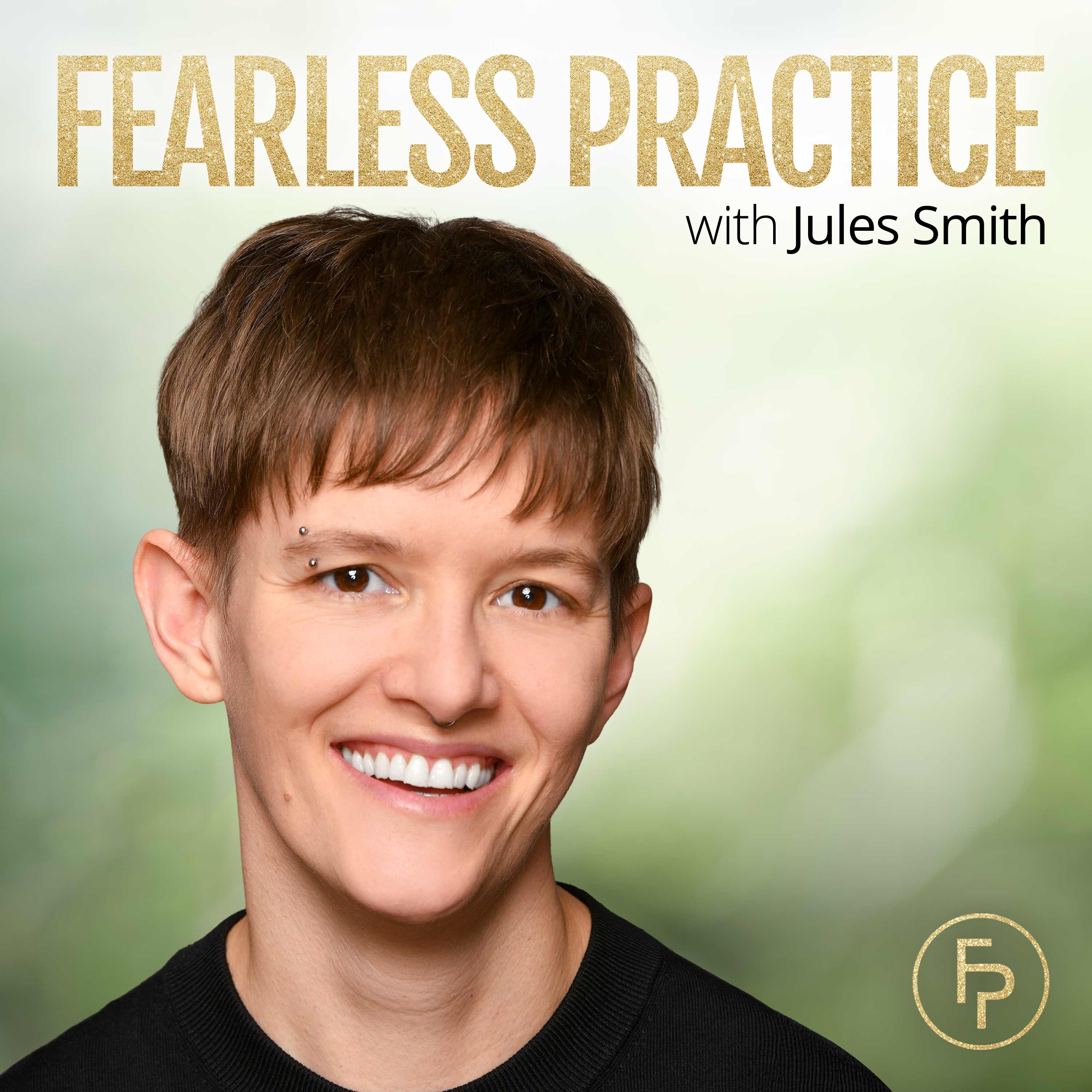
Where are you in your private practice journey? How's it going for you? I'm Jules Smith, and I'm so glad you're here. The Fearless Practice podcast is your go-to resource for building a thriving private practice in Canada. Whether you're just starting out or looking to grow, this podcast is here to guide you every step of the way. I share practical tips on everything from launching your practice and filling your schedule to expanding into a group practice. But you won't just hear from me—I also interview Canadian therapists from across the country who share their real-life experiences, challenges, and wins. These honest conversations offer valuable insight, inspiration, and support to help you confidently create a private practice that works for you. Let's learn, grow, and build fearless practices—together.

Listen to episodes

60 recent
October 21, 202628 min

Kim Michael: From Corporate Leadership to Purpose-Driven Psychotherapy | Ep 205

Would you consider running two different careers in parallel in your life and routine? That's what Kim does! Over the last three years, she has been working in corporate Monday through Friday and sees clients as a psychotherapist in the evenings and weekends. While it may seem like a lot, Kim explains that these two roles fulfill her equally and provide her with purpose and fuel her passion in tandem. Join our conversation today and hear more about how Kim pivoted to therapy later in her career and ended up running her private practice alongside her corporate job. She shares her tips, advice, and gives guidance on how to keep moving forward even when you aren't sure what the next step will be. MEET KIM Kim Michael is a Registered Psychotherapist and Licensed Clinical Hypnotherapist, as well as the founder of Thrive Through Therapy, a virtual psychotherapy practice serving adults and couples across Ontario. With a compassionate, trauma-informed approach, she helps clients navigate relationship challenges, anxiety, trauma, life transitions, and the pressures of demanding personal and professional lives. Kim integrates evidence-based approaches such as CBT, DBT-informed skills, mindfulness, parts work, solution-focused therapy, and Gottman Method principles to help clients create meaningful and lasting change. Alongside building her private practice, Kim brings extensive corporate leadership experience, giving her a unique understanding of workplace stress, burnout, high-performance environments, and the courage required to pursue a more purpose-driven life. Through Thrive Through Therapy, she is committed to creating a warm and inclusive space where clients feel truly seen, strengthen their relationships, and move from simply surviving to genuinely thriving. Learn more about Kim on her practice website , Psychology Today , and Instagram profiles. In this episode: Why Kim became a therapist Balancing corporate work and private practice Marketing the practice Overcoming struggles in private practice Kim's advice to listeners Why Kim became a therapist Kim didn't plan to be a therapist: her career pivoted from corporate to therapy, although she works in both! As a child, she was always curious about other people's experiences and emotions. It was naturally interesting for her to connect with people and talk with them about their lives. Before becoming a therapist, Kim explored therapy, reiki, and even clinical hypnotherapy, but she wanted to go a step further and integrate it all into her approach to life. Kim has had experience navigating stress, pressure, and conflict with her staff when she was in corporate, and these skills carried over into therapy, especially when she reached a professional crossroads and decided to pivot into becoming a psychotherapist. Balancing corporate work and private practice In 2023, Kim started as a solo practitioner after graduating from Yorkville University in 2022 - but at the moment, Kim has a foot in both worlds: corporate and private practice. She works a standard nine-to-five during the week and dedicates portions of her evenings or weekends to seeing clients in her growing Canadian private practice. Initially, it was more challenging, but Kim has gotten into the habit of working on what is realistic for her and her schedule. Kim has given herself the space to understand what she wants to do, and it is working out for her organically. For now, and for the foreseeable future, Kim is happy working as both a therapist and a woman in corporate. Marketing the practice At first, Kim started with the basics: launching a private practice website and opening a Psychology Today listing. However, what she has noticed working better now is word-of-mouth marketing. She's dialing down on great copy on her website, because she knows that clients want to recognize themselves in your content. Additionally, Kim has stopped comparing herself to the larger, more-established private practices out there. She trains her mindset to be proactive and focus on what she does uniquely, which also supports better word-of-mouth referrals. Overcoming struggles in private practice For Kim, the main struggle has been finding a balance between her corporate job and her work as a therapist. She's committed to finding a way to do both, because they are both important to her, but it remains something that she has to find a balance between. Another challenge Kim faces is the fluctuation of busyness throughout the year. Some weeks and months are busy, others are quieter, and it can be a struggle to keep the practice steady amidst the uncertainty. Kim's advice to listeners You don't have to feel completely ready, because readiness often comes with experience. Your confidence will grow with time. And don't compare your practice to anybody else's! If you are purpose-driven, it will fall into the right place. Connect with me: Instagram Website Resources mentioned and useful links: Maria Tsoukalas: From Forensic Assessments to Nomadic Therapy | EP 204 Learn more about the tools and deals that I love and use for my Canadian private practice Sign up for my free e-course on How to Start an Online Canadian Private Practice Jane App (use code FEARLESS2MO for two months free) Get started with Hushmail here and get one month for free! Learn more about Kim on her practice website , Psychology Today , and Instagram profiles Rate, review, and subscribe to this podcast on Apple Podcasts , Spotify , Amazon , and TuneIn

October 14, 202626 min

Maria Tsoukalas: From Forensic Assessments to Nomadic Therapy | Ep 204

Is there something you have been wanting to try in your Canadian private practice, but you're unsure of how to approach it? Could you be waiting for permission to be creative? Well, here you have it! Maria pivoted her career from working as a forensic psychologist in prison systems and other group practices when she sat down with herself and was honest about chasing her goals: she wanted to travel the world while seeing her clients virtually. She figured it out, kept her clients at the center of her itinerary (including her interests), and found a way to bring her goal and dream to life. In this podcast episode, Maria and I discuss her journey - and encourage you to build the work/ life balance you desire! MEET MARIA Maria Tsoukalas is a Calgary-based psychologist with over 15 years in practice and is the owner of Aware Psychology - a private practice that sees clients virtually across Alberta and the Northwest Territories. She specializes in working with adults dealing with anxiety, sleep problems & insomnia, relationship issues, and grief & loss. Since 2023, she has visited 20+ countries while continuing to see clients and teaches clinicians how to build the same freedom into their careers. She believes travel can be a catalyst for self-reflection and personal growth and explores these insights on her Substack – Nomadic Minds. Learn more about Maria on her practice website , Psychology Today , LinkedIn profiles, and Substack account . In this episode: Why Maria became a therapist Starting a private practice and travelling Marketing the private practice Building the practice while travelling Advice for listeners Why Maria became a therapist Maria completed her Master's in Forensic Psychology because her passion at the time lay more in understanding criminal minds than in working as a therapist for the general population. She did that for a few years: Maria worked at a jail, at a security prison, but she found after a while that completing forensic assessments became a little boring. This discovery led Maria to pivot her career and work more therapeutically with her clients, building long-term relationships based on trust rather than doing forensic assessments. Starting a private practice and travelling Maria did open up her Canadian private practice, but before that she worked in other group practices and in the prison system. However, after some time, she decided that she felt more drawn to opening her own and working for herself. So, Maria left the agency where she was working part-time and started her own practice - while pursuing her dreams of travelling. Marketing the private practice When it comes to marketing her solo practice, Maria is doing what works best for her. For example, she's getting involved with Google Ads but choosing not to spend much time or money on SEO, since it fits her approach to her private practice in its current size better. However, Maria enjoys podcasts and researches ways to meet people and get her practice's name out there into the therapy community directly. Building the practice while travelling Once Maria got started, and after a few months in, she realized she could find a way to make it work and suit her schedule as well as her clients. She wasn't active in marketing or trying to build a caseload; Maria took it as it came. Maria would bunch her sessions together on a day that she knew she was going to be settled somewhere, having three or four sessions a day. Her workday would be over by noon, and she'd use the rest of the day to explore wherever she was. Advice for listeners Maria's advice for new therapists coming into the work: you don't have to practice the same way everyone else does. As long as you are following the ethics, regulations, and protecting your clients, you can bring in your creativity and find ways to do things differently! Secondly, bring your values front and center, and be brave to curate the life that you want. Allow your business to support your life, rather than building your life exclusively around your business Connect with me: Instagram Website Resources mentioned and useful links: 6 Mistakes To Avoid When Starting A Canadian Private Practice | EP 203 Learn more about the tools and deals that I love and use for my Canadian private practice Sign up for my free e-course on How to Start an Online Canadian Private Practice Jane App (use code FEARLESS2MO for two months free) Get started with Hushmail here and get one month for free! Learn more about Maria on her practice website , Psychology Today , LinkedIn profiles, and Substack account Rate, review, and subscribe to this podcast on Apple Podcasts , Spotify , Amazon , and TuneIn

October 7, 202611 min

6 Mistakes to Avoid When Starting a Canadian Private Practice | Ep 203

Starting a Canadian private practice can be such an exciting time in your life, but also very overwhelming! This means that sometimes things can get missed, or too much time can be spent on one task, running the risk of other important steps falling through the cracks. In private practice, anything missing could have serious consequences! It is important to be thorough. So, I thought it would be helpful to share a couple of common mistakes and how to avoid them! In this episode: Waiting for perfect clarity before launching Using US advice without adapting to Canada Underestimating privacy/security needs for a Canadian practice Setting policies too late Not blocking out consistent admin time Growing before your foundations are stable Waiting for perfect clarity before launching The cost of waiting for perfect clarity can be months of delay in launching your practice, which can lead to lost revenue and delays in building up your clientele base. That's why I love using WordPress . It gives you everything you need to start your website. With its built-in optimization and responsive, mobile-ready themes, there's no limit to who you can reach with your new website. No matter the size of your budget, WordPress has a plan that's right for you! Using US advice without adapting to Canada 'Sometimes, [US-based advice] does not apply in Canada or in your province, so you want to make sure you are listening to Canadian content like this podcast! Or other Canadian podcasts, or Canadian websites talking about private practice in Canada.' - Jules Smith For example, many provinces require all healthcare data to be stored on Canadian servers. So, if you have been only listening to US-based advice, you may have accidentally purchased a subscription to a US-based private practice management system, which could place you in some hot water! I highly recommend using JaneApp for a Canadian practice management system. Jane offers online booking, charting, scheduling, secure video, and invoicing on one secure, beautifully designed system. It makes admin a breeze and maintains an effective workflow. Underestimating privacy/security needs for a Canadian practice To send secure emails and keep my communication safe, I use and recommend Hushmail . Hushmail protects your clients by adding encryption to your emails, web forms, and e-signatures. It's secure, PIPEDA-compliant, and trusted by healthcare professionals worldwide. Plus, all of their servers are in Canada! Additionally, consider Nord VPN. It helps protect your internet connection and privacy online when working. VPN stands for "virtual private network," and it creates an encrypted tunnel for your data, protects your online identity by hiding your IP address, and allows you to use public Wi-Fi hotspots safely. Setting policies too late While it is true that you don't need everything to be perfect before launching your private practice, setting up your policies before you launch is essential. I know this can be a lot to research, think about, and write. So, you can always purchase my Fearless Practice Scripts that go over all of those policies. You can edit and discuss them with your attorney before publishing them for your practice's launch. Not blocking out consistent admin time I highly recommend reserving admin time and completing it between sessions. If you don't stay on top of your admin, it can lead to chronic stress, not being present with clients, and feeling overwhelmed. Growing before your foundations are stable Sometimes you want a group private practice right away, so you start hiring therapists within the first couple of months of starting your private practice. While some therapists may pull it off, for most therapists, this rapid growth pace may lead to burnout and overwhelm, and even risk associate or client dissatisfaction. Connect with me: Instagram Website Resources mentioned and useful links: Katie McLean: Combining Two Master's Degrees into One Practice | EP 202 Learn more about the tools and deals that I love and use for my Canadian private practice Sign up for my free e-course on How to Start an Online Canadian Private Practice Jane App (use code FEARLESS2MO for two months free) Get started with Hushmail here and get one month for free! Rate, review, and subscribe to this podcast on Apple Podcasts , Spotify , Amazon , and TuneIn

September 30, 202631 min

Katie McLean: Combining Two Master's Degrees Into One Practice | Ep 202

Some doors close so that others can open: when Katie didn't get accepted into the original Master's Education in Counselling program she wanted, it was disappointing. However, she ended up following another piece of her passion, and got her Master's in Teaching and Education. Then, once she had graduated, she pursued her second Master's in Counselling Psychology, achieving the degree she was initially looking for! Today, Katie runs her fully booked private practice where she combines her passion for education and psychology into one. Join us today as we discuss how she opened her practice, strategically marketed it with networking to become full, and built community to support her goals. MEET KATIE Katie is a Registered Provisional Psychologist in Calgary with a "just do it" attitude. She launched her private practice in November 2025 and has a bustling practice focusing on ADHD, Anxiety, OCD, and perinatal care. She is also the co-host of the Happiness of the Commons Podcast. Learn more about Katie on her private practice website , Psychology Today , Instagram accounts, and podcast . In this episode: Why Katie decided to start a private practice Registering as a Psychologist Completing two Master's degrees: Teaching and Psychology Marketing the practice Why Jane App makes private practice easier Why Katie decided to start a private practice While Katie loved working at a group practice initially for her provisional hours, once she was qualified and certified, she wanted to open her own Canadian private practice. Ultimately, for Katie, opening her own private practice meant two things: bringing more income home and having more freedom in her schedule. Registering as a Psychologist In Alberta, you can register as a psychologist with only a Master's degree: you go through a provisional period, which includes 1600 hours working under supervision with a registered psychologist. Once Katie's hours are completed, she won't have to pay for supervision any longer. She also has her Master's in Education, so Katie explains that she'd like to teach. Completing two Master's degrees: Teaching and Psychology Katie has always had a passion for psychology, so she completed her undergraduate degree in psychology. While studying, she worked in student affairs for some time, which included leadership, mentorship, and event planning, and it was something she really loved. Initially, Katie applied to complete her Master's of Education in Counselling. Unfortunately, she wasn't accepted into that course, but she was accepted into a Master's of Education in Teaching and Learning because, at that time, she was working in higher education. However, later on she was accepted to complete her Master's in Counselling Psychology. It was back-to-back Master's degrees, and Katie took six months off of school afterwards! Marketing the practice Now, Katie's practice is full, and her biggest and most successful marketing strategy has been networking. Katie puts a lot of effort into networking with therapists adjacent to her practice, because she knows that when the relationship is strong and solid, people trust and depend on each other, and can easily send referrals between practices. Why Jane App makes private practice easier Katie lists plenty of the reasons why she enjoys using Jane App in her private practice and encourages listeners to do the same: Clients can book sessions online directly, including a series of appointments a few weeks in advance Clients can also book many sessions in advance and can cancel one if they need to at least 24 hours before the session is due to begin Billing is incredibly easy Taxes are easy to manage All data is centralized in one spot Katie's advice to listeners Private practice is not impossible. There are challenges, but it can be done. Don't underestimate it, but you don't need to overestimate it either: with a good mentor or membership community, you can definitely open your own practice! Connect with me: Instagram Website Resources mentioned and useful links: Sandra Karlin: From Tech to Therapist in Private Practice | EP 201 Learn more about the tools and deals that I love and use for my Canadian private practice Sign up for my free e-course on How to Start an Online Canadian Private Practice Jane App (use code FEARLESS2MO for two months free) Get started with Hushmail here and get one month for free! Learn more about Katie on her collective practice website , private practice website , Psychology Today , Instagram account, and podcast Rate, review, and subscribe to this podcast on Apple Podcasts , Spotify , Amazon , and TuneIn

September 23, 202620 min

Sandra Karlin: From Tech to Therapist in Private Practice | Ep 201

Our paths can change in ways that we may not easily foresee. While Sandra was someone who always knew that she liked and wanted to help people, she only became a therapist later on in life: her first career was in tech! It was only after she completed her Master's degree - studying part-time while working in the Canadian tech hub - that she pivoted her career, starting both from scratch and in a new industry in counselling. Over the last three years, Sandra has graduated, started, and grown her private practice from solo to group, and become a new mom. In this episode, we cover her journey, what she has learned, and what she wants to share with you, the listener. Join us! MEET SANDRA Sandra Karlin is a Registered Psychotherapist and group practice owner of Beyond Happiness Counselling, supporting adults and couples in Kitchener‑Waterloo and virtually across Ontario. With a Master of Arts in Counselling Psychology, she brings a warm, supportive, and sensitive approach to therapy, helping clients make sense of what they're going through while building practical skills for change. Sandra works with concerns such as anxiety, depression, stress, loneliness, self‑esteem and body image, grief and loss, career changes, major life transitions, trauma, and relationship challenges. Her integrative style includes mindfulness, person‑centred therapy, Cognitive Behavioural Therapy (CBT), Acceptance and Commitment Therapy (ACT), Dialectical Behavioural Therapy (DBT), Walk & Talk therapy, and Gottman Method couples counselling (Clinical Foundations training). Learn more about Sandra on her private practice website , Psychology Today , LinkedIn , and Instagram profiles. In this episode: When Sandra started her private practice Running a private practice as a new mother Changing careers from tech to therapy Marketing the private practice Offering walk-and-talk therapy Sandra's advice to listeners When Sandra started her private practice Sandra completed her internship at a local clinic and then decided to stay on. While at the clinic, she slowly started building out her private caseload on the side. At times, Sandra was working with an average of two private clients for a year, so it was truly slow and steady! Sandra completed her Master's at Yorkville University and landed a great placement where she still occasionally works part-time, while now running her private practice. She also joined another group practice, where she works one day every two weeks, while managing her ever-growing practice with contractors. Running a private practice as a new mother Sandra started looking into hiring contract therapists when she was around four months pregnant. She was concerned about her client's therapy journeys and didn't want their work to be interrupted while she took maternity leave. So, Sandra decided to hire contractors to take over some of her caseload. Changing careers from tech to therapy She always knew that she wanted to help people and be of service, but that has taken shape over time: being a therapist is Sandra's second career. At first, Sandra worked in tech. However, she decided to complete her Master's degree part-time over four years while working in tech, and once she graduated, she made the switch. Marketing the private practice To market her private practice currently, Sandra has been using a mixed approach in terms of techniques, utilizing: Psychology Today referrals Word-of-mouth Google Ads Social media presence Videos on social media profiles Offering walk-and-talk therapy Sandra has found that offering walk-and-talk therapy in her private practice makes therapy more accessible. Some clients might feel nervous, shy, or too self-conscious to sit face-to-face with their therapist, and walking in nature means that you are side-by-side with them instead. Additionally, you get to be out in nature, which may aid in helping people's mental health, bringing a sense of calmness, and allowing one's eyes to travel as they gather their thoughts without feeling self-conscious. Walking also supports people's therapeutic journey by offering them a literal way to talk through their stuck patterns or thoughts, bridging new thoughts and patterns with physical motion. Sandra's advice to listeners If private practice is something that's often on your mind, try it out! Connect with me: Instagram Website Resources mentioned and useful links : My Biggest Takeaways from 200 Podcast Episodes! | EP 200 Learn more about the tools and deals that I love and use for my Canadian private practice Sign up for my free e-course on How to Start an Online Canadian Private Practice Jane App (use code FEARLESS2MO for two months free) Get started with Hushmail here and get one month for free! Learn more about Sandra on her private practice website , Psychology Today , LinkedIn , and Instagram profiles Rate, review, and subscribe to this podcast on Apple Podcasts , Spotify , Amazon , and TuneIn

September 16, 202615 min

My Biggest Takeaways From 200 Podcast Episodes! | Ep 200

This is an amazing milestone: I had no idea back in 2022 that the Fearless Practice Podcast would grow so big, and that I would still be here recording in 2026! Of course, I could not have done this by myself. Thank you to Jane App, my podcast department team, and you, the audience. You are as much a part of this team as we are, and your listenership helps us develop and continue publishing new episodes. In celebration of this milestone we've all achieved together, I'm sharing eight of my biggest takeaways from this journey with you. In this episode: The path is rarely linear - and that's not a problem! Values are a business strategy Offline marketing still works! Clarity is essential Sustainable scheduling prevents burnout (6) 09:06 Privacy tools and EMRs are your best friends Everyone benefits from mentorship The path is rarely linear - and that's not a problem! 'Across 200 episodes, one of the most consistent themes that I've seen is that Canadian private practice rarely follows a clean timeline.' - Jules Smith From the interviews I've shared on the Fearless Practice Podcast, a consistent thread that continues through them all is that the path to private practice is varied. Many therapists didn't graduate and open a private practice with a full caseload, and many therapists start in agencies, hospitals, or even have to take steps back from private practice throughout their careers for different reasons. 'For myself, I started working for the BC Government, moved to Halifax, opened a private practice, and then worked at Dalhousie for a bit as I grew my private practice. And then, once COVID hit, I went completely online and built my private practice as a virtual [one] … And it took almost 10 years!' - Jules Smith Remember this: just because your path takes turns doesn't mean that you aren't on the right path! Keep going, take stock when needed, and enjoy the ride. Values are a business strategy 'Values aren't just something you put on your website, they're a decision-making tool. On this podcast, there have been so many conversations with Canadian private practice owners about their values and how it helps [them] guide their private practice.' - Jules Smith When you're clear on what matters, such as community, accessibility, autonomy, and integrity … You suddenly have a filter for the big decisions. These big decisions could pertain to your schedule, who you hire, and how you spend your time working. At the end of the day, the foundation upon which you build your practice is rooted in the values that mean a lot to you. Offline marketing still works! One thing that shows up in the podcast conversations again and again is how Canadian private practice owners are focusing on offline or in-person marketing and networking - especially in this saturated market. '[Offline marketing] is working for private practice owners because therapy is trust-based, and when they meet you in person, it builds that connection and trust. Plus, it helps you stand out in a saturated market.' - Jules Smith Having a conversation with a community member about your private practice will take you further in a way that posting about it on social media may not be able to. The power of meeting people where they're at, and in person, cannot be overstated in building rapport with your community. Clarity is essential Clarity is what helps the right clients choose you quickly. I discuss clarity in-depth in my free workbook on how to start a Canadian private practice, and who you help and why. Remember, the more that you niche, the more you stand out, and that can be really helpful for someone who's looking for help with a specific problem. Sustainable scheduling prevents burnout 'One of the biggest lessons that shows up repeatedly when I'm talking to Canadian private practice owners, as well as when I'm doing my solo episodes, is that scheduling isn't just a lifestyle preference: it's part of clinical care.' - Jules Smith Edit your mindset to only see success as something that is sustainable. If something requires you to continuously push yourself beyond your limits mentally, physically, and professionally, then it may not be success in the holistic sense. Whatever helps you do great work and supports your well-being is essential to being successful, so try challenging yourself to start to see it that way! Privacy tools and EMRs are your best friends As you know, I love and use Jane App as my practice management system. I love that I can do bookings, reminders, invoicing, notes, intake forms, direct billing: everything that you need to start and grow a private practice! They will walk you through the solutions to your problems step-by-step. And, they're a Canadian-founded business as well. They take so much stress away so that we can focus on being the best therapists that we can be! Also, I've been using Hushmail for my emails, and I sleep so much better at night knowing that my emails and my client's personal information are all secure. Everyone benefits from mentorship 'Everyone benefits from mentorship, consultation, and shared learning. Private practice can be very isolating, so make sure that you have clinical and community support so that you're not alone!' - Jules Smith Consider joining group consultations with other therapists, renting out office space if you have extra, and collaborating with other therapists - such as listening to this podcast! Connect with me: Instagram Website Resources mentioned and useful links: Nicole Lobo: From Group Practice Back to Solo | EP 199 Learn more about the tools and deals that I love and use for my Canadian private practice Sign up for my free e-course on How to Start an Online Canadian Private Practice Jane App (use code FEARLESS2MO for two months free) Get started with Hushmail here and get one month for free! Rate, review, and subscribe to this podcast on Apple Podcasts , Spotify , Amazon , and TuneIn

September 9, 202628 min

Nicole Lobo: From Group Practice Back to Solo | Ep 199

What happens when the practice you worked so hard to build no longer fits the season of life you're in? How do you know when it's time to grow, and when it's time to simplify? In another installment from my mini-series, "Where are they now?" I'm chatting with Nicole Lobo, who was on the show back in 2023 ! In this episode, Nicole returns to the podcast to reflect on how her practice has evolved over the last three years, why she transitioned from group practice back to solo work, and how motherhood reshaped her understanding of success, sustainability, and balance. From marketing struggles and wearing too many hats, to rediscovering groundedness in private practice, Nicole shares an honest look at what it means to build a business that fits the life you actually want to live. MEET NICOLE Nicole Lobo is a Registered Psychotherapist and founder of Be Well Therapy Studio in London, Ontario, with over nine years of experience supporting thoughtful, high-functioning adults through anxiety, burnout, perfectionism, and life transitions. Drawing on an integrative approach that weaves together CBT, DBT, ACT, emotion-focused therapy, attachment theory, and trauma-informed care, Nicole specializes in the in-between seasons of life — the moments when what once fit no longer does. She has a particular passion for working with millennial adults navigating the quiet pressure to hold it all together, including the profound identity shifts that come with parenthood. Beyond her clinical work, Nicole also provides supervision for Registered Psychotherapists and business coaching for therapists building sustainable practices. She holds a Master's in Counselling Psychology from Yorkville University and sees clients both in person in London and virtually across Ontario.​​​​​​​​​​​​​​​​ Learn more about Nicole on her practice website , Psychology Today , and LinkedIn profiles. In this episode: Nicole's private practice in 2023 Going from group back to solo practice How Nicole is marketing her practice Rebalancing virtual and in-person sessions What's next for Nicole Nicole's private practice in 2023 Nicole had some big goals back in 2023, and all of them came to fruition over these past three years! She explains that she was passionate and motivated, and that by taking consistent steps, Nicole was able to bring all of these dreams together into the practice that she now runs. Going from group back to solo practice While Nicole loved her time running a group private practice, at the beginning of 2026, she decided to restructure her business into a solo practice again. Therefore, once Nicole's last contractor was ready to move on, she decided not to take on another and readjusted her practice to run as a solo practitioner. How Nicole is marketing her practice Nicole is honest about having had a difficult time marketing her practice when it was a group-focused entity. Finding a way to honor everyone's skills in the practice of marketing is essential, and can be difficult to do. Therefore, shifting back to solo practice has also made marketing easier for Nicole, because now she's marketing herself only, and not having to do that heavy lifting for a team of other clinicians, as group practice owners often need to. Rebalancing virtual and in-person sessions At first, Nicole would see more than half of her clients in person and offer a day or two for virtual sessions. However, she unfortunately experienced numerous no-shows, last-minute cancellations, and other hiccups, which made it difficult for her to continue seeing most of her clients in person, especially when she needed to arrange childcare and commute to the office. Therefore, Nicole has found a new balance to seeing clients: the majority online, and a few in person. That, combined with being a solo practitioner, has made it easier and little less stressful for Nicole to balance her work and personal life commitments. What's next for Nicole For Nicole, the road ahead is smooth and steady. While she's not closed off from potential opportunities, such as partnering with another clinician in the future or taking on contractors again, she is focused on this season of her professional life, which is to be a solo practitioner for the time being. Connect with me: Instagram Website Resources mentioned and useful links: Shulamit Ber Levtov: Building a Sustainable Practice Without Losing Yourself | EP 198 Learn more about the tools and deals that I love and use for my Canadian private practice Sign up for my free e-course on How to Start an Online Canadian Private Practice Jane App (use code FEARLESS2MO for two months free) Get started with Hushmail here and get one month for free! Learn more about Nicole on her practice website , Psychology Today , and LinkedIn profiles Click here to listen to the previous episode with Nicole Lobo Rate, review, and subscribe to this podcast on Apple Podcasts , Spotify , Amazon , and TuneIn

September 2, 202630 min

Shulamit Ber Levtov: Building a Sustainable Practice Without Losing Yourself | Ep 198

Building a business while caring for others can be deeply meaningful work, but it can also come at a cost if your own well-being is left behind. It can be easy to get absorbed in caring for others and accidentally lose focus on your own personal needs in the process. Shulamit experienced this firsthand. In this episode, Shulamit Ber Levtov shares her unconventional path into therapy, from activism, graduating with a Master's degree at 48, and building a thriving group practice in a rural community. She opens up about the realities of entrepreneurship, the mental health challenges that led her to step away from group practice ownership, and why sustainable success starts with taking care of yourself first. Join us for an insightful discussion! MEET SHULAMIT Shulamit is known as The Entrepreneurs' Therapist. She's the mental health professional you hire when you're a woman business owner, and you want to build the internal steadiness--for your emotions and your money psychology-- to lead effectively through the uncertainty, weight, and complexity of running a business. Shulamit has been an entrepreneur for over 27 years and has more than 22 years of professional experience supporting women's mental health and personal growth. As a trauma survivor and Master's-level trauma therapist, with certifications in Dare To Lead™, Trauma of Money®, and Financial Social Work as well as somatic parts therapy, Shula brings a unique perspective and approach to supporting women in business. Learn more about Shulamit on her website , LinkedIn , and Instagram profiles. In this episode: Graduating with a Master's at 48! Evergreen marketing strategies Going from group private practice to solo Shula's plans for the future Final takeaways for listeners Graduating with a Master's at 48! Shulamit's story is an adventurous and inspiring one. Shula explains how her mother was an activist, and that this type of work was prominent in her family lineage throughout her life. That, she explains, impacted how she wanted to contribute to the community around her, leading her to study Social Work. However, after arguing with a professor about socialism and fighting on behalf of people who need to be paid a living wage, she was dropped from the programme because her grades (from this professor's class) pulled her average too low. While Shula had attempted to complete her Master's degree twice before, this was the moment in her life, decades after that Social Work course, that she decided to bring everything together and really go for it. Evergreen marketing strategies Back in 2012, after Shula graduated with her Master's and began her path to private practice, she decided on a location that (at the time) had relatively few therapists and counsellors. Therefore, pre-COVID, Shula was marketing her brick-and-mortar group private practice in a small town that had a strong need for therapy services. What worked for her and her business then did not always continue to work post-COVID and into the online world. So, Shulamit's main advice for consistently successful marketing is to be present and create deep connections with the community, whether that's in-person, online in videos on social media, or both. Going from group private practice to solo Shulamit explains that this is the reason why she's the entrepreneur's therapist: she went on a personal journey from group private practice to a solo business owner for her own well-being. Shula came to realize that either she leaves her business or continues to suffer with poor mental health, and she chose her mental health. Shula recognized that her associates were depending on her to bring in clients for the business to prosper, and for them to have an income as well. But, when she understood the depth of her struggle, she had to remove herself from the practice and allow someone else to take her place to stop her entire team from suffering as well. Shula's plans for the future In two words, here are Shulamit's goals for the future of her practice: sustainability and growth. Sustainability for her solo practice, to continue to see her clients and sustain herself in the process, growth for the profession, and expansion in the research of caring for entrepreneurs. As she continues to experiment and as the digital work continues to change, she's committed to finding strategies that will be evergreen. Final takeaways for listeners Shulamit wants you to take care of yourself. Don't let your mental, physical, and emotional well-being be an afterthought. So, take a regular temperature check on yourself once a week, or every now and then at least, to figure out what you are feeling, why, and how to help yourself move forward with less stress. Secondly, don't let the nature of the work make you feel like you are failing. The work is hard because it is inherently hard, and not because you can't do it. You can. Connect with me: Instagram Website Resources mentioned and useful links: Paula Gonzalez: From Purpose to Practice and Scaling with Intention | EP 197 Learn more about the tools and deals that I love and use for my Canadian private practice Sign up for my free e-course on How to Start an Online Canadian Private Practice Jane App (use code FEARLESS2MO for two months free) Get started with Hushmail here and get one month for free! Learn more about Shulamit on her website , LinkedIn , and Instagram profiles Rate, review, and subscribe to this podcast on Apple Podcasts , Spotify , Amazon , and TuneIn

May 20, 202626 min

Paula Gonzalez: From Purpose to Practice and Scaling With Intention | Ep 197

Building a meaningful practice often starts with a personal story, and grows through courage, creativity, and a commitment to helping others. In this episode, I talk with Paula Gonzalez. We discuss her journey into mental health, which was shaped by both her background and lived experience, and how it led her from community work to launching and scaling her own private practice. From navigating the early days of going solo during COVID to building a supportive group practice, Paula offers an honest look at growth, purpose, and the systems that make it all sustainable. Join us for a great conversation! MEET PAULA Paula Gonzalez is a Toronto-based Registered Psychotherapist, Clinical Supervisor, and the founder of Infinite Horizons Psychotherapy, located in North York. After 15 years working in community mental health and private practice, Paula made the decision to follow her passion and expand her solo practice into a group practice. Now, she works with a team of therapists who align with her mission to transform the way people experience therapy. Learn more about Paula on her practice website , Psychology Today , Facebook , and Instagram profiles. In this episode: Why Paula started working in mental health Starting a private practice Scaling from solo to group private practice Using Jane App in private practice Paula's advice to listeners Why Paula started working in mental health Over the last 15 years, Paula has dedicated her career to the mental health field. 'Even back in high school years, you know, when we had to volunteer, it's always been in mental health. Even in university and placements, and my Master's, and now being a therapist, so it's been a long time in this field!' - Paula Gonzalez When explaining how Paula came into the world of therapy, and what encouraged her to pursue becoming a therapist and working in mental health, Paula recalls her family lineage and that she came from a long line of women who worked in various helping professions. 'My mom being a social worker, my grandmother was a teacher, you know, my aunt is a doctor, so it's always been a part of my life to be in the helping profession. For me, having gone through my own experiences, like immigrating to Canada at a young age … That experience was very difficult for me … That made it clear … that I really wanted to become the kind of person I wish I had had at that time to get me through that.' - Paula Gonzalez Starting a private practice Paula completed her Master's degree in 2016, and then she started working in community mental health, where she stayed for four years. While Paula loved the community aspect of working with people in her city, it was difficult to find a full-time job at the time, especially since virtual sessions were not yet popular or common. But when COVID hit in 2020, Paula started thinking about opening up her own solo virtual private practice. 'I did start in community mental health, and then I worked at a group practice. As a new grad, very new territory for me. Eventually, I decided, "I miss community mental health!" So I decided to go back. But then COVID hit. What led me to open up my own … during COVID … I felt so called to doing my part in working with folks directly.' - Paula Gonzalez And so, Paula launched her online private practice! She would see clients in the evenings or even on weekends while she continued working in community mental health. Scaling from solo to group private practice 'Every day I wake up, and I'm like, "How, I can't believe I get to do this!" I'm still figuring it out as I go, but I love it.' - Paula Gonzalez Creating the office spaces, editing the website, and social media content: all of these aspects are ways in which Paula gets to practice and unleash her creative freedom, and they are some of the things she loves the most about running a group practice. More than that, Paula wanted to share the work and expand the impact by creating a team, which is what motivated her to take her practice from solo to group. 'I knew that I wanted to create a team … I loved my role as a clinical supervisor, but there's something about having a team of new grads, I love working with them, whether it is in a supervisory capacity or as colleagues, and knowing that we're all trying to figure this out … I find it so important to have a team as a part of our support system, and that aligns with what I'm hoping to put out there in the world.' - Paula Gonzalez Using Jane App in private practice From her solo practice to her current group practice, Paula has consistently used Jane App for her business admin. '[Jane App] is so user-friendly. It's got everything that I need, I can pull the reports that I need to track metrics and see what's working, what's not … I've also gotten very good feedback from clients that use it too … Very user-friendly for both therapists and clients.' - Paula Gonzalez Jane App was designed to serve therapists and clients equally, while in different ways, and allows them both to navigate an easy interface that lets them communicate with each other smoothly. If you are ready to give Jane App a try, click here and use the code FEARLESS2MO for a two-month free trial ! Paula's advice to listeners Focus your marketing on your client niche, and don't spread yourself too thin! The work you do is important, so take care of yourself to take better care of your clients. Connect with me: Instagram Website Resources mentioned and useful links: Amber Sperling: Three Years of Private Practice Growth | EP 196 Learn more about the tools and deals that I love and use for my Canadian private practice Sign up for my free e-course on How to Start an Online Canadian Private Practice Jane App (use code FEARLESS2MO for two months free) Get started with Hushmail here and get one month for free! Learn more about Paula on her practice website , Psychology Today , Facebook , and Instagram profiles Rate, review, and subscribe to this podcast on Apple Podcasts , Spotify , Amazon , and TuneIn

May 13, 202632 min

Amber Sperling: Three Years of Private Practice Growth | Ep 196

Growth rarely happens by accident because it's built through intention, care, and a willingness to evolve. In this episode of my mini-series "Where Are They Now?", Amber Sperling reflects on the journey of expanding her practice from a single basement setup to a thriving, multi-location space rooted in accessibility and community care. Amber and I first spoke on the podcast in 2023! To get the full experience of the there-and-now conversation, you can click here to listen to the episode when Amber first came on the Fearless Practice Podcast . In our conversation in this episode, she shares how prioritizing clients over waitlists, investing in genuine relationships, and leaning into what works have shaped her success, along with the practical lessons and marketing strategies that continue to guide her forward. Welcome to the conversation! MEET AMBER Amber Sperling is a Registered Social Worker, psychotherapist, and founder of Amber Sperling Social Work & Psychotherapy Services, a growing group practice specializing in perinatal mental health and trauma. She is EMDRIA-certified and one of the first clinicians in Canada to hold certification in perinatal mental health, known for helping clients experience meaningful change from the very first session. Amber is expanding her work through MARSHA Care—a broader model that integrates therapy, education, and community to support women's health across life transitions. She is passionate about building a practice that blends clinical excellence with connection and sustainable growth, so more mothers can access the support they need. Learn more about Amber on her private practice website , LinkedIn , and Psychology Today profiles. In this episode: How Amber's practice has grown from 2023 to 2026 What has changed How Amber's practice goes the extra mile in client care Amber's top 3 marketing tips Amber's lessons learned advice to listeners How Amber's practice has grown from 2023 to 2026 Over the last couple of years, Amber's practice has grown. During her first interview with the Fearless Practice Podcast, she was operating from her basement in her old house. However, now the practice has its own dedicated space! What has changed Amber credits her team and practice's drive to meet the needs of their community as the spark that pushed them to continue growing and building up the business. As Amber explains, for her team, having some flexibility and availability is important so that every client that comes into the practice can get seen to in a matter of days. It bothered Amber to keep clients on a waiting list, and that drive is what contributed to her growing her practice to meet more of the community's needs. How Amber's practice goes the extra mile in client care Amber deeply cares about her client niche because she also knows what it feels like to be sitting in the opposite chair. As such, she and her team have made it a priority to care not just for the client's mental well-being, but also for the little things, through things like: Keeping snacks on hand for the moms and toddlers Making the building accessible for every type of ability or need Offering free parking for clients Offering both in-person and virtual options for sessions Amber's top 3 marketing tips For Amber, networking has been the top marketing strategy, consistently growing her practice the most. Even when she felt nervous or unsure, connecting with other mental health practitioners and practice owners has consistently created more and more referral sources, which have sustained her business and helped it expand. Secondly, Amber recommends utilizing social media. While it isn't for everyone, if it does work for you and allows you to market your practice creatively, use it. Make videos, use your voice, share professional photos or information; anything that can help build consistent traction and help place your practice in front of more people. Be authentic, because that resonates the most with your ideal clients. And lastly, lean into what you enjoy doing, and do more of it. This could be networking, social media, or even public speaking, hosting community events, or anything that allows more people to interact positively with you, your staff, and your practice. Don't overthink it, and just do it! Amber's lessons learned and advice to listeners Over these three years, Amber credits the power of goal-setting and pursuing. Keep yourself focused on these goals, because there will be so many shiny objects in your periphery, so be specific about where you are going and what needs to be done to bring these dreams to fruition one at a time. And, keep doing the things that work! Sure, try a bunch of new techniques, but once you start receiving feedback on what works and what doesn't, pick what does and scale it. Connect with me: Instagram Website Resources mentioned and useful links: How I Developed a Marketing Strategy for My Private Practice - Networking | EP 195 Learn more about the tools and deals that I love and use for my Canadian private practice Sign up for my free e-course on How to Start an Online Canadian Private Practice Jane App (use code FEARLESS2MO for two months free) Get started with Hushmail here and get one month for free! Learn more about Amber on her private practice website , LinkedIn , and Psychology Today profiles Rate, review, and subscribe to this podcast on Apple Podcasts , Spotify , Amazon , and TuneIn

Is this your show?

Claim this listing to keep it up to date, reach guests who want to pitch you, and manage bookings with Guestify.

Claim this listing

More Business podcasts