Find partners
The Pre-Read

The Pre-Read

Hosted by Workiva

BusinessNewsInterviews guests

Episodes

178

Latest episode

Aug 2026

Language

EN

About the show

Just like the slides you get before a big meeting, The Pre-Read prepares CFOs and senior leaders for the decisions ahead. This is the global podcast for the modern office of the CFO, focused on how finance leaders drive performance, resilience, and long-term value in a constantly shifting environment. Designed for executives operating at scale, the show features candid conversations with CFOs, board advisors, regulators, and business leaders shaping how companies compete, comply, and grow. Hosts Alyssa Zucker and Steve Soter connect financial performance, data integrity, regulation, and technology to the real questions CFOs are being asked by boards, investors, and stakeholders. From AI adoption and enterprise data trust to evolving disclosure expectations and global regulatory pressure, The Pre-Read focuses on what matters now and what's coming next. Each episode cuts through noise to surface practical insight, strategic perspective, and the signals CFOs need to lead with clarity. If you're responsible for stewarding capital, managing risk, and creating value over time, you're in the right place.

Listen to episodes

60 recent
August 17, 202619 min

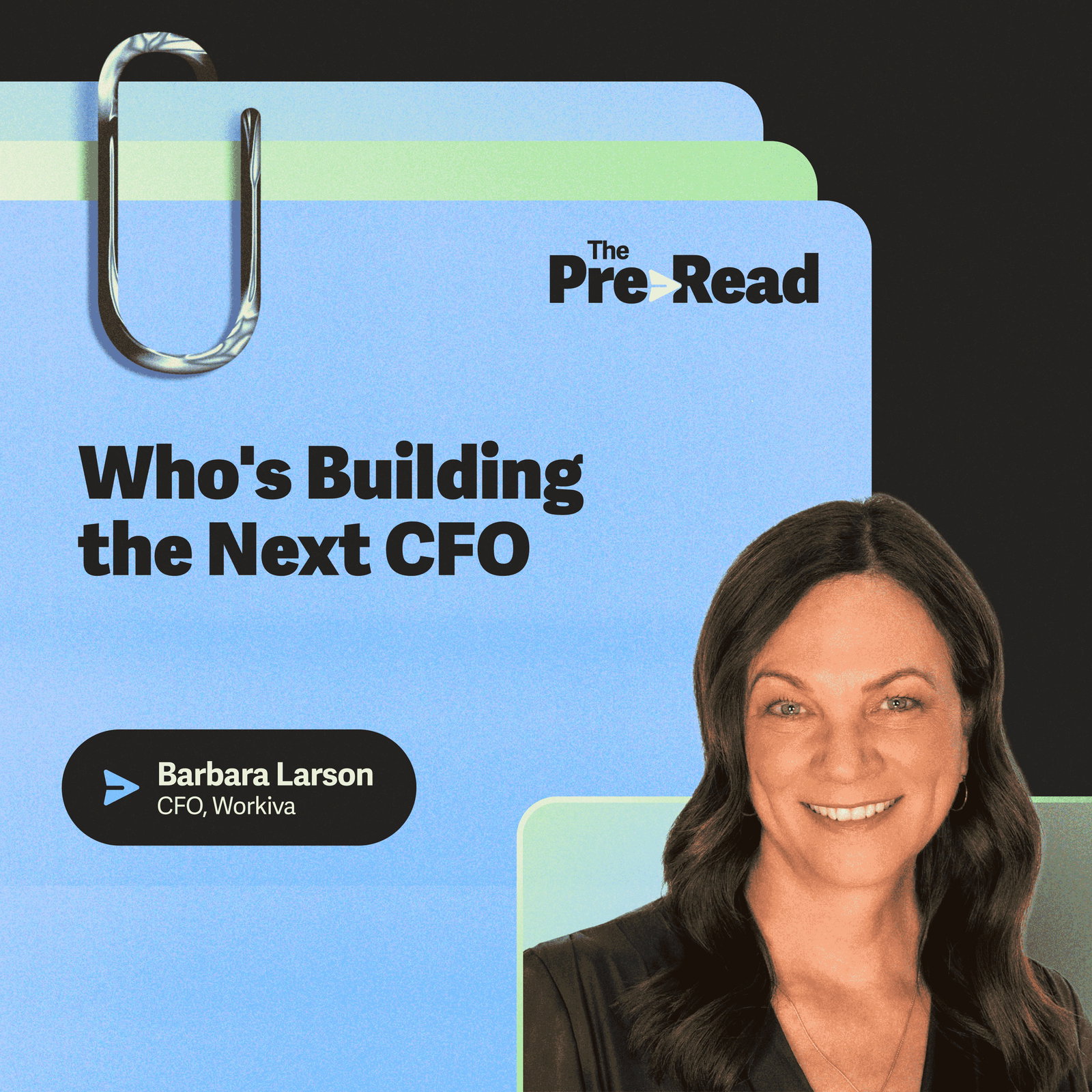
Who’s Building the Next CFO?

Finance leaders build judgment and gain experience by doing the work throughout their career. But what happens when agents do the work instead? Workiva CFO Barbara Larson joins The Pre-Read to talk about her first six months in the role and the talent pipeline risk she thinks is flying under the radar: a generation of finance leaders who are skilled at directing AI but may not have the experience to recognize when something breaks. In this episode: • Why the path to CFO is about doing work and growing financial skills alongside AI • How to build a finance culture where people are ready to lead • What the CFO of 2035 will need to prove to compete against AI numbers • Why finance leaders should focus less on pursuing the CFO title, and more time learning the skills necessary to identify and respond to risk Subscribe for episodes on the issues shaping finance, audit, risk, and sustainability at the C-suite level.

August 3, 202628 min

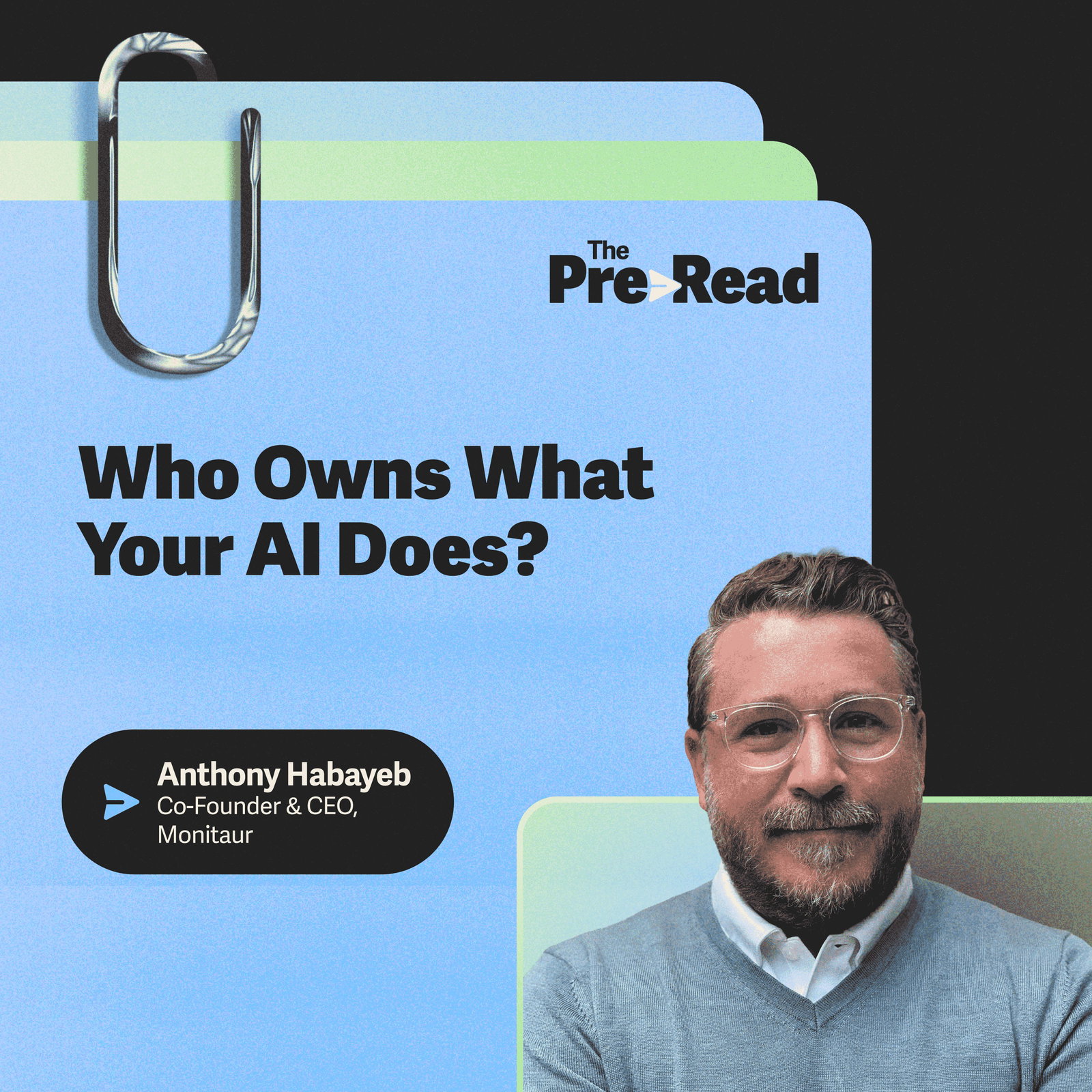
Who Owns What Your AI Does?

AI transformation is a problem of governance, not technology. Anthony Habayeb, CEO of Monitaur, argues that organizations don’t need to spin up a new AI governance framework, but they need better use of the controls CFOs and auditors already own. In this episode: -Why AI pilots stall and what it reveals about governance gaps -How to build an AI governance framework from structures you already have -Why the agent isn’t the risk, but the use case is -Who owns accountability when an autonomous system takes action? -How CFOs and audit teams are becoming the forcing function for AI quality Subscribe for episodes on the issues shaping finance, audit, risk, and sustainability at the C-suite level.

July 20, 202623 min

What Your Climate Risk Assessment Is Missing

Most climate risk assessments are missing hazards, scoping too narrowly, and leaving physical climate risk under-analyzed. Linda Romanovska helped write the rules, and she’s here to explain what better reporting looks like. As co-author of the European Sustainability Reporting Standards and a member of the EU Sustainability Reporting Board, Linda has spent 20 years working on climate risk assessment across sectors and jurisdictions. She joined The Pre-Read to break down what mandatory climate-related financial disclosure requires. In this episode: Why most climate risk assessments assess too few hazards The key differences between physical climate risk and transition risk How to scope scenarios and time horizons without cutting corners What climate-related financial disclosure users want to see Where AI is making climate risk assessment faster and more audit-ready

July 6, 202622 min

Markets Are Moving: Is Your Finance Team?

The M&A market is heating up, and AI is compressing deal timelines from weeks to days. In this episode of The Pre-Read, guest host Josh Gertsch and Troy Hooper of Mergermarket provide a capital markets update that touches on the SpaceX IPO, the quiet M&A surge, and why quality assets with resilient cash flows are winning. Then, guest host Esther Toth talks with Latitude Financial Services CFO Guillaume Leger about leading finance teams through change, AI, and why sustainability reporting is a frontier CFOs can’t ignore. 0:00 What’s in this episode 1:56 Capital markets & M&A update with Josh and Troy 3:32 The IPO boom and M&A recovery 4:39 Trends driving M&A 13:18 Esther asks Guillaume about guiding finance teams through change 16:55 Upsides and downsides to AI in finance 19:48 The new frontier of financial reporting Subscribe to The Pre-Read for weekly conversations at the intersection of finance, sustainability, audit, and risk.

June 22, 202629 min

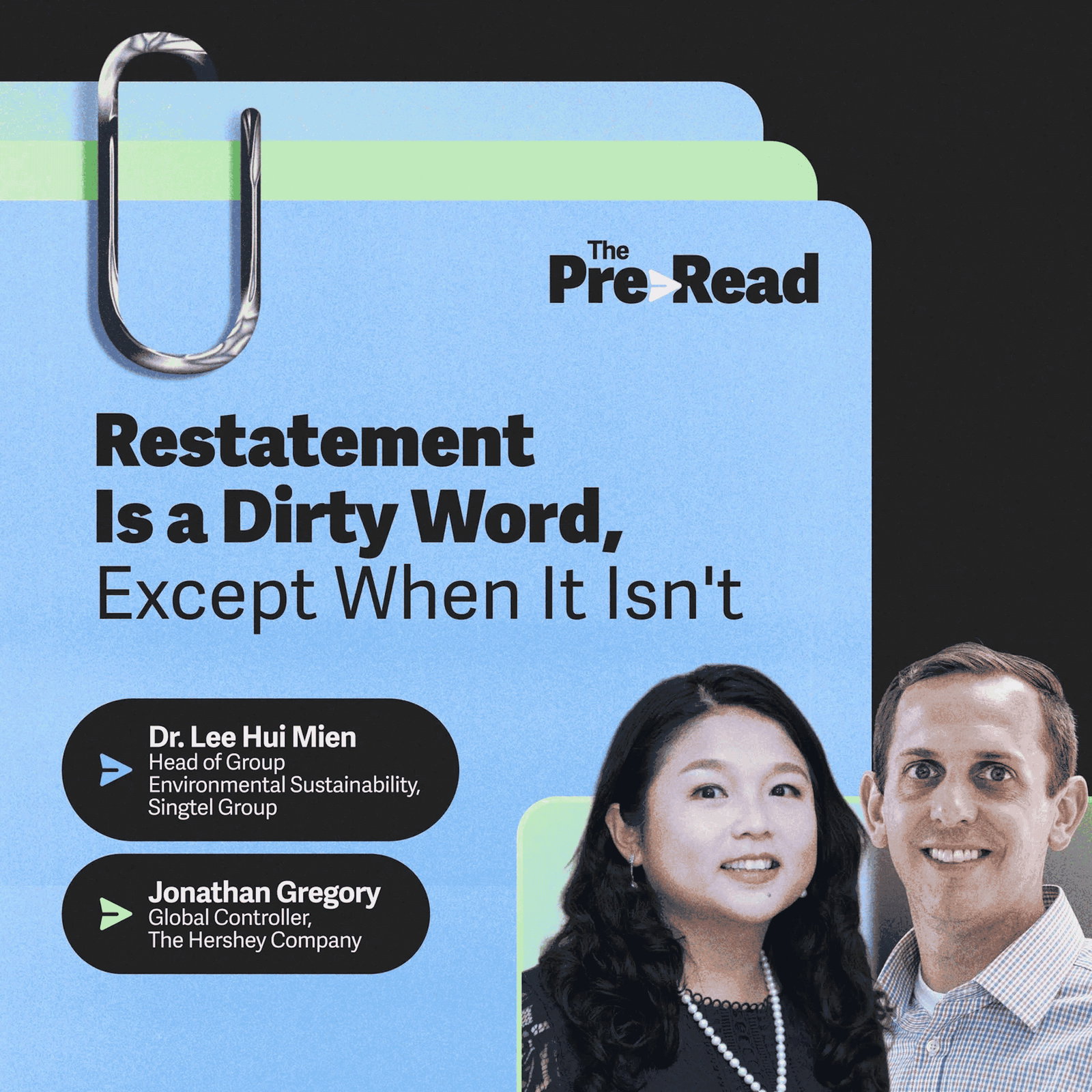
Restatement Is a Dirty Word, Except When It Isn't

Sustainability reporting and financial reporting are converging fast. But the controller who treats them as the same thing could get burned. In this episode, Dr. Lee Hui Mien of Singtel and Jonathan Gregory of The Hershey Company offer their views on one urgent question: what does it actually mean to bring sustainability reporting under the finance umbrella, and where does that process break down? Chapters: 0:00 — Intro 2:30 — Dr. Lee Hui Mien on why sustainability data is fundamentally different 8:45 — Why restatement in sustainability is a feature, not a failure 13:20 — Scope 3 and why supply chain visibility can break down at tier two 19:10 — Jonathan Gregory, Global Controller at The Hershey Company 24:00 — AI governance and segregation of duties 29:45 — What the next five years demand from controllers Guests: Dr. Lee Hui Mien, Sustainability Leader, Singtel Jonathan Gregory, Global Controller, The Hershey Company Subscribe to The Pre-Read for more conversations at the intersection of finance, sustainability, audit, and risk.

June 8, 202633 min

Are You Taking Enough Risk? Probably Not.

Boards are under pressure to govern AI responsibly, but most directors still lack the knowledge to ask the right questions, let alone hold management accountable. Two leaders explain what it actually takes. Dr. Chong Yoke Sin chairs Singapore’s SCS AI Ethics and Governance Council and sits on financial services, property, and healthcare boards. Heather Holding is Chief Risk Officer at Best Egg and hosts an AI adoption series called “AI With Heather.” They’ve approached AI governance from opposite ends of the org chart—and landed on the same answer. In this episode: Why fiduciary responsibility now extends to AI (and what that means for directors who lack technical backgrounds) How continuous AI monitoring is disrupting the traditional three-lines-of-defense model The “organize my closet” onboarding method that got an entire risk team using AI regularly Why curiosity is the most important governance capability of the next 12 months What “clean data in” means for getting AI outputs you can trust Subscribe to The Pre-Read for bi-weekly insight for finance, risk, audit, and sustainability leaders.

May 11, 202624 min

The Strategic Compass: Navigating the Intersection of GRC and Sustainability

Climate mandates, GRC strategy, and a bike metaphor that'll change how you think about controls. In this episode, Alyssa Zucker speaks with sustainability expert Mark Mellen on California's SB 253 soft launch—and why companies treating this year as a free pass will be blindsided in 2027. Then 25-year GRC veteran Graeme Fleming explains why governance-first programs help organizations move faster. Chapters 00:00—Intro: California, GRC, and what's at stake 01:45—Mark Mellen: California SB 253 and the soft launch 07:00—SB 261, climate risk, and the commercial case 10:00—Global mandates: CSRD, ISSB, and the fragmented web 11:30—The ESG controller and data governance 17:00—Quantifying sustainability value 20:00—Graeme Fleming: Putting the G back in GRC 22:00—AI, the EU AI Act, and GRC's strategic role 23:00—The bike brake framework Subscribe for new episodes!

April 27, 202632 min

Regulatory Reprieve? SEC Simplification and 2026 Capital Market Updates

"I think risk factors have become more of an area where companies are trying to reduce their exposure to litigation, and it's not really viewed as being a meaningful section to most readers of financial statements." — Chelsea Hall In this episode, we tackle SEC updates and the high-stakes world of IPO readiness. Market dynamics are shifting from rigid quantitative thresholds to a new era of professional judgment. Financial reporting expert Chelsea Hall unpacks recent SEC signals on materiality and the potential for significant tariff refunds. Then, Josh Gertsch joins to discuss the massive backlog of unicorn companies and a capital markets explosion sitting on the sidelines. Key Discussion Points: Materiality Overhaul: Why the SEC is moving away from the 5% or 10% rules and toward a crisp, digestible MD&A. Tariff Refund Opportunity: Evaluating accounting models for potential recoveries following a Supreme Court ruling. The Deal Accelerator: How AI is cutting weeks and months off due diligence and registration drafting. The Rule of 40: Why investors are prioritizing companies where combined revenue growth and profit margin exceed 40%. Timestamp Highlights: 0:00 - Intro 01:50 – Moving away from quantitative materiality thresholds 02:20 – The Supreme Court and tariff refund opportunities 03:55 – Why risk factors have become a "CYA" exercise 17:00 – The IPO quality bar and the return of the rule of 40 19:30 – Leveraging technology and AI in the deal cycle 24:40 – The shift in readiness strategy for private companies

April 13, 202625 min

Nostalgia on Trial: What the Blockbuster Trademark Case Can Teach the C-Suite

A visit to Blockbuster Video used to be the ultimate Friday night trip, but today, that blue and yellow ticket is a legal battleground for intangible assets. In this episode of The Pre-Read, we unearth the true drivers of company valuation, from nostalgic trademarks to proprietary AI. "The question isn't whether Blockbuster was famous. It's whether it's famous enough now for trademark law to care in the same way." —Ivan Moreno Guest spotlight: Ivan Moreno, senior reporter at Law360®, breaks down the Blockbuster trademark case against a Mississippi animal feed company. He discusses why heritage brands must fight to stay legally relevant even when they no longer lead the market. Then Alana Chartier, Sustainability Analyst at Workiva, explains the $81 trillion blind spot in global company valuation. She argues that a 21st-century economy cannot run on 20th-century reporting systems that classify human capital and AI as costs instead of assets. Timestamps: 0:00 Introduction 03:30 The Blockbuster trademark case vs. Southern Seed and Feed 05:40 Dilution by blurring: Can you protect a legacy name? 08:30 Accounting for brand value: Acquisition vs. internal builds 11:00 Reputation as a corporate credit score 18:40 The orchard analogy: Why we only count the fruit 21:30 Integrated reporting: Connecting financial and non-financial data Subscribe to catch all upcoming episodes of The Pre-Read.

March 30, 202622 min

Sustainability in the C-Suite: Strategy over Compliance

Don't let the political noise fool you: Green hushing is real, but green quitting is a myth. In this episode, we sit down with Grant Harrison, VP at Trellis Group, to bridge the narrative reality gap. We explore how the office of the CFO is taking the lead, shifting sustainability from a values-driven initiative to a finance-led sustainability strategy anchored in financial materiality. Learn how to build a data backbone that delivers assurance-ready sustainability data for global mandates like CSRD and ISSB. Key moments: 00:00 Introduction 02:15 Identifying the narrative reality gap in today's market 05:40 Green hushing vs. green quitting: What the data says 09:10 Why the controller's office is the new home for sustainability 12:50 Moving beyond a check-the-box compliance mindset 17:45 Using assurance-ready sustainability data to optimize the cost of capital "Companies getting it right treat the disclosure as a byproduct of good decision-making, not an output of something that was ... machine built to produce PDF outcome." —Grant Harrison, VP of Sustainable Finance and ESG at Trellis Group Find past conversations at workiva.com/podcast/the-pre-read #Sustainability #CFO #ESG #FinanceStrategy #Workiva

Is this your show?

Claim this listing to keep it up to date, reach guests who want to pitch you, and manage bookings with Guestify.

Claim this listing

More Business podcasts