The AI Reinvention: Rebuilding Business Without Losing Human Intelligence | DisrupTV Ep. 449
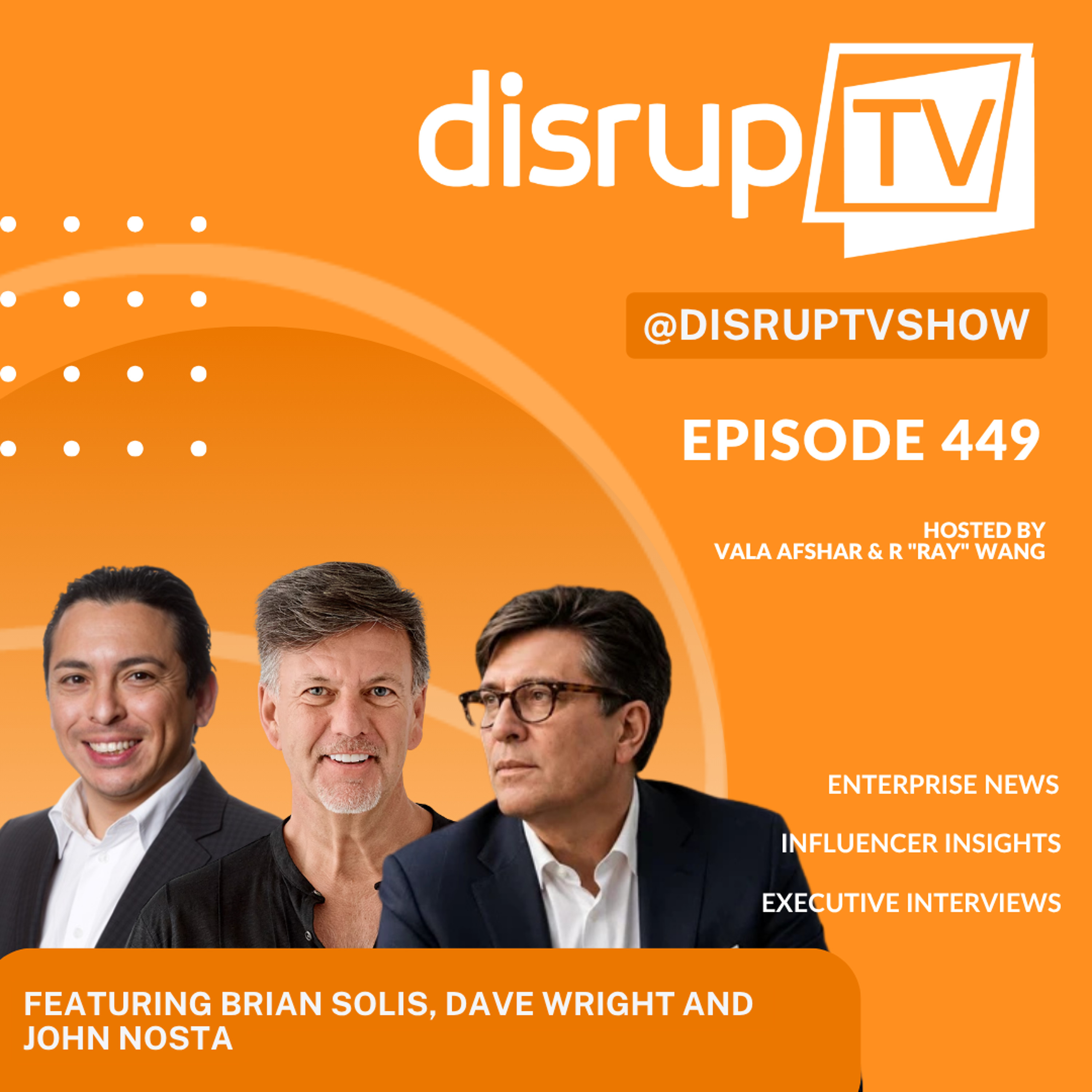
In Episode 449 of DisrupTV, hosts Vala Afshar and R "Ray" Wang bring together three thinkers whose work spans the enterprise and the individual, the organizational and the deeply human — and who arrive at the same essential warning: AI is not a tool to be deployed. It is a force that will reshape how companies create value and how humans think, whether we are intentional about it or not. Brian Solis and Dave Wright, co-authors of Infinite and leaders at ServiceNow, make the case that most enterprises are caught in the iteration trap — automating the past instead of building the future. They explain why CEOs must start with why rather than how, why the number one driver of AI ROI is reimagining end-to-end workflows rather than layering AI onto existing ones, and why the real transformation is relational and organizational — from org charts to work charts, from ROI to Return on Intelligence. They bring it to life through IKEA’s one-billion-euro pivot from cost-cutting to revenue creation, the ANZ bank story of reclaiming 600 FTEs worth of hidden capacity, and a clear-eyed look at the governance challenges of multi-agent systems. John Nosta, one of the world’s leading innovation theorists, shifts the lens from the enterprise to the individual. His concept of anti-intelligence challenges the assumption that AI is a smarter version of human thinking — human cognition and AI computation are orthogonal, not parallel. He introduces the distinction between iterative intelligence (using AI to deepen thinking) and cognitive surrender (using AI to replace it), shares clinical research on AI rebound showing that extended AI use can erode the skills it was meant to support, and proposes Activities of Daily Thinking as the human practice we may need to protect most urgently in an age that makes thinking optional. Together, they sketch a coherent arc from the enterprise to the individual: AI demands reinvention at every level — of business models, of workflows, and of how we relate to our own minds.