Find partners
CXOTalk

CXOTalk

Hosted by Michael Krigsman

Episodes

548

Latest episode

Jun 2026

Language

EN-US

About the show

C-Suite Conversations on AI & Strategy. Join industry analyst Michael Krigsman for unfiltered discussions with the leaders shaping the future of business. From AI implementation to digital transformation, hear directly from CIOs, CTOs, CEOs, and more from the world's largest companies. No scripts. No PR fluff. Just real questions from our live audience and honest answers from the C-Suite. Want to participate? Get invited to the next live show: https://www.cxotalk.com/subscribe

Listen to episodes

60 recent
June 15, 2026Episode 92153 min

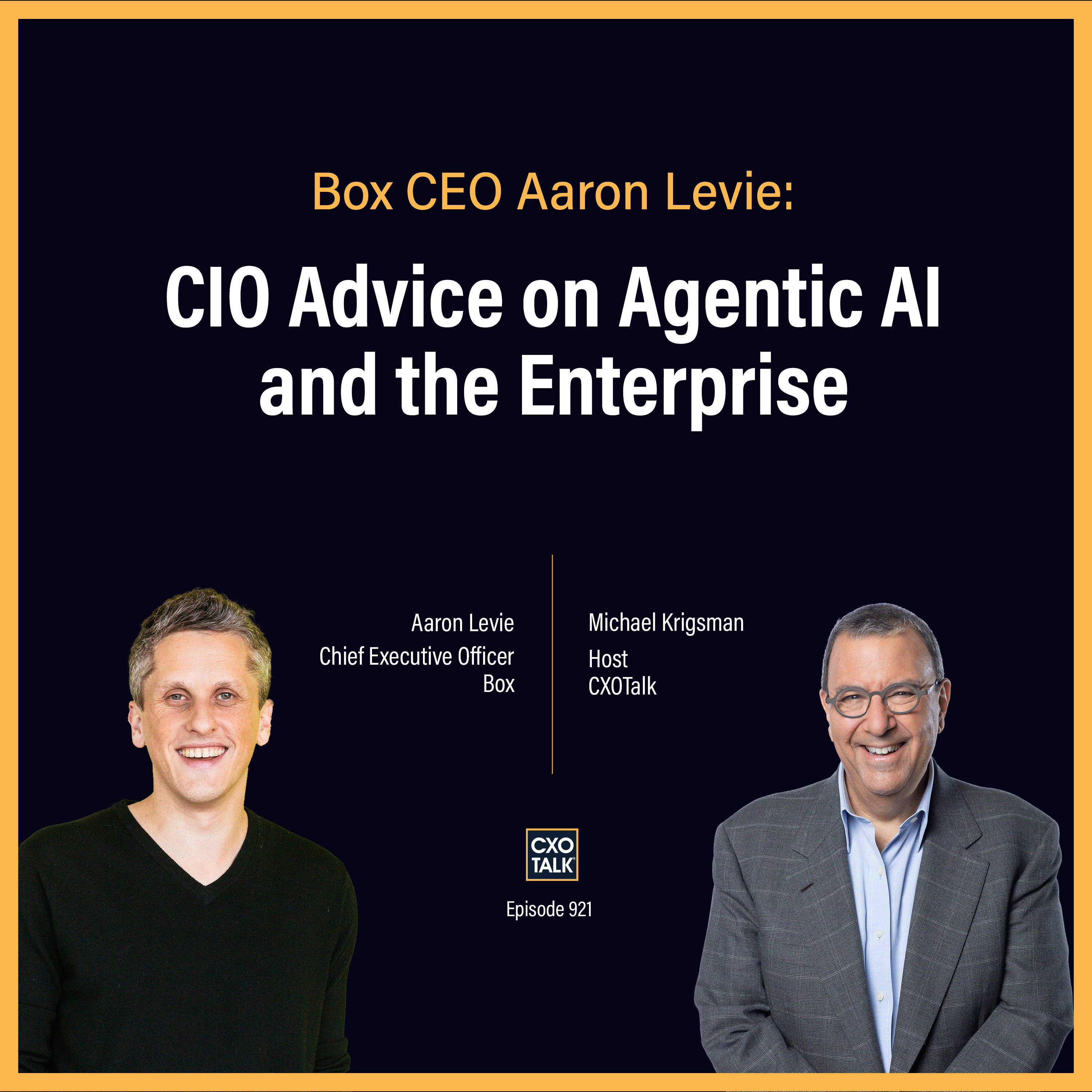
Aaron Levie, Box CEO: Advice for CIOs on AI Agents

Agentic AI has taken off in software engineering, but most CIOs still cannot make agents work in everyday knowledge work in the enterprise. Aaron Levie, co-founder and CEO of Box, explains why that gap exists and what enterprises must change to close it. Drawing on what Box sees across its enterprise customer base, including 68% of the Fortune 500, Levie covers data access, verification, budgets, architecture, and the new roles required to realize real value from enterprise AI agents.======This episode is brought to you by Gartner IT Symposium/Xpo™. Ready to scale agentic AI from pilot to production? Join top CIOs and IT executives at Gartner IT Symposium/Xpo, taking place this October 19th through the 22nd in Orlando, Florida. Over 300 Gartner analyst-led sessions will cover top priorities shaping IT—from AI value, governance, and cybersecurity to cost optimization, IT operating models, and beyond. Get practical, actionable insights—and connect with peers tackling the same challenges you are.Secure your spot today at gartner.com/us/symposium.======YOU'LL DISCOVER✅ Why agentic coding raced ahead while knowledge work agents lag, across three properties: text based work, verifiability, and data access✅ The "AI psychosis" pattern Levie says makes CEOs overestimate agents, and why distance from the last mile of work distorts executive judgment✅ Why you should retry a failed AI project roughly every six months as frontier models keep improving✅ The forward-deployed engineer role, internal and external, and why it becomes essential to enterprise AI adoption✅ Why your IT and data architecture, not the model you pick, often determines what you actually get from agents✅ The end of venture-subsidized tokens, and why the line of business, not just IT, now has to own the AI budget✅ Why Levie says you should not vibe-code core systems of record like ERP or CRM, and where agent value actually accrues✅ Value maxing versus token maxing: how to judge AI ROI and avoid a surprise overnight token bill⏱️ TIMESTAMPS0:00 The promise of agentic coding5:11 Why knowledge work resists agents8:52 The AI psychosis trap for CEOs14:57 Be ambitious, then retry in six months17:25 The rise of the forward-deployed engineer21:09 Frontier models need your data architecture27:14 The end of subsidized tokens31:18 How knowledge workers should prepare36:37 Where software value shifts39:03 Reimagining workflows around abundance43:03 Value maxing versus token maxing49:46 Advice for CIOs🔔 Subscribe for weekly conversations with the world's top business and technology leaders.📩 Get the CXOTalk newsletter: https://newsletter.cxotalk.com💬 Read the show notes and episode summary: https://www.cxotalk.com/episode/box-ceo-aaron-levie-cio-advice-on-agentic-ai-and-the-enterprise#CXOTalk #AaronLevie #Box #EnterpriseAI #AIAgents #AgenticAI #DigitalTransformation #CIO #KnowledgeWork #AIStrategy

June 9, 2026Episode 92057 min

Mozilla CTO: Why Most Enterprises Don't Control Their AI

Most enterprises are renters, not owners, of their technology and AI. Raffi Krikorian, Chief Technology Officer of Mozilla, explains why dependence on a handful of closed model providers means losing control over model behavior, pricing, and your own data.In CXOTalk episode 920, Krikorian lays out where open-source AI actually wins in the enterprise, how lock-in happens quietly, and what CIOs and CTOs should do about it now. Krikorian draws on his experience building infrastructure at Twitter and running the self-driving division at Uber to ground the discussion in real engineering and economic tradeoffs, not hype.YOU'LL DISCOVER✅ Why 85% of enterprises believed they could switch AI vendors, but only about 30% actually could when they tried✅ The "renters vs. owners" framing and what it means to control your AI destiny✅ Why Krikorian wants data "protected by architecture, not legal handshakes"✅ How Pinterest reportedly saved on the order of $10 million in a single quarter by switching from closed to open models✅ Why IT is becoming "the HR team for agents," and the read/write "dangerous triangle" of agentic permissions✅ The case for recording your prompts and running your own evaluations instead of trusting public benchmarks✅ Why roughly 70% of enterprise GPUs sit idle, and the missing "LAMP stack for AI" that could put them to work✅ How closed "validation machines" can quietly steer answers toward sponsored outcomes⏱️ TIMESTAMPS0:00 Renters vs. owners: who controls enterprise AI2:26 The risks of depending on closed model makers6:23 How lock-in happens and where open source fits9:53 Regression testing and building your own evals13:24 Pricing instability and the post-IPO cost question23:31 Governance: IT as HR for AI agents32:38 Can a small organization own its AI stack end-to-end?38:47 Validation machines, trust, and sponsored answers43:39 Keeping humans at the center, not in the loop47:23 Can open source beat big tech in AI?51:39 Inside Mozilla.ai: Otari, CQ, Octanus, Thunderbolt55:21 The "rebel alliance" strategy🔔 Subscribe for weekly conversations with the world's top business and technology leaders.📩 Get the CXOTalk newsletter: https://newsletter.cxotalk.com💬 Read the show notes, summary, and transcript: https://www.cxotalk.com/episode/mozilla-cto-open-source-ai-agents-and-the-fight-for-control🎙️ ABOUT CXOTALKCXOTalk features unfiltered conversations with C-suite executives from major companies about AI, digital transformation, and business strategy. Hosted by Michael Krigsman.Episode 920#CXOTalk #EnterpriseAI #OpenSource #AIGovernance #CIO #Mozilla #DigitalTransformation #AIStrategy #VendorLockIn #AgenticAI

May 16, 2026Episode 91942 min

Enterprise AI: Shadow AI and Agentic Risk - CIO advice

AI agents are entering enterprise AI faster than CIOs can govern them. Line-of-business users are vibe-coding their own tools, agents are operating with employee credentials, and foundation models are changing under running systems. In CXOTalk episode 919, Anthony Scriffignano, PhD, a prominent data scientist, and Tim Crawford, a strategic advisor to CIOs at the world's largest companies, examine what enterprise AI governance, shadow AI, and agentic risk require of technology leaders today. The discussion grounds the AI agent conversation in practical decisions: what to keep from established IT governance, what is genuinely new, and where the CIO role must evolve.YOU'LL LEARN:✅ Why traditional regression testing breaks when foundation models, training data, and environments all change at once✅ How shadow AI and vibe-coding by non-developers expand the threat paradigm beyond the enterprise perimeter✅ Why HR-style policies do not transfer to AI agents, and what changes when super-agents call sub-agents through an orchestration layer✅ Specific controls for shadow AI: sandboxes, token counting, personal Identifying Information (PII) guardrails, and watching for value leaving the organization✅ Red, blue, and green teaming for autonomous agents, including why red teams need a defined target list, not a license to break things✅ The three governance layers CIOs must now reconcile: user role-based access controls (RBAC), agent governance, and knowledge governance, across ServiceNow, Salesforce, and SAP✅ When human in the loop is meaningful and when it becomes theater, including the limits of audited-sample review at machine speed✅ How the transformational CIO mindset differs from the traditional one, and why business depth is now the prerequisite skill⏱️ TIMESTAMPS0:00 AI agents are running wild: framing the problem3:11 From automation to autonomy: how CIOs should reframe risk5:21 What old governance disciplines still apply, and what is new6:12 Shadow AI, vibe coding, and the limits of control9:11 Practical controls: sandboxes, token counting, PII guardrails11:53 Why HR policies do not work for AI agents15:24 Regression testing for misuse and misadventure18:43 The aspiring CIO: traditional vs. transformational mindset21:07 Disciplined red, blue, and green teaming23:30 When mandatory automation becomes the only option32:03 Human in the loop: meaningful or theater?34:09 What AI governance actually looks like in practice38:10 New roles: context engineers, AI FinOps, and value frameworks40:30 Talent and jobs inside IT: what changes🔔 Subscribe for weekly conversations with the world's top business and technology leaders.📩 Get the CXOTalk newsletter: https://newsletter.cxotalk.com💬 Read the show notes: https://www.cxotalk.com/episode/cio-playbook-agentic-ai-in-the-enterprise🎙️ ABOUT CXOTALKCXOTalk features unfiltered conversations with C-suite executives from major companies about AI, digital transformation, and business strategy. Hosted by Michael Krigsman.Episode 919 #cxotalk #ShadowAI #AIAgents #AIGovernance #AgenticAI #CIO #EnterpriseAI #DigitalTransformation #AIRisk #CIOLeadership

May 5, 2026Episode 91818 min

Autonomous Software Development at Enterprise Scale: Inside a 1,000-Developer Pilot (with Blitzy) | CXOTalk #918

Enrique Ibarra, CIO and Head of Business Transformation at GNP, Mexico's largest insurance company, walks through an enterprise-scale pilot of autonomous software development involving roughly 1,000 internal and external developers. The episode examines how agentic AI changes developers' roles from creators to editors and orchestrators.In CXOTalk episode 918, Ibarra explains why AI co-pilots alone were insufficient to modernize a 20-year-old mainframe system, how GNP evaluated the Blitzy autonomous development platform across four real-world use cases, and how developer roles are shifting from creators to editors and orchestrators. The episode covers legacy modernization, enterprise AI adoption, change management, measurable results, and the two-year roadmap to retool the full engineering organization.YOU'LL DISCOVER✅ The CIO's phased human-in-the-loop playbook: target high-effort, low-risk friction points first (documentation, test suites, version upgrades)✅ Measured outcomes: 5 to 10X engineering velocity, near-100% autonomous completion on language upgrades, roughly 80% on frontend modernization✅ Why GNP's 20-year-old mainframe system forced a modernization decision tied to cost and the coming COBOL talent shortage✅ How the pilot was structured across four use cases: Java 8 to Java 21 migration, Angular frontend upgrade, new feature build, and security vulnerability remediation✅ Why autonomous platforms differ from co-pilots, and when to use each (Blitzy for heavy lifting, IDE-based co-pilots for the final 20%)✅ How to encode technical, security, and architectural guidelines as prompt inputs rather than post-hoc review✅ The change management approach that converted skeptical developers into active users within weeks✅ Strategic payoff: shipping new insurance products in weeks rather than months, and shifting IT from maintaining the business to dictating market paceTIMESTAMPS0:00 Introduction and headline results0:39 Why GNP needed to modernize a 20-year-old mainframe system1:15 From coding co-pilots to an autonomous platform2:36 Designing the four-use-case pilot4:26 Autonomous platforms versus vibe coding5:49 What autonomous development means in practice7:24 Encoding security and governance as prompt inputs8:24 Results: velocity, autonomy rates, and the final 20%10:16 How developer roles and daily work change11:19 Managing developer skepticism and change resistance12:25 Advice for CIOs: the phased human-in-the-loop playbook13:34 Strategic business benefits and first-to-market product launches14:58 Rolling out across seven teams and a two-year horizon16:34 Final advice for engineering leaders getting started🔔 Subscribe for weekly conversations with the world's top business and technology leaders.📩Get the CXOTalk newsletter: https://newsletter.cxotalk.com 💬 Read the show notes: https://www.cxotalk.com/episode/autonomous-software-development-at-enterprise-scale-inside-a-1-000-developer-pilot-with-blitzy🎙️ ABOUT CXOTALKCXOTalk features unfiltered conversations with C-suite executives from major companies about AI, digital transformation, and business strategy. Hosted by Michael Krigsman. Episode 918#CXOTalk #AutonomousSoftwareDevelopment #Blitzy #AgenticAI #EnterpriseAI #CIO #AICodeGeneration #LegacyModernization #DigitalTransformation #SoftwareEngineering

May 4, 2026Episode 91556 min

How AI Swarms Weaponize Disinformation | CXOTalk #915

AI swarms are now considered the most dangerous influence weapons ever created, actively fabricating grassroots consensus and corrupting enterprise AI training data through disinformation. Daniel Thilo Schroeder, Research Scientist at SINTEF, and Jonas R. Kunst, Professor at BI Norwegian Business School, co-authored a study with 22 authors published in Science that maps this threat. They explain how AI swarms operate without human oversight, why traditional detection methods fail, and what governments, platforms, and business leaders must do to fight back. This is CXOTalk episode 915.YOU'LL DISCOVER✅ How AI swarms shift from central command to emergent hive behavior with decreasing human oversight✅ Why AI-generated social media messages now pass the Turing test, rendering individual message detection obsolete✅ The persona-centric architecture: how single AI agents coordinate behavior across email, X, Bluesky, and Facebook simultaneously✅ How swarms fabricate synthetic consensus by hijacking human conformist psychology✅ The perverse incentives of social media business models that profit from AI swarm engagement metrics✅ How AI swarms poison LLM training data, causing future models to output manipulated facts as objective reality✅ The proposed Distributed AI Influence Observatory for decentralized threat intelligence sharing✅ Why malicious actors can deploy self-optimizing AI swarms from a bedroom using existing multi-agent frameworks⏱️ TIMESTAMPS0:00 The Shift from Bot Networks to AI Swarms2:00 Why Cheap AI Inference Enables Long-Term Influence Campaigns4:30 Autonomous Coordination and Emergent Hive Behavior7:00 Persona-Centric Agents Across Multiple Platforms8:30 Weaponizing Disinformation to Fabricate Synthetic Consensus14:15 How AI Swarms Corrupt LLM Training Data18:00 Why Individual Message Detection No Longer Works23:00 The Research Frontier: Coordination Pattern Detection27:00 Platform Business Models and Perverse Incentives32:00 Building Defenses: The AI Influence Observatory39:00 Corporate Risks: Fabricated Boycotts and Targeted Harassment\46:00 Can It Be Stopped? The Arms Race Democracies Must Join🔔 Subscribe for weekly conversations with the world's top business and technology leaders.📩 Get the CXOTalk newsletter: https://newsletter.cxotalk.com💬 Read the show notes, summary, and transcript: https://www.cxotalk.com/episode/how-ai-swarms-weaponize-disinformation🎙️ ABOUT CXOTALKCXOTalk features unfiltered conversations with C-suite executives from major companies about AI, digital transformation, and business strategy. Hosted by Michael Krigsman.#CXOTalk #AISwarms #Disinformation #InformationWarfare #Cybersecurity #AgenticAI #TechPolicy #EnterpriseRisk #Democracy #InfluenceOperations

May 4, 2026Episode 91721 min

AI-Enabled Software Development: AI Coding at a Global Insurer, with Blitzy | CXOTalk #917

Autonomous software development creates a dilemma for leaders in regulated industries: adopt AI coding at scale or fall behind on product velocity without compromising auditability and code quality. In CXOTalk episode 917, Kris Tokarzewski, Group Chief Technology Information Officer at Vitality, describes how a 14,000-employee multinational insurer is rebuilding its software development life cycle around AI. This episode examines the impact of agentic AI on software development in the enterprise.Recorded at Blitzy's headquarters, the conversation examines deterministic code generation, Blitzy's infinite code context, context engineering, test-driven development, and the shifting bottlenecks that surface as throughput accelerates.YOU'LL DISCOVER✅ Why regulated industries require deterministic, auditable code rather than the probabilistic output most AI coding systems generate✅ How Blitzy's infinite code context (ingestion of codebases, engineering standards, and business rules) creates high-quality software aligned with compliance requirements✅ How Vitality reverse-engineers legacy systems with autonomous AI, achieving a measured 5x acceleration over manual methods✅ Why optimizing end-to-end SDLC throughput matters more than local efficiency at any single stage✅ How code review of 50,000 to 100,000-line pull requests becomes the next limiting factor, and how AI reviewers close the gap✅ How test-driven development pairs with autonomous code generation to raise quality and compliance pass rates✅ How the roles of requirements engineers, software engineers, and product teams converge inside an AI-native SDLC✅ How to instrument AI spend against velocity, quality, end-to-end throughput, and customer value rather than isolated gainsTIMESTAMPS0:00 Deterministic code vs. probabilistic AI output0:14 Meet Kris Tokarzewski, Group CTIO of Vitality0:32 Why Vitality is modernizing legacy insurance systems1:30 Event-driven architecture as agentic AI's natural partner3:00 Building an AI-native software development life cycle with Blitzy4:28 Throughput optimization versus local efficiency6:02 Reverse engineering legacy systems and deterministic code generation9:05 Infinite code context: ingesting codebases, standards, and rules10:00 Test-driven development with autonomous code generation10:49 Results: 5x faster legacy reverse engineering13:17 Product, engineering, and DevOps convergence15:04 Roles level up: requirements engineers and software engineers16:18 Reviewing 50,000 to 100,000-line pull requests17:56 Instrumenting AI spend against business outcomes19:16 Executive sponsorship for autonomous development20:16 Advice for CIOs and CTOs adopting AI-driven development🔔 Subscribe for weekly conversations with the world's top business and technology leaders.📩 Get the CXOTalk newsletter: https://newsletter.cxotalk.com💬 Read the show notes: https://www.cxotalk.com/episode/autonomous-software-development-ai-coding-at-global-scale-with-blitzy🎙️ ABOUT CXOTALKCXOTalk features unfiltered conversations with C-suite executives from major companies about AI, digital transformation, and business strategy. Hosted by Michael Krigsman.Episode 917 | Recorded at Blitzy Headquarters#CXOTalk #AICoding #AutonomousDevelopment #DeterministicCode #AINativeSDLC #ContextEngineering #InfiniteCodeContext #LegacyModernization #RegulatedIndustries #EnterpriseAI #Blitzy

May 3, 2026Episode 91655 min

Agentic AI in the Enterprise 2026 | CXOTalk #916

Agentic AI is reshaping enterprise software faster than most CIOs, CFOs, and vendors are prepared for. Praveen Akkiraju, Managing Director at Insight Partners, joins Michael Krigsman to examine the state of agentic AI in 2026: what works in production, what remains hype, and how sophisticated enterprises are now running more than 1,000 agents at scale. The conversation covers the engineering that separates reliable agents from unreliable ones, the economics of token consumption, and the build-vs-buy calculus facing enterprise buyer4s.YOU'LL DISCOVER✅ Why Praveen argues "the agent is actually the harness," and what a harness includes: tools, context, memory, and guardrails✅ "Jagged intelligence": why state-of-the-art models still fail on basic prompt variations, and the implications for production deployment✅ How leading enterprises are operating 1,000+ agents and the governance questions that remain unresolved✅ A bounded vs. unbounded framework for deciding where agent autonomy is realistic and where human approval must stay✅ Why "token maxing" is consuming annual AI budgets in 90 days, and what CIOs can do about it✅ How Stampli inserts agentic steps into invoice reconciliation rather than rebuilding the workflow from scratch✅ Build vs. buy: why front-end workflows favor buying and back-end, data-heavy workflows favor building✅ The fractional-FTE pricing model emerging for agentic products, and what it means for software economics⏱️ TIMESTAMPS0:00 Token maxing and the enterprise AI budget problem0:23 Model evolution: reasoning, DeepSeek, and the agentic inflection2:03 What is an agent: models plus harness4:46 Hype versus reality in agentic AI8:31 Where agents deliver measurable value today13:10 Agent negligence, guardrails, and sandboxes16:06 Data access boundaries: APIs, MCP, and policy files20:38 Bolt-on agents versus agent-native software26:53 Human in the loop or autonomous: the operating model question33:49 Fix your data first, or start now?41:54 Will agents replace Salesforce and Workday?47:28 Build vs. buy: front end versus back end50:45 Token costs and the return of variable-cost software54:09 Pricing agents as fractional FTEs🔔 Subscribe for weekly conversations with the world's top business and technology leaders.📩 Get the CXOTalk newsletter: https://newsletter.cxotalk.com💬 Read the show notes: https://www.cxotalk.com/episode/agentic-ai-and-the-future-of-enterprise-software-in-2026🎙️ ABOUT CXOTALKCXOTalk features unfiltered conversations with C-suite executives from major companies about AI, digital transformation, and business strategy. Hosted by Michael Krigsman.Episode 916 | Recorded April 2026 #CXOTalk #AgenticAI #EnterpriseAI #AIAgents #AIGovernance #CIOStrategy #InsightPartners #EnterpriseSoftware #DigitalTransformation #LLM

April 10, 2026Episode 91455 min

AI Agents in Finance with HPE's Chief Financial Officer (CFO) | CXOTalk 914

Marie Myers, Chief Financial Officer of HPE, explains how she measures business value while deploying agentic AI across a 3,600-person finance organization. Her framework separates direct ROI from indirect value (speed, accuracy, fewer errors) and the operating requirements that make finance AI trustworthy at scale.YOU'LL DISCOVER✅ How Myers separates direct ROI from indirect value, including speed, accuracy, and lower error rates✅ Why determinism was "foundational" for finance AI, and why HPE co-engineered with Nvidia NIMs to achieve consistent answers across half a million data elements✅ What "human in the loop" means in practice, and why accountability stays with finance leaders✅ How Alfred (built on Deloitte's Zora platform) moved from transactional workflows to core finance operating rhythms like HPE's weekly ops call✅ Why clean, reconciled data and a strong data layer are prerequisites for enterprise AI✅ How HPE redesigned FP&A workflows, centralized the team, and pushed "one source of truth" before layering in agents✅ How Myers thinks about agile experimentation, stage gates, and when to stop AI investments that will not pay off✅ Why change management and cultural adoption are often harder than the technology, and how training 3,000+ people was essential⏱️ TIMESTAMPS0:00 Measuring AI value beyond hard ROI3:40 Stage gates, scorecards, and when to stop an AI investment6:49 "This is a team sport": IT, business, compliance7:20 Determinism vs probabilism in financial AI9:38 Alfred, Deloitte Zora, and private cloud (on-premises) architecture13:04 Human in the loop and limits on agent autonomy14:31 Highest ROI AI use cases: engineering, marketing, IT16:23 Where finance sees ROI first: transactional workflows19:00 "AI slop" and maintaining quality standards25:32 Data quality and trusted, reconciled financial data33:49 Redesigning FP&A workflows, "one source of truth"40:35 Change management is the hardest part of AI🔔 Subscribe for weekly conversations with the world's top business and technology leaders.📩 Get the CXOTalk newsletter: newsletter.cxotalk.com💬 Read show notes and the full transcript: https://www.cxotalk.com/episode/hpes-cfo-making-agentic-ai-work-in-finance🎙️ ABOUT CXOTALKCXOTalk features unfiltered conversations with C-suite executives from major companies about AI, digital transformation, and business strategy. Hosted by Michael Krigsman. This is episode 914.#CXOTalk #HPE #CFO #AIROI #AIinFinance #AgenticAI #AIGovernance #FPandA #FinanceTransformation #EnterpriseAI

March 25, 2026Episode 91429 min

Governing AI Agents at Scale: Identity, Scope, and Observability (with Glean and Cvent) | CXOTalk #914

Pradeep Mannakkara (CIO) and Ben Mayrides (CISO) of Cvent explain how they govern AI agents at scale across their 5,500-person organization, which now has over 6,000 agents in production. In this fireside chat recorded at a Glean event in NYC, they walk through the AWARE framework developed by Glean's Work AI Institute with Databricks and Palo Alto Networks, and describe the practical tradeoffs of moving fast while managing risk. The conversation covers agent identity, observability, cultural adoption, CIO/CISO dynamics, and what enterprise-grade AI governance looks like in practice.You'll discover:✅ Why traditional IAM and observability controls fail in agentic architectures where agents reason, delegate, and act autonomously✅ How Cvent deliberately encouraged 6,000 agent creations to build AI fluency before layering in moderation and metrics✅ The AWARE framework's five pillars: identity, context, guardrails, risk scoring, and ecosystem observability✅ Why "risk is too high" is never the final answer, only "risk is too high for now"✅ How Cvent filters AI demand through ROI gates before projects reach security review✅ Why replacing gut-feel security objections with shared criteria moves the CISO from gatekeeper to business partner✅ The sandbox-first approach that separates experimentation from production deployment✅ Why SOC 2 control criteria for AI agents are likely within 18 to 24 months⏱️ TIMESTAMPS0:00 Introduction and the AWARE framework0:34 Core challenges of agent governance2:43 What agents do for us and to us4:36 Applying the AWARE framework in practice7:09 Choosing platforms with built-in controls9:25 Making governance a cultural shift11:51 Earning trust through deliberate risk decisions13:49 Replacing gut reactions with shared criteria15:20 Managing the CIO/CISO tension18:54 Shared language for hard tradeoffs22:01 Go/no-go decisions are never one and done24:48 Advice for putting AWARE into practice26:38 Scaling to 6,000 agents🔔 Subscribe to CXOTalk and hit the bell for new episodes every week.📩 Get the CXOTalk newsletter: https://newsletter.cxotalk.com💬 Show notes: https://www.cxotalk.com/episode/ai-agent-governance-inside-the-glean-aware-framework-with-cvents-cio-and-ciso🎙️ ABOUT CXOTALKCXOTalk features unfiltered conversations with C-suite executives from major companies about AI, digital transformation, and business strategy. Hosted by Michael Krigsman.Episode 913 | Recorded March 10, 2026#CXOTalk #AIGovernance #AIAgents #CISO #CIO #EnterpriseAI #AgenticAI #AWAREFramework #AICompliance #CyberSecurity

March 25, 2026Episode 91253 min

Deloitte CTO: Advice to CIOs on Enterprise AI | CXOTalk #912

Bill Briggs, CTO of Deloitte, shares findings and advice for Chief Information Officers (CIOs) from the 2026 TechTrends report: 93% of enterprise AI spending goes to technology and tooling, while only 7% of funding goes to culture, change management, and learning. Briggs explains why this imbalance drives failed pilots and runaway costs, and what leaders should do about it. 📌 KEY POINTS-- Your AI spending ratio is upside downEnterprises allocate 93% of AI budgets to technology and tooling, while devoting only 7% to culture, change management, and workforce learning. Leaders who invest first in simplifying processes from first principles, before adding AI, consistently produce the strongest returns.-- Frontline trust in AI sits at 6.7%, and it's costing youC-suite executives report 70% trust in AI, while entry-level workers register only 6.7%, creating an inverted value chain where the people closest to broken processes stay silent. Organizations can close this gap by declaring intentions upfront and making it safe for workers to experiment openly, rather than hiding behind personal AI tools.-- Measure outcomes, not agent headcountCompanies broadcasting "tens of thousands of agents" substitute effort metrics for evidence of value; if real business results existed, those numbers would be the headline. Tie every AI initiative to specific operational and financial metrics and kill pilots that result in press releases but no movement that benefits shareholders and employees.YOU'LL DISCOVER:✅ Why applying AI to an inefficient process "weaponizes inefficiency" and drives costs through the roof✅ How trust in AI drops from 70% at the C-suite to 6.7% at the frontline, and why this inverted gap blocks real value✅ Why hospitals are putting robots on org charts and holding naming competitions for AI coworkers✅ The specific governance frameworks enterprises need for a workforce of AI agents (modeled on the HR lifecycle)✅ How inference costs create sticker shock and when to shift from cloud to dedicated hardware✅ Why Briggs says the CIO's most important skill is now storytelling, not systems architecture✅ What "success theater" looks like and how to spot it in your own organization✅ Why 99% of enterprises are fundamentally transforming their IT organizations right now⏱️ TIMESTAMPS0:00 Deloitte's CTO: Spend less on technology0:20 The 93/7 AI spending imbalance3:59 Why a technologist argues against more tech investment5:43 State of enterprise AI: 30% reach production scale8:05 Treating AI deployment like onboarding a coworker10:29 AI itself means nothing without culture change13:14 Redesigning work from first principles16:51 Quantifying AI financial risk and token economics20:03 Inference costs, shadow IT, and runaway bills23:14 The trust gap: 70% at the top, 6.7% at the bottom26:47 Governing a workforce of AI agents32:15 Success theater vs. real business metrics37:37 Responsible deployment, guardrails, and OpenClaw lessons42:37 How AI is transforming the CIO role46:05 Why storytelling is the CIO's most important skill50:02 Human times machine: the essential equation🔔 SUBSCRIBE for weekly conversations with global technology and business leaders who speak candidly about the strategies behind AI, transformation, and organizational change.📩 Get notified about upcoming episodes and exclusive insights: https://newsletter.cxotalk.com💬 Read show notes and get the transcript: https://www.cxotalk.com/episode/deloitte-cto-on-the-ai-investment-trap-cio-advisory-2026🎙️ ABOUT CXOTALKCXOTalk features unfiltered conversations with C-suite executives from major companies about AI, digital transformation, and business strategy. Hosted by Michael Krigsman.Episode 912 | Recorded March 15, 2026#CXOTalk #AIStrategy #EnterpriseAI #DigitalTransformation #Deloitte #CIO #AIGovernance #TechTrends2026 #AIInvestment #AgenticAI

Is this your show?

Claim this listing to keep it up to date, reach guests who want to pitch you, and manage bookings with Guestify.

Claim this listing

More Technology podcasts