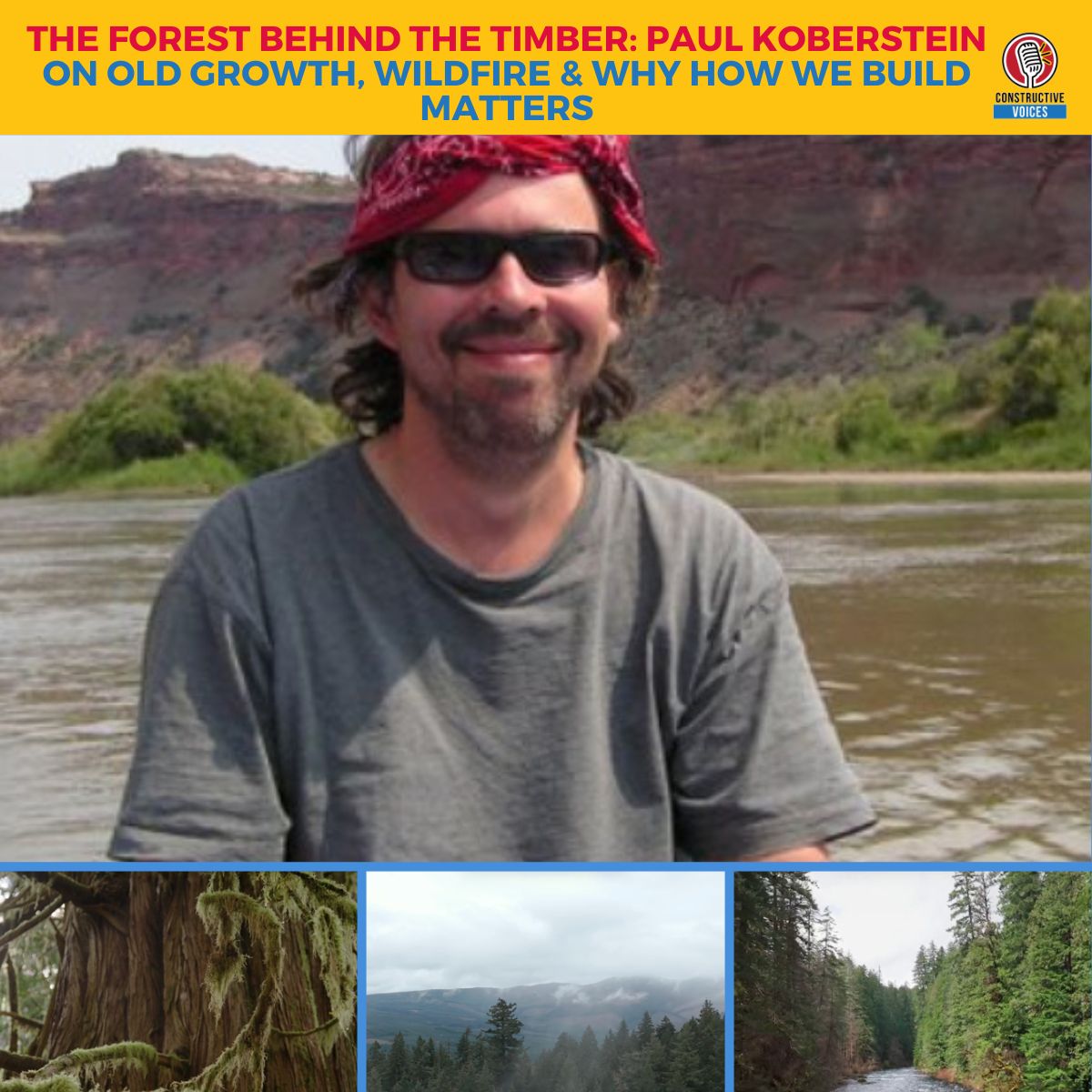
The Forest Behind The Timber: Paul Koberstein On Old Growth, Wildfire & Why How We Build Matters
“We have a solution that is already here. It’s already doing the work that needs to be done. And all we have to do is let them complete the job.” Paul Koberstein He has spent forty years reporting on the forests of the Pacific Northwest — and he is convinced they may be the most powerful climate technology on Earth. Environmental journalist Paul Koberstein, co-author of Canopy of Titans: The Life and Times of the Great North American Temperate Rainforest , makes a deceptively simple argument: the oldest, biggest trees are not scenery, and they are not merely a timber reserve. They are among the most effective carbon-storage systems on the planet — and they are already running. The book began as an investigation and became a celebration. Stretching some 2,500 miles north of San Francisco into Alaska, the great North American temperate rainforest holds some of the largest trees in the world and an immense capacity to draw carbon out of the air. The older a tree gets, the more it stores, and the more it keeps taking in every single day. That reframes the whole climate conversation. We must stop burning fossil fuels, Koberstein insists — but that alone won’t undo three centuries of carbon already in the atmosphere. Only trees can do that. The machine exists. It is running. All we have to do is let it finish the job. “These are the trees that we should protect — the old trees, the big trees, the trees that store the most carbon.” Paul Koberstein In this episode of Constructive Voices, Jackie De Burca speaks with Paul about old growth and carbon, the difference between a forest and a plantation, the rapid dismantling of a century of US forest protection, wildfire and the violent “fires that make their own weather,” the misinformation flowing from the timber industry — and the question every builder should ask before specifying timber: what forest paid the price? In this episode Jackie and Paul explore why old forests deserve to be treated as critical climate infrastructure — and why protecting them is as much a political and communication challenge as an ecological one. They discuss: why the oldest, biggest trees are our best natural defence against climate change what the great North American temperate rainforest is, and why it matters far beyond its own region why a plantation is not a forest — on carbon, biodiversity and water how recent US policy is dismantling more than a century of forest conservation the eye-watering cost of the plan to thin 112 million acres — and what it means for democracy why “wildfire prevention” can be industrial logging in disguise pyrocumulonimbus: the fires so violent they punch smoke into the stratosphere why these fires now reach Spain, Portugal and the Mediterranean the symbiosis between salmon and trees the timber industry’s “plant three for every one we cut” messaging — and what it leaves out what the construction sector must ask about the timber it builds with why technological carbon capture won’t save us — but forests already are “They’re not forests, they’re really just crops.” Paul Koberstein Why this conversation matters This episode is about far more than trees. It is about power, extraction, communication and what we choose to value. Koberstein’s work asks a direct question: if we protect wetlands and coral reefs as critical natural systems, why not t...