CPE Podcasts is a multi-series channel produced by Commercial Property Executive, exploring issues and trends across the U.S. commercial real estate industry. Find out more on our website: www.cpexecutive.com
Listen to episodes
60 recent
June 15, 2026Episode 217 min
CREW Up: Why Women Still Face an Uphill Climb in Brokerage
Women now account for 31 percent of commercial real estate brokers in the U.S., up 10 percentage points over the past 15 years, according to CREW Network. While progress may feel slow, 2026 President Leslie Teskey sees reason for optimism.In this episode of CREW Up, Commercial Property Executive’s Laura Valean sits down with veteran broker Teskey to discuss why brokerage remains one of commercial real estate's most challenging—and rewarding—career paths for women.
June 8, 2026Episode 224 min
RICS Monitor: CRE Sentiment Steady on the Surface, Fragile Underneath
Global commercial real estate sentiment was broadly stable in the first quarter, but the headline numbers mask an uneven picture across markets, according to the latest surveys released by the Royal Institution of Chartered Surveyors in London. The war in Iran, higher energy prices, renewed inflation concerns and shifting expectations around interest rates are beginning to filter through CRE markets in different ways."The global index that we produce barely moved and if you were to only look at that, you kind of reach the conclusion that nothing much happened, but that aggregate figure really does mask quite a bit of movement underneath," said RICS Head of Market Analytics Tarrant Parsons in this podcast.Hosted by Executive Editor Laura Valean, this RICS Monitor episode touches on why credit conditions have become one of the most important indicators to watch, particularly as tighter financing could weigh on investment activity and values over the next several quarters.
June 2, 202631 min
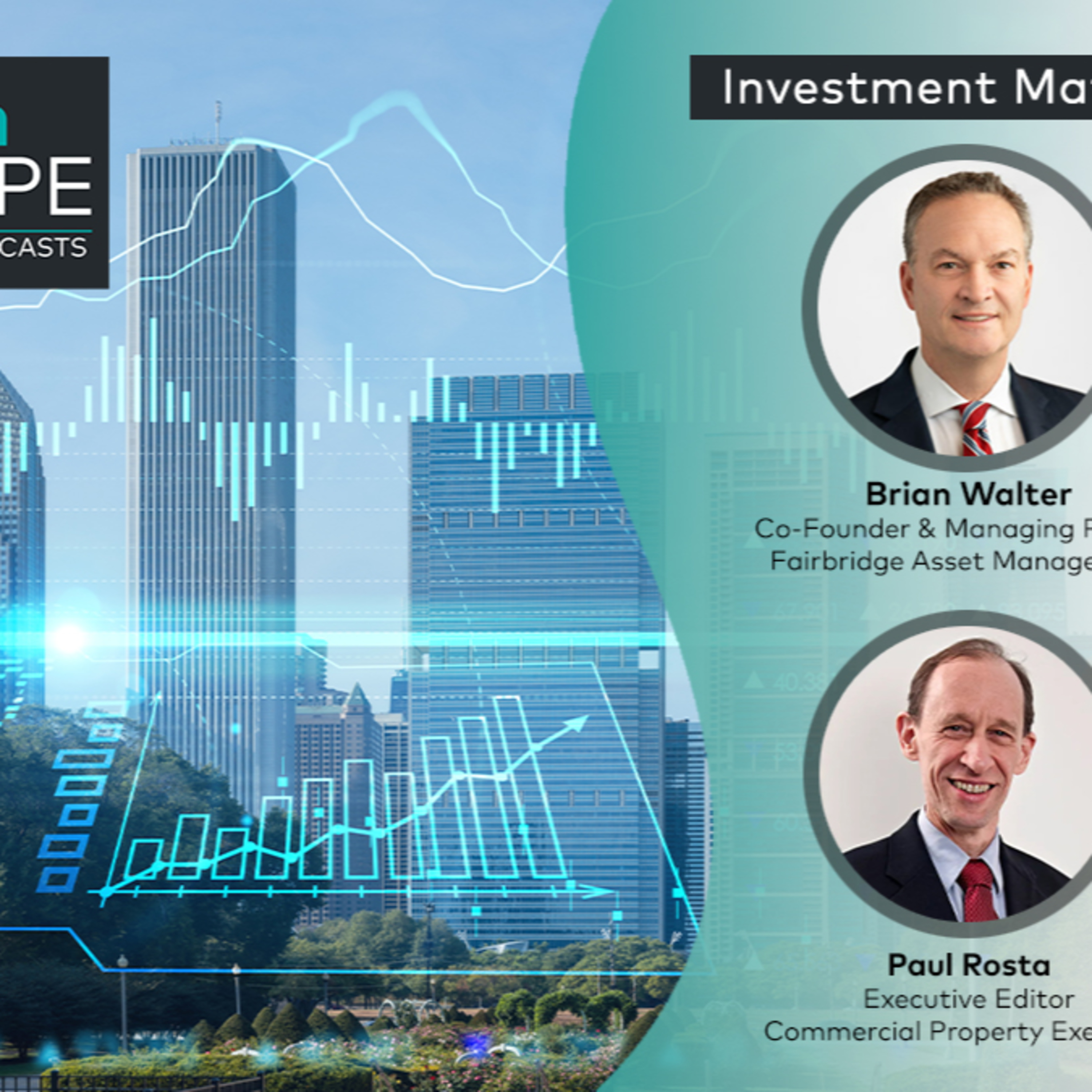
Investment Matters: CRE Capital With Cross-Border Clout
Ronald Dickerman says that real estate is part of his DNA. His family owned and operated apartment buildings in Boston, and when he was still a teenager, he’d spend Saturdays at those properties, vacuuming the halls and cleaning the pools. Back then he figured that he’d probably stick close to home and wind up working in the family business, but as it turned out, he was destined for much wider horizons. As founder and president of Madison International Realty, Dickerman leads a company with an uncommon focus on the secondaries market and a footprint that encompasses offices on three continents. Since its founding a quarter century ago, Madison International has raised upward of $8 billiondollars from scores of investors.In our conversation, Dickerman tells us how he came to focus on the secondary market and fills us in on Madison International’s latest corporate-level moves. From the perspective of nearly four decades in the business, he offers his insights on today’s key trends.And, as an expert on international capital flows, he gives us his take on how the U.S. real estate market stacks up against the competition. If you enjoy the Investment Matters podcast, I hope you’ll check out CPE’s Capital Markets newsletter, our free, twice-monthly roundup of the latest trends, analysis and data in commercial real estate investment. It’s easy to subscribe—just go to https://www.commercialsearch.com/news/subscriptions/. Episode highlights: (2:03) What’s in a name?(3:58) Building a business model(6:44) Corporate-level moves/partnerships(9:14) Top trends to unpack, at home and abroad(13:47) Adjusting to the new normal(15:54) Career origin story: CRE in the DNA(21:31) Capital flows and geopolitics(24:12) Will the REIT rollups continue?(26:56) Executive off the clock: staying fit in mind and body(28:25) Fulfilling “a global mandate”Follow, rate and review CPE’s podcasts on Spotify and Apple Podcasts, and don’t forget to subscribe to CPE’s recently relaunched YouTube channel!
May 22, 202630 min
Step Into My Office: Inside Denver’s Distressed Office Rebound
Distressed office buildings are becoming a defining part of the current market cycle, especially as higher vacancy, tighter lending conditions and slower demand continue to pressure owners. But distress does not always mean an asset is obsolete. In many cases, the challenge is financial, creating an opportunity for other buyers to reinvest and compete for tenants.Real Capital Solutions is one of the firms taking that selective approach. With over $5.1 billion in investment since 1984, the company is targeting assets with strong fundamentals but challenged capital structures, focusing on properties that can still perform well with the right leasing strategy and repositioning.In this episode of Step Into My Office, CPE’s Olivia Bunescu talked with Real Capital Solutions Founder & CEO Marcel Arsenault about Denver’s office reset and the firm’s approach to buying into distress. Arsenault touched on the idea that office is both an operating and a people business, what lenders still get wrong about the sector, which assets the firm is targeting and what office recovery will look like going forward.Here’s what they discussed:How’s the office market right now? (01:42)Office as an operating business, not a passive asset class (03:06)The lender pullback (05:21)Identifying real opportunities in distressed office (08:42)Financial distress vs. operational distress (11:28)Why is Denver different? (13:04)Neighborhoods and building types RCS is watching (14:38)Cap rates, cash flow and the role of lenders in the recovery (16:04)Why some obsolete office buildings may not be fixable (20:19)First moves after acquiring a distressed office asset (22:30)The outlook for Denver and the national office sector (25:19)Real estate is ultimately a people business (28:03)
May 19, 202637 min
Alternative Disruptors: Life Science Real Estate in Transition
Life science real estate has been widely regarded as one of the most resilient sectors of the property market in the U.S. After a surge in new construction that started during the COVID-19 pandemic, the sector is now faced with sharp-rising vacancies in some of the biggest clusters.Long-term drivers like talent, funding, onshoring and biomanufacturing still point to major opportunities, however. In the latest episode of Alternative Disruptors, host Tudor Scolca-Seușan talks with Colliers Executive Vice President Joe Fetterman about where this asset class is headed in 2026 and beyond.Fetterman discusses how the sector evolved in recent years, from the robust enthusiasm felt by investors in 2019 and 2020, to the interest rate increase period and the slow absorption levels in 2024 and 2025.There is hope for the future, however. Fetterman explains why the life science sector’s story is not black and white: while demand for R&D lab space has softened, biomanufacturing is gaining momentum due to onshoring efforts, the U.S. pharma consumption market and blockbuster drug capacity needs.The conversation also covers how investors find opportunities amid oversupply and potential distress, including the case of ‘reversions’ from lab to innovation use or office. Fetterman also touches on the rise of AI and its potential to disrupt the sector.In this episode, you’ll also hear about why the top clusters (Boston, San Diego and San Francisco) are bound to recover faster, as well as which emerging markets have the most potential to become a major hub and why.Here’s a breakdown of the discussion:* (00:00) Intro* (01:08) post-COVID reality check* (04:49) Labs vs. manufacturing split* (08:09) Where opportunity is now* (12:59) Demand drivers and capital* (18:53) Manufacturing durability and AI* (21:06) Top clusters and ecosystems* (24:19) Vacancy, oversupply and recovery* (27:43) Manufacturing location decisions* (30:29) Emerging markets* (34:04) 2026 outlook and wrap-up
May 14, 202624 min
Sustainability Street: The Rise of Intelligent Buildings
Welcome back to Sustainability Street, CPE’s podcast on the intersection of commercial real estate and the world we live in.Smart buildings have gotten really smart. In this episode, R-Zero Chairperson & CEO Jennifer Nuckles and I chat about how intelligent buildings have moved from advisory to actual operational control at a time when property owners are hyper-focused on improving NOI.Today, intelligent, self-optimizing properties can automatically lower owners’ energy costs along with their carbon footprints. According to Nuckles, AI-powered building management systems have enabled energy to transition from “a fixed unavoidable expense to a controllable material driver of operating expense and valuation.”These systems are also facilitating sustainability’s shift from an externally motivated activity to a line item with direct profit and loss and valuation consequences. “Sustainability initiatives are now indistinguishable from margin expansion initiatives, and the office of the CFO is really paying attention," Nuckles noted.Here are some highlights from our conversation:(01:27) Nuckle’s sustainability journey(04:07) Energy costs and dynamic buildings(06:04) Doing the math on smart buildings(08:25) From static to real time(10:15) Sustainability and smart buildings(13:45) Why your data layer is so important(15:47) Optimizing current assets over building new(17:55) Cutting the cost of regulatory compliance(19:49) How office and industrial are converging(21:18) The next frontier in intelligent buildings(22:02) More resources on technology trends
Kansas City’s industrial market has seen a meaningful share of new deliveries translate directly into occupancy, with build-to-suit activity playing an outsized role in recent absorption.In the third episode of Inside Industrial, JLL’s Kevin Wilkerson and Phil Algrim joined CPE’s Diana Firtea to discuss how disciplined development, competition for sites and power availability are influencing Kansas City’s next phase of industrial growth.Wilkerson pointed to a string of large build-to-suit deliveries completed over the last 12 to 18 months, including projects for Ace, Amazon, Church & Dwight, Blue Buffalo, McKesson and Pimco Bakeries.The guests also noted that speculative development has remained disciplined, with a limited pool of active developers and rising competition for development-ready land. They described how data center demand has pushed some land pricing above levels that industrial projects can underwrite, adding another variable for developers trying to pencil new starts.On feasibility, they cited Kansas City’s strong electrical grid for traditional industrial uses, but said power constraints become more complex for manufacturing and data center projects, where Evergy’s energy study process can add meaningful cost and time early in site selection.
May 5, 202642 min
Investment Matters: Institutional Eye
When I want to get a handle on the big picture of commercial real estate investment, I always find it helpful to pick the brain of an executive from a global institutional investor. That’s why I jumped at the chance to sit down and talk with Mike Byrne, the chief investment officer & head of private equity and debt at AEW Capital Management. AEW has been around for 45 years, and Mike himself has been with the company since 2003. During our conversation, Mike walked me through the big issues he’s tracking. He offers compelling insights about office, industrial, retail and multifamily—plus a few words of caution.Mike also tells us about the formative years of his career, including the job that he says was “almost like getting an MBA in our business.” And whether you’re relatively new to real estate, or you’ve been a professional for a while, Mike has thought-provoking ideas about building your career. Just a brief note about the timing of this recording. We spoke shortly before the Middle East conflict started, so we weren’t able to address the potential impact on real estate finance and investment. But I think it’s fair to say that Mike’s observations about market dynamics still hold true.If you enjoy this podcast, I hope you’ll check out CPE’s Capital Markets newsletter, our free, twice-monthly roundup of the latest trends, analysis and data in commercial real estate investment. It’s easy to subscribe—just go to https://www.commercialsearch.com/news/subscriptions/.Hope you enjoy our conversation!
April 17, 202645 min
Sustainability Street: Building With Less Carbon, Not More Cost
Welcome back to Sustainability Street. CPE's podcast on the intersection of commercial real estate and the world we live in.Not so long ago, addressing embodied carbon in construction project was thought to be cost prohibitive. Increasingly, that is not the case.My guests for this episode, are Rebecca Esau, a manager with the Rocky Mountain Institute's Carbon-Free Buildings Program, and Tolga Tutar, senior sustainability director with Skanska. We discuss a report they've co-authored that demonstrates how developers are lowering embodied carbon cost effectively through early planning, available tools and more efficient materials. And we talk about how new developments in technology, circularity and carbon-storing bio-based materials will improve the business case for low-carbon buildings.Here are some highlights from our conversation:(1:54) Zeroing in on embodied carbon(5:23) Embodied carbon then and now(12:17) Proving the case for cost parity(20:26) Mass timber delivers savings(22:02) New life for old buildings(23:01) Elevating the bid leveling process(27:36) The importance of early planning(34:39) The next frontier in reducing embodied carbon(41:03) For more information…Follow, rate and review CPE’s podcasts on Spotify and Apple Podcasts, and don’t forget to subscribe to CPE’s YouTube channel!
April 13, 2026Episode 122 min
The Learning Curve: From College to Career in Industrial Brokerage
In the inaugural episode of The Learning Curve, Kidder Mathews Senior Associate Tobias Hipp sits down with CPE's Mikayla Sciortino and shares his firsthand experience of what his career in industrial brokerage has entailed thus far and what has kept him going over the first few years.
Is this your show?
Claim this listing to keep it up to date, reach guests who want to pitch you, and manage bookings with Guestify.