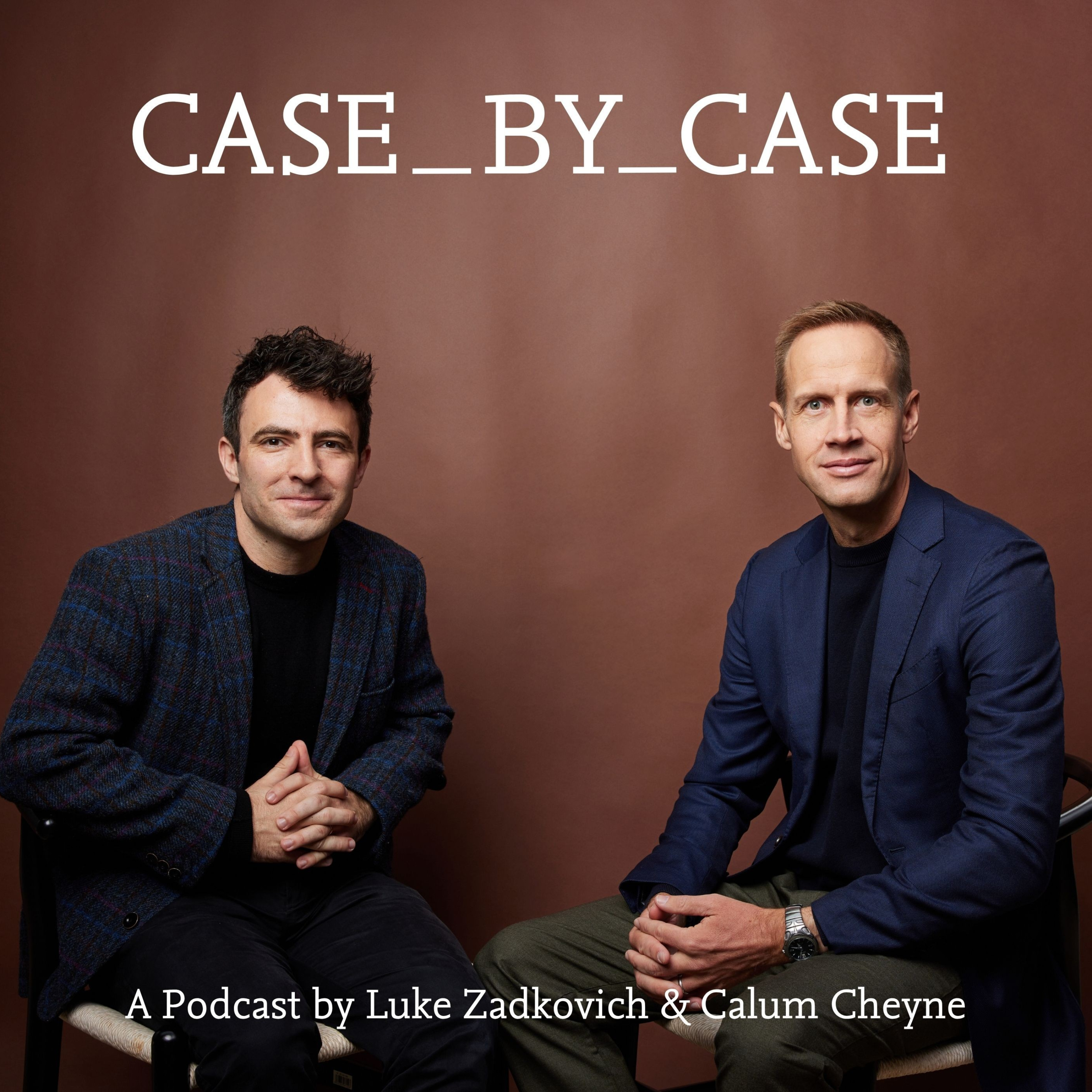
Luke Zadkovich and Calum Cheyne of Floyd Zadkovich discuss a new case each week, focused on shipping, international trade and commercial law. We each read the case, then jump straight on the podcast and hit record. All you hear is our organic conversation and our thoughts on what the case is about, what the Court decided, and how the decision may affect the industry. *any guidance or suggestions given in any podcast episode is generic in nature and not to be considered as legal advice. Please contact lawyers for specific, legal advice. www.floydzad.com / marketing@floydzad.com
Listen to episodes
60 recent
June 4, 202648 min
Ep #100 Palletizing Packages - Carrier wins on limitation in CoAs with Ed Floyd and Eva-Maria Mayer
Case: HDI Global Insurance Co. v. Kuehne + Nagel, Inc., trading as Blue Anchor America Line (2026) Guests: Edward Floyd, Eva-Maria Mayer, both Partners at Floyd Zadkovich. In this episode, Luke is joined by Edward Floyd and Eva-Maria Mayer of Floyd Zadkovich to discuss their recent victory for Kuehne + Nagel, Inc. (K+N) before the U.S. Court of Appeals for the Second Circuit in a significant Carriage of Goods by Sea Act (COGSA) limitation of liability case. The discussion explores the dispute at the heart of the case: how the term "package" should be interpreted for purposes of COGSA's USD 500 per package liability limitation. Ed and Eva-Maria explain the facts surrounding the shipment of electrical wire harnesses, the damage that occurred during loading, and the competing arguments over whether the relevant packages were the individual cartons or the pallets on which they were consolidated. The episode also examines the courts' application of established Second Circuit precedent, the importance of contractual package definitions in sea waybills, and why both the District Court and the Second Circuit concluded that the parties had clearly agreed that the pallets—not the cartons—would constitute the relevant packages for limitation purposes. Listeners will gain practical insight into COGSA limitation provisions, drafting considerations for carriers and cargo interests, and the broader implications of the Second Circuit's decision for the maritime and logistics industries.
April 16, 202649 min
#Ep 99 Clause Chaos: When Arbitration Agreements Collide with Dr Benjamin Hayward
Luke zadkovich and calum cheyne are joined this week by dr ben hayward (monash university, melbourne) to discuss the supreme court of victoria’s decision in downer utilities australia pty ltd v murra warra asset co pty ltd [2026] vsc 48 — a case that shines a spotlight on the practical and legal difficulties posed by hybrid arbitration clauses. Arising out of the murra warra wind farm project, this case concerned an arbitration clause providing for arbitration to be conducted by the resolution institute in accordance with the icc rules — a classic “hybrid” clause. When the dispute crystallised, competing arbitrations were commenced within a day of each other: one before the resolution institute, and another before the icc. This gave rise to a fundamental question — which, if either, of these arbitrations had been validly commenced? Before croft j, the parties advanced competing constructions of the arbitration agreement, alongside arguments as to the applicable statutory regime and whether the court should intervene at all. Central to the dispute was whether the hybrid clause was workable, and how it should be given effect in light of well-established principles favouring party autonomy in arbitration. The court ultimately emphasised that, where possible, arbitration agreements should be construed in a manner that gives effect to the parties’ intention to arbitrate, even where the drafting is less than ideal. In doing so, croft j engaged in a detailed analysis of international authorities on hybrid arbitration clauses, recognising both their enforceability and the practical difficulties they present. The decision also highlights the continuing importance of the kompetenz-kompetenz principle, with the court exercising restraint in circumstances where questions of jurisdiction were properly capable of determination by the arbitral tribunal itself. Luke, calum and ben draw on both the judgment and broader arbitral practice to explore the risks inherent in hybrid clauses, the limits of judicial intervention, and the drafting lessons for commercial parties navigating complex dispute resolution frameworks. This is a case that underscores a simple but critical point: when it comes to dispute resolution clauses, clarity is everything.
March 12, 202658 min
Ep #98 To Recover or Not - the Sunken Military Craft Act’s Application to Salvage Claims with Joseph Carilli
Case: Global Marine Exploration, Inc. v. Republic of France . Guest: Joseph Carilli, Counsel at Floyd Zadkovich (US) LLP . This week, Luke Zadkovich and Joseph Carilli discuss the salvage of sovereign vessels in the U.S. territorial sea, focusing on the decision of the U.S. Court of Appeals for the Eleventh Circuit in Global Marine Exploration, Inc. v. Republic of France . The case traces its origins back to the 16th century, when France challenged Spain’s control over territories in the Americas. In May 1565, seven French vessels led by Jean Ribault sailed to Florida, followed shortly by a Spanish fleet commanded by Pedro Menéndez de Avilés. After a hurricane struck in September 1565, several French vessels were driven south and sank off the coast near Cape Canaveral. Centuries later, in 2015, Global Marine Exploration obtained a permit from the State of Florida to explore an offshore area near Cape Canaveral. During its exploration, the company identified several shipwrecks and believed one to be la Trinité , one of Ribault’s lost vessels. Global Marine contacted the French Embassy, but France responded via diplomatic note asserting ownership of the wreck and opposing any commercial exploration. Despite this, Global Marine filed proceedings in the U.S. District Court for the Middle District of Florida seeking a salvage award and other remedies. The litigation included claims for a maritime lien, unjust enrichment, misappropriation of trade secrets relating to location data, and tortious interference with its relationship with the Florida Department of State. France argued that the claims were barred under the Foreign Sovereign Immunities Act and the Sunken Military Craft Act. Ultimately, the courts agreed. The district court held that the Act barred both in rem and in personam salvage claims and found that la Trinité qualified as a sunken military craft. It also rejected Global Marine’s other claims, including unjust enrichment and trade secret misappropriation. On appeal, the Eleventh Circuit affirmed the district court’s decision. Luke and Joseph explore the legal framework governing sovereign wrecks, the application of the Sunken Military Craft Act, and the implications of the case for salvage operations involving historic vessels.
March 5, 202647 min
Ep #97 Trump’s tariffs trumped: Learning Resources, Inc. v Trump
Judgement: Learning Resources, Inc., et al v Trump, President of the United States, et al, No 24-1287 decided on 20 February 2026 Guest: Andriy Shalennyy - Associate, Floyd Zadkovich Luke and Andriy discuss the decision of the United States Supreme Court in Learning Resources, Inc., et al v Trump, President of the United States, et al, No 24-1287. The dispute arose from President Trump’s decision to impose sweeping import tariffs shortly after he took office in 2025 in reliance on the International Emergency Economic Powers Act (IEEPA). By a 6 to 3 majority, the Supreme Court ruled that IEEPA did not give the US President a power to impose tariffs. The result of the ruling is to invalidate the “drug trafficking tariffs” imposed on most Mexican, Canadian, and Chinese imports and the “trade deficit (or “reciprocal”) tariffs” imposed “on all imports from all trading partners”. IEEPA gives the US President economic tools to address significant foreign threats. When acting under IEEPA, the President must identify an “unusual and extraordinary threat” to American national security, foreign policy, or the economy, originating primarily “outside the United States” and he must declare a national emergency. He may then take a number of actions to deal with the threat. One of such actions available to the President is to “regulate… importation”. President Trump considered the drug trafficking and the trade deficits to be “unusual and extraordinary” threats, and therefore, declared a national emergency as to both. Import tariffs ranging between 10% and 25% followed. The majority decided that the words “regulate” and “importation” (separated by 16 other words in the relevant provision of IEEPA) simply did not bear the weight that the President argued they did. In summary, the reasoning of the Court is as follows: (1) the power to impose taxes is vested by the US Constitution in the Congress alone, (2) trade tariffs are, by nature, taxes levied on imported goods and services, and as such, the President has no inherent authority to impose tariffs during peacetime, (3) the “distinct and extraordinary” power to impose tariffs can only be delegated by clear words (a requirement of the so-called “major questions” doctrine), (4) the words “regulate” and “importation” do not cross that high threshold, (5) this “common sense” approach is supported by legislative practice: when Congress wishes to delegate its taxation powers, it does so in explicit terms. Congress has consistently used words like “duty” in statutes delegating authority to impose tariffs. It is worth pausing at the “major questions” doctrine mentioned above. It is a potent tool used by the judiciary to keep the executive branch in check, when the latter tries to claim that it possesses some extraordinary power. A striking example cited by the Supreme Court related to an attempt by the Biden administration to cancel USD 430 billion (!) in student loan debt in reliance on a statute which authorised the Secretary of Education to “waive or modify” statutory or regulatory provisions applicable to financial assistance programs. The Supreme Court decided that the Secretary could cancel the student debt of a single borrower satisfying certain conditions, but not every borrower in the country. Luke and Andriy focus their discussion on the leading judgement given by Chief Justice Roberts that addresses in detail the questions of separation of powers and the specific statutory language of IEEPA. They then turn to a consideration of the reasons given by the President and echoed by the dissenting justices, and why the majority found those reasons unconvincing. The last item on the agenda is the practical impact of the decision. An interesting feature of the judgement is that it does not spell out whether approximately the USD 175 billion worth of import tariffs are reimbursable – that is the question. We expect that further litigation will ensue to clarify this issue.
December 22, 202520 min
Bonus Episode - Welcoming our new Partners!
In this special bonus episode of Case by Case, we’re doing something a little different. Rather than diving into a case as we usually do, we are taking the opportunity to introduce two new Partners to Floyd Zadkovich…. We are delighted to end the year by announcing that, from 1 January 2026, two of our Senior Associates, Eva-Maria Mayer in New York and Caroline Pennington de Rodríguez Sánchez in London — will be promoted to the firm’s partnership. Luke Zadkovich and Calum Cheyne are joined by Caroline and Eva to talk about their respective journeys to partnership, their practices across commodities, shipping and international trade, and what their promotions mean for the firm as it continues to grow across the UK and US. The conversation also explores how the firm has evolved in recent years, the importance of culture and collaboration in a transatlantic practice, and how Caroline and Eva have contributed to shaping Floyd Zadkovich as it is today. We also look ahead to 2026 and discuss what’s next for the firm, the partnership, and the work they’re excited to take on. A great listen for anyone interested in a modern international firm, career progression, and the people behind the work at Floyd Zadkovich.
December 18, 202556 min
Ep #96 No loss, no worries - it's none of your business: Skyros v Hapag-Lloyd with Emmanuel Michelakakis Howe and Andriy Shalennyy
Case: Skyros Maritime Corporation and Anor v Hapag-Lloyd [2025] EWCA Civ 1529 Guests: Emmanuel Michelakakis Howe, Barrister of Lamb Chambers Andriy Shalennyy, Associate, Floyd Zadkovich This week, Luke Zadkovich is joined by Andriy Shalennyy and Emmanuel Michelakakis-Howe (Lamb Chambers) to discuss the decision of the Court of Appeal in Skyros Maritime Corporation and Anor v Hapag-Lloyd [2025] EWCA Civ 1529. The case concerned an all-too-common scenario, albeit with an unusual twist. It raised questions going to the heart of contractual damages, including what it means to compensate for breach, how loss is identified, and when a claimant’s own commercial arrangements must be ignored as collateral or res inter alios acta. While the factual background will be familiar to those working in shipping, these issues resonate far beyond shipping and commodities. The dispute arose out of the late redelivery of two vessels by their time charterers. The owners claimed damages under the orthodox measure for such a breach, namely the difference between the agreed daily rate of hire and the market rate of hire prevailing at the time for the period of the overrun. The key factual feature of the case was that it was common ground that even if the vessels had been redelivered on time, the owners would not and, under the terms of the sale contracts, could not have rechartered them or earned any further hire. Instead, the vessels would have been delivered directly to their buyers upon redelivery under the time charters. The issue was therefore whether a shipowner can recover substantial damages assessed by reference to the market rate for late redelivery where the breach has caused no actual loss of a chartering opportunity. The arbitral tribunal answered that question in the affirmative, awarding damages by reference to the market rate. On appeal, Bright J disagreed, holding that the owners had suffered no compensable loss and were entitled only to nominal damages. The Court of Appeal, however, restored the award. Giving the leading judgment, Lord Justice Males reaffirmed the orthodox measure of damages for late redelivery, namely the difference between the charter rate and the market rate during the overrun period. The owner’s arrangements for the vessel’s future employment, including a sale, were collateral matters which could properly be disregarded as res inter alios acta. Luke, Andriy and Emmanuel examine the decision from both the owners’ and charterers’ perspectives, asking whether the outcome delivers an unwarranted windfall or instead reflects a principled preference for certainty over factual precision. The discussion considers the policy tension between compensation and predictability, and the commercial attraction of clear, easily applied measures of loss. The trio also grapple with the Supreme Court’s judgment in The Achilleas, and the long shadow which that decision continues to cast over debates on remoteness, assumption of responsibility, and the assessment of contractual damages.
November 13, 202552 min
Ep #95 Catch 32 - transatlantic recognition of arbitral awards with Alexander Wright KC
Case: Eletson Gas LLC v A Limited & Ors [2025] EWHC1855 (Comm) Guest: Alexander Wright KC, 4 Pump Court Luke, Calum and Alexander discuss recognition of foreign arbitral awards in England & Wales, in the Commercial Court decision Eletson Gas LLC v A Limited & Ors. This case concerns an application under s.32 of the 1996 Arbitration Act (“AA”) regarding which of the two rival boards of Eletson Gas (“EG”) had validly appointed an arbitrator on EG’s behalf. The two competing boards were: D4-D8 (“SPs”) and D9-D10 (“KPs”). The significance of this judgment (1) determined which competing Board had validly appointed the arbitrator and (2) explained the importance of recognition of a foreign award for it to produce legal effect and to be capable of being relied upon in England & Wales (“E&W”). The Court analysed issues under English law, US arbitration and bankruptcy law, Marshall Islands law, and Liberian law. This case arose out of three bareboat charterparties (“BBCs”) under which three oil tankers, owned by the 1st to 3rd Defendants (“Owners”), were chartered to EG. The BBCs were subject to arbitration in London. The BBCs provided EG with a purchase option to buy the tankers. Each of the two rival boards issued its own notice purporting to act on EG’s behalf. Owners argued they needed to know whose notice was valid. Owners referred the dispute concerning the rival notices to LMAA arbitration. Both rival boards, purporting to act for EG, appointed an arbitrator. The KPs then initiated proceedings under s.32 of the AA for the English Court to resolve. In the s.32 proceedings, the Court had to consider the relevant background which involved bankruptcy proceedings and ongoing vacatur proceedings of an award in the US. To resolve the dispute, the Court had to determine who controlled the shares of EG. EG had two types of shares: common and preferred. The common shares were owned by Eletson Holdings Inc (“EH”), company that between 2023 and 2024 underwent reorganization proceedings in the US. The KPs controlled EH before the reorganization. Their position was that they maintained control of EH after the US bankruptcy proceedings. The SPs argued that the KPs no longer controlled EH and, to the contrary, D7-D8 and an additional individual became directors in EH following the reorganization. Here, the Court also had to analyse the impact of the US bankruptcy proceedings in EH’s place of incorporation, Liberia. The dispute over the preferred shares concerned a JAMS Award of 2023 (“JAMS Award”) that decided such shares belonged to nominees of the KPs and no longer belonged to a company named Levona Holdings Ltd (“Levona”). However, the award was subject to vacatur proceedings in the US for fraud on the arbitrator and the US court had issued an anti-suit injunction forbidding an application to recognise the JAMS Award. On this point, the Court also had to consider the status of the JAMS Award in EG’s place of incorporation, Marshall Islands. In deciding who had control of EG, the Commercial Court had to decide (i) who controlled EH and (ii) who controlled the preferred shares. In respect of the first issue, HHJ Pelling KC decided that the US bankruptcy proceedings were effective over EH and that the KPs no longer controlled EH. On the preferred shares, the Court had to decide whether the KPs’ nominees or Levona were the owners of the preferred shares. The KPs relied on the JAMS Award. The SPs argued that reliance was unwarranted because (i) no application had been made for recognition in E&W under s.101 of the AA and (ii) the JAMS Award had been suspended in the US. Based on the Court’s reasons, Luke, Calum and Alex dissect the importance of (1) the recognition of foreign arbitral awards in the UK under the NY Convention pursuant to s.101 of the 1996 Arbitration Act and (2) why absent that recognition, a party will not be entitled to rely upon that award by using domestic principles of issue estoppel, res judicata.
July 24, 202529 min
Ep #94 Challenge accepted: the Arbitral Hat Trick with Derek Yixin
Case: CAFI v. GTCS Trading DMCC [2025] EWHC 1350 (Comm) Guest: Derek Yixin, Associate at Floyd Zadkovich This week, Luke Zadkovich and Calum Cheyne explore overlapping arbitration agreements and thorny jurisdictional issues, as they are joined by Derek Yixin (Floyd Zadkovich LLP), to discuss the High Court decision in CAFI v. GTCS Trading DMCC [2025] EWHC 1350 (Comm).The background to this case arises out of a series of GAFTA arbitrations. The Claimant, CAFI (“Buyer”), and the Defendant, GTCS (“Seller”), entered into an agreement for the sale of 28,000 MT of Russian wheat to be delivered from Russia to Egypt (“First Contract”). As a result of sanctions-related issues, the Buyer refused to issue payment while the cargo was enroute. The Seller treated this as an anticipatory breach and terminated the First Contract.Following negotiations, the Parties entered into a second contract on materially similar terms, but at a lower price (“Second Contract”). The Second Contract contained a termination clause which stated that the First Contact was “terminated and void”. After delivery of the cargo, the Seller initiated claims under GAFTA arbitration seeking damages for the Buyer’s alleged breach of the First Contract. The Buyer argued that the termination clause in the Second Contract amounted to a waiver of the Seller’s right to claim damages under the First Contract.The First Tier Tribunal dismissed the Seller’s claims on the basis that by accepting the termination provision, the Seller indicated an intention to ‘waive’ its claim for damages. Importantly, the Tribunal held that it had no jurisdiction to consider the effect or validity of the Second Contract as it fell outside the scope of the arbitration agreement under the First Contract. The Seller successfully appealed to the Appeal Board which accepted the Seller’s claims and awarded USD 700,000 plus interest and costs. In doing so, the Appeal Board agreed with the First Tier Tribunal that it had no jurisdiction to interpret the terms of the Second Contract but that notwithstanding this, it remained ‘good evidence’ of what had happened post-termination.In the High Court, the Appeal Board’s award was challenged under sections 67, 68 and 69 of the Arbitration Act 1996. In what is reported to be the first judgment of its kind, Mr Justice Henshaw accepted all three grounds of challenge under the Arbitration Act and set aside the Appeal Board’s award.In this episode, Luke, Calum and Derek delve into the thorny question of what happens where there are overlapping arbitration agreements. In doing so, the trio consider the practical challenges that arise out of potentially competing (or inconsistent) arbitral awards.
July 10, 202549 min
Ep #93 Thrust Into Trouble: An Engine Deal Hijacked by Fraud with Matt McGhee
Case: Logix Aero Ireland Ltd v Siam Aero Repair Company [2025] EWHC 1283 (KB) Guest: Matt McGhee of Twenty Essex Chambers This week, Luke Zadkovich and Calum Cheyne delve into the subjects of fraud and agency, as they are joined by Matt McGhee (Twenty Essex Chambers), to discuss the High Court decision Logix Aero Ireland Ltd v Siam Aero Repair Company [2025] EWHC 1283 (KB). The background to this case is unfortunate, but not unfamiliar. The buyer, Logix Aero Ireland Ltd (“Logix”), and the seller, Siam Aero Repair Company (“Siam”) were negotiating via email for the sale and purchase of two aircraft engines. Unbeknownst to either party, a fraudster had inserted themselves into the parties’ correspondence. Both parties continued to correspond with the fraudster, all the while thinking that they were communicating with the other. A Letter of Intent, and a final fraudulent invoice was produced, and Logix transferred what it thought to be the purchase price into an account provided by the fraudster. Suffice to say, the money was never seen again, and nor were the engines. Logix sought remedy in an action against Siam. In response to Logix’s Claim Form and Particulars of Claim, Siam applied for strike out, sought a reverse summary judgment, and applied for indemnity costs. Following this, Logix provided a draft Amended Particulars of Claim, substantially revising the structure of the claim. It was agreed that the strike out application would be decided on the basis of these draft Amended Particular of Claim. Logix contended that: (i) a binding contract for the sale and purchase of the engines had been concluded; and (ii) Siam had breached their contractual confidentiality obligations, by (albeit unknowingly) providing information to the fraudster. The argument that a binding contract had been formed was rejected by Willimas J. This issue ultimately turned upon whether the fraudster had apparent authority to act on behalf of Siam in negotiations. Her Honour held that no representation, by words or conduct, had been made by to convey authority of this kind. The second argument, that Siam had breached its confidentiality obligations, was also rejected. Noting that the fraud ‘worked’ because both parties passed what might have been considered confidential information to the fraudster, Williams J decided that Logix’s loss was caused by the fraudster, and not Siam. Guided by her Honour’s reasons, Luke, Calum and Matt dissect the principles of agency and authority, along with boilerplate confidentiality clauses. In doing the trio consider the very real issue of fraud in international commercial transactions with a practical eye, discussing various procedural points in relation to claim formation, and contractual drafting.
June 26, 202554 min
Ep #92 Navigating Limitation of Liability with David Walsh KC
Case: MSC Mediterranean Shipping Company SA v Conti 11 Container Schiffahrts-GmbH & Co KG MS “MSCFlaminia” [2025] UKSC 14 Guest : David Walsh KC, Essex Court Chambers Luke Zadkovich and Calum Cheyne return this week to discuss MSC Mediterranean Shipping Company SA v Conti 11 Container Schiffahrts-GmbH & Co KG MS “MSCFlaminia” [2025] UKSC 14 with Counsel for the Respondent, David Walsh KC. This decision arose out of an incident involving the “MSC Flaminia”, a container ship that exploded while en route from South Carolina to Antwerp, back in 2012, resulting in the death of three crew members. The Owners of the vessel (Conti), obtained an arbitration award against the Charterers (MSC) for the amount of USD200 million in damages. Following this, Charterers sought to limit to their liability under the Convention onLimitation of Liability for Maritime Claims 1976. The Supreme Court considered whether the Charterers could do so, given that the limitation was sought with respect to claims brought by Owners, against the Charterers, for losses the Owners originally suffered themselves. In doing do, the Court also considered the scope of Article 2.1(a), (e) and (f) of the 1976 Convention. Luke, Calum and David discuss the way in which the arguments evolved through the appeal process, and the ultimate rationale behind Lord Hamblen’s decision (withwhom Lord Hodge, Lord Briggs, Lord Leggatt and Lord Burrows agreed). Their discussion provides insightful guidance and clarity on what can be a complexarea of maritime law.
Is this your show?
Claim this listing to keep it up to date, reach guests who want to pitch you, and manage bookings with Guestify.