
Find partners
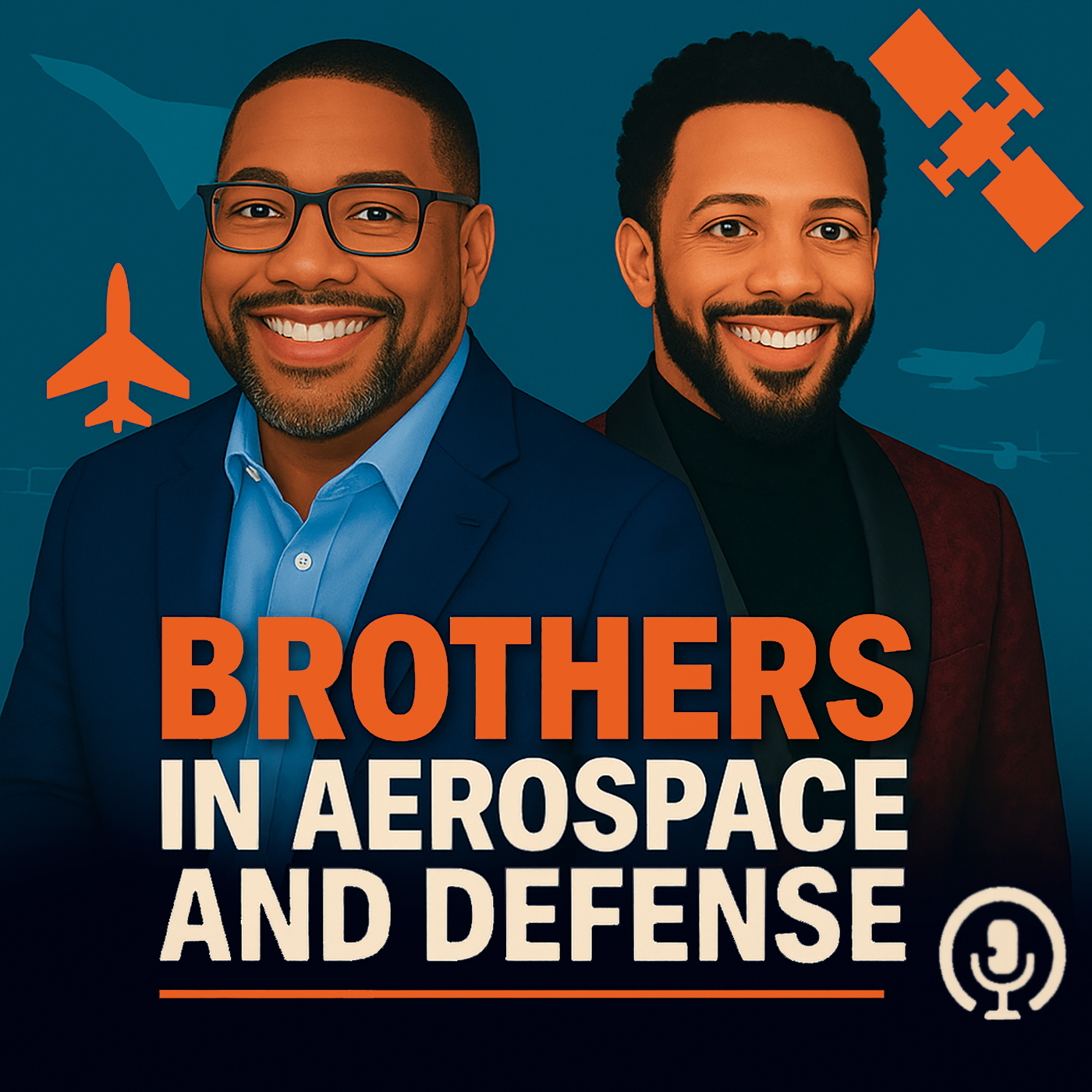
Brothers in Aerospace and Defense

Brothers in Aerospace and Defense

Hosted by DeWayne Allen & Robert Wesley

BusinessInterviews guests

Episodes

0

Language

EN

About the show

”Brothers in Aerospace and Defense” is a podcast that delves deep into the world of aerospace and defense with a unique perspective. Together, we’ll explore the fascinating intersection of technology and business in this dynamic industry. Our goal is to shed light on the achievements, challenges, and inspiring stories of black executives in aerospace and defense. In each episode, we’ll invite prominent guests who have made significant contributions to the field. We’ll also discuss current trends, innovations, and the future of aerospace and defense.

Listen to episodes

21 recent
43 min

How Great Leaders Fix Broken Aerospace Organizations

In this episode, hosts DeWayne Allen and Rob Wesley launch the new Power and Propulsion series with aerospace transformation leader Lillian Dukes. Drawing from decades of experience across aviation operations, supply chain, restructuring, and executive leadership, Lillian shares what it really takes to stabilize broken organizations, rebuild credibility, and lead transformation that actually sticks. The conversation covers regulatory pressure, leadership under stress, supply chain realities, the shift from engineer to executive, and the importance of mentorship, sponsorship, and measurable impact for the next generation of aerospace leaders. Key Takeaways:00:00 - Introduction to the Power and Propulsion Series01:22 - Mission of the Series and Introduction of Lillian Dukes04:15 - Walking Into a Broken Organization06:31 - What to Ignore in the First 30 Days10:13 - System Problems vs. Leadership Problems15:50 - What Real Transformation Looks Like19:40 - Why Executives Lose Touch With Operational Reality21:29 - The Structural Challenge in Aerospace Supply Chains25:21 - From Engineer to Executive30:04 - Training, Development, and Scaling Leadership32:24 - AI, Analytics, and Change Readiness33:38 - Representation, Legacy, and Leadership Responsibility36:18 - Advice for Black Engineers and Emerging Leaders38:24 - Mentorship, Sponsorship, and Breaking Through39:59 - The Leadership Impact That Outlasts a Career41:51 - Lillian Dukes on Her Work Today and What Comes Next Resources:LAD Consulting LLCConnect with Lillian Dukes on LinkedInConnect with us:DeWayne Allen on LinkedInRobert Wesley on LinkedIn Subscribe to our Newsletter:The StoryTeller by DeWayne AllenAutonomous Platforms of the Future by Robert WesleyProduced by NOVA

31 min

Ep. 19. How Missile Defense Actually Works Behind the Radar, AI, and Interceptors

In this episode, hosts DeWayne Allen and Rob Wesley break down how missile defense systems work using a simple framework: detect, decide, and defeat. They walk through the sensor networks that identify threats, the command-and-control systems that evaluate response options, and the intercept technologies that stop incoming targets. Along the way, they also dig into the business side of missile defense, from billion-dollar sensor programs and software-driven system integration to the growing pressure to lower cost-per-shot against emerging drone and swarm threats. Key Takeaways:00:46 – Newsreel: Defense Budget Pressure and Commercial Aerospace Supply Chain Challenges05:17 – Detect: Why Early Threat Detection Is the Foundation of Missile Defense05:38 – Technical Breakdown of the Detect Layer07:06 – Business Dynamics of Sensor Networks and Detection Programs09:17 – Decide: Command and Control as the Brain of the System11:18 – Software Integration, AI/ML, and the Business Value of the Decide Layer14:36 – Defeat: Interceptors, Directed Energy, and Kill Chain Execution16:02 – Cost-Per-Shot Economics and the Business of Intercept Systems20:04 – The Low-Cost Drone Threat and Attritable Countermeasures23:16 – Architecture and Operations: How Detect, Decide, and Defeat Work Together24:29 – Why Missile Defense Is Sold as an Integrated Architecture27:53 – Strategic Wrap-Up: Why the Full System Matters30:22 – Closing and Subscribe for More Aerospace and Defense Conversations Resources:CSIS Missile ThreatConnect with us:DeWayne Allen on LinkedInRobert Wesley on LinkedIn Subscribe to our Newsletter:The StoryTeller by DeWayne AllenAutonomous Platforms of the Future by Robert WesleyProduced by NOVA

22 min

Ep. 18. Weapons, Payloads & the Real Cost of Airpower

In this episode, hosts DeWayne Allen and Rob Wesley break down Weapons and Payloads 101, shifting the focus from aircraft platforms to the systems that actually determine mission success. They walk through air-to-air, air-to-ground, and standoff weapons, explain how payload decisions drive aircraft design, and unpack why integration and lifecycle sustainment account for so much of the cost in aerospace and defense. From the 2026 National Defense Strategy to emerging signals like counter-UAS and interoperability, this episode connects mission requirements to engineering realities and business strategy across the industry. Key Takeaways:00:00 – Why the Mission Drives Everything 01:34 – Industry Newsreel: Strategy, Sustainability & Production Shifts06:28 – What “Payload” Really Means in Aerospace07:19 – Air-to-Air Weapons (AIM-120, AIM-9)08:58 – Air-to-Ground Weapons (JDAM, Hellfire, JASSM)11:36 – Standoff Weapons & Survivability12:34 – Guns and Cannons in Modern Combat13:29 – How Weapons Are Mounted (Hardpoints & Bays)15:37 – The P&L: Why These Systems Cost So Much18:35 – Market Signals: Counter-UAS, Interoperability, Exportability20:52 – Key Takeaways: Systems Over Platforms Connect with us:DeWayne Allen on LinkedInRobert Wesley on LinkedIn Subscribe to our Newsletter:The StoryTeller by DeWayne AllenAutonomous Platforms of the Future by Robert WesleyProduced by NOVA

27 min

Ep. 17. Understanding Airspace Communications

DeWayne Allen and Rob Wesley go behind the curtain on the communications ecosystem that keeps aircraft moving safely through crowded skies, especially during peak holiday travel. They connect the business of aviation comms (who pays, how it scales, and why modernization is accelerating) with the real operational flow of a flight, from clearance to taxi-in. The conversation also spotlights the next wave of complexity: integrating drones, BVLOS operations, and eVTOLs into shared airspace through digital infrastructure, UTM, and more automated, secure data-driven communications. Key Takeaways:00:00 - Holiday travel sets the stage: the “invisible” communications that keep aviation moving  01:39 - Newsreel kickoff: funding continuity, FAA modernization, and pressure from UAS and eVTOL growth  05:17 - The business of aerospace communications: market size, growth drivers, and who pays  07:20 - What the industry is really buying: safety, efficiency, and scalable growth  09:01 - Flight-by-flight architecture: clearance, ground, tower, TRACON, en route, approach, landing  17:18 - Standardization and shared language: ICAO phraseology, FAA protocols, and global operations  18:58 - Voice versus datalink: CPDLC/FANS, reduced congestion, improved routing, situational awareness  20:45 - Humans and technology together: staffing constraints, interoperability, upgrade economics  22:39 - The next airspace wave: UTM, detect-and-avoid, digital ID, and new revenue streams  23:53 - Major industry players and why investment continues  25:49 - Wrap-up: why modernization matters and the shift toward digital, automated communicationsConnect with us:DeWayne Allen on LinkedInRobert Wesley on LinkedIn Subscribe to our Newsletter:The StoryTeller by DeWayne AllenAutonomous Platforms of the Future by Robert WesleyProduced by NOVA

30 min

Ep. 16. Inside the High-Stakes World of Defense Contracting

In this episode, hosts DeWayne Allen and Rob Wesley demystify government contracting in aerospace and defense, showing how contract models quietly dictate risk, margins, engineering choices, and cash flow across programs. They walk through firm fixed price, incentive fee, cost-reimbursable, IDIQ, time & materials, and performance-based logistics structures, explaining where each fits and how they shape both business and technical decisions. Using real-world examples from current missile and radar programs, they lay out a practical decision framework for matching contract type to technical maturity, customer risk appetite, and scope clarity—while designing incentives that actually drive performance. They wrap up with emerging trends like outcome-based availability contracts, digital twins, increasing compliance burden, and the rise of COTS and hybrid funding models that every engineer, program manager, and finance leader needs to track. Key Takeaways: 01:04 – Newsreel: Boeing Chinook award, hybrid airships, and the impact of a prolonged government shutdown03:15 – Why contract types matter: aligning risk, incentives, and performance05:09 – Fixed price and incentive fee models: predictability vs. engineering risk08:05 – Deep dive into fixed price and fixed price incentive fee (FPIF)15:18 – Outcome-based and performance-based logistics: paying for results, not deliverables18:00 – Building a decision framework for selecting the right contract type25:22 – Real-world examples and lessons from major primes26:58 – Future trends: digital twins, compliance, and hybrid funding models30:03 – Closing insights and key takeawaysResources: Defense Federal Acquisition Regulation Supplement (DFARS): https://www.acquisition.gov/dfars FAR 16.2-16.6: Types of Contracts (U.S. Government Publishing Office): https://www.acquisition.gov/far/part-16 Lockheed Martin JASSM Contract (U.S. DoD Press Release, 2024): https://www.defense.gov/News/Contracts Connect with us:DeWayne Allen on LinkedInRobert Wesley on LinkedIn Subscribe to our Newsletter:The StoryTeller by DeWayne AllenAutonomous Platforms of the Future by Robert Wesley Produced by NOVA

24 min

Ep. 15. Deep Space: Where Engineering Meets Economics

In this episode, hosts DeWayne Allen (P&L) and Rob Wesley (technical) pull back the curtain on the real business of deep space. We connect market momentum—massive IPOs, fresh capital, and Big Prime partnerships—to the engineering breakthroughs that make multiyear missions and off-world industry possible. We cover the four core technical hurdles (radiation, propulsion, life support, ISRU), the bonus frontier of autonomy & laser comms, and the strategic playbook for investors eyeing lunar infrastructure, Mars logistics, and future resource markets. We leave you with crisp business takeaways: why the Moon is the proving ground, where the value pools form, and which players are poised to define the next economy beyond Earth.   Key Takeaways: 01:37 – Newsreel: Firefly IPO, Axiom raise, U.S. leads private capital 03:26 – Main Segment Kickoff: Who’s funding it, who’s building it 03:44 – Macroeconomics: Market size, growth, VC flows, unicorns & primes 05:42 – Follow the Money: SpaceX, Firefly (Northrop tie-ins), Rocket Lab & more 07:18 – Prime & Tier-1 Roll Call: L3Harris, Boeing, Northrop/Orbital, etc. 08:22 – The Four Technical Pillars (setup) 08:36 – Pillar 1: Radiation protection (storm shelters, materials, future magnetic shields) 11:07 – Pillar 2: Propulsion beyond chemical (DRACO/NTP, electric, early fusion) 13:53 – Pillar 3: Life support & habitability (ECLSS, recycling, artificial gravity; dual-use on Earth) 16:52 – Pillar 4: ISRU (lunar ice, regolith printing, MOXIE oxygen on Mars) 19:47 – Bonus Frontier: Comms & autonomy (DSN/DSOC lasers, AI for real-time ops) 22:18 – Business Takeaways: Moon as stepping stone; who owns the depots owns the market 23:19 – Personal Updates & Wrap   Resources: Space Foundation Announces $570B Space Economy in 2023, Driven by Steady Private and Public Sector Growth Space economy | World Economic Forum Space industry trends: PwC The Space Economy in Figures | OECD   Connect with us: DeWayne Allen on LinkedIn Robert Wesley on LinkedIn   Subscribe to our Newsletter: The StoryTeller by DeWayne Allen Autonomous Platforms of the Future by Robert Wesley   Produced by NOVA

24 min

Bonus: Inside America’s Golden Dome Defense Program

Duane Allen and Rob Wesley break down America’s Golden Dome Defense Program—an AI-powered, multi-layer missile shield integrating satellites, radars, interceptors, and lasers. They explore its rapid detection and response capabilities, the $25B budget commitment, the industry heavyweights and disruptors driving it, and the sweeping changes it’s sparking across defense tech, supply chains, and the workforce. This is the future of integrated national defense, and it’s already taking shape.   Key Takeaways: 00:00 – Welcome & introduction to the Golden Dome 01:06 – July 2025 defense headlines 02:19 – Anduril’s interceptors, SAF milestones & industry trends 05:00 – Golden Dome overview and how it works 08:34 – Technical challenges and limitations 10:42 – Budget, funding allocations & key contractors 17:02 – Industry shifts, supply chain changes & new opportunities 20:09 – Strategic implications, partnerships & workforce evolution 23:38 – Closing thoughts   Resources: Secretary of Defense Pete Hegseth Statement on Golden Dome for America   Connect with us: DeWayne Allen on LinkedIn Robert Wesley on LinkedIn   Subscribe to our Newsletter: The StoryTeller by DeWayne Allen Autonomous Platforms of the Future by Robert Wesley   Produced by NOVA

23 min

Ep. 14: A Comprehensive Overview of Golden Dome Defense

In this episode, hosts DeWayne Allen and Rob Wesley explores America's Golden Dome Defense Program, a highly ambitious defense initiative. They delve into the technical workings of the program, the key companies involved, and its reflection in the defense budget. The discussion highlights the fusion of space-based sensors, artificial intelligence, and layered interceptors designed to detect and destroy various missile threats.    Key Takeaways: 00:00 - Introduction to America's Golden Dome Defense Program 00:18 - June 2025 Paris Air Show Highlights 02:18 - Strategic Partnerships and Regional Developments 03:10 - Sustainable Aviation Fuel Initiatives 04:20 - Overview of the Golden Dome Architecture 05:06 - Technical Breakdown of the Golden Dome 07:42 - Challenges and Limitations of the Golden Dome 10:40 - Budget Implications and Leading Companies 12:54 - Investment Opportunities and Supply Chain Dynamics 17:28 - Strategic Perspectives and Future Outlook 19:57 - Conclusion and Final Thoughts   Connect with us: DeWayne Allen on Linkedin Robert Wesley on Linkedin   Subscribe to our Newsletter: The StoryTeller by DeWayne Allen Autonomous Platforms of the Future by Robert Wesley

19 min

Ep.13: Aerospace Cybersecurity Threats and Resilience

In this episode, hosts DeWayne Allen and Rob Wesley delve into the critical topic of aerospace cybersecurity. They discuss the evolving landscape of cyber threats targeting aerospace and defense systems, the increasing sophistication of cyber-attacks, including zero-day exploits and AI vulnerabilities, and the significant impacts on national security. Additionally, they explore the burgeoning business opportunities in cybersecurity and the growing demand for skilled professionals in this domain.    Key Takeaways: 00:00 - Introduction to Aerospace Cybersecurity 00:49 - Understanding the Evolving Cyber Threat Landscape 02:46 - Significant Cyber Threats in Aerospace 06:32 - Industry Response to Cyber Threats 10:28 - Future of Cybersecurity in Aerospace 14:59 - Key Takeaways and Conclusion   Connect with us: DeWayne Allen on Linkedin Robert Wesley on Linkedin   Subscribe to our Newsletter: The StoryTeller by DeWayne Allen Autonomous Platforms of the Future by Robert Wesley

41 min

Ep. 12: Brothers in Aerospace & Defense – Special Edition from NSBE 2025

Welcome to a special edition of Brothers in Aerospace & Defense, recorded live at NSBE 2025! In this episode, we explore cutting-edge advancements in aerospace, energy, and defense with leaders from NSBE’s Special Interest Groups (SIGs). Our powerhouse panel shares insights on industry challenges, career strategies, and how Black engineers are shaping the future.   Hear them discuss: The latest breakthroughs in aerospace and defense technology How energy innovation is driving the next generation of engineering the role of AI, quantum computing, and digital transformation in these industries How NSBE’s global outreach initiatives are making an impact Career strategies for Black engineers navigating leadership and technical roles   Special Guests: 🎙️ Enanga Daisy Fale – Director, Aerospace Special Interest Group 🎙️ Natasha Herring – Director, Energy SIG 🎙️ Seth Graham – Program Chair, Young Technical Professionals SIG Resources & Links: 🔗 Learn more about NSBE: https://nsbe.org/   Connect with us: DeWayne Allen on Linkedin Robert Wesley on Linkedin   Subscribe to our Newsletter: The StoryTeller by DeWayne Allen Autonomous Platforms of the Future by Robert Wesley

Is this your show?

Claim this listing to keep it up to date, reach guests who want to pitch you, and manage bookings with Guestify.

Claim this listing

More Business podcasts