From Cursive to Rage Bait: The Radical Shift in How We Think and Feel Due to Digital Media
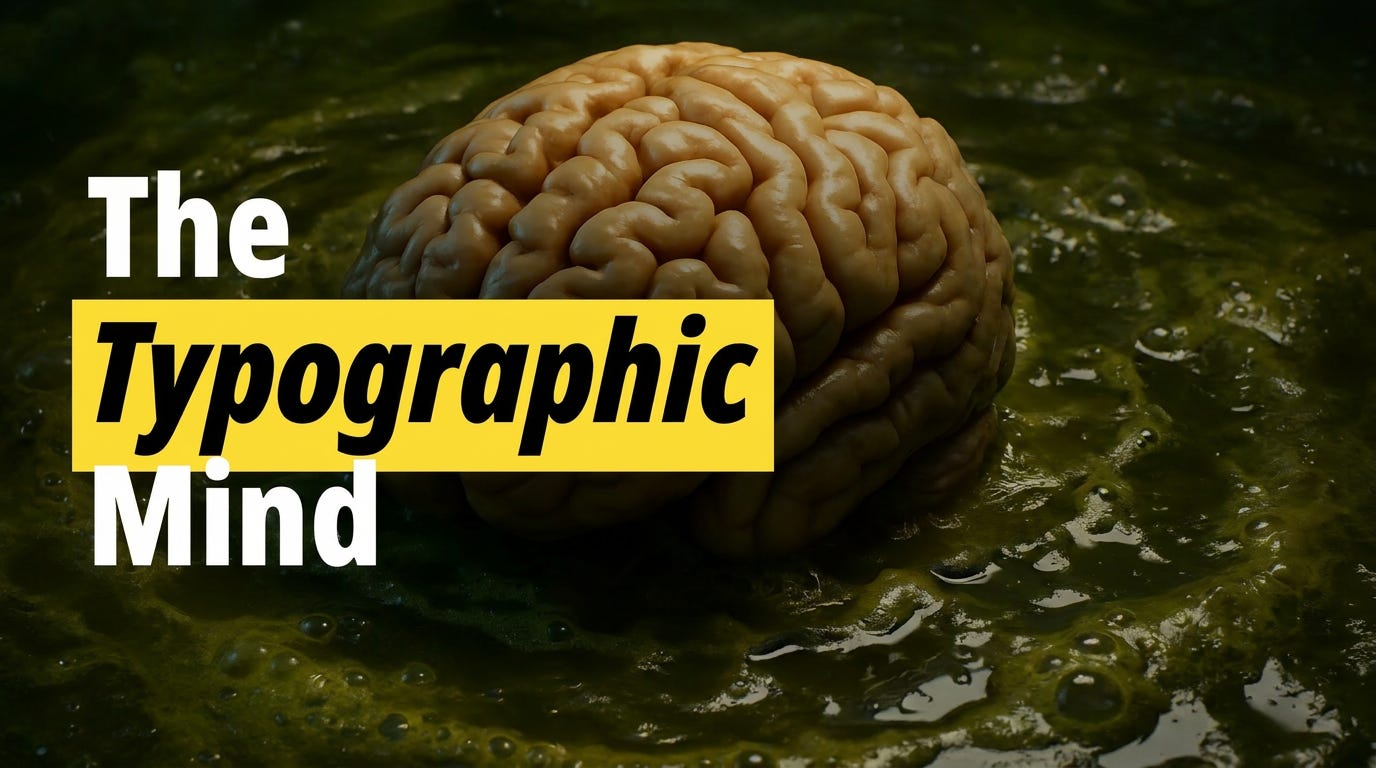
Your Brain Is Being Renovated — And You Didn’t Sign the Permit Let me ask you something. When was the last time you sat with a difficult idea — not scrolled past it, not hit pause and grabbed your phone — but actually sat with it ? Turned it over. Let it challenge you. Felt a little uncomfortable and stayed anyway? If you had to think about that for more than five seconds, we need to talk. Because here’s what’s actually happening. Your brain is being renovated in real time, and the contractor is an algorithm that doesn’t care what the finished product looks like. It just cares that you stay on the job site. The Typographic Mind — And Why You Should Care About It Neil Postman wrote about this in 1985. 1985!! His book Amusing Ourselves to Death introduced the concept of the typographic mind — a brain developed through reading. Not skimming. Not speed reading. Not glancing at captions. Reading. What Postman argued — and what the neuroscience is now catching up to — is that print culture built a specific kind of cognitive architecture. The ability to sustain focus over long periods of time. Linear, sequential reasoning. Tolerance for complexity and deferred gratification. And critically, the ability to hold an argument in your working memory and evaluate it. Now, that last one. Let’s slow down there for a second. The prefrontal cortex — the most evolutionarily advanced region of your brain — is your working memory manager. It’s the part of you that thinks before acting. That considers consequences. That regulates emotion. That empathizes. When we talk about what separates high performers from reactive people, we’re largely talking about how well they use this region of the brain. And working memory is built. It’s practiced. Through deep processing. Through reading. Through sitting with complexity. Maryanne Wolf, a cognitive neuroscientist out of UCLA, puts it plainly: reading is not born, it is built through practice. Your brain doesn’t have a reading circuit by default. You grow one. Which means, just as easily, you can lose one. The Reactive Mind — What Short Form Content Is Actually Doing to You Ready for the discomfort? A meta-study of nearly 100,000 people found that frequent short form video users scored measurably lower in three areas: attention, inhibitory control, and working memory. Let’s talk about inhibitory control specifically, because most people don’t know what that term means. Inhibitory control is your pause button. It’s the mechanism that allows you to suppress automatic urges, filter distractions, and choose a response instead of just reacting . Scratch that mosquito bite or don’t. Lose your temper or don’t. Engage with the rage bait or not. Oxford University Press named “rage bait” the word of the year for 2025. Let that sink in. A term for content that is deliberately engineered to trigger outrage became the defining word of a year. Not because people are getting angrier. Because platforms figured out that anger is the most reliable way to capture your attention. And the more disregulated you become, the better it works. When people are emotionally disregulated, blood flow shifts into the deeper limbic regions — the older, more instinctive parts of the brain. The amygdala takes over. Thinking becomes binary. Black and white. Us versus them. And the inhibitory control that keeps you sharp, measured, and socially intelligent? Gone. The brain you’re practicing is the brain you become. It’s Not Social Media Anymore Mark Manson made an observation recently that I haven’t been able to stop thinking about. He said: it’s not social media anymore. It’s attention media. And he’s right. Think about it. When Facebook launched, you followed people you knew. Your cousin’s wedding photos. Your mate’s holiday. Maybe a group for your favorite TV show. You were suspicious of strangers trying to connect with you. That made sense. That was social. Now? I scroll Facebook and one out of every four posts is from someone I actually know. The other three are targeted ads, suggested influencers, and whatever the algorithm has decided will keep me engaged longest. That’s not a community feed. That’s a behavioral experiment you volunteered for without reading the terms and conditions. The goal of attention media is singular: maximize your time on the platform. More time equals more data equals better targeting equals more revenue. You are the product. This is the business model. And the result of that model, at scale, is the reactive mind. A mind trained on fragments. Conditioned for stimulation. Increasingly unable to sit with anything that doesn’t immediately reward it. What Deep Processing Actually Gives You Here’s what I want you to understand. Working memory isn’t about being smart. It’s cognitive infrastructure. The quality of your decisions, the depth of your empathy, your ability to regulate emotion, follow through, and exert agency over your life — all of it runs on that infrastructure. And deep processing is how you build it. When you read a poem — really read it, not speed-read it — you’re not just comprehending words. You’re asking what the poet chose these words, what they were going through, what they’re asking you to feel. You’re building the capacity for inference. For reading between the lines. That’s the same capacity that lets you read a room, understand what someone isn’t saying, and make better decisions under pressure. A 2010 study found that students who listened to a podcast scored 28% lower on comprehension than those who read the same material. The literal facts were roughly the same. But inferential thinking — the ability to reason from information, not just recall it — that consistently favored reading. Critical thinking. Analysis. Insight. These things require time. They require slowdown. They require you to hold complexity long enough for it to actually reorganize something inside you. Reading is something you do. Listening is something that happens to you. That line. Sit with that one for a second. A Simple Hack — And An Honest Admission Here’s something practical. If you notice yourself reacting — emotionally flooding, getting pulled into a spiral, losing your capacity to think clearly — stop for 30 seconds. Not to distract yourself. Not to scroll something else. Just stop. Thirty seconds is enough for the thinking mind to come back online. Your prefrontal cortex doesn’t disappear when you’re in fight-or-flight. It just goes quiet. And you can call it back. And honestly? I had to look at my own habits here too. I used to spend 30 to 40 minutes on Instagram before bed. Puppy videos, fitness content, whatever. And without fail, the algorithm would work its way toward things that left me activated, frustrated, or watching some dash cam arrest video feeling morally superior about a stranger I’d never meet. How did I get there from puppy videos? I genuinely have no idea. But that’s the point. You don’t navigate the algorithm. It navigates you. So I got a Kindle. A basic one, soft backlight. And I read before bed now. Science fiction, mostly. Some classics I’d never gotten around to. Nothing prescriptive. Just reading. And the difference to how I feel — cognitively, emotionally, in conversation with people — is noticeable. I’m not saying delete everything and move to a cabin. I’m saying: be deliberate about what you’re practicing. Because your brain is adapting to whatever you expose it to, every single day. Whether you intended it or not. The question is just whether you’re the one choosing the stimulus — or whether the algorithm is. Your thoughts. Drop them in the comments. I read everything. Justin Noppe is the founder of Neuro Resilience LLC. He works with leaders and high performers on the intersection of cognitive neuroscience, emotional regulation, and transformational leadership. His book on the Human Operating System is coming soon — drop a comment if you want early access. Interested in being involved in the book process?Sign up here to be an early bird and a participator! This post is based on a recent episode of the show. If you prefer to listen, the full episode is available on Spotify or Youtube. Chapters 0:01 - Introduction to the Brain and Social Media1:31 - The Typographic Mind and Cognitive Architecture8:14 - Reading vs. Short Form Content10:34 - Emotional Regulation and Rage Bait12:25 - The Evolution of Social Media24:39 - Long Form vs. Short Form Content on YouTube29:26 - The Importance of Deep Reading34:56 - Conclusion and Upcoming Projects Other links: This is a public episode. If you would like to discuss this with other subscribers or get access to bonus episodes, visit becomingresilient.substack.com