We examine AI from a lighthearted point of view, occasionally engaging in serious debate and other times simply having fun. Now is the time to listen and laugh while learning about artificial intelligence, which will shape technology in the future. Our inaugural episode serves as a lighthearted yet somber introduction to our brand-new podcast. Even though we occasionally stray onto other topics, we do talk about a lot of current, relevant issues.
Listen to episodes
60 recent
October 11, 2026Episode 11754 min
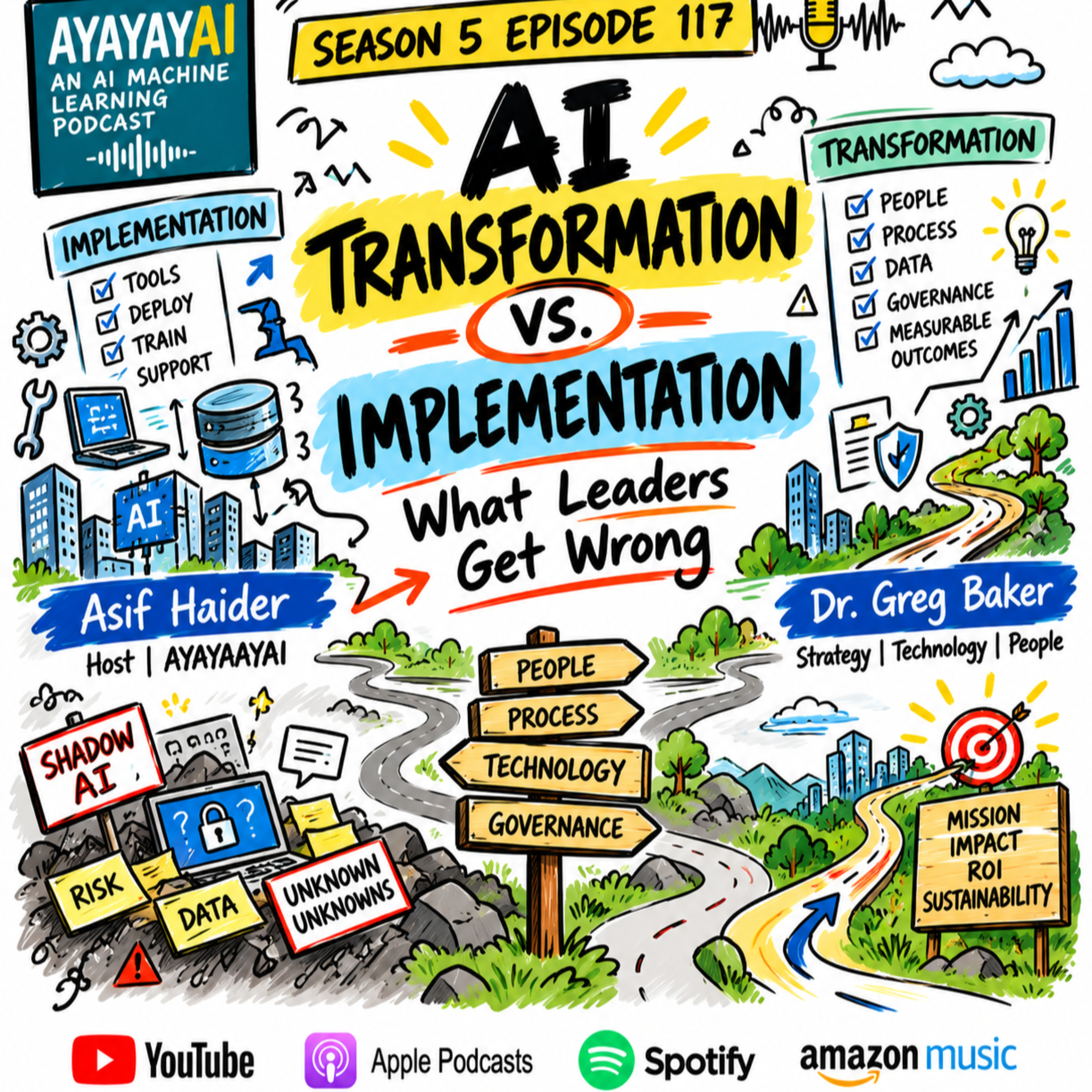
SN: 5 EP: 117 AI Transformation vs. Implementation: What Leaders Get Wrong
AI implementation is not the same as AI transformation. In Season 5, Episode 117 of AYAYAYAI , Asif Haider sits down with Dr. Greg Baker to explore what organizations need to think about before simply buying, building, or deploying more AI. The conversation moves beyond AI hype and into the practical questions leaders should be asking: What outcome are we trying to improve? How will work change? Who remains accountable when AI is involved? And how do we manage risk while AI continues to evolve? Topics include AI transformation vs. implementation, Shadow AI, meaningful use cases, data, cybersecurity, vendor risk, human oversight, accountability, interoperability, scalability, sustainability, ROI, and risk management frameworks (RMF). A central idea throughout the conversation: technology alone does not create transformation. People, process, mission, governance, and measurable outcomes still matter. Hosted by Asif Haider , AI/ML Decision Science Strategic Advisor and host of AYAYAYAI.
September 28, 2026Episode 11652 min
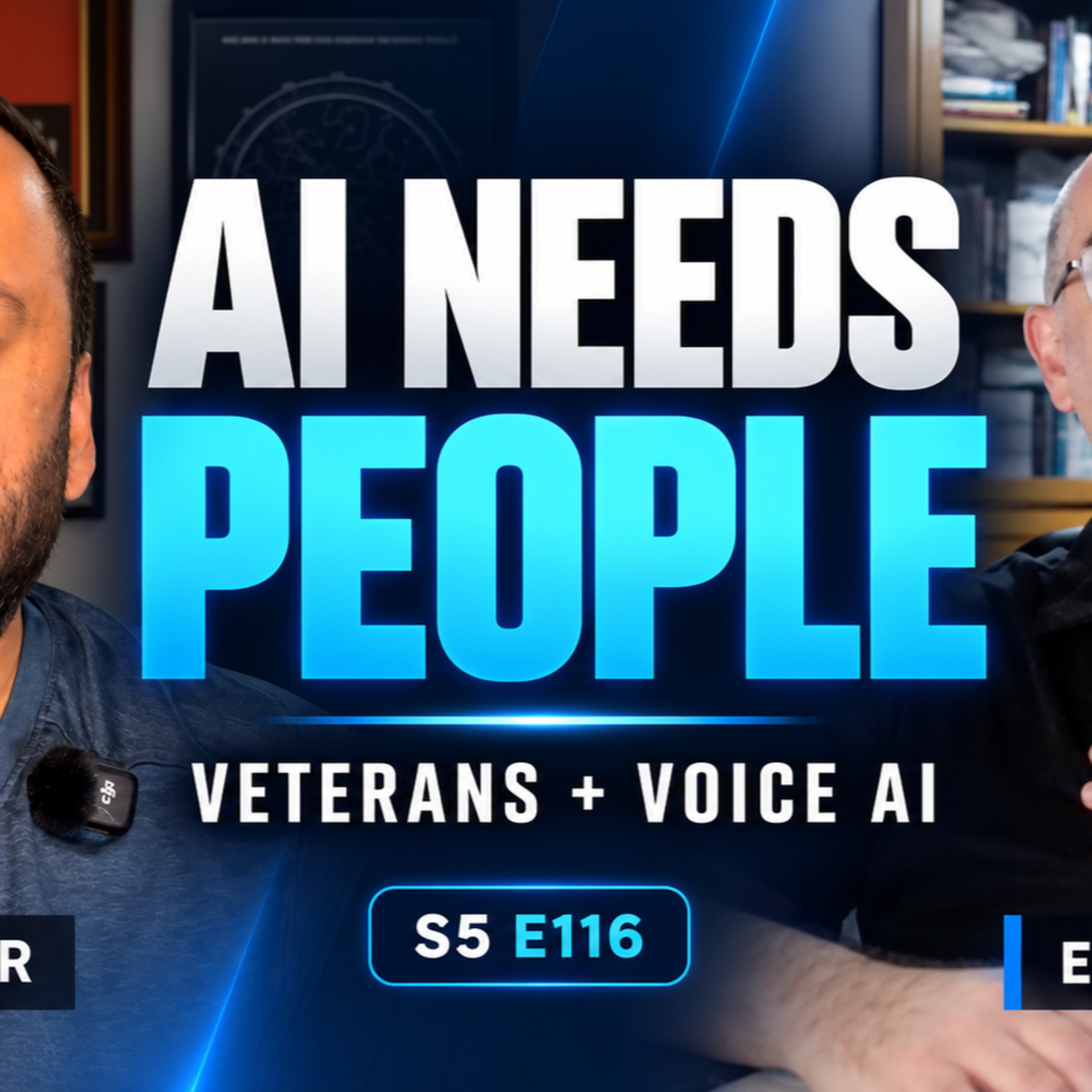
SN: 5 EP: 116 From Military Transition to Voice AI: What It Takes to Make AI Work with Eric Klein
What does it take to help people adapt to AI and to make AI work when real people depend on it? In SN: 5 EP: 116 , AyAyAyAI host Asif Haider speaks with Eric Klein of Cloudonix about military-to-civilian career transitions, the skills veterans bring to business, and how AI can help people describe their experience without replacing their judgment. They also discuss the gap between generating code and operating reliable software. Eric takes listeners behind the scenes of voice AI: connecting an agent to a phone network, handling outages, transferring a caller to another agent or a human, and measuring whether the process delivers a useful business outcome. The conversation comes back to one practical idea: give people the skills and support to work with AI, and check what happens after the demo.
September 20, 2026Episode 11558 min
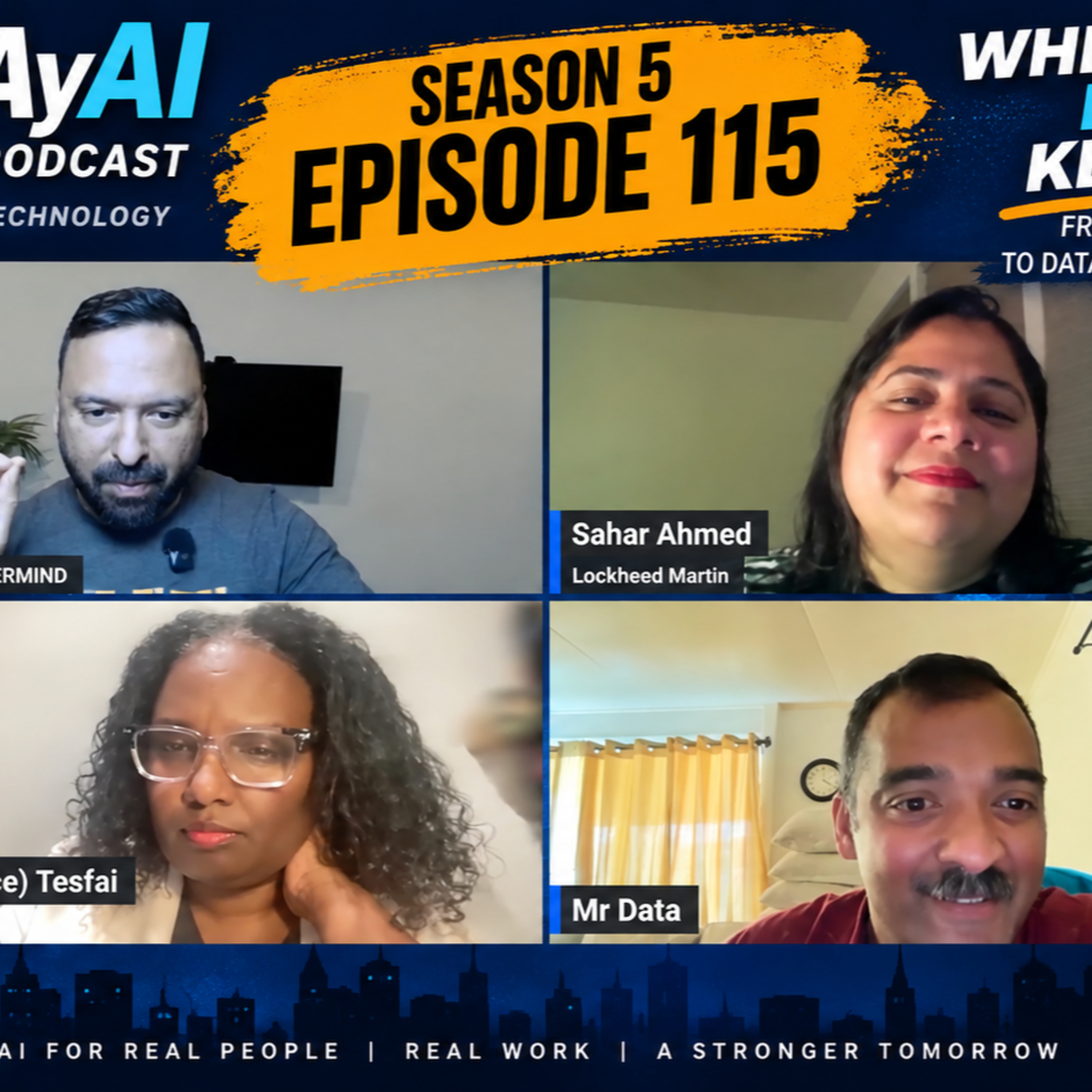
SN: 5 EP: 115 Whiteboard Before Keyboard: From People & Process to Data, Software & Hardware
In SN: 5 EP: 115 of AyAyAyAI , we bring the AI conversation back to the whiteboard. Before choosing another AI tool, chatbot, model, or platform, organizations need to understand the people, processes, data, software, and hardware already inside the business. In this roundtable, Asif Haider, Sahar Ahmed, Tzegha (Grace) Tesfai, and Mr. Data bring perspectives from AI, project management, human capital, cybersecurity, data, and technology operations to explore what practical AI adoption actually requires. We discuss People, Process & Technology , identifying and labeling data, decision-making, human-in-the-loop, data ownership and sovereignty, text-to-code, cloud versus local AI, cybersecurity and risk, MLOps and LLMOps, data centers, hardware, and the growing importance of semiconductor strategy. We also explore an important shift for nontechnical professionals: the people closest to the work may also be closest to some of the organization’s most valuable data. Their knowledge of day-to-day processes needs to be part of the AI strategy conversation. The central idea of this episode is simple: Whiteboard before keyboard. Before implementation, get the right people around the table. Understand the process. Understand the data. Ask who owns it. Determine where human judgment belongs. Then decide what software, AI, cloud infrastructure, and hardware actually make sense. 🎙️ AyAyAyAI: An AI Machine Learning PodcastSN: 5 EP: 115 Topics: AI Strategy | People, Process & Technology | Data Ownership | Human-in-the-Loop | Cybersecurity | AI Risk | Cloud AI | AI Hardware | MLOps | LLMOps | Data Centers | Semiconductor Strategy | Workforce & AI
September 13, 2026Episode 11334 min
SN: 5 EP: 114 The Business Possibility of AI | Better Communication, Decisions & Capacity
AI is changing quickly, but the more important question for a business leader is not simply “What can AI do?” It is: What can AI improve inside the business I already have? In Season 5, Episode 113 of AyAyAyAI, Asif Haider explores the practical business possibilities of artificial intelligence through three connected areas: communication, decision-making, and expanding operational capacity. The episode starts with a reality check. Modern AI demonstrations often show frictionless automation, but real businesses operate with legacy systems, scattered data, human knowledge, security requirements, software limitations, and processes that may have evolved over years or decades. Before adding more AI, organizations need to understand what they already have. This episode explores: • How AI can improve the movement of information between employees, customers, systems, and teams• Why poor communication can quickly become an operational and customer-experience problem• How businesses can organize scattered information into searchable, useful knowledge• The value of being able to “talk to your data” while still tracing answers back to the original source• How AI can help prepare better business decisions without replacing human accountability• Why context, experience, and tribal knowledge still matter when interpreting data• How to identify bottlenecks, duplicated work, delays, and unnecessary manual tasks• Where text-to-code and small software automations can close gaps between existing systems• Why repeatable work is often the best place to begin with automation• The importance of understanding where your data is processed and what permissions AI tools actually have• How local computing, cloud systems, software, hardware, and data fit together• Why measuring productivity gains matters before calling an AI project successful• How teams can build AI capability together rather than depending on one employee who understands the technology• Why sustainability, scalability, and interoperability matter more than a one-time AI experiment A central theme throughout the episode is data. Data may be at rest, in motion, or actively being used. The underlying information may remain valuable for years, while the technology used to process it continues to change. That means businesses should focus less on chasing every new AI tool and more on understanding their own information, workflows, decisions, and operational requirements. A practical place to start: Choose one recurring process. Understand how it works today. Identify where information gets stuck. Identify what decisions depend on that information. Look for repetitive work. Test a small improvement. Measure whether it actually saves time, reduces confusion, improves clarity, or increases capacity. Then ask: Can we do it again next week without starting over? That is where AI begins moving from experimentation into something sustainable. AyAyAyAI | Season 5, Episode 113 Artificial intelligence is changing. Your business knowledge, operational experience, and understanding of your own data are what give those changes direction.
September 6, 2026Episode 11229 min
SN: 5 EP: 113 Hardware, Software, and Data: A Non-Technical Guide to AI Decisions
Season 5, Episode 113 In this episode of AyAyAyAi, Asif breaks down artificial intelligence through three practical layers: hardware, software, and data. The conversation explains why AI is physical before it becomes digital, from CPUs, GPUs, NPUs, and data centers to the electricity, infrastructure, and supply chain constraints behind modern AI systems. Asif also explores how leaders can think about data at rest, data in motion, and data in use when evaluating new AI tools. This episode also looks at AI investment decisions, local versus cloud computing, data center delays, moratoriums, shadow AI, and why organizations should focus less on buying the biggest technology and more on choosing the right-sized solution for the business problem. For non-technical decision makers, this is a practical guide to asking better AI questions before spending money, approving vendors, or building new systems.
August 30, 2026Episode 11129 min
SN: 5 Episode 112: AI Data Centers, Moratoriums, and the Future of Data Control
Season 5, Episode 112 In this episode of AyAyAyAi, Asif discusses AI data centers, local moratoriums, and the growing debate over who controls the infrastructure behind artificial intelligence. The conversation explores how AI demand is driving massive investment in compute, energy, land, and water resources, while communities and policymakers weigh the economic benefits against environmental, regulatory, and data-control concerns. As AI systems become more powerful and more centralized, this episode looks at the bigger question: who owns the future of intelligence when the infrastructure required to run it is concentrated in fewer hands?
August 23, 2026Episode 11150 min
SN: 5 EP: 111 AyAyAyAI Podcast: Operational AI in Healthcare
Season 5, Episode 111 Welcome to AyAyAyAI. This year marks the 5th year of our podcast, and over the years our goal has remained simple: bring practitioners, builders, leaders, and subject matter experts together to talk about what AI looks like beyond the headlines. Today, I am glad to welcome our guest, Sohail Mohammad, CEO of Sobah Systems. Sohail has spent years building technology businesses and today is focused on bringing AI and automation into home health and hospice operations. That makes this conversation particularly interesting because we are not focusing on the clinical AI stories that receive most of the attention. We are talking about operational AI: what happens when AI enters the actual workflows, systems, decisions, people, and processes required to run a healthcare organization every day. During our conversation, we will explore: Operational AI in healthcare, as opposed to the clinical side everyone talks about Why AI that looks great in a demo may struggle in daily operations What healthcare organizations put a vendor through before allowing AI anywhere near their systems, data, and workflows The important difference between AI preparing a decision and AI making the decision How Sohail and his team are using AI inside their own company What a non-technical business owner should actually be doing with AI right now I also want to get beyond the technology itself. What changes when AI meets healthcare operations where privacy, security, reliability, compliance, employees, patients, and business outcomes all matter at the same time? Where should humans remain firmly in the decision loop? And how does a leader separate something that makes a good AI demonstration from something that can actually survive Monday morning?es. Today, I am glad to welcome our guest, Sohail Mohammad, CEO of Sobah Systems . Sohail has spent years building technology businesses and today is focused on bringing AI and automation into home health and hospice operations . That makes this conversation particularly interesting because we are not focusing on the clinical AI stories that receive most of the attention. We are talking about operational AI : what happens when AI enters the actual workflows, systems, decisions, people, and processes required to run a healthcare organization every day. During our conversation, we will explore: Operational AI in healthcare , as opposed to the clinical side everyone talks about Why AI that looks great in a demo may struggle in daily operations What healthcare organizations put a vendor through before allowing AI anywhere near their systems, data, and workflows The important difference between AI preparing a decision and AI making the decision How Sohail and his team are using AI inside their own company What a non-technical business owner should actually be doing with AI right now I also want to get beyond the technology itself. What changes when AI meets healthcare operations where privacy, security, reliability, compliance, employees, patients, and business outcomes all matter at the same time? Where should humans remain firmly in the decision loop? And how does a leader separate something that makes a good AI demonstration from something that can actually survive Monday morning?
April 25, 2026Episode 11044 min
SN: 5 EP: 110 Think Like an AI Consultant: 3 Frameworks Every Exec Needs Now
Season 5, Episode 110 Think Like an AI Consultant: 3 Frameworks Every Exec Needs Now
April 11, 2026Episode 10948 min
SN: 5 EP: 109 Executive Mastermind Session Signal Over Noise
Season 5, Episode 109 If you are navigating AI adoption, digital transformation, or enterprise strategy, the real value is not in adding complexity. It is in removing confusion. This is where leaders cut through the noise, challenge assumptions, and gain the clarity needed to make decisions that actually move the business forward.ve the business forward.
March 28, 2026Episode 1081 hr 8 min
SN: 5 EP: 108 KNOWING, DOING, AND GROWING BUSINESSES WITH AI | HOW APEX ACCELERATORS GUIDE AI ADOPTION
Season 5, Episode 108 KNOWING, DOING, AND GROWING BUSINESSES WITH AI | HOW APEX ACCELERATORS GUIDE AI ADOPTION
Is this your show?
Claim this listing to keep it up to date, reach guests who want to pitch you, and manage bookings with Guestify.