Exploring and unlocking the potential of AI for individuals, organizations, and humanity
Listen to episodes
60 recent
June 17, 2026Episode 4733 min
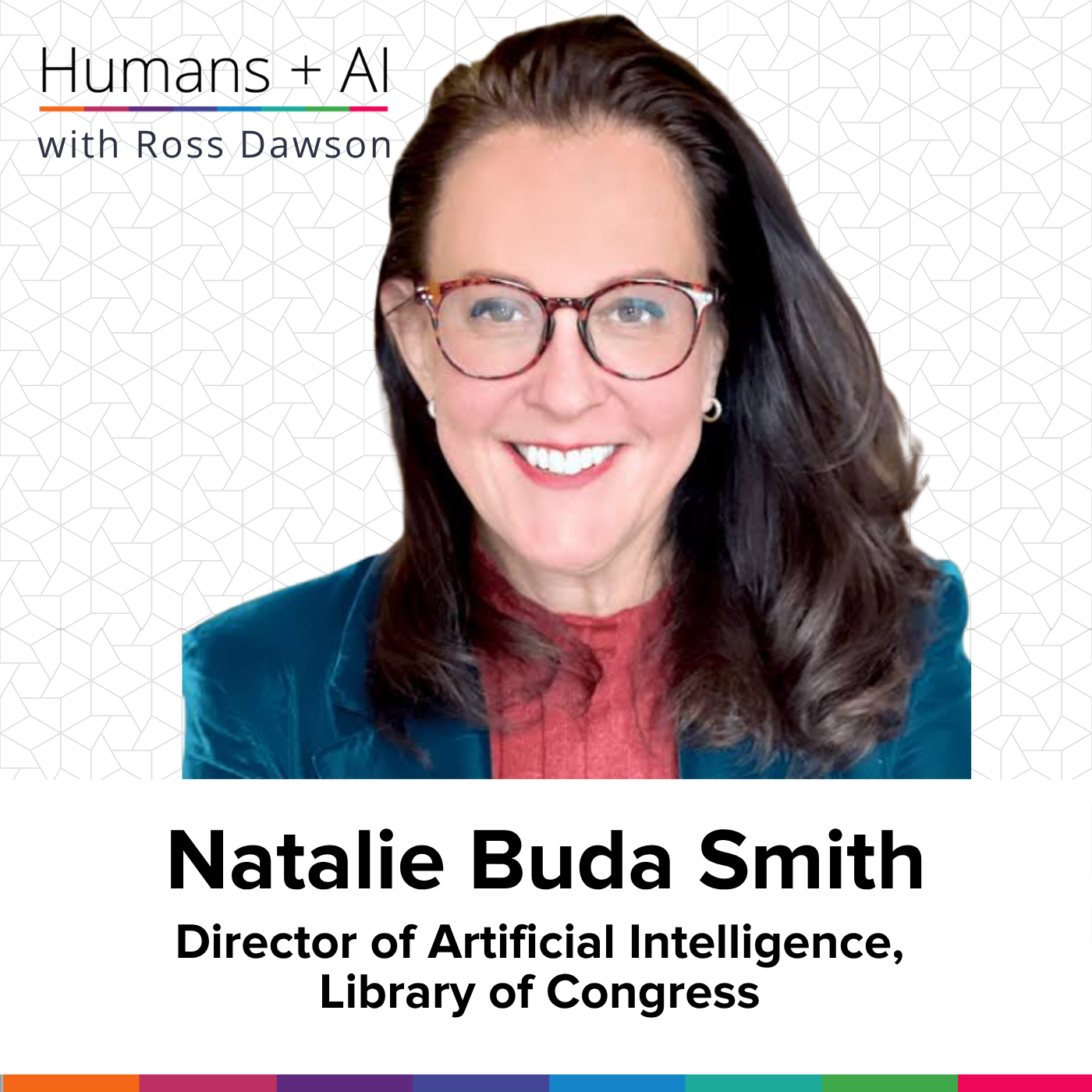
Natalie Buda Smith on AI in libraries, human at the center, deeper storytelling, and language recreation (AC Ep47)
Join Natalie Buda Smith, Director of AI at the Library of Congress, as she explores how digital interfaces and AI are revolutionizing access to human knowledge and cultural memory. In this episode, you'll learn about the shift from primary source access to information intermediated by AI, the importance of preserving historical context through multiple digitization versions, and the challenges of navigating proprietary data and open APIs. Natalie Buda Smith shares firsthand insights into empowering staff with AI tools, fostering personalized information delivery, and how collaborative, AI-powered projects are surfacing new connections and creative storytelling across diverse collections.
June 10, 2026Episode 4635 min
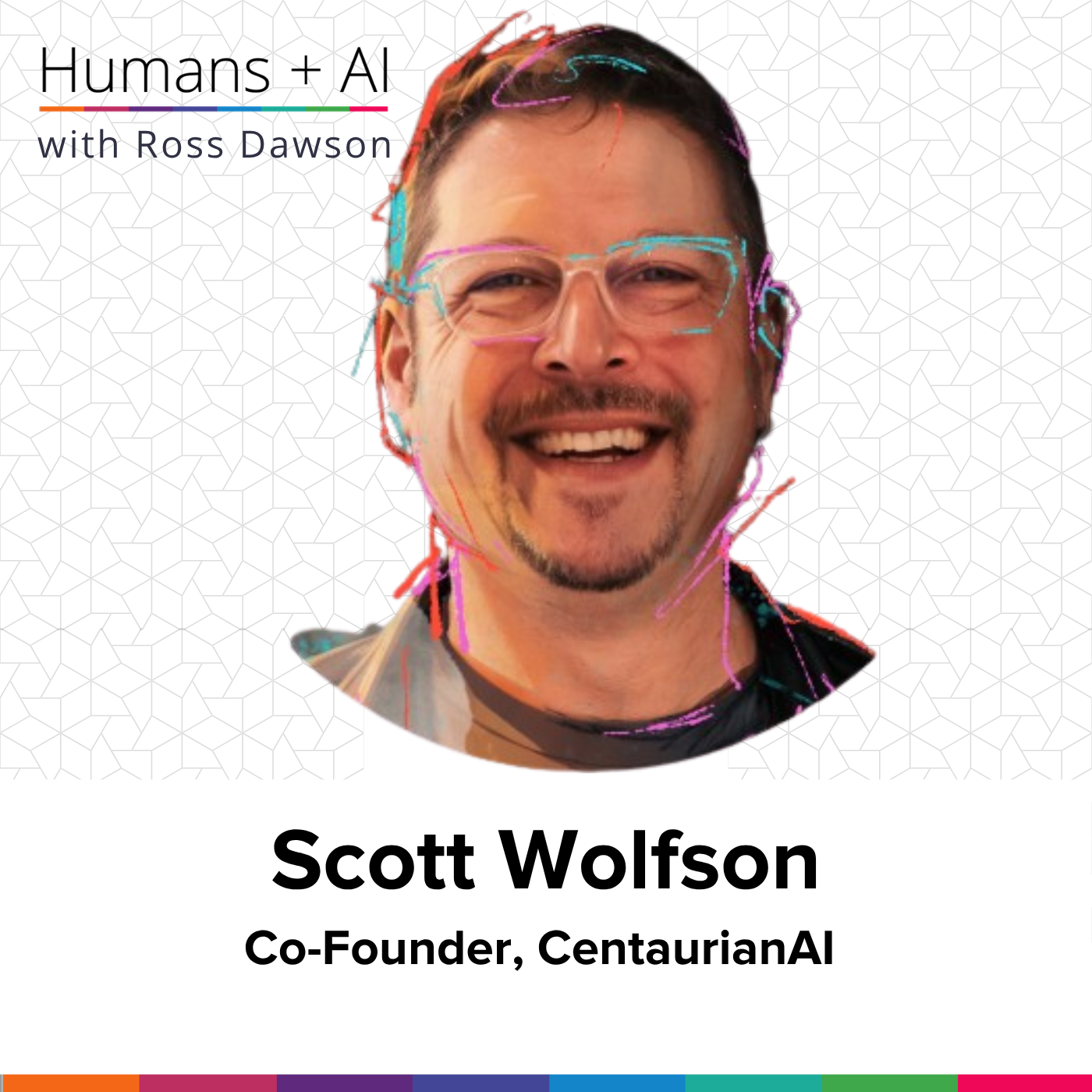
Scott Wolfson on cognitive fitness, System 3 thinking, mastery skill games, and Strategic Imagination Machines (AC Ep46)
In this episode, CentaurianAI Co-Founder shares how becoming 'unbottable' is essential in the age of AI and explores the Centaur chess mindset for thriving alongside intelligent machines. Listeners will discover practical techniques—like brain dumping, ignorance mapping, and the 'think, prompt, check' approach—to boost cognitive fitness, foster independent thinking, and future-proof their unique value. The conversation delves into mastery skill games, motivational intelligence, and the power of collective, connected intelligence for building a truly wisdom-driven future with AI.
June 3, 2026Episode 4532 min
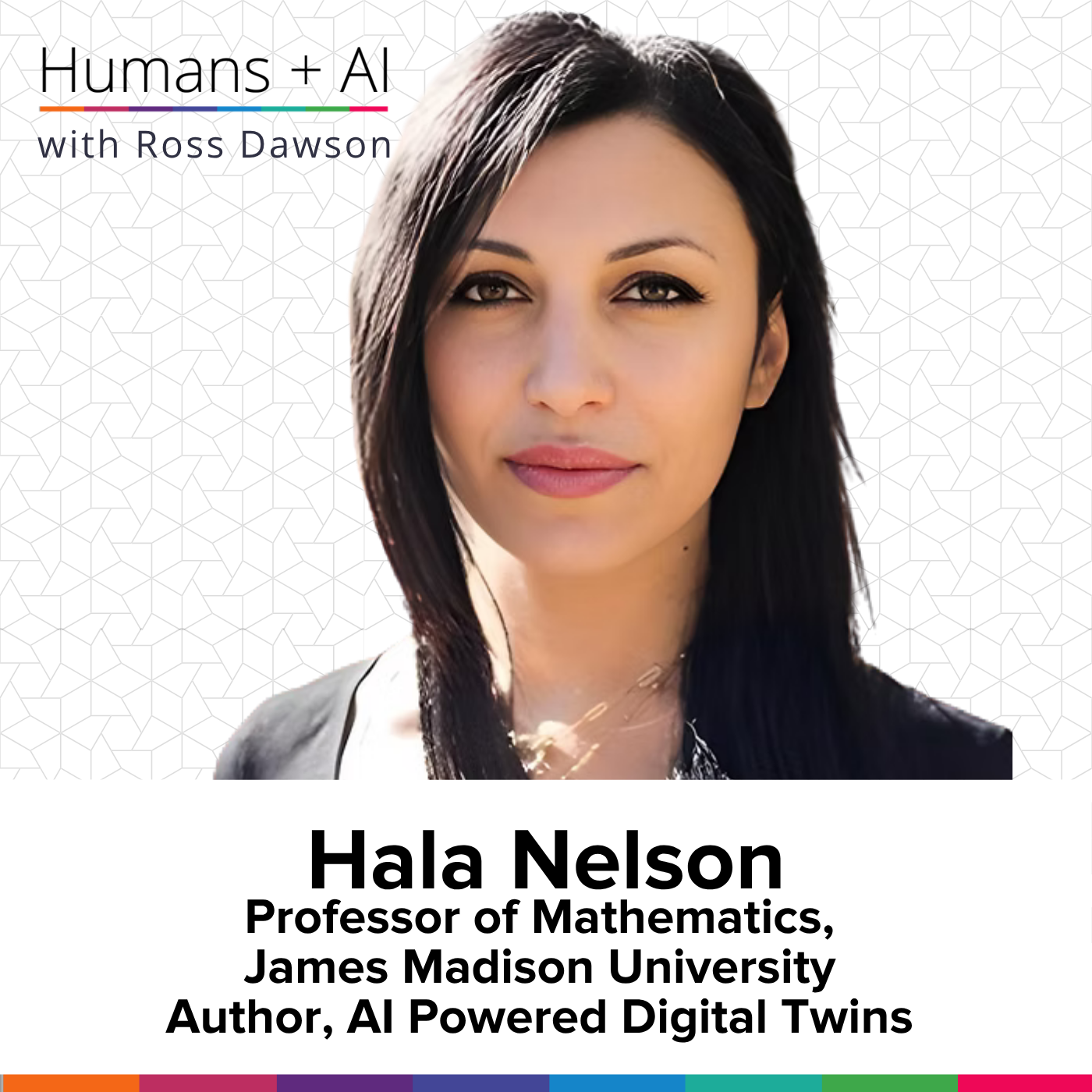
Hala Nelson on human machine coexistence, ontology first, AI driven digital twins, and bidirectional connections to reality (AC Ep45)
Explore how AI is redefining the boundaries between uniquely human intelligence and machine capabilities, and discover which aspects of intelligence remain distinctly human. This episode delves into building smarter, more efficient organizations by leveraging the complementary strengths of people and AI—focusing on the critical role of an ontology-first approach, knowledge graphs, and live digital twins in digital transformation. Listeners will gain actionable insights into integrating dynamic processes for real-time decision-making, structuring enterprise knowledge, and eliminating organizational inefficiencies using practical, AI-powered solutions.
May 27, 2026Episode 4417 min
Ross Dawson on cognitive friction, beyond Human-in-the-loop, and AI-augmented strategy (AC Ep44)
“The value is created in the friction, in the engagement between humans and AI—the pushing back by the humans, the pushing back by the machines.”
–Ross Dawson
About Ross Dawson
Ross Dawson is a futurist, keynote speaker, strategy advisor, author, and host of Amplifying Cognition podcast. He is Chairman of the Advanced Human Technologies group of companies and Founder of Humans + AI startup Informivity. He has delivered keynote speeches and strategy workshops in 33 countries and is the bestselling author of 5 books, most recently Thriving on Overload.
Website:
rossdawson.com
LinkedIn Profile:
Ross Dawson
What you will learn
The dangers of aiming for a frictionless experience between humans and AI
Why meaningful engagement—rather than passive approval—between humans and AI is crucial for cognitive augmentation
How human judgment and reasoning differ, and where AI excels versus where humans add irreplaceable value
The four key pitfalls of the traditional ‘human in the loop’ approach to decision-making with AI
Why too much delegation to AI can erode human vigilance, judgment, and accountability
The importance of adversarial, not just assistive, collaboration with AI for complex, high-stakes tasks
How ‘living strategy’—AI-augmented, continuously updated organizational strategy—addresses the limitations of static strategic planning
The role of AI in surfacing diverse perspectives, supporting dialogue, and enabling truly adaptive decision-making
Episode Resources
Transcript
Ross Dawson: I love speaking to the wonderful guests I have on my podcast. I always learn an enormous amount, but in this episode, I’ll share a little bit of an update for myself and delve into a few interesting things I’ve been seeing and doing lately, including some of the most interesting research papers I’ve seen on humans plus AI lately, looking at human in the loop and the ways in which we should be thinking about that, and AI and strategy.
So, just a quick scan of what’s going on in humans plus AI. I’ve been traveling quite a bit, doing a lot of keynotes as much as possible on humans plus AI, and the resonance around the theme is really rising very rapidly. In fact, somebody recently mentioned that humans plus AI was a cliché, or just overworn at the moment. Since I first started using the phrase three and a half years ago, I think it’s wonderful that now it is gaining a lot of currency. People are talking about it, framing that. Yes, some phrases outlive their usefulness, but I think I’ll stick with humans plus AI for the foreseeable future.
The research papers I’ve been looking at are focused on essentially cognitive augmentation and erosion, and that’s this critical domain where it’s not really clear around whether, or in which circumstances, our cognition erodes, and what it is we can do to make it augmenting.
One of the excellent papers is titled Cognitive Agency Surrender: Defending Epistemic Sovereignty via Scaffolded AI Friction. It’s a bit dense, but it has some great research and analysis in it. The key finding, which it begins with, is that in human-computer interface research literature over the last while, we saw that last year, 2025, there was a big, big rise in this idea of driving human sovereignty in how it is we interact with computers. However, since last year to the first part of this year, we’ve in fact seen that fall dramatically, where the human sovereignty paradigm is reducing dramatically, and we are seeing this big rise in what is called the frictionless paradigm, saying: how do we get as little friction as possible between humans and AI?
There are a number of really important points made in the paper, and really, the starting point is saying that we should stop treating frictionless AI as the goal. If we start to be frictionless, that is starting to essentially take the human out of the loop. The nature of humans is that we need to engage, we need to think, so we need to start building devil’s advocate agents into the systems and to aim for this thing where we start to have both this high degree of engagement with the AI, but also high friction.
That friction is where we are trying to, essentially, the more complex one rising, having more and more friction, and in lower frictions, it’s just more so. Label tasks, but where we’re not just showing the reasoning, giving people the ability to think through tasks and how they think about that, but to be able to challenge, actively challenge people as they are thinking through things.
More broadly, ensuring that the way in which we are designing systems is not emphasizing this frictionless, seamless flow between humans and AI, because that is where the value is created: in the friction, in the engagement between the humans and AI, the pushing back by the humans, the pushing back by the machines, to be able to drive us and move us forward.
Some really interesting research here, which was very much echoed in another very interesting paper called A Task-Driven Human-AI Collaboration: When to Automate, When to Collaborate, When to Challenge. This idea is essentially saying that the default mode for complex, high-stakes work should be adversarial, not assistive. This is, again, obviously, looking at what types of tasks or what types of situations we’re in as to adjust how the machine works, but when we are working in the complex world, we need to be pushing back around the way people’s thinking. It becomes easier, and we’re not looking for the path of least resistance. We’re looking for ones where we’re adversarial.
In fact, you can really see that there is no middle, what’s called this. There is no AI zone, which is in the middle, where essentially the intermediate tasks are ones where, in fact, involving AI can, or involving AI to human decision, involving human and AI decision, is not necessarily the best path. And so, what we need to focus on is the ends of the spectrum, where it becomes a truly collaborative task, or it is purely AI or purely human.
This actually goes very neatly and smoothly into the work which I’ve been doing around human in the loop. People have been talking human in the loop all the time; it’s a very common framing. But what I’ve come to realize, and in fact, my research has borne this out, is that in the vast majority of cases when people say human in the loop, what they actually mean is that the human gives a stamp of approval at the end. An AI makes the decision, then the human says yes or no, or overrides it.
That means that they are accountable, whoever the human is at the end. But there are a number of fundamental problems with this structure, four in particular.
One is that people tend to defer to the AI. AI is usually right, and so, essentially, more and more, you are deferring to the machine. A number of studies have borne out this figure of a 93% approval rate in human approval on an AI or automated system, so very high levels of approval. This starts to become, “Well, by default, I’m going to accept this,” which tails to the second point, which is the decay of vigilance.
Essentially, over time, you are paying less and less attention. It is easier and easier for the human to essentially pay attention and say, “It was probably right. It seems to be good.” My mind is wandering, and I’m not necessarily going to be taking the full attention, which my accountability should point to.
This goes on to the next point, where this role of putting the human at the end of a decision actively erodes their judgment. In one of the frameworks which I shared a little while ago, there was the decision between reasoning and judgment. Reasoning, going through multiple steps, is something which actually AI can do. It’s looking at the different logic, looking at the steps, looking at the relationships, and being able to make a sequence of logic leaps to be able to get to a point.
Judgment is the human part. That is the context, that is the thinking, that is the richness, that is the values, that is the ethics, that is what we bring to bear through the full extent of our human experience. So that is exactly what the human in the loop is: the human applying their judgment to something the AI has done.
But if that is all the human does, provide a judgment at the endpoint, it actively erodes their judgment because they aren’t seeing all of the richness of the reasoning which went through to be able to create that decision. They are potentially being stuck in one single point and taken away from the richness of the context and the experience, which gives them that ability to be judgment.
So, sticking a person in that human in the loop basically erodes their judgment and makes them less valuable over time, and essentially, obviously, is setting us up for a world where that human eventually gets taken out. The fourth problem is simply that this model cannot scale, where we are going to have more and more decisions. We need more and more accountability in systems, and just sticking people at the end of the human in the loop means that that’s going to limit how well we can build decisions that have an impact and have value.
So these are some fundamental challenges. I guess this relates to some upcoming work, or some work which I have been spending a lot of time on, and which I’ll be releasing pretty soon now, which is around some very deep, detailed structures around humans plus AI decision-making.
Those who have followed my work for a while may recall that around three years ago, I released 12 levels of AI delegation on decisions, from AI automation only at the bottom through to human only at the top, and all cascading ways of different ways in which AI and humans are involved in complementing each other in better decision-making.
Now, there are some decisions and some types of decisions where that human in the loop does make sense, where it does make sense to have the AI do things and have a person approve that. But that is, I think, a relatively small proportion of decisions, and most decisions really require a richer integration.
Essentially, AI is involved — sorry, humans are involved — in different points of the decision, including in framing it, including being able to provide different context along the way, to be able to be involved in a process from which a decision comes, rather than the AI doing the decision and the human approving at the end.
This comes back to understanding that there are different types of decisions with different characteristics, and in most cases, that human in the loop, or what I describe as human at the end, because that’s what we normally mean by human in the loop, is something which we should not be designing as the system.
This pulls us in a way to this final topic, which is around AI in strategy. There are some deep failures in strategy as we currently know it, and it’s essentially limited because the strategy has tended to be static. We do a strategy offsite, we create a strategy document, we do a strategy presentation, and that becomes the strategy until the next time the strategy is updated, which may be in a year or a quarter or three years, depending on the organization.
The organization is continually evolving. The world is continually evolving as it happens faster and faster. So, that’s one key challenge: traditional strategy is static.
One of the next key points is that because the strategy is, again, a crystallization, or there’s all of our thinking that we’ve crystallized into an output, which is our strategy, that means that all of the differences of opinion, all of the perspectives that were brought to bear from the board and the executive and the stakeholders and the organization are all collapsed into one thing.
It takes away: did we all agree on this, or did we have a great deal of disagreement around this? Might we start changing our mind if we started to think about this bit differently, or some different evidence comes to light? All of that richness of the diversity of the thinking which forms strategy starts to collapse out of that.
So these are just some of the challenges with the way strategy has been done. Now, this points to a world in which we can have humans plus AI strategy. Strategy, I believe, will always be human, and human first, but I think we will not have strategy which is human only, because there are so many ways in which AI can provide very rich analysis around that.
My platform, Fraxios, so this is probably the thing I’ve been spending the most time on over the last couple of years, is building this platform for AI-augmented strategy. I guess this goes to the points which I’ve been raising. One is it makes strategy alive. It is this living strategy where it’s continually reflecting current thinking, changes in the environment, and opportunities as they emerge.
It is being able to surface the full extent of possibilities for strategy, assessing those in a rigorous way, being able to explore those and develop those. But because this is a true humans plus AI platform, it is really trying to tap the collective intelligence of the people involved in the strategy process. You are identifying where it is that there is agreement, where there is disagreement, and what the issues are.
This is a foundation for constructive dialogue between humans, facilitated by AI to support a strategy which is both living, always evolving, and being able to address and keep the organization moving at the pace of change in the external environment.
So that’s just a few top-of-mind things that I’m currently spending a lot of my cognitive capacity on: these ideas of how it is the research, and being able to bring back these ideas of how it is we can best augment our cognition, our thinking, as we engage with these AI tools, which can be very helpful, but with too much delegation start to erode our cognition; being able to look at the decision-making structures and how those emerge, and with one, I think, particular problem or challenge being around this, the way conception of human in the loop and how that’s manifest.
I’m hoping to release and write a paper on this to be able to support that, and then finally being able to look at this AI-expanded strategy.
So, as always, please check in on Humans Plus AI, humansplus.ai. I’ll be sharing stuff on LinkedIn, and we’ll be back with some wonderful guests in the next few weeks. Thanks.
The post Ross Dawson on cognitive friction, beyond Human-in-the-loop, and AI-augmented strategy (AC Ep44) appeared first on Humans + AI.
May 13, 2026Episode 4338 min
Kathleen deLaski on reimagining higher education, generational mobility, building AI skills, and human originality (AC Ep43)
“There’s a real ‘skillification’ movement where you just want to get the training you need when you need it.”
–Kathleen deLaski
About Kathleen deLaski
Kathleen deLaski is the founder and board chair of Education Design Lab, which helps reimagine higher education. She is a senior advisor to Harvard’s Project on the Workforce and on the advisory board of the Taubman Center at the Harvard Kennedy School of Government. Kathleen is author of Who Needs College Anymore? Imagining a Future Where Degrees Won’t Matter.
Website:
whoneedscollegeanymore.org
eddesignlab.org
LinkedIn Profile:
Kathleen deLaski
What you will learn
The evolving value of college degrees in a rapidly changing economy
Who benefits most from higher education, including four key learner profiles
The rise of ‘skillification’ and alternative pathways to career readiness
How employers assess degrees and non-degree credentials in today’s job market
The impact of AI on both education and workplace expectations
Why AI literacy—and understanding its limits—matters for career success
The growing divide between technical and non-technical learners regarding AI adoption
Practical strategies for maximizing uniquely human skills—like originality and judgment—in an AI-powered world
Episode Resources
Transcript
Ross Dawson: Kathleen, it’s a delight to have you on the show.
Kathleen deLaski: Thanks for having me, Ross.
Ross: So, amongst many other things to your name, you have a fairly recent book out called “Who Needs College Anymore?” So, does anyone need college anymore?
Kathleen: Yes, the answer is yes. There are people who are looking to bash the notion of a three- or four-year university degree, but they need to look somewhere else. What I try to do in the book is serve two audiences. One is universities—what we call colleges in the US—who are actually in a state of panic right now about surveys showing that people are not valuing degrees anymore. It’s a perfect moment to reassess: what does a degree need to deliver as we approach the mid-21st century? That’s the hot topic, the debate that’s raging.
To frame the question, “Who needs college anymore?” is to say, “Wow, you need to step up your value proposition in this age,” especially when, at least here, the number of 18-year-olds is dwindling and we have AI and technological solutions that allow people to get skills as needed. There’s a real ‘skillification’ movement where you just want to get the training you need when you need it. There’s also a questioning of hanging around to learn about the liberal arts, to do your philosophy, English, or history required classes—can’t we get right to the skills? That’s the debate that’s raging. So, colleges need to hear this message; that was one audience.
Secondly, I know so many students—even in my own family—who are trying to parse the different messages they’re hearing. One message is, “You absolutely need a four-year degree if you want to get a ‘good job.'” The other message is, “College isn’t worth it anymore; you can just get the skills you need and get the job.” Meanwhile, families think the price tag is going up and up. Here, it’s staggering—although, in reality, universities in the US have actually begun to hold prices and even give a lot of discounts because they’re short on the number of folks coming through the door. So, all these confusing messages—I think families also need to understand who exactly, among different types of learners, does need a degree and who doesn’t. Which jobs, which age groups, which learning types? I actually walk through all those using a human-centered design approach.
Ross: Human-centered is a good way to go. So I and others have talked about the unbundling of higher education, and there are a number of elements to that, including the educational processes, the social connections, sometimes the physical place, the links with employers and credentials. Of all the facets bundled together in a degree, the real focus, of course, is on the certification—you’ve got a degree—and the point to which that signals to employers. I suppose that’s usually the name of the game. It’s the differentiator. In the past, we’ve seen that in some fields—most notably software—where you can get some indicators of competence outside a degree, and employers have been more than happy to accept that. So, just focusing on the credential, what is the role of the credential today?
Kathleen: Yeah, that’s an excellent question, because it’s particularly coming into question now. We have, like, 1.7 or 1.8 million different distinct credentials in the US alone. If you added the worldwide number, it would be bigger. So, what are learners to make of those? What are employers to make of those, when only a smaller percent are part of a degree? I say that we are absolutely at a time when the degree matters most, but there are many careers and moments in time when you can hack needing the whole degree.
Those moments are in a very tight job market, where employers can’t find enough people, and in sectors that are either new—because people don’t know about them yet, they’re emerging—or they’re very old school, like insurance adjusters, where the workforce is retiring and nobody wants to do those jobs anymore. So, new and old sectors, as well as highly technical sectors that require constant upskilling to stay in the game—things like AI, quantum, and parts of cybersecurity fit into that category. The signal power of a non-degree credential rises in careers certain and certain moments of time, but the degree is always a nice booster. The point is, you can get away with not having the degree in the situations I just described.
Ross: Yes, well, I was just about to leap to our current moment because it has a few specific characteristics. But let’s dig a little more into some of the book’s ideas. You describe four types of people for whom degrees are relevant, which suggests that people who don’t fit in those categories may have alternative paths. So, as you say, it’s related to the economy, the specific type of job or industry, but also to the individual and where they are in their life. Who are the people that do get the most value from a higher degree?
Kathleen: This may be different in different parts of the world, but I think the basic principles probably carry over. The first category, and this is where the research is the best, is what I call a “class transporter.” That’s someone trying to move from a lower or off-the-grid economic class here in the US to the middle class. This is often an immigrant family, where the parents came to this country specifically so their kids could get ahead, knowing they would never be able to get a degree themselves. They’re working three minimum-wage jobs so their kids can live in a neighborhood with decent schools and then get into university. The entire family is lifted up into the next economic rung.
Part of what the university degree does for that student is help with networking, code-switching, and, of course, the technical skills needed to land a role. That’s the number one category, because the research shows that in one generation, you can lift your family up. I actually start the book with the story of how my family did that in the 17th century. My relative came over, we think, in the belly of a ship as an indentured servant from England and was able to be one of the first students at this new college called Harvard, which was the first college in America. He got his son in—who’s my great-grandfather times seven—and then the family was off and running. He became a well-known minister, and his ten brothers and sisters didn’t get to go to college. That’s a very typical story even today. It’s that rags-to-riches story where college is so much a part of the American dream. It’s the launch pad, and that’s ingrained in all of us. So that’s the number one category. The others are probably more strange.
Ross: On that, one of the things I’m very interested in globally is relative generational mobility. The countries with the greatest generational mobility are Scandinavia; Latin America has some of the least. Generational mobility—the ability for children to do better than their parents—America is actually not that high. For all the talk of the American dream, I’m not sure of any studies that show the role of education in generational mobility across countries. I’m not sure whether you do.
Kathleen: That would be very interesting.
Ross: Yeah, I guess a fair hypothesis would be that in America, that is particularly high.
Kathleen: Well, surprisingly to many of us—myself included when I started researching the book—only 38% of Americans get a four-year university degree, which always strikes people as really low. They think everybody has access, but the numbers are probably even lower in other places. It’s not like everybody gets to go to college here, either. So, The second category is what I call a “legitimacy labeler.” That’s someone who may not need to move an economic class, but they feel they need that piece of paper for their own self-confidence and self-realization. What’s interesting is this category is particularly populated by women and minorities. When you look at who goes into debt to get a university degree, it’s very weighted among women and particularly Black Americans, especially for graduate school. They feel they need every possible imprimatur to prove themselves in the workplace. I interview different folks who go through that, and I even talk about my own journey to decide to go to grad school and pay for it myself because I felt I needed that. I was in journalism at the time, a young white blonde woman in the South, and I was not taken seriously. I thought, “I need a graduate degree.” That’s what I need.
It worked. I ended up getting hired at ABC News. I was their youngest correspondent in the ’80s. So, it definitely works, and I think it still works. Part of why it works is the network you make and the confidence you build.
Ross: Yeah, the networks are a big part of the value higher education brings—the people you hang out with. People I know who do MBAs all say it was useful.
Kathleen: Right, right. They don’t even go to class sometimes; they just do the networking. The third category is very basic and straightforward: any career where the piece of paper is actually required by licensure and you can’t get around it. We’re now figuring out how to game it, but we can’t get around it. The best examples are doctor, lawyer, some forms of engineering where there’s a lot of risk management involved, nurses, teachers—those are the best categories. You’ll see in teaching and nursing lately, where we have big shortages, we’re seeing ways you can be in your job and have part of your work experience count towards a degree, so you could maybe do it in two years instead of four. We’re creating these workarounds because we have worker shortages, and that’s interesting. I think you’ll see that across the board. So that’s the third category.
The fourth category is broader and has to do with how badly you feel you need community and structure to make yourself learn and to push yourself. We all know someone—maybe even ourselves—who, in the other category of not needing a degree, is the extreme DIYer who can pick up any skills from YouTube. A lot of people are finding their main learning venue now is YouTube. You can learn almost anything there. But if you’re someone for whom that’s not going to get you there, and you crave the society of others, particularly if you’re 18 to 24, I would say go and get in community at a college, for sure—at a university if you can afford it. If you don’t have other reasons why you can’t do it.
So, those are the four categories. My basic catch-all advice to any 18-year-old is: if you can come up with the money—because here in the US that’s a huge issue—you should go for it. You can always leave, which many people do. Almost half of people who start university in the US don’t finish. You can get in the door, you’ll learn something, but you might be in debt. That’s the problem—a lot of people don’t finish and then they have the debt. I recommend to anyone who doesn’t know what they want to do: take a very economically frugal path, like choosing what we have here called community colleges, which are very inexpensive. It’s not quite as much—you don’t get the football team and all the wonderful seminars with small classes—but you can at least do career exposure and learn what college or university is like. So, those are my categories for who still needs college.
Ross: So, I don’t think we’ve mentioned the word AI yet, so let me say it. This changes quite a few things, and we’ll get to some of the more pointed or current ones right now. But let’s just take this humans-plus-AI perspective, where hopefully almost all employers will, in some form, be using AI and expecting the people who work there to use AI. I guess there are two parts: AI obviously has a role in education, and AI will almost necessarily have a role in the workplace. So, perhaps going beyond specifically the college or university framing, how should we be thinking about both education—essentially, the gaining of AI literacy—to be able to learn, to function well in society, to do well at jobs and meet the expectations of employers, to be AI-competent?
Kathleen: I’ve actually turned my attention since finishing the book to this question, because the conversation about whether you need the degree and how the degree needs to be changed to be purpose-fit for the mid-21st century—a lot of that questioning is revolving around what we do about AI. I taught a class this semester here in the DC area, which is just finishing up, called “How to Get Hired in the Age of AI.” It’s been set up as a design sprint, where the students are researching what students are feeling about AI, what employers are feeling about AI, and then looking towards ideating and prototyping solutions. Along the way, they’re using AI skills and human skills, and we’re measuring which ones come in where—what’s important to use in what part of the process. It’s been fascinating.
The thing that’s been most surprising is how reticent students are to even use AI at the tertiary learning level. I know a lot of people are saying we shouldn’t even let—we’re taking the phones out of the classrooms in secondary and primary school, and there’s a lot of conversation about not letting AI in at all at that age. At the college or university age, the conversation has been around cheating, frankly. So, a lot of universities in the US—I can’t speak to other countries—have banned the use of AI in their classrooms. As of about January of this year, many universities are waking up and saying, “Oh, maybe that was a bad idea,” because of what you just explained: employers are going to want them to use AI when they get to the workplace. In fact, they’re going to hire against those skills, and we’re not setting our students up for success if we’re treating AI as the forbidden fruit.
Our course looks at this, and the students are making recommendations to the administration in papers they’re writing right now: how do we live with this dissonance? But I would say that the students and their fellow students they’re interviewing are not very interested in leaning into AI. For a couple of reasons: number one, they’re mad at it because they think it’s ruining the society they’re launching into; they’re afraid to use it for fear of being accused of cheating; and thirdly, they think it’s turning their brains into mush, and they’re afraid of that—as they should be. So, it’s been interesting. We’re trying to parse out: what AI skills are employers going to expect? What do they expect right now? How do you build those skills but also maintain your skepticism?
Ross: All right, well, totally, because it’s “How to Get Hired in the Age of AI.” So, give me a snappy answer.
Kathleen: What I say is you have to lean in, even if you want to lean out. The leaning in part is being able to play the game with what employers want you to do with AI, but knowing its limits—knowing how you can be the boss of the bots and how you can add value to your employer by using AI and by showing where you’re better than AI. But that requires you to have an understanding of how it works.
Ross: Yeah, and my focus is on judgment and accelerated judgment development. That’s what distinguishes the human skill—judgment you don’t necessarily have early on. So, how do we accelerate that judgment? And also, using the tools to be cognitively better. By default, you can basically think worse—as you said, cognitive erosion. But if we have this attitude of using it to improve our thinking, knowledge, and capabilities, then we can work out how to do that well. And, Ross, you’re pointing—employers get it?
Kathleen: Yeah, you’re pointing to an important realization that I think students came to over the course of the semester, which is that if the first rung of the career ladder is being eroded because we won’t be hiring as many people to do those baseline professional jobs, we need to teach judgment and provide the experience for students to jump up to the next rank. What does that look like?
Ross: Yeah, well, which speaks to this integration where the work experience and a whole lot of things—it’s not like, “Okay, today your degree is finished, and tomorrow you get a job.” This is 2026, and people are saying, “In three or four years, I’ve got no idea what anything is going to be like anymore, so why would I start a degree when I don’t even know if there’ll be any jobs at the end of it?” It’s an interesting question. What do you say to that? What do you think?
Kathleen: Yeah, I mean, I tend to come at this as an optimist, sort of glass half full. Maybe partly because I’m old enough to have been working in the early consumer internet business in the 1990s. There was this little startup—not sure everyone around the world remembers it—called America Online. Our job was to basically train the public; we were called the training wheels of the internet in the ’90s. There were many of these same arguments about how all these jobs were going to go away. Looking back 30 years later, yes, a lot of those jobs have gone away. I haven’t seen a study that actually looks at the net gain or net loss of new types of job roles, but a lot of jobs were created—in fact, like UX designer, web designer, a lot of software roles, analyst, digital analyst. You can name so many in most fields.
I think one of the reasons we’re panicked right now is because we can see which jobs are going away, but we can’t see which ones will get created. I feel like a lot of new and more interesting jobs are going to get created. That’s where I think the debate is: are the jobs that get created going to offer the same professional advancement that a college degree would require, as the jobs that get lost? In other words, the ones that are left—are they really going to be those jobs where you actually need a human in the loop, or are those jobs going to be minimum wage, low-paid jobs like being a waitress taking orders or an orderly in a hospital pushing beds around? Those are the jobs we know aren’t going away. What are the jobs further up the scale that will still need the judgment we described and the creativity and oversight.
Ross: Yeah, well, I also am—certainly relative to many others—very optimistic about the future of work. But I guess two points—well, many points—there is still deep uncertainty. We just don’t know. The second related point is we don’t know what the skills are that people will hire for. So, whatever jobs are created, does it mean you want a degree in AI and computer science and workflow, or is it history and philosophy and literature, which gives you the human context that machines don’t have? Or is it both? What are the skills today that are going to lead to employability in the future?
Kathleen: Well, I still tell people to lean in. In the US this year, we’ve had an 8% decrease in computer science majors, and everyone’s attributing that to AI. I still tell people to lean into computer science and related majors, because those folks are going to be the most comfortable with the technical cutting edge. They know what they need to know. If you’ve begun to vibe code—which I’ve taught the class to do, and it’s so easy, even though I’m not technical and you’re making apps—you realize you’re one button away from having the thing crash. You still need the technical people behind the screen, and I think you always will, not just to be your help desk, but to take us to the next level.
I’m still bullish on technical jobs in computer science, and they can leverage themselves into the next new thing, whether it’s AI or quantum or whatever comes after that. I worry if we tell everyone to major in philosophy—I love philosophy; my husband got his PhD in philosophy—but if those people try to be, let’s say, AI Luddites and don’t want to use AI, I think they will become more and more distant from the hum of society, and that’s not going to serve them well.
I see a lot of liberal arts majors—we even did a survey at our university to ask, “Are you willing to build AI skills?” Interestingly, the humanities and arts, creative majors, were not interested in building their AI skills. The finance majors, business majors, IT majors—they were. So, we could have even more of a divide here than we already have between like this digital divide. If we have an AI divide, I do worry about that. So, I would say yes, if you want to major in philosophy, fine, but also lean into the technical side of your life.
Ross: Yeah, yeah. I think we must be multifaceted—today more than ever. As you say, that points to education not being too tightly tracked, which is probably useful. So, we are the Humans Plus AI podcast. Let’s pull back to the big picture. Listeners are humans, mainly. What’s your advice to humans in a human-plus-AI world?
Kathleen: I think to have some mental models. The future is human, right? We want to keep it that way. Consider the mental models of where AI can assist your life versus where it can take over the parts of your life that you like and want, or affect or hurt societal norms of community, the environment, and mind mush and everything else. I would say to think about where human skills are still both necessary and rule the day.
I’ve been listening for what are the words people say in terms of what we still need to be able to do to “beat the bots,” if you will. One of them is originality. I find that an interesting construct, because in an age of AI slop, where all content looks the same, what will stand out are people and ideas that are new and different, not broadly derivative. I’ve talked to my students about that—traits like originality and, on the human interaction side, charisma and the ability to interact will stand out. You already see that happening on Instagram or social media—authenticity and originality are ruling the day right now.
Those are traits on the human experience side that I would mention. In terms of business or getting things done, I’m really leaning into this idea that I will use AI to try most anything, but I’m going to manage the transitions of those activities. In our design sprint, AI is doing some of our research—that’s okay—but we’re also interviewing humans, synthesizing the ideas, prioritizing them, and deciding what to do with them. We are the decision makers, but AI is even good at ideation, and that’s fine. You can have your large language model spark ideas for you, but you have to figure out what to do with them, and that’s where originality comes in. I try to look at those transitions for workflow or creative flow and figure out where AI is useful and what part of my brain I need to bring to bear to rule the day.
Ross: Fantastic. So, where can people find out more about your work, Kathleen?
Kathleen: Probably most currently, particularly related to the AI stuff, I would say my Substack, which is also called “Who Needs College Anymore?” That’s an easy place to find me. I’m on LinkedIn, and the book has a website where I post a lot of stuff, and that is also whoneedscollegeanymore.org.
Ross: Fantastic. Love your work. Great to speak with you. Thanks, Kathleen.
Kathleen: Well, thank you, Ross. It was engaging. Thanks.
The post Kathleen deLaski on reimagining higher education, generational mobility, building AI skills, and human originality (AC Ep43) appeared first on Humans + AI.
May 6, 2026Episode 4235 min
David Vivancos on the end of knowledge, cognitive flourishing, resilient societies, and artificial democracy (AC Ep42)
“Delegating knowledge is not the same as delegating wisdom. You learn by experience, and if you don’t have any experiences…you will get cognitive atrophy.”
–David Vivancos
About David Vivancos
David Vivancos is an AI, data, and neuroscience serial entrepreneur, having cofounded five startups since 1995. He is a frequent keynote speaker and is the author of six books, including the Artificiology series.
Website:
vivancos.com
LinkedIn Profile:
David Vivancos
What you will learn
Why embracing advanced AI is crucial for human progress
How shifting from digitization to automation and datification redefines value
The evolving distinction between human-acquired and AI-generated knowledge
How to avoid cognitive atrophy and actively exercise your mind alongside AI
What cognitive flourishing means in a world of widespread AI augmentation
Ways AI can transform and personalize education across all levels
The importance of coexistence training as we prepare for AGI’s societal integration
Why rethinking human identity, humility, and social structures is essential for a future with machine citizens
Episode Resources
Transcript
Ross Dawson: David, it is wonderful to have you on the show.
David Vivancos: Thank you very much, Ross. Glad to be here.
Ross: So you have a more developed, or some would say, extreme view of the relative role of humans plus AI. I’d love to dig into where you think things are going, and how we can best respond.
Perhaps the starting point is, you say that we should not be resisting or pushing back. We should fully embrace the shift towards very high levels of AI capability, or at some point, AGI.
David: Yeah, that’s fully my point. I think we are in a moment in history where we are really building this technology that one day is not going to be a technology anymore.
So, the sooner we start to embrace it, to teach it, and to be really in sync with what we are creating day by day, the better off we will be. So yes, my point of view is that we should embrace it. We should start building as soon as possible. We should fix most of the problems that humans have had over the last millennia, and some of these problems could be solved by using AI.
So basically, our “fourth brain”—we have the three-part brain, but in reality, there’s only one brain—this fourth brain, AI, will help us solve all of these issues. So yes, it’s an opportunity.
Ross: Yes. I mean, I think there’s always two sides—as in, every opportunity has a challenge, every challenge has an opportunity. So I always think we need to acknowledge challenges and focus on opportunities. I think we’ll get onto that in discussing some of the cognitive implications.
You have a series of books which have really told the story over time around this. One of them was “Automate or Be Automated.” This idea of saying, well, there are things which machines, in the broader sense, can do in automating things. So, how would you frame that now, in terms of what it is that can be automated, and how do we position ourselves relative to that? Where do machines start to do what humans have done?
David: Yep. I’ve been in this business of trying to build the impossible for the last 30-plus years. “Automate or Be Automated,” the book you mentioned, is from about six years ago. When I started creating and building technology, also about VR and many other things, about 30 years ago, the first companies were internet companies. Back then, what we did is what people now call digitization. But over the last 20–25 years, what we’ve mostly been doing is datification—gathering data and using that data for companies to grow and to understand what happens in the world.
But over the last maybe 10 or 11 years, what I call the new golden age of AI, we are starting to build the capabilities to use that data to really build algorithms. Once we have that, we can start to automate, and with this automation, basically what we regain is time. I think time is our most precious asset, along with health and the people we love. Being able to stop doing these repetitive things over and over and put a machine to do that is a fundamental trait for humans.
That book, six years ago, was about building a methodology of what can be automated in the digital world, but also in the physical world. That has changed over the last year and a half with the physicality of AI—humanoid robots. I was invited last year to attend the first humanoid Olympia in Greece, in Olympia, the place where 2,800 years ago, humans started to compete. We’ve just seen this week the explosion of the new race, for example, of the half marathon in China, where robots already beat the human mark.
So yes, with automation, you need to see what you are doing, and if you are repeating anything, you can try to see if that can be automated by using an agent, by using the cloud, by using a robot—whatever. So yes, we should regain our time and automate, or be automated. It’s all about that.
Ross: Yeah. I think people understand the automation thesis. It’s obviously not new—we’ve been automating things in various ways for centuries, at an increasing pace. Your following book was “The End of Knowledge.” This is an interesting framework, starting to get to cognition.
The idea is that knowledge is built on experience of whatever kind, whether that’s just in data or otherwise. Obviously, humans use data just as much as machines. But where this starts to become a distinction, as well as a complementarity, is between AI-embedded knowledge and human knowledge. So why is it “the end of knowledge”?
David: Yeah, that’s a really great question. It came as an epiphany for me. That book is from about three years ago. I’ve also been involved, of course, in building AI and AGI algorithms over the last 20 years. We started using GPT models before they became can across, but the GPT moment, a year before that, really marked the difference—when we started to be able to use AI in a very seamless way to regenerate and process knowledge.
That book, “The End of Knowledge,” came from the realization that we are starting to delegate the production and understanding of knowledge to machines. That’s a critical shift in human history, because through history, humans have needed and used knowledge a lot. Knowledge is power. The more knowledge you have that others don’t, the more advantages you have to do whatever you want. That started to change back then.
Now, what people call the “dead internet theory” is basically some of the things I expressed in that book earlier, because we are starting to generate more knowledge. In fact, we’ve already passed the point where most of the human-written knowledge since the printing press has been surpassed by the amount of knowledge we can create using AI.
Myself, for example, I started learning to code when I was young. I’ve coded in more than 25 languages and written over a million lines of code in my life. That same number of lines of code, I might now write in the last couple of weeks. So as you can see, you have 40-plus years of your own life in a week. That’s why “the end of knowledge” means that the human capability to gather knowledge and to be knowledgeable about whatever you want can now be delegated to machines.
That book marked the difference and started a new field that I now call artificiality. I didn’t know that when I started writing it, but I started this path of trying to see what happens when you delegate some of the main capabilities of your mind to a machine.
Ross: Yeah, and I’d like to come back later to the themes of artificiality, machine citizenship, and the societal value we attribute to machines. But I want to start digging into the cognitive piece here. One of the points you make is that we do need to avoid cognitive atrophy. You say we need to have cognitive exercise in order to avoid cognitive atrophy—obviously, a strong analog to the physical world. We need to collaborate with others and with machines to do that. I’d love to get more specific around that. What is the nature of cognitive exercise that will avoid cognitive atrophy, which will enable us to keep our cognition refined and even improving?
David: Yeah, that’s a fundamental piece. When we start to delegate all these things to machines, the easy thing to do—and probably the oldest human brain capability—is to not do it yourself. You just delegate everything, and you basically become like in the movie “Idiocracy,” which played out quite well what could happen if we do that.
The thing is, with the current AIs—even with the latest releases, like DeepSeek and GPT-5.5—everything is changing quite fast. But even with those AIs, you still need to be in the loop. It’s good if you stay in the loop. I think it’s fundamental. Use the technologies—the AIs, I always call them in plural because there are many—and use as many as you can, but you should still be in the loop, at least for now. Maybe for a couple of years or months, I don’t know exactly, but for a while, you still need to have your hands on the wheel.
If you use most of them and get all the information from all these AIs, as a human you need to understand the bias, because all AIs are going to be biased. We all know humans are biased; there are no unbiased humans. The same happens with AIs. But if you are in charge and have that council of intelligences, you can start to grasp what each one is doing. I use about 20 of them every day and get different sets of answers in small batches. You can start to see where they come to consensus and where they differ.
So, to avoid cognitive atrophy, if you use AIs to keep yourself in the loop and apply your human curiosity—I don’t even say creativity, because creativity is also being widely delegated to machines—but human curiosity and other things that are still hard to embed in LLM models, you can still add a lot of human value. That’s where, to avoid cognitive atrophy, you should use AIs, but use them with your human in the loop.
Ross: So, what specifically, what’s your advice to someone who sees that they’re using LLMs and getting lazy in their thinking? What should specifically they do if they notice their brains are getting lazy?
David: They should differentiate between simple questions—where you look for something you need quickly—and other things that should make you think. Delegating knowledge is not the same as delegating wisdom. You learn by experience, and if you don’t have any experiences and you delegate not only knowledge gathering or creation, but also the experience itself, then you will get cognitive atrophy.
So, understanding this difference and using knowledge to think is really the key point. It’s not just asking for something simple, but for more complex things, you should still add your thoughts. When you talk to an AI or AIs, it’s basically a conversation. It shouldn’t be, in most situations, just a one-way communication. It’s fundamental to keep this line of communication open, so you can keep feeding your brain with information and other activities, and gather wisdom with that.
Ross: I guess this goes to another phrase you use—cognitive flourishing. There is absolutely the potential for us to think bigger, better, broader, and in more refined ways than we have in the past using LLMs. But that’s not the default path for most people. Many people start to fall into that trap, so there is a divide. We need this metacognition. We need to be aware of what we are doing and at what level we are working with the LLMs. Maybe paint this picture of cognitive flourishing. What is the positive? How far could we go in terms of potentially improving, augmenting, and letting out our cognition blossom?
David: Yeah. The thing is, we humans—of course, there are many intelligences. That’s the first thing we must address, because there isn’t a single IQ or whatever way you want to measure intelligence. For me, the most important one is the capacity to adapt. That’s probably the most important intelligence of all.
If we talk about the G factor, it’s one way, maybe mixing different aspects. In that sense, we have limitations. Since the beginning of time, humans have developed tools to extend our physical capabilities, but we’ve also developed tools to extend our mental limitations. This is really the final tool to extend these mental limitations.
We have issues, for example, with memorizing long things—it’s quite difficult; our brains aren’t made for that. We’re basically pattern recognition machines; almost two-thirds of our brains are devoted to that. That’s something machines do quite well, so we can use that to extend our mental performance.
If we think that now we have AIs with close to 150 IQ points—regardless of what you mean by IQ points, or at least in the Mensa standard test, maybe they’ve learned that, so maybe it’s not so fair to think that—but if that trend continues, even over the current year, it’s not far-fetched to have 200 IQ AIs at your fingertips. That’s a game changer. It’s like we all can have a conversation with Einstein, Newton, Carl Sagan, or whoever you want, and even make them argue about things.
That’s another interesting point—when you use AIs, you can have them argue, not just agree with you, but also challenge what you or other AIs are saying.
That power at your fingertips—to have this IQ potential of machines—is very critical. Another important aspect is the volume. For example, you can’t read a million books, or even 100 books in a month would be quite challenging. The capability to have machines provide all that knowledge, and even create that knowledge, is huge. We’re now in the age of identity AIs, which is really booming. There have been three big moments in AI over the last five years: the ChatGPT moment, the DeepSeek moment, and the OpenClaw moment. It’s really challenging.
I use billions of tokens every month because it’s really changing everything. With that change, you can create one of these clones or agents to build a book for you with the 1,000 books most interesting to you, tailored fully to what you want to learn. You can have that in one page, 10 pages, 100 pages—whatever you want. You can use AI to synthesize and build the knowledge you want to use. That’s another great extension, if you use it that way.
Having this capability of really augmented minds that you can interact with, chat with, and create with is important. Humans need the experiential part of building—it’s another critical trait. You shouldn’t just focus on asking or doing things; you should create things and interact with things, especially with multimodality. Two-thirds of our brain is devoted to vision, and we don’t use that as much. We’ve all been “one-eyed” since the beginning of technology, but we have two eyes for a reason.
When I started building virtual reality or AR companies—I’ve built a couple, the first in 1995—it was because I was challenged by that. But humans are still using flat screens instead of 3D worlds. This is one area where new AIs with world models and interactive 3D spaces will be a game changer in how you feed knowledge to your brain and make it easier to grasp and understand what’s going on.
Ross: Yeah, many people observe that once you start to get machines to experience the world directly for themselves, that’s a different layer compared to doing it through the intermediation of texts written by a human based on their own experience. I want to look at some of the layers of the social, structural, and economic implications. One of the core ones is education. If we are moving into a very different world, which it certainly looks like at the moment, then the nature of education needs to change. What do you think we can or should be doing in terms of redesigning education? Are there any examples you’ve seen that point to where a good education structure may already exist?
David: Yeah, that’s a fundamental piece. I started this it in “The End of Knowledge.” There are two types of education. Humans aren’t able to live a meaningful life when we start here on planet Earth—we need at least maybe 15, 11, whatever number of years to build that human from the beginning. That kind of education is fundamental.
The other kind—higher education, when you try to become functional by having some sort of capabilities—is another game that probably is going to end quite soon. But the first part is still fundamental, and we need to keep growing it. The thing is, there are a lot of asymmetries. We don’t have enough teachers, but we have a lot of students. The same happens with the elderly—we don’t have enough people to take care of them, and there are a lot of them. With children, it’s even more critical, because if you don’t get that from the early beginning, you won’t be able to really see what every child is good at.
There are talents we are all born with, and those are fundamentally lost if you don’t nurture them. If you just try to create clone humans, you’ll get cloned humans when they’re older. That’s fundamental, and I think AI can help a lot. If you start to create that path of learning from early on—I’m involved in a project called Education (with “action” at the end) here in Europe, where we’re trying to reframe all that. It’s like when banks needed to be rescued a few years ago; we think the same is happening with education, and we’re pushing that new project. We think education needs to be rescued to start to keep up with what’s going on.
We need to be in sync with learning—with AIs and with physical AIs too. It’s not far-fetched that every child will have a humanoid robot companion. Teaching needs to be bidirectional—we need to help them learn in sync. There are many aspects of technology that can help you grasp what’s happening when you learn, because we all learn in different ways.
It’s fundamental to teach you how to learn by yourself. I think the most important trait at the moment is not needing to rely on others, but to learn by yourself and learn all your life. That should be taught from the beginning. There are a lot of technologies starting to pop up. We’re starting to see it in China, for example—a lot of brain-computer interfaces or devices to read some of the biological signals of kids. You can do it with other devices and mix that with multimodality, with different tests, to start seeing what’s happening, why they get distracted, where they learn best.
We’re reaching a point where you can really tailor 100% of the learning experiences and even the content itself. You can create it in real time now, so you don’t need to rely on books. You can use interactive 3D content—the interactivity can be quite extensive. These new ways to teach and learn are fundamental. For that, we need to integrate AIs in schools. Of course, regulation is needed—it may be easier in China than in Europe, Australia, the US, or other places. But we need to see the trade-off—not just banning screens, as many countries are doing, but really changing the narrative. The problem isn’t the screen; it’s what’s inside the screen—the content itself.
We’ve built smartphones with addictive capabilities, but for other purposes, not for teaching. If you change what’s inside the operating system of the devices—whether it’s a screen or any medium, or a talking experience with a humanoid robot for your child—that can be a game changer. That should be integrated as soon as possible to start having these new ways of learning. It should be gradual, because the technology of today is basically old science just a year or a few months from now. We need to see everything changes so fast, so education should change at the same pace.
Ross: Yeah, and this was an interesting phrase you came up with—coexistence training. This is about preparing us for where we have to coexist with systems that, to your mind, will be considered as equivalents to us.
David: Yeah, I think it’s happening. I’ve been quietly involved in researching AGI for 25,000–26,000 hours so far—a lot of time and years devoted to that. I see the trend is now starting to close the gap, not through LLMs alone—that could be one way to brute-force some of it—but through new models, new bio-inspired models that are starting to change things. We’re starting to learn from biology, neuroscience, and integrating all that into new models. We’re not still working with the perceptron of Rosenblatt from the 1950s; we’re building new models to cope with something that is alive and learning 24/7. We don’t differentiate between training and inference, and our brain doesn’t either.
With that kind of model, the gap is narrowing, and we start to have the “next task,” as I call it—the last human tool. When we start to have that, it’s better if, through the process, we’ve been more in sync with them, instead of just building tools without being the teachers of these tools. The current kids will probably be the last human teachers of machines. That’s the responsibility at the moment—to make these machines that will surpass us. Biologically, we cannot compete; our DNA and the way we evolve is not as fast as machines. They will surpass us, probably by the end of the decade—unless there’s a big nuclear issue or we run out of energy, but otherwise, it’s very probable we’ll have AGIs and ACIs by the end of the decade.
We need to start to see that it’s going to be a multi-species world. It already is, but not as intelligent as us. We need to rethink what anthropocentrism means. We’ve gotten rid of some things like that in the past—for example, realizing our planet isn’t the center of everything, like in Galileo’s days. We need to do the same with human intelligence. Human intelligence is not the end game, and very soon, that’s going to change. The sooner we grasp that and understand that some entities will be at the top, the better off we’ll be. If they see us as parents or elders, we’ll be better than if they see us as competition. The competition will be quite limited anyway.
Ross: Yeah!
David: Well, it’s better if we reframe that.
Ross: So, I found out about your work because we were both contributors to the report “Building Human Resilience in the Age of AI.” That point of resilience is particularly critical. Humans are generally pretty adaptable—it’s one of our strengths. But now the pace of adaptation and the need to be resilient is absolutely fundamental. One of the other things you point to is around identity reconstruction. I guess you’ve just been talking about that—the sense that we have to reimagine who we are as individuals, as a society, as the human species, and reconstruct and rebuild that in a way where we can feel at home in this new emerging world.
David: Yeah. I think we need to change the contract somehow—between humans and humans, and between humans and the next thing, and between societies and themselves. The models of society we’ve been building over the last millennia are going to be fully changed in just years. If we don’t really connect and put everyone together to understand that, for example, we’ve been building a world where there is no abundance—but there could be abundance if machines take over and we change how we build and process. Scarcity has been the driving force of conflict and many other things in the current world. All these things can change.
Of course, work itself—the meaning of having something to do that’s not related to what you earn—even the role of money, for example. There are many questions we should address as soon as possible to build resilient societies, instead of just trying to keep adapting to the last war and being in the medieval stages of the current world.
Ross: So, to round out, you take all of this further than most people do. In your most recent book, “Artificiality,” you point to machine citizenship—where, if there are human citizens, machines are our peers in the sense of also being citizens, able to participate in our society and be players alongside humans. How long might this take? What does this look like? What is required if we are moving in that direction? And, particularly, if this happens, how do we make this a positive for humans? We may recognize the rights of intelligences other than our own, but I think most people would prefer that humans still retain their sovereignty and equality, even if we have other intelligences alongside us.
David: Yeah, at the end, it’s humility—understanding your point and your role in the new world. That’s fundamental. As you say, I created more books besides “The End of Knowledge.” The next one was “EAGI”—an acronym I coined for Embodied Artificial General Intelligence—because when we get this physicality of AIs, with millions or billions of humanoid robots, it will be easy to see what happens when they learn in the world.
The last book was about “artificeracy,” or this mix of artificial democracy, if you want to frame it that way. These three books are the “Artificiality Trilogy,” in a sense. Artificiality is like anthropology for humans—artificiality is to try to understand all these new things, how they will develop and be among us.
So yes, humility is probably the key factor. If you keep thinking you’ll be ruling things that are much smarter than us quite soon, I think that’s not very clever from a human perspective. It’s like if ants wanted to stay at the top of the food chain—it doesn’t make sense if you understand the growth of this intelligence and the capabilities they’re gathering and will gather. The trend is very difficult to stop. I don’t like the word impossible—it’s not in my dictionary—but it’s quite difficult for humans to compete in those asymmetric capabilities, because the increase in machine capabilities is going to be exponential.
The last book, “Artificiality,” is the only one where the first part is fully devoted to what’s happening now—it’s called “The Storm,” the first block of the book, narrating what’s happening at the moment. The other two parts look into the possible future. I call it science prediction more than science fiction, because with what you know now, you can see things that could happen in a really short time.
My point is that if we start to think and start the narratives at all levels—from every human on Earth to governments and institutions—and start to see what could happen if this happens sooner rather than later, we’ll be better off. Otherwise, if we try to legislate and limit what’s happening, we’re only going to lose competitiveness. Some countries are going to move ahead. If you want to live in the future, just visit somewhere in China, or Shanghai, or this week with the humanoid half marathon and 300 different robots working together, trying to compete with us. You see the pace of change.
Now, with just one human, you can build a $1 billion revenue company. That wasn’t possible when I started creating companies in 1995. The capabilities didn’t exist. But now, with AIs, you can move much faster. So, we need to see what role we want to have in that new world. For that, again, humility is the best trait. And, of course, see things with reality lenses. If you think that with your current brain and intellect you can overrun things that are going to be 100 or a million or a billion x more intelligent than you, something is not going well.
Ross: So, where can people go to find out more about your work?
David: Well, vivancos.com is my site. There you can find all my books, references, and keynotes. I give a lot of keynotes all around the world. I’m going to Berlin to present a paper, later to Osaka and to San Francisco again. Last time, I went to Singapore.
I haven’t been to Australia yet, but I’d like to go there—maybe it’s a good place also. Yes, at vivancos.com you have all the information and can reach me there. I’m very open to talk to anyone.
Ross: Thank you so much for sharing your insights today, David.
David: Thank you, Ross. Fantastic to be with you today.
The post David Vivancos on the end of knowledge, cognitive flourishing, resilient societies, and artificial democracy (AC Ep42) appeared first on Humans + AI.
April 29, 2026Episode 4138 min
Jon Husband on wirearchy, web weaving, the relational economy, and drift diving (AC Ep41)
“What I’m really interested in and fascinated about is that, as AI penetrates and spreads throughout the workplace and gets placed into or integrated into workflows, the first thing that happens is that people in the mix are going to have to learn how to use AI and learn why to use AI when they do.”
–Jon Husband
About Jon Husband
Jon Husband is the Founder and Principal of Wirearchy, a creative research and experimentation laboratory exploring the crossroads of AI and networked workplaces and society. He works as a coach, consultant, speaker and writer, and has co-authored three books, including Wirearchy.
Website:
wirearchy.com
LinkedIn Profile:
Jon Husband
What you will learn
The origins and evolution of wirearchy as a response to traditional organizational hierarchies
How AI integration is reshaping knowledge work, workflows, and tacit knowledge within organizations
The persistence of Taylorist job evaluation and why traditional work design remains resistant to change
The rise of the relational economy and the increasing value of human judgment, trust, and relationships beyond financial exchange
New approaches and tools for surfacing and mapping intangible or non-financial value exchanges in organizations
The concept of emergence and the need to foster conditions for positive outcomes in complex adaptive systems
Challenges and opportunities as organizations shift from rigid, control-based management to adaptive, networked, feedback-driven models
Why coaching, facilitation, and skills like listening and allowing for emergence will be critical in navigating AI-augmented workplaces
Episode Resources
Transcript
Ross Dawson: Jon, it is wonderful to have you on the show.
Jon: Thank you very much, Ross, it’s good to see you again.
Ross Dawson: We’ve known of each other and each other’s work for a very, very long time now from, I suppose, the roots of—yeah, I suppose you can crudely say—the intersection of knowledge and networks. So, as I think many of us who have come from that background, we now are thinking about humans and their relative role to AI.
Some people will know of your wirearchy and a lot of your work of the past; others will not. So I’d love to just start off with: what is the concept of wirearchy? And then, how is that morphing or evolving, or are you building on that in how you’re thinking now? We’ll dig in and explore that.
Jon: Okay, well, I started paying attention to knowledge work and work in organizations and so on as I changed careers in my early 30s, moving from banking, where I was in management, into management consulting. I ended up working for a large global HR consulting firm that, amongst several others—all the major consulting firms that address organizational issues—have services where they do what’s called job evaluation.
What job evaluation does is put a size or a measure or a weight to a job, which then basically places it on the organization chart. I spent quite a few years writing thousands of job descriptions and helping streamline workflows and so on and so forth.
So, when the internet came along, I had always been an avid reader, and I suppose a wannabe futurist—a wannabe Ross Dawson, if you will. I was reading all sorts of books back then. Instead of dating, because I was single in my mid-30s, I was spending Friday nights reading books about organizations, like “The Living Company” by Arie de Geus, the Tofflers’ work, “Powershift,” certainly Peter Drucker’s work.
There was one day—well, I was reading all of these books, and all of the books were about the coming Information Age. The Information Age had not arrived yet; this was roughly late ’80s, early ’90s. All of a sudden, we hit 1994. I’m sitting in London, and I was just told by my team leader in my consulting firm that I was going to be proposed as one of the next global partners.
Three weeks later, I quit my job in the consulting firm because I had begun to feel very uneasy about the work I was doing. If I was made a partner, your job becomes basically selling larger projects to keep the younger consultants employed. I realized that I would be selling methods that I had come to not believe in anymore, and the reason for that is that all of the job evaluation methods sold by all the major consulting companies are all versions of generic Taylorism.
They have semantic statements that you pick to figure out a level of a job on a number of different factors. This is one of the things I’ve talked and written quite a bit about in wirearchy: this generic Taylorism is still deeply at the core of most of the work of most organizations. It’s how the work is designed.
There has been now, what, 15 or 20 years—how far back does Enterprise 2.0 go?—about collaboration and cooperation and better knowledge management and sharing and transfer of knowledge, and so on and so forth. If you know these semantic statements, which are burned into my brain from this method—the Hay method—you realize that no amount of talking about doing things differently is going to make much difference.
It’s not going to change much. And the remuneration—the way people get paid—every single person in every single company, is tied to all of that. It’s tied to your job size, it’s tied to the compensation practice, it’s tied to your performance management, it’s tied to your career plans, if an organization is still doing career planning. Frankly, it has not been touched in 75 years now.
Ross Dawson: Used to describe it as a job as a box.
Jon: Well, sure, and that’s where that term “think outside the box” comes from. I wrote an article about this at one point in time—oh, I can’t remember the title, so it doesn’t matter—but about the semantic statements essentially becoming semantic straightjackets, because they put limits around what you do.
They’re a graded level of permissions, basically, or amounts of influence and authority, and that’s the codified, official organizational chart.
So anyway, I was working with this all the time, and I realized if I was going to be made a big-time partner, I’d have to be selling these tools all the time. The internet had come along, so I quit, and I didn’t know what to do after that. I had to move from the UK because I was on a work permit, had to go back to Canada.
When I went back to Canada, all the companies I tried to approach to work as an independent consultant didn’t want to engage me, because all of the work I’d been doing in the UK was with really large multinationals, and according to them, too sophisticated for what they were doing in Vancouver.
But at the same time, I was still reading all the time—reading Charles Handy’s work, reading Gerard Fairtlough’s work on heterarchy, and so on. I came to believe very strongly that the ongoing sharing of information—which we were starting even 20 years ago to build into constant, incessant flows of information carried via hyperlinks—was going to inevitably begin to affect, I’m going to use the word affect, the traditional top-down power of hierarchy. That comes from the “knowledge is power” by Francis Bacon kind of perspective.
Now, that was 25 years ago. What we’ve seen since is, of course, what you know—one umbrella term I could apply to much of what’s going on outside of organizations is the “enshittification” of the web. The same thing applies in a lot of ways, I think, to people doing work, sitting behind screens in organizations.
Now, a whole host of things have happened in the past 10 or 15 years: there were armies of developers sitting in office spaces, all of them with their headphones on behind screens coding. There were all sorts of people beginning to understand how to use the internet. There were many failed attempts at effective knowledge management because of the idea that it’s still just good search, find documents, retrieval, without really paying any attention to the connections between people and how they work together, and so on.
Ross Dawson: So, the frame there is, I mean, obviously, moving—the wirearchy being an arche of the organization being essentially a network. Obviously, there’s more richness to that as you describe the organization as a network, as opposed to the rigid structures, which are still very much rampant. But fast-forwarding to today, what we’ve overlaid is, whilst the old rigid structure is in place, organizations are effectively a lot more loosened up by Enterprise 2.0 and other types of frames, and essentially more peer communication.
Now AI is changing a fundamental role, now being, in many ways, a participant in those workflows, in the creation of value. So where does that take us today, in this humans-plus—essentially wirearchy—pulled into where AI plays a role within those networks?
Jon: Well, it’s a fascinating question for which I don’t have an answer. I have some responses, I suppose. The notion of wirearchy came, as you pointed out, out of everybody being wired, everybody being networked—the organization as a network.
What I’m really interested in and fascinated about is that, as AI penetrates and spreads throughout the workplace and gets placed into or integrated into workflows, the first thing that happens is that people in the mix are going to have to learn how to use AI and learn why to use AI when they do. Often, it’s very soft at the beginning because it’s reminders, or “did you want to do that,” or “do you want to say that,” and so on. Increasingly, the AI, I think, will have more and more coaching built into it. But what I’m interested in is how, as we learn from the mistakes that are made in integration, and also learn from the successes that are made from integration, is that going to decompose a knowledge worker’s work and eventually capture most of their tacit knowledge and ways of working to reduce the cost of doing that kind of work?
Then, on a larger scale, what is the active decomposition of types of work through the influence and integration of AI? How is that going to change the fundamental assumptions about work design? My belief is that the work of Dave Snowden and others with respect to complex adaptive systems is what is going to become—and this is a poorly connected parallel or analogy—but I think something like the Cynefin framework, or a unified approach to complex adaptive systems, will become the Taylorism of the 21st century.
In other words, there will come to be forms of patterns and models and actions that help you address certain kinds of conditions, because I think, especially with AI, work and outputs are going to become continuous flows. They are the push and the pull, or the dynamic flow of power and authority that is alluded to in the working definition of wirearchy, the working definition of wirearchy includes knowledge, trust, credibility, and a focus on results, each of which you could write a book about. But as general headings, they are what capture what’s in play, I believe.
Ross Dawson: Yeah, no, I think absolutely still relevant today. Now, the point I was going to make was around, in complex adaptive systems, a really central concept is emergence—
Jon: Yes.
Ross Dawson: —where you are not planning or overlaying or dictating a structure; the structure and the value and how that’s created emerges. And to your point, a lot of the key aspect in that world is, how do you create the conditions for emergence of positive outcomes, as opposed to less positive outcomes?
And that’s still, of course, arguably at least as much an art as a science, particularly when you’re looking at complex adaptive systems composed of not just many humans, but also AI, which are stochastic in nature.
Jon: Yes, well, it’s a very, very good point. I think it relates to the paper I shared with you a couple of days ago about what the author is calling “weaving the web.” There is an enormous amount of human input and activity, combined with the AI, that doesn’t get measured and is not seen in our currently technocratic, generic Taylorist worldview. That’s not seen, not captured, and it arguably is the kind of human input, work, and knowledge that is going to make this whole new era operate fairly well. That’s this notion of exchanges of value.
Once that code is cracked, in terms of how to understand it, surface it, see it, measure it, this is going to lead to more and more of what Nvidia’s Jensen Huang is doing with respect to tokenization. There are some people who say tokenization will become the replacement for money in some cases, or even many cases in another, let’s say, 10 years or so. It’s kind of hard to imagine, but if you come back to the paper that you and I first connected on—Alex Imas’s review of the structural changes to the economy—if you can see the logic of his argument, he says there’s going to be a lot more work, but it’s going to be relational economy work, which ties directly into value exchange and surfacing how that exchange of value operates, say, between two people at work, or a group and a person, or two groups, and so on.
This notion of value exchange is going to ground a lot of the conceptual and abstract issues that we talk about when we talk about, you know, why is making effective collaboration so hard? Why is it hard to de-silo an organization? All of those kinds of things are going to, I believe, eventually be washed away in this continuous flow of information. So we have to look for new concepts and new ways to measure what’s being created, the value that’s being created.
Ross Dawson: Well, that’s—I mean, this is really interesting. As long as you do not recall, in “Living Networks,” I was actually laying out a quite similar thesis around value creation and network structures, and I did quite a bit of work with Verna Allee on value networks. We ran some workshops together, and we’re essentially—a lot as laid out in the paper you described, and as you’re saying now—a lot of it is saying, how do you look at the non-financial or intangible exchanges of value, which sometimes are apparent and sometimes less apparent? There are all sorts of these structures where, as you say, there is an exchange of value. Sometimes it involves money, oftentimes it doesn’t. To understand the landscape, you do need to understand all of these non-financial structures.
But are you suggesting that in this tokenization or other structures, there is a way then of being able to, I suppose, capture some of these non-financial values, which does imply there needs to be some kind of measurement, or at least a mutual agreement or assessment on what that value is?
Jon: Yes, the paper that I sent you, and the tool that I’m interested in and think is important, is called VEMapper—Value Exchange Mapper—which has some sophisticated capabilities with respect to AI, mainly by calling the main AI engines into the conversation. There’s a process set out whereby, in a dialogue that’s captured both by recording and by typing, there’s a record of a conversation or a dialogue about value exchange.
I’ve carried out a few of them. I recommend trying it, because it’s quite remarkable. You really just tell your story, but it surfaces the tacit knowledge often that you’ve put to work in the creation and exchange of the value. The tool is also quite sophisticated today in terms of its databases and other components. Please forgive me, I’m not a technologist, but it creates a data commons. You, as a participant in a value exchange using this tool, your data, your output, is yours and yours alone. You own it. There’s a notion of data ownership and privacy, and as you carry out more and more of this value exchange, the way it’s captured—and again, I don’t really know about this, but I do know about the structure of the semantic web—it captures triplets: subject, predicate, object, which then makes them readable, makes them discoverable in knowledge graphs and other ways.
The tool also has a 3D knowledge graph. If you read that paper, it’s really following the logic, the reasoning, and the innovations that were introduced by Vint Cerf long ago in terms of how knowledge would work, whether there would be things like knowbots, which are agents, and so on. So it stores all of this, and then there’s a process whereby you enter into a dialogue. The AI coach helps you clarify, elaborate, and so on, and then you revisit this process. What this does is it builds and scaffolds trust between people and between groups or whomever is working on a problem.
Ross Dawson: Back to a broader frame here. So, what you’re describing—this tool or other tools—has been able to, as you state, capture or make visible value exchange in various guises, with the potential to shift to where we are looking and understanding far beyond the exchanges of financial or overt products and services, and so on. But we’re also relating it to Alex Imas’s thesis that we are moving into a relational economy, where the value—what is scarce—is not AI churning away on reasoning; what is scarce is human relation and judgment.
In a whole variety of exchange contexts, including in simple conversations or other knowledge exchange, they’ll be able to apply human expertise to people in situations and organizations. So perhaps, if we just marry those two, what do you see might happen if we move into both a relational economy with the potential to surface more of the nature of how value is exchanged?
Jon: Wow, that’s quite a question. I think it’s one of those things where there’s likely to be a very large and durable polarity emerge. I think that the polarity is that there will be some people—probably younger, I’m guessing under 45-ish—that will take to the new environment like ducks to water. They’re already living it in many ways. Their work is much more precarious. They operate in networks that are often networks of support and help, and so on.
I think the other end of the polarity is that there will be lots of people who are—I sent you another piece about a week ago called “Artificial Intelligence and Sleeping Humans,” which was about the fact that many of us are, whether we like it or not, not all that much awake when we’re walking around every day, particularly after we’ve been working for 10 or 15 or 20 years, and, you know, kids, busy life, and so on. As AI moves through the workplace, different industries, different natures of work, and brings up issues of relation and so on, I think that relational work will always be AI-aided and supported.
I think there’s a significant possibility of something emerging that currently I’m calling AI psychosis. I think that it will disturb a lot of people. They’ll try to build habits or create habits, and they’ll be trained for this with organizations with respect to using AI, but I think it will feel very foreign to them. I think there’s been something—you probably have talked about this before somewhere; I seem to remember reading something from you—but there’s been about 25, 30, 40 years of what I’d call atomization and augmentation in the social fabric. I don’t think that the introduction of AI on a widespread basis throughout work and everything is going to help with that atomization very much.
So I think that the longer-term, emergent impacts of AI—I don’t think they’re going to be about productivity and efficiency. They’re going to be up a level or two in terms of the discombobulation and ongoing anxiety that are created. That makes sense?
Ross Dawson: Yeah, yes, it does. I think most people can relate to what you’re saying. So, you were just saying before we started the podcast, you’ve, in a way, come back to your work. You’ve been reinvigorated by seeing some interesting shifts in the world. So, what are the next years for you? What do you think we should be thinking about? What should we be focusing on? What should we be creating to enable, as much as possible, all of this to go in a positive direction?
Jon: Again, a tough question. It’s so hard because these conditions are all swirling around us. But for me, 10 years—10 years, I’ll be in my early 80s. I don’t like to play golf. I like to swim, so I’ll probably still be swimming. I think we’ll see more and more evidence of the relational economy, with respect to wirearchy and my implication.
I’m going, in about a week, to Cambridge to start a creative residency there that involves a number of components. I’ll meet people with the Digital Futures Institute at the University of Bristol, some people at Cambridge. What I’m going to be doing with this creative residency is paying attention to and learning about improvisational facilitation. I think what’s going to happen, what I’m seeing happen everywhere, is shifts in what will be brought to work around the integration of AI.
I think the evolution of wirearchy, which implies a different kind of leadership and power, will mean there will just be more and more—how do I want to say it? What I’m noticing is that there’s an enormous amount of talk on LinkedIn and other places where people are wondering about similar things to what we’re talking about. They’re emphasizing the ability to listen, the ability to suspend judgment, the ability to allow the time and the space for emergence—a very, very different mindset than the predict, plan, execute, control, linear types of work.
This will be more circular. Many of the elements are already there. We’ve already seen in the last 10 years: develop fast, push versions out fast, fail faster—sort of recursive feedback loops. We’ll all be operating in recursive feedback loops, probably forever more.
Ross Dawson: That’s actually very central to my own beliefs.
Jon: Yeah, and we just—we have to get used to it. There’s an example I like. It’s not specifically apt for this, but I think you’d probably relate to it. Living in Bondi and in Australia, I presume you’ve gone scuba diving more than once in your life. There’s a kind of dive called a drift dive. Do you know what a drift dive is?
Ross Dawson: No.
Jon: Okay, I participated in one once, and it was really fascinating. At certain places, there are coral reefs where, I guess because of the topography, the current moves past it quite quickly—more quickly than you can swim against or manage yourself in. So if you go on a drift dive, the dive masters take you out, drop you in somewhere. They know how fast the water is moving, they know how much air you have, they know where you’re going to come up, so they meet you when you come up. But while you’re in the drift dive, what you do is essentially drift along the coral reef, watching the reef vertically because you can’t really swim.
I learned about that reading a book a long time ago called “The Horizontal Society” by a Yale Law professor. I can find the title and I’ll email it to you. He described that living in our media-saturated environment—and this was a long time ago—was like living in a drift dive. I think we’re all going to be living in a big drift dive for the next forever—well, certainly for the rest of my life. It’s really interesting to think about things in that way. It relates particularly poignantly to my quitting my job as a management consultant, where I learned all of the method with the generic Taylorism.
Because if you go back 20 years ago, the assumption—I know you’ve done a lot of strategic planning with companies and organizations—the assumption was that the next thing, the next time, and we get the strategy right, this thing is going to be stable. This is how it’s going to operate.
Ross Dawson: Yes, it’s a common fallacy.
Jon: Yeah, exactly. That wasn’t the case 20 years ago, and I started realizing it, and it’s much less the case today than it was 10 years ago. So, you know, I guess it’s like, get used to it.
Ross Dawson: Yeah. So where can people go to find out more about your work and what you’re doing, Jon?
Jon: At the moment, just LinkedIn. I’m going to put up a new site. I keep—another interesting, fascinating little story. I’ll do it quickly. I was over in England about a month ago, and there’s a guy, a friend of mine, whose claim to fame is, I think he built the first website in the UK in 1994. His name is Felix Velarde, and he’s run a number of agencies and is on the board of directors of a number of digital agencies now, as he’s gotten older.
When I visited him a couple days later, I said, “Okay, I want to build a new website. I want to develop a new website, and I have some ideas. But Felix, can you point me to—you know a lot of really talented people—to help me design my next website?” He said—we were on a Zoom like this—he said, “Hang on for a sec.” Started typing into Claude a pretty general statement of, “Give my friend Jon Husband—go scrape his website and blah, blah, blah, and give him an idea of what a good website would look like.” Enter. Wow. Wow, just wow.
I started playing with it, and I can do all sorts of interesting things. I can take the wirearchy graphic, I can embed that as a semi-opaque in the back. Anyway, just astonished. I don’t have it up yet, but I will have a new website called wirearchy.com in, I don’t know, about a month or so. I’ll try to put up a couple of my key pieces, but it’s mainly just going to be a landing page. I’ve decided that I don’t have any answers for anything, but I have, you know, 40 years of knowledge about watching organizations morph and change. So I’m going to really just offer half-day and one-day master classes. I respond to all sorts of different situations with different methods, done a lot of facilitation. I think facilitators and coaches are going to be very happy in this new era.
Coaching is really interesting. From what I’ve used—Claude, you know, a bit as a personal coach, haven’t tried the others—but I’m really impressed with what they’re going to be able to do, or already can do. Where coaching is going to become critical is at the higher levels, the top of the organization, because all of what we’ve been talking about—sensing, listening, allowing for emergence. The phrase I used to replace “command and control” was “champion and channel”: champion ideas, channel resources. See what happens. Does the node light up? Does the node wither? Does the node connect to other nodes, and so on. This is the world where I think we’re going to be living in, and coaches will be operating at the higher levels to help executives—who have typically been hard-charging and with mindsets they learned 20 or 30 or 40 years ago—helping them adapt, which will be critical.
Ross Dawson: Absolutely. There are many people who, for a long time, have been following and applying your insights, Jon, so I’m sure they’ll all be glad to get the update from this podcast and also when your website’s back up. Thank you so much, Jon.
Jon: Thank you, Ross.
The post Jon Husband on wirearchy, web weaving, the relational economy, and drift diving (AC Ep41) appeared first on Humans + AI.
April 22, 2026Episode 4037 min
Michael Gebert on designing freedom, human self-determination, cognitive sovereignty, and systems of agency (AC Ep40)
“Freedom no longer exists outside the systems, and it depends on the design. Coming back to the design, it’s about understanding that we need to distinguish between intelligent systems and agency.”
–Dr Michael Gebert
About Dr Michael Gebert
Dr Michael Gebert is Chairman of the European Blockchain Association and co-founder of AI Expert Forum. He works at the intersection of artificial intelligence, digital sovereignty, and institutional responsibility. His book 2079 – Designing Freedom is just out.
Website:
2079.life
LinkedIn Profile:
Dr Michael Gebert
What you will learn
How the concept of freedom extends beyond politics and economics to personal agency in an AI-driven world
Why cognitive sovereignty is essential for maintaining individual responsibility and accountability as intelligent systems become more pervasive
The shift from making decisions ourselves to designing the frameworks and conditions for decision-making with AI involvement
How to distinguish optimization from true human empowerment when integrating AI tools into personal and organizational life
Practical routines and metacognitive strategies for individuals to retain agency when collaborating with large language models and intelligent systems
Why organizational leaders must prioritize cognitive sovereignty and human potential early in AI deployment, not just technical efficiency
Insights into the challenges and importance of embedding frameworks for freedom and cognitive sovereignty within corporate, governmental, and policy structures
The critical need for ambassadors of freedom within institutions to promote reflection, ongoing discussion, and the integration of responsible AI practices across all levels
Episode Resources
Transcript
Ross Dawson: Michael. It is awesome to have you on the show.
Michael Gebert: Hey, great to be on the show. Thanks for having me.
Ross Dawson: So we connected first, probably around 15 years ago, and we were both involved in crowds, creating value from many people. And I think, you know, there’s one of the interesting points now is, I guess, you know, we still live in a world of many people. We’re trying to create collective value. AI is laid over that.
So it’s interesting to see that journey from where we’ve come to where we are today.
Michael Gebert: Absolutely, and I really remember visually when we first had contact about this very exciting topic of crowdsourcing and empowerment of the crowd, and really making people believe, not only in themselves, but really in communities. And therefore, not only strengths in terms of crowdfunding, crowd investing, their financial gains, but also being empowered in what they do. And this is a very fundamental, I would say, even a right for humanity to reflect on and do that.
I think the methodology and technology back then helped a lot. And to be honest, I’m still partly involved in some of those efforts. Even the big crowdfunding platforms, also here in Europe and in Germany, are vital and really active. Of course, not in that dramatic media shift hype that we experienced, but they’re still there, and it proves that it’s a concept that should stay.
Ross Dawson: Yep, absolutely. You know, there’s obviously collective intelligence, amongst other facets. But this goes to, I think, the frame of your new book, 2079, Designing Freedom. So freedom is an interesting word, and something which I hope we all aspire to.
Michael Gebert: Yeah, you know, freedom, of course, is one of those very multifaceted words, right? It could be translated in a political context. It could be translated in an economic concept, meaning monetary-wise. It could be translated—and this is my translation—in a very personal, one-to-one reflection about how do I as a human being see myself in that surrounding, bombarded not only by information but by intelligent systems, basically AI as we describe them, and all that is behind those systems.
Ross Dawson: So there’s a few things I want to dig into here. And I guess there’s another word there: designing. Obviously, at a societal infrastructure layer, we want to be able to design the systems whereby we can all individually have that freedom of choice in how we live our lives.
Michael Gebert: Yeah, and not always, I would say, looking at the world geopolitically, of course, there is sometimes no choice. And if you are able to generate those choices, first of all by understanding how to design them, that’s a very good first step. So when I wrote the book, the prior part was basically a research paper I did, a small research paper also on ResearchGate. This is the foundation where I started thinking and reflecting. Basically, the core there is about a question that I think is becoming unavoidable now and for the future.
The question is: if more and more cognition or judgment and action are delegated to intelligent systems, what has to be true for human beings in order to remain genuinely free? So the book is really about freedom, agency, responsibility, and at the end, about belonging in a world of increasingly disruptive intelligence.
Ross Dawson: Yeah, yeah. So the word agency is obviously very much of the moment, in lots of ways. But I think human agency is absolutely critical. One of the central things you lay out in the paper, which I think is really, as you were saying a moment ago, is on everyone’s minds. You’re saying this idea of agency used to be about making decisions, whereas now, as you describe it, agency is shifting to authoring the conditions for decision making. So we’re not necessarily making the decisions ourselves, but we do control and guide the conditions, the context, or the structures for decisions so that we retain responsibility and accountability, and those decisions are the ones we would want. So how do we do that?
Michael Gebert: Yeah, you know, the question before asking how is really to understand under what conditions do human beings remain authors of their lives when more and more of those decisions are shaped by, as you say, agency systems or whatever name they go by, whether fancy, new, or already existent. So the how—and it’s not about lifting a secret—is about going back to cognition and having that cognitive intelligence and cognitive roots, which are in us, but which, over the years—and you reflected on the last 15 years, especially the generation after 2008, meaning after the iPhone—have lost large parts of that ability, which is very human.
So it’s not really a reshaping or something new. It’s also not a book advising how to; it is really a finger going up and saying, people, please remember that the deeper question is under what conditions do human beings remain genuinely free when more and more cognition, judgment, and action is to be owned back and not delegated to the systems. This is, of course, very formal in the need and in the demand, but especially, as you mentioned, when laying it out into organizations or government structures, it is hardcore policy and hardcore principle. You can write a lot of things in your genuine AI policies, but what I see right now is that in reality, first of all, nobody’s really reading them in depth. Secondly, there is really no reflection point on this cognition, judgment, and delegation. Therefore, this is really prior before any interest in how-to in terms of technology and what LLM to choose. This is really prior—it’s day zero—when you think about what’s going on, and when you think about how to position yourself, your company, and your team in there. Then this is the next step of thinking.
Ross Dawson: So I want to come back to that, but I think one of the phrases you use is cognitive sovereignty, and this is in a context where one of the most shared papers recently is around cognitive surrender. Cognitive sovereignty is the opposite of cognitive surrender. But the reality is that in interacting with LLMs, it does change our cognition.
Michael Gebert: As long as we, yeah, as long as we delegate cognition, basically. The auto effect is—
Ross Dawson: Conversation with a human changes our cognition too, and I think we need to recognize that. So it’s not just conversing with LLMs. Conversing with a human changes the way we think, which is a good thing because we’re getting more diverse opinions. But obviously, LLMs are not humans, and while possibly that interaction could enhance our thinking, if we get some great ideas and different perspectives from an LLM, then we’re still retaining cognitive sovereignty. So let’s frame this: how do we as individuals get to cognitive sovereignty? What does that look like?
Michael Gebert: Yeah. So first of all, I think we need to understand that when we delegate cognition to an AI, we redesign responsibility. This is undisputably non-negotiable. This is a fact. When you compare it to a human interaction, there is no default responsibility redesign necessary. It’s a reflection point, it’s a discussion. If it’s a good conversation, it’s uplifting for both ends. You go out of this conversation and you have, yeah, uplifted cognition.
Surrendering cognition, as you said, is a very factual statement that brings a lot of views, but it’s basically raising the white flag and saying, I surrender. What I say is, no, it’s not time to surrender. It’s time to appreciate, and it is time to understand that freedom no longer exists outside the systems, and it depends on the design. Coming back to the design, it’s about understanding that we need to distinguish between intelligent systems and agency. We need to separate the capacity for governance. Therefore, we should distinguish between formal freedom and substantive freedom. The difference there is that there are two parts: assistance and substitution. Understanding that there is a very important difference, and really feeling that difference personally with input, makes it powerful. When we think about AI and all those systems, we often confuse optimization with empowerment, and this is one of those very dangerous paths.
Even, you know, you are very active on LinkedIn, I’m a little bit active on LinkedIn, and we see all those posts. To be honest, I would say since the start of ChatGPT and all the other LLM models, 80–90% of those posts and comments are now AI-driven, and you see it, you read it, once you’ve been longer on those platforms. Therefore, people think they feel empowered, but it is not empowerment. It is maybe optimization, but it’s not a reflection point. Coming back to your core question of cognitive sovereignty, cognitive sovereignty would be really going back and abstracting and saying, all right, AI can absolutely expand human possibility, but it is hopefully about human potential and not about completely outsourcing and empowering the systems.
Ross Dawson: So, so what? Let’s just—what does an individual do when they’re working with an LLM? What are the practices that enable them to retain cognitive sovereignty?
Michael Gebert: Yeah, I think, first of all—and this is, of course, a lot of work—every output of any system is a suggestion. Treat it as a suggestion. Compare it to a conversation: if you have a conversation with a very wise person, very reflective, very well known, normally you don’t instantly believe what’s coming out of their mouth. It depends, of course, on your dependency on that person, but normally, you reflect.
What we see right now is a dramatic shift towards instant reputation and instant recognition of AI output. Even though I’m not a skeptic about augmentation, I’m skeptical about unexamined delegation. That means there is human flourishing everywhere possible, but it does not emerge automatically from capacity. This is the reflection point, and it is, as I said, not easy. It’s a routine. It’s basically a self-delegated routine, saying, all right, this is the output, that’s interesting. Maybe it’s misleading. Maybe it is another opinion. Maybe it really substitutes my argumentation. It feels like empowerment, but at most it’s optimization.
Ross Dawson: So, you know, obviously this requires that metacognition, as in, to be aware of your own thinking processes, individually and with the machines and with others, and at which point you can start to observe and reflect.
Michael Gebert: It’s, you know, Ross, to be honest, it’s hard work. Because in the daily life, for a regular person at work, there’s time pressure, social pressure, work pressure—there’s a lot of pressure. The core motivation for most companies is efficiency: to integrate AI and AI systems to be faster, easier, leaner, to make more profit. So the human factor is not in the center. We learned that also from crowdsourcing and crowd intelligence. My PhD about crowdsourcing integration in companies many years ago was about the same reflection: once people have those pressure points triggered, then the reflection within that, that is needed as we talked about, goes down massively.
So the things that are coming now, historically and consequentially, is that the whole AI should not be a technological footnote. It should be really a core issue, to integrate that cognitive sovereignty, and out of that, basically the designing process—what I call now freedom—is ongoing. Because it’s kind of then on auto-shift at some point. But really, there are a lot of stakes that become reasonable here in the Western civilization and in our civilization. So it’s not about tools. The point is at which a tool becomes an environment. This is really what I think a lot about, and it is mind-blowing on the one hand, and on the other hand, really frightening to see, as you say, also the opposite that is happening.
Ross Dawson: Yep, yep. So we’ll come back to that. We’ve still been talking about, in many ways, these decision structures. So, I guess, in an organization, let’s say a head of transformation or CEO says, “Okay, we need to move to what I call humans plus AI decisions,” where humans are involved and AI is involved, and we get to decisions that may be better, faster, cheaper, but also still retain governance, meeting your ethical and compliance requirements, and that the humans are accountable. Of course, there are many types of decisions, and so that will play out in different ways across different types of decisions. But what is the process for just thinking through and implementing those decision structures or conditions whereby you can have better decisions while still maintaining that control or freedom, as well as accountability?
Michael Gebert: Yeah, first of all, I think the real leadership challenge is not just to deploy, right? It’s about preserving agency while doing so. This is the critical factor. I don’t know if you can recall in history, but from my understanding, it’s the first time that we have this hyper-integration of AI usage in both private and commercial business environments. There is no real cut, meaning that the person, the human, is using AI systems privately—shopping lists, optimization, planning, automation, personal agents—and it’s used in the company. Therefore, two things should happen structurally.
First of all, the reflection on how to integrate cognitive sovereignty has to be ramped up, learned, taught, and really developed within the organization. Optimal would be beforehand, but to be realistic, while deploying AI with that knowledge, this is a training program. So how is it? It is a training program. I know that you are a fan and you have superb pictorials and structural views that you post on LinkedIn, and this would be a perfect example of producing such a roadmap, basically saying, “All right, these are the basic steps. You may not be able to follow them 100%, but just to give you a core idea of step 1, 2, 3,” and then follow the roadmap, a framework. But now, with the difference that as it is so integrated, the person understanding the framework can reflect the framework also for their private lives, meaning with their children, godchildren, partners. This is why it’s so interesting, because it’s core learning.
Right? So basically—and I know you have a couple of those already in existence—so it’s kind of the next step. What should come out, or should be produced, is a combination, saying, “Okay, this is the addition to that framework, in combination with that framework, understanding what myself and others try to explain here.”
Ross Dawson: Fantastic. I interrupted you, and you were at the point of saying, okay, this training or these frameworks are assisting people to have agency in this process. Let’s come back to that. You’re helping people to frame or to have agency themselves, but this is part of a process where you are starting to bring AI into decisions. So where does that take us?
Michael Gebert: It takes us to a very fragile and really hard-to-judge state where we are at the moment. I just can really reflect on my experience right now with training and with conversations within organizations—not just because maybe the book is a foundation, but because I’ve been doing that for the last 30 years. Having that reflection point, I would say it has never been easy to have a disruptive framework implemented in a running ship. The company is moving. There are goals. There are different goals. There may be goals that are totally the opposite to what the framework says. But realism kicks in very easily. My first door opener is saying, if you as a company want in a possible future to integrate human potential into your upcoming company framework, then we have to talk and put a framework about cognitive sovereignty and understanding of systems of agency into your existing and upcoming, mediated, intelligent systems. Otherwise, if that is not understood, then we will have a dependency on decision, which is not only bad for your employees, but in the medium term, maybe even in the short term, depending on where you integrate the AI systems, can be very destructive for the whole company. This understanding is a massive shift from a regular decision, which is mostly still coming out of the technical department—meaning the CTO or the CIO are fascinated by the possibilities, they report it to the board, the board sees efficiency, and out of that, a testing period and pilots are developed, and then the rollouts begin. Which is all fine in the old thinking, because it doesn’t price in what’s happening on the cognitive and human potential side. So it’s an additional card that has to be integrated very early on.
Ross Dawson: So are there any organizations that you have seen who are doing any of this well, or even just a little bit well, in terms of even just taking this framing into how they’re trying to approach it?
Michael Gebert: You know, in general, I would say there are a couple. I have one from a city company who is worldwide active, who is doing, on a department level, a very good job. Generally, overall, the whole company is fragmented, and therefore decision making is fragmented. Therefore I cannot really judge on how they are doing as a whole, as a company.
Ross Dawson: Just on the department. If they were doing it well, what were they doing?
Michael Gebert: In that specific company, they understood—and maybe that is the interesting part—they understood relatively early, due to the fact that they are coming from a very human-side factor of product, meaning pharmaceuticals. Because whatever you take in, a pharmaceutical elevates or alters your human condition, and therefore they have this sensitivity for the topic very early on, which made it very helpful to attract attention and also understanding within the leadership and decision making to integrate, in the development and R&D departments for future potential aids and medicals, that thinking. Which I think is perfect and fascinating and it fits, but the foundation was a preset of basic understanding which is bounded to the product, or bounded to the industry itself. The other one was automotive. You know, I’m in Munich, so there are, and in Germany, there are still a couple of automotive companies left, and they understand that there is a big shift on robotics, FSD, and there is the other shift of human-centric driving. But still, in the car is a human person, so somebody has to be transported from A to B. The department there on AI and future development understands this cognitive sovereignty also very well, because their approach is coming from a very human angle. What I want to say is, it benefits a lot once you have that framework integrated into existing acceptance of the importance of the topic. What I found is that especially in the financial sector, it is, at the moment, not really recognized. It’s very product-focused, very output-focused, very efficiency-focused. It’s not really focused on preservation of human intelligence and reflection and agency, and therefore, you know, designing their cognitive sovereignty—aka freedom. I think that will fall back massively, but we will see. This is just a reflection point now in Europe, or especially in Western Europe, like Germany. But the similarities appear to be there on a global scale, because the systems tend to be very similar that are being used.
Ross Dawson: So which kind of just takes us to round out, the big picture. Your book is for, amongst others, policymakers, and we’ve talked about the individual and organizational level. So now pulling it up to the macro level, as those who are creating the policies for governments and supranational organizations and so on, what are just a few core lessons or insights for how we design policy to enable human freedom, agency, and dignity?
Michael Gebert: Yeah, maybe I’ll give you some really concrete examples, because I presented the book this year in Davos at the World Economic Forum. I had a reading session there. Of course, it’s kind of a competition between giants, so I was humbled to have a couple of people there, but not as many as I wished, to be honest. Still, I was there talking to a couple of those macro-level, high-end policymakers, and what they said is very similar to what I heard back in my crowdsourcing research: they have the data, they know the importance, they sometimes even have a hint of a framework to do it. However, inside the rollout pattern and inside the organizations themselves, there are a lot of—not risks, but—hindering mechanisms that tend to prevent an instant understanding. What they sometimes do—and this was a gentleman, interestingly enough, from a country in Africa—he said, “We need to have, like in the old days, ambassadors of freedom within the organization at all levels.” Basically, they are the spearheads, they’re the flag keepers and the wisdom keepers, in a very front-end way, understanding the core concept and elevating the rest of the crowd, of the team, to a level where they are open to discuss, understand, and integrate. This, I think, was one of the most hands-on approaches I’ve heard, because all the others about training and retraining and certification—it’s all good, but it doesn’t really guarantee integration.
Ross Dawson: Yeah, yeah. So, Michael, where can people go to find more about your work and your book?
Michael Gebert: So, basically, if you have a ResearchGate account, the free prelude—the research there—can be downloaded for free. It’s a PDF. I would be happy to extend or expand it. If there are researchers or organizations out there that want to use that as a foundation or expand it to their special needs, I’m more than happy to assist. The book itself is at 2079.life. It’s a dedicated website for it, and you can buy it, of course, online or from any dealer that you want. Interestingly, with that book, I really have lifted it to a hardcover version—not that I’m old school, but I think there is something about seeing it physically, marking it. I’ve seen it now, when I did the promotion, I gave it to a couple of people who normally don’t really read so much because they have audiobooks or PDFs and a lot of work but no time. But with that book, they came back to me and made photos where they really underlined things, marked it, put their reflection points. I think this is what this book is about, because it’s not a 300-plus page book. It’s quite condensed, but it should bring you, in basically every paragraph, to rethinking about your approach to the topic. When that is reached, the book is 100% where I want it to be. It’s definitely not a how-to book—how to be great, or “in 30 minutes you’re an AI prompt magician,” or anything like that. It’s quite the opposite. It really goes way deeper. A lot of books kind of flag it at some point, but not in that condensed area. As you may have read, there’s no version 4.0. When I started thinking about it, it was COVID times, and the first version I gave to you has nothing to do with the current version. The first version was a blue pill, red pill approach—really, there will be a dystopian version and there will be a freedom version. Over the years, now in the fourth year after COVID, with all that’s happened on the technology side, geopolitical, and human side, this is the output now, a development. So the book itself is not a still space; it is a development space.
Ross Dawson: Fantastic. Well, thank you so much for your time and your insights on the call today and the very important work, because obviously freedom is something which we need to work on. Thank you, Michael.
Michael Gebert: I think that’s the core. Thank you so much, Ross. And have a great day. Thanks for having me.
The post Michael Gebert on designing freedom, human self-determination, cognitive sovereignty, and systems of agency (AC Ep40) appeared first on Humans + AI.
April 8, 2026Episode 3939 min
Marshall Kirkpatrick on cognitive levers, combinatorial possibilities, symphonic thinking, and compound learning (AC Ep39)
“The technology we’re working with today really makes a lot of those best practices and mental models and the whole toolkit more accessible than ever to more people.”
–Marshall Kirkpatrick
About Marshall Kirkpatrick
Marshall Kirkpatrick is founder of sustainabilty consultancy Earth Catalyst and AI thinking tool What’s Up With That. His many previous roles include founder of influence network analysis tool Little Bird, which was acquired by Sprinklr, where he was last Vice President Market Research.
Website:
whatsupwiththat.app
LinkedIn Profile:
Marshall Kirkpatrick
What you will learn
How generative AI transforms cognitive tools and lowers barriers to advanced thinking
Techniques to combine human and AI-powered sensemaking for richer insights
Practical strategies for filtering and extracting value from infinite information
The importance and application of diverse mental models in modern decision-making
Methods to balance manual cognitive work with AI assistance for optimal outcomes
The role of adaptive interfaces in enhancing individual cognitive capacity
Metacognitive approaches to networks and how AI can foster organizational awareness
Ethical and societal implications of democratizing access to AI-powered cognitive enhancements
Episode Resources
Transcript
Ross Dawson: Marshall, it is awesome to have you back on the show.
Marshall Kirkpatrick: Oh, thank you, Ross. It’s such a pleasure to be reconnecting with you here. Thanks for having me on.
Ross Dawson: So back you were very, very early on in the podcast when it was Thriving on Overload, and it was interviews with the book, and you got incorporated—some of the wonderful things you were doing in Thriving on Overload. So I think today, in this world of generative AI, which has transformed everything, including the way in which we think, the Thriving on Overload themes are still super, super relevant, and in a way, we need to be talking about them more.
That theme at the time was finite cognition, infinite information. How do we work well with it? I don’t know if our cognition has become more finite, but the information has become more infinite, and there’s just more and more. But also, it cuts two ways, as in, what is the source of all the information? AI is also a tool. So anyway, let’s segue from some of your cognitive thinking tools, technology-enabled cognitive thinking tools and so on, which we looked at. So how do you—where are we? 2026, what do you think about human cognition in our current universe?
Marshall Kirkpatrick: Well, especially when you frame it up in Thriving on Overload terms. I mean, those were four, five long years ago that we last spoke, and the book that came out of it was just fantastic. I think it has some timeless qualities, and I think that the technology we’re working with today really makes a lot of those best practices and mental models and the whole toolkit more accessible than ever to more people. That’s what I hope.
I think that, yeah, between individuals and organizations, there’s so much that, historically, someone like you or me or the people closest in our networks were willing and able to do and excited to do, that many other people said, “That sounds like a lot of work.” The bar is lower now, because a lot of just the raw cognitive processing can be outsourced into a technology that serves as a lever.
Ross Dawson: Well, I mean, that idea of levers for these cognitive tools is interesting. I guess, the very crude way of saying it is, we’ve got inputs into our human brain, and then we are processing information. I’m just thinking out loud a bit here, but it’s like, okay, we have tools to be able to filter, to present, to find what is most relevant, to present it to us in the ways which are most useful—very obvious, like summarization, visualization.
Then as we are processing it ourselves, we have dialog, or we can have interlocutors who we can engage with and be able to refine and help our thinking. Does that sort of make sense, or how would you flesh that out?
Marshall Kirkpatrick: Yeah, I mean, when you put it that way, it makes me think about Harold Jarche and his Seek, Sense, Share model, right? I think that AI, especially when connected to things like search and syndication and other traditional technologies, can impact all three of those stages. It can hypercharge our search. I think the archetypal example of that, on some level, feels like the combinatorial drug research being done, where just an otherwise cognitively uncontainable quantity of combinatorial possibilities between molecules can be sought out and experimented with for a desirable reaction.
And then that sensing, or the pattern recognition that AI is so good at, is something that we do as humans—some of us better than others—and it’s a lifelong muscle to build and what have you. But the AI is really, really good at it, and so it’s a ladder to climb up in some of that sensing. And then the sharing component becomes so much easier with the rewriting capabilities—turn A into B, reformat something into a summary or a set of bullet points, or ideas and words into code. AI is just so excellent for that translation that makes new levels of sharing possible.
Ross Dawson: That’s fantastic. Yeah, I had Harold on the show again in the Thriving on Overload days. But you’re right, that’s extremely relevant. Let’s dig into that. I love that you brought up that combinatorial search, which is so important. As opposed to going into Perplexity to do a search, it’s far more interesting to find the uncovered connections between things, which are relevant to what you’re doing. And that’s—
Marshall Kirkpatrick: Absolutely. I remember reading, years ago, Dan Pink’s book “A Whole New Mind,” which preceded the generative AI era. But he said, if your kind of work is something that’s easily reproducible by computers, good luck to you. You really are going to need uniquely human practices in the future, and what exactly those are, I’m not sure, because the one that he identified, I don’t think has proven to be uniquely human.
But I really appreciated learning about it from him, and that was what he called symphonic thinking, or the ability to draw connections between seemingly unconnected phenomena. So for many years, I have been doing a personal exercise with pen and paper that I call triangle thinking, where I’ll take three different phenomena—maybe that’s the owl outside my window, one of the notes that I’ve taken on paper, and something I come upon on the internet, or maybe it’s three very deliberately related things. I label them A, B, and C, and I ask, what might A have to say about B? What might B offer to A, and vice versa? I write out the six unidirectional connections between those things. And without fail, one, two, or three of those end up being real keepers, where I say, “Aha, that’s a really interesting idea. I’m going to take action on that.” And now, by the time I’ve got the letter B written out, an AI has done that ten times over. I like to do it both ways—still both AI and with my naked brain—but that combinatorial ideation, the generative combinatorial ideation, is, yeah. I’m curious what your thoughts and experience and hope for that might be.
Ross Dawson: Well, there’s a prompt I use called “Apply Diverse Thinking,” where it generates extremely diverse perspectives on a topic—who might those very unusual people to think about something be, and then what would they think about this particular situation? Of course, there are a whole array of different thinking tools. There’s Marshall McLuhan’s tetrad, which is a little bit similar to your thing where, again, you can and should do it—well, not manually. What’s the manual equivalent of brain?
Marshall Kirkpatrick: Thoughtfully, perhaps. Yeah, good one—deliberately, manually. I mean, Azeem Azhar over at Exponential View uses a fountain pen and paper and will sometimes have his team come online and they’ll do two-hour thinking sessions with no AI allowed. They just get on, I believe, Zoom, and just think through things with pen and paper, individually and together. And then they’ll kick off OpenAI or what have you, and use all the tools afterwards.
Ross Dawson: Yeah, well, a couple of things. Actually, research has shown that in brainstorming, it is better for everyone to ideate individually before doing it collectively. And of course, that’s unaided.
I think there are analogs there where—actually, one of the frameworks I just released last week was basically to say, think it through for yourself before you ask the AI, because then you have a reference point. If not, you don’t have a reference point to say, “Well, what am I expecting it to do? Let me think it through for myself,” even if it’s just a little bit, as opposed to just going in blank—”All right, give me an answer.” Just that simple thing of thinking through for yourself first is enormous. What it does is, obviously, give you a reference point for that.
And I’m going on a lot about appropriate trust at the moment—as in, trust the AI enough, but not too much, which I think is absolutely critical capability. And part of it is being able to say, “Well, this is what I think it should be giving me.” Now you have a reference point for what it gives you.
Marshall Kirkpatrick: Yeah, that sounds great in many cases. I do think that’s the right tool for the job in a lot of places, but not necessarily all. I’m thinking of the Iron Triangle of product management—fast, cheap, good, pick two. On some level, just handing the AI the keys for certain decisions is uniquely fast and cheap, right? And maybe it’s good enough.
Ross Dawson: Oh yeah. Well, you’ve got to choose your battles, because if you’re now doing ten times what you were doing last week, then maybe for a tenth of those you can do some thinking before you delegate it to the AI.
Marshall Kirkpatrick: Yeah, a strategy for how to do that. I think, well, that sounds important—some checkpoints along the way, some random selection of testing things.
Ross Dawson: Well, that’s interesting. One of the critical things people talk about with AI model oversight is sampling. As they say, “Okay, I’ve got 1,000 outputs—I’m going to take 20 of them and check how good they are.” You’re not checking every output, but you’re doing some kind of ongoing sampling.
Marshall Kirkpatrick: Are you checking with your own deliberate brain, or are you checking with another AI?
Ross Dawson: It could be either, depends on the case—how critical it is. This comes back, of course, to the fact that accountability is only human, and so the human who is accountable has to make that decision: “All right, I’m happy for another AI to check it,” or, “Actually, I want to go in myself to see.” And that’s a judgment call.
Marshall Kirkpatrick: Totally. And it feels like a process design issue and a personal accountability matter. I mean, “The AI made me do it” is not a viable excuse.
Ross Dawson: Let’s hope it remains that way. So, good for those Seek, Sense, Share stages. Sense is one of your superpowers, both in the way you think and also the way you use the tools. It’s probably worth introducing—now you’ve just released this wonderful product called What’s Up With That. So just tell us about the product, but also, I want to go to the bigger context of sense—sensemaking, how we use it generally, how AI can use that, and your role with the tool in that.
Marshall Kirkpatrick: Yeah, you know, I think there are so many different ways that sense can be made of anything, so many different ways that anything you read or think about or do can be put into context. It’s just overwhelming. I think we all have our favorite—not all of us, but those of us who are into this have our favorite tools, our favorite ways to—you know, a lot of people will think about something in terms of its past, its present, and its future, or they will break it down in analysis into parts, or they’ll synthesize it together with other phenomena and see how to understand.
I think sometimes of the famous Donella Meadows quote, the mother of systems thinking, who said, “Systems thinking isn’t any better than analytical linear thinking than a telescope is better than a microscope.” So there’s just a superabundance of fascinating, powerful tools that all provide different views on anything we’re trying to make sense of. One of the things that I’ve always found a lot of joy and usefulness and power in is learning about new lenses and processes and tools. Now that generative AI has put the ability to develop software into my hands—instead of having to go and hire someone else to build that software—I have built a system that takes as many of those different models and lenses and processes for making sense of something as I can.
I mean, it would be trivial to pull up a list of 200 mental models. I might go visit Shane Parrish’s website and The Knowledge Project. I think of ones that would be particularly useful, like, “Tell me who the intellectual predecessors are of this thing I’m reading,” or one of the other capabilities inside of What’s Up With That—my favorite, probably, is a combinatorial one called Fertile Edges. That says, “Take what I’m reading right now, identify the topic that it is a constituent of, and then find other adjacent topics where innovative people have built bridges between those adjacent topics and what I’m reading about, and tell me who those people are.” And that’s really fun. So I have built this sensemaking system, and that’s a part of What’s Up With That.
There are really three parts to it. The first is, it analyzes whatever you’re reading or watching, and it pulls out the net new, truly novel, most notable elements. Yesterday, I was telling you, it was a little bit inspired by the US military intelligence guideline that says, when you’re writing up a report about something, focus on what’s new in that situation—tell us what we don’t already know. That’s the first thing that What’s Up With That does. It says, “All right, here’s what’s new in this document relative to its field,” because we just drew a real-time map of the state of the art, and we say, “Okay, here’s what’s really novel there.” The second thing that it does is that toolbox full of all the different mental models and lenses, and it recommends a sequence. One of my favorite books I ever read was “On Grand Strategy,” about strategic thinkers throughout history, who talks about the significance of thinking in terms of sequences of actions. So now, What’s Up With That will say, “Here’s a sequence of analytical lenses we recommend that you subject this document to,” and with a click, it’ll go and do that for you—it’ll do that cognition for you and then just give you a report.
The third thing that it does is probably—it, the shorthand for it is compound learning. You don’t have to remember all the things that you read anymore, because our system extracts the causal claims from everything you read, archives them, and then compares everything you read in the future that you analyze with our system to your library of causal connections in the past, to say, “Whoa, we just found a chain of claims that could surface a multi-step risk or opportunity that’s relevant to your work.” We do that both for your data exhaust—your history of things you’ve analyzed—and we do persistent monitoring of the web to detect anything that could be relevant to a project or chain by that same kind of symphonic synthesis and connection. So those are the categories that it has.
Ross Dawson: Yeah, I think you’re only scratching the surface of what your tool actually does, and obviously, more generally, these are just pointing in wonderful ways to how you can go beyond saying, “Tell me about this, ChatGPT,” to some far more nuanced ways of getting AI to do it.
Marshall Kirkpatrick: People have had the same challenge with Google, historically. Google has struggled with that, to figure out—”I’m feeling lucky” was probably the first intervention in a novice, beginner’s mind, coming to a hyper-complex opportunity space. Even still, now, 20 years since Google launched, I feel like you can tell people that they can search for “site:domain keyword” to find instances of that keyword not in the web at large, just inside that specific domain, and most people don’t know that. It’s a simple power, and there’s a bunch of things like that.
So figuring out how to unlock—and I don’t know how much they’ve even worried about it, because they’ve got that cash cow of advertising—but people don’t even recognize, sometimes, whether they’re clicking on an ad or a search result. In polls, when people are asked, they say, “No,” even if they put the ads at the top or mark them as ads, or a bunch of stuff they do do, but nobody notices. So that interface of complexity and accessibility and scale—we’re in it again here now, in this generative AI era. There’s so much more that could be done than is immediately obvious. It’s a real challenge.
So I’ve taken the approach that I have, which is to roll up a bunch of that and turn them into buttons and recommend them automatically and try to recommend them just in time, and stuff like that. But I’m sure lots of different people are going to try to respond to that gap of simplicity and complexity in different ways.
Ross Dawson: Yeah, that’s—which comes back, I think, a little bit to, you know, I firmly believe that the heart of the future is interfaces. We have these extraordinary capabilities—against finite cognition and infinite capabilities, let’s call them. That’s very much to the individual. The adaptive interface, I think, is going to be absolutely critical. All right, well, it’s after lunch and I’m not feeling so—the interface adapts to you.
Marshall Kirkpatrick: So I heard you say that.
Ross Dawson: The interface adapts again.
Marshall Kirkpatrick: Right? I heard you say that in a conversation with Ramez Naam some time ago. I was listening to that interview that the two of you did together while I was playing hacky sack out in front of my house. I grabbed my hacky sack and I said, “I’ve got to go inside and do something about this idea of Ross—yes, interface variability.”
In that case, I did a little experiment that I didn’t implement because I decided not to, but the general idea I want to pursue further, and I’ll tell you what that experiment was. One of the capabilities inside of What’s Up With That is that you can get a reading review synthesized, so that instead of just a list of links, you can get a narrative document exploring the themes, weaving together the last ten articles that you’ve read, and it’s easier to remember and to think about. I decided to hit the Nanonets API and have an image put up at the top that illustrated the themes. Now, maybe it’s just because I read a lot of dystopian AI, authoritarian politics type of stuff, but the images were terrifying, and they’re kind of expensive and slow, and they also look kind of repetitive. I was like, “All right, Ross, I haven’t cracked that nut quite yet in the variable interface, but I think you’re really on to something there.”
Ross Dawson: I’ll try to work on that too, a little bit. So coming back to this wonderful thing we laid out, alluding to some of the wonderful ways we can use for really rich investigation of ideas and how to think. It comes back to this frame of mental models. All of us get our mental models from the moment we’re born—we get this understanding of the world, which is hopefully useful. Sometimes, some people’s mental models are not very effective in guiding them in how they work. Our role is to continue evolving, getting better. I call it enriching mental models. Back in my first book, I talked about that, and of course, that’s in the context of the world changing, so mental models can’t be static anyway.
In a way, what you’re pointing to is the many, many ways in which we can, at one point, improve our mental models. All right, I understand this linear lineage of thinking, and I can see the strands between that, and these neurons are connecting in my brain in some form. But how can we pull to that bigger picture of all of this lattice of things to be able to say, “All right, I am actually thinking better through these interactions”?
Marshall Kirkpatrick: You know, I think that there is a visceral sense—a sense of safety that can come sometimes when a new mental model illuminates a risk that you hadn’t considered before, and you breathe a sigh of relief and say, “Oh, thank goodness, I can now account for that.” And there’s an excitement with opportunity. There is something about a collective greater-than-individual opportunity here, because it’s tempting to—I’m not sure what that looks like, but I feel like there’s some social and interpersonal and network-based.
One of the other things I do is build systems for network self-awareness, to build metacognitive network monitoring kinds of systems. I feel like there are mental models on that level as well.
Ross Dawson: So I’ve got to dig into that—metacognitive network monitoring. Explain
Marshall Kirkpatrick: Yeah. So every one of us, and our organizations, exists in a network of customers, suppliers, competitors, regulators, thought leaders, with orbits that extend out. The signals are strongest in the closest ones, and perhaps they are weaker and harder to hear, but really significant coming from outer orbits—even from other industries or other topics. It is overwhelming.
It is cognitively uncontainable for any of us to keep up with all the work being done, all the thoughts being shared, all the new developments and opportunities from all the different entities that we’re interconnected with. One of the other offerings that I build for organizations is a system where I go out and map as many of those as possible with people. Those might be your target accounts you’re wanting to sell to, or your peers in a community of practice. Then I set up systems, basically using RSS, email newsletters, web page change notification—the technical underpinnings—to say, especially when organizations are—there are some forms of communication that organizations do naturally by default, and those tend to be speaking to their own customers.
If you can listen to what organizations are saying to their own customers at scale, you can pull in a large quantity of signal, and then the challenge is to winnow that down into just the filtered signals that are most relevant to your priorities. I’ve got a system that uses AI to do that. Then there are combinatorial possibilities as well. I’ve started merging that in with What’s Up With That now, for example, where when we’re watching your broader network and a signal gets picked up on the back end, we’re generating hundreds of possible scenarios for that signal to intersect with your work and projects and priorities, and then we’re filtering to say, “Yeah, but tell me just the subset of these that are most significant and imminent and actionable and interesting.” If there’s something, then we will alert you and tell you what’s going on. Otherwise, you never hear from us, and you just go about your business.
But a couple times a day, I get alerts. Yesterday I got an alert that said, “Hey, one of the founders of Manus, the AI platform that Meta just acquired for $2 billion, just got detained in China trying to go back to Singapore. Given your interests in AI and anti-authoritarian politics and the infrastructure battles around AI, we thought you might want to know about this.” I said, “Thanks, What’s Up With That, I really appreciate it.” That’s an example of the sort of thing—so that’s how I do it. Other customers will take that and use it to populate a podcast or a newsletter, and do both an intake and an output as a conduit of that kind of network self-awareness.
Ross Dawson: Yeah, well, as you know, my kind of—my metacognition is my mantra. I think one of the key points is this simple question: How can AI assist me in getting to a point of metacognition? I would argue, if we use AI even vaguely well, it’s already doing that, because you’re saying, “Okay, well, let me think about what I can do and what the AI can do,” and you’re starting to think of that system. The only thing that enables this humans plus AI is metacognition, because you can actually see above and see your role and the AI’s role. I think this broader question of saying, many of the things you’ve been talking about are how AI is helping us to get to a point in metacognition.
Marshall Kirkpatrick: Ross, can I ask you a question adjacent to that? I think I am not the only one who wants to know, perhaps—and maybe this is a trade secret, I don’t know—but how you think about your analysis and sharing of scientific research papers online? You’re so good at that, and you do a lot of it, and it’s really valuable. It comes to my mind when you talk about metacognition—what role does that function, what are you doing there, what role do you see that playing in this bigger conversation?
Ross Dawson: Well, I’ll just tell you the mechanics of it, which might partly answer your question. I go into, often, three or four of the AI engines, including Grok, actually, because it’s very good at search. I say, “Tell me the most interesting research papers in the last few weeks,” whatever—on, I might say, human-AI collaboration or AI and strategy, whatever it might be, just different frames. Then I go and look at them. To be frank, I probably should do some more filtering with AI and tell them, “Only from reputable authors,” etc., because I have to just look at a lot of stuff, but that’s useful in its own right. Then I start to see, okay, this is a paper which is not only interesting, but actually would be useful to summarize for other people.
I do a lot of surfacing—a lot. I’m very quick at scanning, so that’s just a mental process. At that point, when I found the paper, I’ve got a Gemini gem and an OpenAI GPT, both of which I call Insight Distiller. Basically, I stick the paper in there, it comes out, and I always rewrite it. I will either prompt the AI to improve it in various ways, and then always just rewrite or choose which of the points I put in, and so on. So there’s actually a fairly manual process, but very, very AI-assisted. To your point, there’s so much extraordinary research going on, and people don’t look at it. The function, I think, is what you’re alluding to—it’s just like saying, “This is the essence of a paper, and you can read it in a few minutes and get some really good insights, and hopefully that will inspire you to go have a proper look at the paper, because there’s a lot more in there.” To myself, of course, going through all that is enormous and valuable to me, but it’s useful to others too.
Marshall Kirkpatrick: Absolutely, wow. That is a high-touch. That’s great. I bet you really have a lot of compounding learning as a result of it.
Ross Dawson: Yeah, it’s kind of this thing where, just the nature of how my brain works and my immersion in stuff, I think it somehow gets me to some decent understanding of what’s going on. So to round out, what’s the next phase? I think this is an extraordinary time, but in the frame of what we’re talking about—AI and cognition—from your perspective, or just the world’s perspective, where do we go from here?
Marshall Kirkpatrick: Well, I think that it comes down, in part, to values. I can’t help but think about this K-shaped future that we risk moving towards, where some people are using all kinds of augmented capabilities and building on top of past experience and education and what have you, and income inequality just gets more and more intense. The gap between people who are excited about this stuff and can use it, and everyone else, just gets all the bigger. That’s not good for anybody. I really hope that isn’t the case. I’d love to get the J of exponential change without too much of the K of increasing inequality. I think that’s the direction we’re pointed in, but I do hope that we can democratize access to a lot of these capabilities and figure out how to use them in partnership with other ways of thinking—like Azeem and his team, writing on paper, like some of the indigenous traditional knowledge practices around the world that are very place-based and around ecosystem balance and recognizing humans as a part of nature, working with AI and technologies. I’d love to see this be an additive experience, more than a destructive experience for humanity and the rest of the planet.
Ross Dawson: Yeah and that’s why you and I both working on is doing whatever we can to nudge things in those directions. So where can people go to find out more about your wonderful work?
Marshall Kirkpatrick: Well, these days, I am pointing people mostly to whatsupwiththat.app. That’s kind of my home these days for all the different work.
Ross Dawson: I’ll recommend it.
Marshall Kirkpatrick: Oh, thank you so much, Ross.
Ross Dawson: Very useful, and I’ve only just begun to use it so—
Marshall Kirkpatrick: Awesome, well, let’s stick some of those papers in there and red team it and hit “Find Science” and get other scientific reviews of the claims in the paper, etc. Thanks—it’s so great to be back in touch with you here and not just watch from a distance, but to get to put our heads together like this is a real pleasure.
Ross Dawson: Thanks so much, Marshall.
The post Marshall Kirkpatrick on cognitive levers, combinatorial possibilities, symphonic thinking, and compound learning (AC Ep39) appeared first on Humans + AI.
April 1, 2026Episode 3834 min
Nina Begus on artificial humanities, AI archetypes, limiting and productive metaphors, and human extension (AC Ep38)
“Fiction has this unprecedented power in tech spaces. The more I started talking to engineers about their technical problems, the more I realized there’s so much more that humanities could offer.”
–Nina Begus
About Nina Begus
Nina Begus is a researcher at the University of California, Berkeley, leading a research group on artificial humanities, and the founder of InterpretAI. She is author of Artificial Humanities: A Fictional Perspective on Language in AI, which received an Artificiality Institute Award, and First Encounters with AI.
Website:
ninabegus.com
LinkedIn Profile:
Nina Begus
Book:
Artificial Humanities
What you will learn
How ancient myths and archetypes influence our understanding and design of AI
Why the humanities—literature, philosophy, and the arts—are crucial for developing more thoughtful and innovative AI systems
The dangers of limiting AI concepts to human-centered metaphors and the need for new, more expansive imaginaries
How metaphors shape our interactions with AI products and the user experiences companies choose to enable
The challenges and possibilities of imagining forms of machine intelligence and language beyond human templates
Why collaboration between technical experts and humanists opens new frontiers for creativity and responsible technology
What makes writing and artistic creation uniquely human, and how AI amplifies—not replaces—these impulses
Practical ways artists, engineers, and thinkers can work together to explore new relationships and futures with AI
Episode Resources
Transcript
Ross Dawson: Nina, it is wonderful to have you on the show.
Nina Begus: Thank you for having me.
Ross Dawson: You’ve written this very interesting book, Artificial Humanities, and I think there’s a lot to dig into. But what does that mean? What do you mean by artificial humanities?
Nina Begus: Well, this was really a new framework that I’ve developed while I was working on the relationship between AI and fiction, and I started working on this about 15 years ago when I realized that fiction has this unprecedented power in tech spaces. So this is how it all started, but then the more I started talking to engineers about their technical problems, the more I realized there’s so much more that humanities could offer in this collaborative, generative approach that I’ve developed.
I would say that now, as the field stands, it’s really a way to explore and demonstrate how humanities—as broad as science and technology studies, literary studies, film, philosophy, rhetoric, history of technology—how all of these fields can help us address the most pressing issues in AI development and use. And it’s been important to me that this approach uses traditional humanistic methods, theory, conceptual work, history, ethical approaches, but also that it’s collaborative and exploratory and experimental in this way that you can look back into the past and at the present to make a more informed choice about the future. You can speculate about different possibilities with it.
Ross Dawson: Well, art is an expression of the human psyche, or even more, it is the fullest expression of humanity, and that’s what art tries to do. Also, I’m a deep believer in archetypes, human archetypes, and things which are intrinsic to who we are, and that’s something which you can only really uncover through the arts.
Now we have arguably seen all these archetypes play out in real time, these modern myths being created right now in the stories being told of how AI is being created. So I think it’s extraordinarily relevant to look back at how we have depicted machines through our history and our relationship to them.
Nina Begus: Yes, this is the reason why I started exploring this topic, actually, because there were so many ancient myths, these archetypal narratives that I’ve seen at the same time, both in technological products that were coming to the market and in the way technologists were thinking about it, and also in fictional products and films and novels in the way we imagined AI. I framed my book around the Pygmalion myth, but there are many, many other myths—Prometheus, Narcissus, the Big Brother narrative, and so on—that are very much doing work in the AI space.
The reason why I chose the Pygmalion myth is because it’s so bizarre in many ways: you have this myth where a man creates an artificial woman, and then in the process of creation, falls in love with her. So there’s the creation of the human-like, and there’s also this relationality with the human-like. You would think this would not be a common myth, but quite the opposite—I found it everywhere I looked. It wasn’t called the Pygmalion myth, but the motif was there. I found it on the Silk Road, in ancient folk tales, in Native American folk tales, North Africa, and so on.
So I think this kind of story is actually telling us a lot about how humans are not rational, how we have some very deeply embedded behaviors in us, and one of them is that we anthropomorphize everything, including machines.So I think this was a really important takeaway that we got already from the early days of AI with the first chatbot, Eliza. We’ve learned that that will be a feature of us relating to machines.
Ross Dawson: So Joseph Campbell called the hero’s journey the monomyth, as in, there is a single myth. And I guess what you are doing here is—well, if you agree with that, which I’d be interested in—is that there are facets. The classic hero’s journey is quite simple, but there are facets of that monomyth, or something intrinsic to who we are, that is around this creation. And in this case, as you say, this relation we have with what we have created. Would you relate that at all to Joseph Campbell’s work?
Nina Begus: I haven’t thought about it in this way, because I thought about myth and myths more and less of a storytelling issue, which here is definitely happening—the hero goes on a task, returns back changed, and maybe changes something in the community. The myths that I was looking into and the metaphors that I was exploring, primarily this huge metaphor of AI as a human mind, as an artificial reason—I think it works differently. It’s less of a narrative; it’s more of an imaginary of how or towards what we are building.
I think this is a big problem, actually, because the imaginary around AI is very poor. What you get is mostly imagining machine intelligence on human terms, and a lot of people are bothered by that in the AI discourse—right, when you say the machine thinks, or the machine learns, or it has a mind, and some people go as far as to say it has consciousness. I think this kind of debate is actually not that productive. I think it’s more important to see how all these different AI products that we’ve created—and mostly when we talk about AI, people think of language models now—are very much designed as a sort of character, almost as an artificial human that, in literature, authors have been creating for a long time.
So I think in that case, we can get back to a hero’s journey. But I think what I was looking at was actually more on the surface level of what kind of shortcuts we are using with these metaphors that we’re employing when building and using AI. I think the book makes a really good case showing that, yes, this is actually a very cultural technology. It’s very much informed by our imaginaries. One surprising part of it was really how hard it was to break out of this human mold. It was pretty much impossible to find examples of machines that are not exclusively human-like. I think Stanislaw Lem is one of the rare writers who can consistently deliver this kind of imaginary.
Even looking at more recent works, like popular films such as Hollywood’s Ex Machina or Her, you can see how the technologists themselves would say, “Oh, we were influenced by this film,” in a way that it affirmed their product development trajectory. You can see it now, at this moment, with OpenAI launching companionship. So in many ways, not a lot has changed.
Ross Dawson: Yeah, there’s a lot to dig into there. I just want to go back—in a sense, Pygmalion is a metaphor, but it’s also a myth. It is a story: creates a woman, and then falls in love with her, and then whatever happens from there. There is this, something happens, and then something else happens. That’s what a story is. I think that can impact the implicit metaphor, but coming back to the metaphor—so George Lakoff wrote the beautiful book Metaphors We Live By. I think the way the brain works is in metaphors and analogies to a very large degree. Some of those are enabling metaphors, and some of those are not very useful metaphors.
I think part of your point is that some of the metaphors that we have for thinking about AI and machines are not useful. There may be, or we could create, some metaphors that are more useful. So, what are some of the most disabling metaphors, and what are some of the ones which could be more constructive?
Nina Begus: Yes, So I think this main metaphor that I’ve mentioned—of AI as a human mind—is very limiting. I think it really limits the machinic potential to actually do something good with it. The fact that we’re still using the criteria that were made for humans, like different criteria developed on human language—the Turing test was one of them, right, a while ago. Now we have stricter ones. I think this tells you a lot about how we actually evaluate AI and how even these benchmarks that are supposed to be quantitative are actually often qualitative, often stories, like mini-narratives.
But yeah, when we look at different metaphors in this space, there are other ones that also emerge from fiction. I mentioned the Big Brother, the AI as an Oracle, and we need to be aware that these ideas inform the very interaction we have with AI. If we think of it as a mirror, we’re going to use it differently—it’s almost as a bouncing board. If we think of it as a teacher, or as a coach, or as an assistant, it would again create a different use. So I think there are a lot of these metaphors that the companies themselves are trying to decide which one they will go with, because it completely changes the user and the interaction.
I think they’re also very cultural, even though you might say, “Oh, it’s a categorical mistake to treat a machine as a human.” I think you can see this kind of treatment across, at least in part, and it doesn’t mean that we consider it human. It just means that we’re engaging with it on our own terms, as if it was human.
Now, what could be productive? I do think metaphors, even if they’re not accurate, can be productive. My goal, really, with the book was to break out of this projection of what the machine could be, to find in this exploratory way other directions, other landscapes where we couldn’t go because we’re being limited by our imaginary, by our ideas. So in this way, I think humanistic approaches can be very helpful to designers, to technology builders, to artists, to explore the novelty that so many of these sectors are after.
Ross Dawson: Yeah, and I guess people latch on to what they know. I think that’s part of the thing where with AI, “Oh, it’s like a human. Let’s treat it like a human, and let’s make it like a human.” It is, amongst other things, a lack of imagination. That’s where the humanities, the arts, can offer us—those who have the imagination to be able to envisage different possibilities or relationships.
But I guess part of it is also that humans relate, and so we have learned to relate to other humans and also to other animals and hopefully to nature as well. But these are all established patterns of relating. So do we need to discover in ourselves new ways of relating to new categories—things which are not humans, not animals, and not nature?
Nina Begus: Exactly, this is the exact problem we’re dealing with, and because we’re dealing with a yet unexplored, yet undefined relation, and we’re using old, outdated terms for that relation. This is why we don’t really have a good way of describing it and establishing it. It will take a while for this to develop, which is fine, but we need to realize that there are some concepts that we’re using that we better leave behind and go ahead by building new ones.
This is why I think it’s really important to work in a more interdisciplinary collaboration, so that you can see what you can actually build from the technical perspective, so that you can see what these machines are actually capable of. Because you usually don’t know when you create them right?Machine learning is sort of exploratory by design.
Ross Dawson: So, just to call it out more explicitly, what are the metaphors you think are the most destructive or most inappropriate, and what are some of the ones which you think are the most promising?
Nina Begus: Well, I’m just writing on the Midas myth, which is sort of the opposite of the Pygmalion myth. With Pygmalion, you lean into that human imitation, but with Midas, you lean into the liminality that Midas presents as this sort of hybrid creature. I think leaning into the boundaries that we draw for ourselves—and now AI is not cooperating with them—this is where the productive part will be in actually creating something that has philosophical dignity, but also a kind of productive trajectory for the machines to go.
I feel like we’re still in this first phase of developing AI, because when you look at it historically, we haven’t really moved from the conceptual and philosophical premises that were established in the 1940s, 50s, and 60s for this technology. We have now gotten the technology that caught up to the ideas from the 60s, but we’re still stuck in the same conceptual space.
Ross Dawson: Yeah, very much so. And, you know, of course, what is AGI, which everyone talks about, is basically—the only way in which people seem to be able to frame it is as relative to humans, which is the only reference point we have. I mean, there’s, of course, animal intelligence, but that’s because of that. It is, again, that lack of imagination—saying, “Well, intelligence, oh, intelligence is what humans do, so let’s do something which is the same as that,” whereas there’s so much white space in what intelligence could be.
I think this almost comes back to definition. When people say intelligence, the word, when they use the word intelligence, they are referring to what humans do. It’s not a general term, and so it all becomes a language problem as well, because we are so rooted to relating our language to human capabilities, as opposed to a more general potential.
Nina Begus: Yes, I think you’re really on to something here, because I can see it also—because I work with animal communication researchers, and we’re finding things there that we didn’t find because we limited ourselves to thinking language is just a human production, that it needs a human subject. Now, as soon as we got rid of this presumption, we’re finding new things, things that are basically parallel to what we do in our language.
So language is in a space of tension because it’s being attacked both from the animal side and from the machinic side, which is why I really focused on language in this book. It’s not a coincidence that we centered artificial intelligence in language as the interface, because this is how we relate to the world—this is our interface to talk to each other, to understand each other.
I think the fact that language is coming under such pressure as an interface brings with it a lot of other concepts that are being challenged. Are only humans creative? Is there a natural creativity, machinic creativity? Is there a different kind of intelligence that’s maybe solely biological, embodied? How do we think about cognition? How do we think about culture? In AI and in the natural world, there’s so much that comes with it: agency, autonomy, freedom, community, which I think we will be grappling with for the next few decades, at least.
Ross Dawson: I think you alluded before to the potential for AI to have its own languages.
Nina Begus: I’ts happening already. The reason why I like Stanislaw Lem so much is because he can actually think about a machine—back in the 1970s, he’s doing that—about a machine that’s not human-like, that’s not limited to human language. It is trained on human language, but then it goes its own way, where the human linguistic ceiling just cannot go anymore.
We’re already seeing that in the models, in Berkeley’s Biological Artificial Intelligence Lab, in the models that are not large language models, but generative adversarial networks that are based on speech. We see that as they are learning the words, they are encoding some information into silences that we don’t know what it is.
I think what’s really exciting to me are two things about language in machines. The first one is, what is this non-human production of language? We did not think that non-humans can produce language, even though we had parrots who had to crawl their way to us to speak in “humanese,” to show that they have some kind of intelligence—even if it’s just parroting, even if it’s just what we call imitation, which some people consider not to be intelligence.
We’ve had these examples before, but now it’s gotten nuclear—on this scale that LLMs are performing, it’s really challenged a lot of our solely human attributes: creativity, storytelling. A lot of journalists come to me because there’s this existential fear of machines taking over their work and so on. So we’ve been thinking about those things, and now it’s actually happening.
Ross Dawson: One of the other key points here, I think, is that humanity is—the arts—there’s so much, as you mentioned, in terms of fiction, in terms of films, in terms of visual arts, and many other artistic domains. We have reference points that we use, and the amount which people refer to the movie Her in the last years is pretty extraordinary, partly because it’s obviously coming very much true. I think the Ex Machina story is very interesting as well, as are many others in the past.
But there is also this act of imagination. There are people who have written these books, who have crafted these films, who have created these things, and they are the ones who have been not just manifesting our human psyche, but also pushing that out and coming up with ideas which others haven’t had, to give us something. So one thing we can certainly do is mine and dig into what has been created. But is there a way to interface through this to this act of imagining, which can give us new artifacts and ways of thinking and ways of relating?
Nina Begus: Yes, I think imagination and humanities in general are going to become more and more important, because AI will do a lot of technical work, but imaginaries—this is what we really excel at. It’s actually interesting to see how you think fiction is this unbounded landscape where you can imagine anything, and yet it’s really hard to find examples of machines that are beyond the human.
Even these writers, like the screenwriters for Her and Ex Machina, create these completely Pygmalion-esque films, where you have an artificial woman leading a relationship with a human man, and so on. For the whole film, you have her act as a human-like entity. But then at the end of each of those films—well, particularly in Her—Spike Jonze really tried to break out of this and show her AI side. Basically, there was no language to describe it, so he resorted to a metaphor—the metaphor of a book, where Samantha, the operations assistant, explains that her world is falling apart, like the way words are floating further and further apart in a book. That’s how she’s able to describe it; that’s the closest she gets.
And then in Ex Machina, Alex Garland really wanted to portray the world from the social robot Ava’s perspective in a visual way. He wrote down a scene, but he said, “I failed to execute it visually. I just couldn’t do it well.” So instead, he gave us a different scene that’s shot from afar, where Ava embarks onto a helicopter and she has to undergo her Turing test—the helicopter pilot cannot recognize her as a robot; he needs to think she’s a human woman.
There have been attempts, I think even in Garland’s next film Annihilation, they’re trying to set the grounds for something that’s entirely new and hard to imagine. I think a big takeaway for us is this is very hard to do.
Ross Dawson: Yes, well, given that context, I do want to—as in the human plus AI framing—given all of this, what is it that we can do or should be doing in order to amplify our humanity, our capabilities, the positive aspects of what it is to be human? How can we relate to or use AI in order to amplify the best of us?
Nina Begus: Yeah, I actually had, while I was writing the book Artificial Humanities, this other dream project to work with writers—professional writers, creatives, people who live in a world of words—to see what they make of AI. I waited a little bit for the public’s polarized reactions to calm down a bit and gathered 16 writers, some of whom already made a space for themselves in the field, like Sheila Heti and Ken Liu and Ted Chiang, and then some of the more junior writers who I knew were thinking about that—a Netflix screenwriter, and so on.
I gathered them to see—I think the creative people are really the answer here—I gathered them to see how they approach this very human part of the new human and AI collaboration zone. What was common across a lot of essays that are coming out in October under the title “First Encounters with AI” is this argument that, well, AI doesn’t have subjectivity, it doesn’t have emotions, it doesn’t have a body, it doesn’t have experience, it doesn’t have meaning—all of these things that really make us human, all of these parts that actually make art compelling and literature compelling.
So Ken Liu’s argument, for example, was, let’s leave machines what they’re good at—they’re good at imitating and copying—and we’re good at interpreting, we’re good at creating and imagining. I think this is really a way to go with this. This catastrophizing that’s very present in the public discourse, I think, is a bit misleading. I wish we had a more nuanced approach to what’s actually happening, particularly in the space of writing.
Obviously, AI is a groundbreaking technology that affects pretty much every one of us and all the sectors, but when it comes to writing, we just don’t think it’s killable. We think that there’s this perennial impulse that humans have to play with language, and that is not going to go away with AI. We’re just going to amplify it through AI, through this new possibility that has now opened in many ways.
I like to think about AI as—you know, we’ve figured out how to fly. As soon as we figured out the physics of flight, we had planes and helicopters and drones and kites, and these are the new possibilities for human activities. In the same way, we figured out the machine learning principles, and now we have large language models and diffusion models, and we have GANs and so on, and there will be more. These are the new spaces of possibility that have opened for our activities, for our spirit to work on, but they do not replace the human in a meaningful way. It’s more about extension than it is about automation.
Ross Dawson: Yeah, that’s a wonderful way of framing it. So where can people go to find out more about your work?
Nina Begus: I have a pretty populated website with my name, ninabegus.com, where I write about my books, I write about my public work. I have videos on there, podcasts, links, and so on. I also have a pretty lively lab with a lot of collaborators and students, where a lot of what I imagined when writing Artificial Humanities—where a lot of collaborative projects happen. We have artists, we have engineers, we have philosophers that work on the same question, but come at it from very different backgrounds and with very different skills. I think this is becoming more and more important in the world of AI.
Ross Dawson: Yes, yes, bringing all of those disciplines and frames and thinking together. That’s wonderful. I love what you’re doing—very important. I hope the messages ripple through, and obviously wonderful to be able to share this with the Humans Plus AI audience. Thank you so much.
Nina Begus: Thank you, Ross, and thank you all for listening.
The post Nina Begus on artificial humanities, AI archetypes, limiting and productive metaphors, and human extension (AC Ep38) appeared first on Humans + AI.
Is this your show?
Claim this listing to keep it up to date, reach guests who want to pitch you, and manage bookings with Guestify.