Find partners
Alt Goes Mainstream: The Latest on Alternative Investments, WealthTech, & Private Markets

Alt Goes Mainstream: The Latest on Alternative Investments, WealthTech, & Private Markets

Hosted by Michael Sidgmore

BusinessSocietyCultureInterviews guests

Episodes

230

Latest episode

Aug 2026

Language

EN

About the show

Alt Goes Mainstream podcast is the place to turn to for interviews with some of the brightest and most experienced minds in the world at the intersection private markets and wealth management. AGM dives into investment strategies like private equity (PE), private credit, venture capital (VC), secondaries, GP stakes, infrastructure, real estate, wealth management, and comprehensively covers tools and frameworks for approaching private markets, such as asset allocation, evergreen funds, model portfolios, and more. For anyone looking to invest into private markets (from experienced wealth managers to family offices to the individual investor looking for a more diversified investment portfolio), you’ll hear inside stories from executives and founders at some of the world’s largest financial institutions, alternative asset managers firms, and wealth management firms. More than a personal finance podcast, Alt Goes Mainstream dives deep into trends, investment strategies, firm building lessons, and innovative technologies that are enabling investors to access private markets.

Listen to episodes

60 recent
August 12, 2026Episode 22957 min

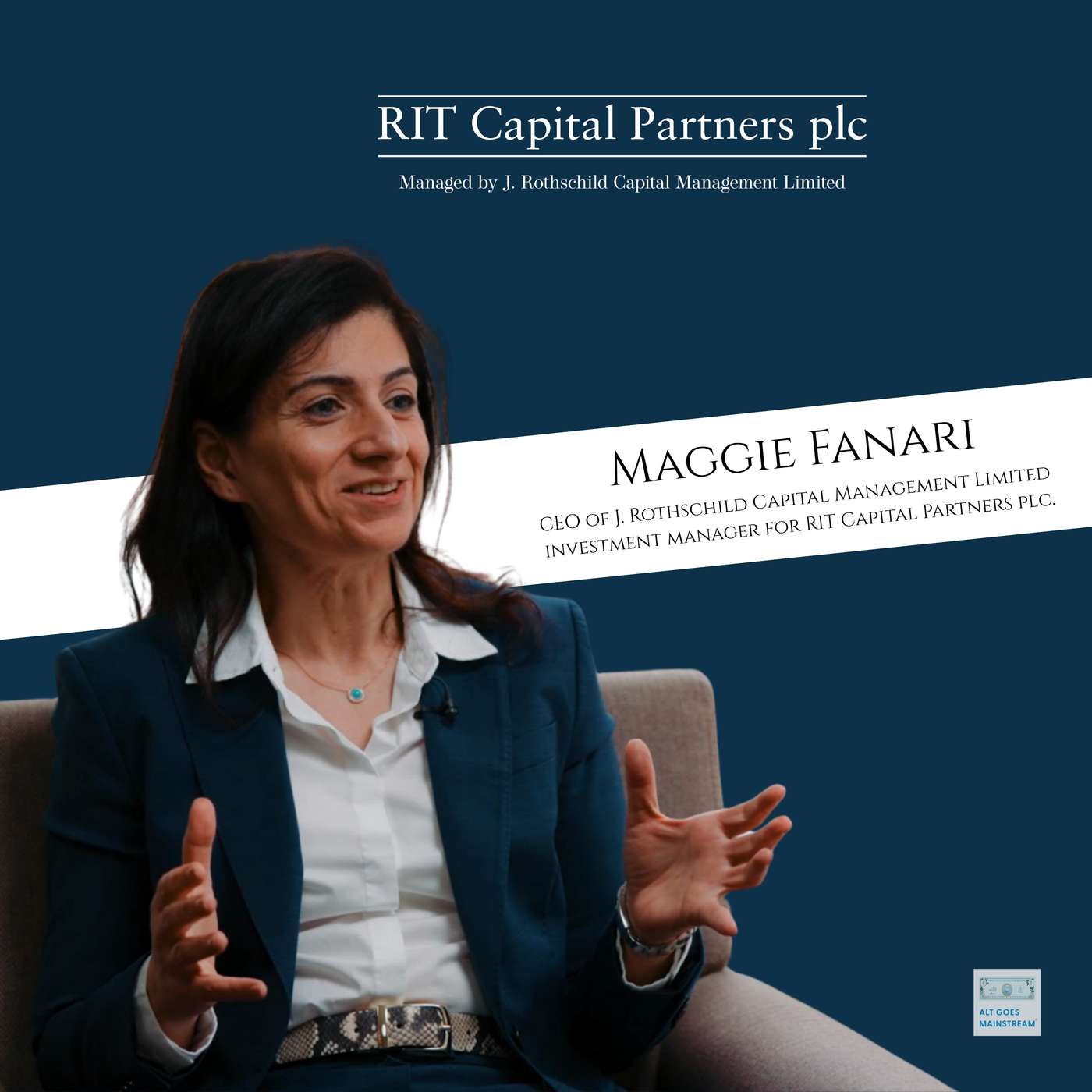
RIT Capital Partners' Maggie Fanari - why permanent capital is a privilege

Welcome back to the Alt Goes Mainstream podcast.Today’s podcast takes us to the heart of London, where we sat down with Maggie Fanari, the CEO of J Rothschild Capital Management Limited, manager of RIT Capital Partners plc. RIT blends a rich heritage with a modern approach to both asset allocation and private markets. Lord Jacob Rothschild founded Rothschild Investment Trust in 1971. RIT listed on the London Stock Exchange with total assets of £280M. Today, the firm stands tall as one of the UK’s largest investment trusts with over £4.7B of total assets.The firm’s permanent capital and family office heritage have enabled the firm to think long-term, according to Maggie. “Permanent capital is a privilege,” she said.Maggie has brought an institutional allocator’s background to RIT. She joined as CEO of RIT from Ontario Teachers’ Pension Plan in 2024, where she was Senior Managing Director, Global Group Head of High Conviction Equities at OTPP, which has a global mandate to invest in public and private companies.Maggie and I had a fascinating discussion about how the firm invests across public and private markets, balancing both top-down portfolio construction and bottom-up asset selection. We covered:How RIT has aimed to compound wealth over time.Why top-down portfolio construction and bottom-up asset allocation are equally important.How can investors capture as much growth, limit market volatility, and compound growth over a long period of time?How RIT finds unique and different managers in private markets, which includes some of the top investors in the world.What market structure changes mean for investing across public and private markets?How to invest when the world order has changed.Taking a family office mindset and applying that investment mindset for investors in RIT.Why permanent capital is a privilege.How to be early to a theme rather than chase the trend.Why RIT decided to invest in SpaceX, Anthropic, OpenAI, Databricks, and Epic Systems.Where do investors bucket RIT into their asset allocation?What is a manager’s edge and how can they apply that edge with consistency?Why depth of network matters for private markets managers.Why RIT invested in firms like Thrive, Greenoaks, and Ribbit.BioMaggie Fanari is the CEO of J. Rothschild Capital Management Limited (JRCM) , investment manager for RIT Capital Partners plc. She is Chair of JRCM’s Investment Committee.Maggie was previously Senior Managing Director, Global Group Head of High Conviction Equities at Ontario Teachers’ Pension Plan, which has a global mandate to invest in public and private companies.At Ontario Teachers’, she served as a member of many of the pension plan’s investment committees. She was involved in the execution of investments across a variety of asset classes (private and public), including supporting the development and execution of the venture and growth business.Before joining Ontario Teachers’, Maggie worked at KPMG and Scotia Capital. Maggie is a chartered accountant and a CFA charter holder. She also holds a BBA from the Schulich School of Business at York University and ICD.D certification from the Institute of Corporate Directors.Maggie served as a non-executive director on the Board of RIT Capital Partners plc from April 2019 to February 2024.Thanks, Maggie, for sharing your wisdom, expertise, and passion across public and private markets and your thoughtful perspectives from your experiences as an institutional investor.This podcast was recorded on 15 June 2026, and therefore all RIT data is provided as at 31/05/2026. Show Notes00:42 Meet Maggie Fanari03:44 Teachers’ Pension Roots04:51 Top Down Meets Bottom Up05:50 Allocating In New Paradigm06:15 Diversification Returns07:02 Volatility Creates Opportunity07:22 What Makes RIT Unique08:08 Compounding With Downside09:41 Brand Opens Doors10:05 Backing Emerging Managers11:57 Co-Invest Importance12:36 Returns And Realizations13:22 Great Co-Investor Playbook15:02 Building AI Theme Exposure16:06 Sourcing Deals Like SpaceX16:37 Public Private Value Split20:09 Public Themes And Sovereignty20:58 Moats And Terminal Value24:06 Permanent Capital Edge25:07 Oversubscribed Fund Access26:46 Underwriting And Discipline27:17 Why AI Needs Capital27:49 Anthropic Growth Math28:15 Databricks Scale Comparison28:41 Can Funds Get Bigger30:22 FOMO And Chasing30:47 Portfolio Allocation Guardrails31:47 Permanent Capital Advantage32:13 Right Sized Private Exposure32:51 Liquidity And Realizations33:28 Owning Winners At Scale34:11 Private To Public Hold34:41 Re Underwriting Post IPO35:38 Retail Investor Impact36:20 Public Market Liquidity Needs37:57 Why Investment Trusts Work38:56 Discounts As Margin Safety40:08 How Shareholders Allocate41:03 Sentiment Shifts In Cycles42:02 What Makes Great Managers43:14 Manager Edge Examples45:02 AI And Finding Leaders46:56 Consolidation And Differentiation47:51 Being A Great LP Partner48:50 Macro Lens As Edge49:42 Private Signals Inform Public50:48 Culture One Team One NAV51:28 Risk And Scenario Analysis52:59 Multipolar World Investing54:14 Geopolitics In Diligence55:10 Permanent Capital Best Of BothA Word from Our Sponsor, UltimusThis episode of Alt Goes Mainstream is brought to you by Ultimus, the full-service fund administrator and transfer agent powering asset managers in private and public markets. As alts go mainstream, you need real expertise to handle complex fund structures, connect with key distribution partners, and handle sophisticated compliance, reporting, and transparency demands.That’s Ultimus: high-tech, high-touch solutions for over 450 clients and 2,500 funds with $775B in assets under administration. Backed by an expert team of over 1,200 employees, they place client service at the core of their business, helping you navigate complexity during your fund structuring or launch and then supporting you through every stage of growth. Whether you’re already in the market or thinking about entering private wealth, you can trust their team’s deep expertise in retail alternatives to help you reach your goals.Learn more at ultimusfundsolutions.com or email info@ultimusfundsolutions.com.We thank Ultimus for their support of alts going mainstream.Editing and post-production work for this episode was provided by The Podcast Consultant.

August 6, 2026Episode 22824 min

Wellington Management's Mike Trihy - going long on evergreen funds: AGM Live from SuperReturn

Welcome back to the Alt Goes Mainstream podcast.We sat down with Mike Trihy, Head of Portfolio Management for the Venture Growth Evergreen strategy at Wellington Management.We were live from Berlin, which becomes the “capital of private capital” in June as private equity industry leaders make the annual pilgrimage to the city for one of the marquee private equity conferences, SuperReturn Berlin.With Prosek Partners and former Bloomberg TV journalist Deirdre Bolton as my producer, along with her team, we took over a Tiny Space cabin to hold big conversations with some of the industry’s leading alternative asset managers.Wellington Management has a rich heritage as an independently owned asset manager. The firm, which has taken a research-driven approach and long-term thinking to active management in public markets and, increasingly, in private markets, is nearing its 100-year anniversary. Wellington has grown to over $1.3T in AUM and is the largest sub-advisor in the world.Mike joined from Bow River Capital to run Wellington’s Venture Growth Evergreen strategy, which will focus on direct growth and venture investments, secondaries, and select fund investments. Mike brings deep expertise in the evergreen fund management space, co-founding and scaling Bow River’s evergreen private markets platform and working as a portfolio manager at evergreen pioneer Partners Group.Mike and I had a fascinating discussion about the current state of evergreen funds and the venture and growth investing market. We covered:The evolution of evergreen private markets funds.The convergence of public and private investing.Lessons learned from building and managing evergreen funds at Partners Group and Bow River.The importance of portfolio construction, liquidity planning, and evergreen fund operations.Which firms are well-positioned to run and manage evergreen funds?Partnerships in asset management.How the market may shake out and why structure must match the asset, the client, and the liquidity terms. LP composition, evergreens vs. drawdowns across wealth and institutions, and the role of partnerships. What the potential wave of mega IPOs could mean for DPI, exits, and private market fundraising.BioAs lead portfolio manager for the Venture Growth Evergreen (“VGE”) strategy, Mike is responsible for overall portfolio construction and allocation of capital across direct growth and venture investments, secondaries, and select fund investments. He also oversees risk management, liquidity management, and cash flow forecasting for the evergreen fund.Prior to joining Wellington Management in 2025 Mike was a portfolio manager at Bow River Capital, where he co-founded and scaled their evergreen private markets platform while overseeing the fund’s investment activity across multiple private markets asset classes. Prior to Bow River, he was a portfolio manager at Partners Group where he was responsible for portfolio construction and asset allocation for evergreen products and custom separate account mandates. He started his investment career at wealth-focused listed private equity firm Red Rocks Capital.Mike graduated from the University of Colorado with a degree in finance, and he is a CFA and CAIA charterholder.Thanks, Mike, for sharing your wisdom, expertise, and perspectives on private markets and evergreen funds.Show Notes00:00 Live from SuperReturn Berlin00:12 Meet Mike Trihy02:06 Defining the Perfect Evergreen02:27 Evergreen vs Drawdown DNA02:42 Deal Flow Isn’t Everything03:01 Portfolio Construction Focus03:20 Cashflow Planning Mindset03:33 Operations and Valuations03:47 Sales and Flow Forecasting04:03 Regulation and Complexity04:11 Fiduciary Growth Discipline04:46 Do Firms Have the Toolkit05:20 Scale vs Boutique Nuances05:42 When Bottom Up Fails06:18 The Deal Flow Constraint06:44 Should There Be More07:00 Shakeout and Quality Wins08:07 No One Best Wrapper08:28 Matching Assets and Clients09:43 LP Mix and Herding Risk11:34 Evergreens Future in Wealth13:21 Public Markets DNA Advantage14:56 Partnerships and Mega IPOs17:07 Private Markets Stay Private18:52 DPI and Exit Wave Impact20:17 Public vs Private Valuations22:21 What Happens Faster Slower24:08 Closing

August 5, 2026Episode 22741 min

Investcorp Strategic Capital Group's Anthony Maniscalco - the evolution of GP stakes

Welcome back to the Alt Goes Mainstream podcast.We sat down with Anthony Maniscalco, the Managing Partner and Business Head of Investcorp Strategic Capital Group (ISCG).We were live from Berlin, which becomes the “capital of private capital” in June as private equity industry leaders make the annual pilgrimage to the city for one of the marquee private equity conferences, SuperReturn Berlin.With Prosek Partners and former Bloomberg TV journalist Deirdre Bolton as my producer, along with her team, we took over a Tiny Space cabin to hold big conversations with some of the industry’s leading alternative asset managers.Investcorp has been a pioneer in private equity. Since its founding in 1982, the firm has grown from a “boutique Gulf firm” into a global and diversified alternative asset manager. Investcorp launched its Strategic Capital Group (SCG) (GP stakes) business long after its founding in 1982. But the firm brought in a pioneer to launch and build SCG into a leading GP stakes firm, which now has over $2.2B of AUM. Anthony has been involved in GP stakes from the industry’s early days. He was a founding member of Blackstone Strategic Capital Holdings, a $3.3B private, permanent capital vehicle focused on acquiring minority interests in alternative asset manager GPs. He was also a Managing Director of the Hedge Fund Solutions business at The Blackstone Group. Prior to joining Investcorp, Anthony was a Managing Director and Co-Head of Credit Suisse Anteil Capital Partners. Launched in 2019, Investcorp’s SCG acquires minority interests in alternative asset managers, particularly GPs that manage longer-duration private capital strategies. SCG has completed 12 investments since inception.Anthony and I had a fascinating conversation about the evolution of GP stakes and the benefits of GP stakes for investors. We covered:Why have stakes shifted from hedge funds to alternative asset managers?Why the features of the alternative asset management business model (contracted management fees, locked-up capital, less key-person risk) can make for a good GP stake investment.Why a GP would sell an equity stake in its firm to finance its growth.Unpacking the middle-market GP landscape and where middle-market GPs need help growing their firm.The evolution from fund to firm and what’s next for GP stakes.BioAnthony Maniscalco is the Managing Partner and Business Head of Investcorp Strategic Capital Group (ISCG), based in New York. ISCG is focused on providing capital solutions to the GPs of mid-sized private market alternative asset managers. ISCG closed its inaugural fund in the Spring of 2022 and currently manages over $2.2 billion of AUM. In his current role, Mr. Maniscalco is focused on managing the overall business, sourcing new investment opportunities, advising portfolio GPs and is the chairperson of the Investment Committee.Prior to his current role, Mr. Maniscalco was a Managing Director and Co-Head of Credit Suisse Anteil Capital Partners. Prior to this, he was Managing Director of the Hedge Fund Solutions business at The Blackstone Group. At Blackstone, he was a founding member and on the investment committee of Blackstone Strategic Capital Holdings, a USD 3.3 billion private, permanent capital vehicle focused on acquiring minority interests in alternative asset manager GPs.Prior to Blackstone, Mr. Maniscalco was Head of Alternative Asset Management Banking at Barclays (and its predecessor Lehman Brothers) within its Financial Institutions Group. Prior to this role, Mr. Maniscalco was head of the Media and Telecom vertical within Lehman Brothers’ Leveraged Finance Group.Early in his career, he worked at Bank of America and its predecessor Continental Bank in Chicago, focused on high-yield, mezzanine, syndicated bank loans, and interim financing products.Anthony holds a B.S. from Indiana University (2026 College Football National Champions!) and an M.B.A. from the University of Chicago.Thanks, Anthony, for sharing your expertise, wisdom, and passion about GP stakes and the business of alternative asset management.Show Notes00:00 Live From Berlin00:15 Meet Anthony Maniscalco02:56 Early Staking Was Hedge Funds03:05 Banks And Prime Brokerage03:40 Private Equity Hits A Wall03:53 Shift To Private Equity Stakes04:30 Why Stakes Are Attractive04:54 Locked In Fee Streams05:31 Carry And Diversification06:06 How LPs Classify Stakes06:59 Three Allocation Buckets07:55 Strategic Access Flywheel09:05 Tougher Fundraising Today09:19 Why Middle Market09:05 Fundraising Help For GPs10:55 Underwriting Growth Readiness12:15 Primary Capital Use Of Proceeds12:49 Why Equity Is Worth It14:46 Talent Retention And Next Gen15:46 Wealth Channel Fit18:23 Portfolio Construction Framework19:36 Why Venture Is Harder23:23 From Fund To Firm24:34 Liquidity And Exit Paths27:35 Prefs, Debt, And New Solutions38:41 Continuation Vehicles Flywheel41:02 Closing Thoughts

August 4, 2026Episode 22629 min

Coller Capital's Jake Elmhirst - secondaries coming in first: AGM Live at SuperReturn

Welcome back to the Alt Goes Mainstream podcast.We sat down with Jake Elmhirst, Partner, Head of Private Wealth Secondaries Solutions and Head of Capital Formation at Coller Capital.We were live from Berlin, which becomes the “capital of private capital” in June as private equity industry leaders make the annual pilgrimage to the city for one of the marquee private equity conferences, SuperReturn Berlin.With Prosek Partners and former Bloomberg TV journalist Deirdre Bolton as my producer, along with her team, we took over a Tiny Space cabin to hold big conversations with some of the industry’s leading alternative asset managers.Coller Capital has been a pioneer in the rapidly growing secondaries market. Coller’s tagline? “First in secondaries.” Coller might be “first in secondaries.” The industry they focus on has moved to the forefront of private markets. Secondaries are coming in first for many LPs, in part because secondaries are now an active portfolio management solution for LPs (LP-led secondaries) and a way for LPs and GPs to continue to invest in the growth and value appreciation of some of their funds’ best assets (GP-led secondaries). The firm completed its first secondaries transaction in 1990 and its first GP-led investment in 1996. Today, Coller has $55B in AUM (as of 3/31/26). Jake joined Coller after a long career at UBS, where he partnered with Coller from a few different vantage points co-founding and co-leading the Private Funds Group within UBS Investment Bank and leading the Private Markets effort within UBS Global Wealth Management. His perspective on Coller was very much a reason why he decided to leave his farm in Yorkshire (as a 23rd generation farmer!) to join Coller as they build out their wealth efforts.Jake and I had a fascinating conversation about the evolution of secondaries and how they are increasingly “solutions” for LPs and GPs. We covered:Jake’s experience witnessing the rise of the early days of private markets and how that’s shaped how he thinks about secondaries today.Why secondaries are becoming “solutions” for LPs and GPs.Why secondaries can be a core portfolio holding.The features of secondaries. The drivers of the increase in LP-led sales.Why have GP-led continuation vehicles become a popular solution?Why secondaries make sense for private wealth investors.BioJake is a Partner and Head of Private Wealth Secondaries Solutions and Head of Capital Formation. He is based in the firm’s London office.Prior to joining Coller Capital in April 2022, Jake spent 25 years at UBS where he led the Private Markets effort within UBS Global Wealth Management, based in London. Prior to that, Jake co-founded and co-led the Private Funds Group within UBS Investment Bank, based in New York.He previously worked at Freshfields in London, where he qualified as a solicitor working in the Tax Team with a focus on collective investment schemes.Jake has a degree in Law (LLB) from the University of Bristol.Jake Elmhirst is a registered representative of Parallel Distributors LLC.Thanks, Jake, for sharing your wisdom, expertise, and passion in private markets, private wealth, and secondaries. Show Notes 00:00 Live in Berlin Intro00:39 Jake Elmhirst’s Career Journey02:08 Wealth Channel Lessons05:06 Farming Roots Detour07:34 Secondaries Liquidity Fix09:26 Continuation Vehicles Impact11:21 Wealth Channel and Scale13:21 Why Secondaries Work15:15 Core Holding for Wealth16:31 Discount Versus Quality18:43 Underwriting in CV Era20:56 Evergreen Portfolio Mix21:56 Future of Solutions23:02 Toolbox Expansion Ideas24:55 Why Scale Matters25:53 Discount Nuance Explained27:30 Active Portfolio Management28:45 Closing Thoughts

July 30, 2026Episode 22523 min

Goldman Sachs' Kyle Kniffen - the arc of alternatives at Goldman Sachs: AGM Live at SuperReturn

Welcome back to the Alt Goes Mainstream podcast.We sat down with Kyle Kniffen, Managing Director, Global Head of Alternatives, Third Party Wealth at Goldman Sachs. We were live from Berlin, which becomes the “capital of private capital” in June as private equity industry leaders make the annual pilgrimage to the city for one of the marquee private equity conferences, SuperReturn Berlin.With Prosek Partners and former Bloomberg TV journalist Deirdre Bolton as my producer, along with her team, we took over a Tiny Space cabin to hold big conversations with some of the industry’s leading alternative asset managers.A little over two years ago, I wrote on AGM about how, at $456B in AUM in alternatives, Goldman Sachs was a “sleeping giant” in private markets. In reality, Goldman is anything but a sleeping giant in private markets, having started its private equity business in 1984 and earning the distinction of being a top-5 alternatives manager by AUM across both traditional and alternative asset managers.Today, Goldman has grown its alternatives business to over $625B in AUM.The firm has expanded its platform with the acquisition of Industry Ventures and a partnership with T. Rowe Price to deliver public and private markets solutions to the wealth channel, and, most recently, the creation of its Alternative Investment Platform to provide HNW clients with direct access to private companies.The evolution of Goldman’s Alternatives business reflects a thoughtful, measured approach to understanding the needs of wealth channel investors and finding the utility and purpose of strategy, product, and product structure.That was much of the focus of the conversation Kyle and I had in Berlin. We discussed the objective and utility of private markets in a portfolio. We covered:The growth of evergreen funds.Why evergreens are the product structure of choice.Why are evergreens also appealing to institutional allocators, insurance companies, and UHNW investors?How GPs and LPs are approaching LP composition to evergreen vehicles.The next wave of product innovation.The build, buy, partner framework Why Goldman is so excited about the GeoWealth partnership and what the future of model portfolios look like.What is not known but should be known about the Goldman Alternatives franchise.BioKyle Kniffen is a managing director in the Client Solutions Group within Goldman Sachs Asset Management. He serves as global head of Alternatives for Third Party Wealth (TPW), overseeing client strategy for the firm’s TPW clients globally, delivering the power of the Alternatives investing platform to a broad set of individual investors through our partnerships with financial intermediary clients and their advisors, including Private Banks, Broker-Dealers, RIAs and other distribution platforms. Kyle partners closely with leadership across our Alternatives franchise to develop products that meet our clients’ evolving needs. He is also co-chair of the AWM Global Distribution Working Group.Prior to this role, Kyle was in Alternative Capital Markets (ACM), serving as head of ACM for Goldman Sachs Ayco and leading coverage for One Goldman Sachs financial sponsors globally. He joined Goldman Sachs in 2018 as a vice president in ACM and was named managing director in 2021.Prior to joining Goldman Sachs, Kyle led a variety of distribution and product management teams for Bank of America’s Alternative Investment Group within their Global Wealth and Investment Management division.Kyle is a board member for the Institute of Portfolio Alternatives (IPA), and a member of The Economic Club of New York. Kyle earned a BA from Gettysburg College.Thanks, Kyle, for sharing your wisdom, expertise, and passion about private markets and serving the wealth channel.Show Notes00:00 AGM Live from SuperReturn Berlin00:22 Meet Kyle Kniffin01:10 Wealth Meets Private Markets01:37 Big Pools Little Allocation02:24 Alt Strategies Explosion03:04 Lessons from Hedge Funds03:34 Start with Client Goals03:53 Risk Liquidity Tradeoffs04:10 Portfolio Utility First04:25 Holistic Private Markets04:44 Fit and Terms Matter05:07 Setting Expectations05:32 Product Innovation Shift05:52 Evergreens and Flexibility06:10 Monthly Access and Tactics06:39 Evergreen Growth Rates06:45 Education and Dispersion07:15 Why Evergreens Exist07:41 Diversification Lower Minimums08:04 Operational Simplicity08:21 Evergreen Nuance Phase One08:47 Goldman in Third Party Wealth09:26 Institutions Buying Evergreens10:31 LP Mix and Liquidity Caps11:36 Institutionalizing Wealth Platforms13:29 Goldman Platform Advantage14:46 Feeding the Evergreen Engine15:13 GeoWealth and Model Portfolios15:45 T Rowe Price Collaboration16:12 Build vs Buy Partner Balance16:42 Industry Ventures Acquisition17:33 Goldman Alts Heritage18:35 Pioneering GP Stakes19:45 Secondaries Since 199820:12 Apex of Private Markets21:08 Will Secondaries Be Core21:48 Max Flexibility for Wealth22:42 Customization vs Scale23:16 Flagships Then Bespoke23:49 Lessons from Private Wealth25:10 Broader Menu of Privates25:34 Closing Thoughts

July 29, 2026Episode 22425 min

Sagard's Paul Desmarais III - building the next generation alternative asset manager: AGM Live at SuperReturn

Welcome back to the Alt Goes Mainstream podcast.We sat down with Paul Desmarais III, the Co-Founder, Chairman, and CEO of Sagard, the fast-growing $46B global multi-strategy alternative asset manager.We were live from Berlin, which becomes the “capital of private capital” in June as private equity industry leaders make the annual pilgrimage to the city for one of the marquee private equity conferences, SuperReturn Berlin.With Prosek Partners and former Bloomberg TV journalist Deirdre Bolton as my producer, along with her team, we took over a Tiny Space cabin to hold big conversations with some of the industry’s leading alternative asset managers.Sagard combines a rich history and heritage of building asset management businesses with a modern approach to building a global alternative asset manager.Paul’s deep understanding of the industry comes from being part of a family of multiple generations of asset management pioneers in Canada who have built some of the industry’s largest financial services businesses. Paul is the “next first generation” of asset management pioneers to come out of the Desmarais family. He started Sagard with $400M in seed capital in 2016 and, in ten short years, has grown the platform into a global multi-strategy alternative asset manager with over $46B. Sagard’s mission to empower founders by being a business that builds businesses shines through in the approach Paul and the team have taken in building Sagard. The firm has incubated, built, and acquired asset management talent and firms to scale across strategy and geography into the global platform that it is today.Paul and I had a fascinating conversation about the business of asset management and why Sagard exists to serve entrepreneurs around the world. We covered:Sagard’s entrepreneurial DNA.What does it mean to build a business that builds businesses?Being the “next first generation.”How Sagard approaches the buy, build, partner framework of asset management businesses.How Sagard has expanded its platform across asset classes and strategies.How to build a global, multi-strategy asset management brand.Why specialization matters in asset management.How to approach the wealth channel.The decentralized pod shop model.The future of private markets.BioPaul Desmarais III is the Chairman and CEO of Sagard, an alternative asset management firm active in venture capital, private equity, credit, and real estate.Paul has led Sagard since 2016, along with a handful of close partners bound by a common vision: partnering with entrepreneurs to catalyze transformation in our investments and communities. Sagard has experienced outstanding growth, with assets under management increasing to over $46B.Under Paul, Sagard has built a global network of expertise that helps companies lead, embrace, and stay ahead of disruptive trends, expanding activity in North America, Europe, and the Middle East. Paul engages actively in growing Sagard companies. Within the Sagard ecosystem, Paul is the Executive Chairman and Co-Founder of Portage (fintech & financial services investing) and the Chairman and Co-Founder of Diagram (venture builder). Within the investment portfolios, he is the Chairman of Wealthsimple, Novisto, and Sagard Wealth, and a director of Nesto and Midas. Paul also sits on the board of Empower, the number two 401(k) business in the U.S.Show Notes00:00 Live From SuperReturn00:10 Meet Paul Desmarais III01:06 Family Business Roots01:23 G1 Entrepreneur Mindset01:35 Launching Sagard 201601:51 Generational Reinvention02:02 Early Spark To Build03:40 Learning From Mistakes04:33 By Entrepreneurs For Entrepreneurs04:45 Sagard Origin Story04:58 Power Corp Alternatives Gap05:43 Starting With Credit06:10 Serving Beyond The Family06:46 Alignment With Family Capital07:19 Customer First Performance07:44 Team Money Invested07:53 Generational Time Horizon08:47 Patience Builds Partnerships09:22 Innovation In The DNA09:39 Regional To Global Champions09:53 Why Reinvention Matters10:26 Platform Strategy Mix11:02 Pillars Of The Firm11:25 Fintech Ecosystem Flywheel11:35 Building The Competitive Moat12:07 Emerging Managers Advantage12:41 Synergies At Scale13:08 Designing Collaboration13:47 Incentives And Shared Carry15:07 Values Drive Culture23:25 Legacy And Entrepreneur Impact24:39 Closing Thanks

July 28, 2026Episode 22331 min

Brookfield's Anuj Ranjan - "own the boring that makes exciting possible": AGM Live at SuperReturn

Welcome back to the Alt Goes Mainstream podcast.We sat down with Brookfield Private Equity CEO Anuj Ranjan. We were live from Berlin, which becomes the “capital of private capital” in June as private equity industry leaders make the annual pilgrimage to the city for one of the marquee private equity conferences, SuperReturn Berlin.With Prosek Partners and former Bloomberg TV journalist Deirdre Bolton as my producer, along with her team, we took over a Tiny Space cabin to hold big conversations with some of the industry’s leading alternative asset managers.Brookfield has a rich legacy as an asset owner and operator of some of the “businesses that drive the global economy.” Brookfield is a firm where skin in the game (~25% of every fund includes an investment from Brookfield’s balance sheet) meets scale and synergies across its investment platform, which spans private equity, infrastructure, real estate, credit, and energy.Now, they are looking to own what’s next.What will the next era of private equity require? A different approach, according to Brookfield Private Equity CEO Anuj Ranjan. The conversation that Anuj and I had in the Tiny Space cabin covered big themes.Brookfield is investing in the megatrends that are driving the world’s economy across its platform, from digitalization to decarbonization to deglobalization. The firm’s focus on industrials in its private equity business makes it well equipped to invest in essential companies, as Brookfield aptly describes their investment focus as “own[ing] the boring that makes exciting possible.”Anuj and I had a fascinating conversation about the current state of private equity and what it will take to drive value in a new era for the industry where “12 is the new 5.” We covered:Brookfield’s history as an owner-operator.How the firm’s long-term perspective informs its investments in and ownership of private equity-backed companies.Anuj’s experience investing in India was an exercise in patience.Why is today the era of “roll up your sleeves private equity?”How Brookfield is approaching value creation in industrial companies.Where Brookfield believes it can leverage AI to create post-deal operational value.Why Brookfield partnered with OpenAI to create DeployCo in order to scale enterprise AI deployment.Where are we in the adoption curve of physical AI and robotics?BioAnuj Ranjan is Chief Executive Officer of Brookfield’s Private Equity Group and Brookfield Business Corporation. In this role, Mr. Ranjan is responsible for the investments, operations, and expansion of the Private Equity business, in addition to managing Brookfield’s external strategic partnerships. He is a member of Brookfield’s Executive Committee.Mr. Ranjan joined Brookfield in 2006 and has held various positions within the company and its affiliates. He established and previously led Brookfield’s India and Middle East operations.Mr. Ranjan holds a Master of Business Administration degree from Ivey Business School at Western University and a Bachelor of Science degree from the University of Alberta.Thanks, Anuj, for sharing your wisdom, expertise, and passion about private markets and how to create value through operating companies better.Show Notes00:00 Welcome to SuperReturn00:07 Meet Anuj Ranjan00:55 From Software to Finance02:03 Building India and Mideast02:48 India Deal Frenzy03:17 Five Years of Patience03:22 Learning Before Buying03:28 First True Buyouts04:06 Profits and Team Growth04:16 Taking Model Global04:32 Growth Amid Headwinds04:58 Roll Up Sleeves Private Equity Era05:06 Operational Value Creation05:12 Brookfield Platform DNA05:33 Balance Sheet Advantage05:54 Long-Term Investing06:12 Patience Gets Rewarded07:14 Testing Tech on Balance Sheet07:32 Owning What’s Next07:41 AI Needs Hard Assets07:58 Brookfield at the Center09:09 One Firm Collaboration09:51 Platform Informs Deals11:27 Westinghouse Nuclear Bet15:19 Picking the Right Carve Outs16:34 Pricing Power Example17:51 From Five to Twelve18:59 Why Carve Outs Win Now20:05 AI for Industrial Ops20:53 Data Before AI22:12 Predictive Maintenance Story23:31 Physical AI and Robotics24:52 Digitizing the Physical World25:33 Humanoid Robotics Timeline26:28 Deploying AI at Scale26:56 Execution Beats Innovation27:52 Best AI Investment Thesis28:00 Buying Boring Businesses28:52 AI Ready Leadership Team29:30 Hiring Real Tech Leaders30:00 Blockbuster vs Netflix30:43 Closing Reflections

July 22, 2026Episode 22225 min

Vista Equity Partners' Monti Saroya - "harnessing" the power of AI in the enterprise: AGM Live at SuperReturn

Welcome back to the Alt Goes Mainstream podcast.We sat down with Vista Equity Partners’ Senior Managing Director, Co-Head of Flagship Fund, Monti Saroya. We were live from Berlin, which becomes the “capital of private capital” in June as private equity industry leaders make the annual pilgrimage to the city for one of the marquee private equity conferences, SuperReturn Berlin.With Prosek Partners and former Bloomberg TV journalist Deirdre Bolton as my producer, along with her team, we took over a Tiny Space cabin to hold big conversations with some of the industry’s leading alternative asset managers.Vista Equity Partners has been a pioneer in enterprise software investing. They have been at the forefront of every major technology platform shift, whether it was on-prem to cloud, the adoption of enterprise software, and now the agentification of the enterprise with AI.The $103B AUM scaled specialist software investor has dedicated its efforts to building “mission critical” enterprise software companies that organizations can’t live without.Monti has had a front-row seat in building and developing both infrastructure and software that the technology industry can’t live without. He brings to bear the perspective of someone who lived through the early days of the internet from his time at Cisco Systems and Siebel Systems. Through this lens, and drawing on his experience investing in enterprise software companies since joining Vista in 2008, Monti is able to make sense of where, how, and why AI will be adopted within the enterprise, and what it means for both operators and investors.This conversation with Monti was one of the most illuminating conversations I’ve had on AI recently. He pieced together so much of what is happening in AI today, covering:The different layers of AI adoption.Why “harness” companies can be valuable.Where AI agents are having the most impact on a business.Why open source is the next wave of the AI buildout.The Linux lesson for AI.Why Monti is so excited about the firm’s investment in SambaNova.Do “harness” companies have a moat?Why the moats for many AI companies might surprise you.Why sovereign AI is the next big thing.BioMonti Saroya joined Vista Equity Partners in 2008 and is Co-Head of the Vista Flagship Fund and sits on its Investment Committee.Additionally, Monti serves as a member of Vista’s Executive Committee, the firm’s governing and decision- making body for matters affecting its overall management and strategic direction, and Vista’s Private Equity Management Committee, the firm’s decision-making body for matters affecting Vista’s overall private equity platform.Monti is also the Co-Chief Executive Officer of VistaOne, Vista’s evergreen private equity vehicle, and serves on the Investment Committee. Monti helps lead Vista’s artificial intelligence initiatives, driving the firm’s approach to AI adoption through strategic partnerships and the deployment of AI-enabled infrastructure and capabilities across the platform and portfolio ecosystem.He currently sits on the boards of Acumatica, Allvue Systems, Avalara, Cloud Software Group, Duck Creek, Finastra, Infoblox, Playlist, Smartsheet, Solera, among others. Monti was actively involved in the firm’s investments in Apptio, Cvent (NASDAQ: CVT), Datto (formerly NYSE: MSP), Marketo, PowerSchool (formerly NYSE: PWSC), SumTotal, The ACTIVENetwork, and Transfirst, among others.Prior to Vista, Monti worked as a Senior Research Analyst for JMP Securities, where he provided research for buy-side clients on public on-demand (SaaS) companies. Monti previously worked as an Associate on the enterprise software/applications team. Before JMP, Monti worked at Siebel Systems in a sales capacity for the CRM On Demand division. Prior to Siebel, Monti worked for Cisco Systems in various operations roles.Thanks, Monti, for sharing your wisdom, expertise, and passion about AI, enterprise software, and technology transformations.Show Notes00:00 Intro: Live from SuperReturn00:10 Meet Monti Saroya00:20 Why AI Matters Now00:41 Career Origins Cisco00:57 Building Internet 1.0 01:21 Infrastructure Before Apps01:25 From Compute to Giants01:38 AI as New Buildout01:56 Internet 1.0 Lessons02:17 Change Slower Then Bigger02:48 Consumer Adoption First03:08 What We Underestimate03:26 AI Like Electricity03:41 Three Layer AI Stack04:03 Cloud Providers Layer04:15 App Layer Value Capture04:26 What Is the App Layer04:41 Software Needs Humans05:25 Agents System of Action05:53 Where Agents Impact Today06:20 Engineering Productivity Gains07:29 Augment Not Replace07:51 Rearchitecting With AI08:16 Harnesses Around Intelligence09:17 Routing Cuts Compute Cost09:26 Model Choice and Governance10:55 Enterprise Goals Drive AI11:51 Workflow Context Is Key12:47 SambaNova Compute Economics14:27 Token Subsidies Ending15:39 Open Source Next Wave16:02 Linux Lesson for AI17:03 Deploying Is the Hard Part17:40 Vista Agentic Factory18:42 Avoiding Services Trap19:05 Where Value Gets Created19:32 NeoCloud Inference Centers20:21 Harness Companies and Moats21:05 Enterprise Software Reality Check21:51 CFOs Demand ROI Metrics22:44 Word Association Game23:15 Workflow Specific Future23:48 Sovereign AI Is Coming24:24 Wrap Up and Thanks

July 21, 2026Episode 22128 min

Apax's Andrew Sillitoe and Mitch Truwit - buying complexity for value in the middle market: AGM Live from SuperReturn

Welcome back to the Alt Goes Mainstream podcast.We were live from Berlin, which becomes the “capital of private capital” in June as the private equity’s industry leaders make the annual pilgrimage to the city for one of the marquee private equity conferences, SuperReturn Berlin.Much of the SuperReturn conference is centered on fundraising. GPs take up every available space — from hotel rooms to Tiny Space cabins that line the parking spots on Budapester Strasse outside of the InterContinental conference venue — to conduct meetings with LPs.With Prosek Partners and former Bloomberg TV journalist Deirdre Bolton as my producer, along with her team, we took over a Tiny Space cabin to hold big conversations with some of the industry’s leading alternative asset managers.Our first conversation was with Apax Co-CEOs Andrew Sillitoe and Mitch Truwit.Apax is one of the pioneers in the private equity industry. The firm’s rich history dates back to the 1970s, when its founders, Alan Patricof (US), Sir Ronald Cohen (UK), and Maurice Tchénio (France), came together to establish the first US-UK partnership firm in private equity. During that time period, the firm backed Steve Jobs and the first iteration of Apple. The UK and US firms merged in 1981, laying the foundation for Apax.Today, Apax stands at over $80B in aggregate funds raised. The firm underwent its second leadership transition in 2014, when Andrew and Mitch were elected as Co-CEOs, succeeding Martin Halusa, who became Chairman.Apax sits in a unique position. They are a scaled platform that focuses on the middle market. They operate across three sectors, Tech, Services, and Digital / Consumer, infusing a digital DNA and value creation team into everything they do. Their platform spans “a mile wide and a mile deep,” which is what much of the conversation between Andrew, Mitch, and me unpacked.We had a fascinating discussion about the current state of private equity and the middle market, why Apax focuses on “density-driven business models,” why the firm focuses on carveouts in the middle market, what’s underappreciated about the middle market, why it’s important to “buy in the right neighborhood and fix it up,” and how the firm’s core values of “having impact through insight and tenacity” drive every decision they make.BiosAndrew Sillitoe has been Co-CEO of Apax since 2014. He is Chairman of the Apax Global Investment Committee and the Digital Investment Committee, amongst others. He is also a member of the Apax Executive Committee. He has been based in London since joining the Firm in 1998, focusing on Tech & Telco investments.Andrew has been involved in a number of investments including Inmarsat, Intelsat, King, Orange Switzerland, TIVIT, TDC and Unilabs.Prior to joining Apax, Andrew was a consultant at LEK. Andrew holds an MA in Politics, Philosophy and Economics from the University of Oxford and an MBA from INSEAD.BoardsAndrew has previously served on the boards of Inmarsat, King, Intelsat, Orange Switzerland and TDC.Mitch Truwit is Co-CEO of Apax, based in New York.Prior to joining Apax in 2006, Mitch was the President and CEO of Orbitz Worldwide between 2005 and 2006 and was the Executive Vice President and Chief Operating Officer of priceline.com between 2001 and 2005.Mitch is a graduate of Vassar College where he received a BA in Political Science. He also holds an MBA from the Harvard Business School.BoardsMitch serves as a Board member of Openlane and Trade Me. Prior boards include Advantage Sales & Marketing, Assured Partners, Dealer.com, Bankrate, Garda World, Hub International, Trader Canada, Boats Group and Quality Distribution Inc.Mitch serves on the charitable boards of the Apax Foundation, the John McEnroe Tennis Project, Posse and StreetSquash.Thanks, Andrew and Mitch, for a fascinating conversation and for sharing your expertise, wisdom, and passion at the intersection of investing and operating in private equity.Show Notes00:00 Meet Apax co-CEOs, Andrew Sillitoe and Mitch Truwit00:26 Andrew’s Origins at Apax00:47 Private Equity Then vs Now01:25 Apax Growth and Values01:45 Curiosity as a Differentiator02:04 Mitch’s Operator Background02:56 Why Mitch Joined Apax03:40 Defining the Middle Market04:14 Why Sub-Billion EV Works04:59 Middle Market Talent Gap05:20 Carve Outs as a Strategy05:29 TRADER Corporation - Canada App Turnaround06:12 Scaled Platform Advantage07:14 Digital DNA and AI Wave07:50 Top Line Growth Lever08:36 Add-ons and TAM Expansion09:33 ECI Case Study Roll Up10:07 Integration Over Collection10:28 Exit Options in a Bigger PE World10:59 Building for Multiple Buyers11:45 Fund Size Discipline12:34 Choosing Returns Over AUM13:16 Understanding Firm DNA14:01 Global Micro Investing14:49 Making Global Pods Work15:50 Scale Specialization Flexibility17:08 Where to Invest Now19:23 Buying Complexity for Value20:15 Moats and Investment Committee22:13 Why Middle Market Excites Them23:19 Future of PE and AI at Scale24:50 Impact Insight Tenacity Culture25:54 Obligation to Dissent Story26:55 Aspirational Brand Analogy27:48 Wrap Up and Thanks

July 9, 2026Episode 22038 min

Blackstone's Farhad Karim - a "relentless" focus on serving private wealth

Welcome back to the Alt Goes Mainstream podcast.Today’s podcast takes us to the heart of Mayfair in London, where Blackstone Private Wealth COO Farhad Karim shared the firm’s history and evolution in Europe. He took a walk down memory lane to discuss the firm’s 25th anniversary in Europe as we walked through Berkeley Square from Blackstone’s current office to their new office at the other end of the square, highlighting how the firm has become the largest owner of commercial real estate in Europe and the importance of building a local presence in the region.Farhad took on the role of Chief Operating Officer of Blackstone Private Wealth in 2024 after a career at Blackstone that included serving as Chairman and Chief Operating Officer of Blackstone Europe and holding a senior leadership role in the firm’s Real Estate business.Farhad and I had a fascinating discussion about the evolution of Blackstone’s business in Europe and the firm’s Private Wealth business globally. We covered:Why it’s important to “meet people where they are at.”What Farhad learned from his experience as chairman of Blackstone Europe.Building and expanding Blackstone’s Private Wealth business.How Blackstone will continue to be a pioneer in private wealth.The next phase of product innovation in the wealth channel.How an international perspective has shaped Farhad's approach to building the Private Wealth business.Harmonizing the institutional and private wealth businesses when delivering solutions to LPs.The human element of working with wealth.What it means to be “relentless.”Perspectives on evergreen funds.The scale of opportunity, information, and access.Thanks, Farhad, for sharing your wisdom, expertise, and passion about private markets and private wealth.Show Notes00:33 A Message from Our Sponsor, Ultimus Fund Solutions02:14 Farhad’s Blackstone Journey03:37 Speed and Certainty Culture04:07 Real Estate to Wealth Channel Parallels05:04 Building for Local Markets06:16 On-the-Ground Coverage Worldwide07:45 Education at Scale08:52 How Well Advisors Understand Private Markets10:45 Early Innings Adoption12:09 Packaging Private Markets Products13:46 Simplicity vs Customization14:39 Consolidation and Institutionalization19:14 Global Trends Localization19:33 Scale and Deal Competition20:11 AI Advantage in Investing20:53 Portfolio Ops AI Playbook21:42 Private Markets Risk Setup22:17 Noise Versus Facts22:57 Fighting False Narratives23:42 Wealth Channel Narrative24:18 Why Private Markets Matter25:10 Investing Through Geopolitics26:25 Evergreen Versus Drawdown27:21 Discipline Over Structure28:28 Semi-liquid as a Feature29:17 Evergreen for Founders30:39 Evergreen Mindset and Compounding32:01 Owning the Narrative Direct35:22 Fiduciary Seriousness Balance36:15 Relentless Culture Explained38:39 Closing Footnotes(Timestamp 02:46.7): Largest owners of commercial real estate in Europe.(Timestamp 31:33.0): Reference to Class I annualized, inception-to-date return from January 2017.A Word from Our Sponsor, UltimusThis episode of Alt Goes Mainstream is brought to you by Ultimus, the full-service fund administrator and transfer agent powering asset managers in private and public markets. As alts go mainstream, you need real expertise to handle complex fund structures, connect with key distribution partners, and handle sophisticated compliance, reporting, and transparency demands.That’s Ultimus: high-tech, high-touch solutions for over 450 clients and 2,500 funds with $775B in assets under administration. Backed by an expert team of over 1,200 employees, they place client service at the core of their business, helping you navigate complexity during your fund structuring or launch and then supporting you through every stage of growth. Whether you’re already in the market or thinking about entering private wealth, you can trust their team’s deep expertise in retail alternatives to help you reach your goals.Learn more at ultimusfundsolutions.com or email info@ultimusfundsolutions.com.We thank Ultimus for their support of alts going mainstream.

Is this your show?

Claim this listing to keep it up to date, reach guests who want to pitch you, and manage bookings with Guestify.

Claim this listing

More Business podcasts