If you have complex questions about your healthcare business, Zotec has answers. In this podcast series, experts at Zotec answer key questions around healthcare revenue cycle management, patient experience, business strategy, financial advice, and more. Tune in today to get the answers you seek.
Listen to episodes
60 recent
October 14, 202617 min
Why is the Find It Early Act still stalled, and is there a viable path forward for national 3D mammography coverage?
October is Breast Cancer Awareness Month, and this episode takes a closer look at a critical healthcare access question: Should coverage for medically recommended breast imaging depend on where a patient lives or what type of insurance card they carry? Jennifer Fox, Megan Applegarth, and Mark Isenberg break down the patchwork of state breast imaging coverage laws, the limits of state action for self-funded employer plans, and the potential impact of the Find It Early Act . Key topics include: Why breast imaging coverage varies by state, plan type, and service classification The difference between screening, diagnostic, and supplemental breast imaging How dense breast tissue can make cancer harder to detect on a mammogram alone Why self-funded ERISA plans are often exempt from state insurance mandates What the Find It Early Act would change for patients, physicians, and clinicians How the bill could expand coverage for 2D mammography, 3D mammography, ultrasound, MRI, and other appropriate breast imaging Why eliminating deductibles, copays, and coinsurance may help reduce delays in follow-up care Why the bill has bipartisan support but remains stalled in Congress How committee jurisdiction, healthcare costs, and competing priorities affect the bill’s path forward Why early detection is central to improving outcomes and reducing long-term healthcare costs The episode also encourages listeners to stay informed ahead of the 2026 midterm elections. For nonpartisan election resources, text ZPVOTE to 50457 to access the Zotec Election Center.
October 5, 202617 min
Why is the IDR process different in Florida, and how has it evolved due to recent advocacy efforts?
In this Zotec Answers episode, Ed Gaines and Dr. Eliot Goldner break down Florida’s out-of-network claims dispute process, how it differs from the federal No Surprises Act IDR process, and why recent advocacy efforts matter for physicians and clinicians. Key topics include: How Florida’s state-specified law applies to certain out-of-network claims Why the No Surprises Act does not replace valid state dispute resolution processes The difference between state-regulated plans and ERISA plans in IDR How payer opt-outs weakened Florida’s process over time Why advocacy was needed to clarify and preserve the state process How FCEP, EDPMA, radiology, and other physician groups worked together Why coalition-building is critical in healthcare policy What other states can learn from Florida’s IDR advocacy win Why physician engagement remains essential to fair reimbursement and patient access Ed and Dr. Goldner also highlight the importance of continued vigilance as insurers, regulators, and lawmakers respond to evolving No Surprises Act implementation. As the November 3 midterm elections approach, listeners can access Zotec’s free, nonpartisan Election Center by clicking here or by texting ZPVOTE to 50457 to review voter registration information, ballot details, polling locations, and more. Related listening: For more on the No Surprises Act and physician reimbursement, listen to our previous Zotec Answers episode, “Who Is Really ‘Gaming’ Who in the NSA?”
September 30, 202613 min
Who should be accountable when AI influences healthcare decisions?
Who should be accountable when artificial intelligence influences healthcare decisions? In this episode of Zotec Answers , Jennifer Fox and Megan Applegarth examine how AI regulation, health insurance prior authorization, Medicare oversight, and state laws are shaping the future of healthcare. They explore the benefits AI can offer while addressing a critical concern: When technology influences patient care or coverage, who is ultimately responsible for the outcome? Key topics include: How the federal government is approaching AI innovation, safety, and oversight What the proposed federal AI Force and AI Czar could mean for national AI policy How the Open-Source AI Leadership Act , or H.R. 10152, would support American open AI models How the bipartisan AI for Secure Networks Act , or H.R. 7294, would examine AI’s effect on telecommunications security Why AI-assisted coverage reviews and prior authorization require transparency and qualified human oversight Whether physicians and patients can effectively challenge an AI-influenced decision How CMS’s WISeR Model uses technology, including AI, to review selected Traditional Medicare services Concerns surrounding WISeR, including patient access, delays, financial incentives, transparency, and possible expansion How state AI laws are addressing health insurance decisions, clinician review, and AI-powered therapy chatbots Why healthcare organizations should identify where AI is operating and what decisions it influences How integrated AI tools can improve documentation and efficiency without replacing physician judgment Jen and Megan explain that responsible healthcare AI requires more than an accurate algorithm. Organizations must understand how each tool works, who reviews its recommendations, whether results can be explained, and what happens when a physician or patient disagrees. They also discuss how AI can support healthcare when it solves a clearly defined problem within existing workflows. Real-time documentation support is one example, helping reduce documentation gaps, improve efficiency, and support appropriate reimbursement while keeping physicians responsible for the final judgment. Learn more about integrated AI documentation support in How Is Zotec’s AI-Driven Documentation Streamlining Patient Care? Have an idea for a future episode? Email zotecanswers@zotecpartners.com .
September 16, 202615 min
How is Zotec's AI-driven documentation streamlining patient care?
In this episode, Ed Gaines and Dr. Mohak “Mo” Davé take a closer look at how AI-driven documentation is changing the way emergency physicians and clinicians approach patient care, coding, and workflow efficiency. Key topics include: Why documentation has long been a challenge for emergency medicine How ZDI provides real-time feedback while clinicians are still documenting patient care Common documentation gaps, including critical care time, independent interpretations, and consultant communication How AI can help physicians and clinicians get credit for the work they are already doing Why reducing RFIs, or requests for information, can help speed up coding and billing How documentation tools can support better education, consistency, and behavior change Why the goal is to streamline workflows without creating unnecessary alert fatigue How AI-driven documentation can help preserve the full story of the patient encounter Ed and Dr. Davé also discuss the future of ZDI and how real-time documentation support may continue to improve physician efficiency, patient care, and revenue cycle outcomes. If you are attending ACEP Scientific Assembly in Chicago this October and would like to attend the ZDI discussion featuring Dr. Davé, contact Ed Gaines or Dr. Davé to reserve your seat.
September 2, 20268 min
What do the new state-led AI laws mean for healthcare?
Artificial intelligence is becoming more integrated into healthcare, and states are moving quickly to regulate how it can be used. During the first half of 2026, states enacted 84 AI-related laws, including 14 that directly affect healthcare. In this episode of Zotec Answers , Jennifer Fox, Director of Compliance and Advocacy Communications at Zotec Partners, and Megan Applegarth, Manager of Client Advocacy and Government Affairs, explain what these new state-led AI laws mean for healthcare organizations, insurers, physicians, clinicians, and patients. From AI-assisted prior authorization and insurance coverage decisions to mental health chatbots and clinical documentation, states are establishing a consistent standard: AI can support healthcare decisions, but it should not replace human judgment. In this episode, you’ll learn: Why states are advancing healthcare AI laws without waiting for a comprehensive federal framework How AI can be used in prior authorization and medical necessity determinations Why several states require human review before care is denied, delayed, or modified How states are addressing AI transparency, accountability, and potential discrimination What new laws mean for AI-assisted claims downcoding and reimbursement decisions Why states are limiting AI-powered therapy and mental health chatbots What disclosure requirements may apply to AI recording and clinical transcription How state and federal action could shape the future of healthcare AI regulation What do these AI laws mean for healthcare organizations? Healthcare organizations should identify where AI is currently being used, confirm that licensed physicians or clinicians remain involved in consequential decisions, evaluate applicable disclosure requirements, and monitor developments in every state where they operate. Across the laws discussed, four priorities are clear: human oversight, transparency, accountability, and independent medical judgment. Have a healthcare policy question you would like answered in a future episode? Email zotecanswers@zotecpartners.com .
August 20, 202613 min
Will a new Congress change the future of healthcare?
The 2026 midterm elections could reshape healthcare policy by changing the makeup of Congress, committee leadership, and the legislative priorities affecting physicians and healthcare organizations. From physician reimbursement and administrative reform to artificial intelligence in healthcare, the next Congress could play an important role in determining which healthcare issues move forward and where opportunities for bipartisan progress emerge. In this episode of Zotec Answers , Henry Isenberg, the Advocacy Summer Intern, sits down with Mark Isenberg, Executive Vice President of Healthcare Advocacy at Zotec Partners, to answer an important question: Will a new Congress change the future of healthcare? Together, they explore what healthcare leaders should be watching as the 2026 midterm elections approach, how changes in Congress could affect federal healthcare priorities, and why physicians and clinicians have an important role to play in shaping the policies that affect their practices and patients. In this episode, you'll learn: How the 2026 midterm elections could influence the future of healthcare policy What congressional turnover and changing committee leadership could mean for physicians and healthcare organizations Where opportunities for bipartisan healthcare legislation may emerge What a new Congress could mean for physician reimbursement and payment reform Why reducing administrative burden remains an important priority for physicians and healthcare organizations How artificial intelligence in healthcare could become an increasingly important federal policy issue Why physician and clinician perspectives matter when lawmakers develop healthcare policy How healthcare leaders can engage with policymakers and advocate effectively Why healthcare advocacy remains important before, during, and after an election How healthcare organizations can prepare for changing federal healthcare priorities How could the 2026 midterm elections affect healthcare policy? The midterm elections could change the makeup of Congress, committee leadership, and the legislative agenda. Those shifts could influence which healthcare priorities receive attention and create new opportunities for action on issues affecting physicians, healthcare organizations, and the business of healthcare. What could a new Congress mean for physician reimbursement? Changes in congressional leadership and priorities could create opportunities for renewed conversations around physician reimbursement, payment reform, and the financial pressures facing medical practices. These policies have implications beyond reimbursement itself because financially sustainable physician practices are essential to preserving patient access to care. Why should physicians and healthcare leaders engage with Congress? Healthcare policy is stronger when policymakers hear directly from the people working within the healthcare system. Physicians, clinicians, and healthcare leaders can provide lawmakers with valuable real-world insight into how federal policies affect reimbursement, administrative burden, practice operations, and ultimately, patients. Preparing for the next chapter of healthcare policy Election outcomes can change the political landscape, but meaningful healthcare advocacy cannot begin and end on Election Day. Staying informed, building relationships with policymakers, and communicating the real-world impact of healthcare policy can help ensure physician perspectives remain part of the conversation as the next Congress establishes its priorities. What should healthcare leaders be watching ahead of the 2026 midterm elections, and where could the next opportunities for meaningful healthcare reform emerge? Listen to the full episode of Zotec Answers to hear Mark and Henry explore what a new Congress could mean for physicians, healthcare organizations, and the future of healthcare.
August 12, 202629 min
What is really happening with the No Surprises Act and who is 'gaming' who?
Take Action Now Contact your lawmakers today to support the No Surprises Act Enforcement Act (H.R. 4710/S. 2420). On the go? Simply text ZPNS A to 50457 . The No Surprises Act (NSA) was designed around two important goals: protecting patients from surprise medical bills and establishing a fair process for physicians and insurers to resolve out-of-network payment disputes. But as use of the Independent Dispute Resolution (IDR) process has grown, so has the debate over why physicians are filing disputes and winning so many of them. In this episode of Zotec Answers , Ed Gaines, Vice President of Regulatory Affairs and Industry Liaison at Zotec Partners , is joined by Dave Walker, Chief Revenue Officer of Radiology Associates of North Texas (RANT) , one of the nation’s largest independent radiology practices and a longtime Zotec client. Together, they take a closer look at claims that physicians are “gaming” the No Surprises Act IDR process and ask a more fundamental question: Is the process functioning the way Congress intended? In this episode, you'll learn: Why physician groups are increasingly turning to the No Surprises Act IDR process How insurer initial payments can contribute to payment disputes reaching arbitration What happens after a physician submits a claim and where the process can begin to break down Why high physician success rates in IDR do not necessarily mean physicians are “gaming” the system What physician arbitration wins may reveal about insurers’ initial payment amounts Why winning a legally binding IDR decision does not necessarily mean a physician practice has received payment How delayed or unpaid arbitration awards can affect independent physician practices Whether stronger enforcement and compliance could reduce the need for IDR disputes Why patient protections and fair physician reimbursement are complementary goals What a more transparent, balanced, and effective No Surprises Act process could look like A closer look at IDR payment challenges One of the most striking examples discussed in the episode comes from RANT. The practice has reportedly won nearly $5 million in arbitration awards while receiving only about $1 million , highlighting an important distinction in the No Surprises Act debate: winning an IDR dispute and actually receiving payment are not necessarily the same thing. The episode examines whether better compliance with arbitration decisions, more accurate initial insurer payments, and stronger enforcement of existing requirements could help the IDR process function more effectively while preserving the patient protections at the heart of the No Surprises Act.
August 6, 202615 min
What's in the 2027 Medicare Physician Fee Schedule Proposed Rule, and why should physicians care?
Take action Congress is considering H.R. 8163, the Provider Reimbursement Stability Act , a long-term solution aimed at addressing ongoing Medicare physician payment instability. Physicians and stakeholders can make their voices heard by participating in advocacy efforts referenced in this episode by clicking here or by texting ZPPAY to 50457 . The Centers for Medicare & Medicaid Services (CMS) has released the 2027 Medicare Physician Fee Schedule (MPFS) Proposed Rule , introducing significant payment and policy changes that could impact physician reimbursement, practice operations, and patient access beginning January 1, 2027. In this episode of Zotec Answers , Mark Isenberg, Executive Vice President of Healthcare Advocacy , and Ed Gaines, Vice President of Regulatory Affairs and Industry Liaison , explain what healthcare organizations need to know before the rule is finalized. In this episode, you'll learn: Why CMS is proposing another reduction to physician reimbursement How payment updates differ for APM participants versus MIPS participants Which physician specialties could experience the greatest financial impact Why the proposed Evaluation & Management (E/M) payment changes are generating concern New opportunities to support primary care and coordinated, longitudinal care What CMS's Requests for Information (RFIs) reveal about the future of Medicare payment policy Why physician advocacy during the public comment period can influence the final rule Key dates July 14, 2026: CMS released the proposed rule September 14, 2026: Public comment period closes Early to mid-November 2026: Final rule expected January 1, 2027: Expected effective date
July 22, 202613 min
How are federal and state AI policies shaping healthcare?
This episode of Zotec Answers explores the evolving landscape of artificial intelligence (AI) policy and its implications for healthcare. The discussion centers on how AI governance is shifting from creating policies to implementing them, while individual states continue introducing their own AI regulations, creating both opportunities and challenges for healthcare organizations.
July 9, 202611 min
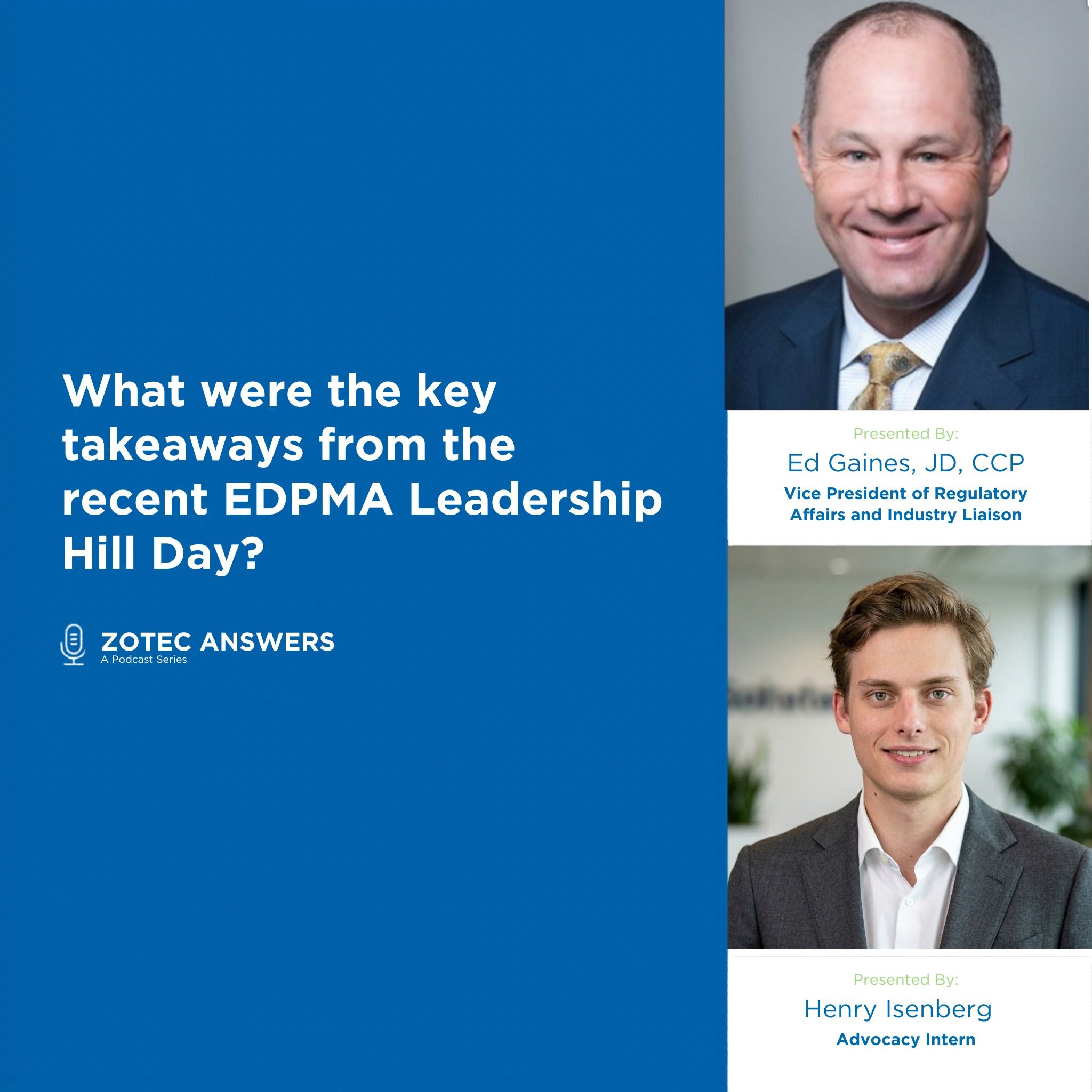
What were the key takeaways from the recent EDPMA Leadership Hill Day?
This episode recaps EDPMA's recent Day on Capitol Hill, where emergency medicine leaders met with members of Congress to advocate for policies that strengthen physician reimbursement and protect patient access to emergency care. Ed Gaines shares the organization's top legislative priorities, explains the value of building relationships with lawmakers, and highlights how data, including contributions from Zotec, is playing an increasingly important role in supporting advocacy efforts and influencing healthcare policy.
Is this your show?
Claim this listing to keep it up to date, reach guests who want to pitch you, and manage bookings with Guestify.