
Find partners
Women Emerging Podcast

Women Emerging Podcast

Hosted by Women Emerging

EducationSocietyCultureInterviews guests

Episodes

232

Latest episode

Aug 2026

Language

EN

About the show

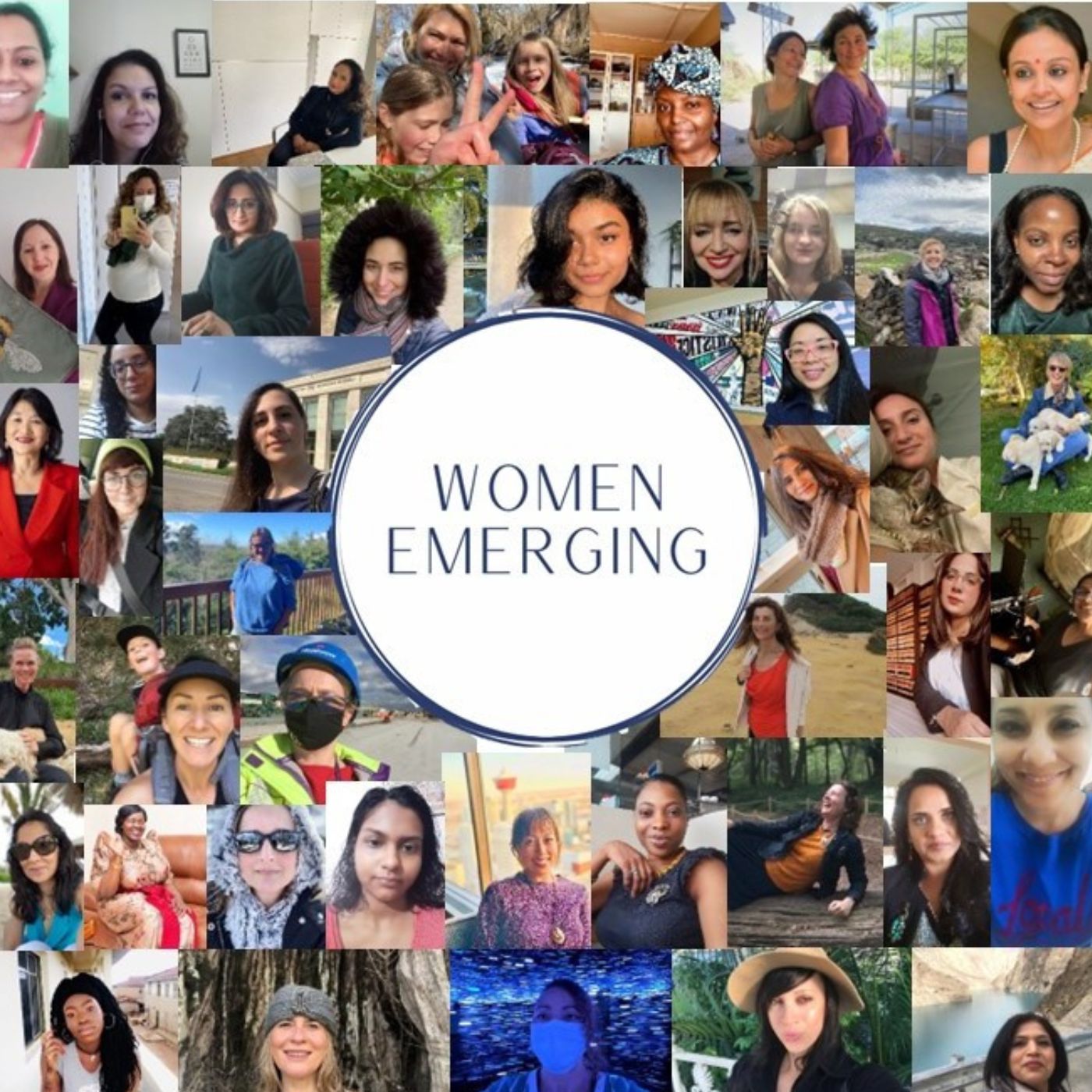
Every week, we produce a new episode that explores women and leadership from a different perspective. In a series of lively, wide-ranging discussions, we talk to women all over the world who are dealing with tough leadership challenges in their daily lives. We find out the barriers they face and how they are overcoming them; they share their experiences, insights and advice. (the series also informs and illustrates the expedition while it is underway and gives updates on the members’ progress.) Episodes come out every Wednesday and once a month, we do a live q&a.

Listen to episodes

60 recent
September 9, 202628 min

234. Taking Space and Creating Space for Others While Leading

In this episode of the Women Emerging Podcast, Julia Middleton sits down with documentary filmmaker Justine to explore how the 4Es helped her find language for questions of existence, confidence and taking space. During the Brussels City Expedition, Justine began looking more closely at her essence and the influence of her maternal ancestors. Having grown up hearing herself described as an “unwanted child”, she had carried a fear of taking up too much space. A filmed conversation with her mother revealed a different story: the fear surrounding her birth was not about her right to exist, but about money—and belonged to a longer, inherited history of scarcity. Together, Julia and Justine explore how understanding this history enabled Justine to move away from seeing herself as a victim and begin recognising her own agency and power. They discuss why taking space sometimes requires disagreement, honesty and accepting that it is impossible to please everyone. Justine also reflects on the “motherness” she brings to filmmaking: creating an environment in which her crew feels safe, seen and able to offer their full selves. For her, leading requires a balance between care and control, and taking space herself enables her to create more space for others. This is a conversation about inherited fear, the right to exist and how the 4Es can give structure and language to emotions that are otherwise difficult to name. About the Guest: Justine Cappelle is a documentary filmmaker who takes her own existence as a “spiral child” as a starting point: conceived despite an IUD, against a very small chance of being here. From this paradox, she questions what it means to exist, why we are here and how we give meaning to the world around us. Her films turn toward people, stories and phenomena that often remain unseen, using documentary as a way to make space for other forms of presence and perspective. At the same time, she questions the documentary image itself: how we show, tell and construct reality, and what happens between what is visible and what remains hidden. Her practice searches for different ways of approaching truth, moving between observation, lived experience and interpretation. Her films have been presented at international festivals including IDFA, FIFA and Kassel Dokfest.

September 2, 202628 min

233. How Women Weave the Fabric of a City

In this episode of the Women Emerging Podcast, Julia Middleton sits down with Lara following the first Women Emerging City Expedition in Brussels to explore what impact did the expedition leave on her. Lara reflects on how the expedition changed her understanding of leading. Having previously assumed that leadership required a title, a certain age or responsibility for a team, she began to recognise it as the work of anchoring people, connecting ideas and restoring direction when priorities become unclear. Together, Julia and Lara explore why leading in Brussels requires flexibility and local understanding, why cities must build from their strengths as well as address their problems, and how empathy needs boundaries if it is to remain a sustainable source of leadership. They also consider whether women build bridges in cities through something quieter and more everyday: weaving people together through conversations, introductions and informal spaces of connection. This is a conversation about leading without a title, stepping beyond familiar bubbles and recognising the often-invisible work that holds communities—and cities—together. About the Guest: Lara Loi is a graduate of Cultural Diplomacy, with a background in Conflict & Development and Political Sciences, and is deeply interested in the intersection of culture, dialogue, and leadership. She is an Explorer with the expedition for women leading in Brussels.

August 26, 202629 min

232. Vulnerability Does Not Require Full Exposure

In this episode of the Women Emerging Podcast, Julia Middleton sits down with Njeri Margaret to explore why vulnerability matters when we lead—and why it must come with boundaries. Together, they begin with what vulnerability makes possible. It allows people to relate to the person behind the title, makes leadership more authentic and can help others feel seen and heard. Njeri reflects on how sharing lived experience can build community, give voice to what others have struggled to express and turn a personal story into a resource for change. But vulnerability can also become exposure. Drawing on her own experience of speaking publicly about mental health and accumulated fatigue, Njeri describes the vulnerability hangover that followed: the fear that she had revealed too much, before she had fully processed it herself. She and Julia explore how preparation, purpose and the emotional maturity of the room can help a leader decide what to share, what to hold back and when a story is ready to be told. This is a conversation about vulnerability, strength and the discipline of sharing with intention. It asks whether a leader is revealing something to create connection and change—or simply revealing for the sake of attention. The conclusion is not to become less vulnerable, but to become more conscious: vulnerability is essential to leading, but it does not require full exposure.

August 19, 202626 min

231. Are You Ever Too Young To Lead?

In this episode of the Women Emerging Podcast, Julia Middleton sits down with Ema to look back at a leading journey that began when she was just 12 years old. Together, they explore what Ema now knows about leading across generations, staying true to herself and beginning before she felt entirely ready. Ema reflects on what it was like to lead adults while still being seen as a child. She shares how she once believed that being respected meant appearing older and more experienced, before recognising that her creativity, passion and willingness to see things differently were not weaknesses she needed to outgrow. They were an important part of what she brought to leading. The conversation also explores what the ocean has taught Ema: how to remain calm through storms, respond to forces beyond her control and look beneath the surface to recognise what may be hidden within other people. She and Julia discuss why leading sometimes asks us to move beyond shyness, build connections and create spaces where people of different ages and experiences can contribute to a shared purpose. This is a conversation about cross-generational leading, self-doubt, finding your voice and resisting the pressure to become someone else before you begin. As Ema reminds her 12-year-old self, the timing will never be perfect and you may never feel completely ready. Sometimes, you simply have to throw yourself into it.

August 12, 202634 min

230. Unpacking The Hidden Risk of Empathetic Leadership

In this episode of the Women Emerging Podcast, Julia Middleton sits down with Janice to explore one of the questions many women face as they begin leading others: can empathy ever become too much? Together, they begin by affirming something fundamental: empathy is essential. We are leading people, not robots, and understanding the human impact of our decisions is at the heart of good leading. But then the conversation turns to a more difficult question. What happens when empathy has no boundaries? What happens when understanding becomes enabling, when kindness is mistaken for weakness, or when one person's needs begin to overshadow the needs of the wider team? Drawing on her own experience, Janice reflects on recognising manipulation, setting boundaries for the first time, and discovering that protecting a team sometimes means making decisions that feel deeply uncomfortable. Julia explores how empathy can become self-sabotage without clear limits, why motherness includes both nurturing and fierceness, and how empathy must extend not only to individuals, but also to the purpose, the team and yourself. This is a thoughtful conversation about empathetic leadership, boundaries, difficult decisions and learning that compassion and accountability are not opposites. As Julia concludes, perhaps one of the most enduring lessons for anyone leading is simply this: be loving, but firm.

August 5, 202626 min

229. When Student Life Gets in the Way of Leading

In this episode of the Women Emerging Podcast, Julia Middleton sits down with Iris Lin, an Explorer from the Global Changemakers 2 expedition, to explore how our experience of education can continue to shape the way we approach leading. For Iris, being a good student meant believing that preparation, perfection and having the right answers were the keys to success. But through her Women Emerging expedition, she began to question whether those same habits were holding her back when working with others and navigating uncertainty. Together, Julia and Iris explore the difference between solving problems with a blueprint and exploring alongside others without knowing every step ahead. They discuss why perfection can slow momentum, how fear and courage can exist side by side, and why leading is less about having all the answers and more about creating the energy for a group to keep moving forward. This is a thoughtful conversation about education, essence, courage and discovering an approach to leading that is rooted in curiosity rather than certainty.

July 29, 202629 min

228. How Poverty is a Big Piece of My Essence and Shapes My Approach to Leading

In this episode of the Women Emerging Podcast, Julia Middleton sits down with Fatou to explore one of the most profound influences on how we lead: growing up with poverty as part of our essence. For Fatou, poverty is far more than a lack of money. It is a way of seeing the world that can shape generations, convincing people that scarcity is inevitable and possibility is out of reach. Drawing on her own journey—from growing up in poverty in Africa to studying at Harvard and teaching at MIT—she reflects on what it has taken to challenge those deeply embedded beliefs and discover a different way of leading. Together, Julia and Fatou explore how experiences of scarcity can lead to overachievement, burnout and an overwhelming need for control. They discuss the difference between leading from fear and leading as a steward, why personal transformation must come before public influence, and how confronting our deepest fears can become the foundation for wiser leadership. This is a deeply personal conversation about identity, resilience, responsibility and the courage to imagine possibilities beyond the circumstances we inherit. About the Guest: Fatoumata (Fatou) Fall is an entrepreneur, a business coach, and strategist who helps top scientists and executives in tech overcome fear and self-sabotage at the moments that matter most in industry: the negotiation table, the public stage, and high-stakes business trips. As co-founder of Teamrora, she facilitated over 400 negotiation coaching sessions co-creating a cumulative $5 million USD in wealth transfer to candidates. She also trained more than 1,000 professionals, opening doors for underrepresented talent in tech and business along the way. A Harvard-trained mathematician and Forbes 30 Under 30 honoree, she blends analytical rigor with a deeply human approach to coaching. Fluent in five languages and shaped by her work across Africa, LatAm, and the U.S., she helps professionals walk into these rites of passage with clarity, confidence, and cultural intelligence.

July 22, 202626 min

227. How Clothes in My Essence Shape My Approach to Leading

In this episode of the Women Emerging Podcast, Julia Middleton sits down with Henrietta Bankole-Olusina to explore how one aspect of our essence—how we choose to show up—can reveal something much deeper about who we are. For Henrietta, clothes are never just clothes. Growing up in Nigeria, vibrant colours, textures and craftsmanship became part of how she expressed her identity. Yet after spending more than two decades in consulting, banking and financial services, she found herself dressing to fit into a world of blacks, greys and navy suits. The challenge wasn't her confidence or competence. It was learning how to remain true to herself while working within someone else's expectations. Together, Julia and Henrietta explore what it means to adapt without losing yourself, why authenticity isn't always about changing the outside, and how our greatest strengths often lie in the perspectives we bring rather than the clothes we wear. They discuss "leading in colour", finding "islands of advantage", balancing different parts of our essence and remembering where we come from, even as our careers take us into unfamiliar spaces. This is a conversation about identity, belonging and the quiet courage of bringing your whole perspective into the room—even when the room wasn't designed with you in mind.

July 15, 202629 min

226. How Martial Arts in my Essence Frames my Approach to Leading

In this episode of the Women Emerging Podcast, Julia Middleton sits down with martial arts instructor, coach and entrepreneur Jo Hall to explore how one unexpected part of our essence can profoundly shape the way we lead. At first glance, martial arts might appear to be about fighting. Jo argues the opposite. After decades of training, she believes its greatest lesson is knowing when not to fight. Together, Julia and Jo explore how confidence changes our decision-making, why leading isn't about proving you're right, and how understanding yourself allows you to choose your battles more wisely. Their conversation moves beyond martial arts into questions that every person leading will recognise. How do we decide which conflicts are worth our energy? What happens when our ego becomes louder than our purpose? Why do great coaches and mentors find joy not in their own achievements, but in watching others realise they are capable of far more than they imagined? And what does it mean to create space for others, rather than occupy it yourself? Together, they explore confidence, competition, collaboration, flow, self-awareness and the relationship between strength and restraint. Jo also reflects on why she chose to build her own martial arts school rather than follow someone else's path, offering a powerful reminder that our journeys are strongest when they are true to who we are. Whether you're navigating difficult decisions, building confidence, or discovering your own way of leading, this conversation offers a thoughtful reflection on why the strongest people are often those who know when to step back, when to stand firm and when to simply let go. About the Guest: Jo Hall is the CEO and Founder of Good to Go AB and Founder and Chief Instructor of Mamori Budo. With over 30 years of experience in martial arts, fitness, coaching, and bodywork, they help people build strength, confidence, and resilience. Combining the roles of personal trainer, massage therapist, and coach, Jo delivers practical, results-driven guidance that empowers people to perform at their best and live healthier lives.

July 8, 202632 min

225. Re-release: Aha Moments of Women in Their Journey to Leadership

As Women Emerging concludes its Journeys to Leadership series, this special re-release revisits one of the conversations that helped shape how we think about leadership. The episode brings together Rouba Mhassen, Erica Su, and Folawe Omikunle as they reflect on the moments that transformed how they understood themselves and the way they lead. Rouba shares how she did not recognise herself as someone leading until others named it, and how embracing that identity changed everything. Erica explores the importance of writing your own story, making decisions that are self-defining rather than self-limiting, and having the courage to say no. Folawe reflects on leading with love, building communities that lift one another up, and accepting that difficult conversations are part of the journey. Together, their stories explore confidence, responsibility, identity, relationships, courage, and the quiet moments that reshape how we see ourselves. The conversation reminds us that leadership is rarely a linear journey, and that the most significant turning points are often recognised only in hindsight. About the Guest: Rouba Mhaissen Rouba Mhaissen is an economist, activist, and development practitioner focused on the MENA region, particularly forced migration and the Syrian refugee crisis. She is the founder and director of the Sawa Foundation and Sawa for Development and Aid, organizations dedicated to working with Syrian refugees through an integrated development approach since 2011. Mhaissen has also worked with Lebanese, Iraqi, and Palestinian refugees and has been actively involved in lobbying for human rights, especially concerning Syrian refugees. Her expertise spans a range of issues, including education, gender, violence, conflict, household economics, forced migration, and activism. Erica Su Erica is the EY Global Emerging Markets Leader for Strategy and Transactions, with 20 years of experience in cross-border M&A. She specializes in helping foreign companies expand in China and advising Chinese companies on international investments. Erica’s expertise spans due diligence, M&A negotiation, financing, and post-merger integration. She has worked across industries like manufacturing, automobile, FMCG, and healthcare, focusing on enhancing value, competitiveness, and efficient resource allocation through M&A. Folawe Omikunle Folawe Omikunle is the CEO of Teach for Nigeria, where she leads efforts to address education inequity. She graduated with a bachelor’s in international law and diplomacy from Babcock University and a master’s from the Diplomatic Academy of London. Folawe’s passion for education grew while working as a school administrator, particularly after helping an orphaned child. Influenced by Montessori’s belief in every child’s potential, she pursued further education in Montessori education. Folawe’s work with Teach for Nigeria and the Association of Private Educators in Nigeria has focused on improving education for marginalized children and leading systemic change. She was recognized as one of the 100 most influential young Nigerians in 2017.

Is this your show?

Claim this listing to keep it up to date, reach guests who want to pitch you, and manage bookings with Guestify.

Claim this listing